Adhyaya 294
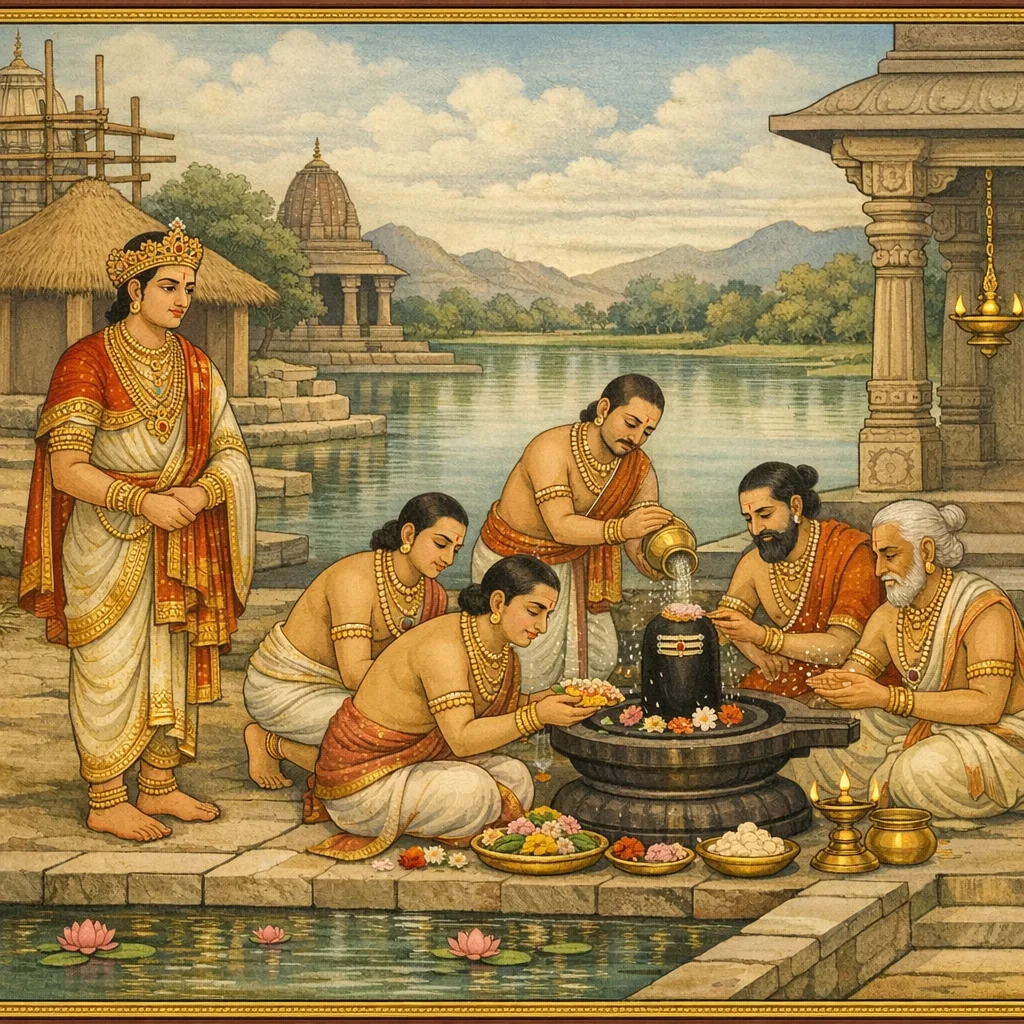
The chapter unfolds as a dialogue between Śiva and Devī. Īśvara points Devī to a sacred Puṣkara tīrtha lying east of Kubera’s quarter, and Devī asks how a fisherman (kaivarta)—a wrongdoer and killer of fish—could attain spiritual success. Śiva recounts an earlier incident: in the cold month of Māgha the fisherman entered Puṣkara carrying a wet net and saw a Śaiva temple structure overgrown with creepers and trees. Seeking warmth, he climbed the prāsāda and spread his net atop the flagstaff to dry in the sun; through stupor and heedlessness he fell and died suddenly within Śiva’s kṣetra. The net remained fastened, as though binding the temple flag and making it auspicious; by the māhātmya of the flag he was reborn as the Avanti king Ṛtadhvaja, who ruled, traveled widely, and enjoyed royal pleasures. In time he became jāti-smara, returned to Prabhāsa-kṣetra, built or renovated the Ajogandha shrine-complex, and installed or honored the great liṅga Ajogandheśvara near a kuṇḍa, worshipping with long devotion. The text prescribes pilgrimage rites: bathe in Puṣkara’s western kuṇḍa called pāpataskara, remember Brahmā’s ancient sacrifices, invoke the tīrthas, worship the Ajogandheśvara liṅga, and offer a golden lotus to an eminent brāhmaṇa. The phalaśruti declares that worship with gandha, flowers, and akṣata frees one from sins accumulated even across seven births.
Shlokas
Verse 1
ईश्वर उवाच । ततो गच्छेन्महादेवि कौबेरात्पूर्वसंस्थितम् । गव्यूतिपंचके देवि पुष्करंनाम नामतः । यत्र सिद्धो महादेवि कैवर्तो मत्स्यघातकः
Īśvara said: “Then, O great Goddess, one should proceed eastward from the place of Kubera. At a distance of five gavyūtis is a spot known by name as Puṣkara—where, O great Goddess, a fisherman who killed fish became perfected, a siddha.”
Verse 2
देव्युवाच । सविस्तरं मम ब्रूहि कथं स सिद्धिमाप वै । कथयस्व प्रसादेन देवदेव महेश्वर
The Goddess said: “Tell me in full detail how he truly attained that spiritual fulfillment. Out of grace, O God of gods—Mahādeva, Mahēśvara—please narrate it to me.”
Verse 3
ईश्वर उवाच । शृणु त्वं यत्पुरावृत्तं देवि स्वारोचिषेंतरे । आसीत्कश्चिद्दुराचारः कैवर्तो मत्स्यघातकः
Īśvara said: “Listen, O Goddess, to what happened long ago, in the period of Svārociṣa. There was a certain fisherman of wicked conduct, a killer of fish.”
Verse 4
स कदाचिच्चरन्पापः पुष्करे तु जगाम वै । ददर्श शांकरं वेश्म लतापादपसंकुलम्
That sinful man, while wandering, once went to Puṣkara indeed. There he saw a Śaiva dwelling—Śaṅkara’s shrine—thickly overgrown with creepers and trees.
Verse 5
स माघमासे शीतार्त्तः क्लिन्नजालसमन्वितः । प्रासादमारुरोहार्त्तः सूर्यतापजिघृक्षया
In the month of Māgha, tormented by the cold and bearing a wet net, he climbed up to the palace, distressed and yearning to catch the warmth of the sun’s heat.
Verse 6
ततः स क्लिन्नजालं तच्छोषणाय रवेः करैः । प्रासादध्वजदंडाग्रे संप्रसारितवांस्तदा
Then, to dry that wet net by the sun’s rays, he spread it out upon the tip of the palace’s flagstaff.
Verse 7
ततः प्रासादतो देवि जाड्यात्संपतितः क्रमात् । स मृतः सहसा देवि तस्मिन्क्षेत्रे शिवस्य च
Then, O Goddess, through heedlessness he gradually fell down from the palace. He died suddenly, O Goddess—there, within that very sacred field of Śiva.
Verse 8
जालं तस्य प्रभूतेन जीर्णकालेन यत्तदा । ध्वजा बद्धा यतो जालैः प्रासादे सा शुभेऽभवत्
And that net, as much time passed and it grew old there, came to bind the flag by its meshes; upon the palace-shrine that flag thereby became auspicious.
Verse 9
ततोऽसौ ध्वजमाहात्म्याज्जातोऽवन्यां नराधिपः । ऋतध्वजेति विख्यातः सौराष्ट्रविषये सुधीः । स हि स्फूर्जद्ध्वजाग्रेण रथेन पर्यटन्महीम्
Thereafter, by the greatness of that flag, he was born on earth as a king. He became renowned as Ṛtadhvaja, a wise ruler in the land of Saurāṣṭra; and with a chariot whose foremost point bore a fluttering flag, he traveled over the earth.
Verse 10
कामभोगाभिभूतात्मा राज्यं चक्रे प्रतापवान् । ततोऽसौ भवने शंभोर्ददौ शोभासमन्विताम् । ध्वजां शुभ्रां विचित्रां च नान्यत्किंचिदपि प्रभुः
Though his soul was overpowered by pleasures and enjoyments, he—mighty in splendor—ruled his kingdom. Then that lord, at Śambhu’s abode, offered a beautiful flag, white and variegated, giving nothing else besides.
Verse 11
ततो जातिस्मरो राजा प्रभासक्षेत्रमागतः । तत्रायतनं ध्वजाजालसमन्वितम्
Then the king, endowed with memory of his former birth, came to Prabhāsa-kṣetra. There he beheld a sanctuary adorned with a flag and net-like meshes.
Verse 12
अजोगन्धस्य देवस्य पूर्वमाराधितस्य च । प्रासादं कारयामास शिवोपकरणानि च
For the deity Ajogandha—whom he had formerly worshipped—he caused a temple-palace to be built, and also provided the requisites and ritual implements for Śiva’s worship.
Verse 13
नित्यं पूजयते भक्त्या तल्लिंगं पापनाशनम् । दशवर्षसहस्राणि राज्यं चक्रे महामनाः
With devotion he worshipped that sin-destroying Liṅga every day; and being great-souled, he ruled his kingdom for ten thousand years.
Verse 14
तल्लिंगस्य प्रभावेन ततः कालाद्दिवं गतः । तस्मात्तत्र प्रयत्नेन गत्वा लिंगं प्रपूजयेत्
By the power of that Liṅga, after the passage of time he attained heaven. Therefore, one should go there with sincere effort and duly worship the Liṅga.
Verse 15
स्नात्वा पश्चिमतः कुण्डे पुष्करे पापतस्करे । यत्र ब्रह्माऽयजत्पूर्वं यज्ञैर्विपुलदक्षिणैः
Having bathed in the western pond at Puṣkara—the thief that steals away sins—where Brahmā formerly performed sacrifices with abundant gifts (dakṣiṇā).
Verse 16
समाहूय च तीर्थानि पुष्करात्तत्र भामिनि । तस्मिन्कुण्डे तु विन्यस्य अजोगन्ध समीपतः । प्रतिष्ठाप्य महालिंगमजोगन्धेति नामतः
O fair lady, having invoked the sacred tīrthas from Puṣkara and established them in that pond, near Ajogandha he installed a great Liṅga—known by the name ‘Ajogandha’.
Verse 17
त्रिपुष्करे महादेवि कुण्डे पातकनाशने । सौवर्णं कमलं तत्र दद्याद्ब्राह्मणपुंगवे
O Great Goddess, at Tripuṣkara—the sin-destroying pond—one should there give a golden lotus in charity to an eminent Brāhmaṇa.
Verse 18
देवं संपूज्य विधिवद्गन्धपुष्पाक्षतादिभिः । मुच्यते पातकैः सर्वैः सप्तजन्मार्जितैरपि
Having duly worshipped the Lord with perfumes, flowers, unbroken rice, and the like, one is freed from all sins—even those accumulated across seven births.
Verse 294
इति श्रीस्कान्दे महापुराण एकाशीतिसाहस्र्यां संहितायां सप्तमे प्रभासखण्डे प्रथमे प्रभासक्षेत्रमाहात्म्ये पुष्कर माहात्म्येऽजोगन्धेश्वरमाहात्म्यवर्णनंनाम चतुर्णवत्युत्तरद्विशततमोऽध्यायः
Thus ends the two-hundred-and-ninety-fourth chapter, entitled “The Description of the Greatness of Ajogandheśvara,” in the Puṣkara Māhātmya within the Prabhāsa-kṣetra Māhātmya, in the seventh book, Prabhāsa Khaṇḍa, of the Śrī Skanda Mahāpurāṇa, in the eighty-one-thousand-verse Saṃhitā.