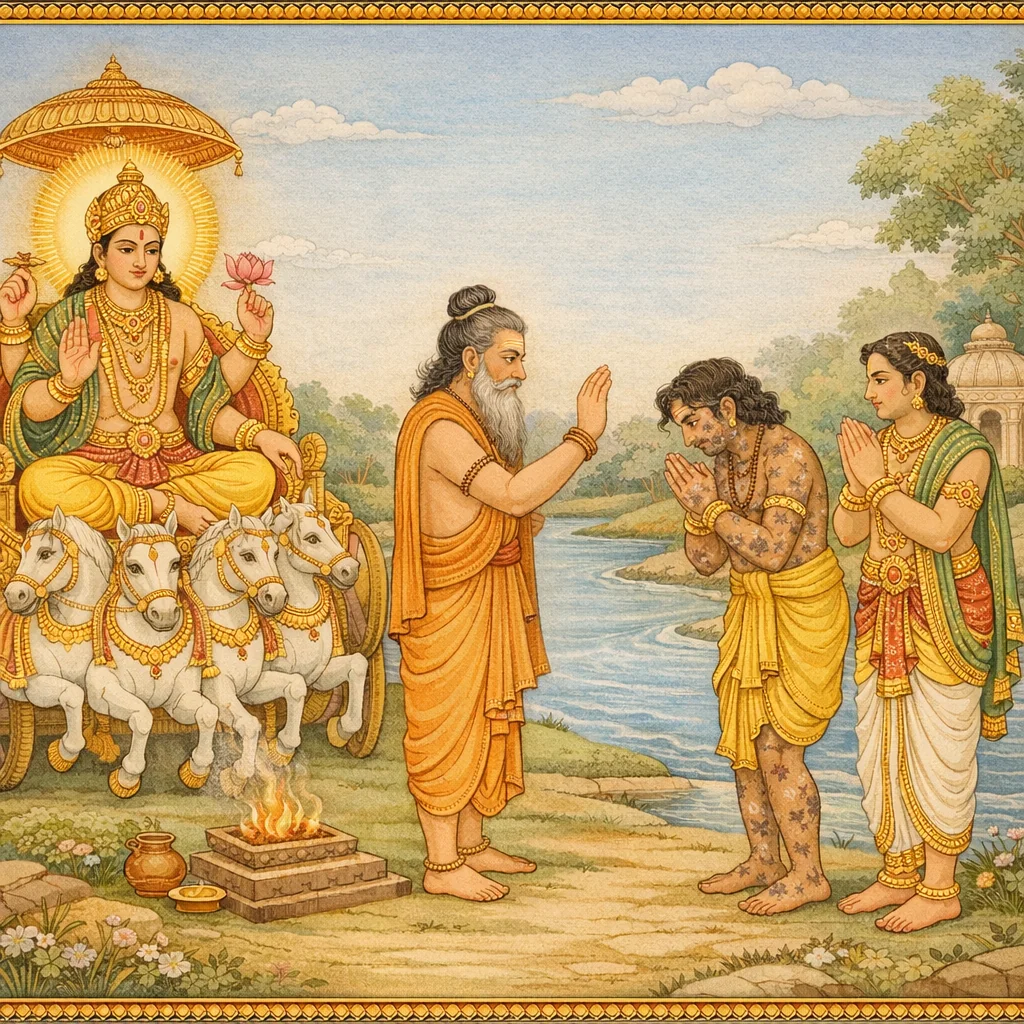
Adhyaya 306
Īśvara recounts a place-centered teaching on Sāmbāditya, a sin-destroying sacred locus in the northern part of Prabhāsa. The legend tells how Sāmba, son of Jāmbavatī, cursed by his father in anger, seeks relief by worshipping Viṣṇu. Viṣṇu directs him to Prabhāsa-kṣetra—especially Brahmabhāga near the lovely bank of the Ṛṣitoyā, graced by Brahmins—promising a boon there in the form of Sūrya. Reaching the auspicious site, Sāmba praises Bhāskara with many hymns and is guided to the Ṛṣitoyā shore where Nārada performs austerities. Local Brahmins affirm Brahmabhāga’s sanctity and approve his resolve; Sāmba then undertakes regular worship and tapas. Viṣṇu reflects on divine functions—Rudra granting lordship, Viṣṇu liberation, Indra heaven, water/earth/ashes purification, Agni transformation, Gaṇeśa obstacle-removal—and concludes that Divākara uniquely bestows ārogya, perfect health. Because the old curse blocks ordinary boons, Viṣṇu manifests as Sūrya, purifies Sāmba, and frees him from leprosy. Sāmba asks for the deity’s perpetual presence at the spot; Sūrya agrees and prescribes a vrata: when Saptamī falls on a Sunday, fast and keep night vigil. The text promises that leprosy and sinful diseases will not arise in the devotee’s lineage, and that devoted bathing, Sunday worship of Sāmbāditya, and śrāddha with Brahmin-feeding at a nearby sin-removing kuṇḍa grant health, wealth, progeny, fulfilled desires, and honor in Sūrya-loka.
Shlokas
Verse 1
ईश्वर उवाच । ततो गच्छेन्महादेवि सांबादित्यमनुत्तमम् । तस्मादुत्तरभागे तु सर्वपातकनाशनम्
Īśvara said: “Then, O great Goddess, one should go to the unsurpassed Sāmbāditya. And on its northern side is the holy place that destroys all sins.”
Verse 2
यत्र सांबस्तपस्तप्त्वा ह्याराध्य च दिवाकरम् । प्राप्तवान्सुन्दरं देहं सहस्रांशुप्रसादतः
In that holy place, Sāmba performed austerities and worshipped Divākara, the Sun; and by the grace of the Thousand-rayed Lord, he attained a beautiful, restored body.
Verse 3
यदा रोषेण संशप्तः पित्रा जांबवतीसुतः । आराधयामास तदा विष्णुं कमललोचनम्
When Jāmbavatī’s son, Sāmba, was cursed by his father in anger, he then worshipped Viṣṇu, the Lotus-eyed Lord.
Verse 4
अनुग्रहार्थं शापस्य सांबो जांबवतीसुतः । प्रसन्नवदनो भूत्वा विष्णुः प्रोवाच तं प्रति
To grant Sāmba, the son of Jāmbavatī, relief from the curse, Viṣṇu—his face gracious and pleased—spoke to him.
Verse 5
गच्छ प्राभासिके क्षेत्रे ब्रह्मभागमनुत्तमम् । ऋषितोयातटे रम्ये ब्राह्मणैरुपशोभिते
Go to the sacred field of Prābhāsika, to the unsurpassed place called Brahmabhāga—on the lovely bank of the Ṛṣitoyā, adorned by Brāhmaṇas.
Verse 6
तत्राऽहं सूर्यरूपेण वरं दास्यामि पुत्रक । इत्युक्तः स तदा सांबो विष्णुना प्रभविष्णुना
“There, my child, in the form of the Sun I shall grant you a boon.” Thus did Viṣṇu, the mighty Lord, speak to Sāmba.
Verse 7
गतः प्राभासिके क्षेत्रे रम्ये शिवपुरे शिवे । तत्राराध्य परं देवं भास्करं वारितस्करम्
He went to the Prābhāsika region, to the auspicious and lovely Śivapura; and there he worshipped the supreme deity Bhāskara (the Sun), who wards off harm and wrongdoing.
Verse 8
प्रसादयामास तदा स्तुत्वा स्तोत्रैरनेकधा
Then he propitiated the deity, praising him with many hymns in various ways.
Verse 9
प्रत्युवाच रविः सांबं प्रसन्नस्ते स्तवेन वै । शीघ्रं गच्छ नरश्रेष्ठ ऋषितोयातटे शुभे
Ravi (the Sun) replied to Sāmba, pleased: “Truly, I am delighted by your hymn. Quickly go, O best of men, to the auspicious bank of the Ṛṣitoyā.”
Verse 10
इत्युक्तः स तदाऽगत्य ऋषितोयातटं शुभम् । नारदो यत्र ब्रह्मर्षिस्तपस्तप्यति चैव हि
Thus instructed, he then went to the auspicious bank of the Ṛṣitoyā, where Nārada, the brahmarṣi, indeed performs austerities (tapas).
Verse 11
तत्र गत्वा हरेः सूनुरुन्नतस्थानवासिनः । आसन्ये ब्राह्मणास्तान्स इदं वचनमब्रवीत्
Having gone there, Hari’s son (Sāmba) approached the brāhmaṇas dwelling in that eminent holy place, and to those nearby he spoke these words.
Verse 12
सांब उवाच । एष वै ब्रह्मणो भागः प्रभासे क्षेत्र उत्तमे । अत्र वै ब्राह्मणा ये तु ते वै श्रेष्ठाः स्मृता भुवि
Sāmba said: “This supreme Prabhāsa, this most excellent sacred field, is truly a portion of Brahmā’s own power. And the brāhmaṇas who dwell here are remembered on earth as the foremost.”
Verse 13
भवतां वचनाद्विप्राः सूर्यमाराधयाम्यहम् । मम वै पूर्वमादिष्टं स्थानमेतच्च विष्णुना
“O brāhmaṇas, at your word I shall worship the Sun. For this very place was formerly appointed to me by Viṣṇu.”
Verse 14
विप्रा ऊचुः । सिद्धिस्ते भविता सांब आराधय दिवाकरम् । इत्युक्तः स तदा विप्रैः प्रविष्टोऽथ प्रभाकरम्
The brāhmaṇas said: “Success (siddhi) shall surely be yours, O Sāmba—worship Divākara, the Sun.” Thus addressed by the brāhmaṇas, he then entered the shrine of Prabhākara, the Sun.
Verse 15
नित्यमाराधयामास सांबो जांबवतीसुतः । तपोनिष्ठं च तं दृष्ट्वा विष्णुः कारुणिको महान्
Sāmba, the son of Jāmbavatī, worshipped the Sun each day. Seeing his steadfastness in austerity, the great and compassionate Viṣṇu took notice.
Verse 16
इदं वै चिन्तयामास पुत्रवात्सल्यसंयुतः । यथैश्वर्यप्रदो रुद्रो यथा विष्णुश्च मुक्तिदः
Moved by affection for his child, Viṣṇu reflected: “Just as Rudra is famed as the giver of lordly powers, and Viṣṇu as the giver of liberation…”
Verse 17
यज्ञैरिष्टो हि देवेन्द्रो यथा स्वर्गप्रदः स्मृतः । शुद्धिकर्तृ यथा तोयं मृत्तिकाभस्मसंयुतम् । दहनात्मा यथा वह्निर्विघ्नहर्त्ता गणेश्वरः
“As Indra, when worshipped through sacrifices, is remembered as the giver of heaven; as water—together with clay and ash—purifies; as fire is by nature burning; and as Gaṇeśvara removes obstacles…”
Verse 18
स्वच्छंदभारतीदाने यथा ब्रह्मसुता नृणाम् । तथाऽरोग्यप्रदाता च नान्यो देवो दिवाकरात्
“Just as Sarasvatī, Brahmā’s daughter, freely grants people eloquence and learning, so there is no god other than Divākara, the Sun, who bestows health.”
Verse 19
अनेकधाऽराधितोऽपि स देवो भास्करः शुचिः । न ददाति वरं यत्तु तन्मे शापस्य कारणात्
“Though I have worshipped that pure god Bhāskara in many ways, he does not grant the boon I seek—because of the cause of my curse.”
Verse 20
एवं संचिन्त्य भगवान्विष्णुः कमललोचनः । सूर्यरूपं समाश्रित्य तस्य तुष्टो जनार्दनः
Thus reflecting, the Blessed Viṣṇu—lotus-eyed Janārdana—assumed the form of the Sun and was pleased with Sāmba.
Verse 21
योऽपरनारायणख्यस्तस्यैव सन्निधौ स्थितः । प्रत्यक्षः स ततो विष्णुः सूर्यरूपी दिवाकरः । उवाच परमप्रीतो वरदः पुण्यकर्मणाम्
Then Viṣṇu—manifest as Divākara in the form of the Sun—became visible, standing in the very presence of him known as ‘Apara-Nārāyaṇa’. Supremely delighted, the boon-giver to the doers of merit spoke.
Verse 22
अलं क्लेशेन ते सांब किमर्थं तप्यसे तपः । प्रसन्नोऽहं हरेः सूनो वरं वरय सुव्रत
Enough of hardship for you, O Sāmba—why do you torment yourself with austerities? I am pleased, O son of Hari; choose a boon, O you of excellent vow.
Verse 23
सांब उवाच । निर्मलस्त्वत्प्रसादेन कुष्ठमुक्तकलेवरः । भवानि देवदेवेश प्रत्यक्षाऽम्बरभूषण । अस्मिन्स्थाने स्थितो रम्ये नित्यं सन्निहितो भव
Sāmba said: By your grace I am purified, my body freed from leprosy. O Bhavānī, O Lord of the gods, O manifest One adorned with radiant garments—abide in this lovely place and remain ever present here.
Verse 24
सूर्य उवाच । अधुना निर्मलो देहस्तव सांब भविष्यति इहागत्य नरो यस्तु सप्तम्यां रविवासरे । उपवासपरो भूत्वा रात्रौ जागरणे स्थितः
Sūrya said: Now, O Sāmba, your body shall become spotless. And the man who comes here on the seventh lunar day that falls on a Sunday, who undertakes fasting and keeps vigil through the night—
Verse 25
अष्टादशानि कुष्ठानि पापरोगास्तथैव च । कदाचिन्न भविष्यन्ति कुले तस्य महात्मनः
The eighteen kinds of leprosy, and likewise the diseases born of sin, will never arise in the lineage of that great-souled devotee.
Verse 26
कृत्वा स्नानं नरो यस्तु भक्तियुक्तो जितेन्द्रियः । पूजयेद्रविवारेण सांबादित्यं महाप्रभम् । स रोगहीनो धनवान्पुत्रवाञ्जायते नरः
Whoever, disciplined in the senses and filled with devotion, bathes and worships the mighty Sāmbāditya on a Sunday—such a person becomes free from disease, prosperous, and blessed with children.
Verse 27
तस्यैव पूर्वदिग्भागे किञ्चिदीशानमाश्रितम् । कुंडं पापहरं पुण्यं स्वच्छोदपरि पूरितम्
In its eastern quarter, slightly inclined toward the northeast, there is a holy pond—sin-destroying and meritorious—filled with clear water.
Verse 28
तत्र स्नात्वा च् विधिवत्कुर्याच्छ्राद्धं विचक्षणः । भोजयेद्ब्राह्मणान्यस्तु सांबादित्यं प्रपूजयेत्
After bathing there in due manner, a discerning person should perform śrāddha according to rule; and whoever feeds brāhmaṇas and duly worships Sāmbāditya—
Verse 29
सर्वकामसमृद्धात्मा सूर्य लोके महीयते
His soul fulfilled in every rightful desire, he is honored in the world of Sūrya.
Verse 306
इति श्रीस्कांदे महापुराण एकाशीतिसाहस्र्यां संहितायां सप्तमे प्रभासखण्डे प्रथमे प्रभासक्षेत्रमाहात्म्ये सांबादित्य माहात्म्यवर्णनंनाम षडुत्तरत्रिशततमोध्यायः
Thus ends Chapter 306, entitled “The Description of the Greatness of Sāmbāditya,” in the first part, Prabhāsa Kṣetra Māhātmya, of the seventh book, the Prabhāsa Khaṇḍa, within the Śrī Skanda Mahāpurāṇa, in the Saṁhitā of eighty-one thousand verses.