Adhyaya 198
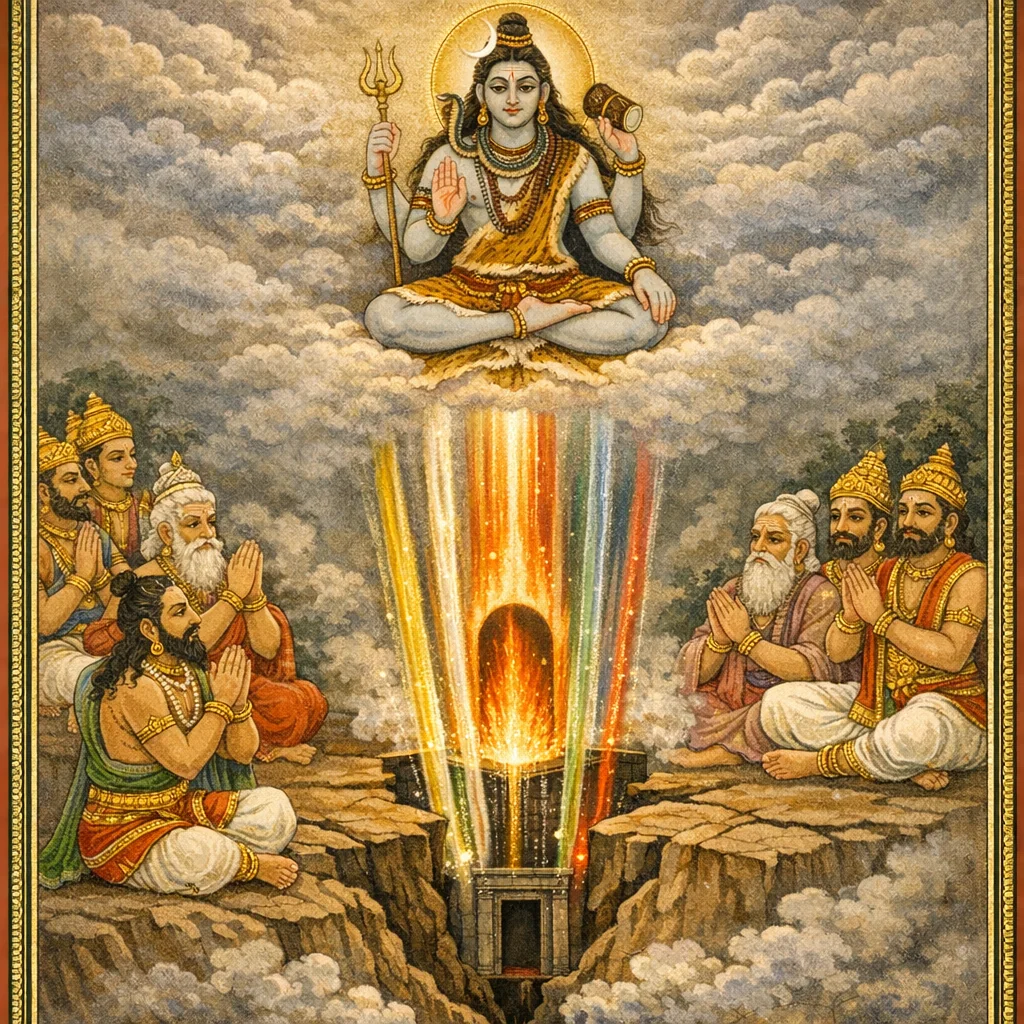
Framed as Īśvara’s discourse to Mahādevī, this chapter extols the eminent holy site Mahāprabhāsa, south of Jalaprabhāsa, said to obstruct Yama’s path—thus proclaiming a protective, liberating power. It then narrates an origin: in the Tretā-yuga a divinely radiant Spārśa-liṅga (“touch-liṅga”) granted release through mere contact. Later, Indra, arriving in fear, covered or restrained it with a vajra-like obstruction; yet fierce uṣmā/tejas burst forth uncontrollably, expanding into a vast, flame-tipped liṅga-form that shook the three worlds with smoke and fire. Gods and Veda-knowing ṛṣis praised Śiva (Śaśiśekhara) and begged that this self-burning radiance be contained lest creation collapse into dissolution. The tejas divided into five streams, breaking through the earth as a fivefold Prabhāsa manifestation. A stone gate was set at the exit-route; when the fissure was sealed, the smoke subsided and the worlds regained stability, while the radiance remained localized. At Śiva’s prompting the gods installed a liṅga there; the tejas “rested” in that place, which became famed as Mahāprabhāsa. The chapter ends with promised fruits: devoted worship with varied flowers grants an imperishable supreme state; mere sight removes sins and fulfills desired aims; and dāna—gold to a disciplined brāhmaṇa and a proper cow-gift to a twice-born recipient—yields the “fruit of birth” and merit likened to Rājasūya and Aśvamedha sacrifices.
Shlokas
Verse 1
ईश्वर उवाच । ततो गच्छेन्महादेवि महाप्रभासमुत्तमम् । जलप्रभासतो याम्ये यममार्गविघातकम्
Īśvara said: Then, O Great Goddess, one should proceed to the supreme Mahāprabhāsa, situated to the south of Jalaprabhāsa—a holy tīrtha that blocks Yama’s path, overcoming the terrors of death and judgment.
Verse 2
शृणु तस्यैव माहात्म्यं यथा जातं धरातले
Hear now the greatness of that very tīrtha, and how it came to be upon the surface of the earth.
Verse 3
पूर्वं त्रेतायुगे देवि स्पर्शलिंगं तु तत्स्मृतम् । दिव्यं तेजोमयं नृणां स्पर्शनान्मुक्तिदायकम्
Formerly, in the Tretā-yuga, O Goddess, it was known as the ‘Sparśa-liṅga’—a divine, radiant liṅga that grants liberation (mokṣa) to people through mere touch.
Verse 4
अथ काले च कस्मिंश्चिद्वज्रिणाच्छादितं प्रिये । इन्द्रेणागत्य वसुधां भयाक्रांतेन सुन्दरि
Then, at a certain time, O beloved, it was covered over by the wielder of the vajra (thunderbolt). O fair one, Indra came to the earth, seized by fear.
Verse 5
उष्मा तदुद्भवो देवि निर्गच्छन्नवरोधितः । दशकोटिप्रविस्तीर्णं ज्वालाग्रं लिंगरूपधृक्
O Goddess, the heat born from it surged forth, unrestrained; the tip of its blazing flame spread for ten koṭis, assuming the very form of a liṅga.
Verse 6
प्रभासक्षेत्रमास्थाय भित्त्वाऽविर्भावमास्थितम् । वज्रेण रुंधिते देवि भित्त्वा चैव वसुंधराम्
Taking its station in Prabhāsa-kṣetra, it broke through and manifested openly. Though restrained by the vajra, O Goddess, it still burst forth, splitting even the earth itself.
Verse 7
धूमसंघैः समेतं तु व्यापयामास तज्जगत् । ततस्त्रैलोक्यमखिलं ज्वालाभिर्व्याकुलीकृतम्
Joined with masses of smoke, it pervaded that world; then the entire threefold cosmos was thrown into turmoil by flames.
Verse 8
ततः सुरगणाः सर्व ऋषयो वेदपारगाः । अस्तुवन्विविधैः सूक्तैर्वेदोक्तैः शशिशेखरम्
Then all the hosts of gods, together with the sages well-versed in the Vedas, praised Śaśiśekhara (Śiva, the Moon-crested Lord) with many kinds of hymns drawn from Vedic utterances.
Verse 9
संहरस्व सुरश्रेष्ठ तेजः स्वदहनात्मकम् त्रै । लोक्यं व्याकुलीभूतमेवं सर्वं चराचरम् । न यावत्प्रलयं याति तावद्रक्ष सुरेश्वर
“Withdraw, O best of the gods, this blazing energy of yours whose nature is self-consuming fire. The three worlds—everything moving and unmoving—have become distressed. Protect us, O lord of the gods, before it rushes toward cosmic dissolution.”
Verse 10
ईश्वर उवाच । एवमाभाषमाणेषु त्रिदिवेषु सुरेश्वरि । तत्तेजः पञ्चधाविष्टं व्याप्याशेषं जगत्त्रयम्
Īśvara said: “As the gods in heaven spoke thus, that radiance manifested in fivefold form, pervading the entire threefold universe without remainder.”
Verse 11
पञ्चप्रभासरूपेण भित्त्वा तत्र वसुन्धराम् । येन मार्गेण निष्क्रान्तं तन्मार्गे च महन्महः
Assuming the form of the Five Prabhāsas, it split the earth there. And along the very path by which it emerged, a great effulgence remained established.
Verse 12
तत्र तैः स्थापितं द्वारं सुप्रदेशेऽश्मजं प्रिये । पिहितेऽथ च रंध्रेऽस्मिन्धूमो नाशमुपेयिवान्
There, in a well-situated spot, they set in place a stone-made gate, O beloved. And when this opening was sealed, the smoke then came to an end.
Verse 13
स्वस्थाश्चैवाभवंल्लोकास्तेजस्तत्रैव संस्थितम् । एवं मया प्रेरितास्ते लिंगं तत्र समादधुः
And the worlds became calm again, while that radiance remained established right there. Thus urged by me, they installed a liṅga at that very place.
Verse 14
तन्महस्तत्र देवेशि विश्राममकरोत्तदा । ततो महाप्रभासेति कीर्त्यते देवदानवैः
That great splendor then came to rest there, O goddess. Therefore it is praised by gods and Dānavas alike as “Mahāprabhāsa.”
Verse 15
यस्तं पूजयते भक्त्या लिंगं पुष्पैः पृथग्विधैः । स याति परमं स्थानं जरामरणवर्जितम्
Whoever worships that liṅga with devotion, offering flowers of many kinds, attains the supreme abode—free from old age and death.
Verse 16
दृष्टेन तेन देवेशि मुच्यते पातकैर्नरः । लभते वाञ्छितान्कामान्मनसा चेप्सितान्प्रिये
By merely beholding it, O Goddess, a man is freed from sins; and, O beloved, he attains the desires he longs for—even those cherished within the mind.
Verse 17
हिरण्यं तत्र दातव्यं ब्राह्मणे शंसितव्रते । गोदानं विधिवत्तत्र देयं चैव द्विजन्मने
There, gold should be given in charity to a Brāhmaṇa devoted to praised vows; and there, too, the gifting of a cow (go-dāna) should be duly performed and given, according to rule, to a twice-born man.
Verse 18
एवं कृत्वा महादेवि लभते जन्मनः फलम् । राजसूयाश्वमेधानां प्राप्नुयात्फलमूर्जितम्
O Great Goddess, by doing so one attains the true fruition of human birth, and gains powerful merit equal to that of the Rājasūya and Aśvamedha sacrifices.
Verse 198
इति श्रीस्कांदे महापुराण एकाशीतिसाहस्र्यां संहितायां सप्तमे प्रभासखंडे प्रथमे प्रभासक्षेत्रमाहात्म्ये पञ्चमप्रभासक्षेत्रमाहात्म्यवर्णनंनामाष्टानवत्युत्तरशततमोऽध्यायः
Thus ends the one-hundred-and-ninety-eighth chapter, titled “The Description of the Fifth Prabhāsakṣetra Māhātmya,” in the Prabhāsa Khaṇḍa (the seventh book) of the Śrī Skanda Mahāpurāṇa, within the Ekāśītisāhasrī Saṃhitā, in the first division called “Prabhāsakṣetra Māhātmya.”