Adhyaya 343
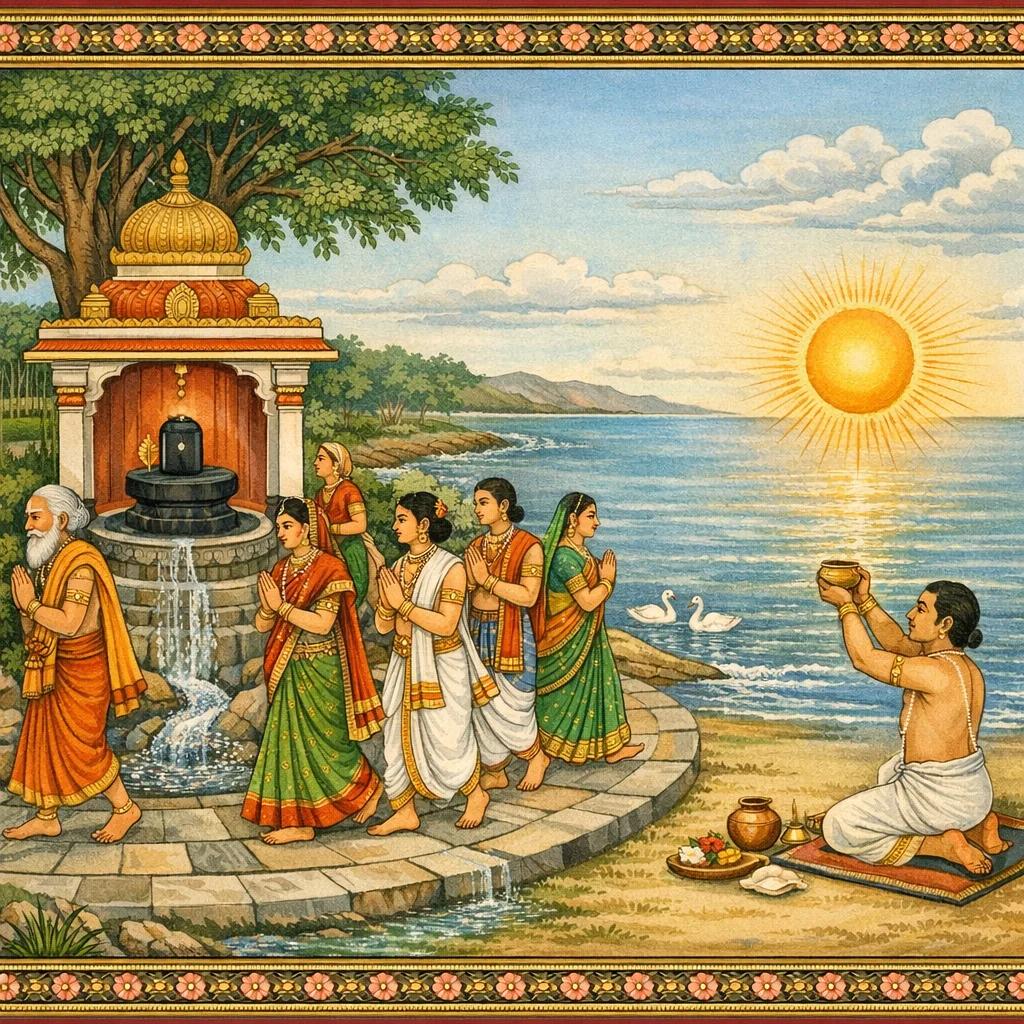
This chapter unfolds as a Śiva–Devī dialogue. It first identifies Kapileśvara and the Kapila-kṣetra through directions and tīrtha-based sacred geography, then establishes the site’s sanctity through a mythic precedent: the sage Kapila’s long tapas and the installation of Maheśvara there. Kapiladhārā is described as a holy river-current connected with the sea, perceptible to those of merit. The main teaching is the Kapilā-Ṣaṣṭhī vrata, defined by a rare calendrical conjunction, and taught through a clear sequence: bathing (in the kṣetra or at a sun-associated spot), japa, offering arghya to Sūrya with prescribed substances, circumambulation (pradakṣiṇā), and worship near Kapileśvara. A concluding donation rite is prescribed—arranging a kumbha with solar symbolism and gifting it to a Veda-knowing brāhmaṇa—followed by an expansive phalaśruti promising expiation of accumulated wrongdoing and extraordinary merit, likened to great sacrifices and to gifts made at many sacred places.
Shlokas
Verse 1
ईश्वर उवाच । ततो गच्छेन्महादेवि कपिलेश्वरमुत्तमम् । शीराभूषणपूर्वेण कोटितीर्थाच्च पश्चिमे
Īśvara said: “Then, O Mahādevī, one should go to the excellent Kapileśvara. It lies to the west of Koṭitīrtha and to the east of Śīrābhūṣaṇa.”
Verse 2
जरद्गवेशाद्दक्षिणे समुद्रोत्तरतस्तथा । एतद्वै कापिलं क्षेत्रं नापुण्यैः प्राप्यते नरैः
It is to the south of Jaradgaveśa and likewise to the north of the ocean. Truly, this is the Kāpila sacred region, not attained by men who are devoid of merit.
Verse 3
कपिलेन पुरा देवि यत्र तप्तं तपो महत् । वर्षाणामयुतं साग्रं प्रतिष्ठाप्य महेश्वरम्
O Goddess, in ancient times Kapila performed great austerity there; and, having installed Maheśvara, he practiced it for ten thousand years and more.
Verse 4
समाहूता तत्र देवी कपिलधारा महानदी । समुद्रमध्ये साऽद्यापि पुण्यवद्भिः प्रदृश्यते
There the Goddess—the great river named Kapiladhārā—was invoked. Even today, those endowed with merit behold her in the midst of the ocean.
Verse 5
तत्र स्नात्वा महादेवि कपिलाषष्ठ्यां विशेषतः । कपिलां दापयेत्तत्र गोकोटिफलभाग्भवेत्
Having bathed there, O Mahādevī—especially on Kapilā-Ṣaṣṭhī—one should gift there a tawny cow (kapilā); one becomes a sharer in the merit whose fruit equals the gifting of ten million cows.
Verse 6
सर्वेषां चैव पापानां प्रायश्चित्तमिदं स्मृतम् । कपिलेश्वरं तु संपूज्य कन्याकोटिफलं लभेत्
This is declared to be an expiation for all sins. By duly worshipping Kapileśvara, one gains merit equal to the fruit of giving ten million maidens in marriage.
Verse 7
देव्युवाच । आश्चर्यं मम देवेश कपिलषष्ठ्या महेश्वर । विधानं श्रोतुमिच्छामि दानमन्त्रादि पूर्वकम्
The Goddess said: “O Lord of gods, O Maheśvara, this Kapilā-Ṣaṣṭhī is wondrous to me. I wish to hear its procedure—beginning with the rules of charity and the mantras.”
Verse 8
ईश्वर उवाच । जन्मजीवितमध्ये तु यद्येका लभ्यते नरैः । संयोगयुक्ता सा षष्ठी तत्किं देवि ब्रवीम्यहम्
Īśvara said: “If, in the course of one’s birth and lifetime, people obtain even one such Ṣaṣṭhī endowed with auspicious conjunctions—what more, O Goddess, can I say?”
Verse 9
प्रौष्ठपद्यसिते पक्षे षष्ठ्यामंगारको यदि । व्यतीपातश्च रोहिण्यां सा षष्ठी कपिला स्मृता
In the bright fortnight of Prauṣṭhapadī, if Mars (Aṅgāraka) falls on the sixth lunar day, and Vyatīpāta also occurs with the Rohiṇī constellation, then that Ṣaṣṭhī is remembered as “Kapilā.”
Verse 10
तत्र क्षेत्रे नरः स्नात्वा अथवार्कस्थले शुभे । मृदा शुक्ल तिलैश्चैव कपिलासंगमे शुभे
Having bathed in that sacred region—or else at the auspicious Arkasthala—one should perform the rite with purifying earth and with white sesame at the blessed confluence of Kapilā.
Verse 11
कृतस्नानजपः पश्चात्सूर्यायार्घ्यं निवेदयेत् । रक्तचंदनतोयेन करवीरयुतेन च । कृत्वार्घपात्रं शिरसि मंत्रेणानेन दापयेत्
After completing the ritual bath and japa, one should offer arghya to Sūrya with water fragrant with red sandalwood and mingled with oleander blossoms. Setting the arghya-vessel upon the head in reverence, one should present the offering while reciting the following mantra.
Verse 12
नमस्त्रैलोक्यनाथाय उद्भासितजगत्त्रय । वेदरश्मे नमस्तुभ्यं गृहाणार्घ्यं नमोऽस्तु ते
Salutations to the Lord of the three worlds, who illumines the threefold universe. O Ray of the Vedas, salutations to You—please accept this arghya; obeisance be to You.
Verse 13
सूर्यं प्रदक्षिणीकृत्य संपूज्य कपिलेश्वरम् । उपलिप्ते शुभे देशे पुष्पाक्षतविभूषिते
Having circumambulated Sūrya and duly worshipped Kapileśvara, one should proceed to an auspicious place freshly smeared and purified, adorned with flowers and with akṣata—unbroken grains of rice.
Verse 14
स्थापयेदव्रणं कुम्भं चन्दनोदकपूरितम् । पंचरत्नसमायुक्तं दूर्वापुष्पाक्षतान्वितम्
One should set up a flawless kalaśa, filled with sandalwood-scented water, furnished with the five gems, and accompanied by dūrvā grass, flowers, and akṣata (unbroken rice).
Verse 15
रक्तवस्त्रयुगच्छन्नं ताम्रपात्रेण संयुतम् । रथो रुक्मफलस्यैव एकचित्रविचित्रितः
A ritual ratha should be prepared—covered with a pair of red cloths, provided with a copper vessel, and ornamented with a single distinctive pattern—for the offering of rukma-phala.
Verse 16
सौवर्णपलसंयुक्तां मूर्तिं सूर्यस्य कारयेत् । कुंभस्योपरि संस्थाप्य गंधपुष्पैः समर्चयेत्
One should have an image of Sūrya made, furnished with gold according to the palasa measure. Placing it upon the kalaśa, one should worship it fully with fragrances and flowers.
Verse 17
कपिलेश्वरसान्निध्ये मण्डपे होमसंस्कृते । आदित्यं पूजयेद्देवं नामभिः स्वैर्यथोदितैः
In a pavilion (maṇḍapa) sanctified for homa, in the very presence of Kapileśvara, one should worship the god Āditya, invoking Him with His own names as prescribed.
Verse 18
आदित्यभास्कर रवे भानो स्वयं दिवाकर । प्रभाकर नमस्तुभ्यं ससारान्मां समुद्धर
O Āditya, Bhāskara, Ravi, Bhānu—You who are truly Divākara, the maker of day—O Prabhākara, salutations to You; lift me up from this wandering stream of saṃsāra.
Verse 19
भुक्तिमुक्तिप्रदो यस्मात्तस्माच्छांतिं प्रयच्छ नः
Since You bestow both worldly enjoyment and liberation, therefore grant us peace.
Verse 20
प्रार्थनामन्त्रः । नमोनमस्ते वरद ऋक्सामयजुषांपते । नमोऽस्तुविश्वरूपाय विश्वधाम्ने नमोऽस्तु ते
Prayer-mantra: Repeated salutations to You, O Bestower of boons, Lord of the Ṛg, Sāma, and Yajus. Obeisance to Your universal form; obeisance to You who are the abode of the universe.
Verse 21
अमृतं देवि ते क्षीरं पवित्रमिह पुष्टिदम् । त्वत्प्रसादात्प्रमुच्यंते मनुजाः सर्वपातकैः
O Goddess, your milk is ambrosia—pure in this world and a giver of nourishment. By your grace, human beings are released from every sin.
Verse 22
ब्रह्मणोत्पादिते देवि वह्निकुण्डान्महाप्रभे । नमस्ते कपिले पुण्ये सर्वदेवनमस्कृते
O Goddess, brought forth by Brahmā, born from the fire-pit, O greatly radiant one! Salutations to you, O holy Kapilā, revered even by all the gods.
Verse 23
सर्वदेवमये देवि सर्वतीर्थमये शुभे । दातारं पूजयानं मां ब्रह्मलोकं नय स्वयम्
O auspicious Goddess, who embodies all the gods and all the tīrthas—lead me, who am worshipping you as a giver of charity, by your own power to Brahmā’s world.
Verse 24
पूजामंत्रः । एवं संपूज्य कपिलां कुम्भस्थं च दिवाकरम् । ब्राह्मणे वेदविदुष उभयं प्रतिपादयेत्
The worship-mantra: Having thus fully worshipped Kapilā and the Sun, Divākara, established in a water-pot, one should formally offer both to a Brāhmaṇa learned in the Vedas.
Verse 25
व्यासाय सूर्यभक्ताय मंत्रेणानेन दापयेत्
With this very mantra, one should give (the offering) to Vyāsa, the devotee of the Sun.
Verse 26
दिव्यमूर्त्तिर्जगच्चक्षु र्द्वादशात्मा दिवाकरः । कपिलासहितो देवो मम मुक्तिं प्रयच्छतु
May that god Divākara—the Sun—of divine form, the eye of the universe, of twelvefold essence, accompanied by Kapilā, grant me liberation.
Verse 27
यस्मात्त्वं कपिले पुण्या सर्वलोकस्य पावनी । प्रदत्ता सह सूर्येण मम मुक्तिप्रदा भव
Since you, O holy Kapilā, are the purifier of all the worlds—when gifted together with the Sun—become for me a bestower of liberation.
Verse 28
पलेन दक्षिणा कार्या तदर्धार्धेन वा पुनः । शक्तितो दक्षिणायुक्तां तां धेनुं प्रतिपादयेत्
A gratuity (dakṣiṇā) should be given of one pala, or again of half of that. According to one’s capacity, having added dakṣiṇā, one should formally present that cow in donation.
Verse 29
योऽनेन विधिना कुर्या त्षष्ठीं कपिलसंज्ञिताम् । सोऽश्वमेधसहस्रस्य फलं प्राप्नोति मानवः
Whoever, by this prescribed rite, performs the Ṣaṣṭhī observance known as “Kapilā,” that person attains the fruit of a thousand Aśvamedha sacrifices.
Verse 30
यत्फलं सर्वतीर्थेषु सर्वदानेषु यत्फलम् । तत्फलं सर्वमाप्नोति यः षष्ठीं कपिलां चरेत्
Whatever fruit arises from all tīrthas and whatever fruit arises from all gifts—one who observes the Kapilā Ṣaṣṭhī attains all of that fruit in full.
Verse 31
कपिलाकोटिसहस्राणि कपिलाकोटिशतानि च । सूर्यपर्वणि यद्दत्त्वा तत्फलं कोटिशो भवेत्
If, on the Sun’s sacred festival day (sūrya-parvan), one makes the gift connected with Kapilā—by tens of millions and by hundreds of crores—then the merit arising from that act becomes multiplied millions of times.
Verse 32
कोटिगोरोम संख्यानि वर्षाणि वरवर्णिनि । तावत्स वसते स्वर्गे यः षष्ठीं कपिलां चरेत्
O fair lady, for as many years as can be counted by “crores of cow-hairs,” so long does that person dwell in heaven—who duly observes the Kapilā-Ṣaṣṭhī.
Verse 33
ज्ञानतोऽज्ञानतो वापि यत्पापं पूर्वसंचितम् । तत्सर्वं नाशमायाति इत्याह कपिलो मुनिः
Whatever sin has been accumulated from the past—whether committed knowingly or unknowingly—all of it comes to destruction: thus declared the sage Kapila.
Verse 343
इति श्रीस्कान्दे महापुराण एकाशीतिसाहस्र्यां संहितायां सप्तमे प्रभासखण्डे प्रथमे प्रभासक्षेत्रमाहात्म्ये कपि लधाराकपिलेश्वरमाहात्म्ये कपिलाषष्ठीव्रतविधानमाहात्म्यवर्णनंनाम त्रिचत्वारिंशदुत्तरत्रिशततमोऽध्यायः
Thus ends, in the Śrī Skanda Mahāpurāṇa—within the Saṃhitā of eighty-one thousand verses—in the seventh, the Prabhāsa Khaṇḍa; in the first, the Prabhāsakṣetra Māhātmya; in the Māhātmya of Kapiladhārā and Kapileśvara—the chapter entitled “The Account of the Greatness of the Procedure for the Kapilā-Ṣaṣṭhī Vow,” being Chapter 343.