Adhyaya 354
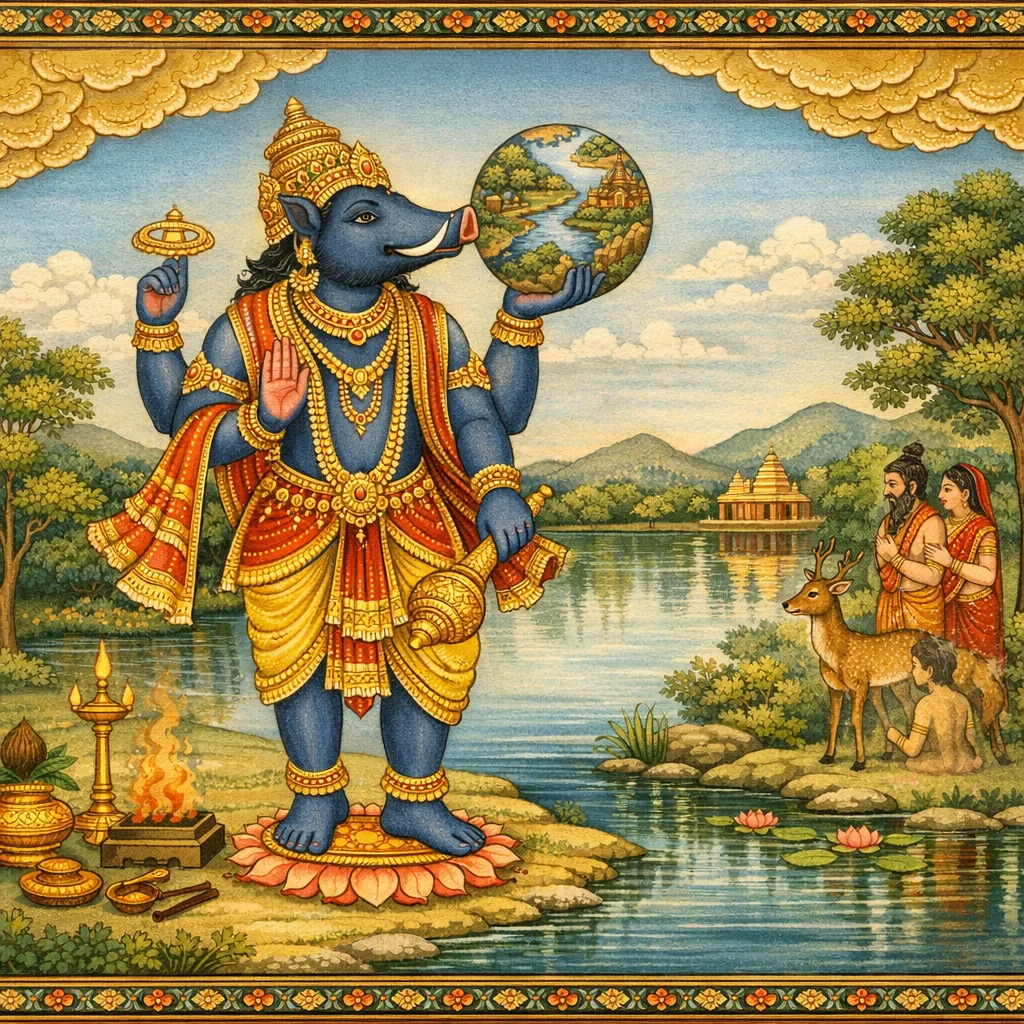
This adhyāya is cast as Īśvara’s theological instruction to Devī on the tīrtha called Kardamālā, famed in the three worlds as a remover of all pāpa. Set against cosmic dissolution (pralaya, ekārṇava), the earth lies submerged and the luminaries are said to be in ruin; Janārdana (Viṣṇu) assumes the Varāha form, raises the earth upon his tusk, and restores her to her proper place. Viṣṇu then proclaims his sustained, regulated presence at this sacred spot. The tīrtha’s power is tied to ancestral rites: tarpaṇa at Kardamālā is said to satisfy the pitṛs for a full kalpa, and śrāddha performed even with simple offerings—greens, roots, fruits—is declared equal to śrāddha at all tīrthas. A phalāśruti extols bathing and darśana here as leading to higher destinies and release from lower rebirths. A miracle follows: a terrified herd of deer, driven by hunters, enters Kardamālā and immediately attains human status; the hunters abandon their weapons, bathe, and are freed from sins. Asked for origins and boundaries, Īśvara reveals a “secret” account: Varāha is described at length in yajña-symbolic anatomy, with Vedic limbs and ritual components forming his body. The tusk-tip (daṃṣṭrāgra) is identified as mud-smeared in the Prabhāsa field—hence the name Kardamālā. The chapter also names a great pond (mahākuṇḍa) and a water-source likened to a vast Gaṅgā-abhiṣeka, defines the measure of Viṣṇu’s sacred territory, and concludes with strong claims about the merit of seeing the boar-form and the unique accessibility of liberation in Kali Yuga through this “Saukara” kṣetra.
Shlokas
Verse 1
ईश्वर उवाच । ततो गच्छेन्महादेवि कर्दमालमनुत्तमम् । तीर्थं त्रैलोक्यविख्यातं सर्वपातकनाशनम्
Īśvara said: Then, O great Goddess, one should go to the unsurpassed Kardamāla—a tīrtha renowned in the three worlds, destroying all sins.
Verse 2
तस्मिन्नेकार्णवे घोरे नष्टे स्थावरजंगमे । चन्द्रार्कतपने नष्टे ज्योतिषि प्रलयं गते
When that dreadful single ocean alone remained—when the moving and unmoving beings had perished; when the moon, sun, and heat had vanished; when the luminaries had entered dissolution—
Verse 3
रसातलगतामुर्वीं दृष्ट्वा देवो जनार्दनः । वाराहं रूपमास्थाय दंष्ट्राग्रेण वरानने । उत्क्षिप्य धरणीं मूर्ध्ना स्वस्थाने संन्यवेशयत्
Seeing the earth sunk down to Rasātala, the god Janārdana assumed the form of the Boar, Varāha. O fair-faced one, lifting the earth upon the tip of his tusk and bearing it upon his head, he set her again in her proper place.
Verse 4
उद्धृत्य भगवान्विष्णुर्वाक्यमेतदुवाच ह
Having thus lifted her up, the Blessed Lord Viṣṇu spoke these words:
Verse 5
अत्र स्थाने स्थितेनैव मया त्वं देवि चोद्धृता । ममात्र नियतं वासः सदैवायं भविष्यति
‘Right in this very place, while standing here, I lifted you up as well, O Goddess. Therefore my dwelling here is fixed; it shall be so forever.’
Verse 6
ये पितॄंस्तर्पयिष्यंति कर्दमाले वरानने । आकल्पं तर्पितास्तेन भविष्यंति न संशयः
O fair-faced goddess, those who will offer tarpaṇa—water-libations to the ancestors—at Kardamālā will, by that act, keep their forefathers satisfied for an entire aeon; of this there is no doubt.
Verse 7
तत्र श्राद्धं करिष्यंति शाकैर्मूलफलेन वा । भविष्यति कृतं श्राद्धं सर्वतीर्थेषु वै शुभे
O auspicious one, if people perform śrāddha there—even with simple greens, roots, or fruits—that śrāddha is deemed as though performed at all sacred fords.
Verse 8
अत्र तीर्थे नरः स्नात्वा यो मां पश्यति मानवः । अपि कीटपतंगा ये निधनं यांति मानवाः । ते मृतास्त्रि दिवं यान्ति सुकृतेन यथा द्विजाः
At this sacred ford, the person who bathes and then beholds me—indeed, even those who die here as insects or birds—after death ascend to heaven by that merit, just as the righteous twice-born do through their good deeds.
Verse 9
ततो द्वीपेषु जायन्ते धनाढ्याश्चोत्तमे कुले । दंष्ट्राभेदेन यत्तोयं निर्गतं ते शरीरतः
Thereafter they are born in the continents (dvīpas), wealthy and in excellent families—because of the water that flowed from their bodies when their fangs were broken.
Verse 10
तत्र स्नात्वा नरो देवि तिर्यग्योनौ न जायते
O goddess, a person who bathes there is not born again in an animal womb.
Verse 11
ईश्वर उवाच । शृणु देवि यथावृत्तमाश्चर्यं तत्र वै पुरा । मृगयूथं सुसन्त्रस्तं लुब्धकैः परिपीडितम् । प्रविष्टं कर्दमाले तु सद्यो मानुषतां गतम्
Īśvara said: Listen, O goddess, to the wondrous event that occurred there long ago. A herd of deer, terribly frightened and harassed by hunters, entered Kardamālā and at once attained human status.
Verse 12
अथ ते लुब्धका दृष्ट्वा विस्मयोत्फुल्ललोचनाः । अपृच्छंत च संभ्रातास्तान्मर्त्यान्वरवर्णिनि
Then those hunters, seeing them with eyes widened in astonishment, questioned those humans in great confusion, O lady of splendid complexion.
Verse 13
मृगयूथमनुप्राप्तं केन मार्गेण निर्गतम् । अथोचुस्ते वयं प्राप्ता मानुषं मृगरूपिणः
“The herd of deer that we were pursuing—by what path did it come out?” Then they replied, “We have attained humanity, though we had the form of deer.”
Verse 14
एतत्तीर्थप्रभावोऽयं न विद्मो ह्यात्म कारणम् । ततस्ते लुब्धकास्त्यक्त्वा धनूंषि सशराणि च । तत्र स्नात्वा महाभागे मुक्ताश्च सर्वपातकैः
“This is the power of this tīrtha; we know of no personal cause within ourselves.” Then those hunters, casting aside their bows and arrows, bathed there, O greatly fortunate one, and were freed from all sins.
Verse 15
पार्वत्युवाच । भगवन्विस्तरं ब्रूहि कर्दमालमहोदयम् । उत्पत्तिं च विधानं च क्षेत्रसीमादिकं क्रमात्
Pārvatī said: “O Lord, describe in detail the great glory of Kardamālā—its origin, its rites, and, in due order, the boundaries of the sacred field and related matters.”
Verse 16
ईश्वर उवाच । शृणु देवि रहस्यं तु कर्द मालसमुद्भवम् । गूढं ब्रह्मर्षिसर्वस्वं न देयं कस्यचित्त्वया
Īśvara said: “Listen, O Goddess, to this secret concerning the origin of Kardamāla. It is a hidden teaching—the very treasure of the Brahmarṣis—and you must not disclose it to just anyone.”
Verse 17
पूर्वमेकार्णवे घोरे नष्टे स्थावरजंगमे । चन्द्रार्कपवने नष्टे ज्योतिषि प्रलयं गते
Formerly, when the dreadful single ocean alone remained—when all immovable and moving beings had perished—when moon, sun, and wind had vanished, and the lights had entered dissolution—
Verse 18
एकार्णवं जगदिदं ब्रह्मापश्यदशेषतः । तस्मिन्वसुमती मग्ना पातालतलमागता
Brahmā beheld this entire world as a single ocean. In that flood, the Earth (Vasumatī) sank down and reached the levels of Pātāla.
Verse 19
ततो यज्ञवराहोऽसौ कृत्वा यज्ञमयं वपुः । उद्दधार महीं कृत्स्नां दंष्ट्राग्रेण वरानने
Then that Yajña-Varāha, assuming a body made of sacrifice, lifted up the entire Earth upon the tip of his tusk, O fair-faced one.
Verse 20
ईश्वर उवाच । वेदपादो यूपदंष्ट्रः क्रतुदंतःस्रुचीमुखः । अग्निजिह्वो दर्भरोमा ब्रह्मशीर्षा महातपाः
Īśvara said: “His feet were the Vedas; his tusks were the sacrificial posts (yūpa); his teeth were the rites (kratu); his mouth was the ladle (srucī). His tongue was fire; his hairs were kuśa-grass; his head was Brahmā—he was of great austerity.”
Verse 21
ईश्वर उवाच । अहोरात्रेक्षणपरो वेदांगश्रुतिभूषणः । आज्यनासः स्रुवतुडः सामघोषस्वनो महान्
Īśvara said: “Day and night were his gaze; the Vedāṅgas and Śruti were his ornaments. Ghee (ājya) was his scent; the sruva-ladle was his goad; the sound of Sāman-chants was his mighty roar.”
Verse 22
प्राग्वंशकायो द्युतिमान्मात्रादीक्षाभिरावृतः । दक्षिणा हृदयो योगी महासत्रमहो महान्
Radiant, with the prāgvaṃśa as his body, and enveloped in consecrations beginning with the mātrā-rites, his heart was the dakṣiṇā (sacrificial gift). He was a yogin—great, the very grandeur of a mahāsatra-sacrifice.
Verse 23
उपाकर्मोष्ठरुचकः प्रवर्ग्यावर्तभूषणः । नानाच्छन्दोगतिपथो ब्रह्मोक्तक्रमविक्रमः
His lips shone as the Upākarman; he was adorned with the cycles of the Pravargya rite. His pathways were the many courses of Vedic metres, and his strides were the ordered sequences proclaimed by Brahmā.
Verse 24
भूत्वा यज्ञवराहोऽसावुद्दधार महीं ततः । तस्योद्धृतवतः पृथ्वीं दंष्ट्राग्रं निर्गतं बहिः
Becoming Yajña-Varāha, he then lifted up the Earth. As he raised the world, the tip of his tusk emerged outward.
Verse 25
तस्मिन्प्राभासिके क्षेत्रे कर्द्दमेन विलेपितम् । तद्दंष्ट्राग्रं यतो देवि कर्द्दमालं ततः स्मृतम्
In that Prābhāsika sacred region, the tip of the tusk became smeared with mud; therefore, O Goddess, it has been remembered by the name ‘Karddamāla’.
Verse 26
दण्डोद्भेदं महाकुण्डं यत्र दंष्ट्रा सुसंस्थिता । तद्दंष्ट्रयोद्धृतं तोयं कोटिगंगाभिषेकवत्
There is the great pool called Daṇḍodbheda, where the (Boar’s) tusk is firmly established. The water lifted up by that tusk is regarded as equal to bathing anointingly in the Gaṅgā a crore times.
Verse 27
तत्र गव्यूति मात्रं तु विष्णुक्षेत्रं सनातनम् । देशांतरं गता ये च दण्डोद्भेदे म्रियंति वै । यावत्कल्पसहस्राणि विष्णुलोकं व्रजंति ते
There, for an extent of one gavyūti, lies an eternal holy domain of Viṣṇu. Even those who have come from other lands—if they indeed die at Daṇḍodbheda—go to Viṣṇu’s world for thousands of kalpas.
Verse 28
यस्तु पश्येन्महादेवि कर्दमाले तु सूकरम् । कोटिहिंसायुतो वापि स प्राप्स्यति परां गतिम्
O Great Goddess, whoever beholds the Boar (Varāha) at Karddamāla—even if burdened with violence amounting to crores—he shall attain the supreme state.
Verse 29
दशजन्मकृतं पापं नश्येत्तद्दर्शनात्प्रिये । जन्मान्तरसहस्रेषु यत्कृतं पापसंचयम्
O beloved, by that very sight, the sin wrought through ten births is destroyed—indeed, even the amassed heap of sin gathered over thousands of other births is undone.
Verse 30
कर्दमाले तु वाराहं दृष्ट्वा तन्नाशमेष्यति । हेमकोटिसहस्राणि गवां कोटिशतानि च
By seeing Varāha at Karddamāla, that store of sin is brought to destruction. The merit is comparable to gifting thousands of crores of gold and hundreds of crores of cows in charity.
Verse 31
दत्त्वा यल्लभते पुण्यं सकृद्वाराहदर्शनात् । कलौ युगे महारौद्रे प्राणिनां च भयावहे । नान्यत्र जायते मुक्तिर्मुक्त्वा क्षेत्रं तु सौकरम्
Whatever merit one gains by giving in charity, that same merit is obtained by a single sight of Varāha. In the Kali age—fierce and fearful for living beings—liberation is found nowhere else, apart from the Saukara Kṣetra, the Boar’s sacred field.
Verse 32
एतत्सारतरं देवि प्रोक्तमुद्देशतस्तव । कर्द्दमालस्य माहात्म्यं सर्वपातकनाशनम्
Thus, O Goddess, I have told you in brief the very essence: the greatness of Karddamāla, which destroys all sins.