Adhyaya 43
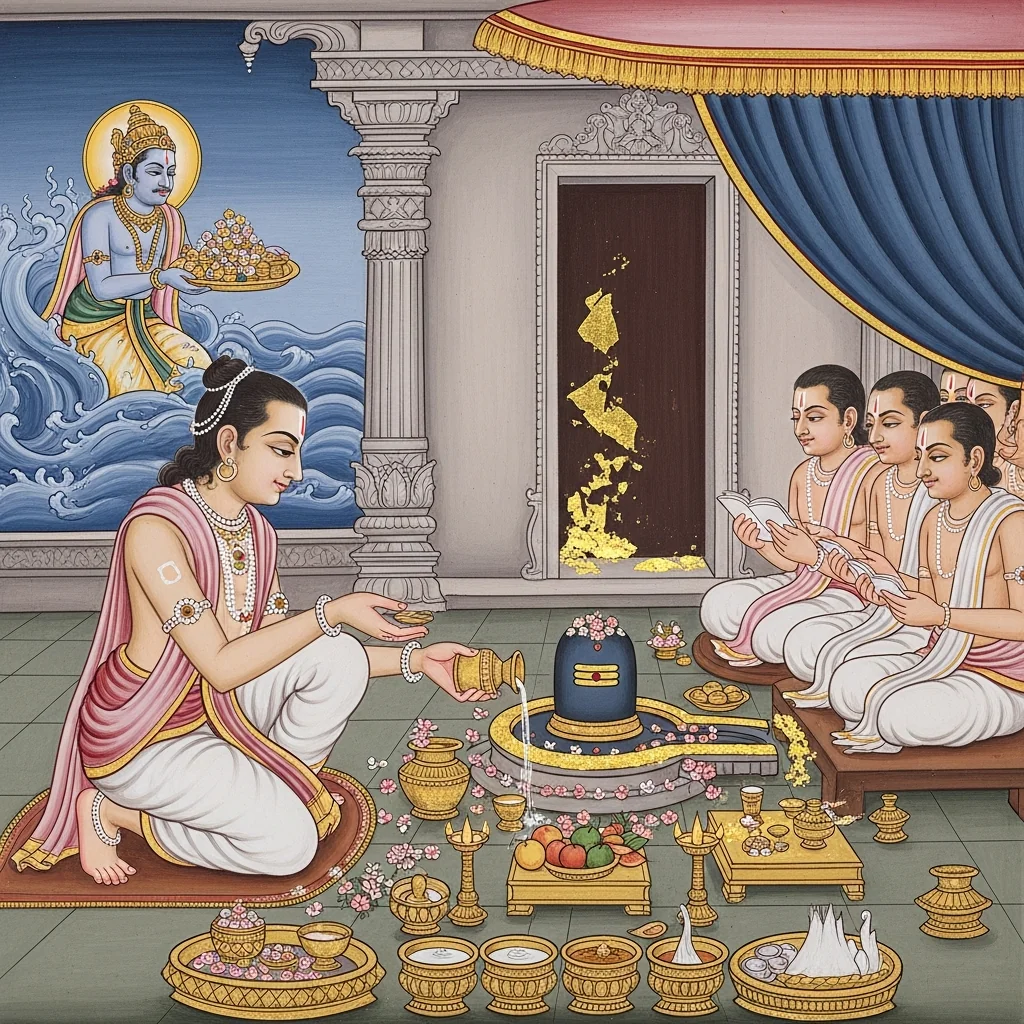
This chapter records Īśvara’s directional guidance to Devī for pilgrimage, leading the seeker to a Sūrya-established liṅga lying west of Somēśa at a measured distance of “seven bows.” The liṅga is named Ādityeśvara and is praised as the destroyer of all sins (sarva-pātaka-nāśana). A remembrance of the Tretāyuga is then given: the ocean (samudra) is said to have worshiped this liṅga for a long time with jewels, grounding the shrine’s authority in mythic time. Hence the secondary name Ratneśvara, “Lord of Gems.” The prescribed rite includes bathing with pañcāmṛta, worship with five gems, and royal-style offerings (rājopacāra) performed according to proper vidhi. The phala teaching declares that such worship yields merit equal to Meru-dāna and the combined fruit of sacrifices and gifts, and it uplifts both paternal and maternal ancestral lines. Seeing Ratneśvara is said to wash away sins from childhood, youth, adulthood, and old age. The chapter also extols cow-gift (dhenu-dāna) at the site, promising salvation for ten prior and ten subsequent generations; and it states that one who, after due liṅga worship, recites the Śatarudrīya to the deity’s right is not born again. It concludes by affirming that attentive hearing itself releases one from karmic bonds.
Shlokas
Verse 1
ईश्वर उवाच । ततो गच्छेद्वरारोहे लिंगं सूर्यप्रतिष्ठितम् । सोमेशात्पश्चिमे भागे धनुषां सप्तके स्थितम् । आदित्येश्वरनामानं सर्वपातकनाशनम्
Īśvara said: Then, O fair-hipped one, one should go to the liṅga established by the Sun, located to the west of Someśa at a distance of seven dhanuṣ-lengths—named Ādityeśvara, the destroyer of all sins.
Verse 2
त्रेतायुगे महादेवि समुद्रेण महात्मना । रत्नैः संपूजितं लिंगं वर्षाणामयुतं प्रिये
In the Tretā Yuga, O Mahādevī, the great-souled Ocean worshipped this liṅga with jewels for ten thousand years, O beloved.
Verse 3
तेन रत्नेश्वरंनाम सांप्रतं प्रथितं क्षितौ । पंचामृतेन संस्नाप्य पंचरत्नैः प्रपूजयेत्
Therefore it is now renowned on earth by the name Ratneśvara. After bathing it with pañcāmṛta, one should worship it with the five gems.
Verse 4
ततो राजोपचारेण पूजयेद्विधिवन्नरः । एवं कृते महादेवि मेरुदानफलं लभेत्
Thereafter, a person should worship with royal offerings, according to proper rite. When this is done, O Mahādevī, one attains the merit equal to the great gift called Meru-dāna.
Verse 5
सर्वेषां चैव यज्ञानां दानानां नात्र संशयः
Indeed, this is the fruit of all sacrifices and all gifts—of this there is no doubt.
Verse 6
तीर्थानां चापि सर्वेषां यच्चान्यत्सुकृतं भुवि । उद्धरेत्पितृवर्गं च मातृवर्गं च मानवः
And one gains the merit of all sacred fords, and whatever other good deeds exist upon the earth. A human being thereby uplifts both the line of fathers and the line of mothers.
Verse 7
बाल्ये वयसि यत्पापं वार्द्धके यौवनेऽपि वा । क्षालयेच्चैव तत्सर्वं दृष्ट्वा रत्नेश्वरं नरः
Whatever sin was committed in childhood, in youth, or even in old age—having beheld Ratneśvara, a person washes away all of it.
Verse 8
धेनुदानं प्रशंसंति तस्मिन्स्थाने महर्षयः । धेनुदस्तारयेन्नूनं दश पूर्वान्दशापरान्
In that place, the great seers praise the gift of a cow. Surely, the giver of a cow delivers ten generations before and ten generations after.
Verse 9
देवस्य दक्षिणे भागे यो जपेच्छतरुद्रियम् । संपूज्य विधिवल्लिंगं न स भूयः प्रजायते
On the southern side of the deity, whoever recites the Śatarudrīya and duly worships the liṅga is not born again.
Verse 10
एवं संक्षेपतः प्रोक्तमादित्येशमहोदयम् । श्रुत्वाऽवधार्य यत्नेन मुच्यते कर्मबंधनैः
Thus, in brief, the great glory of Ādityeśa has been declared. Hearing it and firmly retaining it with care, one is freed from the bonds of karma.
Verse 43
इति श्रीस्कांदे महापुराण एकाशीतिसाहस्र्यां संहितायां सप्तमे प्रभासखण्डे प्रथमे प्रभासक्षेत्रमाहात्म्य आदित्येश्वरमाहात्म्यवर्णनंनाम त्रिचत्वारिंशोऽध्यायः
Thus ends the forty-third chapter, called “The Description of the Greatness of Ādityeśvara,” in the Prabhāsa Khaṇḍa—within the Prabhāsa Kṣetra Māhātmya—of the holy Skanda Mahāpurāṇa, in the eighty-one-thousand-verse Saṃhitā.