Adhyaya 24
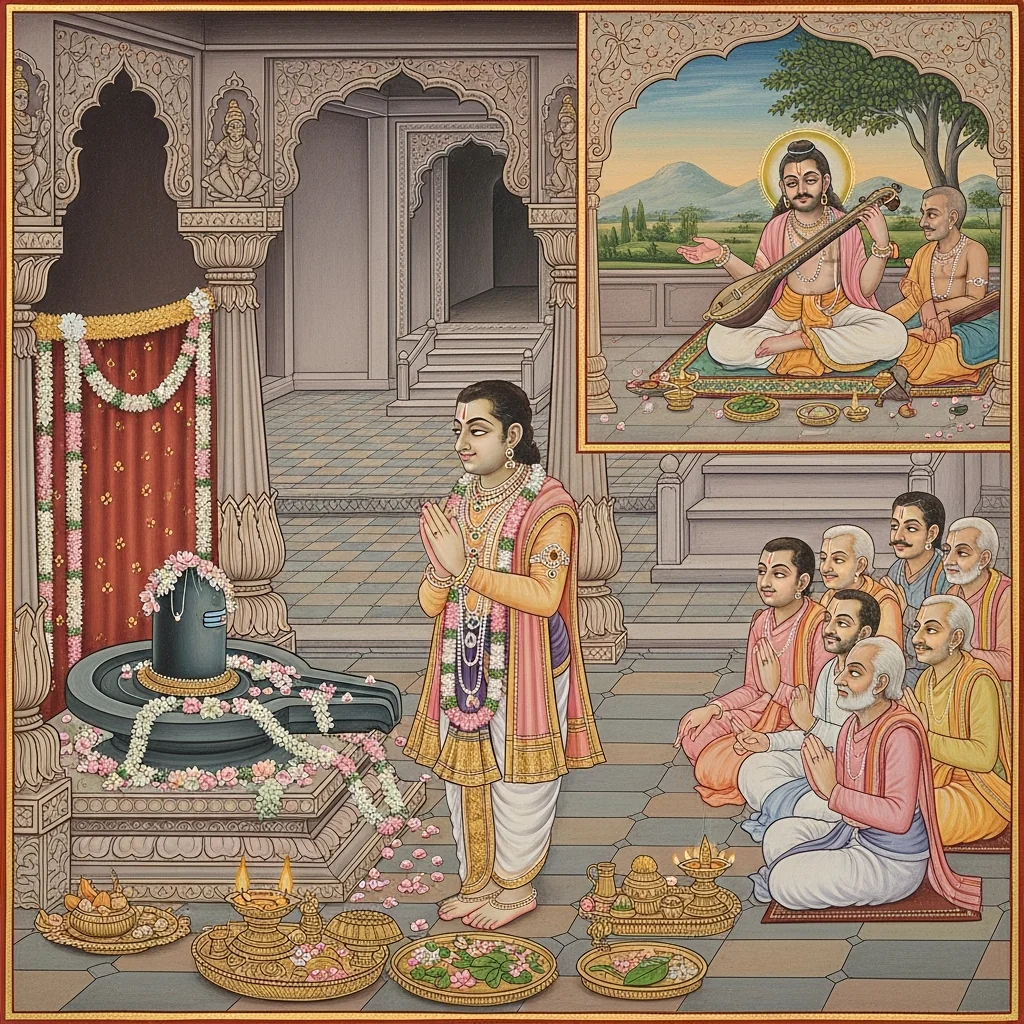
Chapter 24 is cast as a Devī–Īśvara dialogue that places the Somnātha liṅga within a sacred chronology (in the Tretā-yuga) and grounds its authority in Soma’s tapas and sustained worship. Soma offers a many-epithet stuti to Śiva—self as knowledge, yoga, tīrtha, and yajña—after which Śiva grants the boon of perpetual nearness in the liṅga and formally establishes the names “Prabhāsa” for the place and “Somnātha” for the deity. The teaching then turns to phala in a structured way: Somnātha-darśana is declared equal to, or surpassing, extensive austerities, gifts, pilgrimages, and major rites, thus exalting devotional encounter within the kṣetra. The chapter also supplies a technical list of flowers and leaves fit or unfit for worship, with rules about freshness, night/day usage, and specific exclusions. After Soma’s healing, it narrates his building of a temple-city—prāsāda complexes and civic endowments. Brahmins then worry about impurity from handling Śiva’s nirmālya, prompting a doctrinal excursus (via Nārada recalling a Gaurī–Śaṅkara discourse) on devotion, guṇa-shaped dispositions, and the ultimate non-dual relation of Śiva and Hari. The chapter closes by moving into the Somavāra-vrata (Monday vow) as a decisive practice, introducing an illustrative Gandharva-family episode that leads to a cure prescribed through Somnātha worship.
Shlokas
Verse 1
देव्युवाच । कस्मिन्काले जगन्नाथ तत्र लिंगं प्रतिष्ठितम् । कथमाराधनं चक्रे कृतार्थो रोहिणीपतिः
The Goddess said: O Lord of the universe, at what time was the liṅga installed there? And how did Rohiṇī’s lord—the Moon—having attained his purpose, perform its worship?
Verse 2
ईश्वर उवाच । त्रेतायुगे च दशमे मनोर्वैवस्वतस्य हि । संजातो रोहिणीनाथो युक्तो दुर्वाससा प्रिये
Īśvara said: O beloved, in the Tretā Yuga indeed, during the tenth period of Vaivasvata Manu, Rohiṇī’s lord—the Moon—was born, associated with the sage Durvāsas.
Verse 3
तस्मिन्काले तदा तत्र गते वर्षसहस्रके । ततः कृत्वा तपश्चायं प्रत्यक्षीकृतशंकरः
At that time, in that place, when a thousand years had passed, he undertook austerity; and by the power of that tapas he caused Śaṅkara (Śiva) to manifest before him in direct vision.
Verse 4
लिंगं प्रतिष्ठयामास ब्रह्मणा लोककर्तॄणा । पुनर्वर्षसहस्रं तु पूजयामास शंकरम्
He installed a liṅga through Brahmā, the creator of the worlds; and again, for a thousand years, he worshipped Śaṅkara.
Verse 5
ततः संपूज्य विधिना निजकार्यार्थसिद्धये । स्तुतिं चक्रे निशानाथः प्रत्यक्षीकृतशंकरः
Then, having duly worshipped according to the prescribed rite for the fulfilment of his own purpose, the Lord of the Night (Candra), who had obtained Śaṅkara’s direct manifestation, began to offer a hymn of praise.
Verse 6
चंद्र उवाच । नास्ति शर्वसमो देवो नास्ति शर्वसमा गतिः । नास्ति शर्वसमो देवो नास्ति शर्वसमा गतिः
Candra said: “There is no deity equal to Śarva, and there is no refuge equal to Śarva.” (This declaration is repeated for emphasis.)
Verse 7
यं पठंति सदा सांख्याश्चितयंति च योगिनः । परं प्रधानं पुरुषं तस्मै ज्ञेयात्मने नमः
Him whom the Sāṃkhyas ever recite and whom the Yogins contemplate in meditation—Him, the supreme Principle, the transcendent Puruṣa—I bow to that Lord whose very nature is the highest to be known.
Verse 8
उत्पत्तौ च विनाशे च कारणं यं विदुर्बुधाः । देवासुरमनुष्याणां तस्मै ज्ञानात्मने नमः
To Him whom the wise know as the cause of both origination and dissolution—of gods, asuras, and human beings—to that Lord whose essence is pure knowledge, I bow.
Verse 9
यमव्ययमनाद्यंतं यं नित्यं शाश्वतं ध्रुवम् । निष्कलं परमं ब्रह्म तस्मै योगात्मने नमः
To Him who is imperishable, without beginning or end; eternal, everlasting, and steadfast—the partless Supreme Brahman—to that Lord whose essence is Yoga, I bow.
Verse 10
यः पवित्रं पवित्राणामादिदेवो महेश्वरः । पुनाति दर्शनादेव तस्मै तीर्थात्मने नमः
He who is the purity of all purifiers—the primordial God, Maheśvara—who sanctifies merely by being seen: to that Lord whose very essence is a tīrtha, I bow.
Verse 11
यतः प्रवर्त्तते सर्वं यस्मिन्सर्वं विलीयते । पालयेद्यो जगत्सर्वं तस्मै सर्वात्मने नमः
From whom all proceeds, in whom all is dissolved, and who sustains the entire world—to that Lord who is the Self of all, I bow.
Verse 12
अनिष्टोमादिभिर्यज्ञैर्यं यजंति द्विजातयः । संपूर्णदक्षिणैरेव तस्मै यज्ञात्मने नमः
Him whom the twice-born worship through sacrifices such as the Aniṣṭoma—complete with the proper sacrificial fees—to that Lord whose very essence is sacrifice, I bow.
Verse 13
ईश्वर उवाच । एवं स संस्तुते यावद्दिवारात्रौ निशाकरः । अब्रवीद्भगवान्प्रीतः प्रहसन्निव शंकरः
The Lord said: “Thus, as the Moon continued to praise Him through day and night, the blessed Śaṅkara—pleased, as though smiling—spoke.”
Verse 14
शंकर उवाच । परितुष्टोऽस्मि ते वत्स स्तोत्रेणानेन शीतगो । वरं वरय भद्रं ते भूयो यत्ते मनोगतम्
Śaṅkara said: “O dear one, O Śītago (Moon), I am fully pleased with you by this hymn. Choose a boon—may it be auspicious for you—whatever more your heart desires.”
Verse 15
चंद्र उवाच । यदि देयो वरोऽस्माकं यदि तुष्टोऽसि मे प्रभो । सांनिध्यं कुरु देवेश लिंगेऽस्मिन्सर्वदा विभो
Candra said: “If a boon is to be granted to me—if you are pleased with me, O Lord—then, O God of gods, O all-pervading One, abide forever in your presence within this liṅga.”
Verse 16
ये त्वां पश्यंति चात्रस्थं भक्त्या परमया युताः । तेषां तु परमा सिद्धिस्त्वत्प्रसादात्सुरेश्वर
“Those who behold you here—present in this place—with supreme devotion: for them there arises the highest attainment, by your grace, O Lord of the gods.”
Verse 17
शंभुरुवाच । अग्रे तु मम सांनिध्यमस्मिंल्लिंगे महाप्रभो । विशेषतोऽधुना चंद्र तव भक्त्या निरंतरम्
Śambhu said: “Indeed, my presence was already established in this liṅga, O great lord; yet now, O Candra, because of your unbroken devotion, it shall be manifested here in a special way.”
Verse 18
स्थातव्यमद्यप्रभृति क्षेत्रेऽस्मिन्नुमया सह । यस्मात्त्वया प्रभा लब्धा क्षेत्रेऽस्मिन्मत्प्रसादतः । तस्मात्प्रभासमित्येवं नामास्य प्रभविष्यति
From this day onward I shall dwell in this sacred kṣetra together with Umā. Since, by my grace, you obtained radiance (prabhā) in this very place, therefore it shall become renowned by the name “Prabhāsa”.
Verse 19
यस्मात्प्रतिष्ठितं लिंगं त्वया सोम शुभं मम । सोमनाथेति मे नाम तस्मात्ख्यातिं गमिष्यति
Since you, O Soma, auspiciously established this liṅga of mine, therefore my name “Somanātha” shall become famed in the world.
Verse 20
यन्ममाग्रेतनं नामख्यातं ब्रह्मावसानिकम् । सोमनाथेति च पुनस्तदेव प्रचरिष्यति । द्रक्ष्यंति हि नरा ये मामत्रस्थं भक्तितत्पराः
That earlier name of mine—celebrated up to the very end of Brahmā’s age—shall again be current as “Somanātha”. For devotees intent on bhakti will behold me here, present in this place.
Verse 21
शृणु तेषां फलं वत्स भविष्यति निशाकर । न तेषां जायते व्याधिर्न दारिद्र्यं न दुर्गतिः । न चेष्टेन वियोगश्च मम चंद्र प्रभावतः
Listen, dear one, O Niśākara, to the fruit that shall come to them: they will not be afflicted by disease, nor by poverty, nor by an evil fate; nor will they be separated from what they cherish—by my power, O Candra.
Verse 22
यात्रां कुर्वंति ये भक्त्या मम दर्शनकांक्षिणः । पदे पदेश्वमेधस्य तेषां फलमुदाहृतम्
Those who undertake pilgrimage with devotion, longing for my darśana—at every step the fruit of an Aśvamedha sacrifice is declared to be theirs.
Verse 23
किं कृतैर्बहुभिर्यज्ञैरुपवासैर्निशाकर । सकृत्पश्यंति मां येऽत्र ते सर्वे लेभिरे फलम्
O Niśākara, what need is there of many sacrifices and fasts? Whoever beholds Me here even once—each and every one—attains the promised fruit.
Verse 24
एकमासोपवासं तु कुरुते भक्तितत्परः । यावद्वर्षसहस्रं तु एकः पश्यंति मामिह
A devotee intent on bhakti may observe a month-long fast; yet one who beholds Me here even once gains merit comparable to the fruit of a thousand years of such observance.
Verse 25
द्वाभ्यामपि फलं तुल्यं नास्ति काचिद्विचारणा
In both cases the spiritual result is the same; there is no doubt or further deliberation about it.
Verse 26
एको भवेद्ब्रह्मचारी यावज्जीवं निशाकर । सकृत्पश्यति मामत्र समं ताभ्यां फलं स्मृतम्
O Niśākara, moon-crested one: if a man lives his whole life as a brahmacārin, and another beholds Me here even once, both are remembered to obtain the same fruit.
Verse 27
एको दानानि सर्वाणि प्रयच्छति द्विजातये । एकः पश्यति मामत्र समं ताभ्यां फलं स्मृतम्
One man bestows every kind of charity upon the dvija, the twice-born; another beholds Me here—both are said to gain an equal fruit.
Verse 28
एको व्रतानि सर्वाणि कुरुते मृगलांछन । अन्यः पश्यति मामत्र समं ताभ्यां फलं स्मृतम्
O Deer-marked One, one performs all vows and observances; another beholds Me here—of both, the fruit is declared the same.
Verse 29
एकस्तीर्थानि कुरुते जपजाप्यानि भूरिशः । अन्यः पश्यति मामत्र फलं ताभ्यां समं स्मृतम्
One undertakes pilgrimages to sacred tīrthas and performs abundant japa and recitations; another beholds Me here—both are remembered to have the same fruit.
Verse 31
एकस्तु भृगुपातेन याति मृत्युं निशाकर । अन्यः पश्यति मामत्र समं ताभ्यां फलं स्मृतम्
O Moon-crested One, one meets death by the “fall of Bhṛgu”; another beholds Me here—both are said to gain an equal fruit.
Verse 32
एकः स्नाति सदा माघं प्रयागे नरसत्तमः । अन्यः पश्यति मामत्र फलं ताभ्यां समं स्मृतम्
One best of men bathes throughout the month of Māgha at Prayāga; another beholds Me here—both are said to obtain the same fruit.
Verse 33
एकः पिण्डप्रदानं च पितृतीर्थे समाचरेत् । अन्यः पश्यति मामत्र फलं ताभ्यां समं स्मृतम्
One duly offers piṇḍas at the ancestral tīrtha; another beholds Me here—both are said to receive the same fruit.
Verse 34
गोसहस्रप्रदो ह्येको ब्राह्मणे वेदपारगे । एकः पश्यति मामत्र फलं ताभ्यां समं स्मृतम्
One gives a thousand cows to a brāhmaṇa who has mastered the Vedas; another beholds Me here—both are said to attain the same fruit.
Verse 35
पञ्चाग्निं साधयेदेको ग्रीष्मकाले सुदारुणे । एकः पश्यति मामत्र फलं ताभ्यां समं स्मृतम्
One performs the severe ‘five-fire’ austerity in the harsh summer; another beholds Me here—both are declared to obtain the same fruit.
Verse 36
स्नातः सोमग्रहे चन्द्र सोमवारे च भक्तितः । यो मां पश्यति सर्वेषामेतेषां लभते फलम्
Whoever, having bathed at the time of a lunar eclipse and with devotion on a Monday, beholds Me (Somnātha), obtains the full merit of all these sacred observances.
Verse 37
सरस्वती समुद्रश्च सोमः सोमग्रहस्तथा । दर्शनं सोमनाथस्य सकाराः पञ्च दुर्ल्लभाः
Sarasvatī, the Ocean, Soma (the Moon), the lunar eclipse, and the darśana of Somnātha—these five ‘sa-kāras’ are exceedingly rare to obtain.
Verse 38
नैरंतर्येण षण्मासान्विधिना यः प्रपूजयेत् । पुण्यं तदेव सफलं लभते विषुवार्चनात्
Whoever worships continuously for six months according to proper rite gains that same merit—made fully fruitful—through worship performed on the equinox.
Verse 39
एतदेव तु विज्ञेयं ग्रहणे चोत्तरायणे । संक्रांतिदिनच्छिद्रेषु षडशीतिमुखेषु च
This very same principle should be understood to apply at eclipses, at the Sun’s northward course (Uttarāyaṇa), on Saṅkrānti days and their critical junctures, and also at the auspicious ‘six-and-eighty’ moments.
Verse 40
मासैश्चतुर्भिर्यत्पुण्यं विधिनाऽपूज्य शंकरम् । कार्त्तिक्यां स लभेत्पुण्यं चैत्र्यां तद्द्विगुणं स्मृतम् । पुण्यमेतत्तु फाल्गुन्यामाषाढ्यामेवमेव तु
Whatever merit is gained by worshipping Śaṅkara according to rule for four months—one obtains that merit in Kārttika; in Caitra it is remembered to be double. The same measure of merit is likewise taught for Phālguna and for Āṣāḍha.
Verse 41
एको दद्याद्गवां लक्षं दोग्ध्रीणां वेदपारगे । एको ममार्चयेल्लिंगं तस्य पुण्यं ततोऽधिकम्
One person may give a hundred thousand cows to a worthy recipient—learned in the Veda and possessed of milch-cows; yet another, by worshipping my liṅga, gains merit greater than that.
Verse 42
मासेमासे च योऽश्नीयाद्यावज्जीवं सुरेश्वरि । यश्चार्च्चयेत्सकृल्लिंगं सममेतन्न संशयः
O Queen of the Gods, one who performs the monthly sacred feeding/observance throughout life—and one who worships the liṅga even once—these two are equal in merit; of this there is no doubt.
Verse 43
तपःशीलगुणोपेते पात्रे वेदस्य पारगे । सुवर्णकोटिं यद्दत्त्वा तत्फलं कुसुमेन तु
To a worthy recipient endowed with austerity, conduct, and virtues, and learned in the Veda—whatever fruit arises from giving a crore of gold, that same fruit is obtained merely by offering a flower (to Śiva).
Verse 44
अर्कपुष्पेऽपि चैकस्मिञ्छिवाय विनिवेदिते । दश दत्त्वा सुवर्णानि यत्फलं तदवाप्नुयात्
Even by offering a single arka-flower to Śiva, one attains the very fruit that would arise from gifting ten pieces of gold.
Verse 45
अर्कपुष्पसहस्रेभ्यः करवीरं विशिष्यते । करवीर सहस्रेभ्यो द्रोणपुष्पं विशिष्यते
Better than a thousand arka-flowers is a karavīra-flower; and better than a thousand karavīra-flowers is the droṇa-flower.
Verse 46
द्रोणपुष्पसहस्रेभ्यो ह्यपामार्गं विशिष्यते । अपामार्गसहस्रेभ्यः कुशपुष्पं विशिष्यते । कुशपुष्प सहस्रेभ्यः शमीपुष्पं विशिष्यते
Among a thousand droṇa-flowers, apāmārga is said to be superior; among a thousand apāmārga-flowers, the blossom of kuśa is superior; and among a thousand kuśa-flowers, the blossom of śamī is considered superior for worship.
Verse 47
शमीपुष्पं बृहत्याश्च कुसुमं तुल्यमुच्यते । करवीरसमा ज्ञेया जातीविजयपाटलाः
The flower of śamī is declared equal in worth to the flower of bṛhatī. And jātī (jasmine), vijaya, and pāṭalā are to be understood as equal in value to karavīra for offering.
Verse 48
श्वेतमंदार कुसुमं सितंपद्मसमं भवेत् । नागचंपकपुन्नागधत्तूरकुसुमं स्मृतम्
The blossom of the white mandāra is regarded as equal to a white lotus. Likewise, the flowers of nāga-campaka, punnāga, and dhattūra are remembered as being so regarded, as approved offerings.
Verse 49
केतकीजातिमुक्तं च कन्दयूथीमदन्तिकाः । शिरीषसर्जजंबूककुसुमानि विवर्ज्जयेत्
Ketakī, jātī, and mukta flowers, as well as kanda, yūthī, and madantikā, are fit to be offered; but in this worship one should avoid the blossoms of śirīṣa, sarja, and jaṃbūka.
Verse 50
आकुलीकुसुमं पत्रं करंजेन्द्रसमुद्भवम् । बिभीतकानि पुष्पाणि कुसुमानि विवर्ज्जयेत्
One should avoid the ākulī flower, the leaves that arise from karaṃja (and related trees), and also the blossoms of bibhītaka; these are to be rejected for this rite.
Verse 51
कनकानि कदंबानि रात्रौ देयानि शंकरे । देवशेषाणि पुष्पाणि दिवा रात्रौ च मल्लिका
Kanaka and kadamba flowers should be offered to Śaṅkara at night. Flowers that are deva-śeṣa—left over from an offering to another deity—should not be used; but mallikā (jasmine) may be offered both by day and by night.
Verse 52
प्रहरं तिष्ठते मल्ली करवीरमहर्निशम् । कीटकेशापविद्धानि रात्रौ पर्युषितानि च
Mallī (jasmine) stays fresh for a prahara (one watch), while karavīra endures through day and night. Flowers tainted—cast aside by insects or by hair—and those that have grown stale overnight should likewise be rejected.
Verse 53
स्वयं पतितपुष्पाणि त्यजेदुपहतानि च । तुलसी शतपत्रं च गन्धारी दमनस्तथा
One should discard flowers that have fallen of themselves, and those that are damaged as well. For worship one may use tulasī, śata-patra (the hundred-petalled, rose-like flower), gandhārī, and likewise damana.
Verse 54
सर्वासां पत्रजातीनां श्रेष्ठो मरुबकः स्मृतः । एतैः पुष्पविशेषैस्तु पूज्यः सोमेश्वरः सदा
Among all kinds of leaves, Marubaka is remembered as the best. With these special flowers, Someśvara should always be worshipped.
Verse 55
यात्रायाः फलमाप्नोति स्वर्गलोके महीयते । एतावदुक्त्वा वचनं तत्रैवान्तरधीयत
He attains the fruit of the pilgrimage and is honored in the world of heaven. Having spoken these words, he disappeared right there.
Verse 56
चन्द्रमा यक्ष्मणा मुक्तः स्वस्थाननिरतोऽभवत् । आहूय विश्वकर्माणं प्रासादं पर्यकल्पयत् । शुद्धस्फटिकसंकाशं गोक्षीरधवलोज्ज्वलम्
Released from consumption (yakṣmā), the Moon returned to his own station. Summoning Viśvakarman, he caused a palace to be constructed—radiant like pure crystal, shining white like cow’s milk.
Verse 57
प्रासादं मेरुनामानं हेमप्राकारतोरणम् । चतुर्दशान्ये परितः प्रासादाः परिकल्पिताः । तेषां नामानि वक्ष्यामि प्रत्येकं तानि मे शृणु
A palace named “Meru” was made, furnished with golden ramparts and gateways. Around it, fourteen other palaces were also laid out. I shall state each of their names—listen to them from me.
Verse 58
केसरी सर्वतोभद्रो नदनो नन्दिशालकः । नन्दीशो मन्दरश्चैव श्रीवृक्षो ह्यमृतोद्भवः
Kesarī, Sarvatobhadra, Nadana, Nandiśālaka; Nandīśa and Mandara; and also Śrīvṛkṣa and Amṛtodbhava—these are among the prāsādas by name.
Verse 59
हिमवान्हेमकूटश्च कैलासः पृथिवीजयः । इन्द्रनीलो महानीलो भूधरो रत्नकूटकः
Himavān, Hemakūṭa, Kailāsa, Pṛthivījaya; Indranīla, Mahānīla, Bhūdhara, and Ratnakūṭaka—these too are prāsādas known by these names.
Verse 60
वैडूर्यः पद्मरागश्च वज्रको मुकुटोज्ज्वलः । ऐरावतो राजहंसो गरुडो वृषभस्तथा
Vaiḍūrya, Padmarāga, Vajraka, and Mukuṭojjvala; Airāvata, Rājahaṃsa, Garuḍa, and likewise Vṛṣabha—these too are prāsādas known by name.
Verse 61
मेरुः प्रासादराजा च देवानामालयो हि सः । आदौ पञ्चाण्डको ज्ञेयः केसरीनामतः स्थितः
“Meru” is the king of palaces; indeed, it is the abode of the gods. First one should know the shrine called “Pañcāṇḍaka”, established under the name “Kesarī”.
Verse 62
चतुर्थांशा च तद्वृद्धिर्यावन्मेरुः प्रकीर्तितः
Its increase is said to proceed, in successive measures, by a quarter-part, up to the scale of Meru.
Verse 63
एवं पृथक्कारयित्वा प्रासादांश्च चतुर्दश । ब्रह्मादीनां देवतानां समीपस्थानवासिनाम्
Thus, having had the fourteen palaces made separately, (they were arranged) for the deities beginning with Brahmā—those dwelling in nearby stations.
Verse 64
दश चान्यान्भूधरादीन्वृषभान्तान्वरानने । आदौ कपर्द्दिनं कृत्वा प्रासादान्पर्यकल्पयत्
And he arranged ten other prāsādas as well—beginning with Bhūdhara and ending with Vṛṣabha, O fair-faced one. First establishing Kaparddin, he then duly set the palaces in order.
Verse 65
मेरुः प्रासादराजो वै स तु सोमेश्वरे कृतः । त्रेतायुगे तु दशमे मनोवैर्वस्वतस्य च
This Meru—truly the king of prāsādas—was built at Someśvara. It was made in the Tretā Yuga, in the tenth Manvantara, in the time of Manu, the son of Vivasvat.
Verse 66
कारयित्वा मंडपांश्च प्रतिष्ठाप्य यथाविधि । नदानां तु शतं कृत्वा वापीकूप सहस्रकम्
After having pavilions constructed and duly installed according to rule, and after making a hundred channels for water-flow, he also caused a thousand stepwells and wells to be built.
Verse 67
गृहाणां तु सहस्राणि दीनानाथाश्रयाणि च । कारयित्वा विधानेन विप्रेभ्यः प्रददौ पृथक्
He had thousands of houses built—also shelters for the poor and the unprotected—and, in due accordance with proper procedure, he bestowed them separately upon the Brāhmaṇas.
Verse 68
निवेश्य नगरं सोमः श्रीसोमेश्वरसन्निधौ । स्वकर्मणां प्रचारार्थमथाभ्यर्थयत द्विजान्
Having founded a city in the very presence of Śrī Someśvara, Soma then requested the twice-born, so that their own sacred duties might be established and flourish.
Verse 69
सोमोऽस्मि भवतां राजा प्रसादात्परमेष्ठिनः । तथापि विनयेनैव भक्त्यां विज्ञापयामि वः
I am Soma, your king, by the grace of the Supreme Lord; yet even so, with humility and devotion I make this request to you.
Verse 70
धनं हिरण्यरत्नादि धान्यं व्रीहियवादिकम् । गोमहिष्यादिपशवो वस्त्राणि विविधानि च
There is wealth—gold and jewels—grain such as rice and barley, cattle and buffaloes and other livestock, and garments of many kinds.
Verse 71
कदलीनालिकेराणि तांबूलीपूगमालिनः । मनोऽभिरामचरमा आरामाः परितः स्थिताः
Gardens stand all around—filled with banana and coconut trees, adorned with betel and areca—delightful to the mind and rich with pleasing produce.
Verse 72
जंबूद्वीपाधिपाः सर्वे भवतामत्रवासि नाम् । आदेशं च करिष्यंति शिरस्याधाय शोभनम्
All the rulers of Jambūdvīpa will carry out the commands of you who dwell here, placing them upon their heads as an honored charge.
Verse 73
द्वीपांतरादागतैश्च कर्पूरागुरुचंदनैः । अन्यैश्च विविधैर्द्रव्यैः संपूर्णा भवतां गृहाः
Your houses will be filled with camphor, aloe-wood, and sandalwood brought from other islands, and with many other kinds of precious goods.
Verse 74
पण्यानां शतसंख्यानां व्यवहारनिदर्शिनः । ब्रह्मोत्तराणि तन्वंति वणिजो लाभकांक्षिणः
Merchants, eager for gain and skilled in commerce, spread their dealings over hundreds of wares—yet they do so by placing first what is rightly due to the Brāhmaṇas.
Verse 75
भवत्सु भृत्यभावेन वर्त्तमाना हितैषिणः । ते चान्ये च तथा पौरा नावसीदंति कर्हिचित्
Serving you with the spirit of loyal attendants and seeking your welfare, they—and others as well, the townspeople—never fall into distress at any time.
Verse 76
एवं संपूर्णविभवैर्भवद्भिः श्रेयसे मम । क्रतुक्रिया वितन्यंतां विधिवद्भूरिदक्षिणाः
Therefore, you who are endowed with complete means should act for my welfare: let the sacrificial rites (kratu) be duly extended and performed according to rule, with abundant dakṣiṇā—fees and gifts—bestowed.
Verse 77
ब्रह्मादीनि च सर्वाणि प्रवर्तंतामहर्निशम् । दीनांधकृपणादीनां क्रियतामार्तिनाशनम्
Let all works beginning with Vedic study and worship (brahma-ādi) proceed day and night; and through compassionate action let the afflictions of the poor, the blind, the destitute, and others be removed.
Verse 78
अभ्यागतानामौचित्यादातिथ्यं च विधीयताम् । तीर्थयात्राप्रसंगेन समेतानां महात्मनाम्
And for those who arrive, let fitting hospitality be duly arranged—especially for the great-souled pilgrims who have gathered here in the course of their tīrtha-journey.
Verse 79
ब्रह्मर्षीणामाश्रमेषु दीयतामाश्रयाः सदा । मयात्र स्थापितं लिंगं सर्वकालं दृढव्रताः
Let refuge and support be granted always in the hermitages of the Brahmarṣis. Here I have established a Liṅga; therefore remain steadfast in your vows at all times.
Verse 80
पवित्रैरुपचारैश्च पूजयंतु द्विजोत्तमाः । अष्टौ प्रमाणपुरुषाः पौराणां कार्यदर्शिनः
Let the best of the twice-born worship (the Deity) with pure offerings and sacred services. Let eight authoritative men—versed in Purāṇic tradition and skilled in overseeing public affairs—be appointed as standards of guidance.
Verse 81
व्यवहारानवेक्षध्वं स्मृत्याचारविशारदाः । व्यवस्थां मत्कृतामेतां भवंतोऽत्र द्विजोत्तमाः
You, the best of the twice-born—skilled in Smṛti and right conduct—should supervise disputes and civic dealings here, upholding this system of order that I have established.
Verse 82
धारयंतु महात्मानो दिग्गजा इव मेदिनीम् । एवं प्रभुत्वमास्थाय स्थानेऽस्मिञ्छिवशालिनि
Let the great-souled uphold this land as the directional elephants uphold the earth. Thus, assuming rightful authority in this place graced by Śiva, maintain its stability and order.
Verse 83
श्रुतिस्मृतिपुराणोक्तान्धर्मानाचरत द्विजाः । निशम्य सोमस्य वचो विनीतमिति ते द्विजाः
Having heard Soma’s humble instruction, those dvijas undertook to practice the dharmas taught in Śruti, Smṛti, and the Purāṇas.
Verse 84
उवाच कौशिकस्तेषु गोत्राणां प्रथमो द्विजः । साधूपदिष्टमस्माकं द्विजराजेन सर्वथा
Then Kauśika, the foremost dvija among those lineages, spoke: “What has been taught to us by the king among dvijas is wholly proper.”
Verse 85
सर्वमेतत्करिष्यामः किंतु किंचिन्निशामय । नियोगतः पूजयतां शिवनिर्माल्यसेविनाम्
“We shall do all this; yet hear one further point: by formal appointment, let there be honour and worship for those who serve the sacred remnants (nirmālya) of Śiva.”
Verse 86
पातित्यं जायतेऽस्माकं श्रुतिस्मृतिविगर्हितम् । श्रुतिस्मृती हि रुद्रस्य यस्मादाज्ञाद्वयं महत्
For us, a fall into sin arises—condemned by Śruti and Smṛti—for Śruti and Smṛti are indeed Rudra’s own two great commands.
Verse 87
कस्तदुल्लंघयेन्मूढः प्राणैः कंठग तैरपि
What deluded person would transgress that—even if his very life-breaths had risen to his throat?
Verse 88
अष्टमूर्तेः पुनर्मूर्त्तावग्नौ देवमुखे मखान् । कुर्वाणाः श्रुतिमार्गेण प्रीणयामोऽखिलं जगत्
Performing sacrifices into Fire—the divine mouth, a manifest form again of the Eight-Formed Lord—according to the Vedic path, we gladden the entire world.
Verse 89
जगद्भगवतो रूपं व्यक्तमेत त्पुरद्विषः । मिथो विभिन्नमित्येतदभिन्नं पुनरीश्वरात्
This manifest universe is the very form of the Blessed Lord, the Destroyer of the Three Cities; though it appears mutually divided, it is in truth not separate from the Supreme Lord.
Verse 90
अग्नौ प्रास्ताहुतिः सम्यगादित्यमुपतिष्ठते । आदित्याज्जायते वृष्टिर्वृष्टेरन्नं ततः प्रजाः
An oblation properly cast into Fire reaches the Sun. From the Sun arises rain; from rain, food; and from that, living beings thrive.
Verse 91
श्रुतिस्मृतिपुराणादिसदभ्यासप्रसंगिनाम् । तत्तदर्थेषु पुण्यार्थं प्रवृत्ताखिलकर्मणाम्
For those devoted to constant, wholesome study of Śruti, Smṛti, the Purāṇas and the like—who undertake every action for merit, according to each text’s meaning and aim—
Verse 92
अस्माकमवकाशोऽपि विरलो लिंग पूजने । रुद्रजाप्यैर्महायज्ञैर्यजानाश्चैवमीश्वरम्
Even our opportunity for liṅga-worship is rare; thus we worship the Lord in this way—through Rudra-recitation and great sacrifices.
Verse 93
यथाक्षणं यथाकालं लिंगं वेदमुपास्महे । यत्तु तेऽभिमतं सोम श्रीसोमेश्वरपूजनम् । तच्च संपादयिष्यामः सविशेषं महामते
At each proper moment and time we revere the liṅga and the Veda. And what you desire, O Soma—the worship of the revered Śrī Someśvara—this too we shall arrange in a special manner, O wise one.
Verse 94
येन त्वदीप्सितं सिध्येत्तमुपायं निशामय । गौरीशंकरसंवादं श्रुत्वा भगवतो मुखात्
Hear the means by which your cherished aim shall be fulfilled—having heard, from the Lord’s own lips, the sacred dialogue of Gaurī and Śaṅkara.
Verse 95
नारदः प्राह नः पूर्वं कथयामस्तमेव ते । ब्रह्मदेवद्विषः पूर्वं शतशो दैत्यदानवाः । तपोभिरुग्रैर्विविधैः शंकरं प्रतिपेदिरे
Nārada told us of it earlier; now we shall recount that very tale to you. Long ago, hundreds of Daityas and Dānavas—foes of Brahmā and the gods—approached Śaṅkara through fierce and varied austerities.
Verse 96
तेषामत्युग्रतपसामनन्यासक्तचेतसाम् । प्रसादमीश्वरश्चक्रे कारुण्यामृतसागरः
Beholding those ascetics engaged in exceedingly fierce austerities, their minds fixed in undivided devotion, the Lord—an ocean of nectar-like compassion—bestowed His gracious favor upon them.
Verse 97
स हि त्रिभुवनस्वामी देवदेवो महेश्वरः । अपेक्षते वरं दातुं भक्तिमेवानपायिनीम्
For Maheśvara—the Lord of the three worlds, the God of gods—when granting a boon, regards above all unwavering devotion alone.
Verse 98
ददौ स भुवनैश्वर्य्यप्रायानभिमतान्वरान् । तेषां भक्त्यैव संतुष्टो देवब्रह्मद्विषामपि
Pleased by their devotion alone, he granted them the boons they desired—boons almost like sovereignty over the worlds—even to those who were hostile to the gods and to Brahmā.
Verse 99
ब्रह्मणा विष्णुना चापि यस्यांतो नाधिगम्यते । तस्यातर्क्यप्रभावस्य को नु वेदाशयं प्रभोः
Even Brahmā and Viṣṇu cannot reach the limit of Him; of that Lord whose power is beyond reasoning—who indeed can fully know His inner intention?
Verse 100
दुर्वृत्तेभ्योऽपि दैत्येभ्यस्तपोभिर्वरदायिनम् । पप्रच्छ स्वच्छ्हृदया पार्वती परमेश्वरम्
With a pure heart, Pārvatī questioned Parameśvara—He who grants boons through austerities—even to ill-conducted Dāityas.
Verse 101
पार्वत्युवाच । भगवन्प्रसादं ते प्राप्य धृष्यंतो भुवनत्रयम् । उपद्रवंतींद्रमुखान्देवान्संक्षोभयंति च
Pārvatī said: “O Lord, having obtained Your favor, they become bold and harass the gods headed by Indra, throwing the three worlds into turmoil.”
Verse 102
वरं ददासि किं तेषां तादृशानां दुरात्मनाम् । जगतः स्वस्तये येषां न मनागपि चेष्टितम्
“Why do You grant boons to such evil-souled beings—those who have not made even the slightest effort for the welfare of the world?”
Verse 103
त्वया दत्तवरानेतान्दिव्यान्भोगोपभोगिनः । अवधीर्य तवैश्वर्यं कथं विष्णुर्निहंति च
“These enjoyers of divine pleasures, endowed with boons granted by You—disregarding Your sovereignty—how can Viṣṇu possibly slay them?”
Verse 104
हतानां च पुनस्तेषां का गतिः स्याद्वद प्रभो
And when they are slain, what destination will they attain thereafter? Tell me, O Lord.
Verse 105
ईश्वर उवाच । सात्त्विका राजसाश्चैव तामसाश्चेति वै त्रिधा । भवंति लोकास्तेष्वेते तमःप्राया दुरासदाः
Īśvara said: “Worlds are indeed of three kinds—sāttvika, rājasa, and tāmasa. Among these, these beings are predominantly of darkness and are difficult to approach.”
Verse 106
सुरैः सह स्पर्धमानास्तपोभिरपि तामसैः । मां भजंते मुहुर्मोहाज्जगदुत्सादनोद्यताः
Even those who, in their darkness (tamas), compete with the gods through austerities and are intent on the ruin of the world—through delusion they still repeatedly resort to worship of Me.
Verse 107
वरं ददामि यत्तेषां भक्तिस्तत्र तु कारणम् । अहं हि भक्त्या सुग्राह्यो नात्र कार्या विचारणा
When I grant them boons, devotion alone is the true cause. For I am easily attained through bhakti—no further deliberation is needed in this matter.
Verse 108
तपोनुरूपानासाद्य वरांस्ते पापकारिणः । विष्णुना यन्निहन्यते तच्च देवि निबोध मे
Those sinners obtain boons proportionate to their austerities; yet what is then slain by Viṣṇu—O Devī—understand that from Me.
Verse 109
अहं हरिश्च यद्भिन्नौ गुणभागोऽत्र कारणम् । परमार्थादभिन्नौ च रहस्यं परमं ह्यदः
If Hari and I appear to be different, the division of qualities (guṇas) is the cause here. Yet in the highest truth we are not different—this indeed is the supreme secret.
Verse 111
वहामि शिरसा भक्त्या त्वदीक्षाशंकितोऽपि सन् । अपि विष्णुस्त्रिभुवनं परित्रातुं व्यवस्थया
Even while wary of Your glance, I bear Your command upon my head in devotion; and thus Viṣṇu too, by ordained arrangement, protects the three worlds.
Verse 112
मामुपास्य चिरं लेभे चक्रं दुष्टनिबर्हणम् । त्वां च तस्य महामायामप्रमेयात्मनो हरेः
After worshipping Me for a long time, he obtained the discus (cakra) that destroys the wicked; and You too became the great Māyā of that Hari whose nature is immeasurable.
Verse 113
आराधयामि तद्भक्त्या त्रिजगजन्मकारणम् । शिरस्याधाय चान्यां मे शक्तिरूपां तथा हरिः
With that devotion I worship the Cause of the birth of the three worlds; and likewise Hari, placing upon his head another power of Mine in the form of Śakti, honors Me.
Verse 114
अजोऽपि जन्मान्यासाद्य लोकरक्षां करोति वै । हंतुं हिरण्यकशिपुं नरसिंहवपुश्च सः
Though unborn, he truly assumes births to protect the world; and to slay Hiraṇyakaśipu he took the bodily form of Narasiṃha.
Verse 115
जगज्जिघांसुः शमितो मया शरभ रूपिणा । मां च बाणपरित्राणे त्रिशूलोद्यमकारिणम्
When he became intent on destroying the world, I subdued him in the form of Śarabha; and I, raising the trident, became the protector of Bāṇa.
Verse 116
मानुष्येऽप्यवतारेऽसौ स्तंभयित्वा स लीलया । प्रभावं महिमानं च वर्द्धयन्मामकं हरिः । वरिवस्यति मां नित्यमंतरात्मापि मे विभुः
Even in his human incarnation, Hari playfully restrains all opposition and increases my splendor and greatness. That all-pervading Lord—who is also my inner Self—worships me continually.
Verse 117
अथाहं परमात्मानमेनमाद्यंतवर्जितम् । ध्यानयोगैः समाधौ च भावयामि निरंतरम्
Therefore I continually contemplate this Supreme Self, without beginning or end, through the disciplines of meditation, abiding in samādhi without interruption.
Verse 119
तदेवं नावयोर्भेदो विद्यते पारमार्थिकः । भेदं च तारतम्यं च मूढा एव वितन्वते
Thus, in the highest truth there is no real difference between us; only the deluded imagine distinctions and gradations.
Verse 120
मयि भक्त्यवसाने तु हरेः संदर्शनेन च । क्रोधदर्पाभिभूतत्वान्न मुक्तिं प्राप्नुवंति ते
But when their devotion to me comes to an end, even by beholding Hari they do not attain liberation, because they are overpowered by anger and pride.
Verse 121
आवयोस्तु प्रभावेन ते पुनर्द्धौतकल्मषाः । ब्रह्मर्षीणां कुले जन्म संप्राप्ता मुक्तिहेतुकम्
Yet by the power of us both, they are purified once again of their stains and attain birth in the lineage of the Brahmarṣis—a birth that becomes a cause of liberation.
Verse 122
ब्रह्मचारिव्रता दूर्ध्वं योगं पाशुपतं श्रिताः । प्राचीनकर्मसंस्कारात्ते पुनर्मामुपासते
Observing the vow of brahmacarya, they resort to the exalted Pāśupata yoga; and, due to impressions formed by ancient deeds, they again worship me.
Verse 123
भक्तियोगेन चास्थाय व्रतं पाशुपतादिकम् । श्मशानवासिनो नग्ना अपरे चैकवाससः
Taking their stand upon the yoga of devotion, they undertake Pāśupata and related vows—some dwelling in cremation grounds, some unclad, and others wearing only a single garment.
Verse 124
भिक्षाभुजो भूतिभृतो मल्लिंगान्यर्च्चयंति ते । तथा मदेकाग्रधियो मद्ध्यानैकदृढव्रताः
Living on alms and bearing sacred ash, they worship my emblems; and their minds are one-pointed in me, firm in the single vow of meditating upon me alone.
Verse 125
ये त्वामपि नमस्यंति जगतां मम चेश्वरीम् । देहावसानयोगेन मुक्तिं तेषां ददाम्यहम्
Even those who bow to you—O Sovereign Lady of the worlds and mine as well—at the time of the body’s end, through that final union, I grant them liberation.
Verse 126
सारूप्यसालोक्यमयीं मय्यावेशितचेतसाम् । सायुज्यमुक्तये नायं योगः पाशुपतो यतः । स्मृत्याचारेण मुनिभिः स सद्भिस्तेन गर्हितः
For those whose minds are absorbed in Me, this path yields attainments such as sārūpya and sālokya; but the Pāśupata yoga is not a means to sāyujya-liberation. Indeed, because it conflicts with the conduct enjoined by smṛti, it is censured by sages and the virtuous.
Verse 127
द्विजा ऊचुः । तीर्थयात्राप्रसंगेन तानि होपगतान्द्विजान् । स्वमानमुपनेष्यामो भक्त्यावर्ज्जितमानसान्
The brāhmaṇas said: “On the occasion of pilgrimage to the tīrtha, we shall bring those brāhmaṇas who have come here—whose minds are devoid of bhakti—back to proper self-restraint and right conduct.”
Verse 128
शुचिभिक्षान्नकौपीनकमण्डल्वादिसत्कृताः । अनन्यकार्य्याः सततमिहागत्य तपस्विनः
Honoured with pure alms, with kaupīna (loincloths), kamaṇḍalu (water-pots), and other necessities, the ascetics—having no other business—continually come here and live devoted to tapas (austerity).
Verse 129
भवत्प्रदत्तैर्विविधैरुपहारैरतंद्रिताः । तत्त्वतस्तत्त्वसंख्यास्ते शिवधर्मैकतत्पराः
Sustained without weariness by the many offerings given by you, they are truly knowers of the tattvas, the principles of reality, wholly intent on the single path of Śiva’s dharma.
Verse 130
श्रीसोमेश्वरमभ्यर्च्य तव श्रेयोऽभिवर्द्धकाः । मुक्तिमंते गमिष्यंति देवस्यातिसुदुर्ल्लभाम्
Worshipping Śrī Someśvara and thereby increasing your welfare, they will, in the end, attain the exceedingly rare liberation granted by the Lord.
Verse 131
ततोऽन्येऽथ ततोऽप्यन्ये ततश्चान्ये तपोधना । परीक्षितास्तु तेऽस्माभिर्भवितारो निशापते
Then others, and after them still others—many rich in austerity—will also come; and they too, O Lord of the night, will be examined by us.
Verse 132
द्विजा ऊचुः । इत्याह भगवान्देव्या पृष्टः स च त्रिलोचनः । तत्रैव नारदः सर्वं संवादं शिवयेरितम्
The Brāhmaṇas said: Thus spoke the Blessed Lord, the three-eyed One, when questioned by the Goddess. There itself Nārada heard the entire dialogue as spoken by Śivā (Pārvatī).
Verse 133
श्रुत्वा नः कथयामास कथां गोष्ठीषु पृच्छताम् । तव चास्माभिरधुना सर्वमेतदुदीरितम्
Having heard it, he narrated the account to us when we asked in our gatherings; and now, to you, we have related all of this.
Verse 134
एवमुक्तस्तु तैः प्रीतः सोमः स्वभवनं ययौ । तदाज्ञया च तत्सर्वं यथोक्तं तेऽपि कुर्वते
Thus addressed by them, Soma—pleased—went to his own abode; and by his command they too carry out everything exactly as it was said.
Verse 135
देव्युवाच । एवं प्रभावो देवेशः सोमेशः पापनाशनः । केनोपायेन तुष्येत व्रतेन नियमेन वा
The Goddess said: Such indeed is the majesty of the Lord of gods, Someśvara, the destroyer of sin. By what means does he become pleased—by which vow or which discipline?
Verse 136
ईश्वर उवाच । कथयामि स्फुटं धर्म्मं मानुषाणां हिताय वै । स येन तुष्यते देवः शृणु त्वं सुरसुन्दरि
Īśvara said: I shall declare the dharma plainly for the welfare of humankind. Listen, O celestial beauty—by what the Lord is pleased.
Verse 137
नित्योपवासनक्तानि व्रतानि विविधानि च । तीर्थे दानानि सर्वाणि पात्रे दत्तान्यशेषतः
Regular fasts and night-observances, and vows of many kinds; and every charity at the sacred tīrtha, given wholly to worthy recipients—these are the disciplines.
Verse 138
तपश्च तप्तं तेनैव स्नातं तेनैव पुष्करे । केदारे तु जलं तेन गत्वा पीतं तु निश्चितम्
By him alone was austerity truly performed; by him alone was bathing accomplished at Puṣkara; and having gone to Kedāra, he certainly drank the sacred water there.
Verse 139
तेन दृष्टं वरारोहे ज्योतिर्लिंगं महाप्रभम् । सोमवारव्रतं दिव्यं येन चीर्णं तु संश्रये
O fair-hipped lady, by him the radiant Jyotirliṅga of great splendor was beheld; and by him the divine Monday-vow was duly observed—this I affirm with full conviction.
Verse 140
किमन्यैर्बहुभिर्दानैर्दत्तैः पात्रेषु सुन्दरि
O beautiful one, what need is there of many other gifts—even when given to worthy recipients?
Verse 141
पूजितं येन भावेन सोमवारदिनाष्ट कम् । तेन सर्वं कृतं देवि चीर्णं तत्र महाव्रतम्
Goddess, whoever worships with heartfelt devotion on the set of eight Monday-days—by that person everything is accomplished; the great vow is, as it were, fully observed there.
Verse 142
इतिहासमिमं पूर्वं कथयामि तव प्रिये । यथावृत्तं महादेवि सोमवारव्रतं प्रति
Beloved, I shall now relate to you this ancient account, O great goddess—exactly as it happened—concerning the Monday-vow.
Verse 143
ईश्वर उवाच । कैलासस्य महेशानि उत्तरे च व्यवस्थिता । निषधोपरि विस्तीर्णा पुरी नाम स्वयंप्रभा
Īśvara said: O Maheśānī, to the north of Kailāsa there lies a city spread out upon Niṣadha, renowned by the name Svayaṃprabhā (“Self-Luminous”).
Verse 144
नानारत्नसुशोभाढ्या नानागन्धर्वसंकुला । सर्वावयवसंपूर्णा शक्रस्येवामरावती
Adorned with the splendor of many kinds of jewels, thronged with hosts of Gandharvas, complete in every excellence—like Amarāvatī itself, the city of Śakra.
Verse 145
घनवाहननामा च गन्धर्वस्तत्र तिष्ठति । भुंक्ते तत्र महाभोगान्देवैरपि सुदुर्लभान्
There dwells a Gandharva named Ghanavāhana; and there he enjoys great delights—pleasures that are difficult to obtain even for the gods.
Verse 146
नवयौवनसंयुक्ता भार्या तस्य मनोहरा । प्रौढवाक्या सुशीला च पीनोन्नतपयोधरा
His wife was captivating—endowed with fresh youth, mature in speech, virtuous in conduct, and full-bosomed and graceful in form.
Verse 147
तया सार्द्धं तु सम्भोगान्भुंक्ते गंधर्वनायकः । उत्पन्ना तस्य कालेन पुत्री पुत्राष्टकोपरि
Together with her, the lord of the Gandharvas enjoyed conjugal pleasures; and in due course a daughter was born to him—after eight sons had already been born.
Verse 148
सर्वावयवसंपन्ना सर्वविज्ञानवेदिनी । गंधर्वसेना विख्याता नाम्ना सा परमेश्वरि
O Supreme Lady, she was perfect in every limb and accomplished in every branch of knowledge; by name she was renowned as Gandharvasenā.
Verse 149
कन्यानां तु सहस्रेषु प्रवरा रूपशालिनी । कौतूहलेन सा पित्रा प्रोक्ता क्रीडस्व भामिनि
Among thousands of maidens she was the foremost, radiant in beauty. Out of affectionate curiosity her father said to her, “Play and enjoy yourself, O spirited one.”
Verse 150
उद्याने रमणीयेऽत्र नानाद्रुमलताकुले । वृक्षैरनेकैः संकीर्णे फलपुष्पसमन्विते
Here, in a delightful garden crowded with many kinds of trees and creepers—thick with countless trees—abounding in fruits and flowers.
Verse 151
एवं सा रमते नित्यं कन्यापरिवृता सदा । एवं दृष्ट्वा क्रीडमाना माता भर्तारमब्रवीत्
Thus she delighted each day, ever surrounded by young maidens. Seeing her playing in this manner, the mother spoke to her husband.
Verse 152
जीवितं निष्फलं स्वामिन्मम ते सह बांधवैः । यस्येदृशी गृहे कन्या तिष्ठते भर्तृवर्ज्जिता
“My lord, our life—yours, mine, and our kinsmen’s—is fruitless so long as such a daughter remains in the house without a husband.”
Verse 153
इत्युक्तः स तु गंधर्वो भार्यां वचनमब्रवीत् । अन्वेषयामि भर्त्तारं पुत्र्यर्थे तु मनोहरम्
Thus addressed, that Gandharva said to his wife: “I shall seek a husband—charming and worthy—for our daughter.”
Verse 154
इत्युक्त्वाऽह्वाप यामास पुत्रीं तां घनवाहनः । आहूता पितृमातृभ्यां त्वरिताऽगत्य सुन्दरि
Having said so, Ghanavāhana summoned his daughter. Called by her father and mother, the beautiful girl quickly came.
Verse 155
अनुक्रमेण सर्वेषां पतिता पादयोः शुभा । आदेशं देहि मे तात कि नु कार्यं मयाऽधुना
In due order, the auspicious girl bowed at the feet of them all and said, “Father, command me—what should I do now?”
Verse 156
उक्तं च घनवाहेन हर्षितेन वचस्ततः । हे पुत्रि तव यः कश्चिद्वरः संप्रति रोचते । दिव्यं द्रक्ष्ये त्वत्सदृशं गंधर्वाणां शिरोमणिम्
Then the delighted Ghanavāhana said: “O daughter, whichever suitor pleases you now—I shall show you a divine one, your equal, a crest-jewel among the Gandharvas.”
Verse 157
इत्युक्ता क्रोधताम्राक्षी पितरं वाक्यमब्रवीत् । मम रूपस्य कोट्यंशे किं कोप्यस्ति जगत्त्रये । तच्छ्रुत्वा चाद्भुतं वाक्यं पिता माता च मोहितौ
Thus addressed, the girl—her eyes reddened with anger—spoke to her father: “In the three worlds, is there anyone who even possesses a millionth part of my beauty?” Hearing this astonishing speech, both father and mother were bewildered.
Verse 158
सर्वे विषादमापन्ना बांधवाश्च परे जनाः । अशोभनमिदं वाक्यं कन्यया यत्प्रभाषितम् । इत्युक्त्वा तु गताः सर्वे जननीजनबांधवाः
All her kinsfolk and the other people fell into dejection, saying, “This speech spoken by the maiden is unseemly.” Having said so, all—her mother’s people and her relatives—departed.
Verse 159
सा तत्रैव महोद्याने रमते सखिसंयुता । हिंडोलके समारूढा वसंते मासि भामिनि
There itself, in a great garden, she delighted in play, accompanied by her friends—mounted upon a swing, in the spring month, that fair lady.
Verse 160
तावद्दिव्यविमानस्थः शिखण्डी गणनायकः । गच्छन्खे ददृशे कन्यां रूपौदार्य्यसमाकुलाम्
Just then, Śikhaṇḍī, the leader of the Gaṇas, seated in a divine aerial car, was traveling through the sky and saw the maiden—abounding in beauty and youthful splendor.
Verse 161
गीतवाद्येन नृत्येन रमतीं दुदुभिस्वनैः । स माध्याह्निकसंध्यायामवतीर्य विमानतः
As she sported with song, instruments, and dance—amid the resounding of dundubhi kettle-drums—he, at the time of the midday sandhyā, descended from his vimāna, the aerial car.
Verse 162
क्रीडमानोऽप्सरोभिस्तु तत्रोद्याने स्थितस्ततः । शुश्राव वाक्यं कन्याया गंधर्वदुहितुस्तदा
Then, sporting with apsarases and standing in that garden, he heard the words of that maiden—the daughter of a Gandharva.
Verse 163
न कोऽपि सदृशो लोके मम रूपेण दृश्यते । देवो वा दानवो वापि कोट्यंशे मम रूपतः
“No one in the world is seen equal to me in beauty. Whether god or dānava—none is even a ten-millionth part comparable to my form.”
Verse 164
इति वाक्यं ततः श्रुत्वा गणः क्रोधसमन्वितः । शशाप तां सुचार्वंगीं साहंकारां गणेश्वरः
Hearing these words, the Gaṇa, filled with anger, cursed that fair-limbed maiden, proud with ego—O lord of the Gaṇas.
Verse 165
गण उवाच । मां दृष्ट्वा यद्विशालाक्षि रूपसौभाग्यगर्विता । समाक्षिपसि गंधर्वान्देवाद्यांश्चैव गर्विता
The Gaṇa said: “O wide-eyed one, intoxicated with pride in your beauty and good fortune—seeing me, you deride the Gandharvas and even the gods and others, in your arrogance.”
Verse 166
तस्मात्ते गर्वसंयुक्ते कुष्ठमंगे भविष्यति । श्रुत्वा शापं ततः कन्या भयभीता तपस्विनी
“Therefore, O you bound to pride, leprosy shall arise upon your body.” Hearing the curse, the maiden—fearful, a penitent—was struck with terror.
Verse 167
साष्टांगं प्रणिपत्याथानुग्रहार्थमयाचत । भगवन्मम दीनायाः शापस्यानुग्रहं प्रभो । प्रयच्छ त्वं महा भाग नैवं कर्त्री पुनः क्वचित्
Then, prostrating with all eight limbs, she begged for grace: “O Blessed Lord, O Master, show favor concerning this curse upon me, the wretched one. O noble one, grant it; never again shall I act in this way, at any time.”
Verse 168
इत्युक्तस्तव कारुण्याच्छिखण्डी गणनायकः । अनुग्रहं ददौ तस्या गंधर्वदुहितुस्तदा
Thus addressed, and moved by your compassion, Śikhaṇḍī—the leader of the Gaṇas—thereupon bestowed his grace upon that daughter of the Gandharva.
Verse 169
शिखण्ड्युवाच । जातिरूपेण संयुक्तो विद्याहंकारसंपदा । यो येन गर्वितः प्राणी स तं प्राप्य विनश्यति
Śikhaṇḍī said: “A creature endowed with birth and beauty, and furnished with learning, ego, and prosperity—whatever he becomes proud of, upon attaining that very thing, he is undone.”
Verse 170
तस्माद्गर्वो नैव कार्यो गर्वस्यैतत्फलं स्मृतम् । शृणुष्वानुग्रहं बाले श्रुत्वा चैवावधारय
“Therefore pride should never be cultivated—this is remembered as the fruit of pride. Now listen, child, to the grace I shall grant; having heard it, hold it firmly in mind.”
Verse 171
हिमवद्वनमध्यस्थो गोशृंग ऋषिपुंगवः । करिष्यत्युपकारं स एवमुक्त्वा गतः प्रिये
In the midst of the Himālaya forest dwells Gośṛṅga, foremost among sages; he will grant you help. Having spoken thus, he departed, O beloved.
Verse 172
तावत्संध्या समायाता तत्क्षणाद्भुवनांतरे
Just then Sandhyā—twilight—arrived; at that very moment, the narrative turned onward into another sphere of events.
Verse 173
ततो गंधर्व्वतनया भग्नोत्साहा नतानना । परित्यज्य वनं रम्यमागता पितुरंतिके
Then the Gandharva’s daughter—her spirit broken and her face cast down—left the delightful forest behind and came into her father’s presence.
Verse 174
कथयामास तत्सर्वं कारणं कुष्ठसंभवम् । तच्छ्रुत्वा शोकसंतप्तौ पितरौ विगतप्रभौ
She narrated everything—the cause that led to the arising of her leprosy. Hearing it, her parents were scorched by grief and lost their former radiance.
Verse 175
हिमवंतं गिरिं प्राप्तौ त्वरितौ सुतया सह । गोशृंगस्य ऋषेस्तत्र ददृशाते तथाश्रमम्
They hastened with their daughter and reached Mount Himavat. There they beheld the hermitage (āśrama) of the sage Gośṛṅga.
Verse 176
तत्र मध्यस्थितं दृष्ट्वा गोशृंगमृषिपुंगवम् । प्रणम्य दण्डवद्भूमौ स्तुत्वा स्तोत्रैरनेकधा
Seeing Gośṛṅga, the foremost among sages, seated there in the midst, they bowed down—prostrating on the earth like a staff—and praised him in many ways with sacred hymns.
Verse 177
उपविष्टोग्रतस्तस्य प्रणिपत्य पुनःपुनः । प्रोवाच वचनं तत्र पूर्ववृत्तं यथाऽभवत्
Seated before him, and bowing again and again, he spoke there, recounting the earlier events exactly as they had occurred.
Verse 178
कथिते चैव वृत्तांते पुनः पप्रच्छ कारणम् । पृष्टे तु कारणे तत्र गंधर्वः प्रोक्तवांस्तदा
When the account had been narrated, he again inquired about the cause. And when the cause was asked there, the Gandharva then spoke.
Verse 179
गंधर्व उवाच । दुहितुर्मे शरीरं तु व्याधिकुष्ठेनपीडितम् । येनोपशमनं याति तत्त्वं कर्त्तुमिहार्हसि
The Gandharva said: “My daughter’s body is afflicted, tormented by the disease of leprosy. Tell me the true means by which it may be pacified; you ought to set forth that remedy here.”
Verse 180
प्रसादं कुरु विप्रर्षे मम दीनस्य सांप्रतम् । यथा कुष्ठं शमं याति मम पुत्र्यास्तु कारणम्
“O brahmin-sage, show me grace now, for I am distressed. Tell the means by which my daughter’s leprosy may subside and come to peace.”
Verse 181
गोशृंग उवाच । भारते तु महातेजास्तिष्ठत्युदधिसन्निधौ । देवः सोमेश्वरोनाम सर्वदेवनमस्कृतः
Gośṛṅga said: “In Bhārata, near the ocean, there stands a God of supreme radiance, named Someshvara, revered and saluted by all the gods.”
Verse 182
क्षणं कृत्वा हि संपूज्य एकाहारेण मानवैः । सर्वव्याधिविनाशाय सर्वकार्यार्थसिद्धये
Having undertaken a disciplined period and duly worshipped Him, humans—living on a single daily meal—gain the destruction of all diseases and the accomplishment of every desired aim.
Verse 183
सोमवारव्रतेनेशं समाराधय शंकरम् । एवं कृते व्याधिनाशस्तव पुत्र्या भविष्यति
“By the Monday vow (Somavāra-vrata), worship Lord Śaṅkara with full devotion. When this is done, your daughter’s disease will surely be destroyed.”
Verse 184
ईश्वर उवाच । इति तद्वचनं श्रुत्वा महर्षेर्भावितात्मनः । तत्र गंतुं मनश्चक्रे सोमेशाराधनं प्रति
Īśvara said: “Having heard those words of the great seer, whose self was purified and resolute, he resolved to go there, intent upon the worship of Someshvara.”