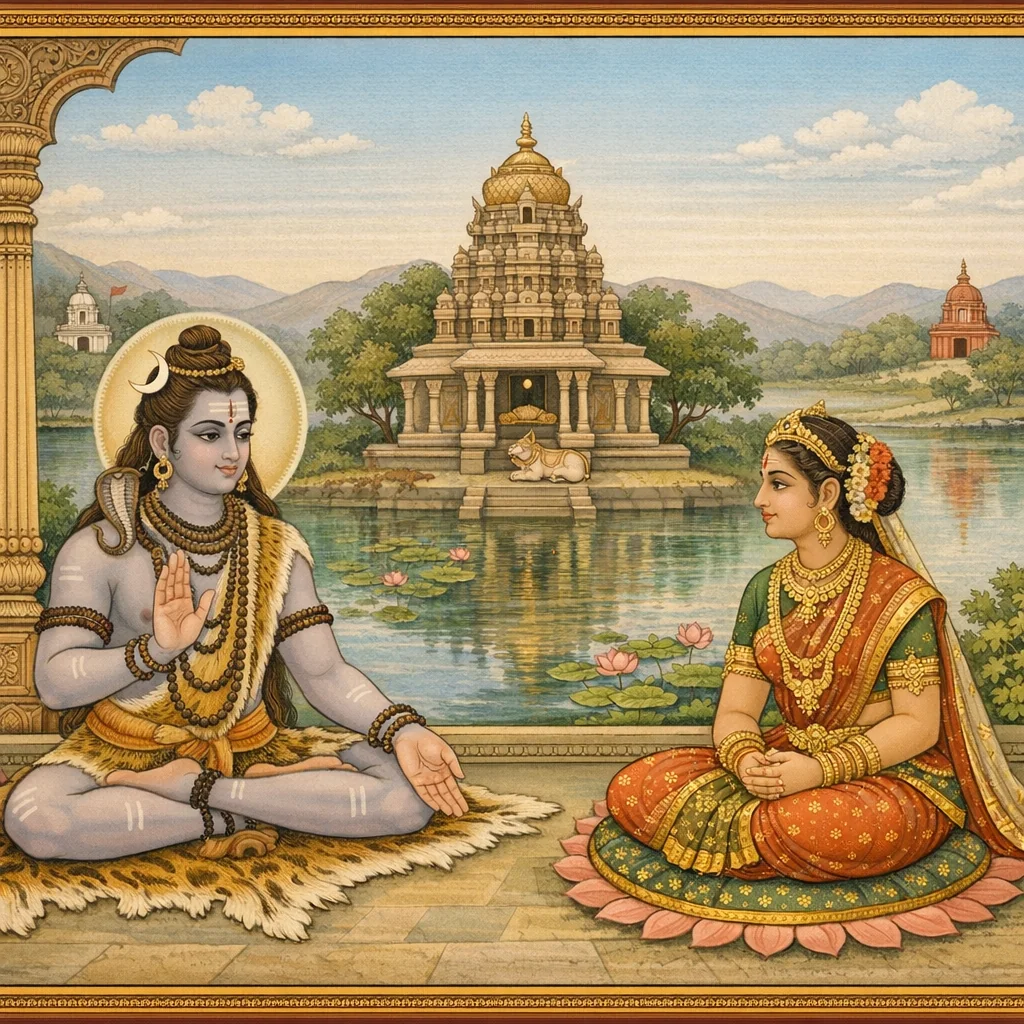
Adhyaya 365
This adhyāya is framed as Īśvara’s instruction to Devī, guiding the pilgrim-seeker to the shrine of Saṃvarteśvara, praised as “uttama” (eminent). It gives clear wayfinding: Saṃvarteśvara lies west of Indreśvara and east of Arkabhāskara, placing the shrine within a connected sacred landscape. A minimal rite is then prescribed: first, darśana of Mahādeva, and next, bathing (snāna) in the water of a puṣkariṇī. The phalaśruti proclaims that one who performs these acts gains merit equal to ten aśvamedha sacrifices, exalting local pilgrimage into supreme spiritual reward. The colophon notes its place in the Skanda Purāṇa—Prabhāsa Khaṇḍa, first division of Prabhāsakṣetramāhātmya—as the 365th adhyāya, titled Saṃvarteśvara-māhātmya-varṇana.
Shlokas
Verse 1
ईश्वर उवाच । ततो गच्छेन्महादेवि संवर्तेश्वरमुत्तमम् । इन्द्रेश्वरात्पश्चिमतः पूर्वतश्चार्कभास्करात
Īśvara said: “Then, O great goddess, one should go to the excellent Saṃvarteśvara—lying to the west of Indreśvara and to the east of Arkabhāskara.”
Verse 2
तं दृष्ट्वा तु महादेवं स्नात्वा पुष्करिणीजले । दशानामश्वमेधानां फलमाप्नोति मानवः
Having beheld Mahādeva and bathed in the waters of the sacred tank, a person attains merit equal to that of ten Aśvamedha sacrifices.
Verse 364
इति श्रीस्कान्दे महापुराण एकाशीतिसाहस्र्यां संहितायां सप्तमे प्रभासखण्डे प्रथमे प्रभासक्षेत्रमाहात्म्ये संवर्तेश्वरमाहात्म्यवर्णनंनाम चतुष्षष्ट्युत्तरत्रिशततमोऽध्यायः
Thus, in the Śrī Skanda Mahāpurāṇa—within the Saṃhitā of eighty-one thousand verses—ends the 364th chapter of the seventh, Prabhāsa Khaṇḍa, in the first part, Prabhāsakṣetra Māhātmya, entitled “The Description of the Greatness of Saṃvarteśvara.”