Adhyaya 366
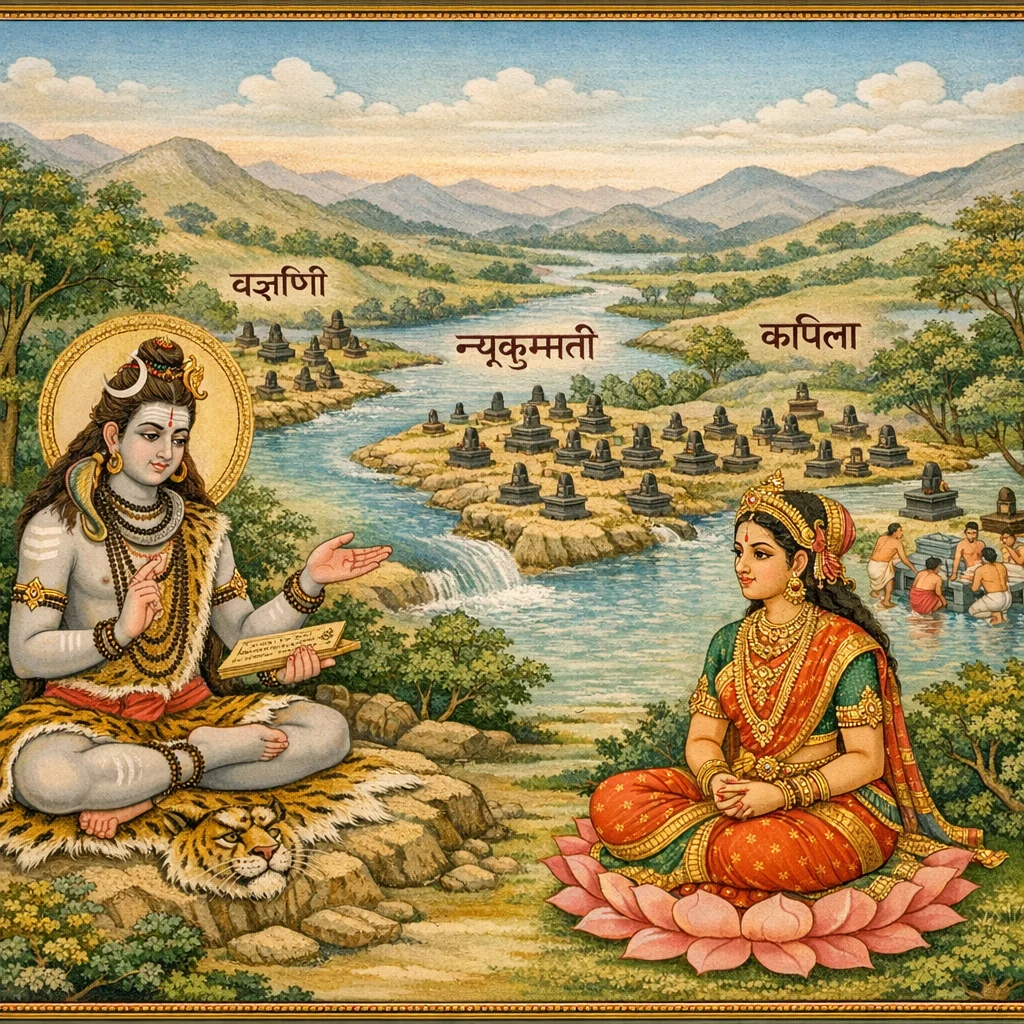
Īśvara instructs Mahādevī to go north of Hiraṇyā to the regions known as siddhi-sthānas, abodes of perfected sages. The chapter then turns to a sacred, quantitative mapping: liṅgas are countless, yet key tallies are given—over a hundred prominent liṅgas in one cluster; nineteen on Vajriṇī’s bank; more than 1,200 on Nyaṅkumatī’s bank; sixty superior liṅgas on Kapilā’s bank; and an uncountable multitude connected with Sarasvatī. Prabhāsa is further defined through Sarasvatī’s five streams (pañca-srotas), whose courses mark out a holy field of twelve yojanas. Water is said to arise everywhere in tanks and wells; it should be recognized as “Sārasvata,” and drinking it is praised. Bathing anywhere in the region with proper faith yields the fruit of Sārasvata-snāna. The chapter concludes by identifying the “Sparśa-liṅga” as Śrī-Somēśa, and declaring that worship of any central liṅga of the kṣetra—when known as Somēśa—is truly worship of Somēśa himself, unifying dispersed shrines under a single Śaiva referent.
Shlokas
Verse 1
ईश्वर उवाच । ततो गच्छेन्महादेवि हिरण्यायाश्च उत्तरे । सिद्धिस्थानानि दिव्यानि यत्र सिद्धा महर्षयः
Īśvara said: “Then, O Mahādevī, one should go to the northern side of Hiraṇyā, where there are divine seats of attainment—places where perfected great sages have achieved siddhi.”
Verse 2
तत्र लिंगान्यनेकानि शक्यंते कथितुं न हि । साग्रं शतं पुनस्तत्र लिंगानां प्रवरं स्मृतम्
“There, the liṅgas are so many that they cannot truly be fully described. Yet among them, a little more than a hundred are remembered as the foremost.”
Verse 3
वज्रिण्यास्तु तटे देवि लिंगान्येकोनविंशतिः । न्यंकुमत्यास्तटे देवि सहस्रं द्विशताधिकम्
“On the bank of Vajriṇī, O Devī, there are nineteen liṅgas. And on the bank of Nyaṅkumatī, O Devī, there are one thousand, plus two hundred more.”
Verse 4
प्राधान्येन वरारोहे पूर्वे स्वायंभुवेंऽतरे । कपिलायास्तटेदेवि लिंगानां षष्टिरुत्तमा
O fair-hipped one, in the former Svāyaṃbhuva era, on the bank of the Kapilā, O Devī, sixty most excellent liṅgas were established and are renowned.
Verse 5
सरस्वत्यां पुनस्तत्र लिंगसंख्या न विद्यते । एवं पंचमुखा देवि लिंगमाला विभूषिता
But there, in the region of Sarasvatī, the number of liṅgas is not known. Thus, O Devī, Pañcamukhā—the five-faced Lord—is adorned with a garland of liṅgas.
Verse 6
प्रभासे कथिता देवि पंचस्रोताः सरस्वती । यस्याः प्रवाहैः संभिन्नं क्षेत्रं द्वादशयोजनम्
In Prabhāsa, O Devī, Sarasvatī is spoken of as having five streams. By her flows the sacred region—twelve yojanas in extent—is interlaced and divided into channels.
Verse 7
तत्र वापीषु कूपेषु यत्र तत्रोद्भवं जलम् । सारस्वतं तु तज्ज्ञेयं ते धन्या ये पिबंति तत्
There, in tanks and wells, wherever water arises, that is to be known as “Sārasvata” water. Blessed indeed are those who drink it.
Verse 8
यत्रतत्र नरः स्नात्वा सम्यक्छ्रद्धासमन्वितः । सारस्वतस्नानफलं लभते नात्र संशयः
Wherever a person bathes there, endowed with proper faith, he obtains the fruit of a Sārasvata bath—of this there is no doubt.
Verse 9
यत्प्रोक्तं स्पर्शलिंगं तु श्रीसोमेशेति विश्रुतम् । प्रभासक्षेत्रलिंगानां कला तस्यैव शांकरी
That liṅga spoken of as the “Sparśa-liṅga” is renowned as Śrī Someśa. The Śaṅkarī power (kalā) of the liṅgas of Prabhāsa-kṣetra is, in truth, his very own.
Verse 10
यद्वा तद्वा पूजयित्वा लिंगं क्षेत्रस्य मध्यगम् । श्रीसोमेशमिति ज्ञात्वा सोमेशः पूजितो भवेत्
By worshipping any liṅga whatsoever that stands in the middle of the sacred region, and knowing it as Śrī Someśa, one thereby worships Someśa himself.
Verse 365
इति श्रीस्कांदे महापुराण एकाशीतिसाहस्र्यां संहितायां सप्तमे प्रभासखण्डे प्रथमे प्रभासक्षेत्रमाहात्म्ये प्रकीर्णस्थानलिंगमाहात्म्यवर्णनंनाम पंचषष्ट्युत्तरत्रिशततमोऽध्यायः
Thus ends, in the holy Skanda Mahāpurāṇa—within the Saṃhitā of eighty-one thousand (verses), in the seventh division, the Prabhāsa Khaṇḍa—within the first part, the “Glorification of the Prabhāsa Sacred Region”, the chapter entitled “Description of the Greatness of the Liṅgas at the miscellaneous sacred spots,” being Chapter 366.