Adhyaya 305
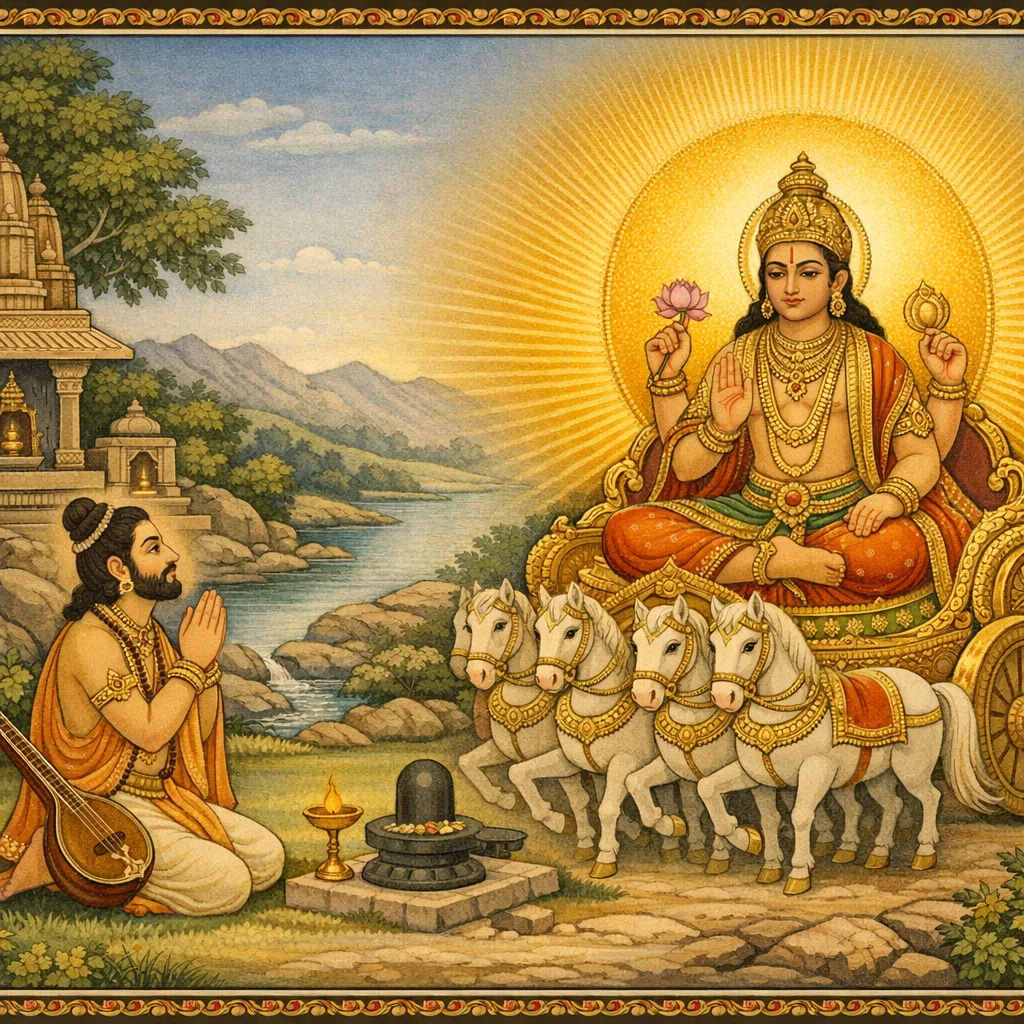
This adhyāya unfolds as a Śiva–Devī theological dialogue. It first identifies a solar shrine called Nāradaāditya in the Prabhāsa region and declares its saving efficacy: the removal of old age (jarā) and poverty (dāridrya). Devī then asks how the sage Nārada could ever become afflicted by old age. Śiva recounts an episode in Dvāravatī: Sāmba, son of Kṛṣṇa, fails to show proper respect and is admonished by Nārada. Sāmba retorts by criticizing ascetic life and, in anger, curses Nārada to be subject to jarā. Stricken, Nārada withdraws to a pure, secluded place, installs a beautiful image of Sūrya praised as the “destroyer of all poverty,” and offers a series of stotras lauding the Sun as Vedic form (Ṛk/Sāman), pure light, all-pervading cause, and remover of darkness. Pleased, Sūrya appears and grants a boon: Nārada regains youthful embodiment. A public benefit is also taught as a rule of darśana—whoever beholds Sūrya on a Sunday that coincides with the seventh lunar day (ravivāra-saptamī) is promised freedom from fear of disease. The chapter ends with a phalāśruti affirming the shrine’s power to destroy pāpa (sin).
Shlokas
Verse 1
ईश्वर उवाच । ततो गच्छेन्महादेवि तस्याः पूर्वेण संस्थितम् । नारदादित्यनामानं जरादारिद्र्यनाशनम्
Īśvara said: Then, O Great Goddess, one should go to the shrine situated to the east of that place, called Nārada-Āditya, which destroys old age and poverty.
Verse 2
पश्चिमे मूलचंडीशाद्धनुषां च शतत्रये । आराध्य नारदो देवि भास्करं वारितस्करम् । जरा निर्मुक्तदेहस्तु तत्क्षणात्समपद्यत
To the west of Mūla-Caṇḍīśa, at a distance of three hundred bow-lengths, O Goddess, Nārada worshipped Bhāskara (the Sun), the warder-off of thieves; and in that very moment he attained a body freed from old age.
Verse 3
देव्युवाच । कथं जरामनुप्राप्तो नारदो मुनिपुंगवः । कथमाराधितः सूर्य एतन्मे वद शंकर
The Goddess said: How did Nārada, the foremost of sages, come to be afflicted by old age? And how was the Sun worshipped? Tell me this, O Śaṅkara.
Verse 4
ईश्वर उवाच । यदा द्वारवतीं प्राप्तो नारदो मुनिपुंगवः । सर्वे दृष्टास्तदा तेन विष्णोः पुत्रा महाबलाः
Īśvara said: When Nārada, the foremost of sages, arrived at Dvāravatī, he then saw all the mighty sons of Viṣṇu there.
Verse 5
तद्राजकुलमध्ये तु क्रीडमाना परस्परम् आयांतं नारदं दृष्ट्वा सर्वे विनयसंयुताः
In the midst of that royal household, while they were sporting with one another, on seeing Nārada approaching, all of them became endowed with courtesy and respect.
Verse 6
नमश्चक्रुर्यथान्यायं विना सांबं त्वरान्विताः । अविनीतं तु तं दृष्ट्वा कथयामास नारदः
They quickly offered salutation according to proper custom—except for Sāmba. Seeing him lacking in humility, Nārada then spoke out.
Verse 7
शरीरमदमत्तोऽसि यस्मात्सांब हरेः सुत । अचिरेणैव कालेन शापं प्राप्स्यसि दारुणम्
Because you are intoxicated with pride in your body, O Sāmba, son of Hari, in a short time you will incur a dreadful curse.
Verse 8
सांब उवाच । नमस्कारेण किं कार्यमृषीणां च जितात्मनाम् । आशीर्वादेन तेषां च तपोहानिः प्रजायते
Sāmba said: What need is there of salutations for sages who have mastered themselves? And by giving blessings, their ascetic power is diminished.
Verse 9
मुनीनां यः स्वभावो हि त्वयि लेशो न नारद । विद्यते ब्रह्मणः पुत्र उच्यते किमतः परम्
O Nārada, not even a trace of the natural disposition expected of sages is found in you. You are called a son of Brahmā—what more needs to be said than this?
Verse 10
न कलत्रं न ते पुत्रा न च पौत्रप्रपौत्रकाः । न गृहं नैव च द्वारं न हि गावो न वत्सकाः
You have no wife, no sons, nor grandsons or great-grandsons; no house, not even a doorway; no cows, nor calves.
Verse 11
ब्रह्मणो मानसः पुत्रो ब्रह्मचर्ये व्यवस्थितः । अयुक्तं कुरुते नित्यं कस्मात्प्रकृतिरीदृशी
A mind-born son of Brahmā, established in brahmacarya—yet you constantly do what is improper. Why is your nature like this?
Verse 12
युद्धं विना न ते सौख्यं सौख्यं न कलहं विना । यादृशस्तादृशो वापि वाग्वादोऽपि सदा प्रियः
Without battle you find no ease, and without quarrel you find no ease. Whatever the occasion may be, verbal disputation is ever dear to you.
Verse 13
स्नानं संध्या जपो होमस्तर्पणं पितृदेवयोः । नारदः कुरुते चान्यदन्यत्कुर्वंति ब्राह्मणाः
Bathing, the twilight Sandhyā prayers, japa, homa, and tarpaṇa—offerings that satisfy ancestors and gods—these duties brāhmaṇas perform; but Nārada does something else.
Verse 14
कौमारेण तु गर्विष्ठो यस्मान्मां शापयिष्यसि । तस्मात्त्वमपि विप्रर्षे जरायुक्तो भविष्यसि
For, swollen with the pride of youth, you will curse me; therefore you too, O brāhmaṇa-seer, shall be burdened with old age.
Verse 15
एवं शप्तस्तदा देवि नारदो मुनिपुंगवः । एकान्ते निर्मले स्थाने कंटकास्थिविवर्जिते
Thus, at that time, O Goddess, Nārada—foremost among sages—being so cursed, went to a solitary, pure place, spotless, free from thorns and bones.
Verse 16
कृष्णाजिनपरिच्छिन्ने ह्युपविष्टो वरासने । ऋषितोया तटे रम्ये प्रतिष्ठाप्य महामुनिः
Seated upon an excellent seat covered with a black deerskin, the great sage, on the lovely bank of the Ṛṣitoyā, duly installed the object of worship.
Verse 17
सूर्यस्य प्रतिमां रम्यां सर्वदारिद्र्यनाशिनीम् । तुष्टाव विविधैः स्तोत्रैरादित्यं तिमिरापहम्
He praised the lovely image of Sūrya, the destroyer of all poverty, and with many hymns extolled Āditya, the dispeller of darkness.
Verse 18
नमस्त ऋक्स्वरूपाय साम्नां धामग ते नमः । ज्ञानैकरूपदेहाय निर्धूततमसे नमः
Salutations to You whose very form is the Ṛk; salutations to You, the abode of the Sāman chants. Salutations to You whose body is the single essence of knowledge, to You who has shaken off all darkness.
Verse 19
शुद्धज्योतिःस्वरूपाय निर्मूर्तायामलात्मने । वरिष्ठाय वरेण्याय सर्वस्मै परमात्मने
Salutations to the Supreme Self—whose very nature is pure light; who is formless and stainless in essence; who is the most excellent and most worthy of choice; who is the All-in-all, the Paramātman.
Verse 20
नमोऽखिलजगद्व्यापिस्वरूपानंदमूर्तये । सर्वकारणपूताय निष्ठायै ज्ञानचेतसाम्
Homage to Him whose nature pervades the entire universe and whose form is bliss itself; to the Pure One who sanctifies and is the root of all causes; to that steadfast Reality upon which the minds of the wise, intent on knowledge, are firmly established.
Verse 21
नमः सर्वस्वरूपाय प्रकाशालक्ष्यरूपिणे । भास्कराय नमस्तुभ्यं तथा दिनकृते नमः
Salutations to You who assume all forms, whose true form is not grasped even by light itself. O Bhāskara, salutations to You; and salutations as well to You, the maker of the day.
Verse 22
ईश्वर उवाच । एवं संस्तुवतस्तस्य पुरतस्तस्य चेतसा । प्रादुर्बभूव देवेशि जगच्चक्षुः सनातनः । उवाच परमं प्रीतो नारदं मुनिपुंगवम्
Īśvara said: As he thus praised with a mind wholly intent, O Goddess, the Eternal Eye of the world appeared before him. Greatly delighted, he spoke to Nārada, foremost among sages.
Verse 23
सूर्य उवाच । वरं वरय विप्रर्षे यस्ते मनसि वर्तते । तुष्टोऽहं तव दास्यामि यद्यपि स्यात्सुदुर्लभम्
Sūrya said: O brahmin-sage, choose a boon—whatever abides in your mind. Pleased, I shall grant it to you, even if it be exceedingly difficult to obtain.
Verse 24
नारद उवाच । कुमार वयसा युक्तो जरायुक्तकलेवरः । प्रसादात्स्यां हि ते देव यदि तुष्टो दिवाकर
Nārada said: O God—O Divākara—if you are pleased, then by your grace may I possess a youthful age while still bearing an aged body.
Verse 25
सप्तम्यां रविवारेण यस्त्वां पश्यति मानवः । तस्य रोग भयं माऽस्तु प्रसादात्तिमिरापह
On the seventh lunar day, when it is Sunday, whoever beholds you—by your grace, O remover of darkness—may he have no fear of disease.
Verse 26
ईश्वर उवाच । एवं भविष्यतीत्युक्त्वा ह्यन्तर्धानं गतो रविः । इत्येतत्कथितं देवि माहात्म्यं सकलं तव । नारदादित्यदेवस्य सर्वपातकनाशनम्
Īśvara said: Saying, “So shall it be,” Ravi vanished from sight. Thus, O Goddess, your entire māhātmya has been related—concerning Nārada and Lord Āditya, the destroyer of all sins.
Verse 305
इति श्रीस्कांदे महापुराण एकाशीतिसाहस्र्यां संहितायां सप्तमे प्रभास खण्डे प्रथमे प्रभासक्षेत्रमाहात्म्ये नारदादित्यमाहात्म्यवर्णनंनाम पञ्चोत्तरत्रिशततमोऽध्यायः
Thus ends the three-hundred-and-fifth chapter, entitled “The Description of the Greatness of Nārada and Lord Āditya,” in the first part, the Prabhāsakṣetramāhātmya, of the Prabhāsa Khaṇḍa of the Śrī Skanda Mahāpurāṇa, the compendium of eighty-one thousand verses.