Adhyaya 237
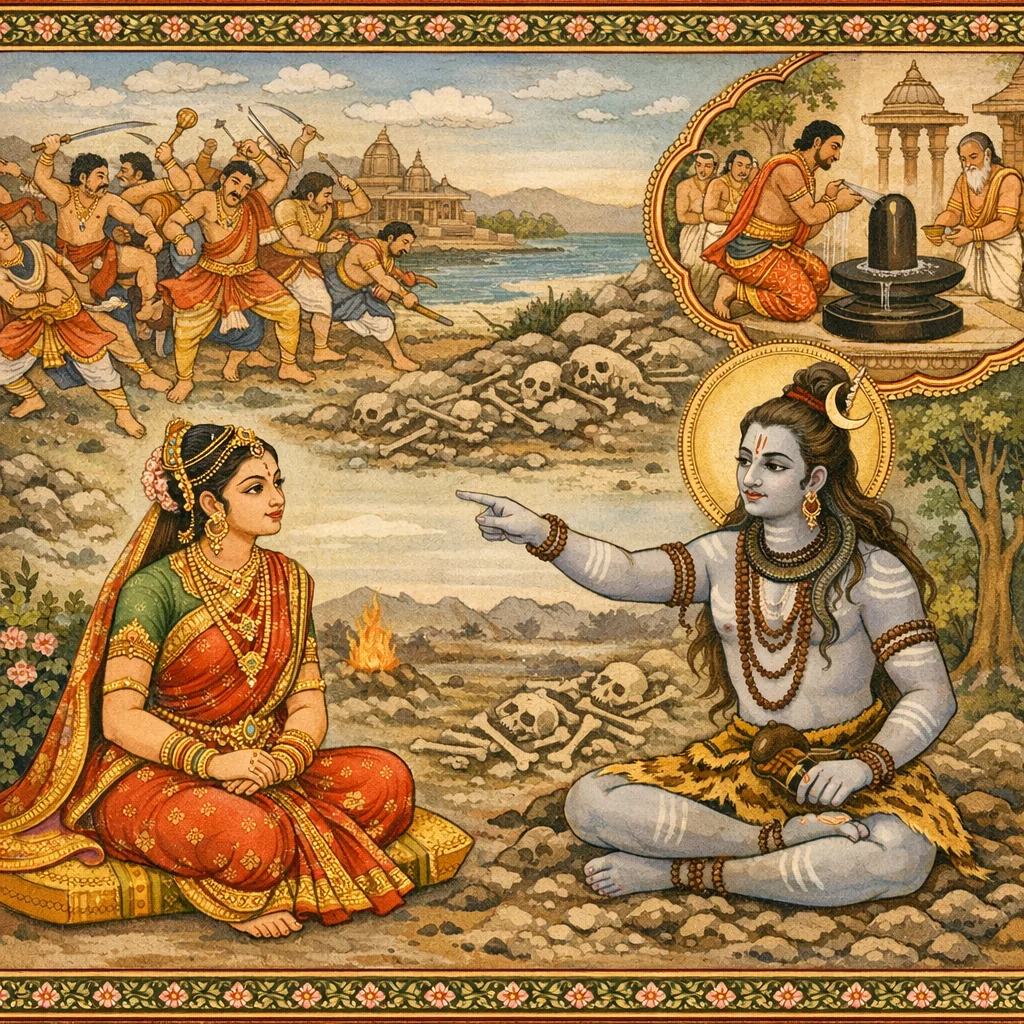
Chapter 237 unfolds as a sacred Śiva–Devī dialogue that anchors epic aftermath in the holy landscape of Prabhāsa. Īśvara points Devī to Yādava-sthala, the ground where vast Yādava hosts perished, and Devī asks why the Vṛṣṇis, Andhakas, and Bhojas were destroyed before Vāsudeva’s eyes. Īśvara recounts the curse: Sāmba, in disguise, mocks sages such as Viśvāmitra, Kaṇva, and Nārada; the offended ṛṣis declare that Sāmba will “produce” an iron muśala (club) for the clan’s ruin. Though the wording seems to spare Rāma and Janārdana at once, it still signals the inescapable decree of Kāla (Time). The muśala is born, ground to powder, and cast into the sea, yet ominous portents fill Dvārakā—social inversion, uncanny sounds, animal anomalies, ritual failures, and terrifying dreams—serving as moral warning. Kṛṣṇa then commands a pilgrimage to Prabhāsa. The Yādavas arrive, and amid intoxication their inner enmity flares; violence erupts (notably between Sātyaki and Kṛtavarman) and ends in mutual slaughter with reeds transformed into vajra-like clubs—understood as the working of the sages’ brahma-daṇḍa and Kāla. Cremation grounds and heaps of bones mark the terrain as “Yādava-sthala.” In the closing episode, Vajra, a surviving heir, comes to Prabhāsa, installs the Vajreśvara-liṅga, and attains siddhi through tapas under Nārada’s guidance. The chapter concludes with rites and fruit: bathing (e.g., in Jāmbavatī-jala), worship of Vajreśvara, feeding brāhmaṇas, and a symbolic ṣaṭkoṇa offering, yielding pilgrimage merit likened to great gifts such as the fruit of donating a thousand cows.
Shlokas
Verse 1
ईश्वर उवाच । ततो गच्छेन्महादेवि यादवस्थलमुत्तमम् । यादवा यत्र नष्टा वै षट्पंचाशच्च कोटयः
Īśvara said: Then, O Mahādevī, one should go to the supremely sacred place called Yādavasthala—where indeed the Yādavas perished, fifty-six crores in number.
Verse 2
यत्र वज्रेश्वरो देवो वज्रेणाराधितः सदा । यत्राभूद्दिव्यदृष्टीनामृषीणामाश्रमं कुलम्
There the deity Vajreśvara is ever worshipped with the vajra; and there existed the lineage-āśrama of seers endowed with divine sight.
Verse 3
देव्युवाच । कथं विनष्टा भगवन्नन्धका वृष्णिभिः सह । पश्यतो वासुदेवस्य भोजाश्चैव महारथाः
The Goddess said: O Blessed Lord, how were the Andhakas destroyed along with the Vṛṣṇis—and how, while Vāsudeva looked on, did the Bhojas too, those great chariot-warriors, meet their end?
Verse 4
केन शप्तास्तु ते वीरा नष्टा वृष्ण्यन्धकादयः । भोजाश्चैव महादेव विस्तरेण वदस्व मे
By whom were those heroes cursed—so that the Vṛṣṇis, the Andhakas, and the rest were destroyed, and the Bhojas as well? O Mahādeva, tell it to me in full detail.
Verse 5
ईश्वर उवाच । षट्त्रिंशे च कलौ वर्षे संप्राप्तेऽन्धकवृष्णयः । अन्योन्यं मुशलैस्ते हि निजघ्नुः कालनोदिताः
Īśvara said: When the thirty-sixth year of Kali had arrived, the Andhakas and Vṛṣṇis—impelled by Time—struck one another down with clubs.
Verse 6
विश्वामित्रं च कण्वं च नारदं च यशस्विनम् । सारणप्रमुखान्भोजान्ददृशुर्द्वारकां गतान्
They saw Viśvāmitra, Kaṇva, and the illustrious Nārada; and they also saw the Bhojas—led by Sāraṇa—who had come to Dvārakā.
Verse 7
ते वै सांबं समानिन्युर्भूषयित्वा स्त्रियं यथा । अब्रुवन्नुपसंगम्य देवदंडनिपीडिताः
They brought Sāmba forward, adorning him as though he were a woman; then, approaching the Ṛṣis, they spoke—already driven on by divine retribution.
Verse 8
इयं स्त्री पुत्रकामस्य बभ्रोरमिततेजसः । ऋषयः साधु जानीत किमियं जनयिष्यति
“This woman belongs to Babhru of immeasurable splendor, who longs for a son. O Ṛṣis, know truly—what will she give birth to?”
Verse 9
इत्युक्तास्ते तदा देवि विप्रलंभप्रधर्षिताः । प्रत्यब्रुवंस्तान्मुनयस्तच्छृणुष्व यथातथम्
O Goddess, thus addressed and provoked by mockery and insult, the sages replied to them. Listen now, exactly as it happened.
Verse 10
ऋषय ऊचुः । वृष्ण्यन्धकविनाशाय मुशलं घोरमायसम् । वासुदेवस्य दायादः सांबोऽयं जनयिष्यति
The sages said: “For the destruction of the Vṛṣṇis and Andhakas, this Sāmba—descendant of Vāsudeva—will bring forth a dreadful iron pestle.”
Verse 11
येन यूयं सुदुर्वृत्ता नृशंसा जातमन्यवः । उच्छेत्तारः कुलं सर्वमृते रामाज्जनार्द्दनात्
“Because you have become thoroughly wicked—cruel and inflamed with arrogance—you will uproot your entire clan, except for Rāma and Janārdana.”
Verse 12
त्यक्त्वा यास्यति वः श्रीमांत्यक्त्वा भूमिं हलायुधः । जरा कृष्णं महाभागं शयानं तु निवेत्स्यति
“Prosperity will forsake you and depart. Halāyudha (Balarāma) will leave the earth. And Jārā will strike the greatly fortunate Kṛṣṇa as he lies resting.”
Verse 13
इत्यब्रुवंस्ततो देवि प्रलब्धास्ते दुरात्मभिः । मुनयः क्रोधरक्ताक्षाः समीक्ष्याथ परस्परम्
O Goddess, after speaking thus, the sages—mocked by those evil-minded men—became red-eyed with anger and then looked at one another.
Verse 14
तथोक्ता मुनयस्ते तु ततः केशवमभ्ययुः । अथावदत्तदा वृष्णीञ्छ्रुत्वैवं मधुसूदनः
After speaking in this manner, the sages then approached Keśava. Having heard what had occurred, Madhusūdana addressed the Vṛṣṇis.
Verse 15
अभिज्ञो मतिमांस्तस्य भवितव्यं तथेति तत् । एवमुक्त्वा हृषीकेशः प्रविवेश पुनर्गृहान्
All-knowing and wise, Hṛṣīkeśa understood: “So it must come to pass.” Saying this, he entered his dwelling again.
Verse 16
कृतांतमन्यथाकर्त्तुं नैच्छत्स जगतः प्रभुः । श्वोभूते सततः सांबो मुसलं तदसूत वै
The Lord of the world did not wish to alter what was ordained by fate. Then, on the very next day, Sāmba indeed produced that iron pestle.
Verse 17
येन वृण्ष्यन्धककुले पुरुषा भस्मसात्कृताः । वृष्ण्यन्धकविनाशाय किंकरप्रतिमं महत्
By that pestle, the men of the Vṛṣṇi–Andhaka line were reduced to ashes—an immense instrument, as though a servant of fate, for the destruction of the Vṛṣṇis and Andhakas.
Verse 18
असूत शापजं घोरं तच्च राज्ञे न्यवेदयत् । विषण्णोऽथ ततो राजा सूक्ष्मं चूर्णमकारयत्
He produced that dreadful object born of a curse and reported it to the king. Then the king, distressed, had it ground into fine powder.
Verse 19
प्राक्षिपत्सागरे तत्र पुरुषो राजशासितः । अथोवाच स्वनगरे वचनादाहुकस्य हि
There, a man—acting under the king’s command—was cast into the sea. Then, in his own city, he proclaimed it, for it had been spoken by Āhuka.
Verse 21
यश्च वो विदितं कुर्यादेवं कश्चित्क्वचिन्नरः । स जीवञ्छूलमारोहेत्स्वयं कृत्वा सबांधवः
And whichever man, anywhere, should disclose this to you—he would, along with his kinsmen, mount the stake alive, having brought that upon himself.
Verse 22
ततो राजभयात्सर्वे नियमं तत्र चक्रिरे । नराः शासनमाज्ञाय रामस्याक्लिष्टकर्मणः
Therefore, out of fear of the king, everyone there undertook a strict rule of conduct; the people, having understood the ordinance of Rāma of unwearied deeds, complied.
Verse 23
एवं प्रयतमानानां वृष्णीनामन्धकैः सह । कालो गृहाणि सर्वाणि परिचक्राम नित्यशः
While the Vṛṣṇis, together with the Andhakas, strove in this manner, Kāla—Time itself—continually went about, circling all their houses day after day.
Verse 24
करालो विकटो मुंडः पुरुषः कृष्णपिंगलः । सम्मार्जनी महाकेतुर्जपापुष्पावतंसकः
A man appeared—grim, monstrous, shaven-headed, dark-tawny in hue—bearing a broom, a great banner, and adorned with a garland of hibiscus (japā) flowers.
Verse 25
कृकलासवाहनश्च रत्तिकाकर्णभूषणः । गृहाण्यवेक्ष्य वृष्णीनां नादृश्यत पुनः क्वचित्
He had a lizard (kṛkalāsa) for his mount and wore rattikā as ear-ornaments. After looking over the houses of the Vṛṣṇis, he was not seen again anywhere.
Verse 26
तस्य चासन्महेष्वासाः शरैः शतसहस्रशः । न चाशक्यत वेद्धुं स सर्वभूताप्ययं सदा
And there were mighty archers who shot hundreds of thousands of arrows at him; yet he could not be pierced—he, ever the dissolution of all beings.
Verse 27
उत्पेदिरे महावाता दारुणा हि दिने दिने । वृष्ण्यन्धकविनाशाय बहवो लोमहर्षणाः
Day after day, dreadful great winds arose—many of them hair-raising—foreboding the destruction of the Vṛṣṇis and the Andhakas.
Verse 28
विवृद्ध्य मूषिका रथ्यावितुन्नमणिकास्तथा । केशान्ददंशुः सुप्तानां नृणां युवतयो निशि
Rats multiplied exceedingly, and so too did the pests called rathyāvitunnamaṇikā. At night, young women bit the hair of men who lay asleep.
Verse 29
चीचीकूचीत्यवाशंत सारिका वृष्णिवेश्मसु । नोपशाम्यति शब्दश्च स दिवारात्रमेव वा
In the houses of the Vṛṣṇis, mynas kept crying, “cīcīkūcī!”, and that sound would not subside, continuing through day and night.
Verse 30
अन्वकुर्वन्नुलूकाश्च वायसान्वृष्णिवेश्मसु । अजाः शिवानां च रुतमन्वकुर्वत भामिनि
In the houses of the Vṛṣṇis, owls began to cry in answer to crows; and even the goats echoed the ominous calls of the jackals—O fair lady—thus revealing inauspicious portents.
Verse 31
पांडुरारक्तपादाश्च विहगाः कालप्रेरिताः । वृष्ण्यन्धकगृहेष्वेवं कपोता व्यचरंस्तदा
Time itself impelled birds with pale, reddish feet; thus, in the houses of the Vṛṣṇis and Andhakas, pigeons wandered everywhere at that time—another ill omen.
Verse 32
व्यजायंत खरा गोषु करभाश्चाश्वतरीषु च । शुनीष्वपि बिडालाश्च मूषका नकुलीषु च
Donkeys were born among cows, and camels among she-mules; cats were born even among dogs, and mice among mongooses—nature’s order thrown into confusion, appearing as fearful portents.
Verse 33
तापत्रयांत पापानि कुर्वंतो वृष्णयस्तथा । अद्विषन्ब्राह्मणांश्चापि पितॄन्देवांस्तथैव च
Afflicted by the threefold sufferings (tāpatraya), the Vṛṣṇis committed sinful deeds; yet they did not hate the Brāhmaṇas, nor the Pitṛs (ancestral spirits), nor the Devas.
Verse 34
गुरूंश्चाप्यवमन्यंते न तु रामजनार्दनौ । भार्याः पतीन्व्युच्चरंति पत्नीश्च पुरुषास्तथा
They even began to slight their elders and teachers—yet not Rāma and Janārdana. Wives spoke harshly against their husbands, and husbands likewise against their wives.
Verse 35
विभावसुः प्रज्वलितो वामं विपरिवर्त्तते । नीललोहितमांजिष्ठा विसृजंश्चार्चिषः पृथक्
Though blazing, the fire—Vibhāvasu—turned to the left; and it cast forth separate tongues of flame, blue, red, and mañjiṣṭhā-hued, revealing inauspicious signs.
Verse 36
उदयास्तमने नित्यं पर्यस्तः स्याद्दिवाकरः । व्यदृश्यत सकृत्पुंभिः कबन्धैः परिवारितः
At sunrise and at sunset, the Sun seemed ever distorted; and at times he was seen as though surrounded by headless trunks—terrifying apparitions to men.
Verse 37
महानसेषु सिद्धांते संस्कृतेऽन्ने तु भामिनि । उत्तार्यमाणे कृमयो दृश्यंते च वरानने
In the great kitchens, when the food had been fully cooked and prepared, O fair-faced lady, worms were seen appearing as it was being served forth—an ominous corruption of sustenance.
Verse 38
पुण्याहे वाच्यमाने च पठत्सु च महात्मसु । अभिधावंति श्रूयंते न चादृश्यत कश्चन
Even as auspicious benedictions were proclaimed and great souls recited the sacred texts, the sound of people running about was heard—yet no one at all could be seen.
Verse 39
परस्परस्य नक्षत्रं हन्यमानं पुनःपुनः । ग्रहैरपश्यन्सर्वैस्ते नात्मनस्तु कथञ्चन
Again and again they saw one another’s natal stars being struck down by the planets; yet they could not perceive their own fate in any way.
Verse 40
न हुतं पाचयत्यग्निर्वृष्ण्यंधकपुरस्कृतम् । समंतात्प्रत्यवाशंत रासभा दारुणस्वनाः
Fire would not properly consume the oblations offered by the Vṛṣṇis and Andhakas; and on every side, donkeys brayed back with harsh and dreadful cries—ominous portents foretelling calamity.
Verse 41
एवं पश्यन्हृषीकेशः संप्राप्तान्कालपर्ययान् । त्रयोदशीं ह्यमावास्यां तां दृष्ट्वा प्राब्रवीदिदम्
Thus Hṛṣīkeśa beheld the turning of time that had arrived; and seeing that the thirteenth day had become as an amāvāsyā (new-moon darkness), he spoke these words.
Verse 42
त्रयोदशी पंचदशी कृतेयं राहुणा पुनः । तदा च भारते युद्धे प्राप्ता चाद्य क्षयाय नः
Again, by Rāhu’s influence, this thirteenth day has been made into a fifteenth—an amāvāsyā-like darkness; and just as it came at the time of the Bhārata war, so now too it has come for our destruction.
Verse 43
धिग्धिगित्येवकालं तं परिचिंत्य जनार्दनः । मेने प्राप्तं स षट्त्रिंशं वर्षं केशिनिषूदनः । पुत्रशोकाभिसंतप्ता गांधारी यदुवाच ह
Reflecting on that time, Janārdana cried, “Fie, fie!” Keśiniṣūdana understood that the thirty-sixth year had arrived—just as grief-stricken Gāndhārī, sorrowing for her sons, had once spoken.
Verse 44
एवं पश्यन्हृषीकेशस्तदिदं समुपस्थितम् । इदं च समनुप्राप्तमब्रवीद्यद्युधिष्ठिरः
As Hṛṣīkeśa thus observed, that fateful moment stood before them; and concerning this very turn of events, he spoke, recalling what Yudhiṣṭhira had said when such a time arrived.
Verse 45
पुरा व्यूढेष्वनीकेषु दृष्ट्वोत्पातान्सुदारुणान् । पुण्यग्रन्थस्य श्रवणाच्छांतिहोमाद्विशोधनात्
Formerly, when the armies were arrayed and dreadful portents appeared, purification was gained by hearing the sacred texts, by appeasement-offerings (śānti-homa), and by rites of cleansing.
Verse 46
पूततीर्थाभिषेकांच्च नान्यच्छ्रेयो भवेदिति । इत्युक्त्वा वासुदेवस्तच्चिकीर्षन्सत्यमेव च । आज्ञापयामास तदा तीर्थयात्रामरिंदमः
“And by consecrated bathing (abhiṣeka) in pure tīrthas, no greater good is to be found.” Saying so, Vāsudeva—resolved to act in truth—then commanded that a pilgrimage to the sacred fords be undertaken, he who conquers foes.
Verse 47
अघोषयंत पुरुषास्तत्र केशवशासनात् । तीर्थयात्रा प्रभासे वै कार्येति वरवर्णिनि
Then men made proclamation there, by Keśava’s command: “A pilgrimage to the tīrtha at Prabhāsa must indeed be undertaken,” O fair lady.
Verse 48
अथारिष्टानि वक्ष्यामि पुरीं द्वारवतीं प्रति । काली स्त्री पांडुरैर्दंतैः प्रविश्य नगरीं निशि
Now I shall describe the ominous signs directed toward the city of Dvāravatī: at night, a black woman with pale teeth entered the city—an inauspicious apparition.
Verse 49
स्त्रियः स्वप्नेषु मुष्णन्ती द्वारकां प्रति धावति । अग्निहोत्रनिकेतं च सुमेध्येषु च वेश्मसु
In women’s dreams she would steal and run toward Dvārakā; and she rushed even into the dwellings of the agnihotra and into the houses of the virtuous—another fearful sign.
Verse 50
वृष्ण्यंधकांश्च खादंती स्वप्ने दृष्टा भयानका । कुर्वंती भीषणं नादं कुर्कुटश्वानसंयुता
In dreams there appeared a terrifying female apparition, devouring the Vṛṣṇis and Andhakas, accompanied by cocks and dogs and uttering a dreadful cry—an omen of impending calamity.
Verse 51
तथा सहस्रशो रौद्राश्चतुर्बाहव एव च । स्त्रीणां गर्भेष्वजायंत राक्षसा गुह्यकास्तथा
Likewise, by the thousand, fierce beings—some even four-armed—were born in women’s wombs: rākṣasas and also guhyakas—another dreadful portent.
Verse 52
अलंकाराश्च च्छत्राणि ध्वजाश्च कवचानि च । ह्रियमाणानि दृश्यंते रक्षोभिस्तु भयानकैः
Ornaments, parasols, banners, and armours were seen being carried away—snatched off by terrifying rākṣasas—another sign of impending ruin.
Verse 53
यच्चाग्निदत्तं कृष्णस्य वज्रनाभमयस्मयम् । दिवमाचक्रमे चक्रं वृष्णीनां पश्यतां तदा
And the discus that Agni had bestowed upon Kṛṣṇa—iron-hard, with a vajra-like navel—then rose up and went to heaven, as the Vṛṣṇis looked on.
Verse 54
युक्तं रथं दिव्यमादित्यवर्णं भयावहं पश्यतो दारुकस्य । ते सागरस्योपरिष्टाद्वर्तमानान्मनोजवांश्चतुरो वाजिमुख्यान्
As Dāruka watched, a fearsome divine chariot, radiant as the sun, appeared—yoked to four foremost horses, swift as the mind, moving above the ocean.
Verse 55
तालः सुपर्णश्च महाध्वजौ तौ सुपूजितौ रामजनार्दनाभ्याम् । उच्चैर्जगुः स्वप्सरसो दिवानिशं वाचं चोचुर्गम्यतां तीर्थयात्राम्
Those two great banners—Tāla and Suparṇa—well honoured by Rāma and Janārdana, rang out loudly; and heavenly apsarases, day and night, proclaimed: “Let the pilgrimage to the tīrthas be undertaken.”
Verse 56
ततो जिगमिषंतस्ते वृष्ण्यंधकमहारथाः । सांतःपुरास्तीर्थयात्रामीहंते स्म नरर्षभाः
Then those great chariot-warriors among the Vṛṣṇis and Andhakas—bulls among men—set out with their households, intent on undertaking a pilgrimage to the tīrthas.
Verse 57
ततो मांसपरा हृष्टाः पेयं वेश्मसु वृष्णयः । बहु नानाविधं चक्रुर्मांसानि विविधानि च
Then the Vṛṣṇis, delighted and intent on meat and drink within their homes, prepared in abundance many kinds of beverages and various meats.
Verse 58
तथा सीधुषु बद्धेषु निर्ययुर्नगराद्बहिः । यानैरश्वैर्गजैश्चैव श्रीमंतस्तिग्मतेजसः
And when the jars of sīdhu (fermented drink) had been securely bound, those splendid men of keen radiance went forth from the city, riding in vehicles, with horses and elephants as well.
Verse 59
ततः प्रभासे न्यवसन्यथोद्देशं यथागृहम् । प्रभूतभक्ष्यपेयास्ते सदारा यादवास्तदा
Then, at Prabhāsa, the Yādavas lodged—each in his appointed place, as though in his own home—together with their wives, well supplied with abundant food and drink.
Verse 60
निर्विष्टांस्तान्निशम्याथ समुद्रांते स योगवित् । जगामामंत्र्य तान्वीरानुद्धवोर्थविशारदः
Hearing that they had settled there, Uddhava—the knower of yoga and wise in discernment—took leave of those heroes and departed toward the seashore.
Verse 61
प्रस्थितं तं महात्मानमभिवाद्य कृतांजलिम् । जानन्विनाशं भोजानां नैच्छद्वारयितुं हरिः
Hari, with joined palms, bowed to that great-souled one as he set out; knowing the destined destruction of the Bhojas, he did not wish to restrain it.
Verse 62
ततः कालपरीतास्ते वृष्ण्यंधकमहारथाः । अपश्यन्नुद्धवं यांतं तेजसाऽदीप्य रोदसी
Then those great charioteers of the Vṛṣṇis and Andhakas—overwhelmed by the power of Time—beheld Uddhava departing, blazing with radiance that seemed to illumine heaven and earth.
Verse 63
ब्राह्मणार्थेषु यत्क्लृप्तमन्नं तेषां वरानने । तद्वाहनेभ्यः प्रददुः सुरागंधरसान्वितम्
O fair-faced one, the food set aside for the Brahmins they gave instead to their mounts—food infused with the fragrance and taste of liquor.
Verse 64
ततस्तूर्यशताकीर्णं नटनर्त्तकसंकुलम् । प्रावर्त्तत महापानं प्रभासे तिग्मतेजसाम्
Then at Prabhāsa, amid hundreds of instruments and crowds of actors and dancers, a great bout of drinking commenced among those of fierce splendor.
Verse 65
कृष्णस्य संनिधौ रामः सहितः कृतवर्मणा । अपिबद्युयुधानश्च गदो बभ्रुस्तथैव च
In Kṛṣṇa’s very presence, Rāma drank together with Kṛtavarman; and so did Yuyudhāna, Gada, and Babhrū as well.
Verse 66
ततः परिषदो मध्ये युयुधानो मदोत्कटः । अब्रवीत्कृतवर्माणमवहस्यावमन्य च
Then, in the midst of the assembly, Yuyudhāna—made arrogant by intoxication—spoke to Kṛtavarman, mocking and scorning him.
Verse 67
कः क्षत्रियो मन्यमानः सुप्तान्हन्यान्मृतानिव । न तन्मृष्यत हार्दिक्यस्त्वया तत्साधु यत्कृतम्
‘What kṣatriya, thinking himself noble, would strike down men who are asleep as though they were already dead? Hārdikya, that deed done by you was not something to be endured—nor was it righteous.’
Verse 68
इत्युक्ते युयुधानेन पूजयामास तद्वचः । प्रद्युम्नो रथिनां श्रेष्ठो हार्दिक्यमथ भर्त्सयन्
When Yuyudhāna had spoken thus, Pradyumna—the foremost among chariot-warriors—approved those words and then began to censure Hārdikya.
Verse 69
ततः पुनरपि क्रुद्धः कृतवर्मा तमब्रवीत् । निर्विशन्निव सावज्ञं तदा सव्येन पाणिना
Then again, enraged, Kṛtavarman spoke to him with contempt—gesturing at that moment with his left hand, as though to strike.
Verse 70
भूरिश्रवाश्छिन्नबाहुर्युद्धे प्रायोगतस्त्वया । व्याधेनेव नृशंसेन कथं वैरेण घातितः
Bhūriśravas, whose arm you had cut off in battle by an act unworthy of fair combat—how was he then slain out of enmity, like a cruel hunter striking down his prey?
Verse 71
इति तस्य वचः श्रुत्वा केशवः परवीरहा । तिर्यक्सरोषया दृष्ट्या वीक्षांचक्रे समः पुमान्
Hearing those words, Keśava, the slayer of hostile heroes, though outwardly composed, cast a sidelong glance filled with restrained anger.
Verse 72
मणिं स्यमंतकं चैव यः स सत्राजितोऽभवत् । स कथं स्मारयामास सात्यकिर्मधुसूदनम्
And Satrājit—he who possessed the Syamantaka jewel—how did he cause Sātyaki to remind Madhusūdana (Kṛṣṇa) of that matter?
Verse 73
तच्छ्रुत्वा केशवस्यांकमगमद्रुदती सती । सत्यभामा प्रक्षुभिता कोपयन्ती जनार्द्दनम्
Hearing this, the virtuous Satyabhāmā—shaken with turmoil and stirring Janārdana’s wrath—came weeping to Keśava’s lap.
Verse 74
तत उत्थाय स क्रोधात्सात्यकिर्वाक्यमब्रवीत् । पंचानां द्रौपदेयानां धृष्टद्युम्नशिखंडिनः
Then Sātyaki rose in anger and spoke words concerning Draupadī’s five sons, and concerning Dhṛṣṭadyumna and Śikhaṇḍin.
Verse 75
एष गच्छामि पदवीं सत्ये तव पथे सदा । सौप्तिके निहता ये च सुप्तास्तेन दुरात्मना
“O truthful one, I shall ever walk the very path that is yours.” And (I speak of) those who, while asleep, were slain in the night-raid (Sauptika) by that wicked man.
Verse 76
द्रोणपुत्रसहायेन पापेन कृतवर्मणा । समाप्तं चायुरस्याद्य यशश्चापि सुमध्यमे
“By sinful Kṛtavarman, helper of Droṇa’s son—today his life is ended, and his fame as well, O slender-waisted one.”
Verse 77
इतीदमुक्त्वा खङ्गेन केशवस्य समीपतः । अभिहत्य शिरः क्रुद्धश्चिच्छेद कृतवर्मणः
Having spoken thus, standing near Keśava, he struck with his sword and, in wrath, severed Kṛtavarman’s head.
Verse 78
तथान्यानपि निघ्नंतं युयुधानं समंततः । अन्वधावद्धृषीकेशो विनिवारयिषुस्तथा
And as Yuyudhāna (Sātyaki) went on slaying others on every side, Hṛṣīkeśa ran after him, seeking to restrain him.
Verse 79
एकीभूतास्ततस्तस्य कालपर्यायप्रेरिताः । भोजांधका महाराजं शैनेयं पर्यवारयन्
Then, driven by the turning of Time, the Bhojas and Andhakas united and surrounded the great king Śaineya (Sātyaki) on every side.
Verse 80
तान्दृष्ट्वाऽपततस्तूर्णमभिक्रुद्धाञ्जनार्द्दनः । न चुक्रोध महातेजा जानन्कालस्य पर्ययम्
Seeing them rushing in swiftly, Janārdana—though enraged—did not yield to wrath; the mighty one understood the turning of Time’s destined course.
Verse 81
ते च पानमदाविष्टाश्चोदिताश्चैव मन्युना । युयुधानमथाजघ्नुरुच्छिष्टै र्भोजनैस्तथा
And they, intoxicated by drink and driven by fury, then struck Yuyudhāna, even hurling leftover food and scraps at him.
Verse 82
हन्यमाने तु शैनेये कुद्धो रुक्मिणिनंदनः । तदंतरमथाधावन्मोक्षयिष्यञ्छिनेः सुतम्
But when Śaineya was being attacked, Rukmiṇī’s son, enraged, rushed into the midst, intending to rescue the son of Śini.
Verse 83
स भोजैः सह संयुक्तः सात्यकिश्चांधकैः सह । बहुत्वात्तु हतौ वीरावुभौ कृष्णस्य पश्यतः
Sātyaki, locked in combat with the Bhojas and also with the Andhakas, was overwhelmed by their numbers; thus both heroes were slain as Kṛṣṇa looked on.
Verse 84
हतं दृष्ट्वा तु शैनेयं पुत्रं च यदुनंदनः । एरकाणां तदा मुष्टिं कोपाज्जग्राह केशवः
Seeing Śaineya slain, and his own son as well, Keśava—the delight of the Yadus—seized in wrath a fistful of eraka reeds.
Verse 86
ततोंऽधकाश्च भोजाश्च शिनयो वृष्णयस्तदा । न्यघ्नन्नन्योन्यमाक्रन्दैर्मुशलैः कालप्रेरिताः
Then the Andhakas, the Bhojas, the Śinis, and the Vṛṣṇis—driven onward by Time—began to strike one another down with club-like weapons amid cries and tumult.
Verse 87
यश्चैकामेरकां कश्चिज्जग्राह रुषितो नरः । वज्रभूता च सा देवि ह्यदृश्यत तदा प्रिये
And whichever man, inflamed with anger, seized even a single eraka reed—O beloved—then, O goddess, it was seen to take the form of a thunderbolt, a vajra.
Verse 88
तृणं च मुशलीभूतमण्वपि तत्र दृश्यते । ब्रह्मदंडकृतं सर्वमिति तद्विद्धि भामिनि
There, even a mere blade of grass could be seen turned into a club; know this, O fair one—everything there was wrought by Brahmā’s chastising decree.
Verse 89
तदभून्मुशलं घोरं वज्रकल्पमयस्मयम् । जघान तेन कृष्णोपि ये तस्य प्रमुखे स्थिताः
That became a dreadful club, thunderbolt-like, wrought of iron; with it even Kṛṣṇa struck down those who stood before him.
Verse 90
अवधीत्पितरं पुत्रः पिता पुत्रं च भामिनि । मत्तास्ते पर्यटंति स्म योधमानाः परस्परम्
A son killed his father, and a father his son, O fair one; intoxicated, they wandered about fighting one another.
Verse 91
पतंगा इव चाग्नौ तु न्यपतन्यदुपुंगवाः । नासीत्पलायने बुद्धिर्वध्यमानस्य कस्यचित्
Like moths plunging into a fire, the foremost Yādavas fell headlong; and in any who were being slain, no thought of flight arose.
Verse 92
तं तु पश्यन्महाबाहुर्जानन्कालस्यपर्ययम् । मुशलं समवष्टभ्य तस्थौ स मधुसूदनः
Seeing that, the mighty-armed Madhusūdana, knowing the turn of Time, stood firm, taking up the club.
Verse 93
सांबं च निहतं दृष्ट्वा चारुदेष्णं च माधवः । प्रद्युम्नमनिरुद्धं च ततश्चुक्रोध भामिनि
Seeing Sāmba slain—and Cārudeṣṇa, and also Pradyumna and Aniruddha—Mādhava then burned with anger, O fair one.
Verse 94
यादवान्क्ष्माशयानांश्च भृशं कोपसमन्वितः । स निःशेषं तदा चक्रे शार्ङ्गचक्रगदाधरः
Overwhelmed by fierce wrath, the bearer of Śārṅga, the discus, and the mace then brought the Yādavas and those lying upon the ground to utter end, leaving none behind.
Verse 95
एवं तत्र महादेवि अभवद्यादव स्थलम् । गव्यूतिमात्रं तद्देवि यादवानां चिताः स्मृताः
Thus, O Great Goddess, that place came to be known as Yādava-sthala; and there, O Goddess, the Yādavas’ funeral pyres are remembered as stretching for the measure of a gavyūti.
Verse 96
तेषां किलास्थिनिचयैः स्थलरूपं बभूव तत् । भस्मपुंजनिभाकारं तेनाभूद्यादव स्थलम्
Indeed, from heaps of their bones that ground assumed a distinct form; resembling a mound of ashes, it thus became the Yādava-sthala.
Verse 97
दिव्यरत्नसमायुक्तं मणिमाणिक्यपूरितम् । यादवानां किरीटैश्च दिव्यगन्धैः सुपूरितम्
Adorned with celestial jewels, filled with gems and rubies, and richly strewn with the Yādavas’ crowns, it was wholly pervaded by divine fragrances.
Verse 98
तेषां रक्षानिमित्तं हि गंगा गणपतिस्तथा । यादवानां तु सर्वेषां जीवितो वज्र एव हि
For their protection, indeed, there were Gaṅgā and likewise Gaṇapati; and for all the Yādavas, life and refuge were truly Vajra alone.
Verse 99
वयसोंते ततः सोऽपि प्रभासं क्षेत्रमागतः । निषिच्य स्वसुतं राज्ये नाम्ना ख्यातं महद्बलम्
Then, at the end of his life, he too came to the sacred kṣetra of Prabhāsa; having installed his own son upon the throne—renowned by name as Mahābala, of great might.
Verse 100
तेनापि स्थापितं लिंगं यादवेन्द्रेण धीमता । वज्रेश्वरमिति ख्यातं तत्स्थितं यादवस्थले
By him as well—the wise lord among the Yādavas—a liṅga was established, famed as Vajreśvara; it stands there in the Yādava-sthala.
Verse 101
तत्रैव सुचिरं कालं तपस्तप्तं सुपुष्कलम् । नारदस्योपदेशेन प्रभासे पापनाशने
There itself, for a very long time, he performed abundant and intense austerities—following Nārada’s instruction—at Prabhāsa, the destroyer of sins.
Verse 102
प्राप्तवान्परमां सिद्धिं स राजा यादवोत्तमः । तत्रैव यो नरः सम्यक्स्नात्वा जांबवती जले
That king, the foremost among the Yādavas, attained the highest siddhi. And any man who bathes properly there, in the waters of the Jāmbavatī, likewise partakes of that sanctifying merit.
Verse 103
वज्रेश्वरं तु संपूज्य ब्राह्मणांस्तत्र भोजयेत् । यादवस्थलसामीप्ये गोसहस्रफलं लभेत्
After duly worshipping Vajreśvara, one should feed Brāhmaṇas there. In the vicinity of Yādavasthala, one obtains merit equal to gifting a thousand cows.
Verse 104
षट्कोणं तत्र दातव्यमंगुल्या यादवस्थले । यात्राफलमवाप्नोति सम्यक्छ्रद्धासमन्वितः
At Yādavasthala, one should trace (or offer) there with the finger a six-angled figure. Endowed with proper faith, one attains the full fruit of pilgrimage.
Verse 237
इति श्रीस्कान्दे महापुराण एकाशीतिसाहस्र्यां संहितायां सप्तमे प्रभासखण्डे प्रथमेप्रभासक्षेत्रमाहात्म्ये यादवस्थलोत्पत्तौ वज्रेश्वरमाहात्म्यवर्णनंनाम सप्तत्रिंशदुत्तरद्विशततमोऽध्यायः
Thus, in the revered Skanda Mahāpurāṇa, in the eighty-one-thousand-verse Saṃhitā, within the seventh—Prabhāsa Khaṇḍa—under the first section, the Prabhāsa-kṣetra Māhātmya, ends the chapter entitled “The Origin of Yādavasthala and the Description of the Glory of Vajreśvara,” being Chapter 237.