Adhyaya 337
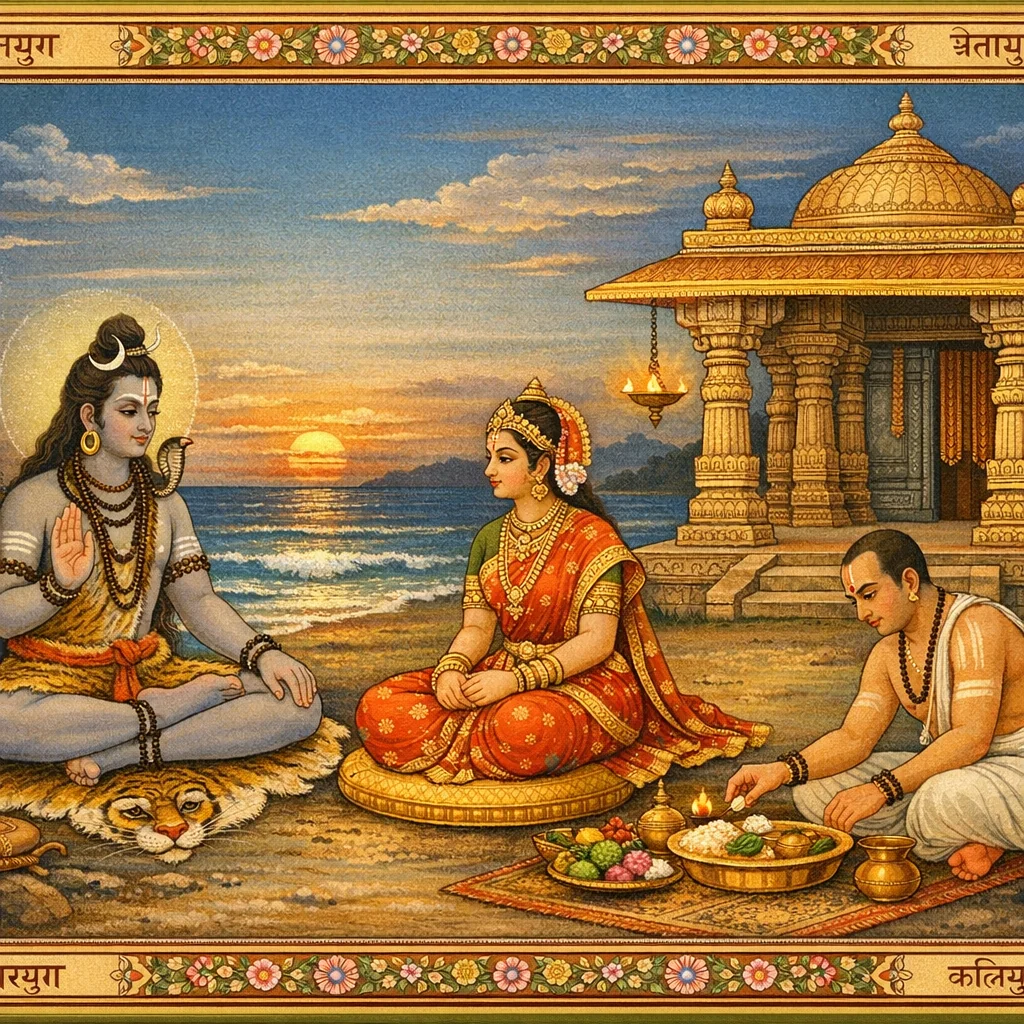
Īśvara speaks to Devī and directs the pilgrim to a supreme shrine called Narāyaṇa-gṛha, on the auspicious seashore south of the place known as Goṣpada, near Nyankumatī, praised as a remover of sins. He declares that Keśava (Hari) abides there enduringly across cosmic cycles (kalpāntara-sthāyī), making this divine “house” renowned in the world. After destroying hostile forces and for the uplift of ancestors in the fierce Kali age, Hari remains in this “house” for repose. The chapter gives yuga-wise names—Janārdana in Kṛta, Madhusūdana in Tretā, Puṇḍarīkākṣa in Dvāpara, and Nārāyaṇa in Kali—presenting the site as a stable center for the ordering of dharma through all four ages. It then teaches observances: on Ekādaśī, one who fasts completely (nirāhāra) and beholds the deity is said to gain a vision of Hari’s “endless” supreme state. Pilgrimage rites such as bathing and śrāddha are prescribed, and yellow garments are to be given in dāna to an exemplary brāhmaṇa. The closing phalāśruti states that hearing or reciting this account grants sadgati and auspicious spiritual attainment.
Shlokas
Verse 1
ईश्वर उवाच । ततो गच्छेन्महादेवि नारायणगृहं परम् । गोष्पदाद्दक्षिणे भागे सागरस्य तटे शुभे
Īśvara said: Then, O Great Goddess, one should go to the supreme shrine called “Nārāyaṇa’s House,” situated to the south of Goṣpada, on the auspicious shore of the ocean.
Verse 2
न्यंकुमत्याः समीपे तु सर्वपातकनाशने । तत्रकल्पांतरस्थायी स्वयं तिष्ठति केशवः
Near the Nyaṅkumatī—destroyer of all sins—Keśava Himself abides there, enduring through kalpa after kalpa.
Verse 3
पितॄणामुद्धरणार्थाय ह्यस्मिन्रौद्रे कलौ युगे । यदा दैत्यविनाशं स कुरुते भगवान्हरिः
Indeed, in this fierce Kali age, for the sake of rescuing the Pitṛs, whenever the Blessed Lord Hari undertakes the destruction of demons,
Verse 4
विश्रामार्थं तदा तत्र गृहे तिष्ठति नित्यशः । नारायणगृहं तेन विख्यातं जगतीतले
Then, for the sake of repose, He ever abides in that house. Therefore it is renowned on the earth as “Nārāyaṇa’s House.”
Verse 5
कृते जनार्दनोनाम त्रेतायां मधुसूदनः । द्वापरे पुण्डरीकाक्षः कलौ नारायणः स्मृतः
In the Kṛta age He is known as Janārdana; in Tretā as Madhusūdana; in Dvāpara as Puṇḍarīkākṣa; and in Kali He is remembered as Nārāyaṇa.
Verse 6
एवं चतुर्युगे प्राप्ते पुनःपुनररिन्दम । कृत्वा धर्मव्यवस्थानं तत्स्थानं प्रतिपद्यते
Thus, whenever the cycle of the four yugas arrives again and again, O subduer of foes, He re-establishes the order of dharma and then returns to His own abode.
Verse 7
एकादश्यां निराहारो यस्तं देवं प्रपश्यति । स पश्यति ध्रुवं स्थाने प्रत्यानन्तं हरेः पदम्
He who, fasting on Ekādaśī, beholds that Deity—he surely beholds, in that very holy place, the boundless and imperishable abode of Hari.
Verse 8
तेन पीतानि वस्त्राणि देयानि द्विजपुंगवे । स्नानं श्राद्धं च कर्तव्यं सम्यग्यात्राफलेप्सुभिः
Therefore, O best of the twice-born, yellow garments should be given in charity; and those who seek the full fruit of the pilgrimage should duly perform the sacred bath and the śrāddha rites as well.
Verse 9
इति ते कथितं महाप्रभावं हरिसंकेतनिकेतनोद्भवम् । शृणुते वा प्रयतस्तु यः सुधीः पठते वा लभते स सद्गतिम्
Thus has its great power been told to you—arising from the sacred abode that is Hari’s very sign and dwelling. The wise who listen with disciplined devotion, or who recite it, attain a blessed destiny.
Verse 337
इति श्रीस्कान्दे महापुराण एकाशीतिसाहस्र्यां संहितायां सप्तमे प्रभासखण्डे प्रथमे प्रभासक्षेत्रमाहात्म्ये न्यंकुमतीमाहात्म्ये नारायणगृहमाहात्म्यवर्णनंनाम सप्तत्रिंशदुत्तरत्रिशततमोऽध्यायः
Thus ends, in the holy Skanda Mahāpurāṇa—within the eighty-one-thousand-verse saṃhitā—the three-hundred-and-thirty-seventh chapter, named “The Description of the Glory of Nārāyaṇa’s House,” in the Nyaṅkumatī Māhātmya, within the Prabhāsakṣetra Māhātmya, in the seventh Prabhāsa Khaṇḍa.