Adhyaya 69
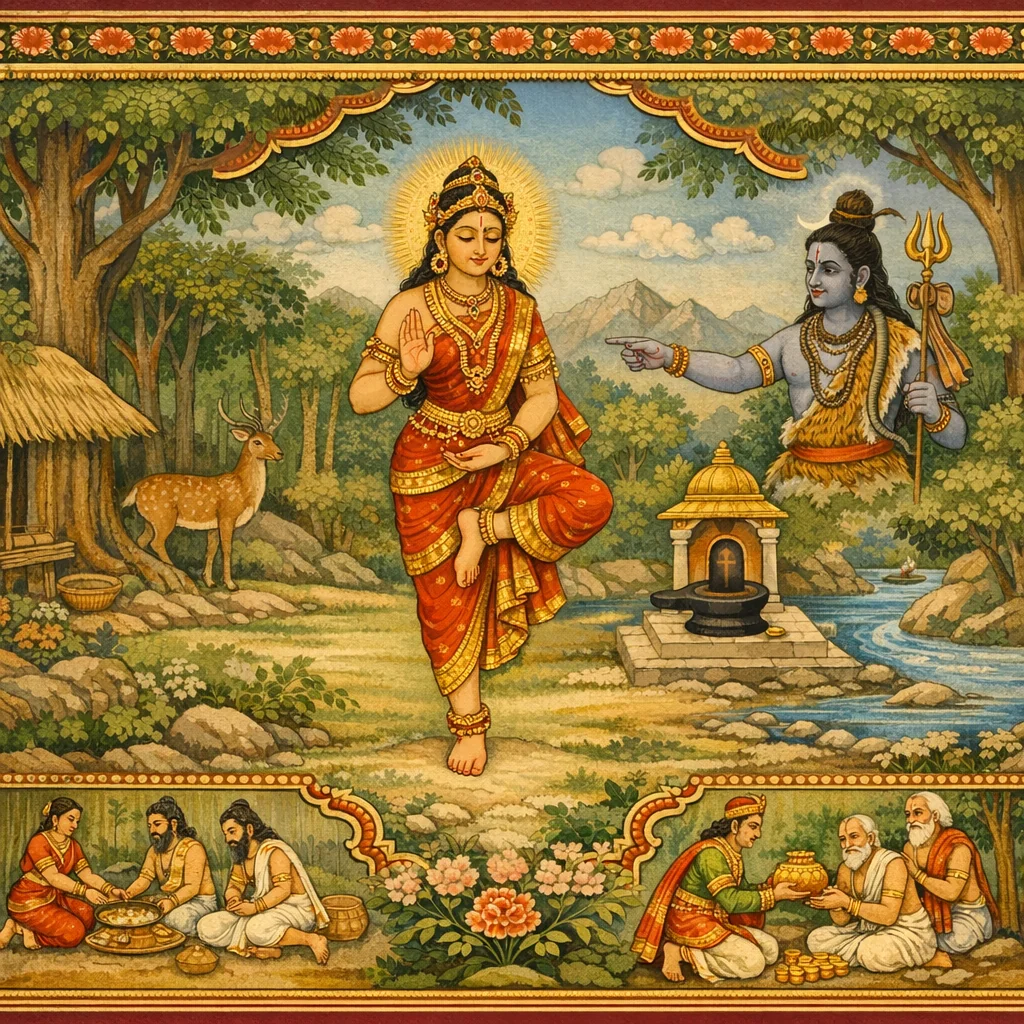
This chapter unfolds as a theological dialogue between Devī and Īśvara on the whereabouts and merit of the famed Gaurīśvara liṅga. Devī asks where the liṅga is situated and what phala (ritual fruit) arises from its worship. Īśvara replies by presenting the account as a pāpanāśana māhātmya—glory that destroys sin—and describes a renowned tapo-vana connected with Gaurī, marked out as a circular sacred precinct measured in dhanus units. Within that holy landscape, Devī is portrayed performing one-footed austerity (ekapādā tapas), and the liṅga’s placement is given with directional precision: slightly to the north, aligned toward Īśāna (the northeast), with distance markers. The discourse then declares the rite’s efficacy: devoted worship of the liṅga, especially on Kṛṣṇāṣṭamī, frees one from sins. Ethical giving is also enjoined as part of the observance—go-dāna (gift of a cow), gold to a worthy brāhmaṇa, and above all anna-dāna (gift of food) to pacify wrongdoing. The promised fruit culminates in a strong expiatory assurance: even grievous sinners are released from pāpa through the mere darśana, the sacred sight of this liṅga.
Shlokas
Verse 1
देव्युवाच । गौरीश्वरेति विख्यातं यत्त्वया लिंगमुत्तमम् । कुत्र तिष्ठति तल्लिंगं पूजितं यत्फलं लभेत्
The Goddess said: “That supreme Liṅga made known by you as ‘Gaurīśvara’—where does that Liṅga abide, and what fruit does one obtain by worshipping it?”
Verse 2
ईश्वर उवाच । शृणु देवि प्रवक्ष्यामि माहात्म्यं पापनारानम् । गौरीश्वरस्य देवस्य सर्वकामप्रदस्य वै
Īśvara said: “Listen, O Goddess; I shall declare the greatness that destroys sins—of the god Gaurīśvara, who indeed grants all desired aims.”
Verse 3
इदं तपोवनं देवि ख्यातं गौर्या महाप्रभम् । धनुषां पचपंचाशत्समंतात्परिमंडलम्
O Goddess, this grove of austerities (tapovana) is renowned through Gaurī and shines with great splendor. It spreads as a circle on every side, measuring fifty-five dhanuṣ-lengths.
Verse 4
तत्र मध्ये स्थिता देवी एकपादा तपोन्विता । तस्या उत्तरतो देवि किंचिदीशानसंस्थितम्
In its center stands the Goddess, performing austerity on one foot. To her north, O Goddess, something is situated slightly toward the Īśāna (northeast) direction.
Verse 5
धनुषां चतुरंते च लिंगं पापभयापहम् । यस्तत्पूजयते भक्त्या लिंगं भक्तियुतो नरः । कृष्णाष्टम्यां विशेषेण स मुक्तः पातकैर्भवेत्
At a distance of four dhanuṣ stands a Liṅga that removes the fear of sin. Whoever worships that Liṅga with bhakti—especially on Kṛṣṇāṣṭamī—is freed from sins.
Verse 6
गोदानं चात्र शंसंति सुवर्णं द्विजपुंगवे । अन्नदानं विशेषेण सर्वपापप्रशांतये
Here they commend the gift of a cow and also of gold, O best among the twice-born. Above all, the gift of food is praised for the pacification of every sin.
Verse 7
गोघ्नो वा ब्रह्महा वाऽपि तथा दुष्कृतकर्मकृत् । सर्व पापैः प्रमुच्येत तस्य लिंगस्य दर्शनात्
Whether one is a slayer of a cow, or even a slayer of a brāhmaṇa, or a doer of evil deeds—by the mere sight of that Liṅga, one is released from all sins.
Verse 69
इति श्रीस्कांदे महापुराण एकाशीतिसाहस्र्यां संहितायां सप्तमे प्रभासखंडे प्रथमे प्रभास क्षेत्रमाहात्म्ये गौरीश्वरमाहात्म्यवर्णनंनामैकोनसप्ततितमोऽध्यायः
Thus ends the sixty-ninth chapter, entitled “The Description of the Glory of Gaurīśvara,” in the Prabhāsa-khaṇḍa—within the Prabhāsakṣetra-māhātmya—of the holy Skanda Mahāpurāṇa, in the Saṃhitā of eighty-one thousand verses.