Adhyaya 330
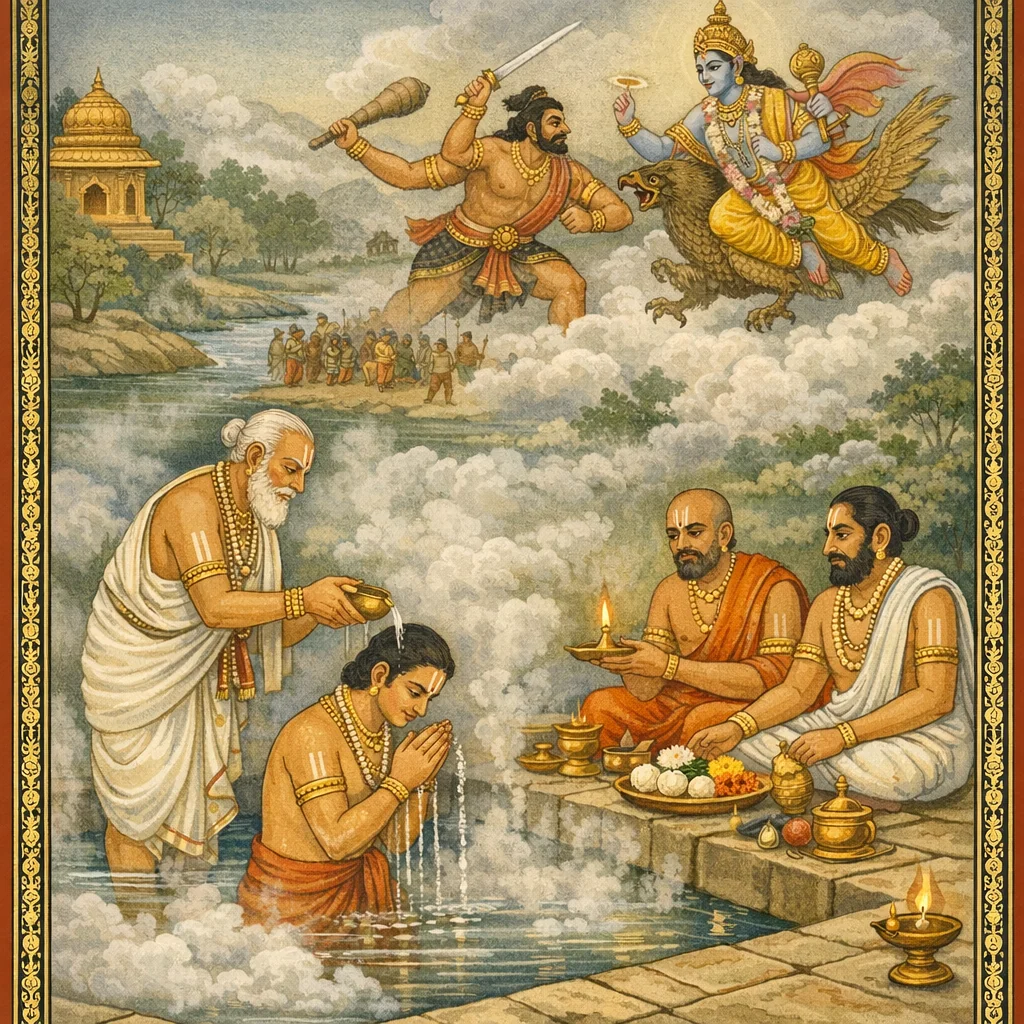
This chapter is framed as Īśvara’s theological discourse, locating a sacred spot about three yojanas north of an elevated landmark. The place is identified with Taptodaka, a thermally potent water source, and with the deity Talāsvāmin. It recalls an earlier mythic battle in which Talāsvāmin—described as a leader among the daityas—was slain by Viṣṇu after a prolonged conflict. That remembrance becomes a rule of pilgrimage: one should bathe in the Taptakuṇḍa, worship Talāsvāmin, and perform piṇḍa-pradāna, the ancestral offering. The phala passage promises greatly increased merit, said to equal the fruit of a “koṭi-yātrā,” a hyperbolic measure of immense pilgrimage reward. Thus the chapter binds together spatial direction, mythic legitimation, and ritual procedure into a single, clearly identifiable tīrtha unit.
Shlokas
Verse 1
ईश्वर उवाच । तस्मात्तदुन्नतस्थानादुत्तरे योजनत्रयात् । तत्र तप्तोदकस्वामी तलो यत्र हतः पुरा
Īśvara said: From that elevated sacred spot, three yojanas to the north, lies the place where the lord of the hot-water (tīrtha) is worshipped—the site where Talu was slain in ancient times.
Verse 2
दैत्यानामधिपो देवि विष्णुना प्रभविष्णुना । कृत्वा वर्षशतं युद्धं तलस्वामी ततोऽभवत्
O Goddess, the lord of the Daityas, after waging war for a hundred years with Viṣṇu—the mighty, all-powerful Viṣṇu—then came to be known as Talasvāmi.
Verse 3
तप्तकुण्डे नरः स्नात्वा तलस्वामिनमर्चयेत् । हृत्वा पिंडप्रदानं तु कोटियात्राफलं लभेत्
Having bathed in the Taptakuṇḍa, a person should worship Talasvāmi; and having offered piṇḍas to the ancestors, one gains merit equal to a koṭi of pilgrimages.
Verse 330
इति श्रीस्कांदे महापुराण एकाशीतिसाहस्र्यां संहितायां सप्तमे प्रभासखंडे प्रथमे प्रभासक्षेत्रमाहात्म्ये तलस्वामिमाहात्म्यवर्णनंनाम त्रिंशदुत्तरत्रिश ततमोऽध्यायः
Thus ends, in the holy Skanda Mahāpurāṇa, in the Saṃhitā of eighty-one thousand verses, in the seventh Prabhāsa-khaṇḍa, within the first Prabhāsakṣetra-māhātmya, the chapter entitled “The Description of the Greatness of Talasvāmi,” being Chapter 330.