Adhyaya 72
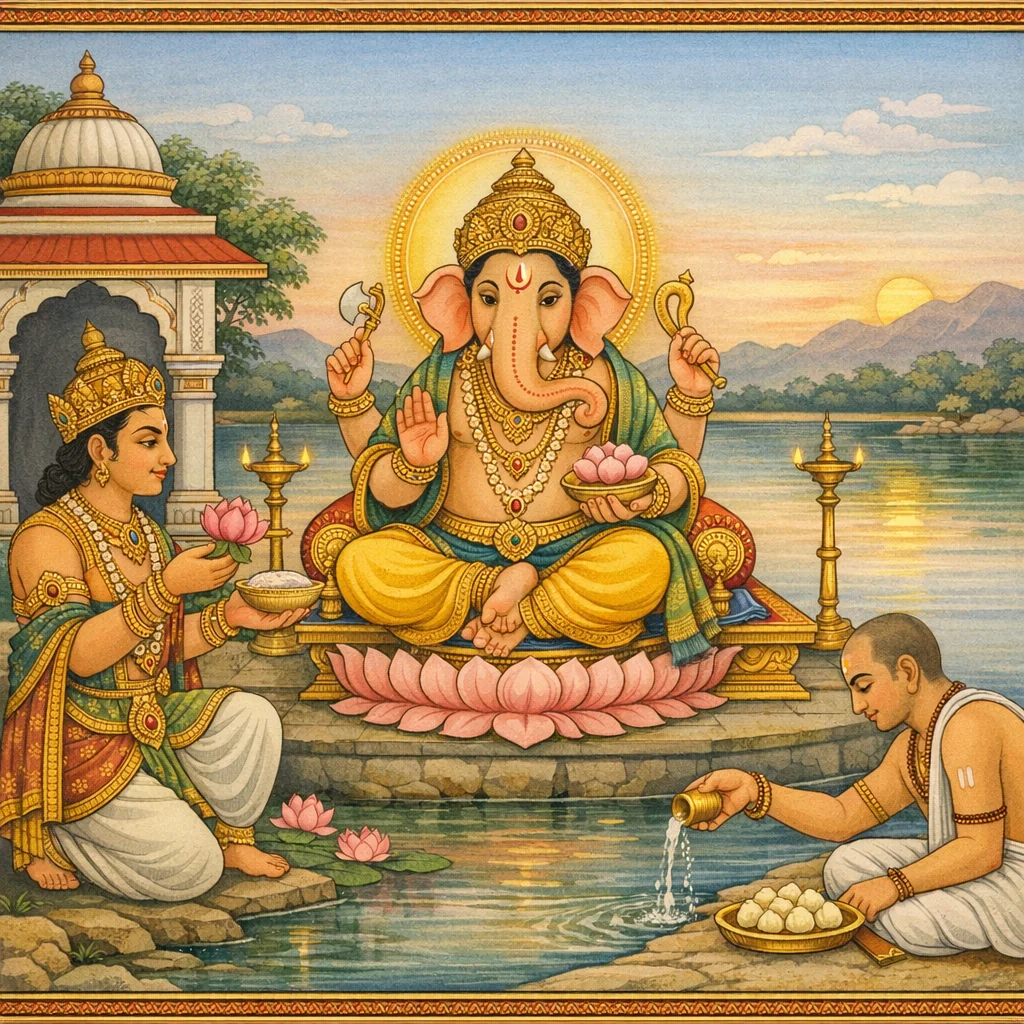
This chapter gives a brief theological and ritual instruction attributed to Īśvara. The devotee is enjoined to seek the darśana of Vighneśa at that very sacred spot, known as “Jalavāsas,” Gaṇeśa who “dwells in water.” Such darśana is praised as powerful for the destruction of obstacles and for the successful completion of all undertakings (sarva-kārya-prasiddhi). As an origin account, Varuṇa is said to have worshiped the Lord with devotion using water-born offerings (jalajaiḥ), so that his tapas might proceed without hindrance (tapo-nirvighna-hetu). The practical observance is set for the fourth lunar day (caturthī): one should perform tarpaṇa and worship with fragrances, flowers, and modakas. The text stresses due proportion—offerings made “according to one’s devotion and capacity” (yathā-bhakti-anusāreṇa) are the basis of Gaṇādhipa’s satisfaction.
Shlokas
Verse 1
ईश्वर उवाच । तत्रैव संस्थितं पश्येद्विघ्नेशं जलवाससम् । सर्वविघ्नविनाशाय सर्वकार्यप्रसिद्धये
Īśvara said: There itself one should behold Vighneśa, known as Jalavāsa, so that all obstacles are destroyed and every undertaking attains success.
Verse 2
वरुणेन महादेवि तपोनिर्विघ्नहेतवे । पूजितो जलजैर्भक्त्या जलवासास्ततः स्मृतः
O Great Goddess, for the sake of unobstructed austerity Varuṇa worshipped him with devotion, using offerings born of water; therefore he is remembered as “Jalavāsa.”
Verse 3
चतुर्थ्यां तर्पयेद्भक्त्या गन्धैः पुष्पैः स मोदकैः । यथाभक्त्यनुसारेण तस्य तुष्येद्गणाधिपः
On Caturthī, the fourth lunar day, one should satisfy him with devotion—using fragrances, flowers, and modakas; according to the measure of one’s devotion, the Lord of the Gaṇas becomes pleased.
Verse 72
इति श्रीस्कांदे महापुराण एकाशीतिसाहस्र्यां संहितायां सप्तमे प्रभासखंडे प्रथमे प्रभासक्षेत्रमाहात्म्ये जलवासगणपतिमाहात्म्यवर्णनंनाम द्विसप्ततितमोऽध्यायः
Thus, in the revered Skanda Mahāpurāṇa, in the Saṃhitā of eighty-one thousand verses, in the seventh—Prabhāsa Khaṇḍa—within the first Prabhāsa-kṣetra Māhātmya, ends the seventy-second chapter entitled “The Description of the Greatness of Jalavāsa Gaṇapati.”