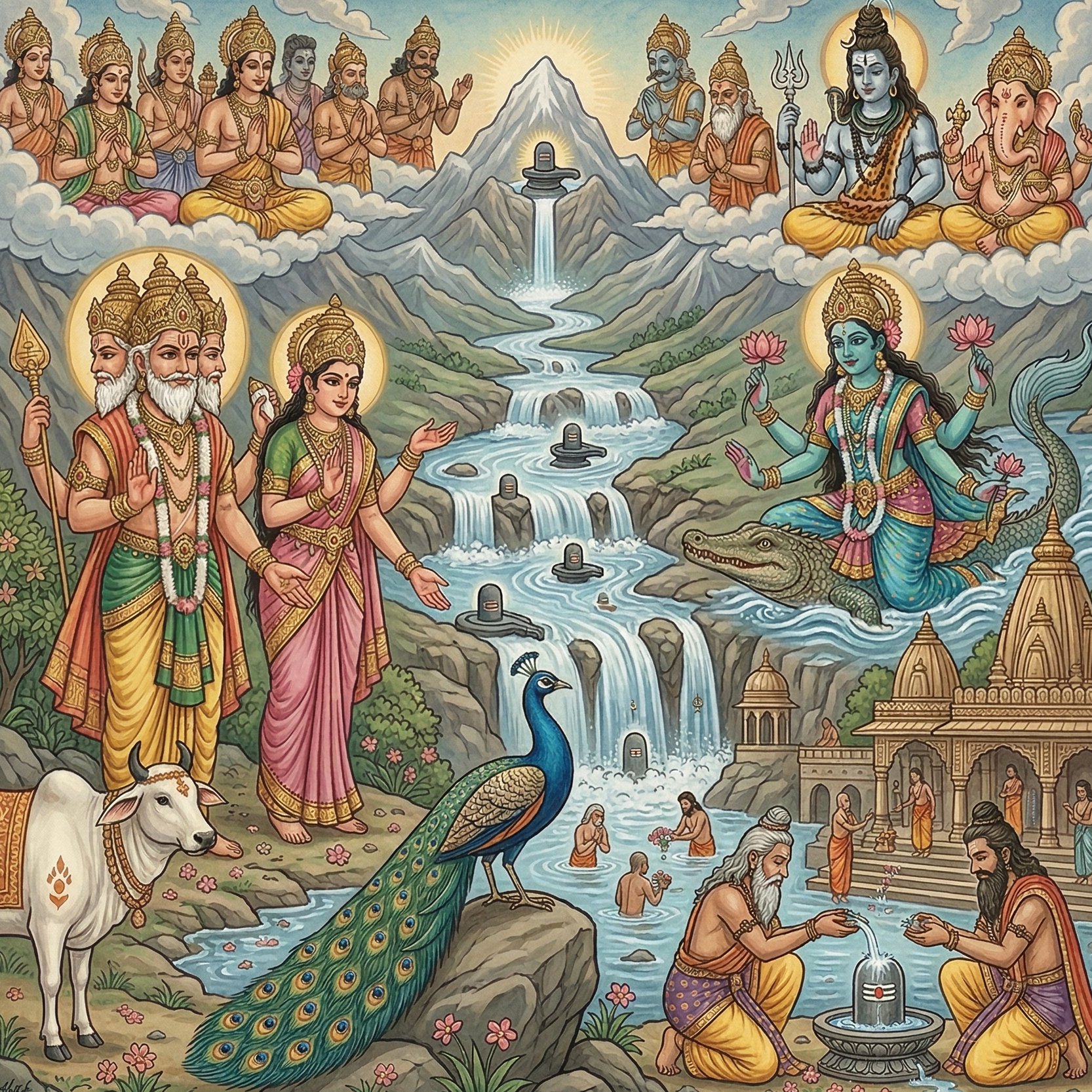
Reva Khanda (Narmada Section)
Reva Khanda
A Narmadā (Revā)–centered sacred-geography unit mapping tīrthas and devotional memory along the river’s banks. The chapter’s frame situates narration at Naimiṣāraṇya (a classical Purāṇic recitation landscape), from which the Revā region is described through hymnic praise, origin inquiry, and tīrtha-oriented questioning.
Adhyayas in Reva Khanda
232 chapters to explore.
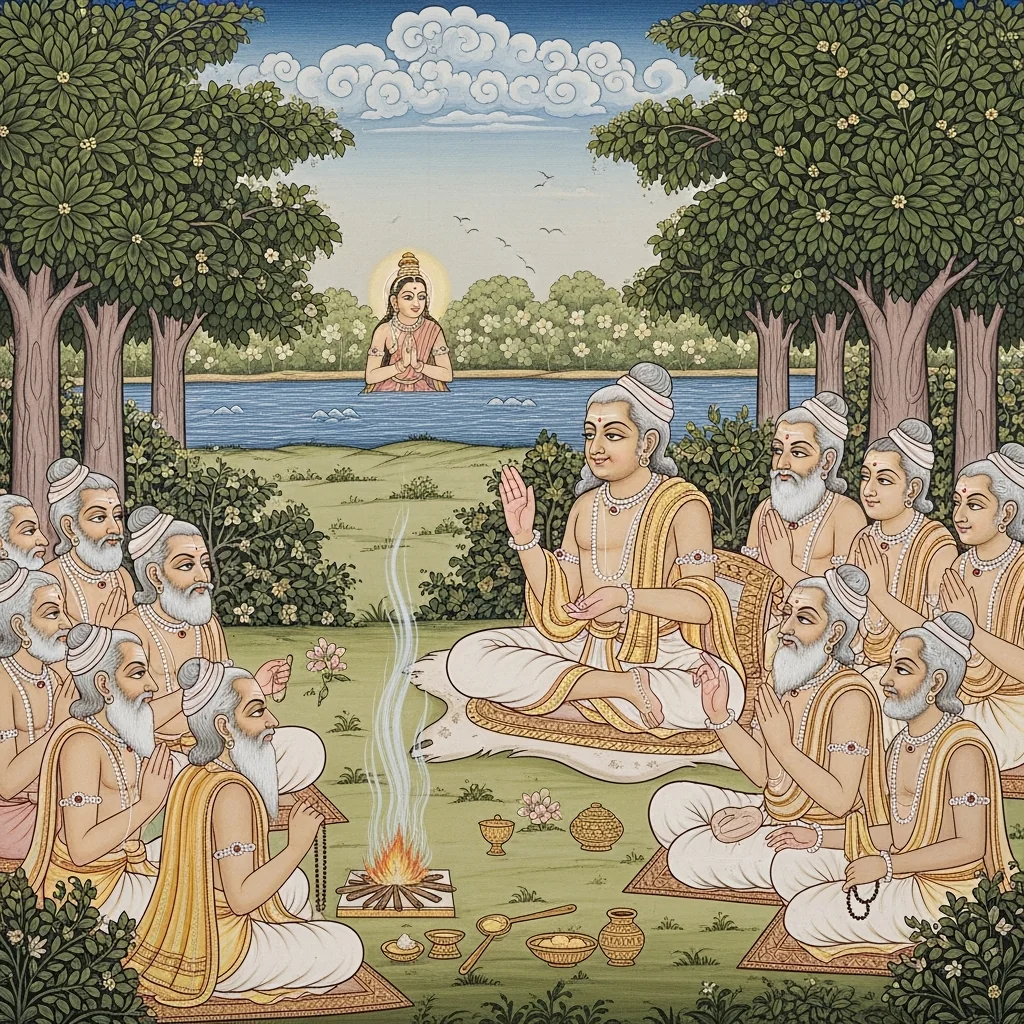
Adhyaya 1
Revā-stutiḥ, Naimiṣa-saṃvādaḥ, Purāṇa-prāmāṇya-nirdeśaḥ (Invocation to Revā; Naimiṣa Dialogue; On the Authority of Purāṇa)
The chapter begins with an invocatory cue and an extended hymn (stuti) praising Revā/Narmadā as the purifier of dūrīta (sin and defilement), revered by gods, sages, and humans, and as a sanctified river whose banks are longed for even by ascetics. The narration then shifts to the Purāṇic frame at Naimiṣa: Śaunaka, seated in the sacrificial assembly, asks Sūta about the “third” great river after Brahmī and Viṣṇu-nadī—identified as the Raudrī river, Revā—requesting her location, her Rudra-linked origin, and the tīrthas associated with her course. Sūta praises the question and offers an epistemic defense of śruti, smṛti, and purāṇa as complementary authorities, presenting purāṇa as a major pramāṇa (often styled the “fifth Veda”) and defining it by the pañcalakṣaṇa. A substantial catalogue follows: the eighteen mahāpurāṇas with their names and verse counts, then a list of upapurāṇas, concluding with a phala statement that recitation or hearing yields vast merit and auspicious posthumous attainment. The chapter thus serves as a prologue—devotional river praise, narrative framing, and an index-like validation for the Revā tīrtha mapping to come.
Adhyaya 2
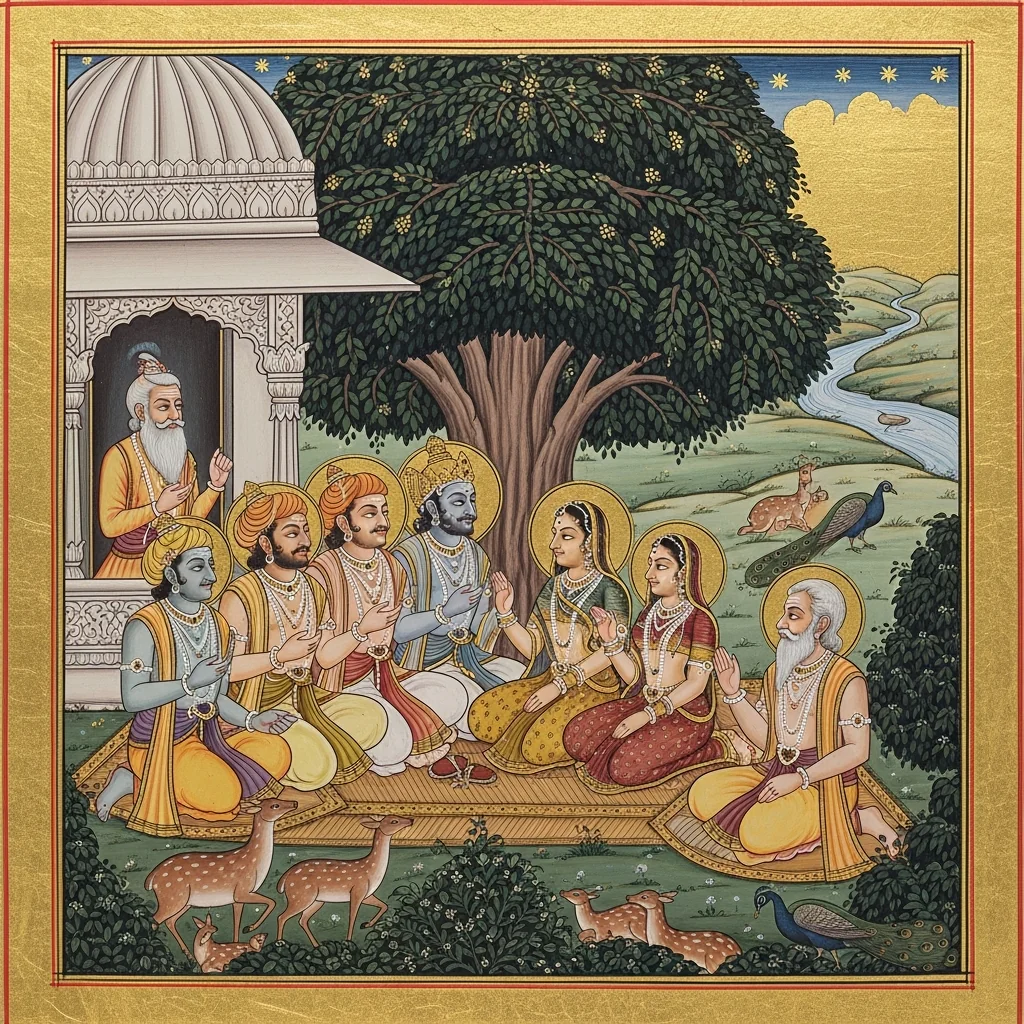
रेवातीर्थकथाप्रस्तावः — Janamejaya’s Inquiry and the Vindhya Āśrama Prelude
Chapter 2 begins with Sūta introducing a vast account of the Narmadā’s tīrthas, admitting how difficult it is to describe them in full. The narrative then recalls an earlier precedent: amid a grand sacrificial assembly, King Janamejaya asks the sage Vaiśampāyana, disciple of Dvaipāyana/Vyāsa, about the Pāṇḍavas’ tīrtha-sevana after their defeat at gambling and their exile. Vaiśampāyana agrees to narrate, first offering reverence to Virūpākṣa (Śiva) and to Vyāsa. He describes the Pāṇḍavas, with Draupadī and Brahmin companions, reaching the Vindhya region after bathing at many sacred fords. An ideal forest-āśrama is portrayed in rich ecological detail, a harmonized place for ascetic practice where even the animals are non-hostile. There the Pāṇḍavas meet the sage Mārkaṇḍeya, surrounded by disciplined ṛṣis performing varied austerities. Yudhiṣṭhira respectfully asks about Mārkaṇḍeya’s extraordinary longevity through cosmic dissolutions (pralaya) and about which rivers endure or perish at pralaya. Mārkaṇḍeya replies by praising a Rudra-bhāṣita Purāṇa, declaring strong fruits for devotional listening, listing major rivers, and asserting that while oceans and rivers decline in cycles, Narmadā uniquely persists through seven kalpa-endings—preparing the way for further explanation.
Adhyaya 3
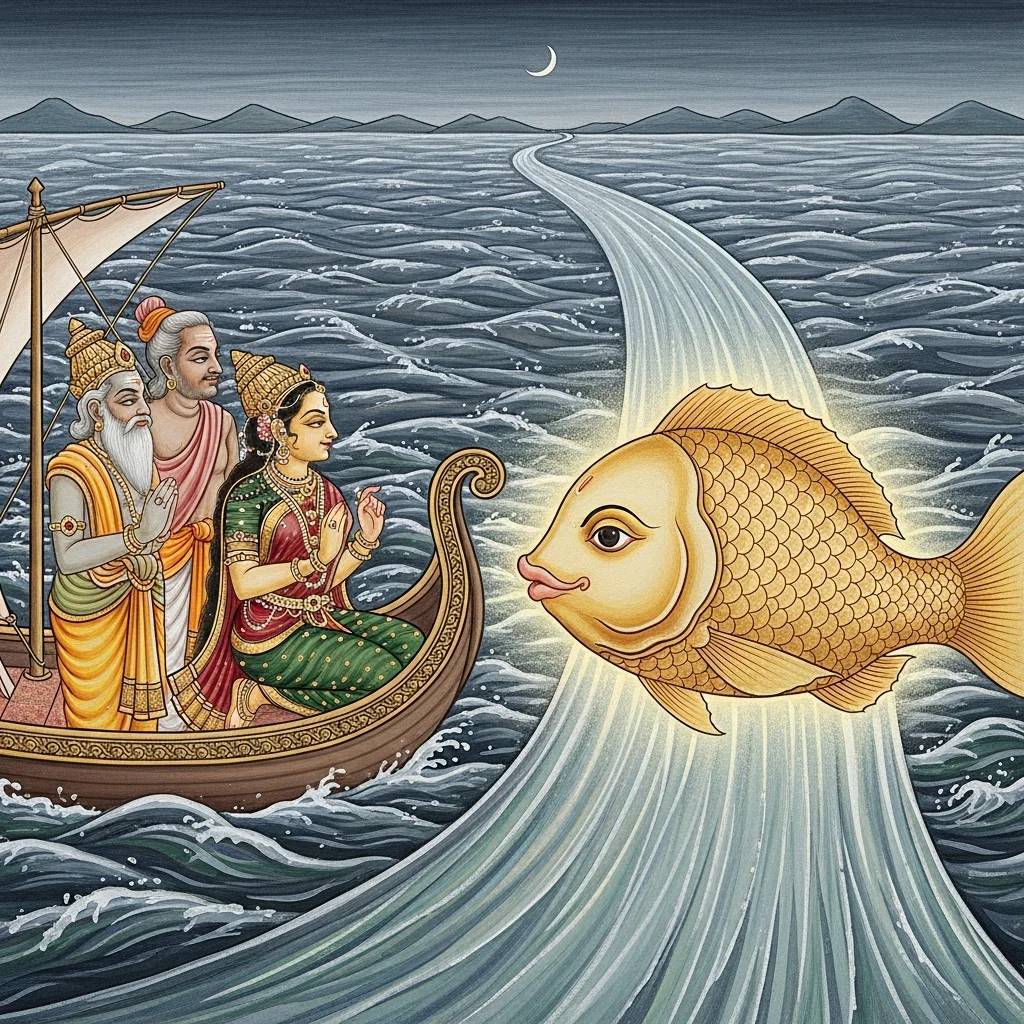
Mārkaṇḍeya’s Account of Yuga-Dissolution and the Matsya-Form Encounter (युगक्षय-वर्णनं मत्स्यरूप-समागमश्च)
The chapter unfolds as a dialogue: Yudhiṣṭhira asks the sage Mārkaṇḍeya about the dreadful end-of-yuga conditions he has witnessed again and again—drought, the loss of herbs, rivers and reservoirs drying up, and beings departing to higher worlds. Mārkaṇḍeya replies by first affirming the authoritative lineage of purāṇic transmission (Śambhu → Vāyu → Skanda → Vasiṣṭha → Parāśara → Jātūkarṇya → other sages) and praising the Purāṇa as a liberating text to be heard, cleansing impurities gathered across many births. He then narrates a cosmic dissolution: twelve suns scorch the world until it becomes a single ocean. Wandering upon the waters, he beholds a primordial, radiant Supreme Being, and also sees another Manu with descendants moving through the dark sea. In fear and exhaustion he encounters a vast fish-form, recognized as Maheśvara, who calls him near. The narrative shifts to the wonder of a “river within the ocean” and a divine woman (Abalā) who explains her origin from Īśvara’s body and the safety of a boat bound to Śaṅkara’s presence. Mārkaṇḍeya boards with Manu and offers a Śaiva hymn invoking Sadyojāta, Vāmadeva, Bhadrakālī, and Rudra as the cosmic cause. The chapter culminates with Mahādeva pleased and inviting a boon, setting devotion and authoritative hearing as the response to the world’s impermanence.
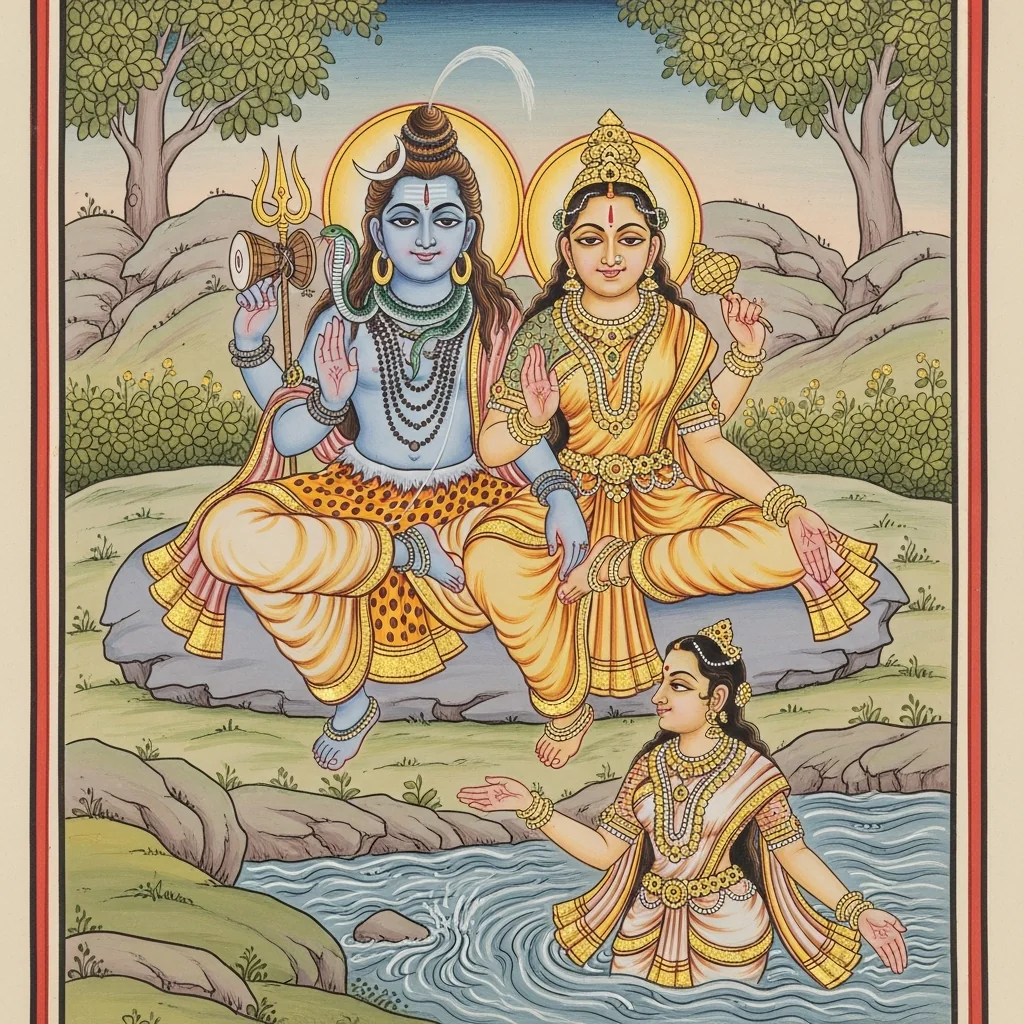
Adhyaya 4
Origin and Boons of Revā (Narmadā) as Rudra-born River
This chapter unfolds a nested chain of testimony. Mārkaṇḍeya recounts how he approached Trikūṭa’s summit and reverently worshiped Mahādeva (Śiva). Yudhiṣṭhira then asks about a lotus-eyed woman seen wandering in the dark cosmic ocean, declaring herself to be Rudra-born. Mārkaṇḍeya says he once asked Manu the same; Manu explains that Śiva, with Umā, performed severe tapas on Ṛkṣaśaila, and from Śiva’s perspiration arose a supremely meritorious river—Revā, the Narmadā—appearing as that lotus-eyed woman. In the Kṛtayuga the river, in feminine form, worships Rudra and seeks boons: imperishability at cosmic dissolution, the power to remove grave sins through devotional bathing, recognition as the “southern Gaṅgā,” bathing-fruit equal to major rites, and Śiva’s abiding presence on her banks. Śiva grants these, distinguishes outcomes for dwellers on the northern and southern banks, and extends salvific benefit widely. The chapter ends with a list of Rudra-origin river-names and a phalaśruti promising merit and an exalted post-mortem destiny to those who recite, hear, and remember them.
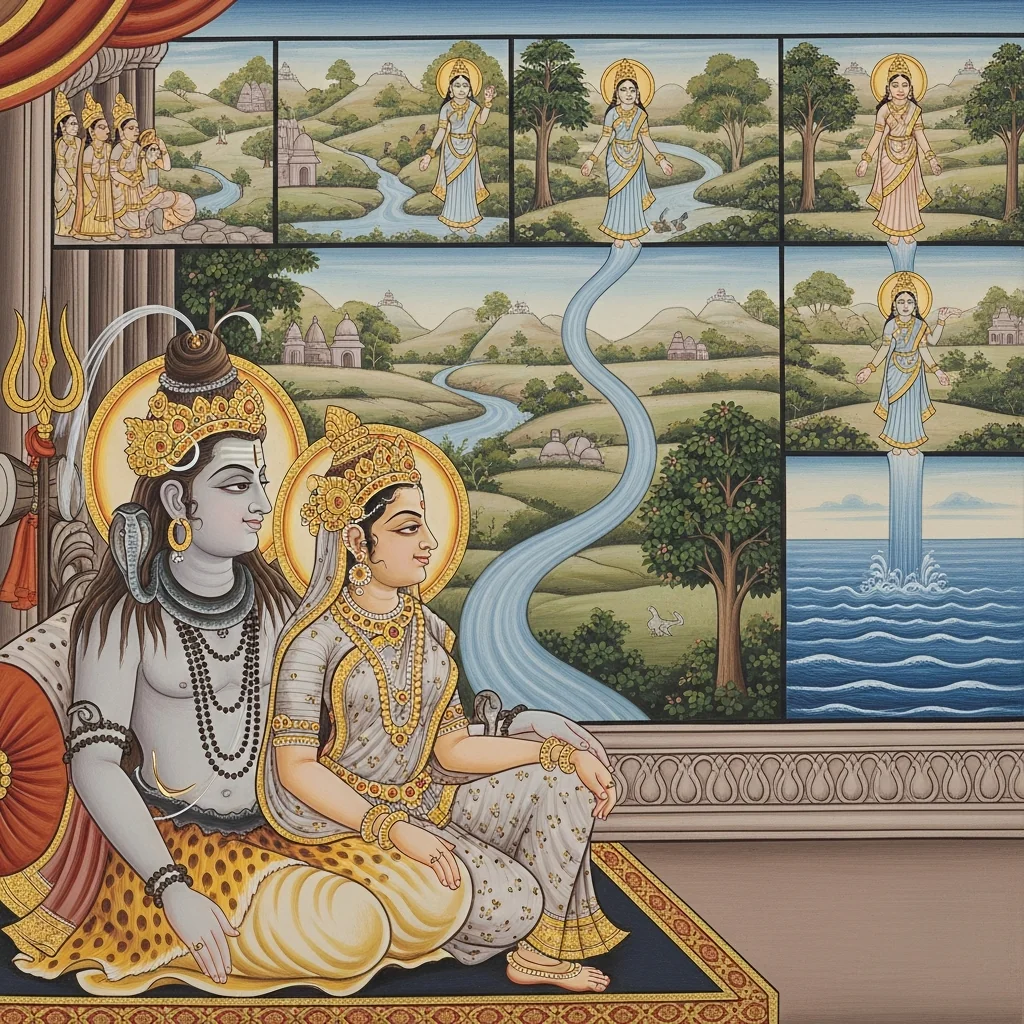
Adhyaya 5
नर्मदाया उत्पत्तिः, नामकरणं च (Origin and Naming of Narmadā; Kalpa-Framing Discourse)
This chapter unfolds as a question-led theological inquiry. Yudhiṣṭhira, with an assembly of sages, marvels at the sanctity of the goddess-river Narmadā and asks why she does not perish even when seven kalpas are exhausted. He also seeks doctrinal clarity on cosmic processes—how the world is withdrawn, abides in an oceanic state, is recreated, and sustained—and on the meanings and ritual grounds of her many names such as Narmadā, Revā, and other epithets, including her traditional classification and the Purāṇa-scholars’ usage of “Vaiṣṇavī.” Mārkaṇḍeya replies by placing the teaching within a lineage of transmission from Maheśvara through Vāyu, then outlines a taxonomy of kalpas. He sketches cosmogony: from primordial darkness the cosmic principle arises, the golden egg comes forth, and Brahmā manifests. The narrative then turns to the river’s mythic origin—a radiant daughter linked with Umā and Rudra whose beauty bewilders gods and asuras; Śiva institutes a test, she vanishes and reappears at far distances, and at last Śiva names her “Narmadā,” connecting it with “narma” (laughter) and divine play. The chapter closes with her being entrusted to the great ocean, entering it from a mountain setting, and with notes on her manifestation within a specific kalpa frame (with Brāhma and Matsya references).
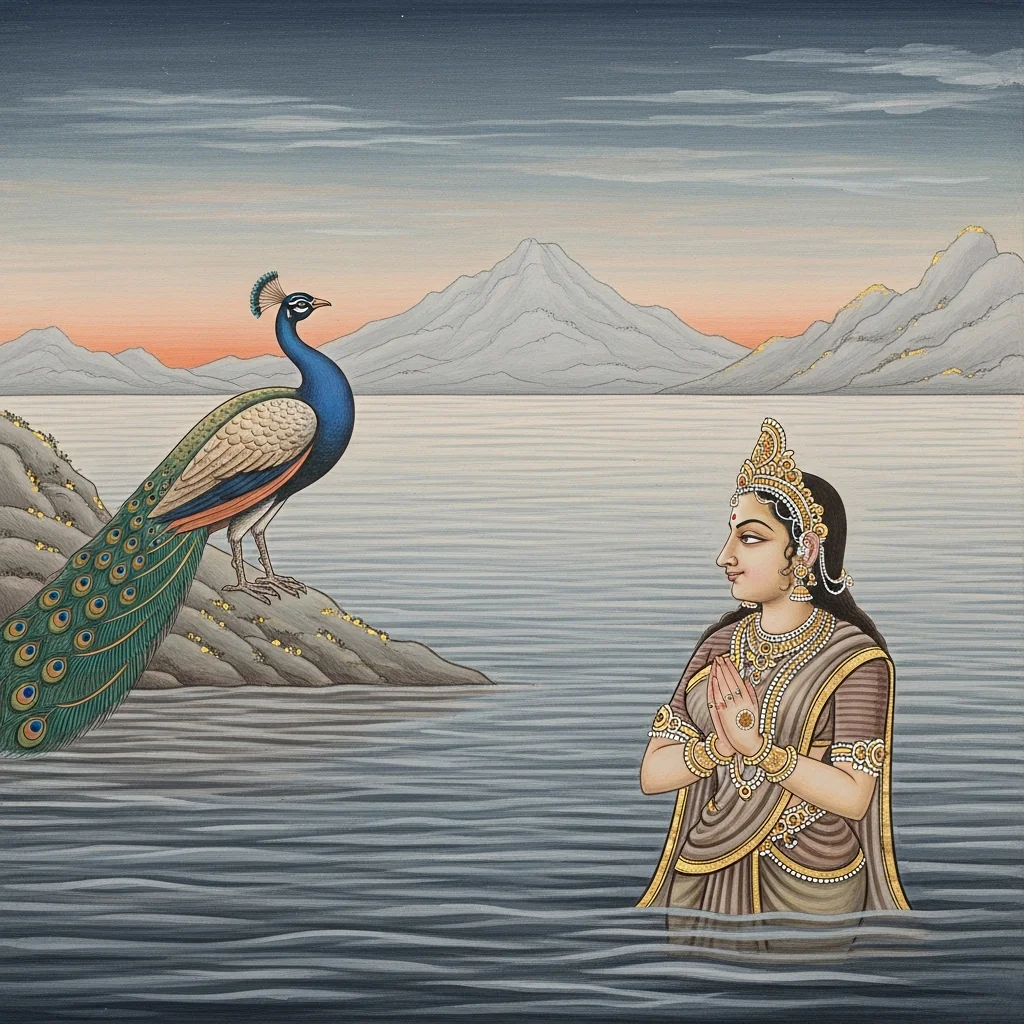
Adhyaya 6
Narmadā–Revā Utpatti and Nāma-Nirukti (Origin and Etymologies of the River’s Names)
Markaṇḍeya recounts a yuga-ending dissolution in which Mahādeva assumes cosmic forms—first fiery, then cloud-like—and submerges the world into a single ocean. In the dark, primordial waters a radiant peacock-form appears, recognized as Śiva’s operative agency, through which re-creation begins to unfold. There Narmadā is encountered as an enduring, auspicious river-being who, by divine grace, does not perish in the dissolution. At Śiva’s command the world is reconstituted: from the peacock’s wings arise divine and anti-divine hosts, and the earth’s order is restored with the manifestation of Mount Trikūṭa and the ensuing flow of rivers. The chapter then systematizes Narmadā’s theological identity through a catalog of names and etymologies—Mahatī, Śoṇā, Kṛpā, Mandākinī, Mahārṇavā, Revā, Vipāpā, Vipāśā, Vimalā, Raṅjanā—each tied to a function such as purification, compassion, salvific passage across saṃsāra, and auspicious visibility. It concludes with a phala teaching: knowing these names and their origins frees one from wrongdoing and grants access to Rudra’s realm.
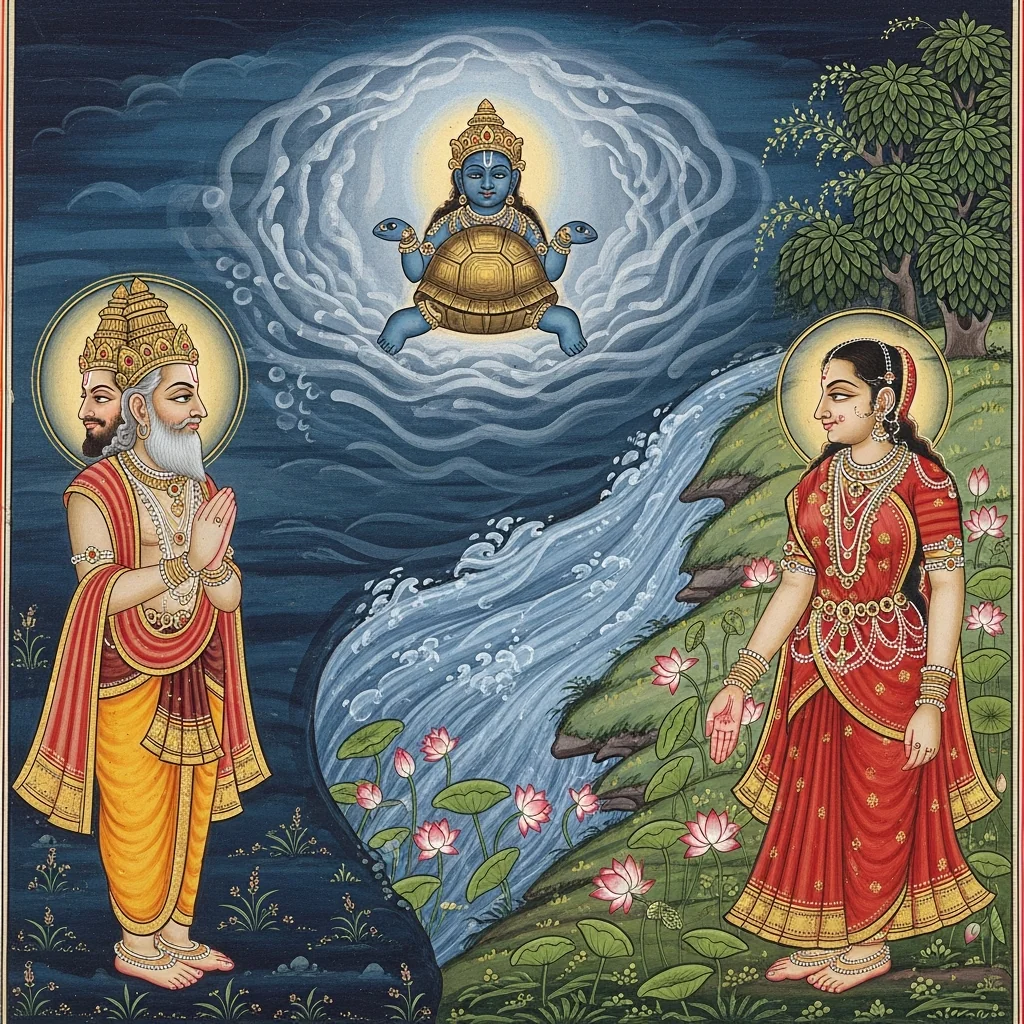
Adhyaya 7
Kūrma-Prādurbhāva and the Epiphany of Devī Narmadā (Revā’s Manifestation)
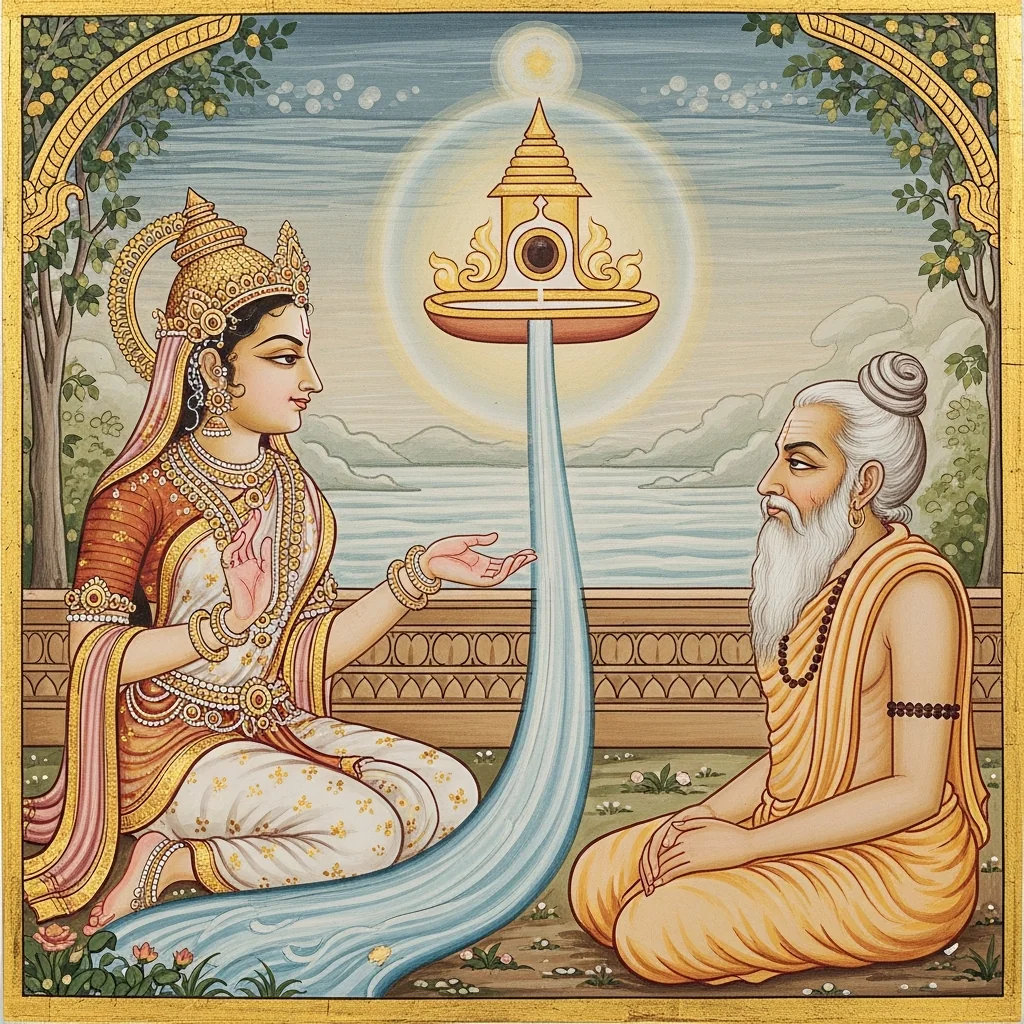
Mārkaṇḍeya depicts a cosmic dissolution: only the ekārṇava, a single dreadful ocean, remains, while all moving and unmoving beings have vanished into darkness. Brahmā, alone upon the waters, beholds a vast radiant Presence in kūrma-rūpa (tortoise form), endowed with supreme, universe-spanning attributes. Brahmā gently rouses and praises the Deity with auspicious stutis in the idiom of the Veda and Vedāṅga, beseeching the re-emission of the worlds previously withdrawn. The Deity rises and releases the three worlds with their orders of beings—devas, dānavas, gandharvas, yakṣas, nāgas, rākṣasas—together with the celestial bodies. The earth is then seen spread out again with mountains, continents, oceans, and the boundary of Lokāloka. Within this renewed geography comes the riverine theophany: Devī Narmadā (Revā) manifests as a divinely adorned woman emerging from the waters, praised and approached with reverence. The chapter ends with a phalaśruti-like assurance that studying or hearing this account of the kūrmya manifestation removes sins (kilbiṣa).
Adhyaya 8
बकरूपेण महेश्वरदर्शनं तथा नर्मदामाहात्म्योपदेशः | Mahādeva as the Crane and the Instruction on Narmadā’s Sanctity
Mārkaṇḍeya describes an extreme cosmic moment: after the world is submerged, he remains in mid-ocean, exhausted by vast time, and meditatively remembers the Deity who enables one to cross the great flood. He then beholds a radiant, crane-like bird and wonders how such a divine being can appear in that terrifying sea. The bird reveals itself as Mahādeva (Maheśvara), the supreme reality encompassing even Brahmā and Viṣṇu, and declares that the universe has been withdrawn in dissolution (saṃhāra). Invited to rest within the bird’s wing, the sage undergoes a passage as though across immense ages. A sudden anklet-sound opens a vision: ten adorned maidens arrive from the directions, worship the bird, and enter a hidden inner realm like the interior of a mountain. Within appear a wondrous city and a resplendent river, culminating in the sight of a multi-hued, marvelous liṅga surrounded by divine beings in a state of withdrawal. A luminous maiden identifies herself as Narmadā (Revā), born from Rudra’s body, explaining that the ten maidens are the directions and that Mahādeva, the great yogin, has brought the liṅga to be worshiped even during cosmic contraction. She teaches that “liṅga” is that into which the moving and unmoving world dissolves, and that the gods are now condensed by māyā but will reappear with creation. The chapter ends with instruction: bathe and worship Mahādeva in Narmadā’s waters with mantra and proper method; this removes sin. Narmadā is affirmed as a great purifier for the human world.
Adhyaya 9
युगान्तप्रलयः, वेदापहारः, मत्स्यावतारः, नर्मदामाहात्म्यम् (Yugānta-Pralaya, Veda-Abduction, Matsya Intervention, and Narmadā Māhātmya)
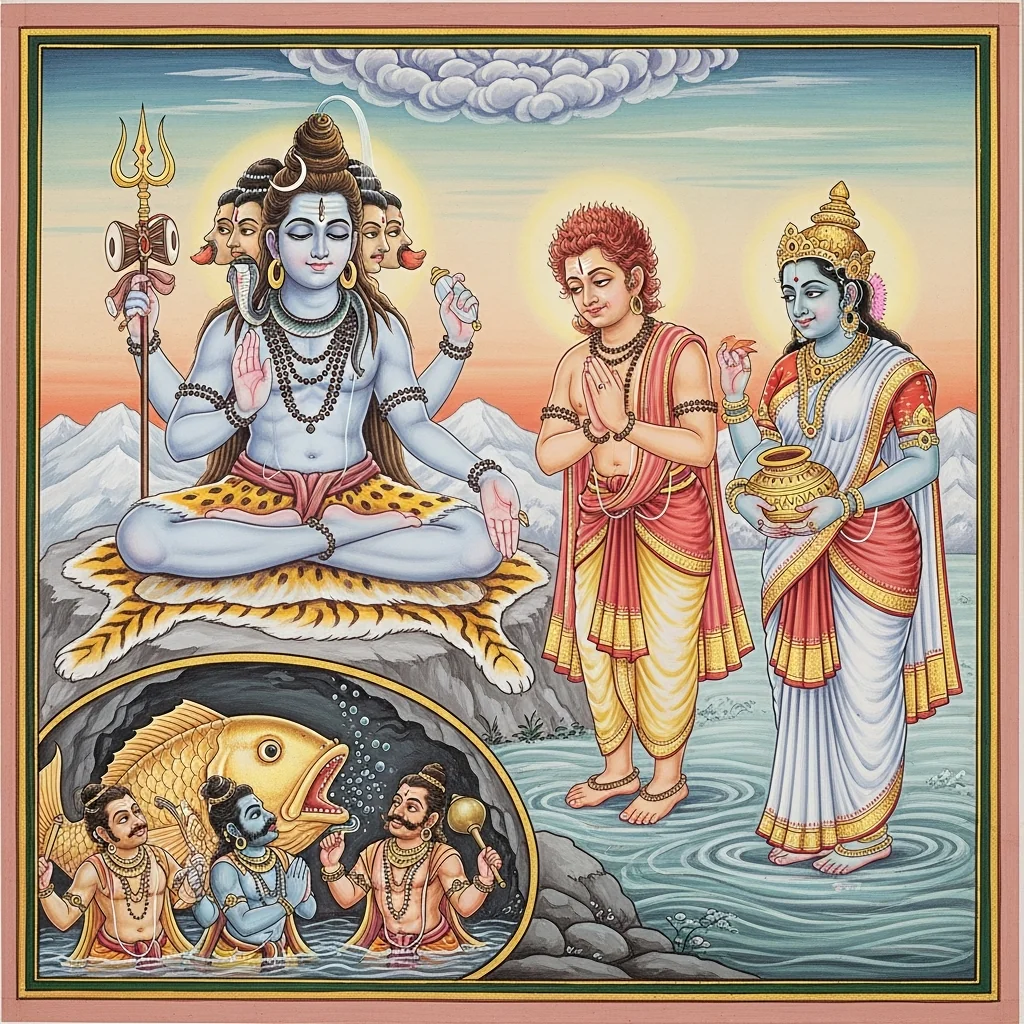
Narrated by Śrī Mārkaṇḍeya, this chapter portrays the yugānta-pralaya: the world is overwhelmed by waters. Śiva, the supreme Lord, is shown resting in yogic absorption, upheld by Prakṛti, as sages and divine beings behold him and offer praise. A theological exchange follows. Brahmā laments that the four Vedas have been lost, declaring them indispensable for creation, for the remembrance of time (past and present), and for ordered knowledge. At Śiva’s prompting, Narmadā (Revā) explains the cause: the mighty daityas Madhu and Kaiṭabha exploited a vulnerability during the divine sleep-state and hid the Vedas in the ocean’s depths. The Vaiṣṇava intervention is then recalled: the deity assumes fish-form (mīnarūpa), descends to Pātāla, finds the Vedas, defeats the daityas, and restores the Vedas to Brahmā so that creation may begin anew. The discourse culminates in river-theology: Gaṅgā, Revā (Narmadā), and Sarasvatī are presented as one sacred power in three expressions, each linked to a major deity-form. Narmadā is praised as subtle, all-pervading, purifying, and a means to cross saṃsāra; contact with her waters and reverent worship of Śiva on her banks are said to grant purification and exalted spiritual fruits.
Adhyaya 10
Revātīra-āśrayaḥ: Kalpānta-anāvṛṣṭi, Ṛṣi-saṅgama, and Narmadā’s Salvific Efficacy (रेवातीराश्रयः)
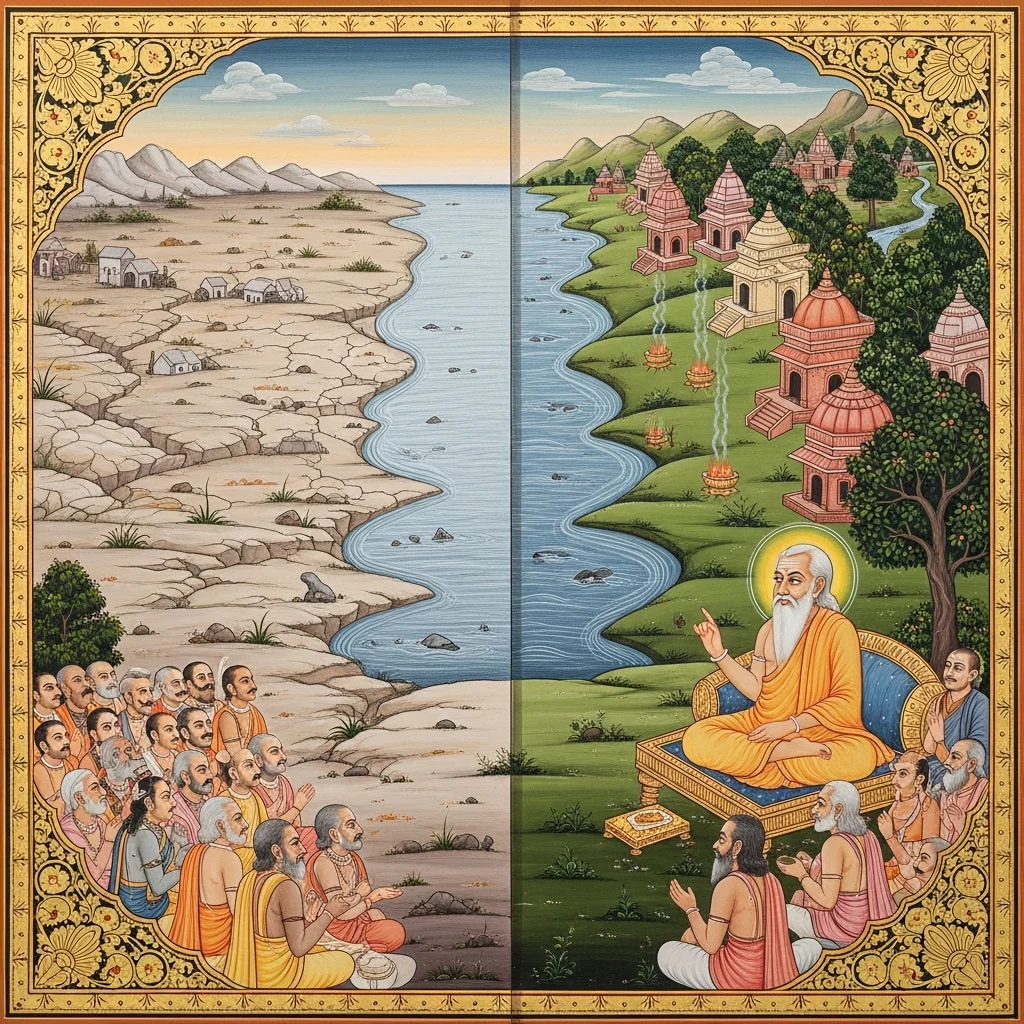
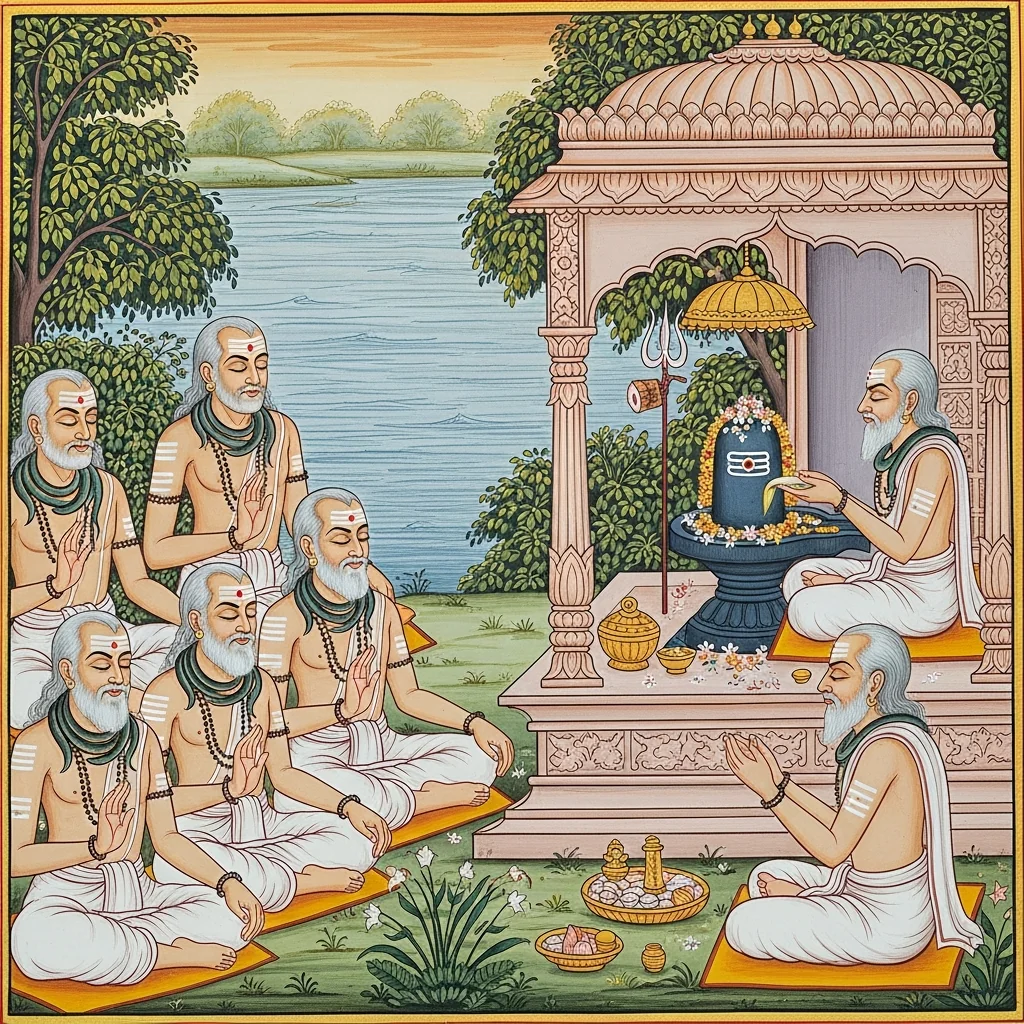
The chapter opens with Yudhiṣṭhira asking about the span of a kalpa and the ordering of the Narmadā region. Mārkaṇḍeya replies by recalling a former kalpa’s end, when anāvṛṣṭi (prolonged drought) dried up rivers and oceans, drove beings to hunger-filled wandering, and shattered ritual and social order—homa and bali sequences failed, and norms of purity were abandoned. In that calamity, great assemblies of ascetics—Kurukṣetra-dwellers, Vaikhānasas, cave-dwelling tapasvins, and others—approach Mārkaṇḍeya for direction. He turns them away from the northern course and sends them south, especially to the banks of the Narmadā, praised as supremely meritorious and frequented by siddhas. Revātata is then portrayed as an extraordinary refuge where shrines and āśramas flourish, agnihotra continues, and varied disciplines of austerity and devotion are practiced: pañcāgni, agnihotra, fasting regimens, cāndrāyaṇa, and kṛcchra. The teaching weaves Śaiva worship of Maheśvara together with continual remembrance of Nārāyaṇa, declaring that devotion aligned with one’s disposition yields corresponding fruits, while clinging to partial supports—like grasping branches instead of the tree—prolongs saṃsāra. Strong phalaśruti follows: worship and disciplined residence on Revā’s banks can lead to non-return, and even those who die in Narmadā’s waters are said to attain exalted states. The chapter concludes by praising reading and recitation as purifying knowledge in accord with Rudra’s authoritative word.
Adhyaya 11
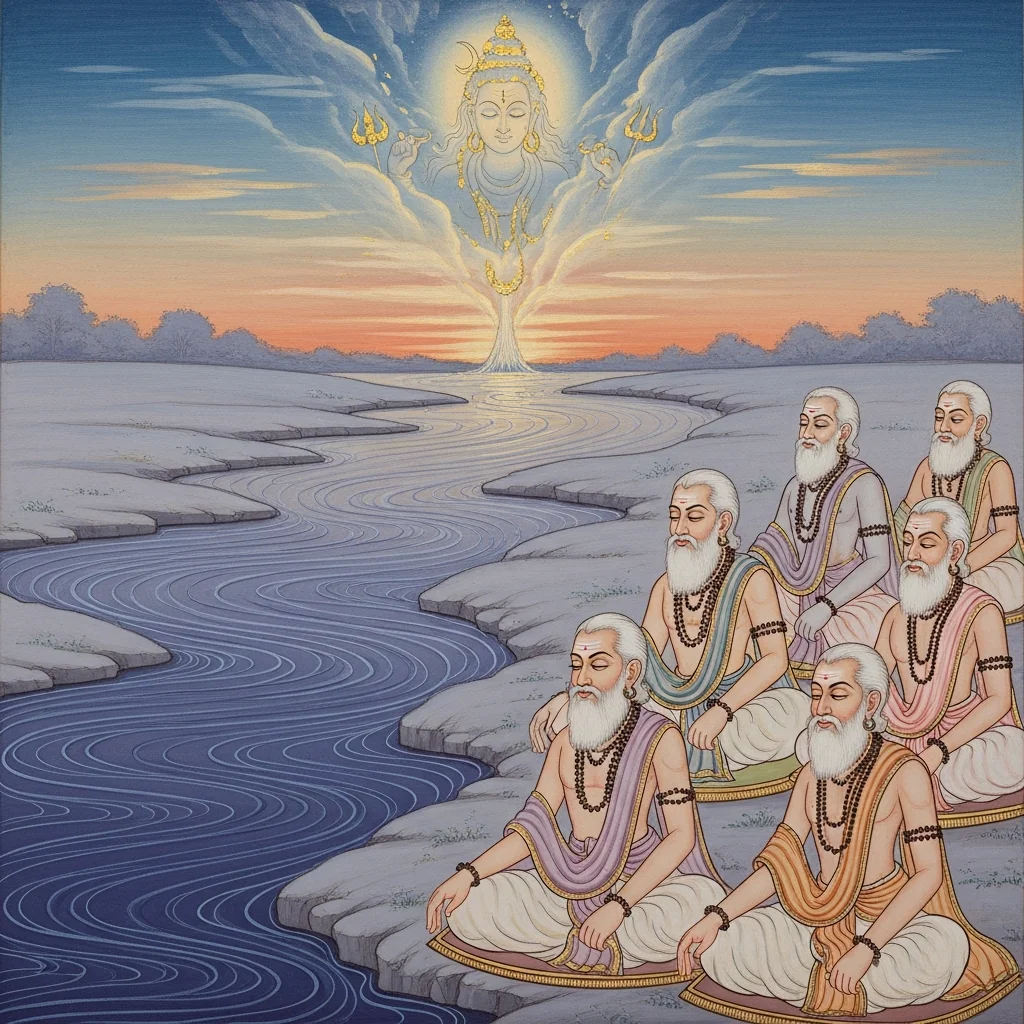
Śraddhā, Narmadā-tīra Sādhanā, and the Pāśupata-Oriented Ethical Code (श्रद्धा–रेवातीरसाधना–पाशुपतधर्मः)
Chapter 11 unfolds as a dialogue in which Yudhiṣṭhira asks why certain sacred observances and tīrthas remain spiritually potent even amid yuga-ending crises, and how sages attain liberation through prescribed niyamas (disciplines). Mārkaṇḍeya answers by placing śraddhā (faithful, devout trust) at the center: without it, ritual acts are said to be fruitless; with it, after merit gathered over many births, devotion to Śaṅkara (Śiva) becomes attainable. The chapter then extols Narmadā-tīra, the bank of Revā, as a place of swift siddhi: worship of Śiva—especially liṅga-pūjā—regular bathing, and the wearing of bhasma (sacred ash) are described as rapid purifiers of sin, even for those with a morally troubled past. A detailed ethical warning follows against dependence on improper food—especially what is termed śūdrānna within a prescriptive purity discourse—linking eating to karmic consequence and spiritual decline. It contrasts sincere Pāśupata-aligned observance with hypocrisy, greed, and ostentation, declaring that such faults can nullify tīrtha benefits. In a hymn-like exhortation (contextually attributed to Nandin), the listener is urged to renounce greed, remain steady in devotion to Śiva, perform japa of the pañcākṣarī mantra, and rely on Revā’s sanctity. The chapter closes with claims about recitation and practice near the Narmadā—Rudra-adhyāya, Vedic passages, and Purāṇa reading—bringing purification and higher destinies, and with a yuga-end drought episode where sages take refuge at Narmadā-tīra, reaffirming Revā as an enduring sanctuary and “best of rivers” for ultimate welfare.
Adhyaya 12
नर्मदास्तोत्रम् (Narmadā-Stotra) — Hymn of Praise to the Revā
Mārkaṇḍeya, speaking within a narrative frame where a king is the listener, relates that after hearing the prior teaching the assembled sages rejoice and, with joined hands, begin praising the Narmadā (Revā). The chapter is a sustained stotra addressing the river as divine power—purifying water, remover of wrongdoing, refuge of all tīrthas—and as one arisen from Rudra’s own body (rudrāṅga-samudbhavā). The hymn emphasizes Narmadā’s ability to cleanse sin and protect beings afflicted by suffering and moral error, contrasting painful wandering with the liberating touch of her waters. It also affirms her steady sacred presence even in the Kali age, when other waters are said to be diminished or polluted. In the concluding phalaśruti, those who recite or hear the hymn—especially after bathing in the Narmadā—are promised a purified destiny and nearness to Maheśvara/Rudra, portrayed with images of divine conveyance and celestial adornment. Thus the chapter serves as both liturgical praise and ethical-theological instruction on devotion, sacred ecology, and liberation-oriented practice.
Adhyaya 13
नर्मदाया दिव्यदर्शनं कल्पान्तरस्थैर्यं च (Narmadā’s Divine Epiphany and Her Continuity Across Kalpas)
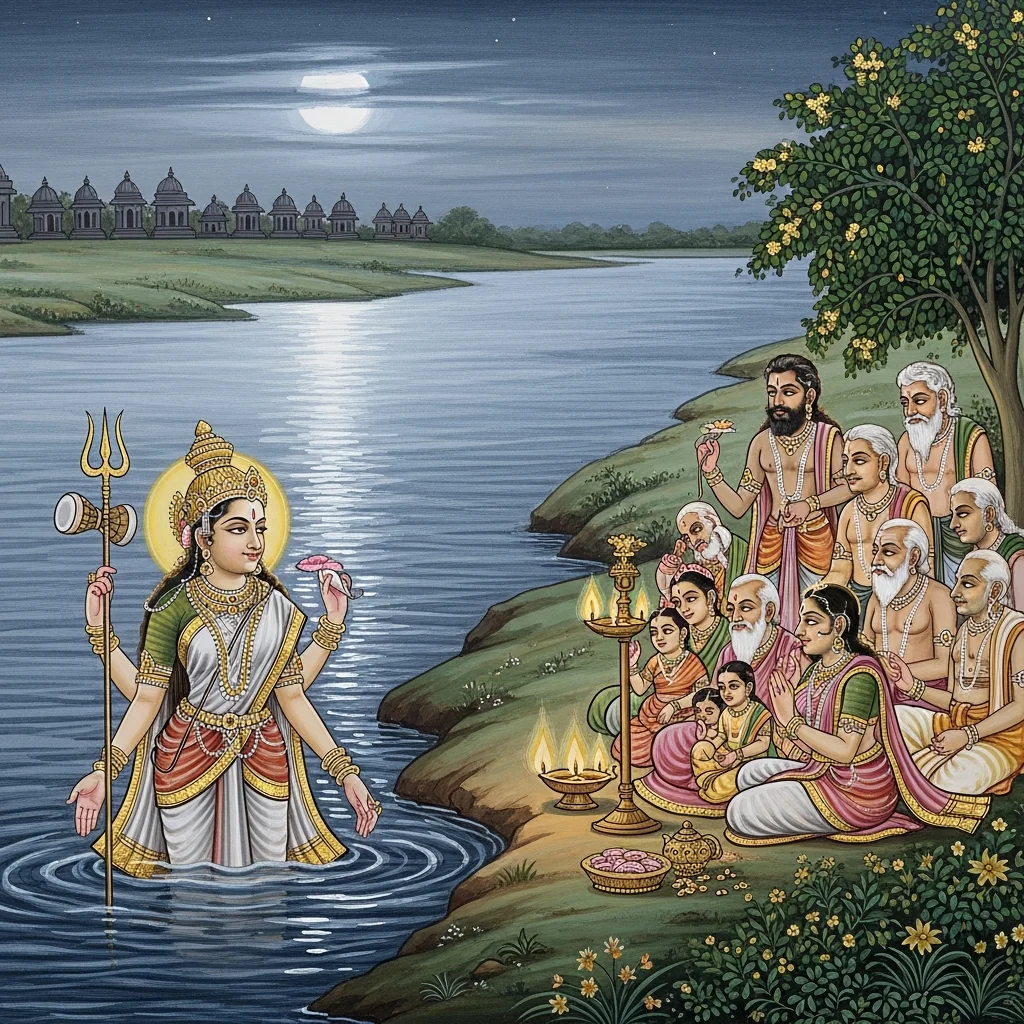
Chapter 13 unfolds a series of theological episodes centered on Narmadā/Revā as a protective, enduring sacred power. Mārkaṇḍeya relates that the Devī, praised by sages, resolves to grant boons and appears to them at night in dreams, reassuring them and inviting them to live near her without fear or want. Extraordinary signs then arise—especially an abundance of fish near the hermitages—marking divine favor and sustaining the ascetic communities. The vision widens: sages dwell along Narmadā’s banks, performing japa, tapas, and rites to ancestors and deities; the riverbanks shine with many liṅga-shrines and disciplined brāhmaṇas. In a later midnight epiphany, a radiant maiden emerges from the waters, bearing a trident and a serpent as sacred thread, urging sages with families to enter her (the river) for protection as pralaya approaches. The chapter finally proclaims Narmadā’s exceptional continuity across multiple kalpas, identifies her as Śaṅkarī-śakti, and names the kalpas in which she does not perish—revealing the river as both sacred geography and a cosmic principle.
Adhyaya 14
नीललोहितप्रवेशः तथा रौद्रदेव्याः जगत्संहारवर्णनम् | Entry into the Śaiva State and the Description of the Fierce Devī in Cosmic Dissolution
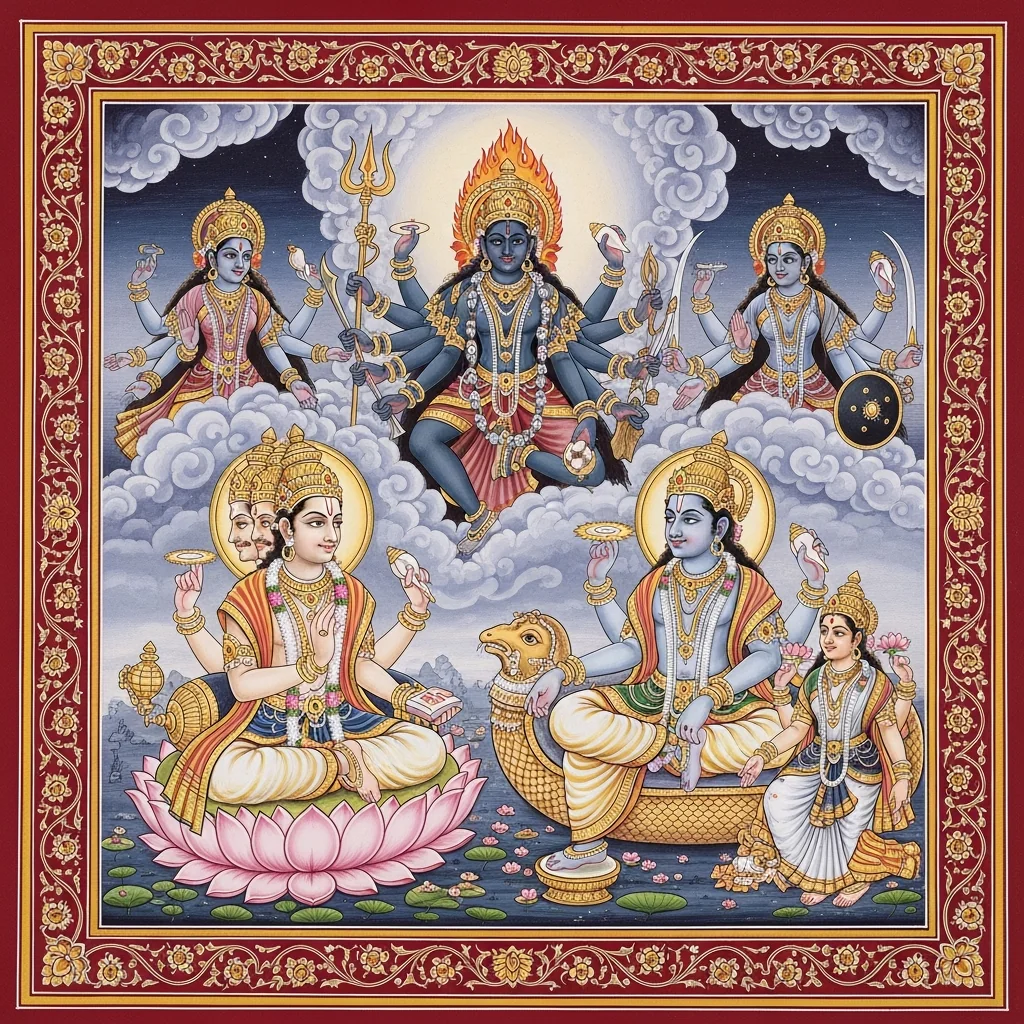
This chapter unfolds as a royal–sage dialogue. Yudhiṣṭhira asks what wondrous event occurred after the sages dwelling on the Narmadā’s bank departed for a higher realm. Mārkaṇḍeya replies by describing a cosmic emergency—a fierce upheaval of destruction (rāudra-saṃhāra) that signals the loosening of the world’s order. Led by Brahmā and Viṣṇu, the gods ascend to Kailāsa, praise the eternal Mahādeva, and petition for dissolution at the close of an immense time-cycle. The teaching is set forth in a threefold mode: the one Divine Reality appears as Brāhmī (creation), Vaiṣṇavī (preservation), and Śaivī (dissolution), culminating in entry into a transcendent Śaiva “pada” beyond elemental conditions. Dissolution is then set in motion. Mahādeva commands Devī to relinquish her gentle form and assume a fierce, Rudra-aligned manifestation. Devī hesitates out of compassion, but Śiva’s wrathful utterance compels her transformation into a Kālārātri-like form. A rising description follows—terrifying iconography, multiplication into innumerable bodies, attendance of gaṇas, and the ordered destabilizing and burning of the three worlds—portraying cosmic dissolution as a theologically governed process rather than a random catastrophe.
Adhyaya 15
Amarāṅkaṭa at the Narmadā: Kālarātri, the Mātṛgaṇas, and Śiva’s Yuga-End Vision (अमरंकट-माहात्म्य तथा संहारा-दर्शनम्)
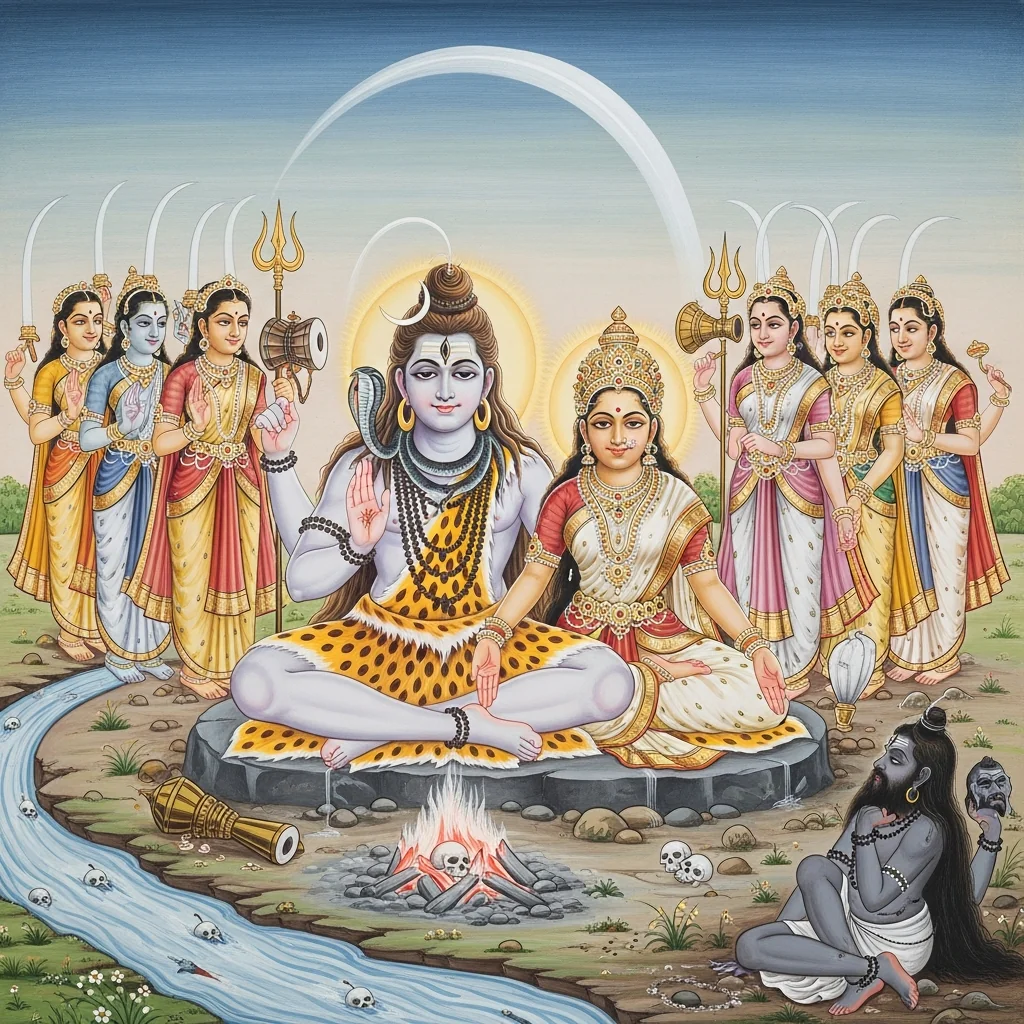
Mārkaṇḍeya recounts a catastrophic, yuga-end-like vision: Kālarātri, encircled by fierce Mātṛgaṇas, overwhelms the worlds. These Mothers are portrayed as powers inflected by Brahmā–Viṣṇu–Śiva and aligned with the elements and the deities of the directions; moving through the ten quarters with weapons, their cries and footfalls scorch the three worlds. The devastation spreads across the seven island-continents, with stark images of blood-drinking and the devouring of beings, signaling cosmic dissolution. After this destructive crescendo, the narrative returns to a sacred center—Śiva’s presence on the bank of the Narmadā at a place called Amarāṅkaṭa, explained through the terms “amarā” and “kaṭa.” Śaṅkara appears with Umā and his hosts (gaṇas and mātṛs), even with Mṛtyu (Death) personified, all joining in ecstatic dance, revealing Rudra as both terror and refuge. The Narmadā is praised as a world-venerated mother-river, mighty and turbulent in her forms. The chapter culminates in an intensified theophany: the storm-wind Saṃvarta arising from Rudra’s mouth dries the oceans; Śiva, marked by cremation-ground emblems and cosmic radiance, enacts dissolution while remaining the supreme object of worship for Kālarātri, the mātṛs, and the gaṇas. The closing verses offer a protective stuti, praising Hari-Hara/Śiva as the universal cause and the focus of continual remembrance.
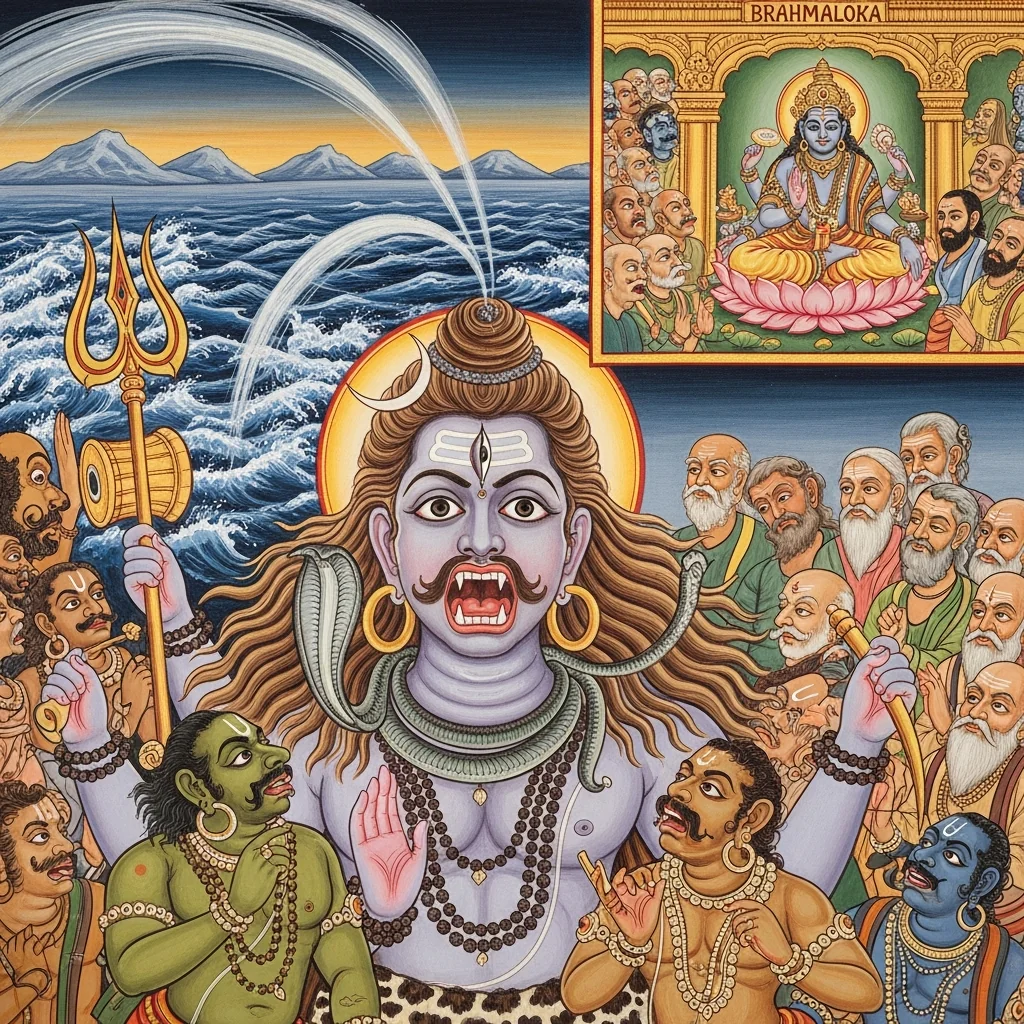
Adhyaya 16
Saṃvartaka-Kāla Nṛtya and Mahādeva-Stotra (Cosmic Dissolution Motif)
Adhyāya 16 unfolds a high-theology sequence through Mārkaṇḍeya’s narration: a formidable Śiva (Śūlī/Hara/Śambhu) dances amid terrifying bhūta-gaṇas, clad in an elephant-hide covering, wreathed in smoke and sparks, with a vadavāmukha-like gaping mouth—evoking the mood of cosmic dissolution (saṃhāra/saṃvartaka-kāla). The shock of the divine aṭṭahāsa (terrific laughter) reverberates through the directions, churns the oceans, and reaches Brahmaloka, unsettling the ṛṣis, who seek clarification from Brahmā. Brahmā explains the phenomenon as Kāla (Time) itself—described through year-cycles (saṃvatsara, parivatsara, etc.), subtle/atomic dimensions, and supreme lordship—turning fear into metaphysical understanding. A stotra then follows: Brahmā offers mantra-inflected praise to Mahādeva, affirming Him as encompassing Śaṅkara, Viṣṇu, and the creator principle, and as beyond speech and mind. Mahādeva reassures Brahmā, bids him behold the “burning” world being drawn in by many mouths, and then disappears. The phalaśruti concludes that hearing or reciting this highly meritorious stotra brings auspicious destiny, freedom from fear, and protection in dangers (battle, theft, fire, forest, ocean), with Śiva praised as the reliable guardian.
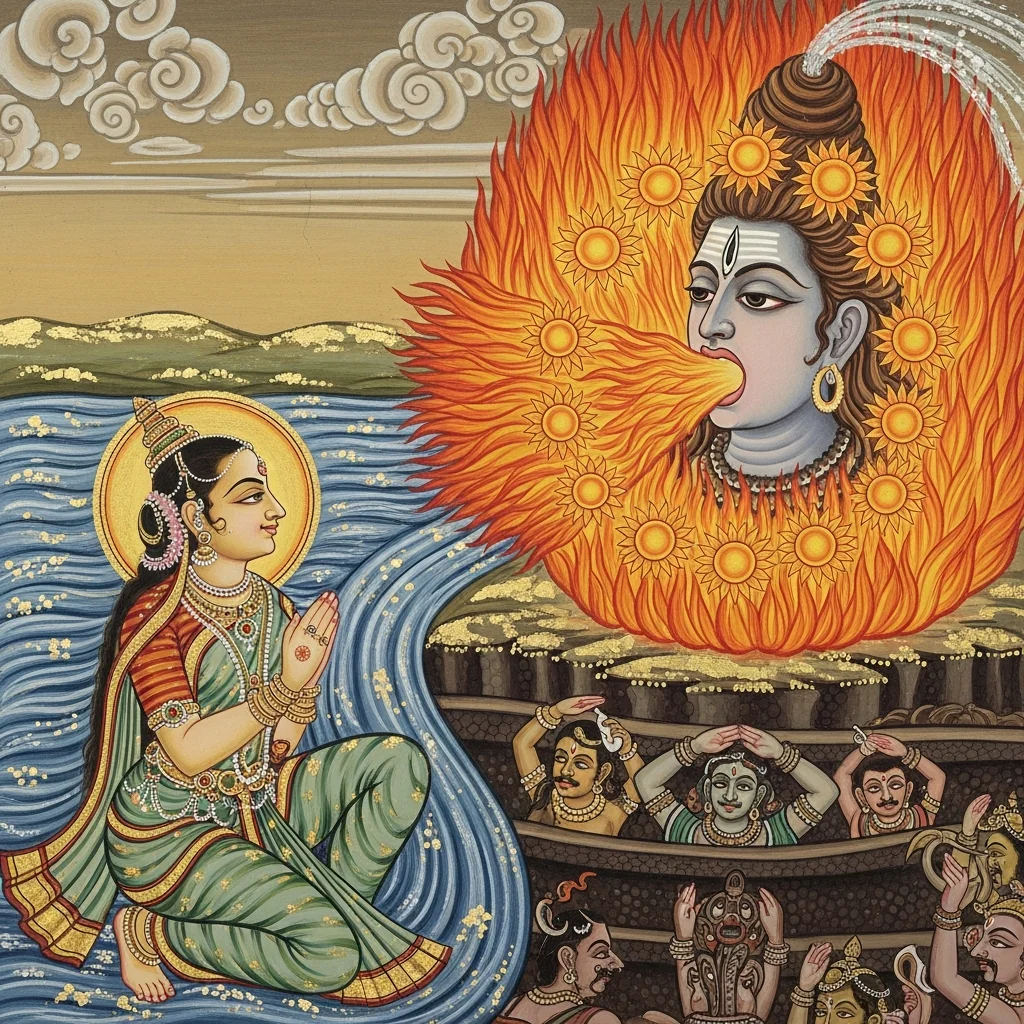
Adhyaya 17
रुद्रवक्त्रप्रलयवर्णनम् (Description of the Dissolution Imagery from Rudra’s Mouth)
This adhyāya sets forth an intense vision of dissolution within a sage–king dialogue. Mārkaṇḍeya describes the cosmic Lord withdrawing the manifested world (saṃjahāra) as gods and sages offer hymns of praise. The account centers on Mahādeva’s terrifying southern face—blazing eyes, massive fangs, serpentine features, and a devouring tongue—through which the world is imagined to enter dissolution, like rivers merging into the ocean. From that mouth burst fierce flames, followed by a twelvefold solar manifestation (dvādaśa ādityas) that scorches the earth, mountains, oceans, and the subterranean realms, including the seven Pātālas and Nāga-loka. Yet the chapter closes with a note of preservation: amid universal burning and the breaking of great mountain ranges, the Narmadā (Revā) is explicitly remembered as not destroyed, affirming a tīrtha-centered sacred geography.
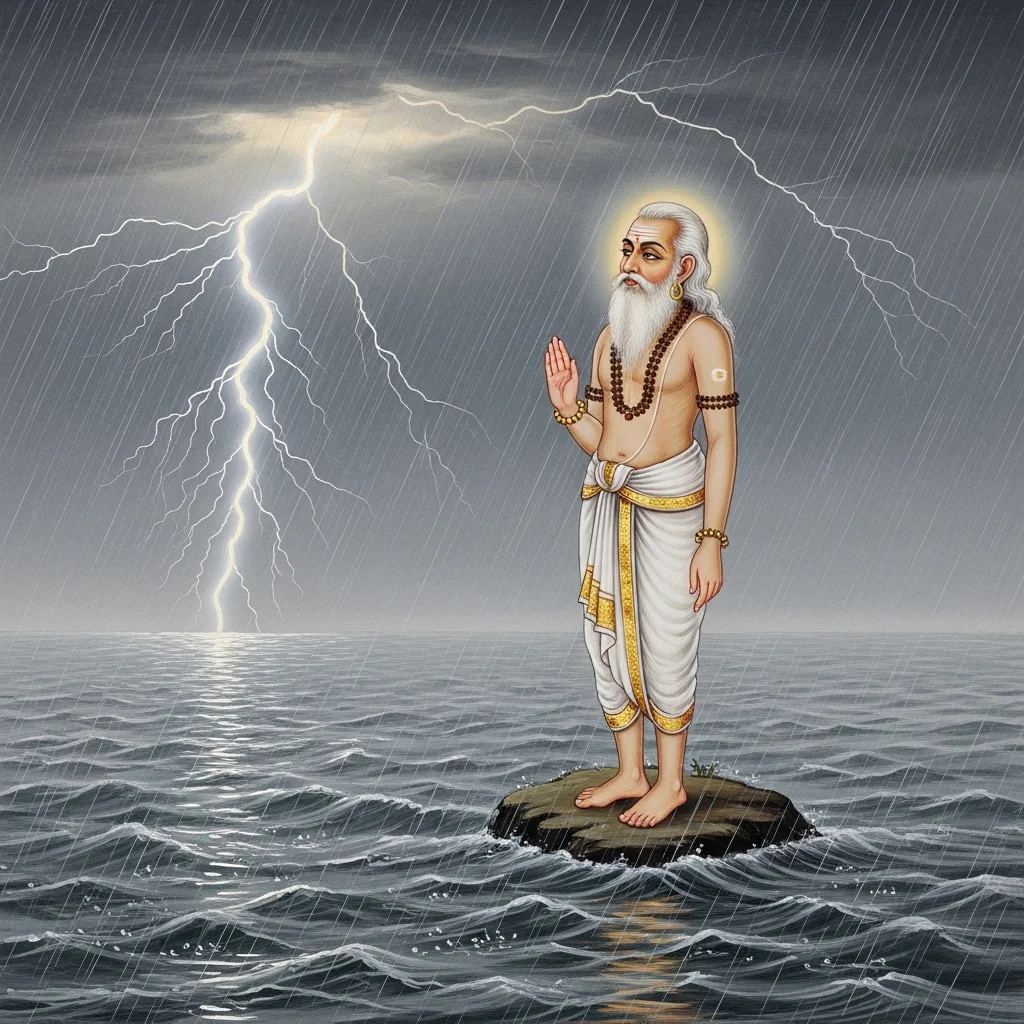
Adhyaya 18
Saṃvartaka-megha-prādurbhāvaḥ (The Manifestation of the Saṃvartaka Clouds) / Cosmic Inundation and the Search for Refuge
Chapter 18, spoken by Śrī Mārkaṇḍeya, unfolds a vision of cosmic dissolution. The world is first scorched by solar power, then the Saṃvartaka clouds arise from a divine source—many-hued and immense, shaped like mountains, elephants, and fortresses, with lightning and thunder. Their rain becomes all-filling, until oceans, islands, rivers, and the earth-spheres merge into a single boundless expanse of water (ekārṇava). With visibility gone, sun, moon, and stars do not appear; darkness and windless stillness prevail, marking cosmic disorientation. Amid the flood, the narrator offers praise and reflects on where true refuge lies, turning inward to disciplined remembrance, meditation, and devotion to the protecting Lord (śaraṇya). By divine grace the mind becomes steady and gains the power to cross the waters, teaching that when outer supports vanish, contemplative refuge and faithful recollection are the rightful spiritual response.
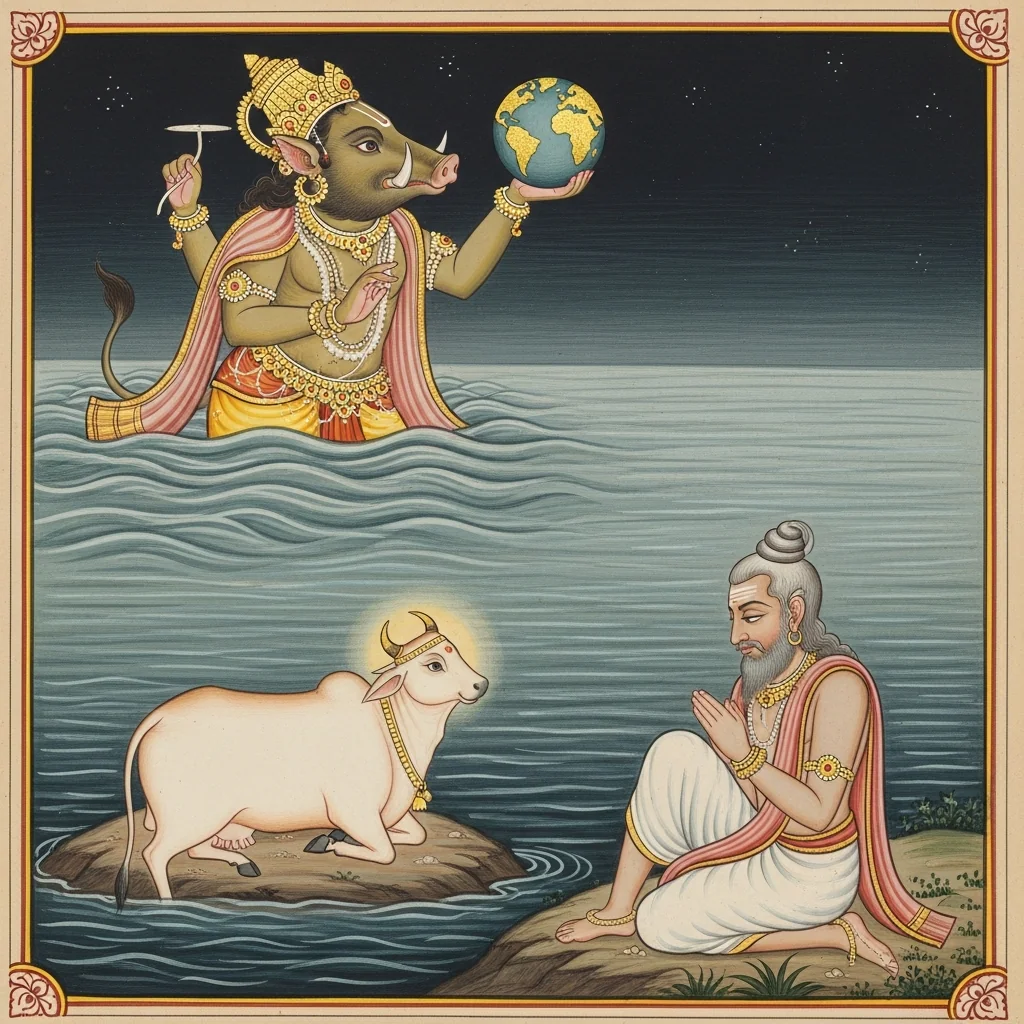
Adhyaya 19
एकोर्णवप्रलये नर्मदागोरूपिण्या रक्षणम् तथा वाराहावतारवर्णनम् | Markandeya’s Rescue by Narmadā (Cow-Form) and the Varāha Cosmogony
Chapter 19 unfolds a two-part theological account in Mārkaṇḍeya’s first-person voice. (1) In the ekārṇava pralaya, when all becomes a single ocean, the exhausted sage nears death and beholds a radiant cow moving upon the waters. She reassures him that by Mahādeva’s grace death will not come, tells him to hold her tail, and grants divine milk that removes hunger and thirst and restores wondrous vitality. She reveals herself as Narmadā, sent by Rudra to save the brāhmaṇa, establishing the river as a conscious savior and a bearer of Śaiva grace. (2) The narrative then turns to a cosmogonic vision: the speaker sees the Supreme Lord in the waters, associated with Umā and cosmic śakti; the deity awakens and assumes the Varāha form to raise the submerged Earth. The text affirms a non-sectarian synthesis, declaring Rudra/Hari and the creator-functions to be non-different in the highest truth, and warns against hostile, divisive readings. The closing phalaśruti proclaims that daily reading or hearing purifies and leads to auspicious heavenly attainments after death.
Adhyaya 20
Pralaya-lakṣaṇa, Dvādaśa-Āditya Vision, and the Revelation of Revā (Narmadā) as Refuge
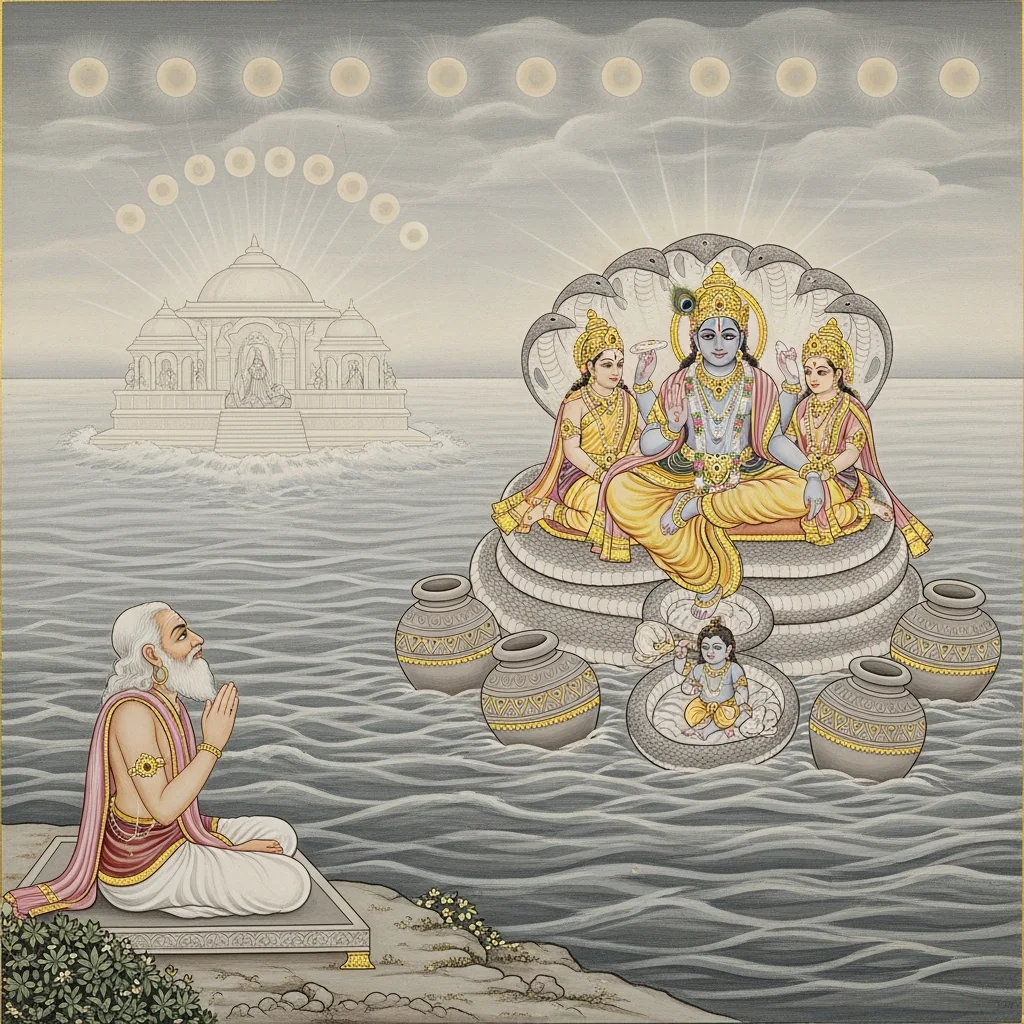
Chapter 20 is framed as a dialogue in which Yudhiṣṭhira asks Mārkaṇḍeya to recount the experienced might (prabhāva) of Śārṅgadhanvan, Viṣṇu. Mārkaṇḍeya describes the omens of pralaya—meteors, earthquakes, dust-rain, dreadful sounds—and the dissolution of beings and landscapes. He then beholds a vision of twelve suns scorching the worlds, with nothing seeming unburnt except Revā and himself. Tormented by thirst, he ascends and reaches a vast, ornamented cosmic abode, where he sees the Supreme Person (puruṣottama) reclining with divine emblems such as conch, discus, and mace. He offers a long hymn praising Viṣṇu as the support of worlds, time, the yugas, creation, and dissolution. A second figure (Hara/Śiva) appears, followed by a manifestation of the Devī, which brings an ethical dilemma about drinking breast-milk to prevent a child’s death. The discourse introduces brāhmaṇa saṃskāra norms (culminating in the traditional forty-eight saṃskāras) to argue ritual propriety, balanced by the Devī’s warning of grave sin in neglecting a child. After a prolonged, dreamlike interval, the Devī reveals the identifications: the sleeper is Kṛṣṇa/Viṣṇu, the second is Hara, the four jars are the oceans, the child is Brahmā, and she herself is the Earth with seven continents; Revā is named Narmadā and declared undestroyed. The chapter closes by affirming the purifying value of hearing this account and inviting further inquiry.
Adhyaya 21
अमरकण्टक-रेवा-माहात्म्य तथा कपिला-नदी-उत्पत्ति (Amarakantaka and Revā Māhātmya; Origin of the Kapilā River)
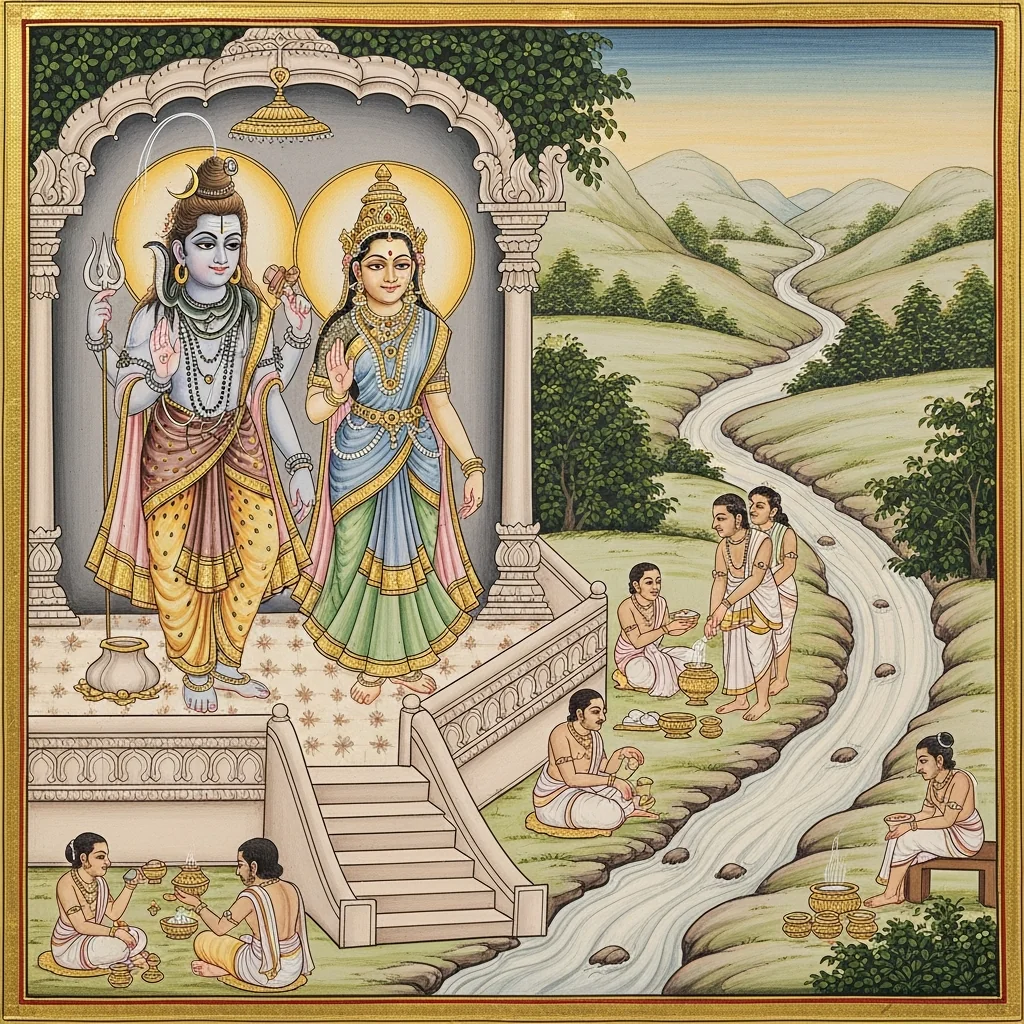
This chapter unfolds as a theological question-and-answer between Yudhiṣṭhira and the sage Mārkaṇḍeya. It proclaims the unrivaled purifying power of the Revā/Narmadā, contrasting holiness tied to particular locales (as with the Gaṅgā at specific spots) with the Revā’s sanctity everywhere. It then portrays the sacred landscape around Amarakantaka as a siddhi-kṣetra visited by devas, gandharvas, and ṛṣis, where tīrthas crowd both banks in near-inexhaustible abundance. A catalog-like section names prominent sites on the northern and southern banks—Charukā-saṅgama, Charukeśvara, Dārukeśvara, Vyatīpāteśvara, Pātāleśvara, Koṭiyajña, and clusters of liṅgas near Amareśvara; also Kedāra-tīrtha, Brahmeśvara, Rudrāṣṭaka, Sāvitra, and Soma-tīrtha. The chapter prescribes disciplined bathing, fasting, brahmacarya, and pitṛ-kriyā (tarpaṇa with tilodaka and piṇḍa offerings), detailing the resulting merit: extended heavenly enjoyment and auspicious rebirth. It further declares that rites performed there become “koṭi-guṇa,” multiplied by Īśvara’s grace, and that Narmadā’s salvific reach extends even to trees and animals touched by its waters; other sacred waters such as Viśalyā are also mentioned. The closing origin tale explains Kapilā’s birth: while Śiva sported in the Narmadā with Dākṣāyaṇī (Pārvatī), water wrung from her bathing garment became the Kapilā River, establishing its name, nature, and extraordinary puṇya.
Adhyaya 22
Viśalyā–Kapilā-hrada Māhātmya (The Etiology of the ‘Arrowless/Healed’ Tīrtha)
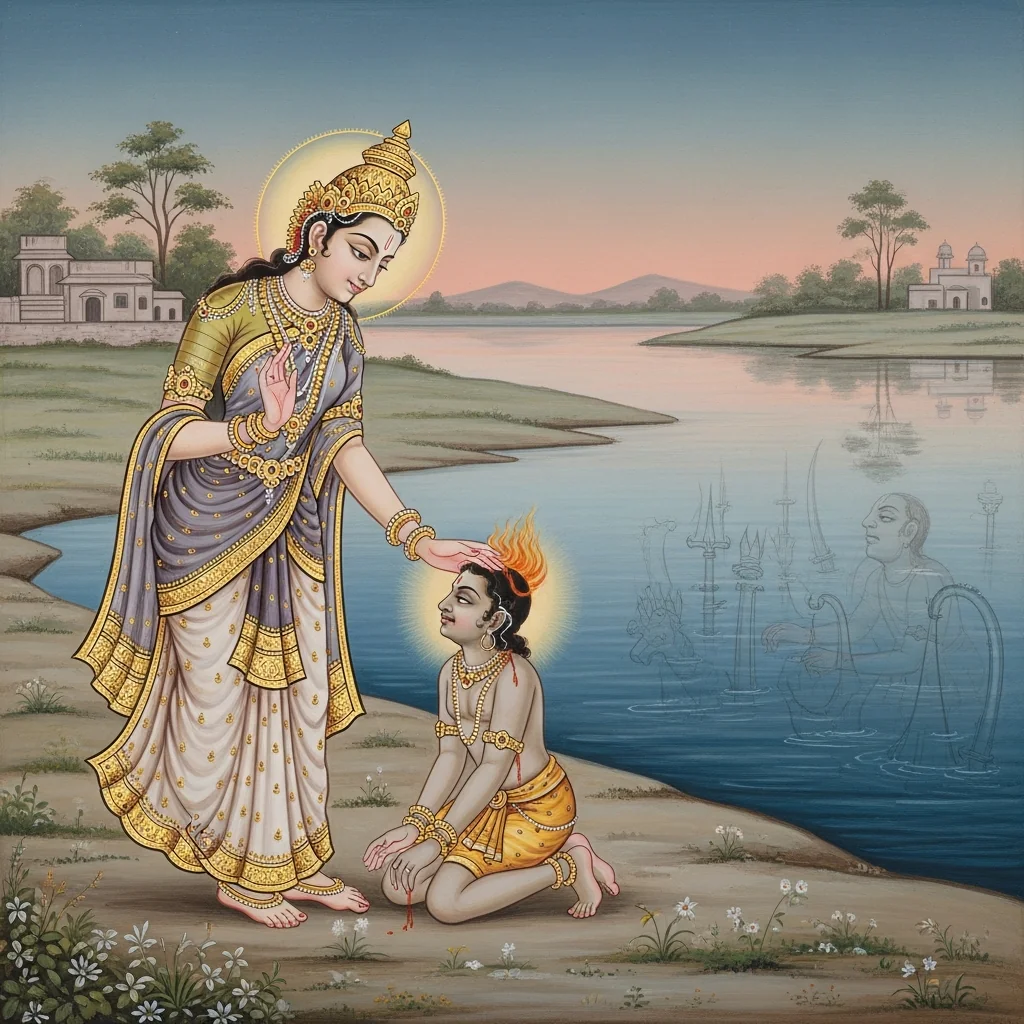
Mārkaṇḍeya recounts the origin of Viśalyā and the holiness of Kapilā Hrada through a layered tale of sacred causation. Agni—praised as a mind-born son of Brahmā and a foremost Vedic fire—performs austerities on a riverbank and receives Mahādeva’s boon: the Narmadā and fifteen other rivers become his consorts, collectively called Dhīṣṇī (river-wives), whose progeny are identified with the sacrificial fires (adhvara-agni) that endure until cosmic dissolution. From Narmadā is born the mighty Dhīṣṇīndra. A great devas–asuras war then arises, linked with Mayatāraka. Seeking refuge, the gods approach Viṣṇu, who summons Pavaka (fire) and Māruta (wind) and commands Dhīṣṇī/Pavakendra to burn the fierce Narmadeya demons. The foes attempt to bind and smother Agni with divine weapons, but Agni and Vāyu consume them, routing the enemies and driving many into subterranean waters. After victory the gods honor the youthful Agni, Narmadā’s son. Returning pierced and wounded (saśalya), he comes to his mother; Narmadā embraces him and enters Kapilā Hrada, whose waters instantly remove the “śalya,” the piercing affliction, making him “viśalya,” free of darts and wounds. The chapter closes with the tīrtha’s promise: those who bathe there are released from “pāpa-śalya” (the barbs of sin), and the departed attain a heavenly goal—thus establishing the site’s name and salvific renown.
Adhyaya 23
Viśalyā–Saṅgama Māhātmya (Glory of the Viśalyā Confluence) — Chapter 23
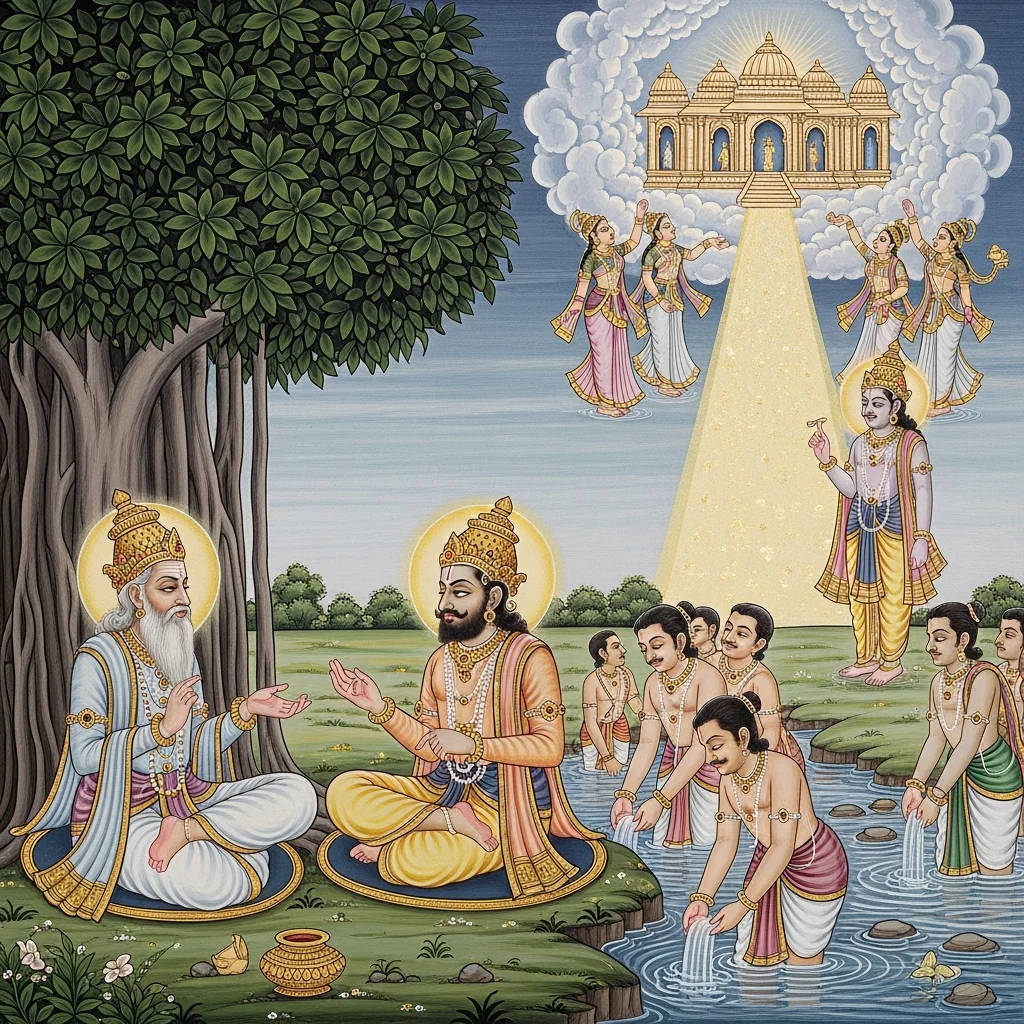
Mārkaṇḍeya instructs a king on the saving power of relinquishing life with devotion at a sacred sangama (confluence), and extols the unmatched purificatory status of Revā (Narmadā) water. The chapter sets forth graded fruits: dying at the sangama with supreme bhakti grants the highest destiny; a renunciant’s death, with all intentions abandoned, leads to heavenly residence after approaching Amareśvara; and relinquishing the body at Śailendra brings ascent in a sun-hued vimāna to Amarāvatī, amid celestial scenes where apsarases praise the fallen devotee. It then ranks holy waters: though some learned authorities speak of Sarasvatī and Gaṅgā as equal, experts place Revā-water above them and discourage dispute over its superiority. The Revā region is portrayed as inhabited by vidyādharas and kinnara-like beings, and those who reverently bear Revā-water upon the head are said to draw near to Indra’s domain. Ethical counsel follows: continual service to Narmadā is urged for those who wish never again to behold the terrifying ocean of saṃsāra; the river purifies the three worlds, and even death anywhere within its sphere yields a gaṇeśvarī (divine attendant) destiny. The riverbank is further described as densely ringed with sacrificial sites, so that even sinners who die there reach heaven. Finally, Kapilā and Viśalyā are named as earlier creations of Īśvara for universal welfare, and bathing with fasting and sense-control is prescribed, promising Aśvamedha-like merit. An anāśaka observance (hungerless discipline) at this tīrtha removes all sins and leads to Śiva’s abode, and a single bath at the Viśalyā-sangama is equated with the fruit of bathing and gifting across the whole earth up to the ocean.
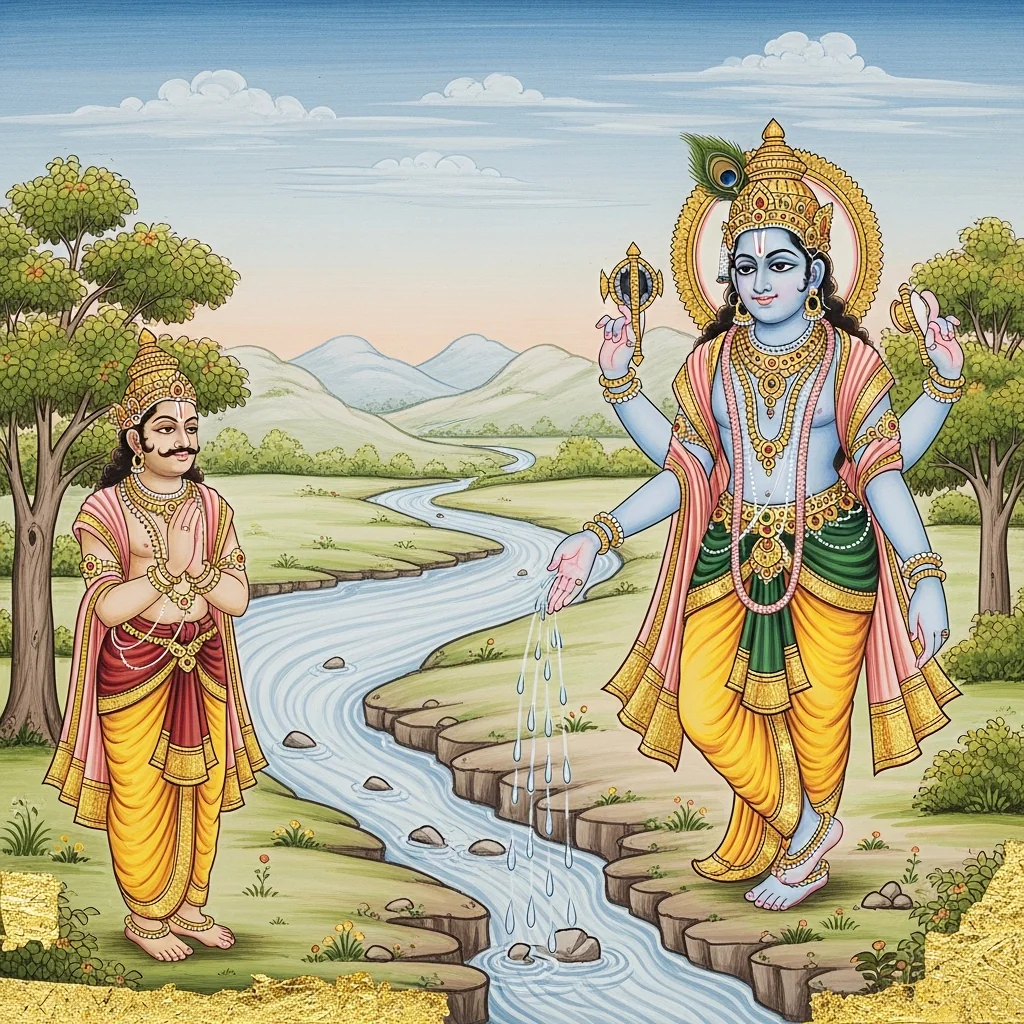
Adhyaya 24
Kara–Narmadā Saṅgama Māhātmya (The Glory of the Kara–Narmadā Confluence at Māndhātṛpura)
This adhyāya, spoken by Śrī Mārkaṇḍeya, points out a particular tīrtha: the saṅgama where the Kara river meets the Narmadā (Revā) at the settlement called Māndhātṛ. It lays down a brief ritual course—go to the confluence, perform snāna (ritual bathing), and cultivate devotion directed to Viṣṇu through worship and reverent remembrance as purifying disciplines. An origin-legend then explains the site’s holiness: when Viṣṇu, intent on slaying a daitya, took up his cakra, an excellent river arose from his perspiration (sveda) and joined the Revā at that very place. The chapter ends with a clear phalaśruti: bathing there, where the river merges with the Revā, releases one from sins.
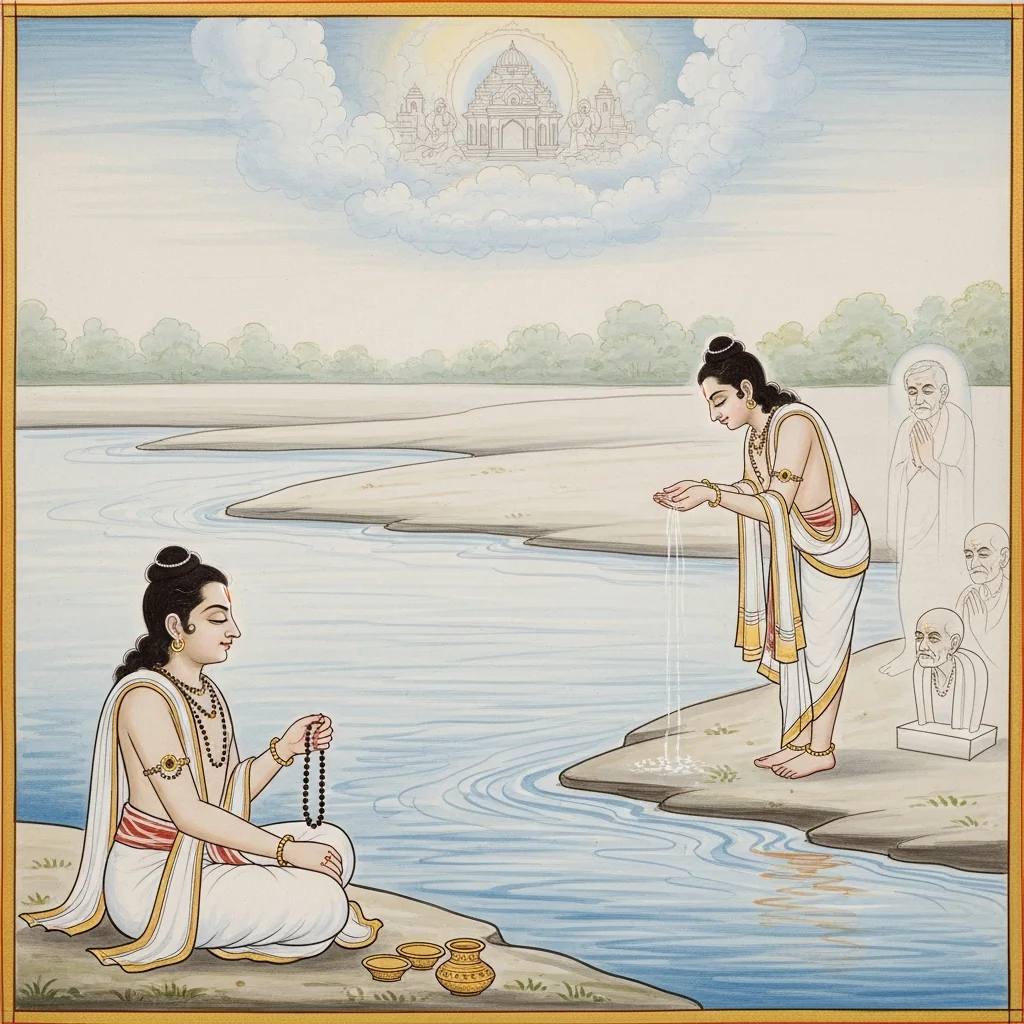
Adhyaya 25
Revā–Nīlagāṅgā Saṅgama Māhātmya (Confluence Theology and Ritual Fruits)
In the Avantī Khaṇḍa, Chapter 25, spoken by Mārkaṇḍeya, points out a celebrated confluence to the eastern side of Oṃkāra, where the Revā (Narmadā) meets the Nīlagāṅgā. The teaching is framed first as a specification of the tīrtha, and then as a compact statement of its fruits (phala). It declares that bathing (snāna) and mantra-recitation (japa) at this saṅgama make worldly aims attainable, presenting the place as a means of ritual efficacy. It further promises a prolonged sacred posthumous residence—sixty thousand years in Nīlakaṇṭhapura—thus linking local geography with a Śaiva-associated holy realm. A lineage-ethical element is added: during śrāddha, if one performs tarpaṇa for the ancestors with water mixed with sesame (tila-miśra jala), the practitioner is said to “lift up” twenty-one persons along with oneself. Overall, the chapter serves as a concise ritual-geo index: location → recommended acts → enumerated fruits.
Adhyaya 26
Jāleśvara Tīrtha-प्रशंसा, Tripura-उपद्रवः, तथा Madhūkā (Lalitā) Vrata-विधानम् | Praise of Jāleśvara, the Tripura crisis, and the Madhūkā vow
Chapter 26 presents a layered theological teaching. Yudhiṣṭhira asks Mārkaṇḍeya why the Jāleśvara tīrtha grants extraordinary merit and is revered by siddhas and rishis. Mārkaṇḍeya praises Jāleśvara as an unsurpassed sacred ford and explains a cosmic backdrop: devas and rishis are harassed by Bāṇa and allied asuras connected with the formidable, mobile Tripura. They first seek refuge with Brahmā, who admits Bāṇa’s near-invulnerability except through Śiva, and then approach Mahādeva with hymns highlighting Śiva’s many forms (pañcākṣara, pañcavaktra, aṣṭamūrti themes). Śiva promises relief and summons Nārada as a key instrument. Sent to Tripura to create internal differentiation through “many dharmas,” Nārada reaches Bāṇa’s splendid city, is honored, and converses with Bāṇa and the queen. The narrative then turns to practical instruction: Nārada teaches women’s vrata and dāna observances tied to lunar tithis, listing gifts (food, garments, salt, ghee, and more) and their fruits (health, auspiciousness, continuity of the family line). A major section details the Madhūkā/Lalitā vow beginning on Caitra śukla tṛtīyā: installing and worshiping an image of the madhuka tree with Śiva–Umā, mantra-linked limb worship, arghya and karaka-dāna formulas, a monthly regimen, and an annual udyāpana with offerings to the guru/ācārya. The chapter closes with promised results—removal of misfortune, growth of marital harmony and prosperity, and auspicious rebirth—framed within ethical and ritual discipline.
Adhyaya 27
Dāna-viveka and Pati-dharma Assertion (दानविवेकः पतिधर्मप्रतिज्ञा च)
After hearing Nārada’s words, the queen offers him lavish gifts—gold, gems, fine garments, even rare items. Nārada refuses personal enrichment and redirects the giving toward needy Brahmins (kṣīṇa-vṛttayaḥ), declaring that sages are sustained by devotion, not by hoarding wealth. The queen then summons impoverished Brahmins skilled in the Veda and Vedāṅga and gives as Nārada advises, stating that the charity is meant to please Hari and Śaṅkara. Immediately afterward she asserts her marital vow: her husband Bāṇa is her sole deity, and she prays for his long life and continued companionship across births, while noting she has still followed Nārada’s instruction in dāna. Nārada takes leave and departs; the women are then described as turning pale and losing their lustre, as if “bewildered” by him—an ending that signals a narrative turn and highlights the power of sage-mediated discourse to reshape minds and social outcomes.
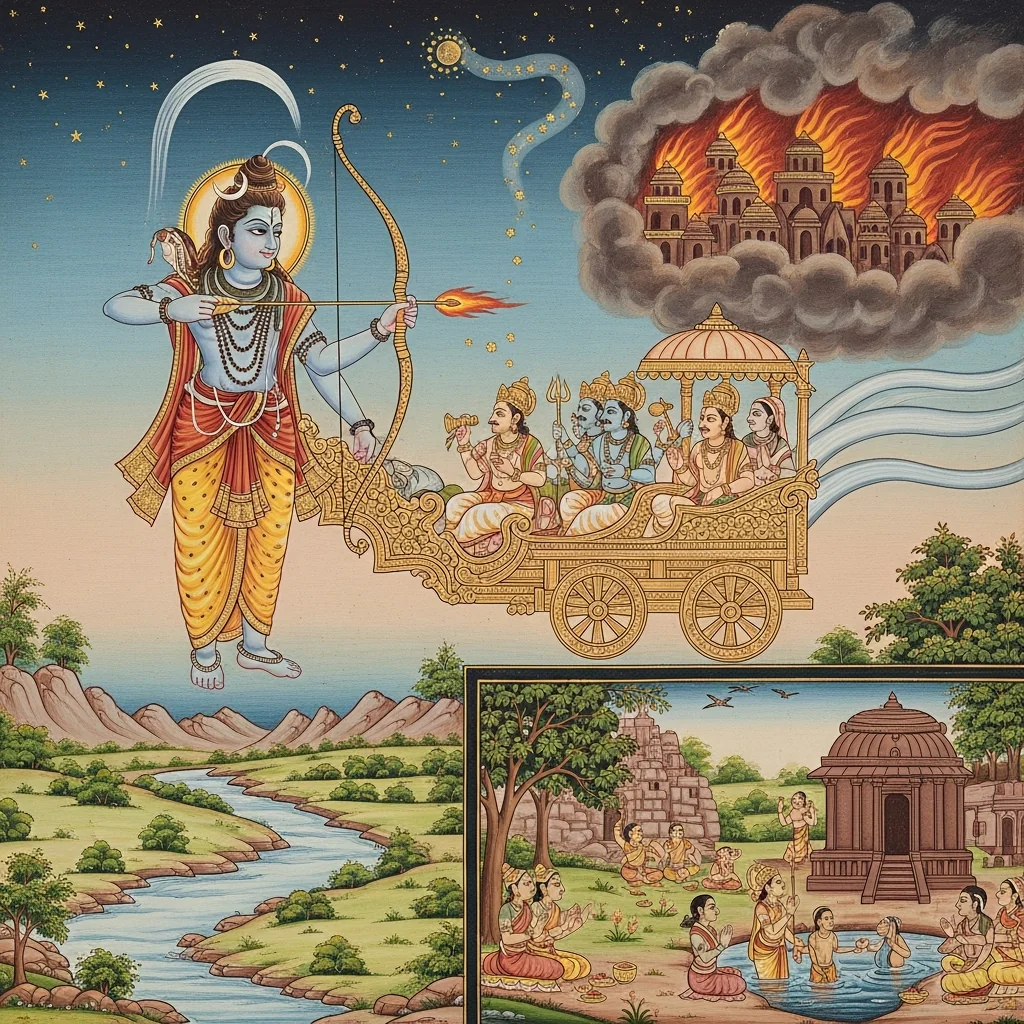
Adhyaya 28
दग्धत्रिपुरप्रसङ्गः, बाणस्तोत्रम्, अमरकण्टक-ज्वालेश्वरमाहात्म्यम् (Burning of Tripura, Bāṇa’s Hymn, and the Māhātmya of Amarakāṇṭaka–Jvāleśvara)
Mārkaṇḍeya relates that Rudra, abiding with Umā on the bank of the Narmadā, receives Nārada’s report concerning Bāṇa and his palace. Śiva then contemplates the Tripura campaign and fashions a cosmic chariot and weapon-system, assigning deities, the Vedas, sacred meters, and cosmic principles to the chariot’s parts; when the three cities align, he releases the arrow and Tripura is brought to ruin. Ominous portents and catastrophic imagery portray the vast conflagration and the social disorientation within Tripura. Bāṇa, acknowledging moral culpability and the devastation wrought, seeks refuge in Śiva and offers a sustained stotra, declaring Śiva the all-pervading ground of gods and elements. Śiva’s wrath subsides; he grants Bāṇa protection and rank, and restrains a portion of the destructive fire. The fallen, burning fragments are then linked to sacred sites such as Śrīśaila and Amarakāṇṭaka, explaining the name Jvāleśvara and establishing a theology of pilgrimage. Mārkaṇḍeya further prescribes a disciplined method (kṛcchra, japa, homa, worship) for the ‘pātana’ practice at Amarakāṇṭaka and lists nearby tīrthas on the southern bank of the Revā, emphasizing regulated observance, ancestral rites, and the removal of faults.
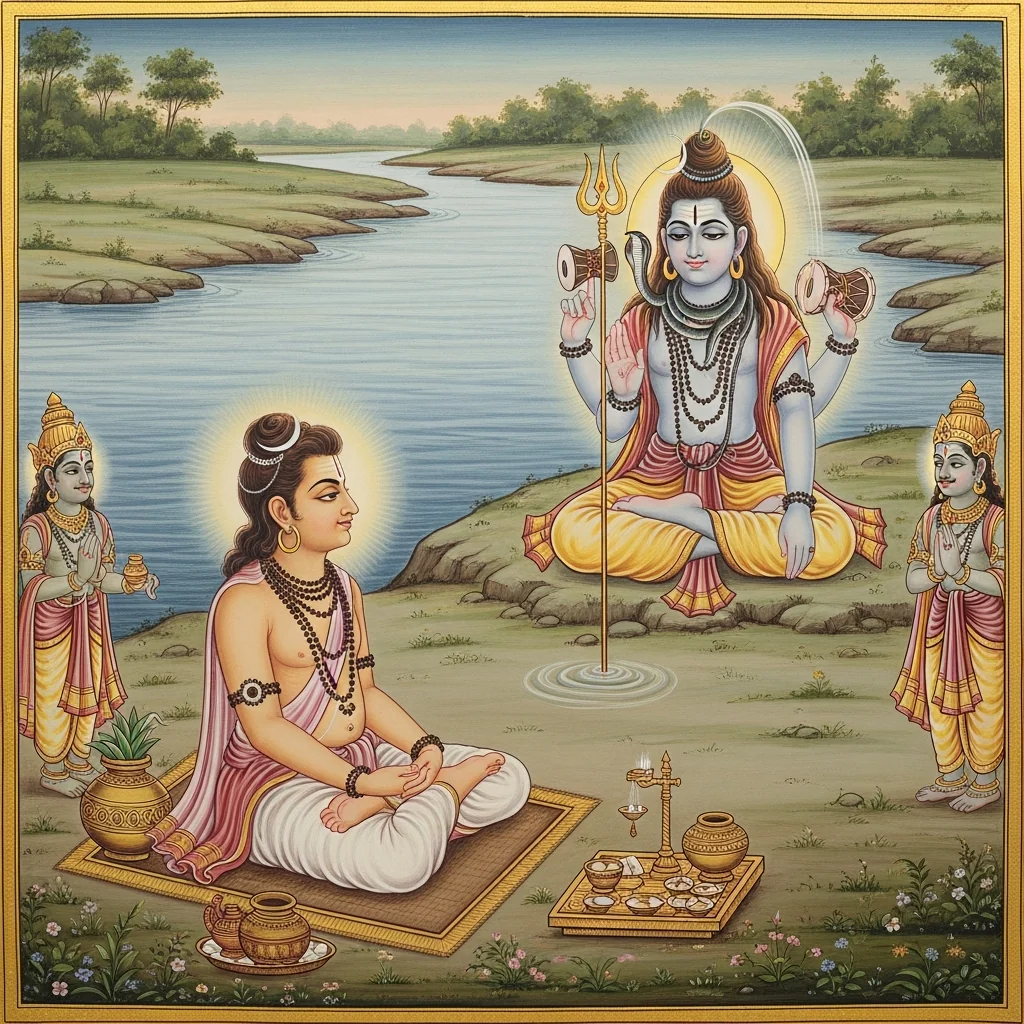
Adhyaya 29
Kāverī–Narmadā Saṅgama Māhātmya (Kubera’s Observance and the Fruits of Tīrtha-Discipline)
The chapter unfolds as a theological question-and-response. Yudhiṣṭhira asks for a precise account of the Kāverī’s renown and the definite fruits gained by beholding her, touching her, bathing, reciting sacred words, giving gifts, and fasting within her holy sphere. Mārkaṇḍeya replies by extolling the Kāverī–Narmadā confluence as a widely famed tīrtha and confirms its power through an exemplary narrative. Kubera, a mighty yakṣa, performs long, rule-governed austerities at the confluence: he maintains ritual purity, worships Mahādeva (Śiva) with disciplined devotion, and undertakes graded restraints of food and vow—regulated intake, periodic fasting, and severe observances—over an extended time. Śiva appears and grants boons; Kubera asks for lordship over the yakṣas, together with enduring bhakti and a steady orientation toward dharma, and Śiva affirms these requests. The discourse then expands into a phalaśruti-like catalogue: the confluence is praised as sin-destroying and as a gateway to heavenly realms; offerings that benefit the ancestors are emphasized; and merits are compared, even equated, with major sacrifices. A protected sacred ecology is also introduced—kṣetrapālas, guarded yogas of the rivers, and named liṅgas in the Amareśvara region—along with a warning that wrongdoing within the sacred field bears especially weighty consequences. The closing verses reaffirm Kāverī’s exceptional status and her sanctity linked to Rudra’s origin.
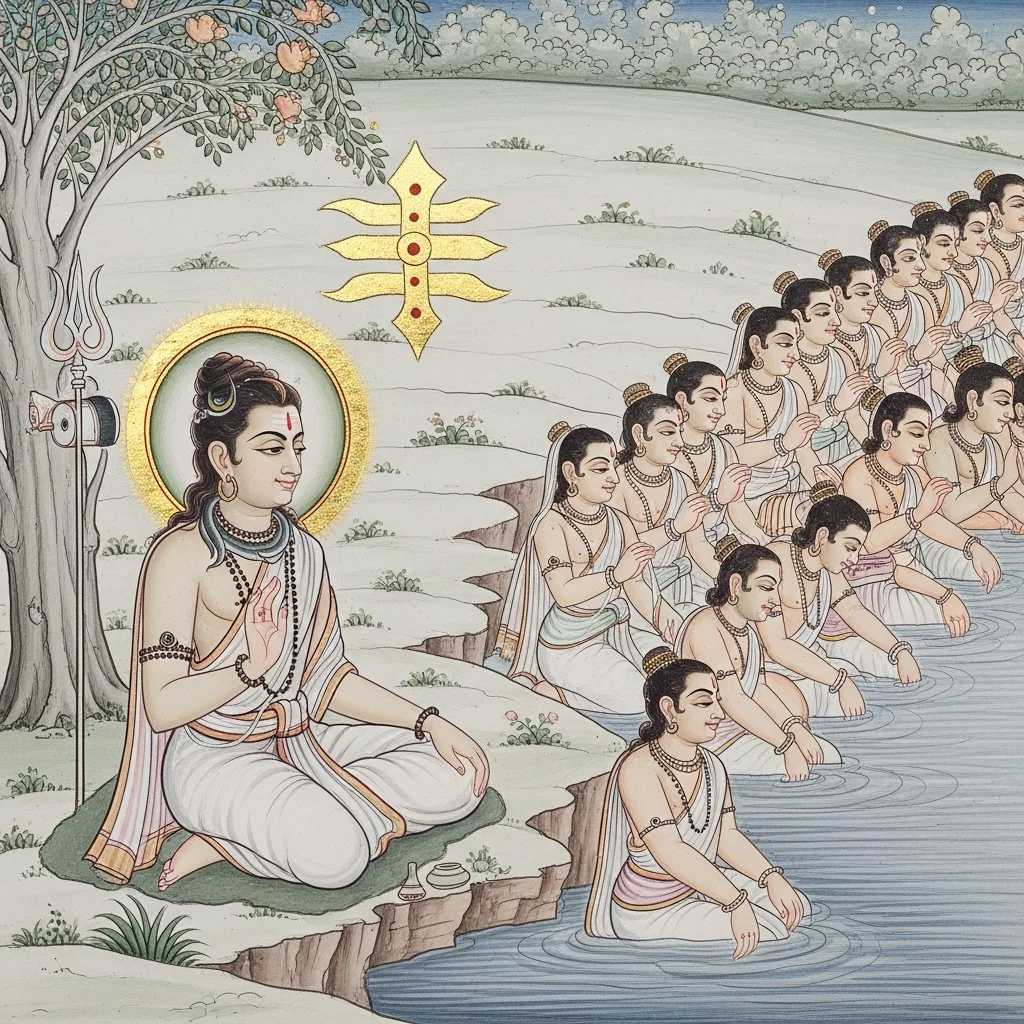
Adhyaya 30
Dārutīrtha-māhātmya (The Glory of Dārutīrtha on the Narmadā)
Adhyāya 30 unfolds as a dialogue in which Mārkaṇḍeya answers Yudhiṣṭhira’s question about a famed tīrtha on the northern bank of the Narmadā—Dārutīrtha. The chapter identifies its namesake, Dāru of the Bhārgava lineage, a learned brāhmaṇa skilled in Veda and Vedāṅga. His life is narrated through the āśrama sequence—brahmacarya, gṛhastha, vānaprastha—culminating in ascetic discipline in accord with yati-dharma. The narrative emphasizes his sustained meditation on Mahādeva and lifelong austerity, by which the tīrtha becomes renowned “in the three worlds.” It then gives observances: bathe there according to rule and worship pitṛs and the deities. Ethical marks—truthfulness, restraint of anger, and the welfare of beings—are paired with promised attainments, while fasting is linked with satya and śauca, and Vedic recitation (Ṛg, Sāma, Yajus) is said to yield “excellent fruit.” In a concluding, phalaśruti-like claim attributed to Śaṅkara, one who relinquishes life there with proper observance attains anivartikā gati, a non-returning course.
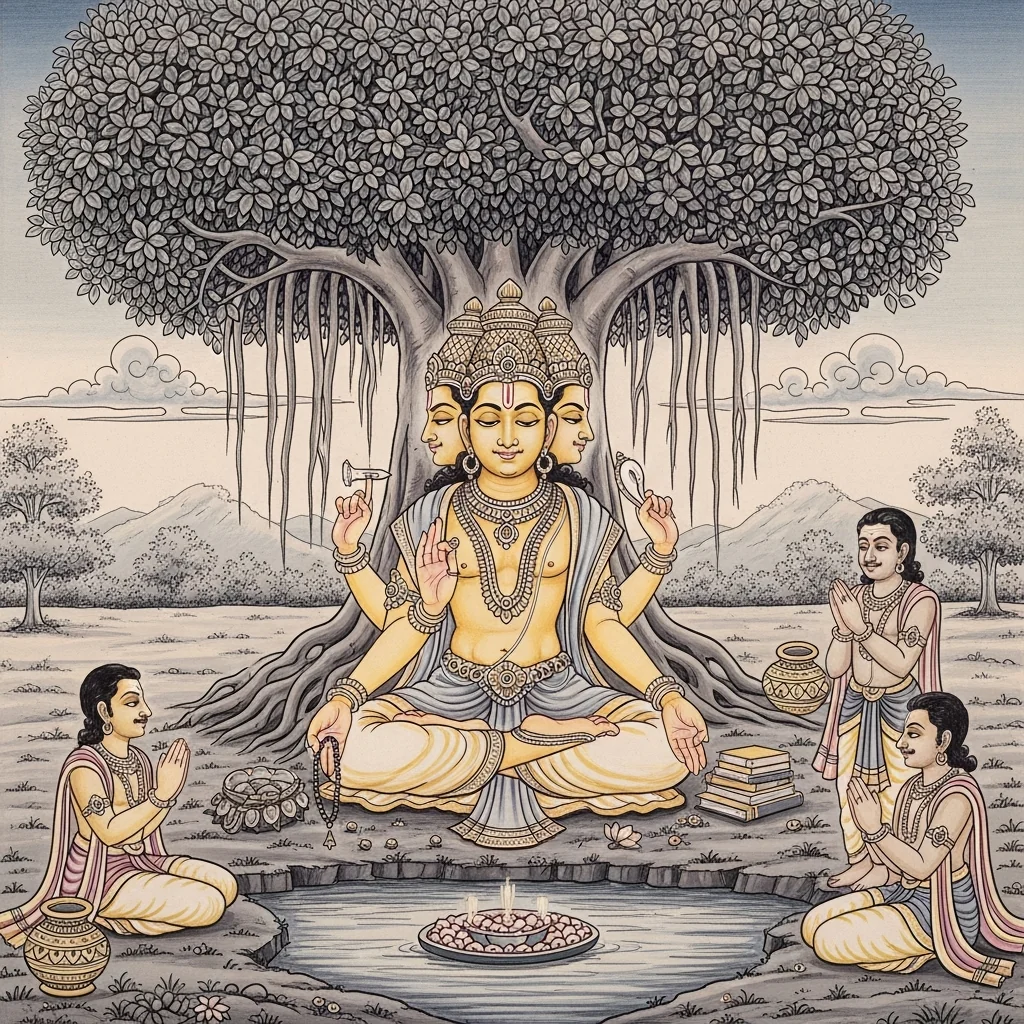
Adhyaya 31
ब्रह्मावर्ततीर्थमाहात्म्य — The Glory of the Brahmāvarta Tīrtha
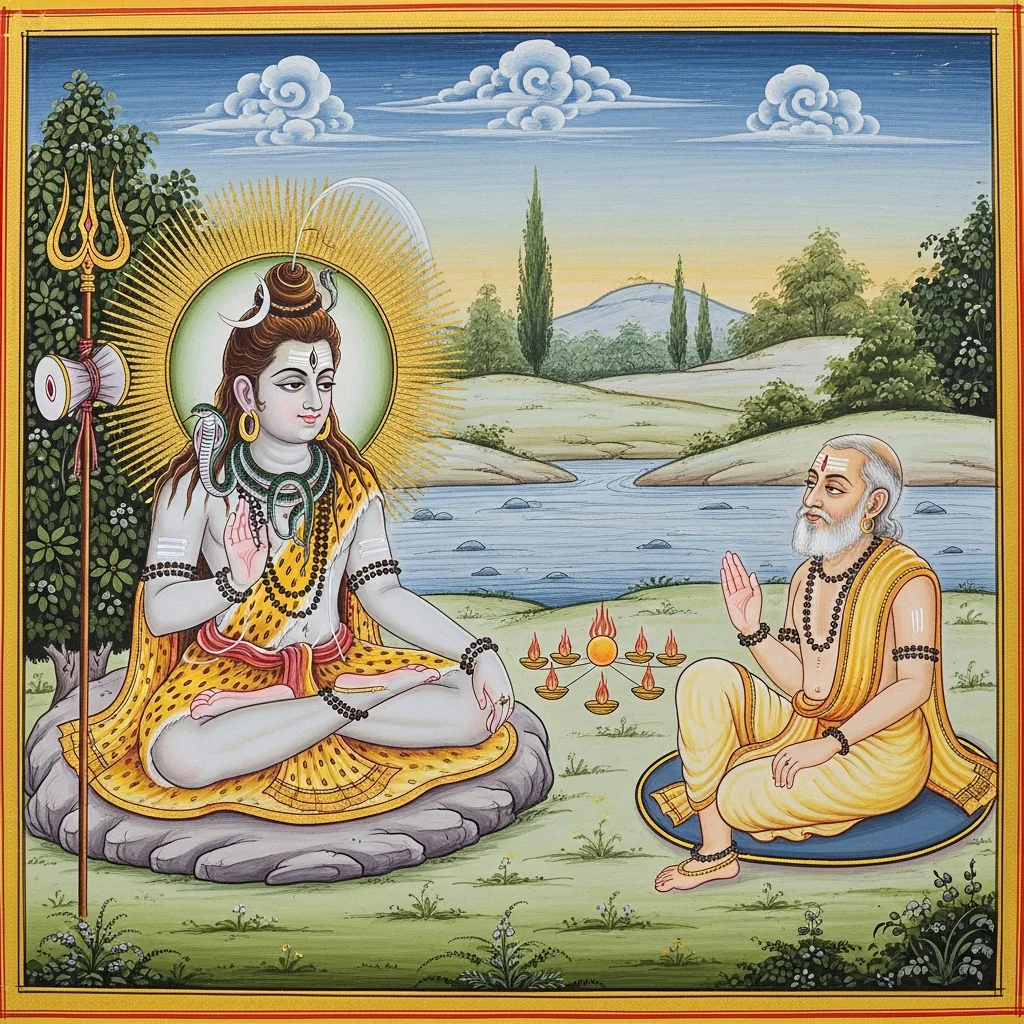
Mārkaṇḍeya tells the listening king of a famed tīrtha called Brahmāvarta, praised as a purifier of all defilement. Brahmā is portrayed as ever-present there, engaged in severe tapas—disciplined living, sustained austerity, and steady contemplation of Maheśvara (Śiva). The chapter then gives practical injunctions: one should bathe according to rule, offer tarpaṇa to ancestors and deities, and worship Īśāna (Śiva) or Viṣṇu as the Supreme Lord. The tīrtha’s fruit is declared to bestow merit equal to sacrifices properly performed with the requisite gifts. It also teaches that places do not become holy for humans without purposeful effort; resolve, capacity, and steadfastness lead to success, while negligence and greed lead to ruin. The closing maxim universalizes disciplined renunciation: wherever a self-restrained muni dwells, that place becomes equal to great sacred fields such as Kurukṣetra, Naimiṣa, and Puṣkara.
Adhyaya 32
पत्त्रेश्वरतीर्थमाहात्म्य (Patreśvara Tīrtha Māhātmya)
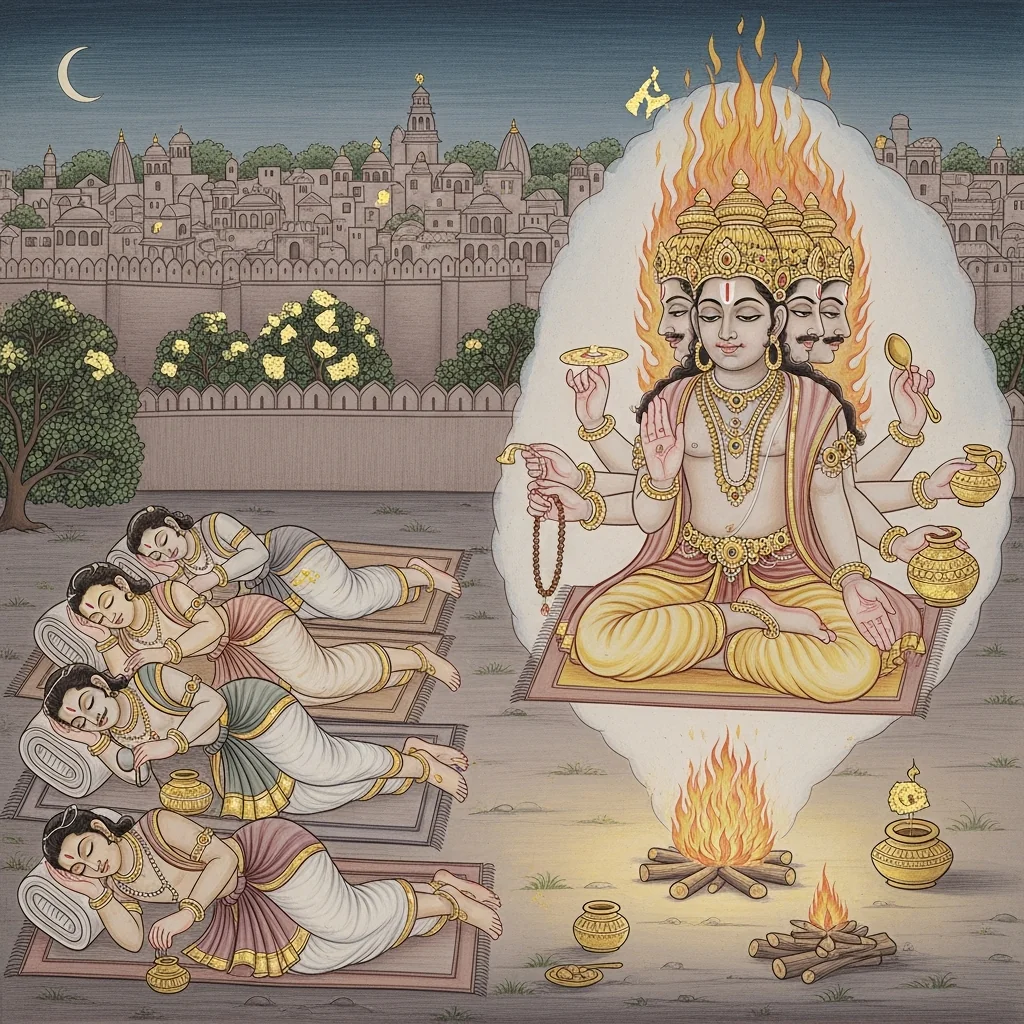
This adhyāya unfolds as a dialogue: Yudhiṣṭhira asks Mārkaṇḍeya to name a mighty siddha connected with the sin-destroying tīrtha called Patreśvara. Mārkaṇḍeya recounts a radiant being—son of Citr(a)/Citr(a)—known as Patreśvara, also called Jaya. In the divine assembly, during Menakā’s dance, he becomes infatuated and loses self-restraint; Indra, seeing this lapse, pronounces a curse of prolonged mortal life, an ethical warning against ajitendriyatā—unconquered senses. To obtain release, the cursed one is directed to undertake twelve years of disciplined practice on the bank of the Narmadā (Revā): bathing, japa, worship of Śaṅkara (Śiva), and severe austerities including pañcāgni tapas. Śiva appears and offers a boon; the devotee asks that Śiva remain at that tīrtha under his name, thus establishing the Patreśvara shrine and its renown in the three worlds. The phalaśruti concludes that a single bath there destroys sins, and worship grants vast merit like the fruit of an Aśvamedha, heavenly enjoyment, auspicious rebirth, longevity, freedom from disease and sorrow, and enduring remembrance of the sacred waters.
Adhyaya 33
अग्नितीर्थमाहात्म्य — Agnitīrtha Māhātmya (The Glory of Agni-Tīrtha)
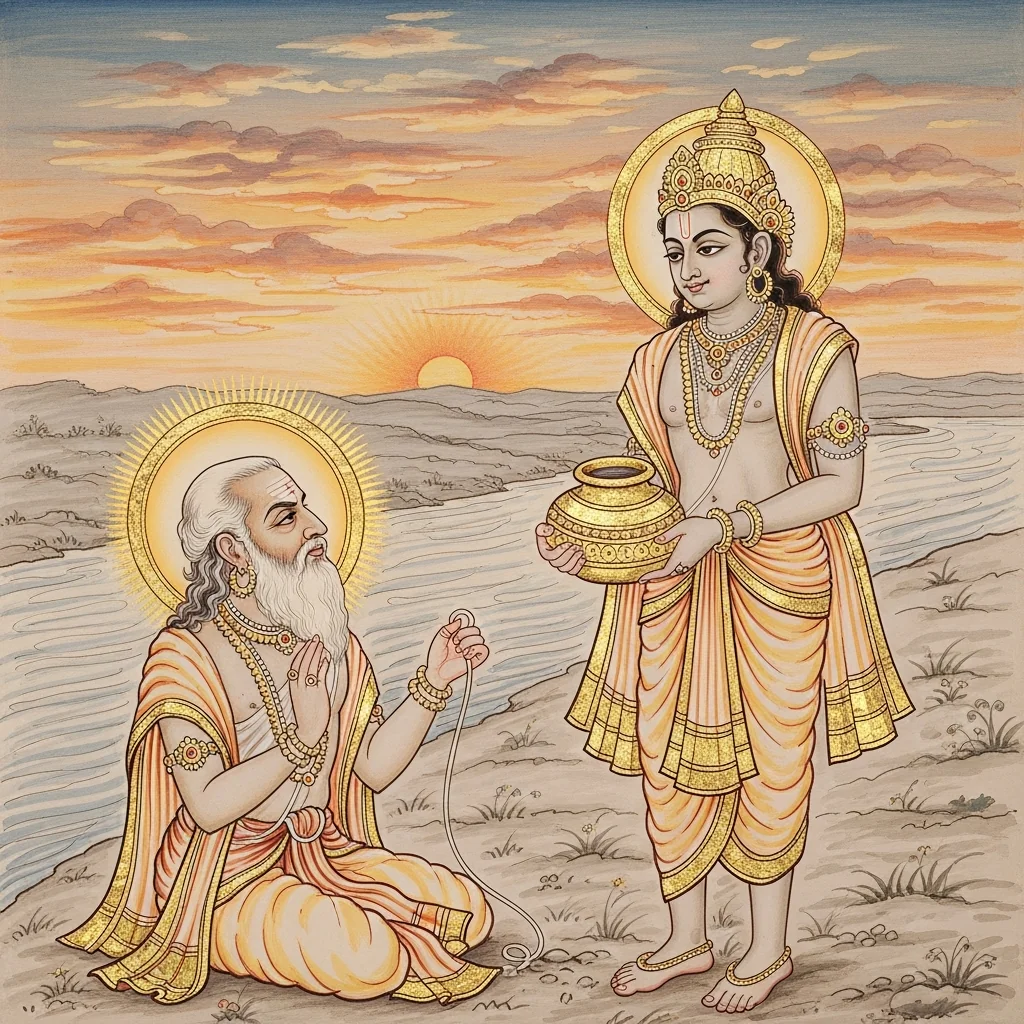
Mārkaṇḍeya instructs Yudhiṣṭhira to proceed to Agnitīrtha and introduces a theological reflection on how Agni becomes “present” at a place through desire and through social-ethical causality. In Kṛtayuga, King Duryodhana rules at Māhiṣmatī and unites with Narmadā, who bears him a daughter, Sudarśanā. When she comes of age, Agni appears disguised as a poor Brahmin and asks for her hand; the king refuses, judging him unfit for want of wealth and status. Agni then vanishes from the sacrificial fire, disrupting rites and alarming the Brahmins. After inquiry and ascetic vigilance, Agni reveals in a dream that the refusal caused his withdrawal. The Brahmins convey the condition: if the king grants the daughter, Agni will blaze again in the royal house. The king agrees, the marriage is arranged, and Agni remains perpetually present at Māhiṣmatī. The text names the place Agnitīrtha and proclaims its merits: bathing and giving at the junctions of the lunar fortnights, offerings to ancestors and deities, the gift of gold equated with the merit of gifting land, and a fasting observance that leads to enjoyment in Agni’s world. The chapter concludes by praising the tīrtha as purifying and beneficial even by hearing alone (the fruit of śravaṇa).
Adhyaya 34
Āditya’s Manifestation at a Narmadā Tīrtha and the Stated Fruits of Worship (आदित्य-तत्त्व एवं तीर्थफल-प्रशंसा)
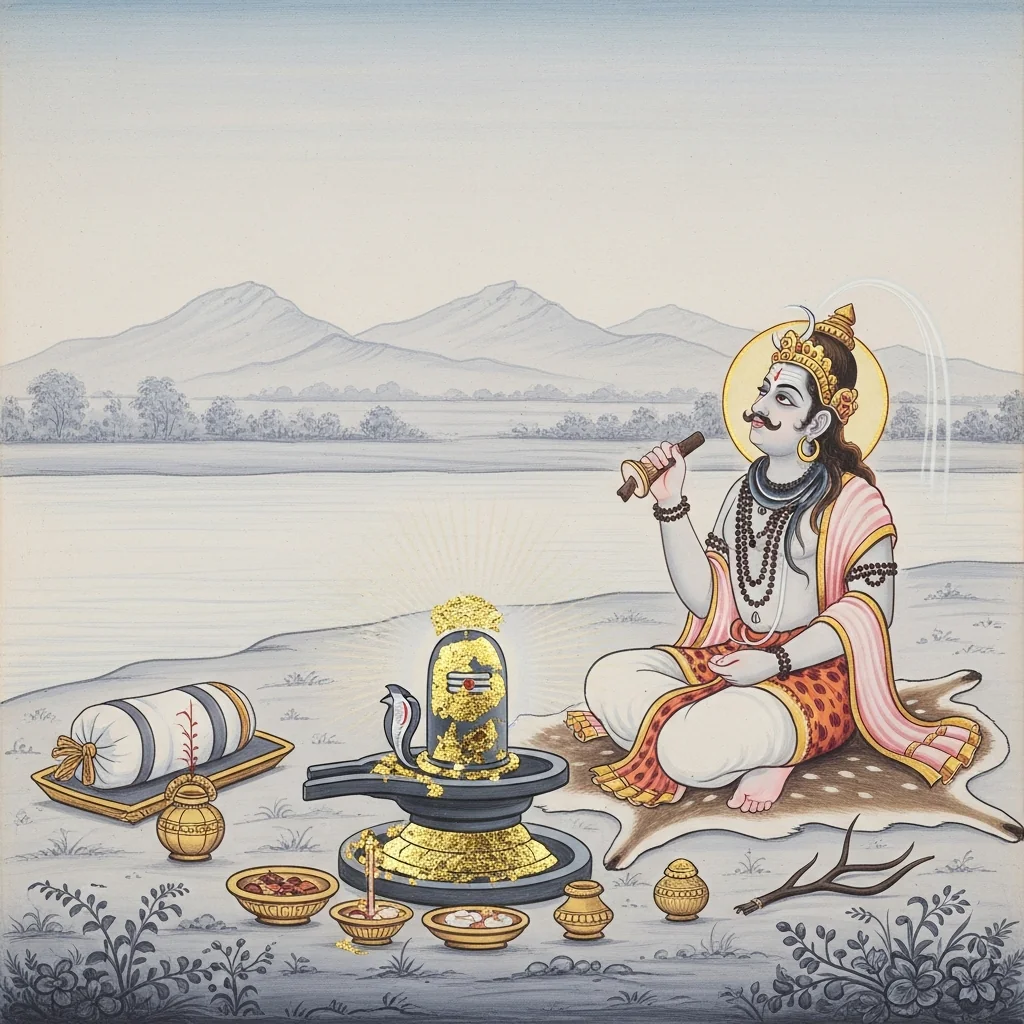
Chapter 34 unfolds as a dialogue in which Mārkaṇḍeya recounts another account of the great Āditya at a Narmadā riverbank tīrtha. Yudhiṣṭhira marvels, and Āditya is praised as all-pervading and as the savior of beings. A brāhmaṇa devotee of the Kulika lineage undertakes a severe pilgrimage-vow—traveling long without food and with only minimal water. The deity appears to him in a dream, instructs him to moderate the vow, and teaches the doctrine that the Divine pervades the moving and the unmoving world. Granted a boon, the devotee asks that Āditya abide permanently on the northern bank of the Narmadā, and that all who remember or worship him—even from afar—and those with bodily impairments receive compassion and benefit. The chapter then proclaims tīrtha-fruits: bathing and offerings yield merit like an Agniṣṭoma; certain end-of-life acts there lead to Agni-loka, Varuṇa-loka, or long honor in svarga; and daily remembrance of Bhāskara at dawn is said to remove sins accumulated through life.
Adhyaya 35
मेघनादतीर्थ-प्रादुर्भावः (Origin and Merit of Meghnāda Tīrtha)
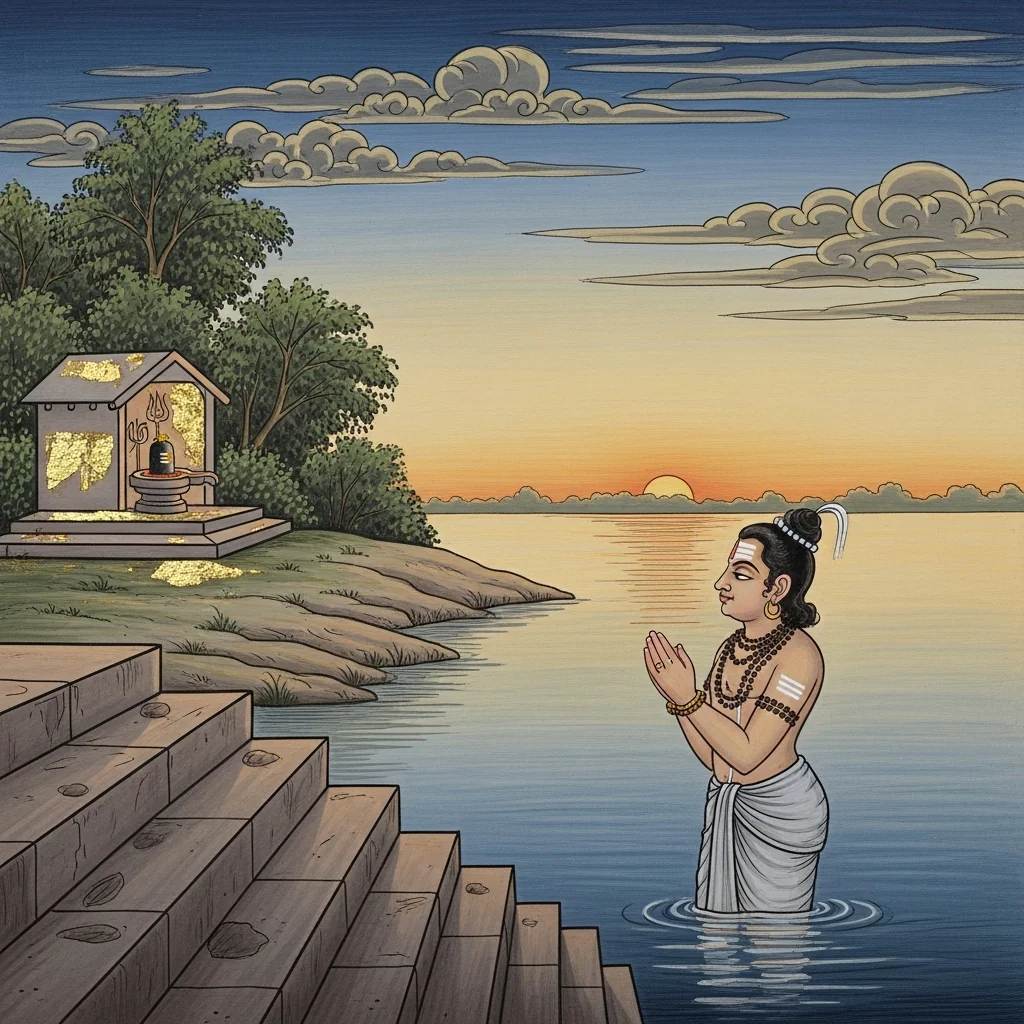
The chapter unfolds as a dialogue: Yudhiṣṭhira asks why Mahādeva (Śiva) is established in the water, not on either bank, and Mārkaṇḍeya replies with an origin-legend of the tīrtha. In Tretāyuga, Rāvaṇa meets the dānava Maya in the Vindhya region and learns that Maya’s daughter Mandodarī is performing severe tapas to obtain a husband. Rāvaṇa requests her and receives her in marriage; a son is born whose roar stuns the worlds, and Brahmā names him Meghnāda. Meghnāda undertakes strict vows and worships Śaṅkara with Umā, bringing two liṅgas from Kailāsa and travelling south. At the Narmadā he bathes and performs pūjā; when he tries to lift the liṅgas to depart for Laṅkā, a great liṅga falls into the river and becomes established midstream, while a divine utterance urges him onward. Meghnāda bows and departs. From then on the tīrtha is famed as Meghnāda (formerly Garjana). The phalaśruti declares: bathing and staying a full day and night yields Aśvamedha-like merit; piṇḍadāna equals the fruit of a sattra; feeding a Brahmin a six-flavor meal grants imperishable merit; and voluntary death there leads to residence in Śaṅkara’s world until cosmic dissolution.
Adhyaya 36
दारुतीर्थमाहात्म्य (Darutīrtha Māhātmya) — Origin Narrative and Pilgrimage Merits
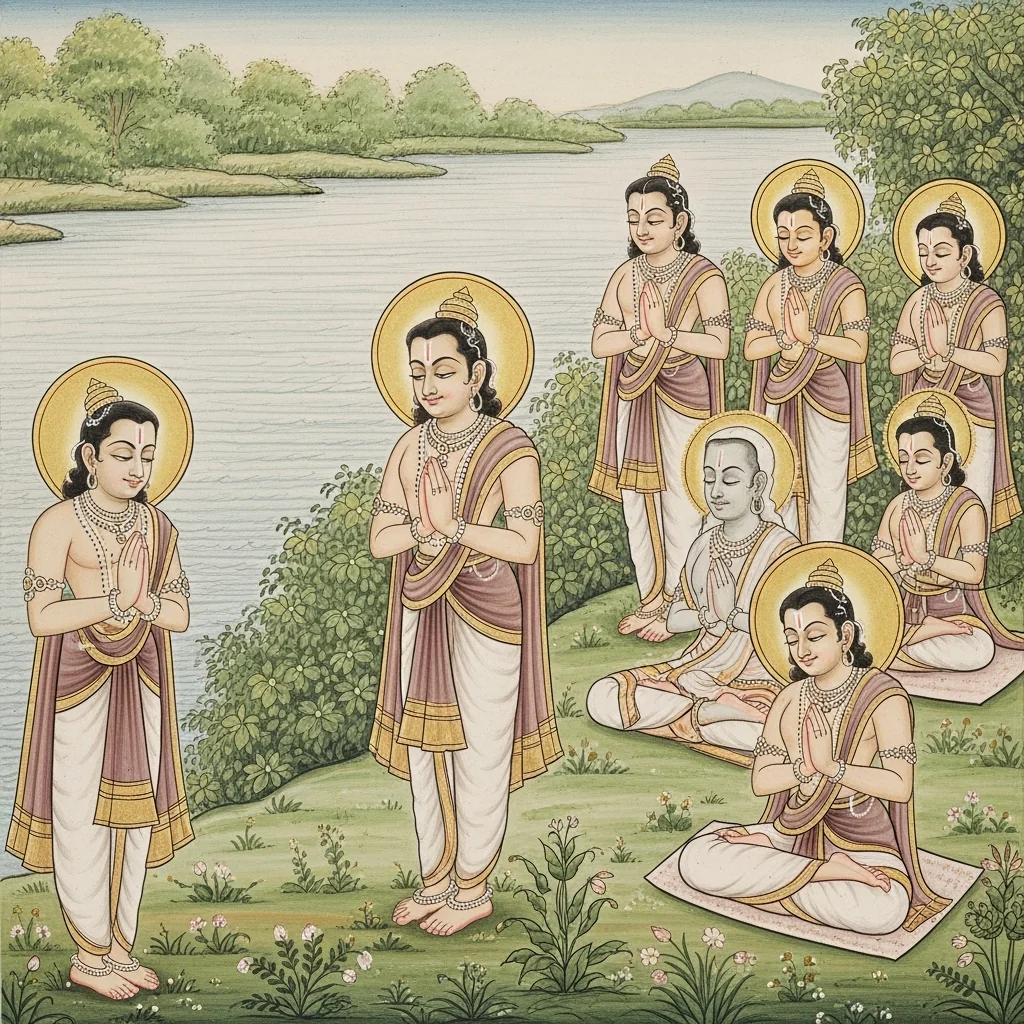
This chapter unfolds as a didactic dialogue. Mārkaṇḍeya answers Yudhiṣṭhira’s question about Darutīrtha, an eminent tīrtha on the Narmadā. It first gives an origin account: Mātali, Indra’s charioteer, once curses his son; the afflicted one seeks Indra’s protection. Indra directs him to live long in austerity on the Narmadā’s bank, devotedly worshipping Maheśvara (Śiva), and foretells rebirth as the famed ascetic Dāruka, who will also cultivate bhakti to the Supreme Lord praised with Vaiṣṇava epithets as the bearer of conch, discus, and mace (śaṅkha-cakra-gadā-dhara), thereby attaining siddhi and a blessed post-mortem destiny. The latter half states the proper observances and their merits. One who bathes duly, performs sandhyā, worships Śiva, and pursues Vedic study gains great sacrificial merit, explicitly likened to an Aśvamedha. Feeding brāhmaṇas yields high fruit, and acts such as bathing, giving, japa, homa, svādhyāya, and deity worship become fully efficacious when performed with purified intention.
Adhyaya 37
देवतीर्थमाहात्म्यम् (Devatīrtha Māhātmya: The Glory of Devatīrtha on the Narmadā)
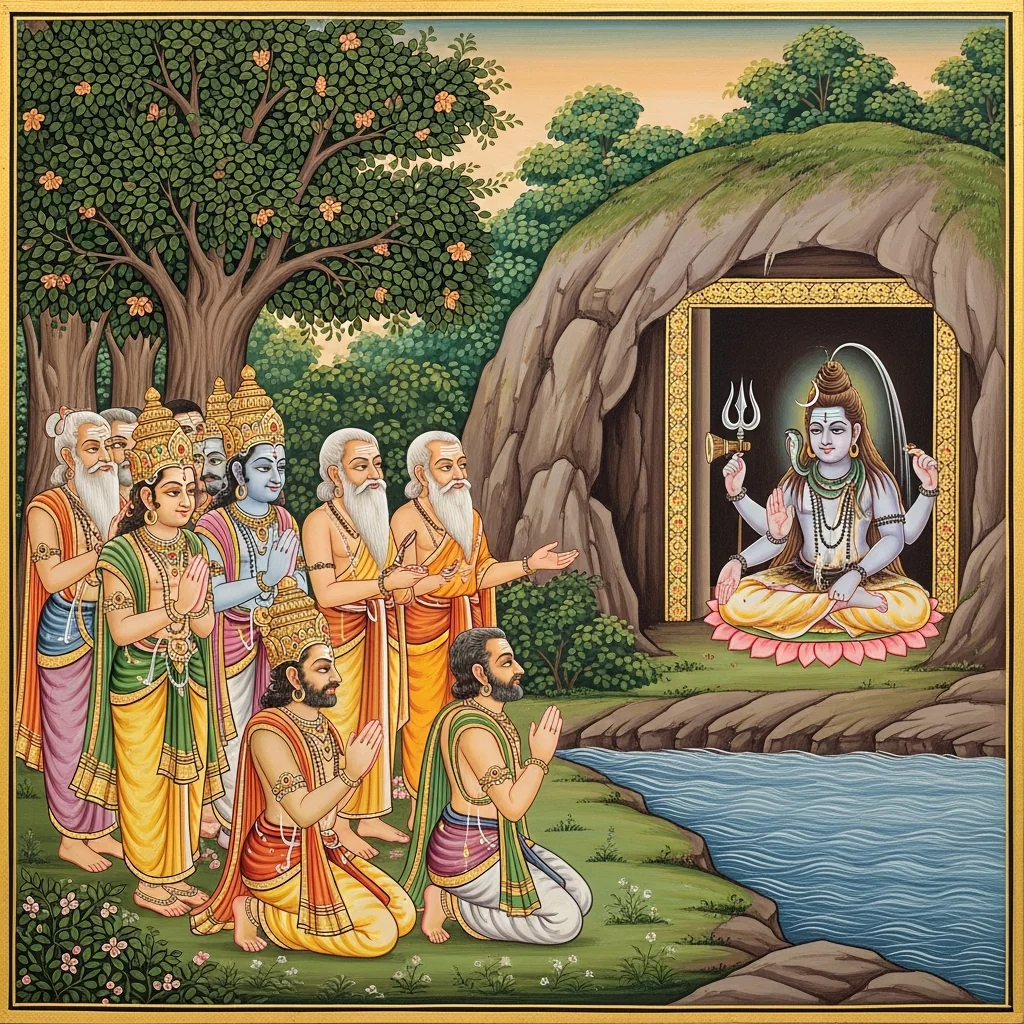
Chapter 37 is a theological dialogue in which the sage Mārkaṇḍeya explains to King Yudhiṣṭhira the origin and ritual power of Devatīrtha, an “unsurpassed” tīrtha on the Narmadā (Revā). The chapter opens by urging a visit to Devatīrtha, declaring that the thirty-three gods attained supreme success after bathing there. Yudhiṣṭhira asks how the devas, once defeated by stronger daityas, could regain success through a bath at that spot. Mārkaṇḍeya recounts that Indra and the devas were routed in battle, sorrowful and separated from their families, and sought refuge with Brahmā. Brahmā teaches that the remedy against the daityas is tapas on the Narmadā’s bank: tapas is the highest strength, and no mantra or deed equals the sin-destroying purity of Revā’s waters. Led by Agni, the devas go to the Narmadā, perform great austerities, and attain siddhi; from then on the place is famed in the three worlds as Devatīrtha, the destroyer of all sins. The chapter then sets out conduct and results: a restrained person who bathes there with devotion gains a “pearl-like” fruit; feeding Brahmins multiplies merit; the presence of a sacred stone (devaśilā) increases puṇya. Certain death-related observances (renunciation-death, fire-entry) are linked to lasting or exalted destinies. At this tīrtha, bathing, japa, homa, svādhyāya, and worship yield “imperishable” results. The closing phalaśruti says that those who recite or hear this sin-removing account are freed from suffering and proceed to the divine world.
Adhyaya 38
गुहावासी-नर्मदेश्वर-उत्पत्ति (Guhāvāsī and the Origin of Narmadeśvara)
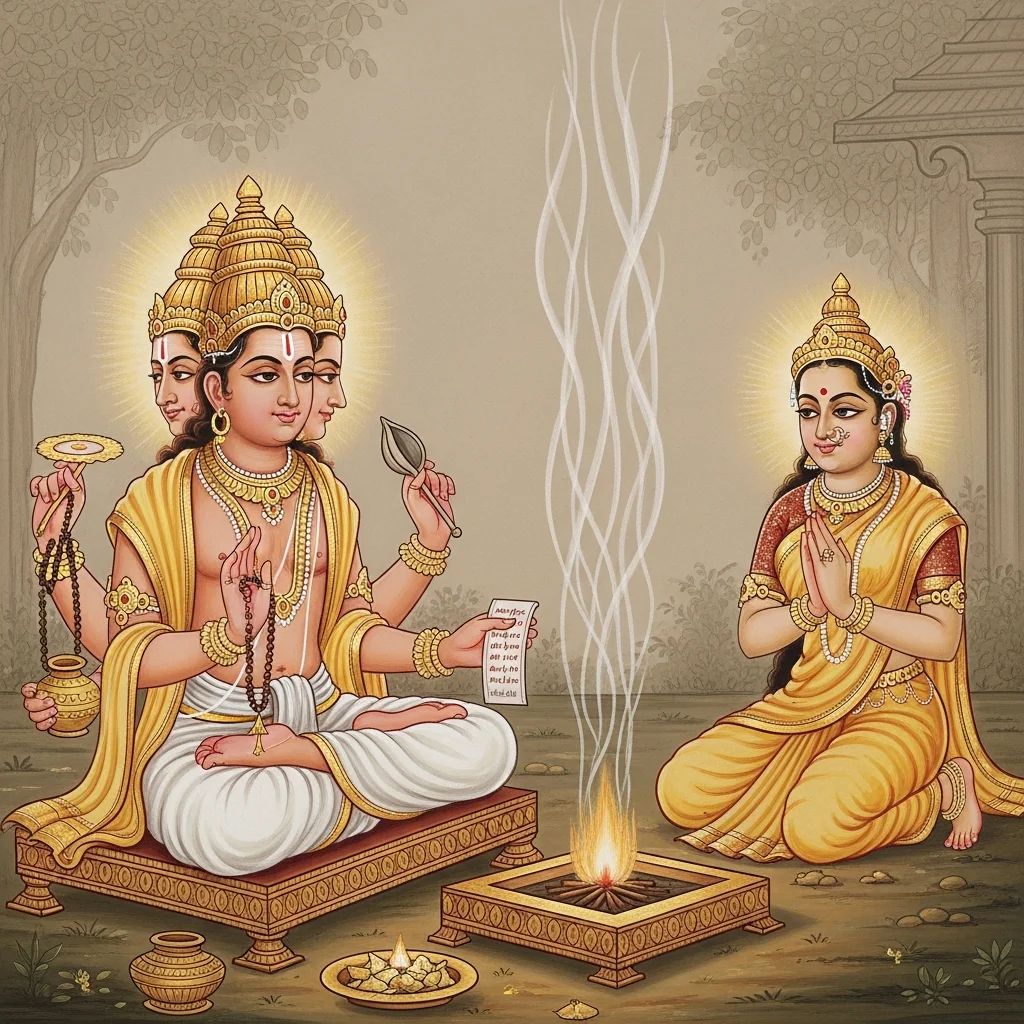
This chapter unfolds as a dialogue: Yudhiṣṭhira asks Mārkaṇḍeya why Mahādeva, revered as jagad-guru, dwelt for a long time in a cave (guhā). Mārkaṇḍeya recounts a Kṛtayuga episode at the great hermitage of Dāruvana, where disciplined practitioners of all āśramas lived in strict observance. Śiva, traveling with Umā, is urged by her to assume a Kāpālika-like ascetic guise—matted hair, ash, tiger-skin, skull-bowl, and ḍamaru—and enter the forest, which unsettles the hermitage women. When the Brahmin sages return and perceive the disruption, they unite in resolve and perform a satya-prayoga (truth-act) that causes Śiva’s liṅga to fall, bringing cosmic disturbance. The gods appeal to Brahmā; the sages counsel Śiva on the potency of Brahminical tapas and anger, and the narrative turns toward reconciliation and re-sanctification. Śiva then goes to the bank of the Narmadā, undertakes the supreme vow as “Guhāvāsī,” and establishes a liṅga there—hence the name Narmadeśvara. The chapter closes with tīrtha prescriptions and phalaśruti: worship, bathing, offerings to ancestors, feeding Brahmins, gifts, fasting on specific lunar dates, and other observances yield stated ritual fruits and protection; even recitation and faithful listening are said to grant the merit of sacred bathing.
Adhyaya 39
कपिलातीर्थमाहात्म्य (Kapilā-tīrtha Māhātmya: The Glory and Origin of Kapilā Tīrtha)
This chapter unfolds as Yudhiṣṭhira’s inquiry and the sage Mārkaṇḍeya’s explanation concerning Kapilā-tīrtha on the Narmadā (Revā). It opens with a brief phalāśruti: a devotional bath at Kapilā-tīrtha—by that act alone—is said to wash away accumulated impurities. Yudhiṣṭhira asks for the tīrtha’s origin and its connection to the sanctity of Narmadeśvara/Narmadā. Mārkaṇḍeya recounts a cosmogonic scene at the dawn of the Kṛta-yuga: Brahmā, absorbed in contemplative rite, beholds a radiant, fire-natured form of Kapilā arising from a blazing kuṇḍa. Brahmā offers a litany of praise, identifying Kapilā with many divine powers and even measures of time, portraying her as all-pervasive within the cosmic order. Pleased, Kapilā asks Brahmā’s purpose; he commissions her to descend from the higher realm to the mortal world for the welfare of beings. Kapilā then goes to the purifying Narmadā, performs austerities on its bank, and thereby establishes the tīrtha’s enduring status. A second unit answers technical questions about how “worlds” and deities are situated in Kapilā’s body, giving an anatomical-cosmological mapping: various lokas rest upon her back, while deities and cosmic principles occupy specific loci (fire in the mouth, Sarasvatī on the tongue, wind in the nasal region, Śiva on the forehead). The chapter closes with applied ritual ethics—praising household veneration of Kapilā, circumambulation and offerings, and prescribing bathing rites, upavāsa (fasting), and tarpaṇa for ancestors—with a promise of benefit to forebears and descendants. It ends by reaffirming that hearing this account is itself purificatory.
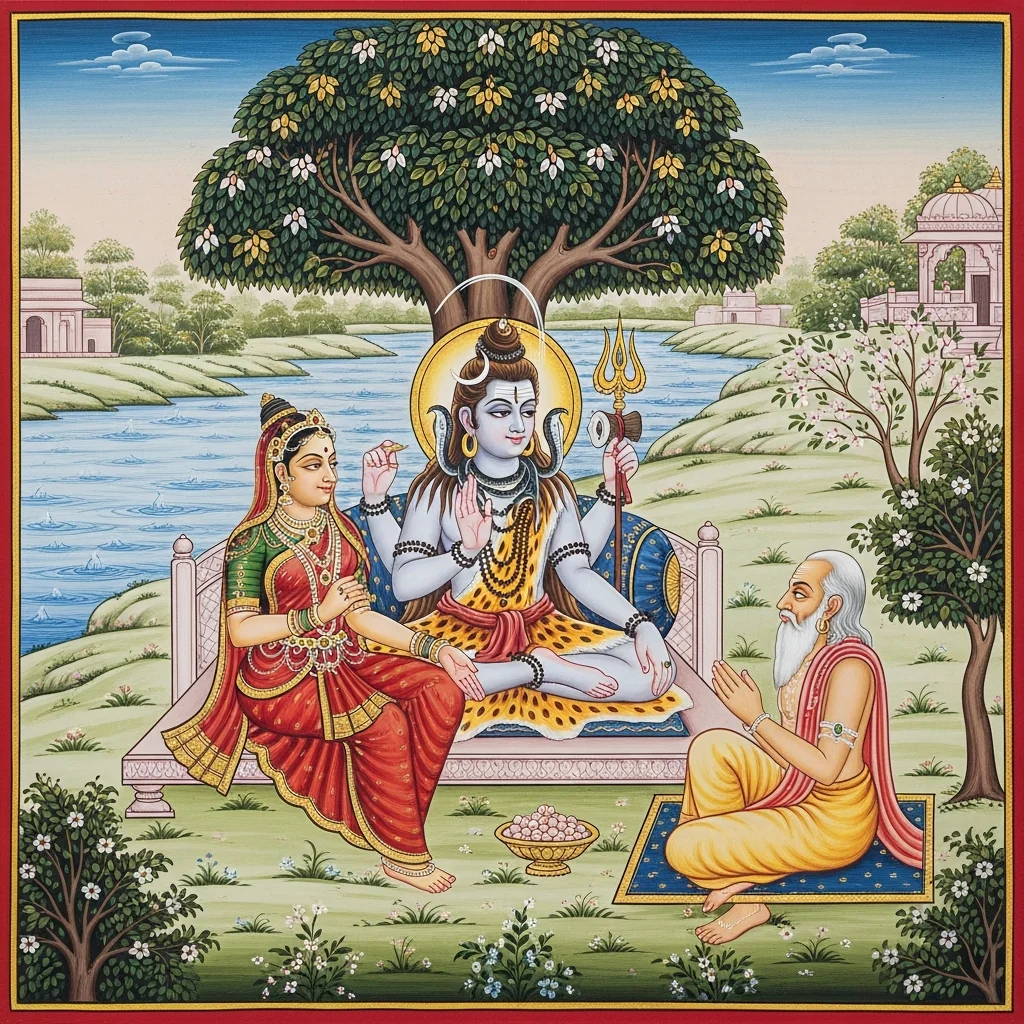
Adhyaya 40
Karañjeśvara Tīrtha Māhātmya (करञ्जेश्वरतीर्थमाहात्म्य) / The Glory of the Karañjeśvara Pilgrimage-Site
Chapter 40 unfolds as a dialogue in which Mārkaṇḍeya answers Yudhiṣṭhira’s question about an eminent siddha connected with the Karañjeśvara tīrtha. The account is set within primordial genealogy: in the Kṛta-yuga the mind-born sage Marīci is mentioned, followed by Kaśyapa and the lineage framework through Dakṣa’s daughters such as Aditi, Diti, and Danu. From Danu’s line is born a daitya named Karañja, said to bear auspicious marks and to perform severe tapas on the bank of the Narmadā, observing long ascetic disciplines and a regulated diet. Śiva (Tripurāntaka), accompanied by Umā, grants him a boon; Karañja asks that his descendants be inclined toward dharma. After the Lord departs, Karañja establishes a Śiva shrine named after himself—Karañjeśvara. The chapter then offers phalaśruti-style assurances: bathing at the tīrtha removes sins; offerings to ancestors yield merit like an Agniṣṭoma sacrifice; specific austerities (including fasting) lead to Rudra-loka; and death by fire or water at the site is praised as bringing long residence in Śiva’s abode and an auspicious rebirth endowed with learning, health, and prosperity. It concludes by extolling the imperishable merit gained through recitation and hearing, and through reading in the context of śrāddha rites.
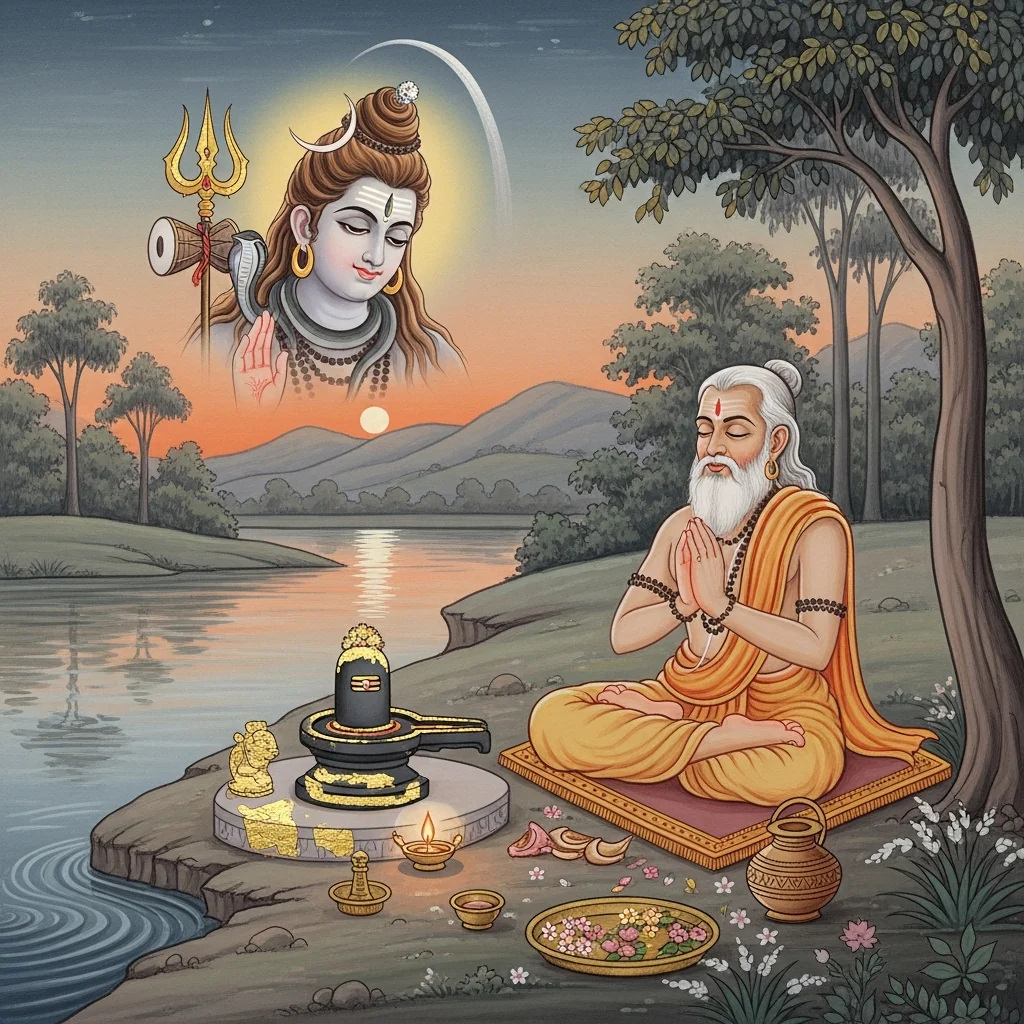
Adhyaya 41
कुण्डलेश्वरतीर्थमाहात्म्य (Kundaleśvara Tīrtha Māhātmya)
This adhyāya unfolds as a sacred dialogue between the sage Mārkaṇḍeya and King Yudhiṣṭhira, directing the king to the renowned tīrtha of Kuṇḍaleśvara. To establish its greatness, Mārkaṇḍeya recounts that in Tretāyuga Viśravā, of Pulastya’s line, performed vast tapas and begot Dhanada (Vaiśravaṇa/Kubera), who was appointed guardian of wealth and a lokapāla. From that lineage arose the yakṣa Kuṇḍa/Kuṇḍala. With his parents’ consent he undertook severe austerities on the bank of the Narmadā—enduring heat, rain, and cold, practicing breath-discipline, and fasting for long periods. Pleased, Śiva (Vṛṣavāhana) granted him a boon: Kuṇḍala became an invincible attendant, free to move by the favor of the lord of yakṣas. After Śiva returned to Kailāsa, Kuṇḍala established the deity there as “Kuṇḍaleśvara,” adorning and worshipping the liṅga and honoring brāhmaṇas with food and gifts. The phalaśruti declares that fasting and worship at this tīrtha destroy sins; dāna brings heavenly enjoyment; bathing and reciting even a single ṛk yields complete merit; and gifting a cow grants a long stay in heaven proportional to the cow’s hairs, culminating in access to Maheśa’s realm for benefactors.
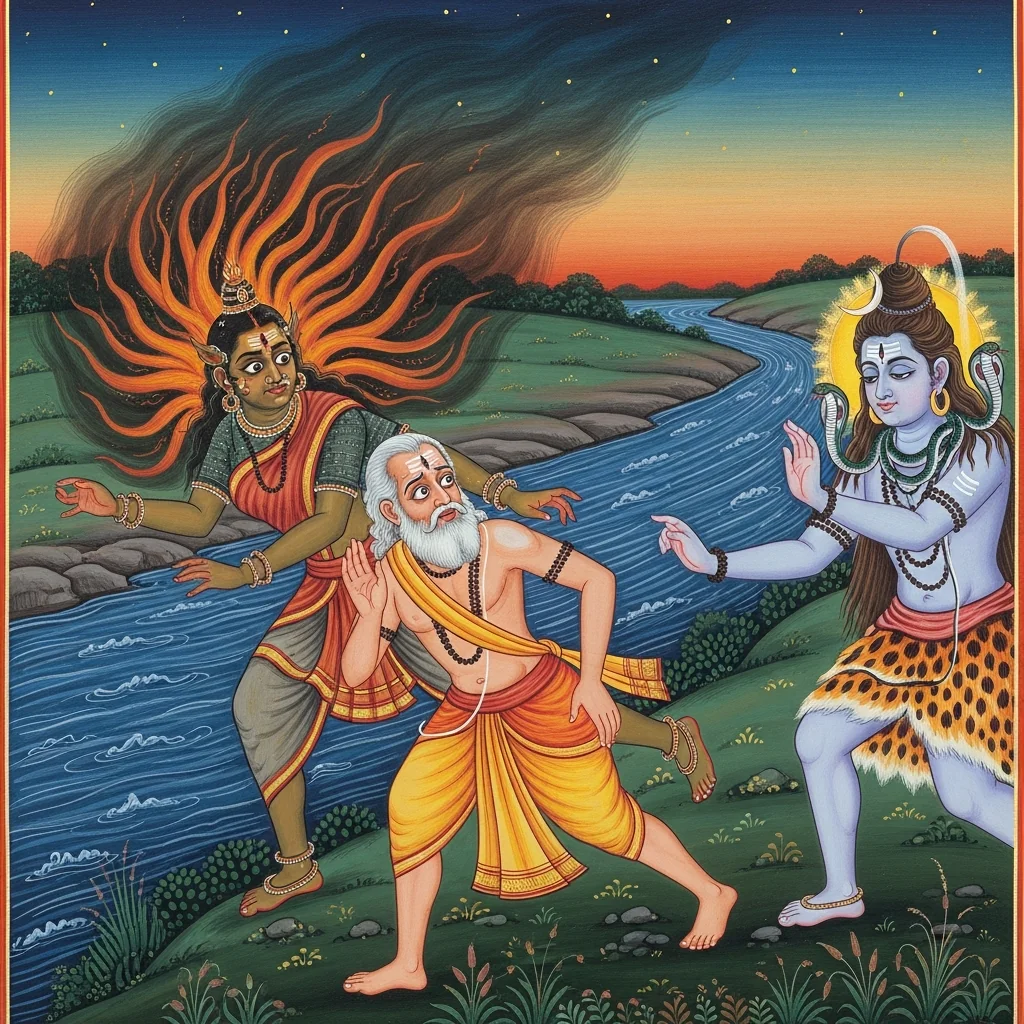
Adhyaya 42
पिप्पलादचरितं पिप्पलेश्वरतीर्थमाहात्म्यं च | Pippalāda’s Account and the Māhātmya of Pippaleśvara Tīrtha
Mārkaṇḍeya, answering Yudhiṣṭhira’s question, recounts the origin connected with Pippaleśvara Tīrtha. It begins with Yājñavalkya’s ascetic practice and a domestic ethical dilemma involving his widowed sister, resulting in the birth of a child who is abandoned beneath an aśvattha (pippala) tree. The child survives, grows, and becomes known as Pippalāda. The narrative then turns to a cosmological and moral encounter with Śanaiścara (Saturn), who begs release from Pippalāda’s anger; a limit is set that Saturn shall not afflict children up to sixteen years of age, establishing a normative rule within the mythic dialogue. Pippalāda’s wrath escalates and produces a destructive kṛtyā aimed at Yājñavalkya; the sage seeks refuge through successive divine realms until Śiva grants protection and brings resolution. Pippalāda performs severe tapas on the bank of the Narmadā, asks Śiva to abide permanently at that tīrtha, and establishes worship there. The chapter ends with pilgrimage observances—snāna, tarpaṇa, feeding Brāhmaṇas, and Śiva-pūjā—explicit statements of merit (even equated with an Aśvamedha), and a phalaśruti promising destruction of sins and relief from bad dreams through recitation or hearing.
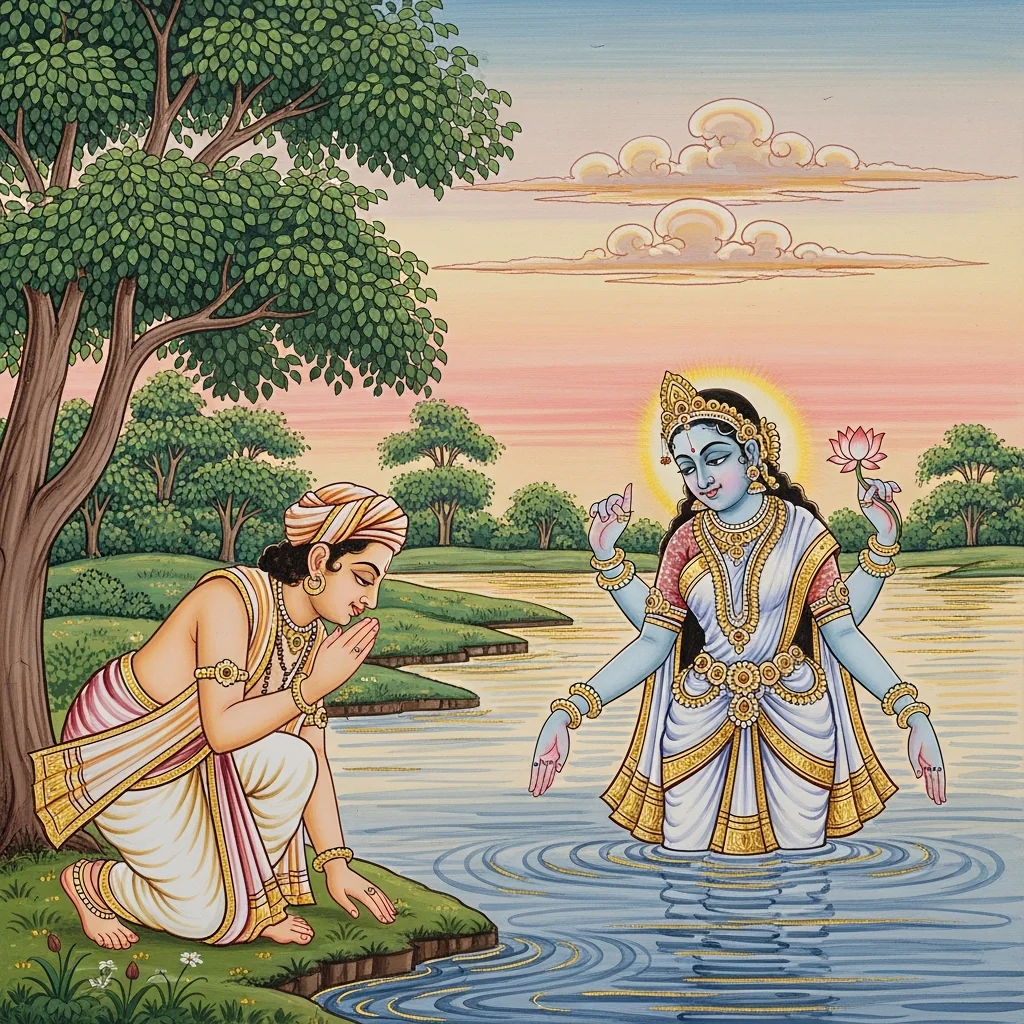
Adhyaya 43
Vimalēśvara–Puṣkariṇī–Dīvakara-japa and Revā/Narmadā Purificatory Doctrine (विमलेश्वर-तीर्थमाहात्म्यं तथा दिवाकरजपः)
This chapter unfolds as a didactic dialogue in which Mārkaṇḍeya instructs Yudhiṣṭhira in a sequence of tīrtha-based observances and their declared fruits. The pilgrim is first directed to Vimalēśvara, where a “devśilā” (a divine stone/altar said to be fashioned by the gods) is praised; bathing there and honoring Brahmins yields inexhaustible merit even from small gifts. Recommended purificatory dānas are then listed: gold, silver, copper, gems/pearls, land, and cows. A strong phala teaching follows: death at that tīrtha grants residence in Rudra’s world until cosmic dissolution, and a regulated end there (through fasting, fire, or water) is said to lead to the highest state. The discourse expands to solar devotion at a purifying puṣkariṇī, prescribing japa—down to a single ṛc or even a single syllable—linking it to Vedic fruit and release from impurities; when performed rightly, merit is described as multiplied koṭi-fold. The latter half sets ethical disciplines for the end of life across the varṇas (Brahmin, Kṣatriya, Vaiśya, Śūdra), stressing restraint from desire and anger, obedience to śāstra, and service to the Divine; deviation is connected with hells and degraded births. The chapter culminates in praise of Revā/Narmadā as Rudra-born and universally salvific, and gives a daily mantra for one who, upon rising, ritually touches the ground, honoring the river as purifier and remover of sin.
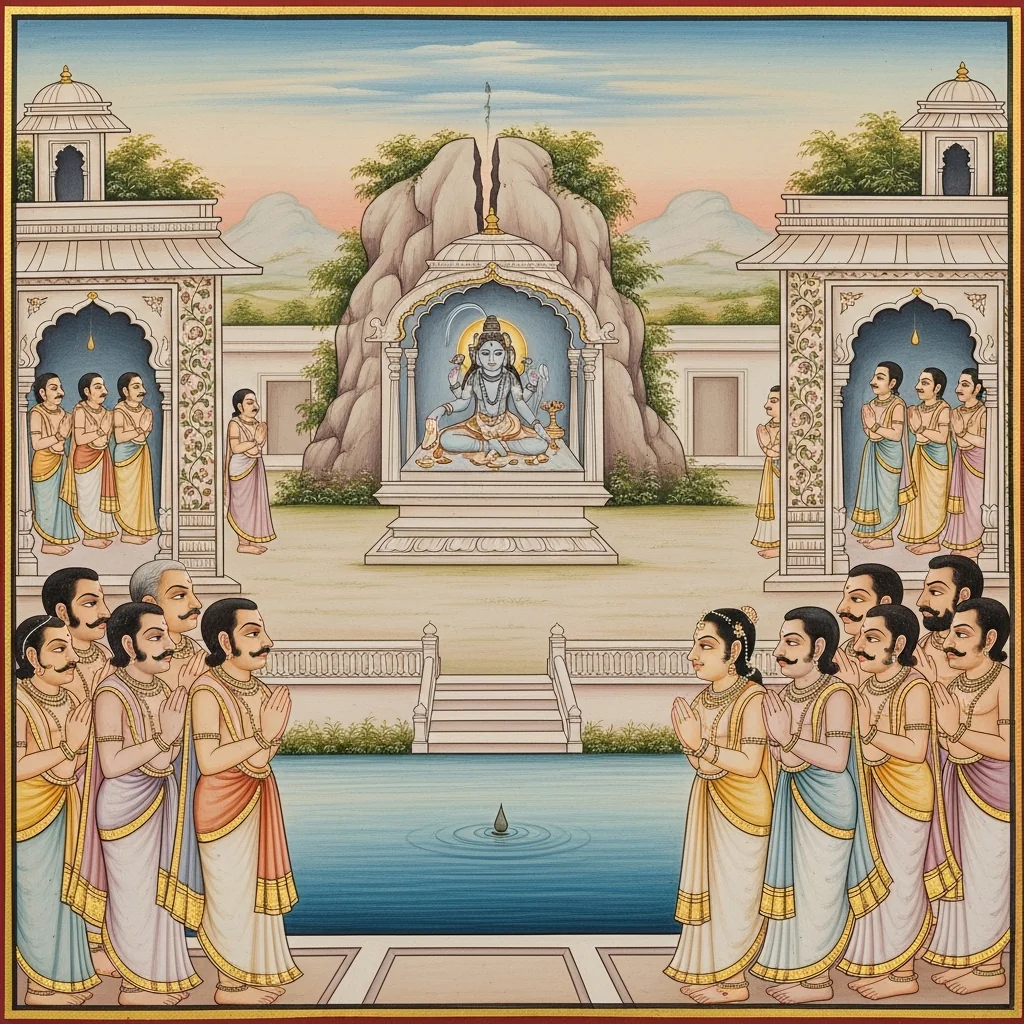
Adhyaya 44
शूलभेदतीर्थमाहात्म्य (Śūlabheda Tīrtha Māhātmya) — The Glory of the Śūlabheda Pilgrimage-Site
This chapter unfolds as an instructive dialogue: Mārkaṇḍeya answers Yudhiṣṭhira’s question aimed at liberation. He points to a supreme tīrtha on the southern bank of the Revā, established by Śūlapāṇi (Śiva) for human seekers of mokṣa. Located on or near the Bhṛgu-named mountain and set upon its summit, it is famed in the three worlds as Śūlabheda. A graded teaching of purification is given: faults of speech, mind, and body are removed through kīrtana (devotional praise) and darśana of the tīrtha; its sacred radius is five krośas, and it bestows both bhukti and mukti. A mythic-hydrological theme follows: a Gaṅgā-current linked with Bhogavatī (the netherworld) is said to emerge as a sin-destroying flow connected with the triśūla’s “piercing” (bheda). Sarasvatī too is recalled as having fallen into a kuṇḍa where the triśūla split the rock, highlighting the power to release ancient sins (prācīna-aghavimocanī). The text then asserts superiority: even renowned tīrthas such as Kedāra, Prayāga, Kurukṣetra, and Gayā do not equal Śūlabheda in full measure. The chapter prescribes śrāddha rites (piṇḍa and water offerings), regular drinking of the site’s water, and honoring worthy brāhmaṇas without hypocrisy or anger, along with a thirteen-day dāna observance of heightened merit. The devotional itinerary includes darśana of Gaṇanātha/Gajānana and reverence to Kambalakṣetrapa, followed by worship of Mahādeva (Śūlapāṇi), Umā, and Mārkaṇḍeśa dwelling in a cave. Entering the guhā and reciting a “three-syllable” mantra is said to yield a fraction of Nīlaparvata’s merit; the place is further praised as sarvadevamaya and associated with an eminent koṭiliṅga. Finally, signs of authentication (pratyaya) are given—sparks or movements seen in the liṅga during bathing, and an oil-drop that does not spread—presented as tokens of the tīrtha’s power. The discourse closes by stressing its “most secret” nature, total sin-removal, and the phalaśruti that hearing or remembering Śūlabheda three times daily purifies the practitioner inwardly and outwardly.
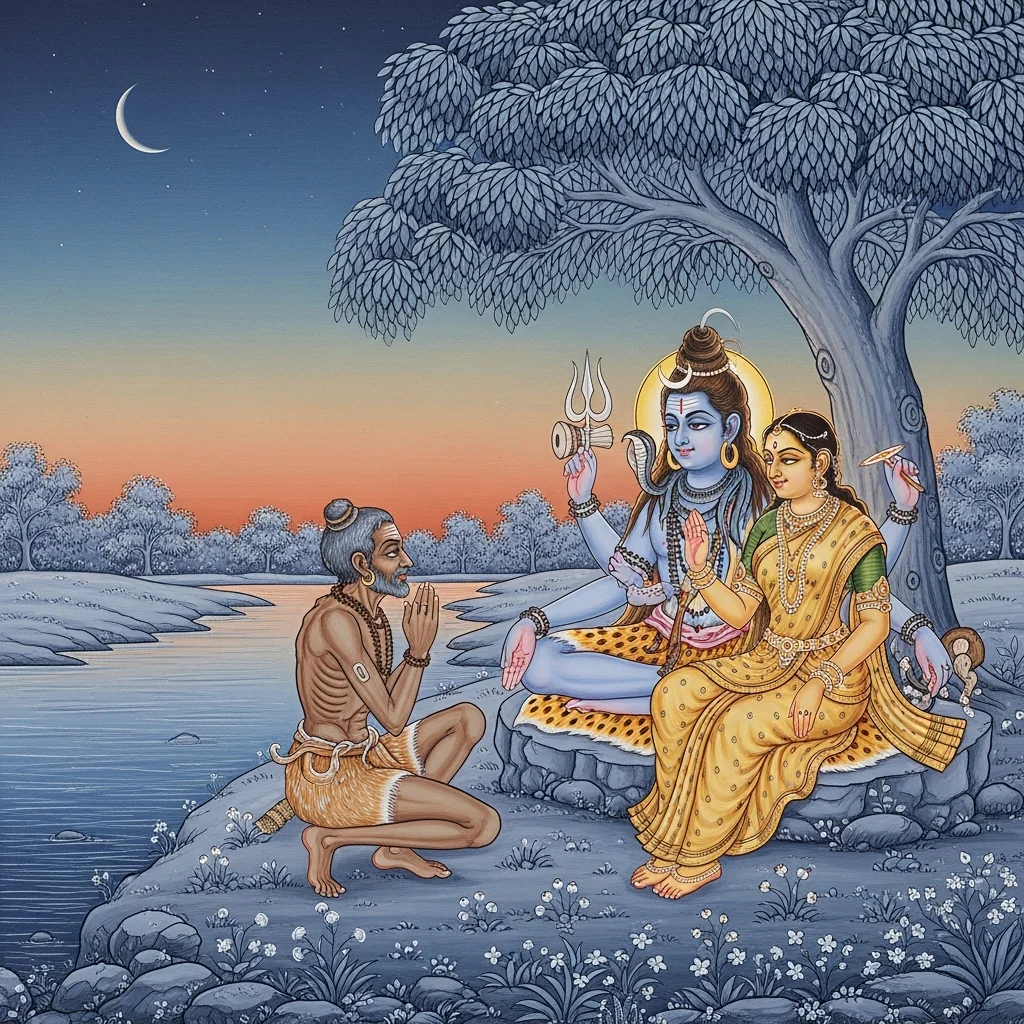
Adhyaya 45
अन्धकस्य रेवातटे तपोवरप्राप्तिः (Andhaka’s Austerity on the Revā Bank and the Granting of a Boon)
Markaṇḍeya recalls an earlier question King Uttānapāda asked Maheśvara before an assembly of sages and gods: about a supremely meritorious yet highly secret tīrtha, the origin of “Śūlabheda,” and the greatness of that sacred site. Īśvara replies by speaking of the daitya Andhaka—immensely powerful, arrogant, and ruling without challenge. Seeking to win Mahādeva’s favor, Andhaka goes to the bank of the Revā and performs tapas in four escalating stages over successive millennia: fasting, living on water alone, feeding on smoke, and sustained yogic discipline, until he is reduced to bone and skin. The heat of his austerity becomes cosmically evident and reaches Kailāsa; Umā marvels at its unprecedented severity and questions the propriety of granting boons too quickly. Śiva and Umā visit the ascetic, and Śiva offers a boon. Andhaka asks for victory over all devas; Śiva refuses as improper and urges another request. Andhaka collapses in despair, and Umā warns that neglecting a devotee would harm Śiva’s renown as protector of bhakti. A compromise boon is set: Andhaka may conquer the devas except Viṣṇu, and he cannot overcome Śiva. Restored to life and strength, Andhaka accepts, and Śiva returns to Kailāsa, closing the tīrtha-linked lesson on tapas, desire, and the rightful regulation of boons.
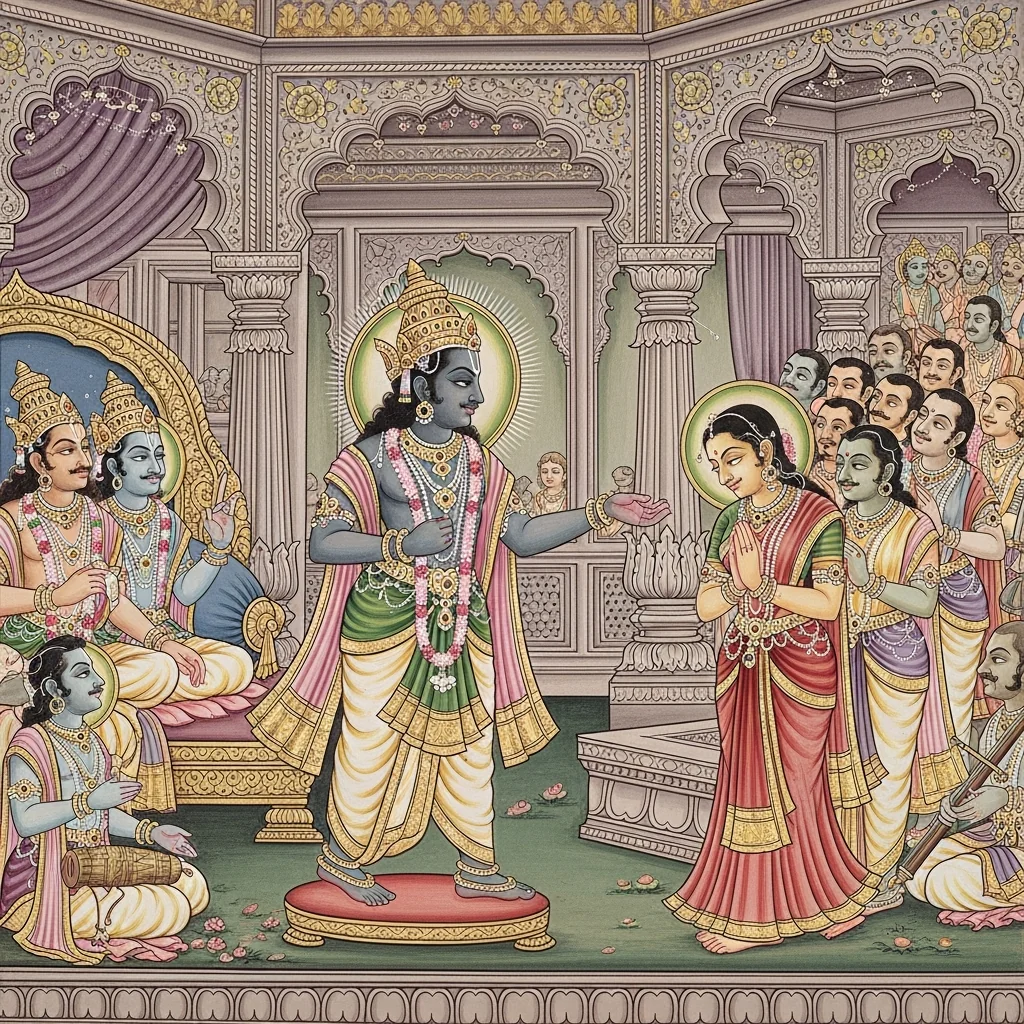
Adhyaya 46
अन्धकस्य स्वपुरप्रवेशः स्वर्गागमनं च (Andhaka’s Return, Ascent to Heaven, and the Abduction of Śacī)
Mārkaṇḍeya recounts that the Daitya Andhaka, empowered by a boon from Śambhu (Śiva), returns to his own city and is welcomed with a grand public celebration—squares adorned, gardens and tanks prepared, temples honored, Vedic recitations and auspicious chants resounding, gifts bestowed, and the community rejoicing. He dwells thereafter in prosperity and power. When the Devas learn that this boon has made Andhaka nearly invincible, they gather and seek refuge with Vāsava (Indra). As they deliberate, Andhaka grows audacious, climbs alone to the difficult heights of Meru, and enters Indra’s fortified realm of Svarga as though it were his own. Indra, fearful and unable to find a protector for heaven, offers hospitality and, at Andhaka’s request, displays celestial treasures—Airāvata, Uccaiḥśravas, Urvaśī and other apsarases, Pārijāta blossoms, and heavenly music. Amid the performances, Andhaka’s gaze fixes upon Śacī; he seizes Indra’s consort and departs, igniting conflict. The ensuing battle shows the Devas driven back by Andhaka’s singular might, revealing how cosmic order is shaken when boon-born power is joined to unchecked desire and coercive domination.
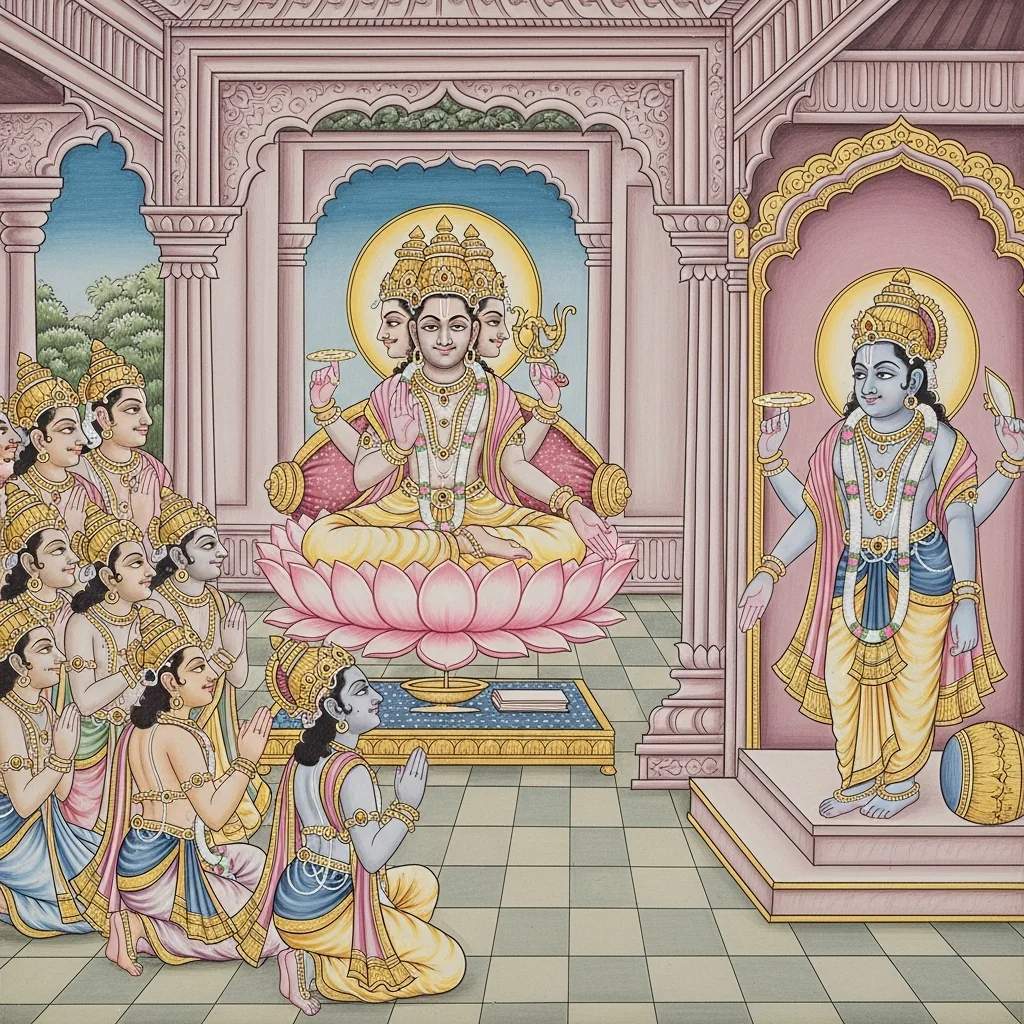
Adhyaya 47
अन्धकविघ्ननिवेदनम् — The Devas Seek Refuge from Andhaka
This adhyāya unfolds as a report of calamity followed by a divine response. Mārkaṇḍeya relates how the devas, led by Indra, arrive in Brahmaloka with splendid conveyances, bow in formal prostration, and praise Brahmā. They then declare their distress: the mighty asura Andhaka has defeated them, seized their wealth and jewels, and forcibly taken Indra’s consort. Brahmā reflects and states a crucial constraint—Andhaka is “avadhya” for the devas, not readily slayable by them due to prior boons or cosmic law. Therefore the devas, with Brahmā at their head, go to Viṣṇu (Keśava/Janārdana), offering hymns and surrender. Viṣṇu asks the cause, and on hearing their humiliation vows to kill the wrongdoer wherever he may be—netherworld, earth, or heaven. Rising with conch, discus, mace, and bow, he reassures the devas and sends them back to their abodes, ending the chapter with the promise of divine protection and the imminent restoration of order.
Adhyaya 48
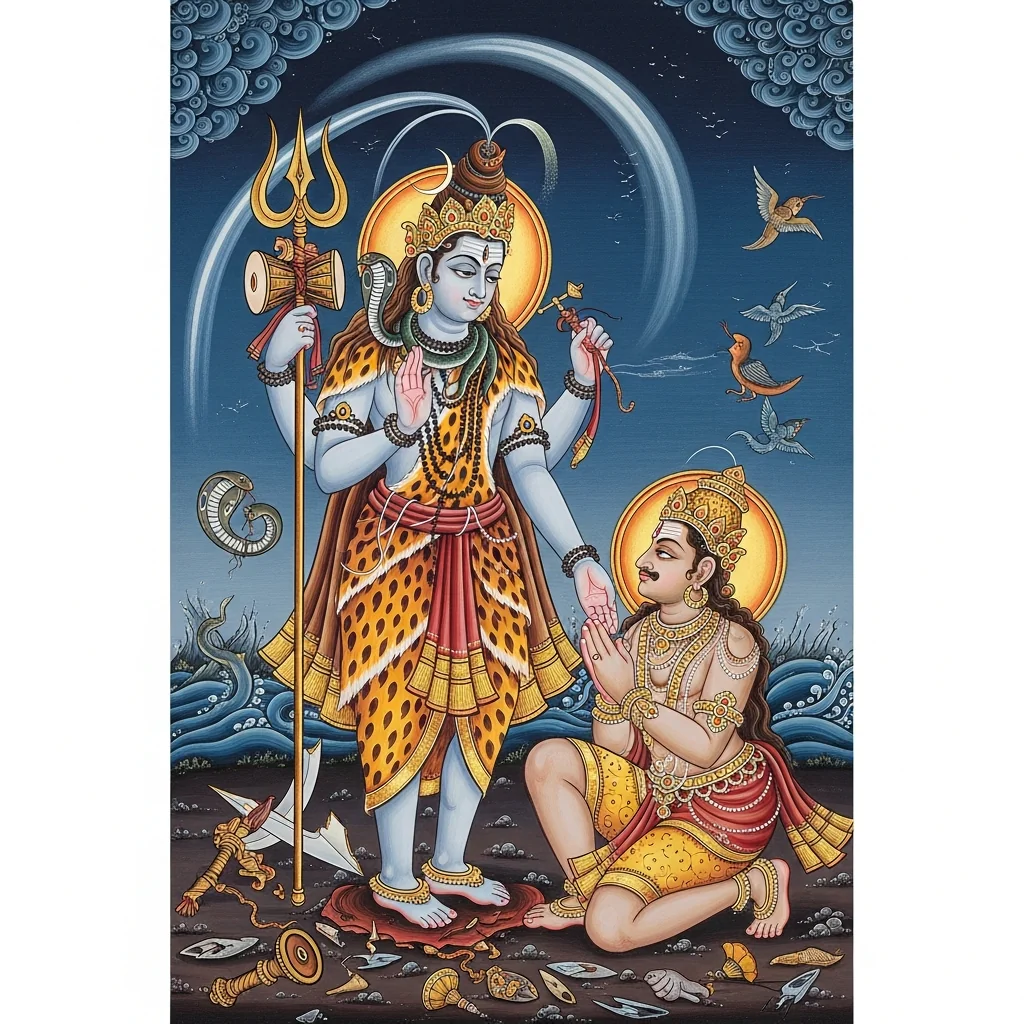
अन्धकस्य विष्णुस्तुतिः शिवयुद्धप्राप्तिः च (Andhaka’s Hymn to Viṣṇu and the Provocation of Śiva for Battle)
The chapter begins with a royal query about Andhaka’s whereabouts and deeds after he has subdued the devas. Mahādeva replies that Andhaka has entered Pātāla, the subterranean realm, and is engaged in destructive acts. Keśava (Viṣṇu) arrives with bow in hand and releases the āgneya astra; Andhaka counters with the mighty vāruṇa astra, and a reciprocal exchange of divine weapons ensues. Andhaka then appears along the arrow’s course, challenges Janārdana, and escalates the quarrel with harsh speech; yet when he is physically overpowered in close combat, he shifts from confrontation to sāma (conciliation). He offers an extended stuti to Viṣṇu, invoking forms such as Narasiṃha, Vāmana, and Varāha, and praising the Lord’s compassion. Pleased, Viṣṇu grants a boon; Andhaka asks for a purifying, glorious battle by which he may ascend to higher worlds. Viṣṇu declines to fight and redirects him to Mahādeva, advising him to shake the peak of Kailāsa to provoke Śiva’s wrath. Andhaka follows this counsel; cosmic disturbances arise, Umā questions the ominous signs, and Śiva resolves to confront the offender. The devas assemble a divine chariot, and Śiva advances into a vast battle where successive astras (āgneya, vāruṇa, vāyavya, sārpa, gāruḍa, nārasiṃha) neutralize one another. The conflict intensifies into hand-to-hand struggle; Śiva is briefly immobilized, then recovers and strikes Andhaka with a major weapon, placing him upon the śūla. Blood-drops generate further dānavas, so Śiva summons Durgā/Cāmuṇḍā to drink the falling blood and prevent proliferation. With the auxiliary threat contained, Andhaka turns to praise Śiva, and Śiva grants a boon: Andhaka is absorbed into Śiva’s gaṇas as Bhṛṅgīśa, marking a movement from violent antagonism to subordinated participation in cosmic order.
Adhyaya 49
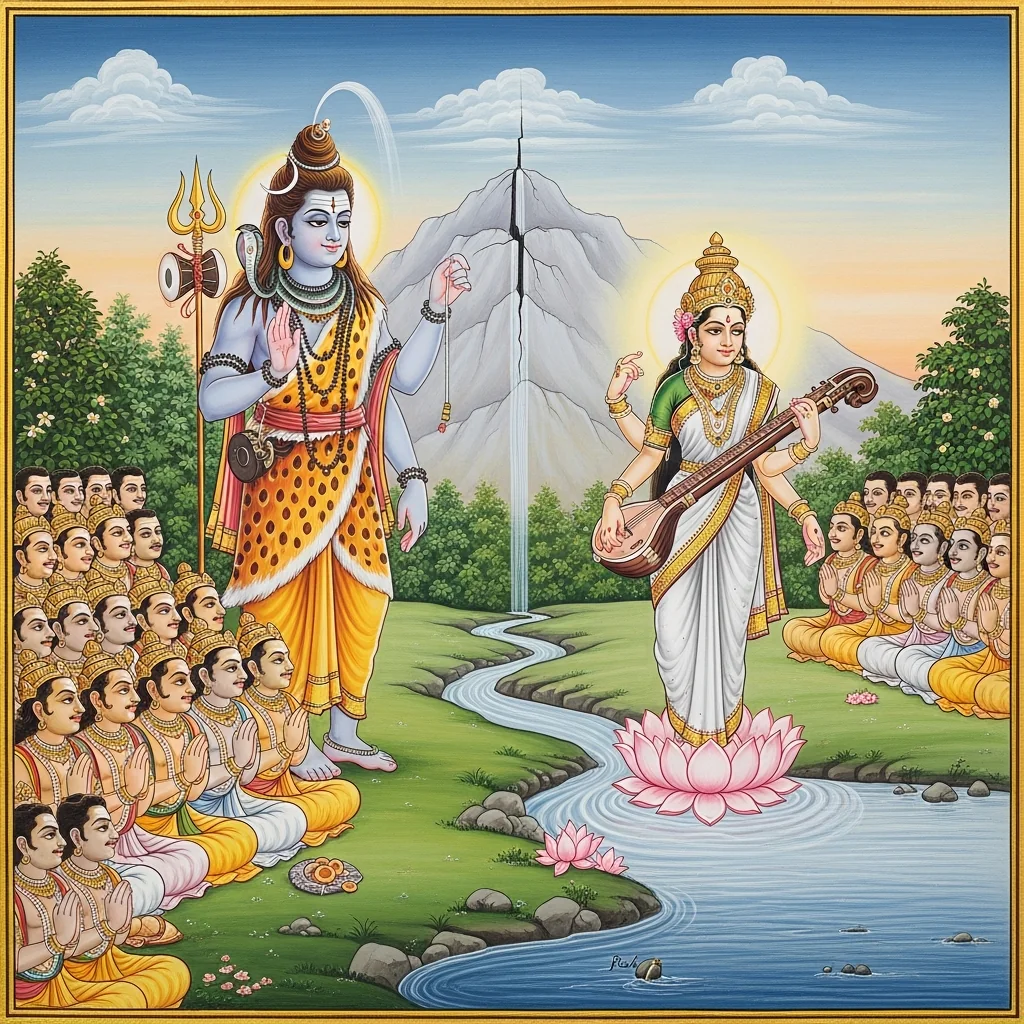
Śūlabheda Tīrtha-Māhātmya (The Glory of the Śūlabheda Pilgrimage Site)
Mārkaṇḍeya relates that after slaying Andhaka, Mahādeva returns with Umā to Kailāsa, where the gods assemble and are seated in due order. Śiva declares that though the demon is dead, his trident remains stained and cannot be purified by customary observances alone; therefore he resolves, with the gathered deities, to undertake a systematic pilgrimage to tīrthas. After bathing at many sacred places from Prabhāsa to the Gaṅgā-sāgara region without attaining the sought purity, he proceeds to the Revā (Narmadā), bathes on both banks, and reaches a mountain associated with Bhṛgu. Resting there in weariness, Śiva discerns a uniquely beautiful, ritually marked spot. He pierces the mountain with his trident, opening a deep fissure, and the trident becomes visibly stainless—thus establishing the purificatory basis of the Śūlabheda tīrtha. Sarasvatī then emerges from the mountain as a supremely meritorious presence, forming a second confluence likened (by analogy) to the famed “white-and-dark” meeting at Prayāga. Brahmā installs an eminent liṅga (Brahmeśa/Brahmeśvara) that removes suffering, while Viṣṇu is said to abide enduringly in the southern part of the site. The chapter details the ritual landscape: a line traced by the trident’s tip channels water into a sacred flow toward the Revā; the tīrtha is named and described, including a “water-liṅga” and three swirling pools (kuṇḍas). It prescribes bathing rules, mantra options (a ten-syllable formula and Vedic mantras), and procedures applicable across varṇas and to both women and men, linking the bath with tarpaṇa, śrāddha-like rites, and dāna. Guardians (vināyakas and kṣetrapālas) and obstacles for those of misaligned conduct are mentioned, presenting pilgrimage as ethical discipline. The phalāśruti proclaims purification, relief from faults, and the uplift of ancestors through correctly performed rites at Śūlabheda.
Adhyaya 50
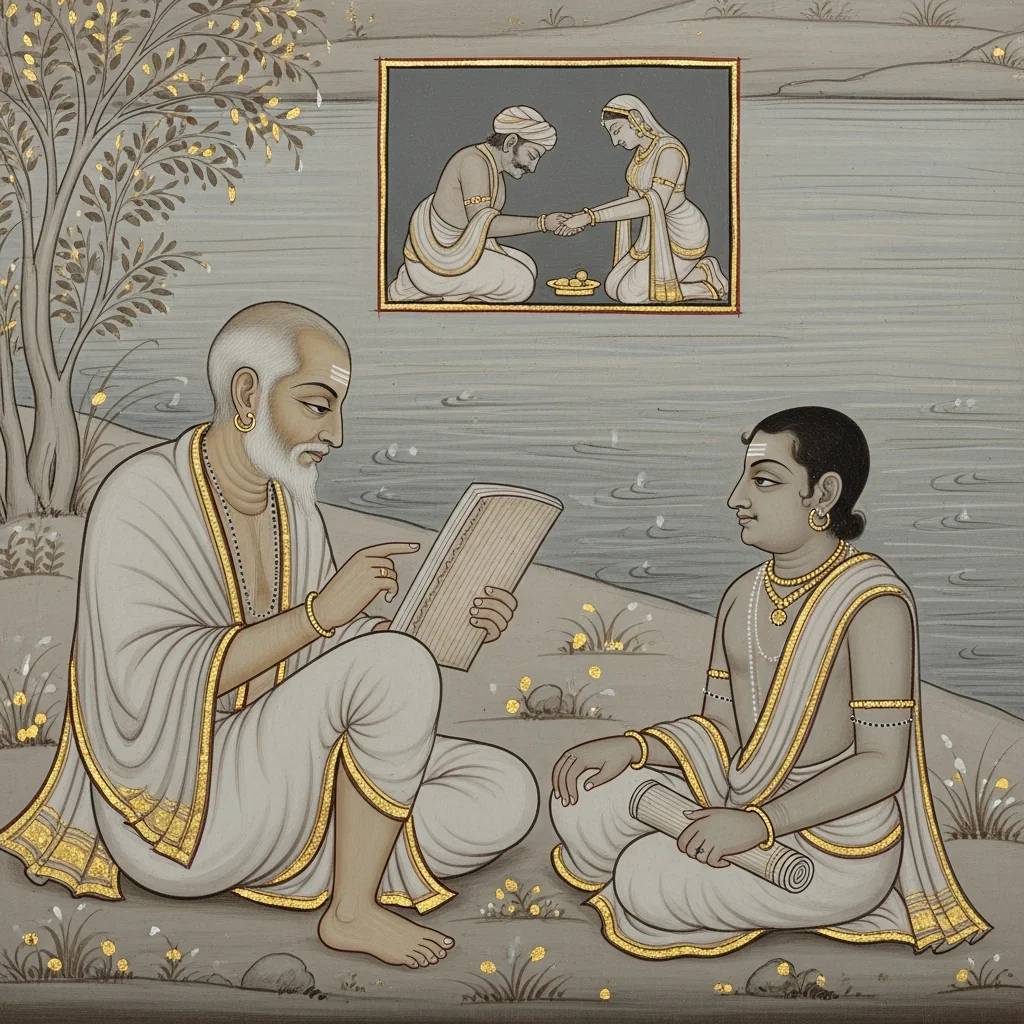
द्विजपात्रता-दानविधि-तीर्थश्राद्धकन्यादानोपदेशः (Eligibility of Brahmins, Ethics of Dāna, Tīrtha-Śrāddha, and Guidance on Kanyādāna)
This chapter is cast as a theological dialogue between Uttānapāda and Īśvara. It first defines who is fit to receive honor and dāna, arguing through analogies that a Brahmin who does not study the Veda (anadhīyāna/anṛca) bears only the name, and offerings made to such a person yield no ritual fruit. A list of moral, ritual, and social disqualifications follows, concluding that gifts given to improper recipients become ineffective. The teaching then turns to the procedure of tīrtha-śrāddha: maintaining purity after the household śrāddha, observing boundary rules, traveling to a specified tīrtha, bathing, and performing śrāddha at multiple stations with prescribed offerings, including piṇḍa with payasa, honey, and ghee. The phala is set out—long satisfaction of the ancestors and graded heavenly results for particular gifts (footwear, bed, horse, umbrella, a house with grains, tiladhenu, water and food), with strong emphasis on annadāna. Finally, it instructs on kanyādāna as the highest of gifts: the proper recipient is of good lineage, virtuous, and learned, while monetizing marriage arrangements is condemned. Dāna is also classified as unsolicited, invited, or begged-for, and the chapter ends with warnings against giving to the incapable and against improper acceptance of gifts.
Adhyaya 51
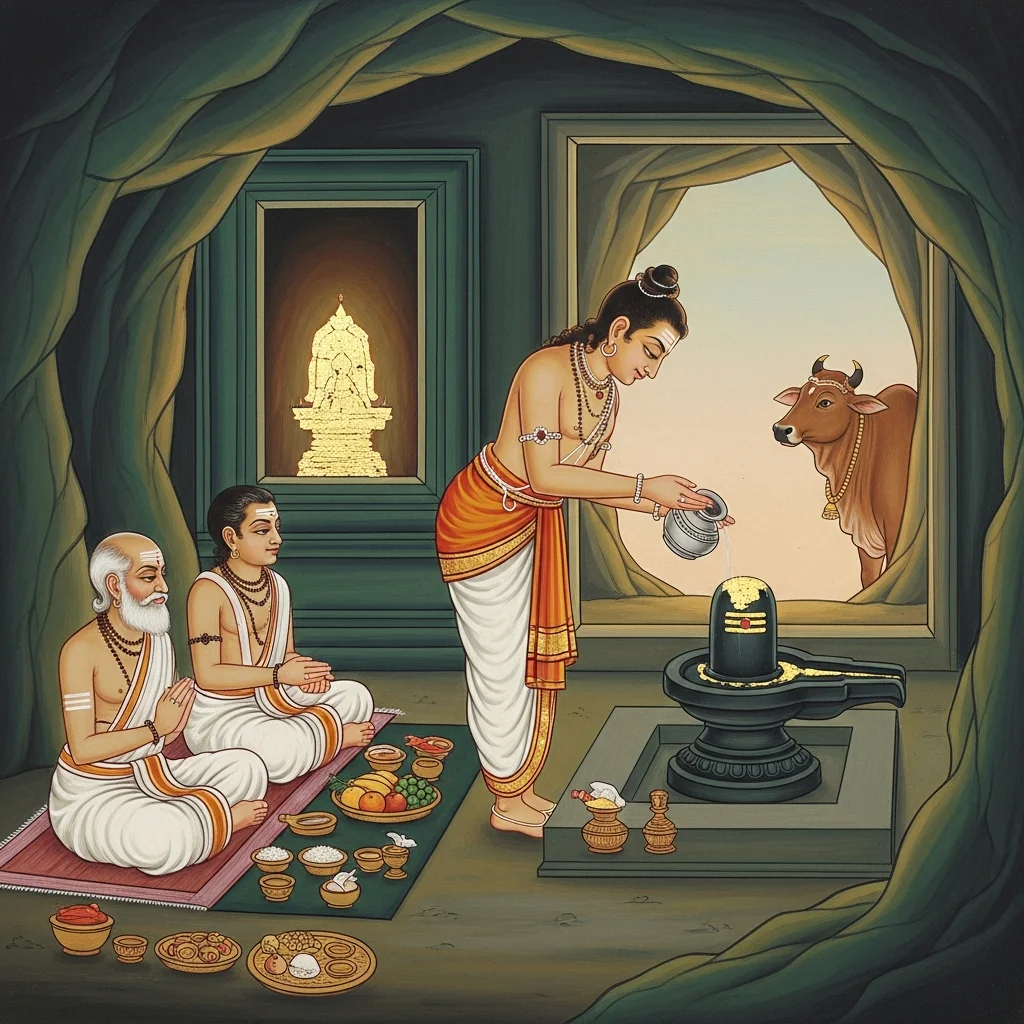
Śrāddha-kāla-nirṇaya, Viṣṇu-jāgaraṇa, and Markaṇḍeśvara-guhā-liṅga Māhātmya (Ritual Timing and Cave-Shrine Observances)
The chapter unfolds as a theological dialogue: Uttānapāda asks Īśvara to specify the proper times for śrāddha, dāna, and pilgrimage. Īśvara answers with a calendrical mapping of auspicious śrāddha-occasions—named tithis through the months, ayana transitions, aṣṭakā, saṅkrānti, vyatīpāta, and eclipse settings—declaring that gifts given then yield akṣaya, imperishable results. The teaching then turns to devotional discipline: fasting on an ekādaśī in the bright half of Madhu-māsa, keeping night-vigil near Viṣṇu’s feet, worship with incense, lamps, offerings, garlands, and recitation of earlier sacred narratives; Vedic-sūkta japa is praised as purifying and salvific. Morning śrāddha is prescribed with careful honoring of brāhmaṇas and capacity-based giving—gold, cows, garments—promising long-lasting satisfaction for the pitṛs. A pilgrimage sequence follows: on trayodaśī one visits a cave liṅga known as Markaṇḍeśvara, established by the sage Markaṇḍeya after severe tapas and yogic practice. Cave observances include bathing, upavāsa, sense-control, vigil, lamp-donation, pañcāmṛta/pañcagavya bathing of the deity, and extensive mantra-japa (including Sāvitrī counts). The text stresses pātra-parīkṣā (fitness of recipients) and teaches both material and “mental” offerings through eight ‘flowers’ culminating in virtues—ahiṃsā, indriya-nigraha, dayā, kṣamā, dhyāna, tapas, jñāna, satya. It closes with expanded dāna lists (vehicles, grains, farm implements, especially go-dāna), extolling incomparable merit during eclipses and affirming that where a cow is seen all tīrthas are present; remembrance and return to the tīrtha, or death there, is proclaimed as nearness to Rudra.
Adhyaya 52
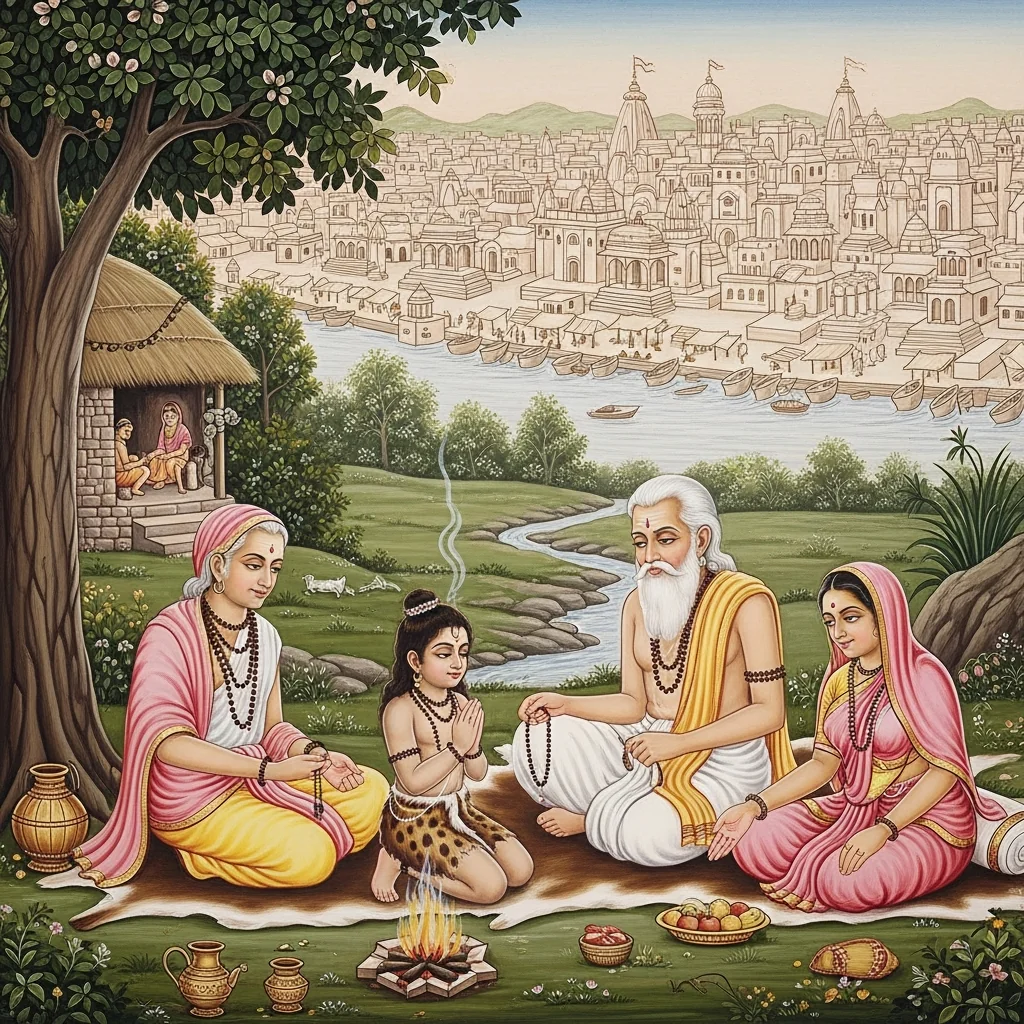
Dīrghatapā-āśrama and the Account of Ṛkṣaśṛṅga (दीर्घतपा-आश्रमः तथा ऋक्षशृङ्गोपाख्यानप्रस्तावः)
Chapter 52 begins with Īśvara announcing an earlier account of a great ascetic who, together with his household, attained heaven; King Uttānapāda requests to hear that narrative in full. The discourse then turns to Kāśī, portraying King Citrasena’s Vārāṇasī as prosperous—resounding with Vedic recitation, bustling with commerce, and rich in temples and āśramas. North of the city, within Mandāravana, lies a famed hermitage where the Brahmin ascetic Dīrghatapā dwells, renowned for intense tapas. Ascetic life is shown as compatible with family order: he lives with wife, son, and daughter-in-law, attended by five sons. The youngest, Ṛkṣaśṛṅga, is Veda-trained, celibate, virtuous, yogic, and austere in diet. A distinctive motif appears—he moves in deer-form and mingles with deer herds, yet returns daily to venerate his parents, embodying disciplined filial devotion. The excerpt ends with a decisive turn: by fate (daiva-yoga) Ṛkṣaśṛṅga dies, setting the stage for reflection on destiny, merit, and the afterlife course of ascetic households.
Adhyaya 53
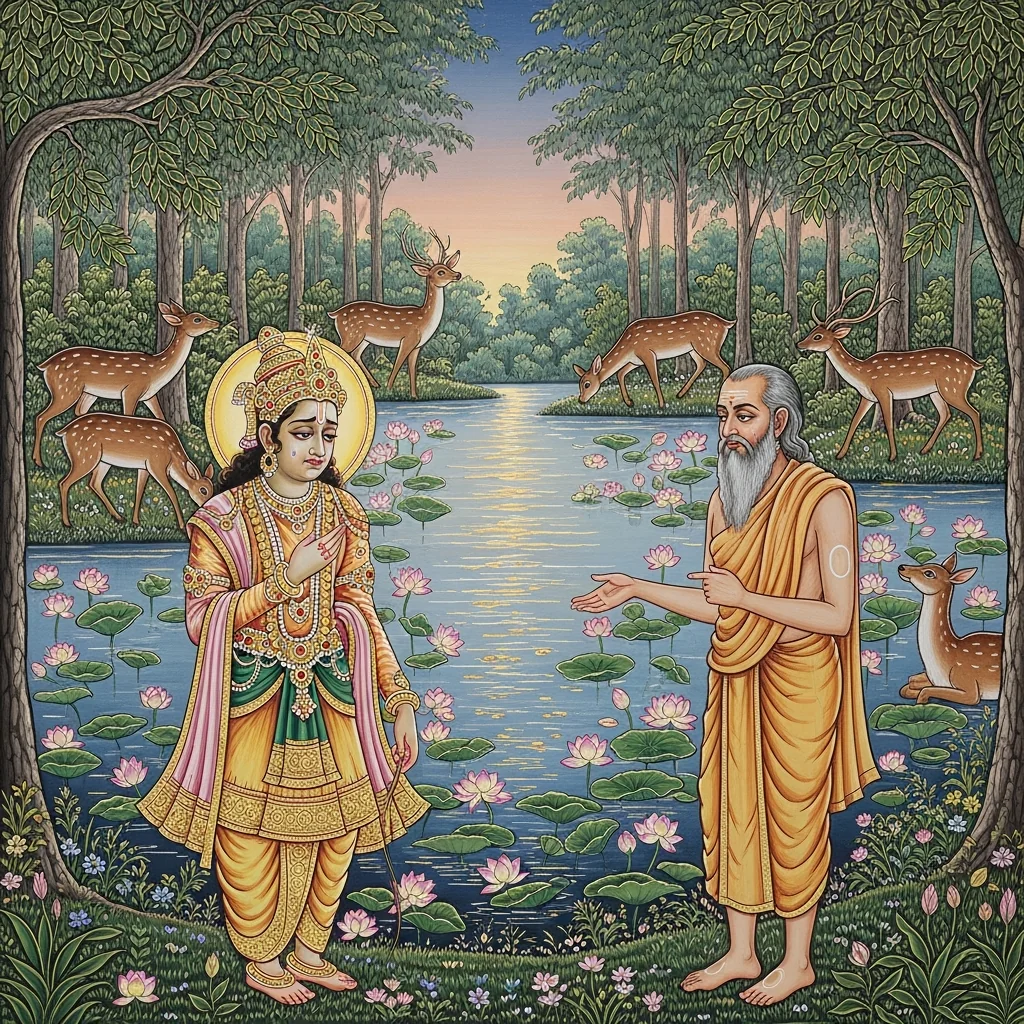
चित्रसेन-ऋक्षशृङ्गसंवादः (King Citrasena and Sage Ṛkṣaśṛṅga: Accidental Injury and Ethical Remediation)
The chapter is cast as a didactic tale spoken by Īśvara to Uttānapāda, declaring that attentive hearing itself purifies wrongdoing. Citrasena, the righteous and mighty king of Kāśī, goes hunting with allied rulers; amid dust and turmoil in the forest he becomes separated from his retinue. Famished and thirsty, he reaches a divine lake, bathes, offers tarpaṇa to pitṛs and devas, and worships Śaṅkara with lotus flowers. He then sees many deer set in varied positions, with the great ascetic Ṛkṣaśṛṅga seated among them. Mistaking the scene for a hunting chance, the king looses an arrow and unintentionally wounds the sage. When the sage speaks in a human voice, the king is shaken, confesses the accident, and offers self-immolation as expiation, knowing brahmahatyā to be uniquely grave. Ṛkṣaśṛṅga refuses, warning that such a remedy would only multiply deaths within the dependent family network, and instructs the king instead to carry him to his parents’ āśrama and confess before the mother as a “son-slayer,” so they may prescribe a path to peace. The king bears him onward, but during repeated halts Ṛkṣaśṛṅga dies through yogic concentration. Citrasena performs the funeral rites according to rule and laments, setting the stage for further teaching on remediation and moral responsibility.
Adhyaya 54
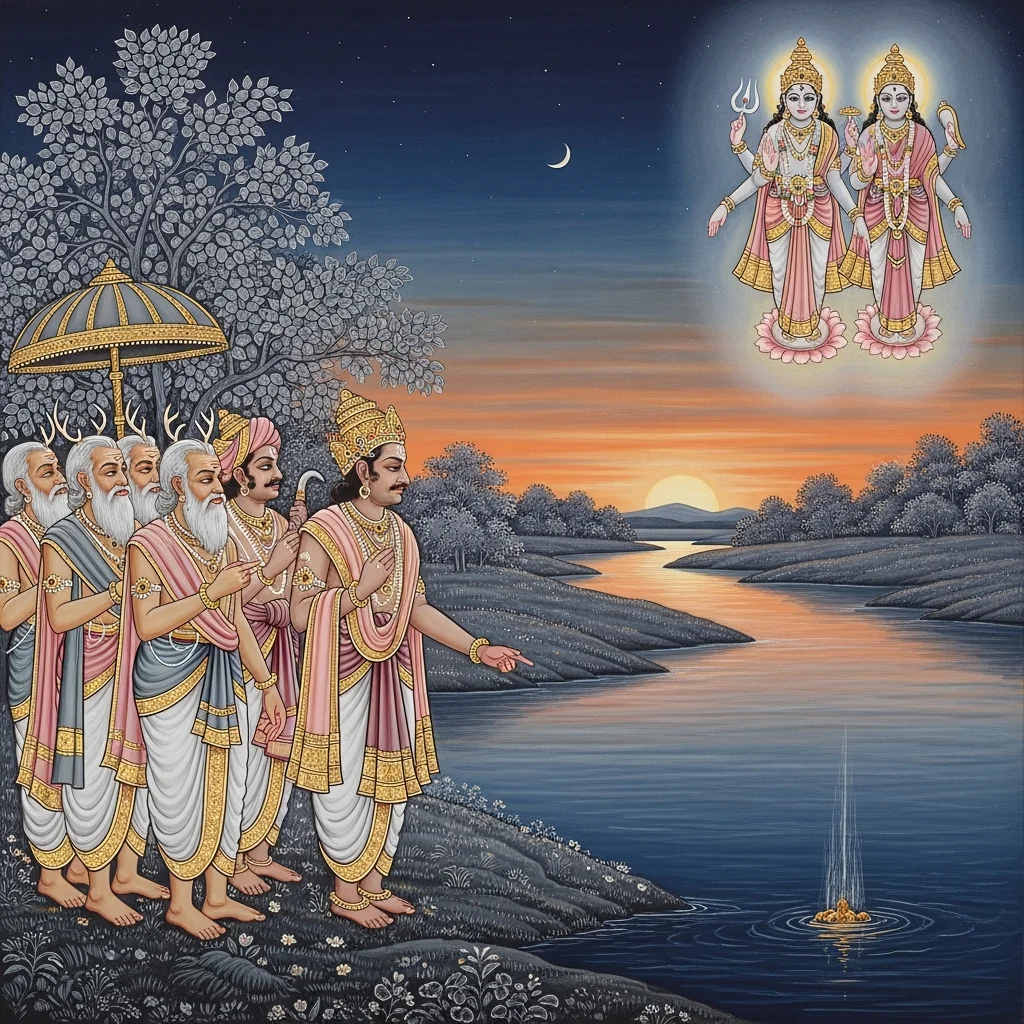
अध्याय ५४ — शूलभेदतीर्थ-माहात्म्य तथा चित्रसेनस्य प्रायश्चित्त-मार्गः (Shūlabheda Tīrtha-Māhātmya and King Citraseṇa’s Expiatory Path)
The chapter presents a moral crisis and its ritual remedy. After a grievous error likened to brahmahatyā, King Citraseṇa approaches the ascetic Dīrghatapā and confesses that, deluded while hunting, he killed the sage’s son Ṛkṣaśṛṅga. The household collapses in grief: the mother laments, faints, and dies, and the sons and daughters-in-law also perish, revealing the social and karmic weight of violence against ascetic life. Dīrghatapā first condemns the king, then teaches that people act under the impulse of prior karma, yet consequences still unfold. He prescribes a definite expiation: cremate the entire family and immerse the bones at the famed Śūlabheda tīrtha on the southern bank of the Narmadā, renowned for removing sin and suffering. Citraseṇa performs the cremations and undertakes an austere southward pilgrimage—walking, eating little, bathing repeatedly—seeking guidance from resident sages until he reaches the tīrtha amid intense ascetic practice. A visionary sign confirms the site’s power. He deposits the remains, bathes, offers tarpaṇa with sesame-mixed water, and immerses the bones; the departed appear in divine forms with celestial vehicles. Dīrghatapā, now exalted, blesses the king, declares the rite exemplary, and promises purification and the attainment of desired fruits.
Adhyaya 55
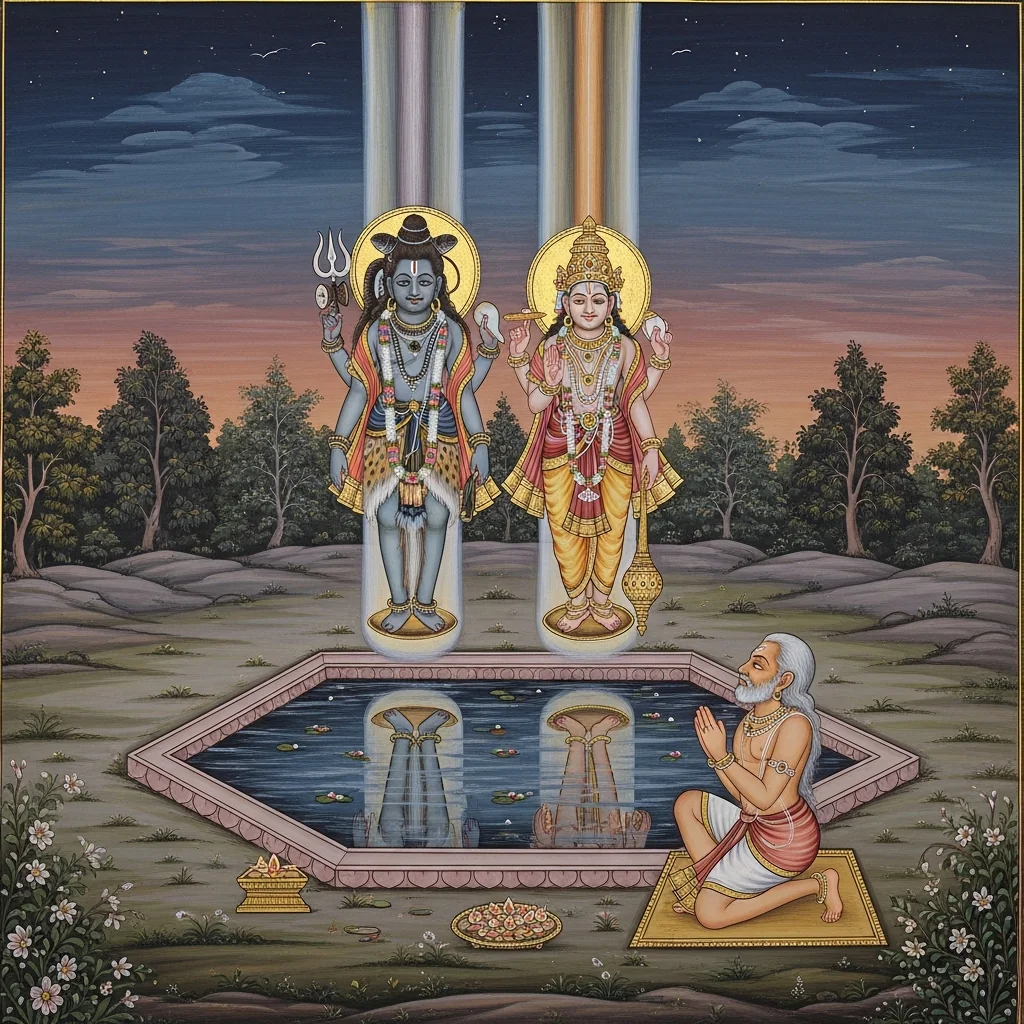
Śūlabheda-Tīrtha Māhātmya (शूलभेदतीर्थमाहात्म्य) — The Glory of the Śūlabheda Sacred Ford
Uttānapāda asks about King Citraseṇa after witnessing the might of a tīrtha. Īśvara relates that Citraseṇa climbed Bhṛgutunga and performed fierce tapas beside a kuṇḍa, meditating on Brahmā, Viṣṇu, and Maheśvara. Rudra and Keśava appear before him, restrain him from premature self-abandonment, and counsel him to return, enjoy rightful prosperity, and rule without hindrance. Citraseṇa rejects royal attachment and instead prays that the divine triad remain there forever, that the place become as meritorious as Gayāśiras, and that he gain leadership among Śiva’s gaṇas. Īśvara grants the boon: the three deities abide at Śūlabheda in partial manifestation through the three times; Citraseṇa becomes the gaṇādhipa named Nandi, functioning like Gaṇeśa and receiving precedence of worship near Śiva. The chapter then defines the tīrtha’s superior merit (surpassing others except Gayā), gives the kuṇḍa-area measures for ritual acts, and proclaims the power of śrāddha and piṇḍa: liberation for ancestors, benefit even for difficult deaths lacking rites, purification of inadvertent sins by mere bathing, and exalted results for renunciation undertaken there. A concluding phalaśruti praises reciting, hearing, writing, and gifting this māhātmya as removing demerit, granting desired ends, and securing residence in Rudra’s realm for as long as the text is preserved.
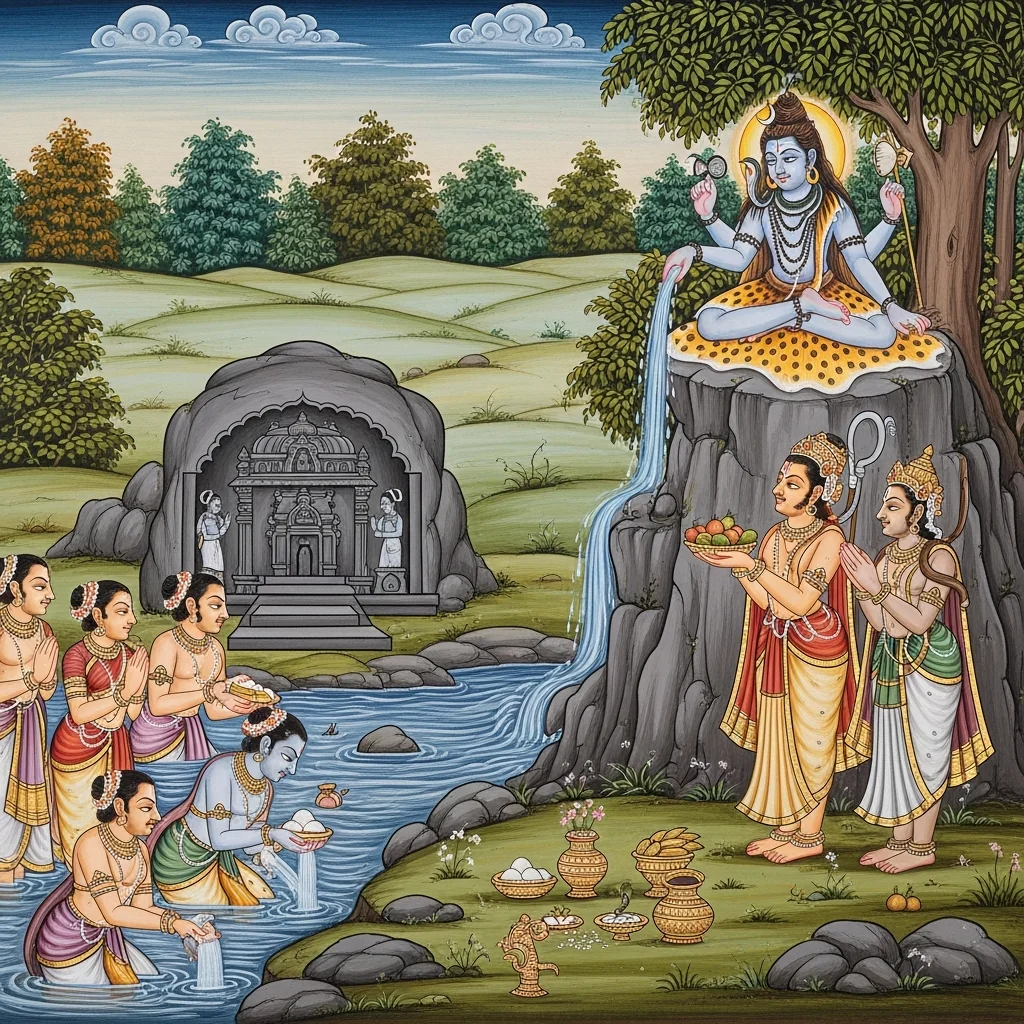
Adhyaya 56
देवशिला-शूलभेद-तीर्थमाहात्म्य तथा भानुमती-व्रताख्यान (Devāśilā–Śūlabheda Tīrtha Māhātmya and the Bhānumatī Vrata Narrative)
Adhyāya 56 unfolds as a theological dialogue. Uttānapāda asks how Gaṅgā descended and how the supremely meritorious Devāśilā tīrtha arose; Īśvara replies with a sacred origin account: the deities invoke Gaṅgā, Rudra releases her from his matted locks (jaṭā), and she manifests as a Devanadī for human welfare. A tīrtha-complex is then established around Śūlabheda, Devāśilā, and the Prācī Sarasvatī site. The chapter turns to ritual application—holy bathing, tarpaṇa, śrāddha with qualified brāhmaṇas, Ekādaśī fasting, night vigil (jāgaraṇa), Purāṇic recitation, and dāna—as means of purification and ancestral satisfaction. Exemplary narratives follow: Bhānumatī, the widowed daughter of King Vīrasena, undertakes strict vows and a multi-year pilgrimage (Gaṅgā → southern route → Revā region → tīrtha to tīrtha), finally residing with discipline at Śūlabheda/Devāśilā in sustained worship and brāhmaṇa hospitality. A famine-stricken hunter and his wife likewise gain merit through simple offerings, Ekādaśī observance, communal tīrtha rites, truthfulness, and charity. The conclusion briefly ranks the fruits of various gifts (sesame, lamps, land, gold, etc.), exalting brahmadāna as highest and affirming that inner intention (bhāva) determines the outcome.
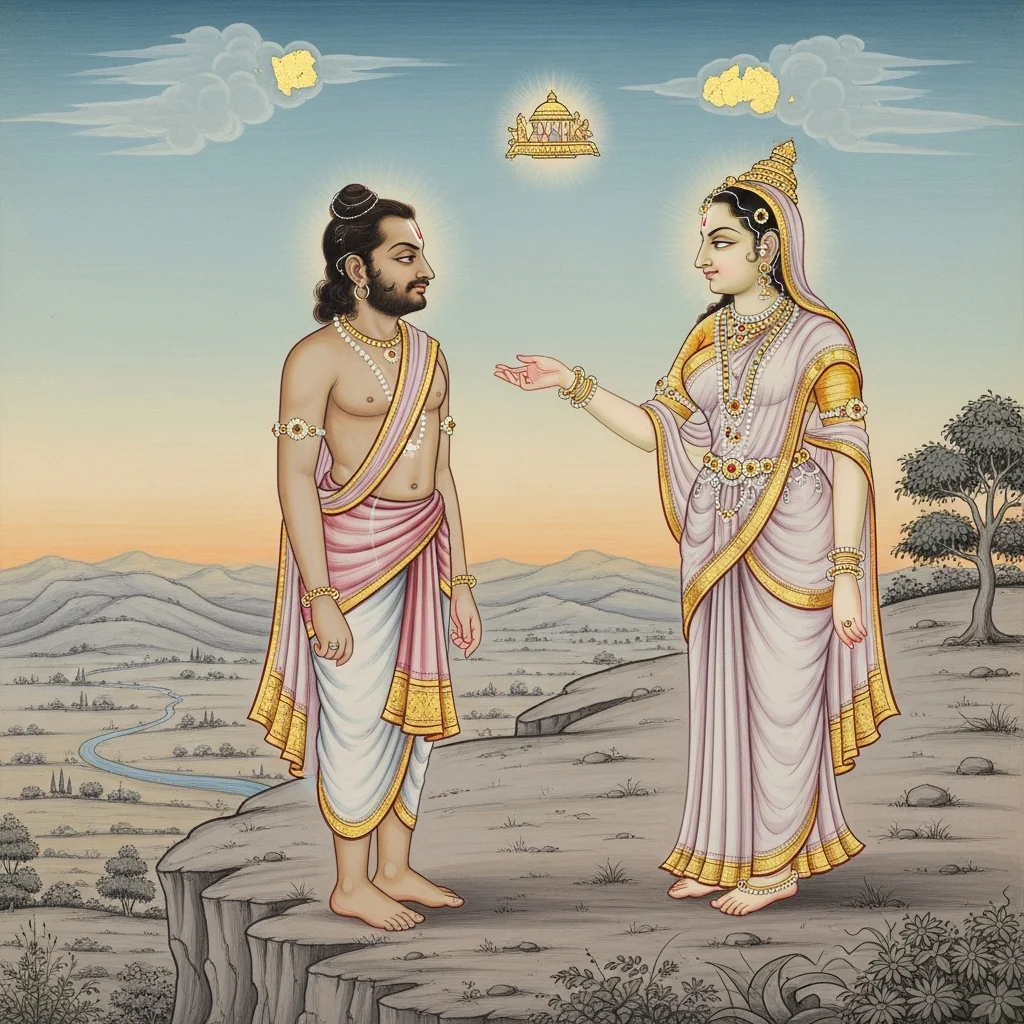
Adhyaya 57
Padmaka-parva and the Śabara’s Liberation at Markaṇḍa-hrada (Revā Khaṇḍa, Adhyāya 57)
This chapter offers a twofold theological teaching. First, Bhānumatī undertakes a disciplined Śaiva observance on key lunar days: she feeds Brahmins, keeps the upavāsa-niyama (fasting and restraint), bathes in Markaṇḍa’s lake (Markaṇḍasya hrada), and worships Maheśvara—also hailed as Vṛṣabhadhvaja—with pañcāmṛta, fragrances, incense, lamps, offerings, and flowers. She maintains an all-night vigil (kṣapā-jāgaraṇa) with Purāṇic recitation, song, dance, and hymns. The Brahmins then identify the occasion as the Padmaka festival, specifying tithi/nakṣatra/yoga/karana markers and declaring that gifts, oblations, and japa performed there become akṣaya, of unfailing merit. Next, the narrative turns to an ethical dialogue. Bhānumatī meets a Śabara who, with his wife, is preparing to leap from the mountain Bhṛgumūrdhan—not from immediate misery, but from fear of saṃsāra and anxiety that, having gained human birth, he has failed to practice dharma. Bhānumatī counsels that time still remains for dharma and for purification through vows and giving. The Śabara refuses wealth-based support, voicing a scruple about food-debt and impurity—“one who eats another’s food eats that person’s wrongdoing”—and remains resolved. Binding himself with a half-garment, he meditates on Hari and falls; soon after, he and his wife are seen ascending in a divine aerial vehicle, signifying liberation and an exalted destiny.
Adhyaya 58
Śūlabheda-tīrtha Māhātmya (Glory of the Śūlabheda Sacred Site)
Chapter 58 delivers a tightly ordered tīrtha-māhātmya of Śūlabheda and ends with a phalaśruti. Uttānapāda asks Īśvara about Bhānumatī’s deed and its meaning. Īśvara recounts how she approaches a kuṇḍa, instantly recognizes its sanctity, and responds with proper observance: she summons and honors brāhmaṇas, gives dāna according to rule, and steadies her resolve. She then worships pitṛs and devas, keeps her vows for a prescribed period (a fortnight in Madhu-māsa is mentioned), and on amāvāsyā goes to a mountain region. After ascending the peak, she requests the brāhmaṇas to carry a message of reconciliation to her family and kin, declaring that by her own tapas at Śūlabheda she will relinquish the body and attain the heavenly state. They agree, removing doubt. She sets her garments in order and, with one-pointed mind, casts off her body; celestial women appear, invite her onto a divine vimāna bound for Kailāsa, and she ascends before the onlookers. Mārkaṇḍeya closes by affirming the account’s transmission and proclaiming a strong phalaśruti: devoted reading or hearing—at a tīrtha or even in a temple—frees one from grave, long-accumulated sins, including many social, ritual, and trust-breaking transgressions, all cut off by the power of “Śūlabheda.” Further merit is promised for recitation during śrāddha while brāhmaṇas dine, bringing joy to the pitṛs, and listeners gain auspicious well-being, longevity, and fame.
Adhyaya 59
पुष्करिणीतीर्थमाहात्म्यं (Puṣkariṇī Tīrtha Māhātmya on the Revā’s Northern Bank)
Mārkaṇḍeya describes a sin-destroying puṣkariṇī (sacred tank) to be visited for purification. It lies on the northern bank of the Revā and is declared supremely auspicious, for Divākara—the Sun, revered as vedamūrti, the embodied Veda—abides there continually. The tīrtha’s merit is likened to Kurukṣetra, especially in granting all desired aims (sarvakāma-phala) and in increasing the fruit of gifts (dāna-vṛddhi). The chapter then sets forth the merits of donations and observances: bathing during a solar eclipse and giving dāna properly (including valuables and livestock); gifting gold and silver to brāhmaṇas with merit multiplied over thirteen days; and performing tarpaṇa with sesame-mixed water to satisfy pitṛs and deities. Śrāddha with payasa, honey, and ghee is said to bestow heaven and imperishable benefit upon ancestors, while offerings of grains and fruits (akṣata, badara, bilva, iṅguda, tila) yield inexhaustible results. Its devotional climax is solar worship—bathing, pūjā to Divākara, reciting the Ādityahṛdaya, and Vedic japa (even a single ṛc/yajus/sāman)—which grants comprehensive Vedic fruit, freedom from sins, and access to an exalted realm. Finally, it declares that one who relinquishes life there according to rite attains the supreme station associated with the Sun.
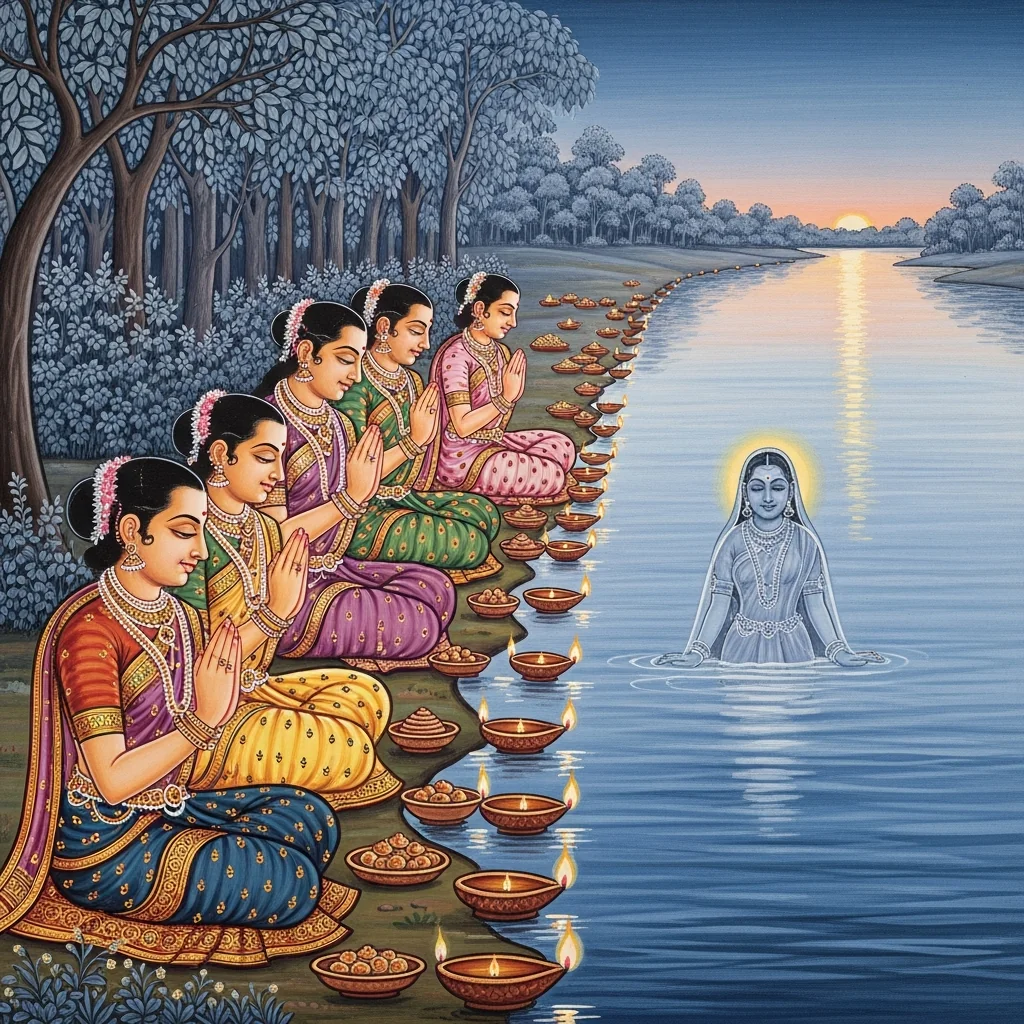
Adhyaya 60
रवितीर्थ-आदित्येश्वर-माहात्म्य एवं नर्मदास्तोत्रफलम् (Ravītīrtha–Ādityeśvara Māhātmya and the Fruit of the Narmadā Hymn)
Mārkaṇḍeya resumes his instruction to Yudhiṣṭhira, extolling Ādityeśvara and Ravītīrtha as a supreme sacred site whose efficacy surpasses renowned tīrthas. He recounts a tale heard near Rudra: during a famine, many sages gather on the Narmadā and enter a forested tīrtha region, where they meet fearsome figures—women and men bearing nooses—who urge them onward to their “masters” at the tīrtha. The sages offer a long hymn to Narmadā, praising her power to purify and protect. The Goddess Narmadā manifests and grants extraordinary boons, including a rare assurance oriented toward liberation. Next, five powerful men engaged in bathing and worship explain that even grave transgressions can be removed by the tīrtha’s influence; they worship Bhāskara (the Sun) and inwardly remember Hari, culminating in a transformation witnessed by the sages. The chapter then sets forth Ravītīrtha’s ritual observances: visiting during eclipses and auspicious calendrical junctures, fasting, night vigil, lamp offerings, Vaiṣṇava kathā and Veda-recitation, Gāyatrī-japa, honoring brāhmaṇas, and gifts of food, gold, land, garments, shelter, and vehicles. The phalaśruti promises purification and residence in the solar realm for faithful listeners, while advising discretion in conveying the tīrtha’s secrets to those marked by serious ethical breaches.
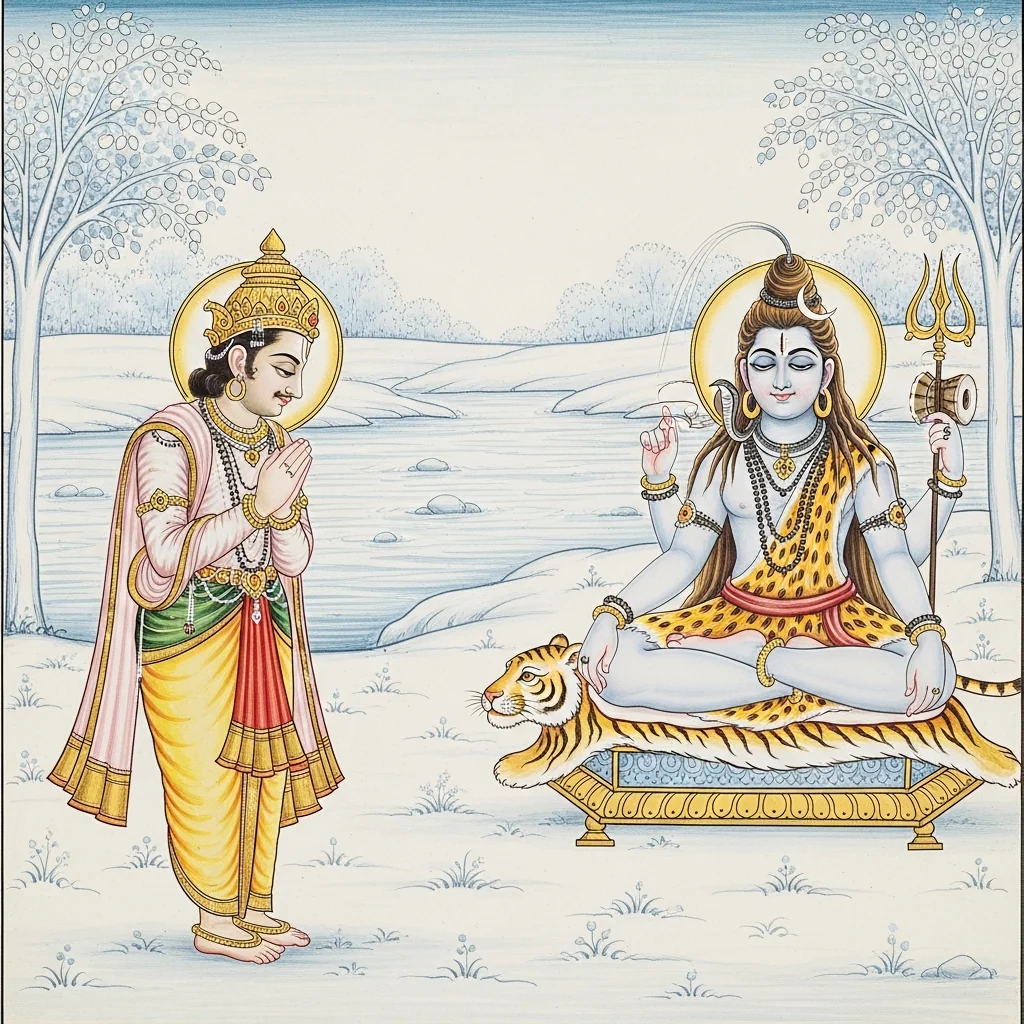
Adhyaya 61
शक्रतीर्थ-शक्रेश्वर-माहात्म्य (Glory of Śakra-tīrtha and Śakreśvara)
Mārkaṇḍeya points the listener to a supremely meritorious place on the southern bank of the Narmadā called Śakra-tīrtha, praised as a remover of accumulated sin. Its sanctity is grounded in an origin-legend: Indra (Śakra) once performed fierce austerities there with intense devotion to Maheśvara (Śiva). Pleased, Umāpati granted boons—Indra’s lordship among the devas, royal prosperity, and the power to overcome hostile beings, here described as dānavas. The chapter then turns to practice, prescribing a devotional fast on Kārttika kṛṣṇa trayodaśī as a means of release from sins, including those connected with troubling dreams, inauspicious omens, and afflictive influences attributed to graha/śākinī categories. Darśana of Śakreśvara is said to destroy wrongdoing accrued from birth, and the text also names transgressions for which purification is promised in this sacred setting. Finally, it enjoins dāna—especially gifting a cow (or a suitable draft animal) to an exemplary Brahmin—performed with devotion by one seeking heavenly abode, and concludes with a concise statement of the site’s promised fruits (phalāni).
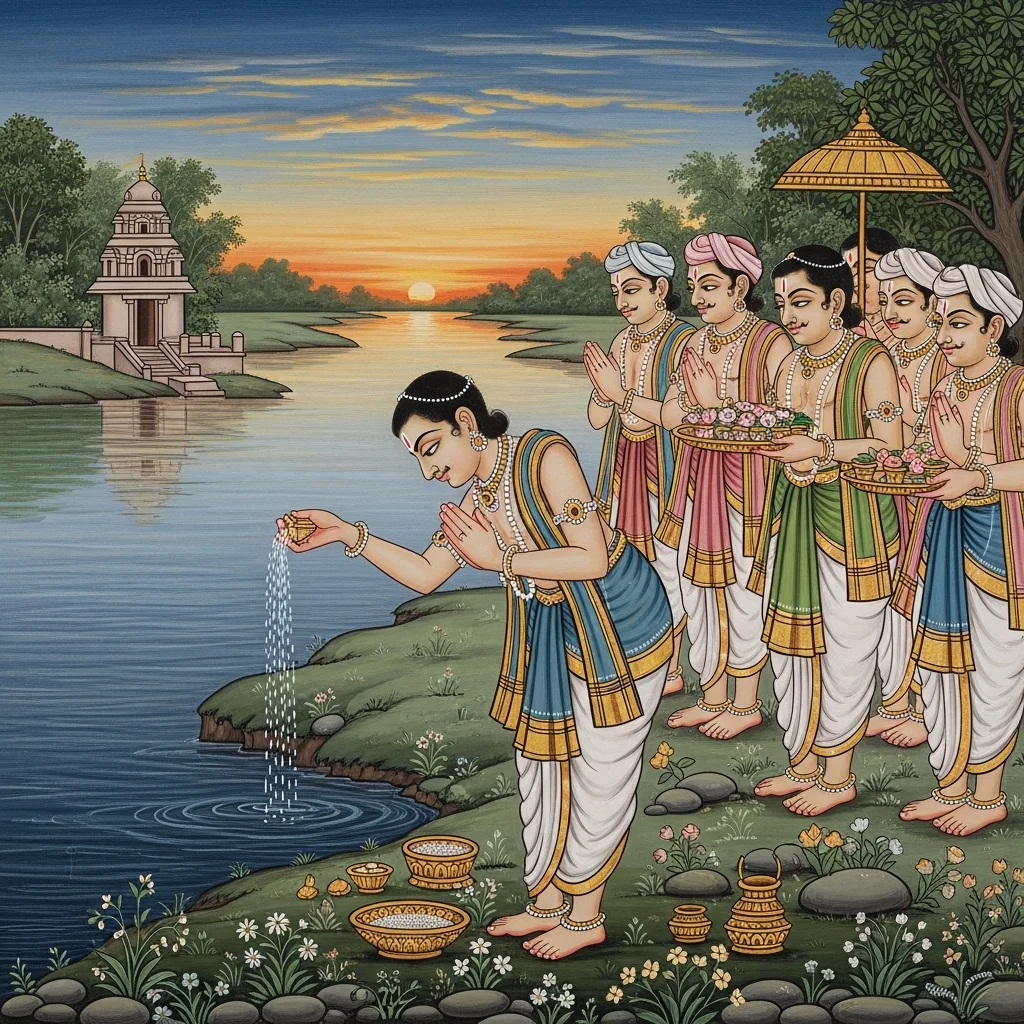
Adhyaya 62
क्रोडीतीर्थ-माहात्म्य (Kroḍī Tīrtha Māhātmya) — The Glory of the Kroḍīśvara Shrine
Adhyāya 62 records Mārkaṇḍeya’s instruction to a king on visiting the renowned tīrtha of Kroḍīśvara. It first narrates the origin: after the devas destroy the dānava forces, they gather the severed heads and consign them to the waters of the Narmadā, recalling bonds of kinship; then they bathe, establish Umāpati (Śiva), and worship him for welfare and for “worldly accomplishment” (lokasiddhi). Thus the tīrtha becomes known on earth as “Kroḍī,” famed as sin-destroying (pāpa-ghna). The chapter then lays out the observance: devotional fasting on the 8th and 14th lunar days of both fortnights; a night-vigil before Śūlin with sacred narration and Vedic study; morning worship of Tridaśeśvara; bathing the deity with pañcāmṛta, anointing with sandal, offering leaves and flowers, mantra-japa facing south, and a disciplined act of water-immersion. It also prescribes south-facing water-offerings (tila-añjali) for the departed, śrāddha, and feeding/gifting to disciplined, Veda-oriented brāhmaṇas, declaring multiplied merit. In the phalaśruti, death at the tīrtha according to rule grants long residence in Śivaloka as long as one’s bones remain in Narmadā water, followed by rebirth as a wealthy, honored, virtuous, long-lived person who later remembers the tīrtha and attains the highest goal by worshipping Kroḍīśvara. The chapter further urges building a shrine on the northern bank of the Revā with honestly acquired wealth, open to all varṇas and to women according to capacity, and concludes that devoted hearing of this tīrtha-māhātmya destroys sin within six months.
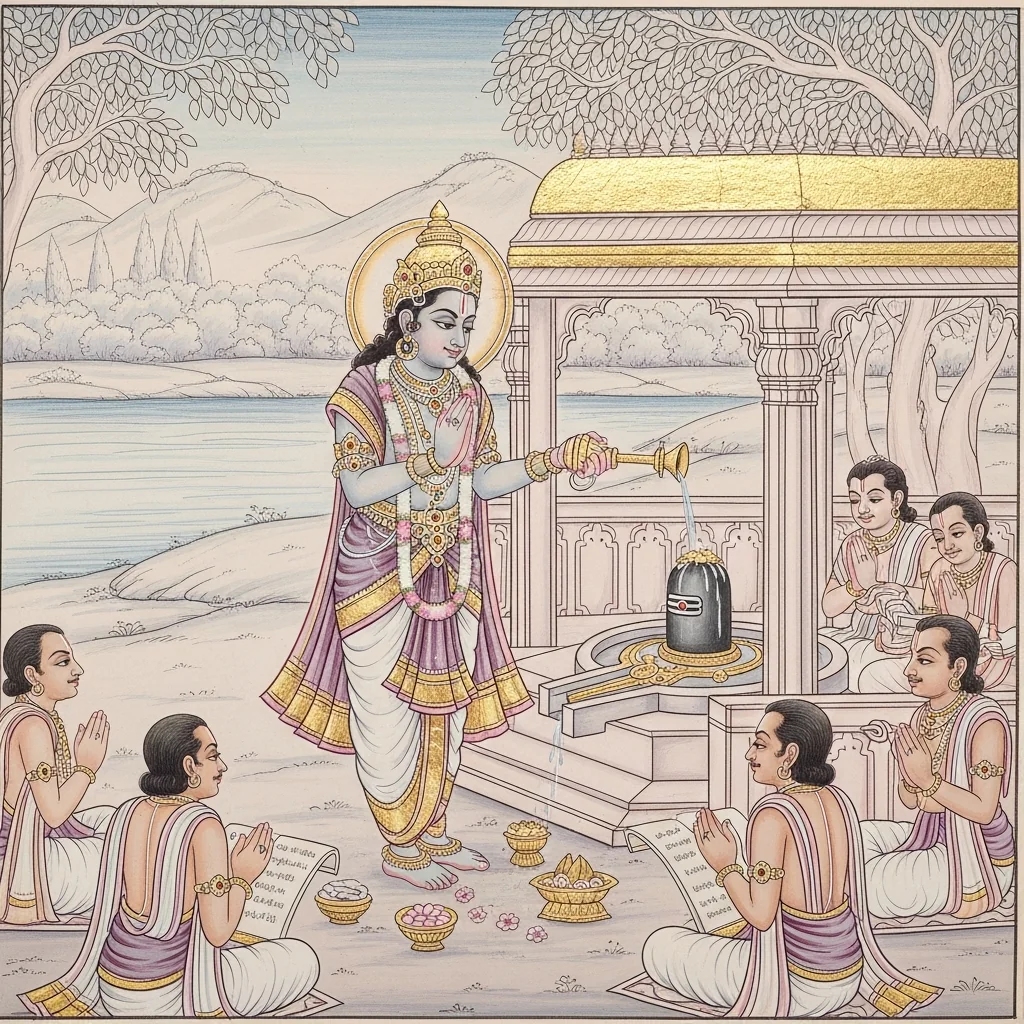
Adhyaya 63
कुमारेश्वरतीर्थ-माहात्म्य (Kumāreśvara Tīrtha Māhātmya)
Mārkaṇḍeya instructs the royal listener to go to the eminent Kumāreśvara, a famed tīrtha near Agastyeśvara on the bank of the Narmadā. The chapter proclaims it a powerful pilgrimage-site upon the Narmadā. It explains the sacred origin: in ancient times Ṣaṇmukha (Skanda) worshipped here with intense devotion and attained siddhi, becoming commander of the divine hosts and a subduer of enemies; from that precedent the place is established as a potent tīrtha. For pilgrims a discipline is prescribed: approach with one-pointed mind and control of the senses, with special observance on Kārttika caturdaśī and aṣṭamī. The rites include bathing/abhiṣeka of Girijā-nātha (Śiva) with curd, milk, and ghee; devotional singing; and proper piṇḍa-dāna, ideally in the presence of learned brāhmaṇas devoted to orthodox duties. A doctrine of merit is stated: whatever is given there becomes akṣaya (imperishable), the tīrtha embodies all tīrthas, and the darśana of Kumāra yields puṇya. The concluding phalāśruti declares that one who dies in connection with this sacred economy attains heaven, affirmed as the Lord’s truthful proclamation.
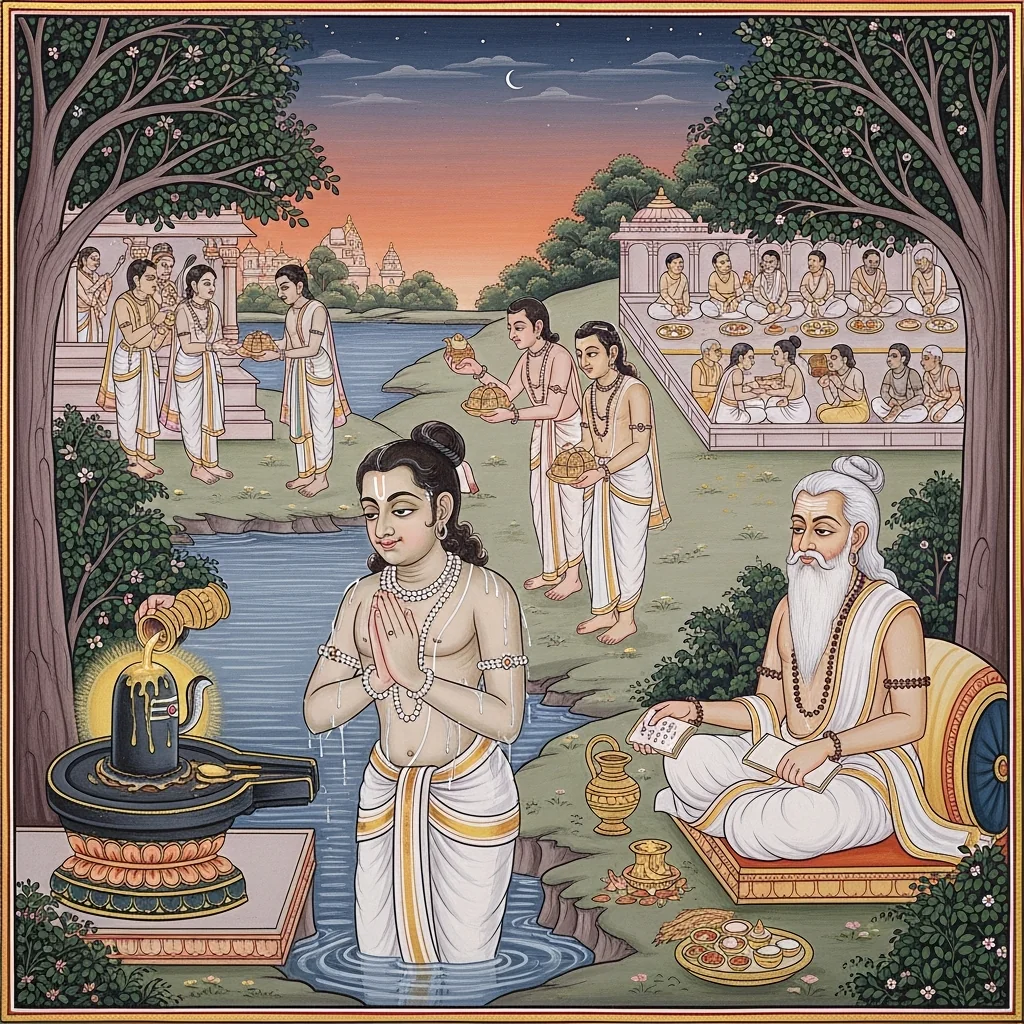
Adhyaya 64
अगस्त्येश्वरतीर्थमाहात्म्य (Agastyeśvara Tīrtha-Māhātmya)
In this adhyāya, Mārkaṇḍeya speaks to a royal interlocutor and directs him to the supremely auspicious tīrtha called Agastyeśvara, praised as a place-based means for removing moral demerit and sin. The chapter sets out a disciplined ritual course: perform snāna (sacred bathing) there, explicitly said to bring release from grievous wrongdoing, expressed in the idiom of brahmahatyā-remission. It also fixes the proper time—Kārttika month, kṛṣṇapakṣa, on caturdaśī—thus uniting time, place, and practice into a single ethical prescription. Further, one should bathe the deity (abhiṣeka) with ghee while remaining established in samādhi and with the senses restrained (jite-indriya). A regimen of dāna is added—wealth, footwear, umbrella, a ghee-blanket, and feeding all—declaring that such acts multiply merit. The teaching emphasizes a structured pilgrimage ethic: purification arises from coordinated observance, devotion, and generosity, not from travel alone.
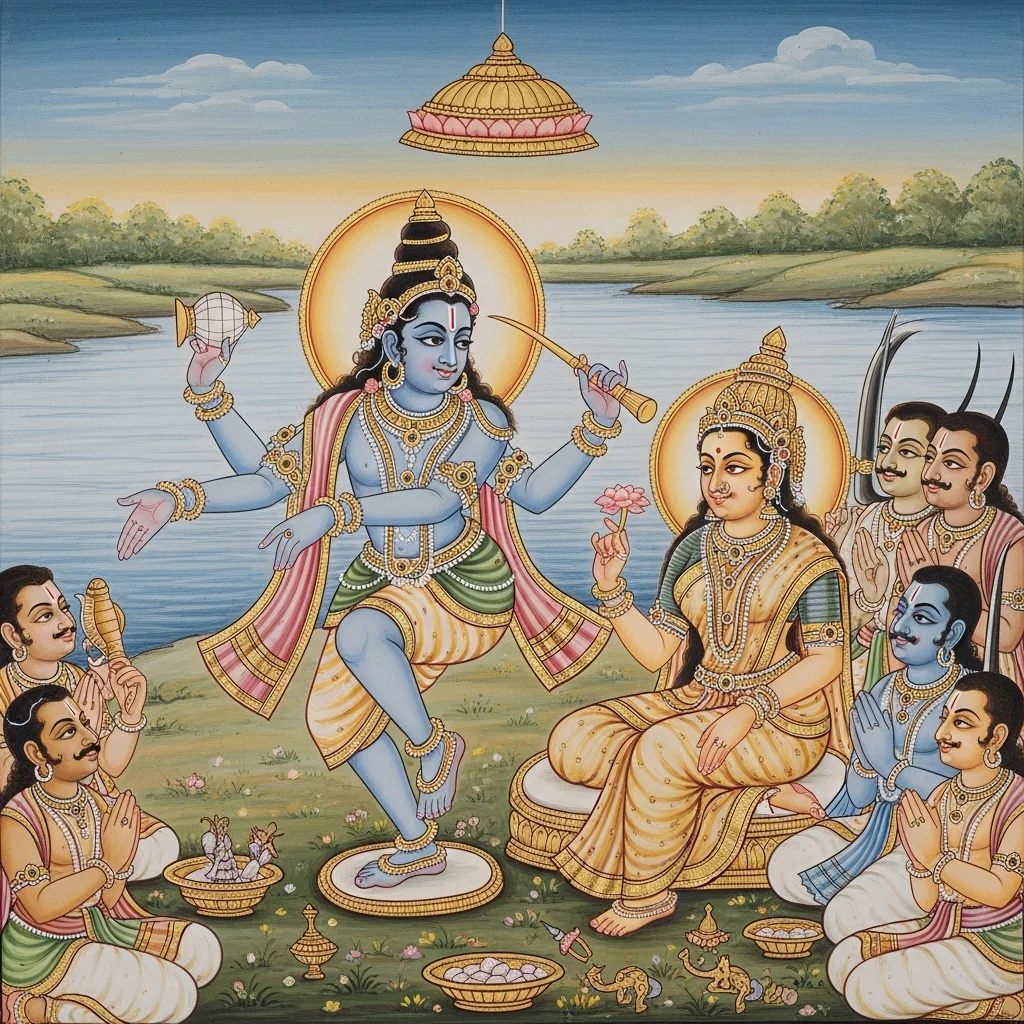
Adhyaya 65
Ānandeśvara-tīrtha Māhātmya (Glory of the Ānandeśvara Tīrtha)
This chapter unfolds as a dialogue in which the sage Mārkaṇḍeya instructs Yudhiṣṭhira about a sacred Narmadā-bank tīrtha called Ānandeśvara. It first recounts the origin: after the demons are slain, Maheśvara (Śiva) is honored by gods and beings; taking the Bhairava form with Gaurī as his consort, he performs a divine dance on the southern bank of the Narmadā. From this foundational event the tīrtha gains the name Ānandeśvara and is praised as a place of purifying power. The teaching then turns to ritual guidance: worship is recommended on Aṣṭamī, Caturdaśī, and Paurṇamāsī, with fragrant anointing and the honoring of brāhmaṇas according to one’s means. Go-dāna and vastra-dāna are commended, and a seasonal śrāddha observance is prescribed (notably the trayodaśī in Vasanta), with practical offerings such as inguda, badara, bilva, akṣata, and water. The closing phalaśruti declares that these acts bring enduring satisfaction to the ancestors and ensure continuity of progeny across many births, presenting ritual performance as both dharmic duty and long-range spiritual welfare.
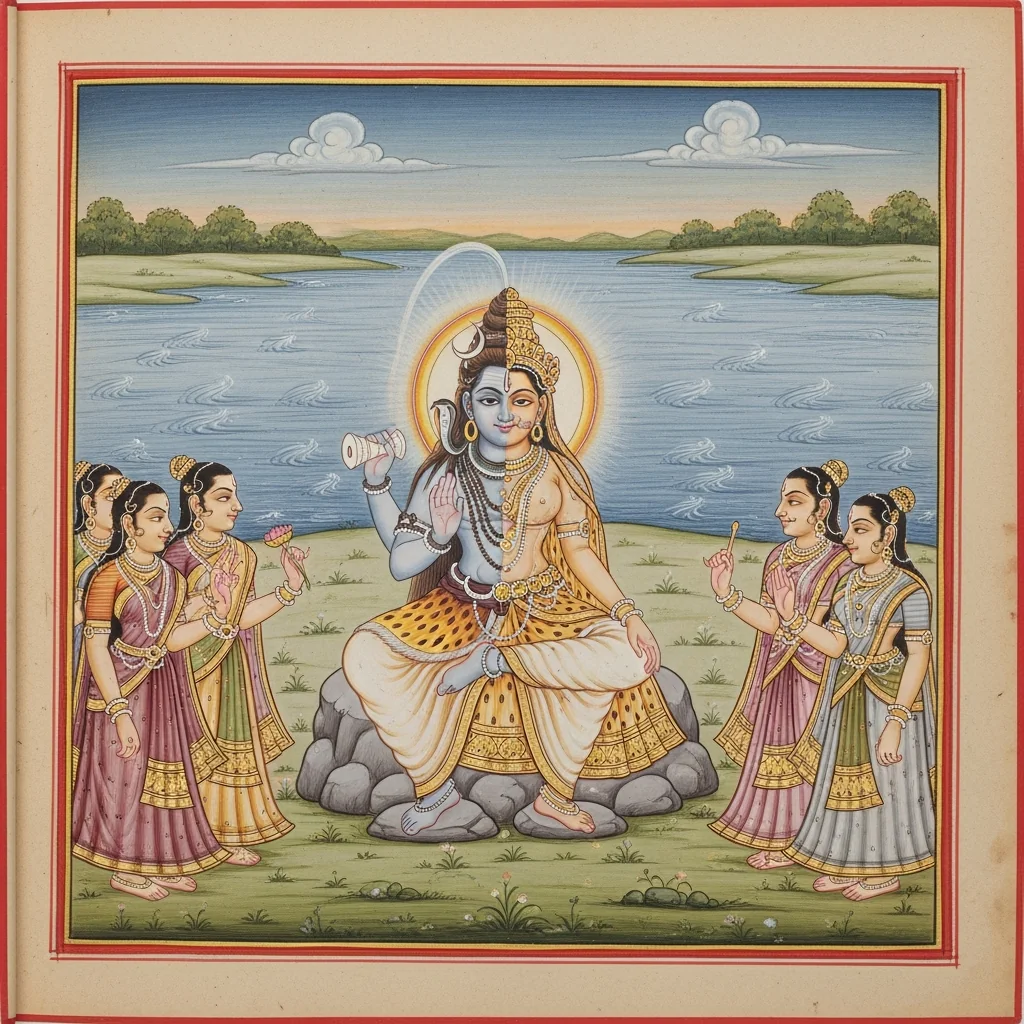
Adhyaya 66
मातृतीर्थमाहात्म्य (Mātṛtīrtha Māhātmya: The Glory of the Mothers’ Pilgrimage Site)
Mārkaṇḍeya instructs Yudhiṣṭhira to go to the unsurpassed Mātṛtīrtha, near a confluence on the southern bank of the Narmadā. Its sanctity is explained through an origin account: the divine Mothers (Mātṛs) manifested on that riverbank, and Śiva—described as having Umā as half of his being and wearing a serpent as his sacred thread—answered the appeal of an assembly of Yoginīs. Śiva authorizes the tīrtha to be famed on earth and then vanishes, making divine sanction the ground of its power. The chapter prescribes an observance on navamī (the ninth lunar day): a disciplined, pure devotee should fast and worship within the Mothers’ sphere (mātṛ-gocara). The fruits are both devotional—pleasing the Mātṛs and Śiva—and practical: for women said to be barren, bereaved of children, or without sons, a teacher skilled in mantra and śāstra should initiate a bathing rite with a golden vessel fitted with five gems and fruits; the teacher then administers the bath in a bronze vessel to obtain a son. It concludes that whatever desire one contemplates is fulfilled, and that no tīrtha surpasses Mātṛtīrtha.
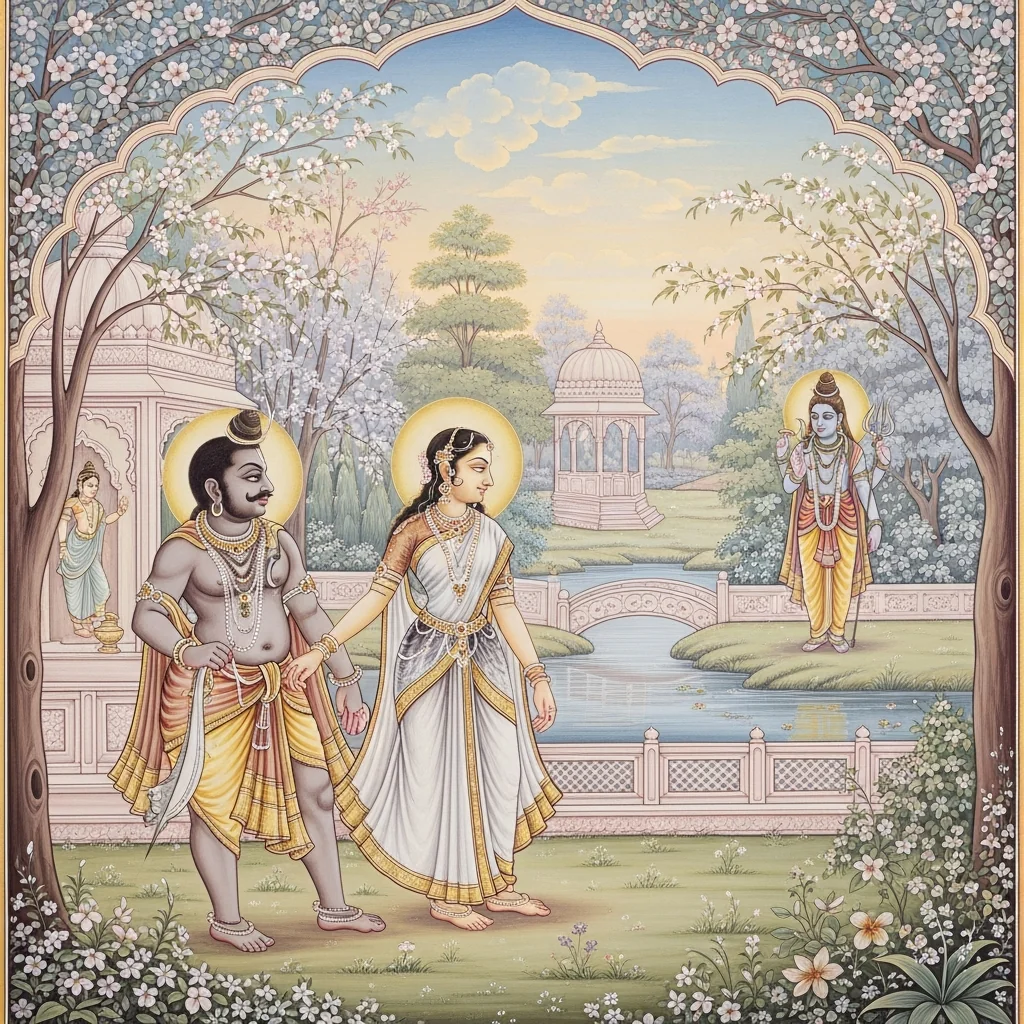
Adhyaya 67
Luṅkeśvara/Liṅgeśvara Tīrtha Māhātmya and the Daitya Kālapṛṣṭha’s Boon
Chapter 67, narrated by Mārkaṇḍeya, offers a tīrtha-centered theological teaching. It introduces a highly meritorious water-based pilgrimage site called Luṅkeśvara, also explained as Liṅgeśvara or a “sparśa-liṅga,” emphasizing sanctity gained through contact with the liṅga. The narrative turns on a boon-born crisis: the daitya Kālapṛṣṭha performs fierce tapas, including the ascetic practice of “smoke-drinking,” and Pārvatī urges Śiva to grant him a boon. Śiva warns against giving under coercion and notes the ethical danger of yielding to improper prompting, yet he grants a perilous boon—any being whose head is touched by the daitya’s hand is reduced to ash. The daitya then tries to use this power against Śiva, leading to a chase across the worlds. Seeking aid, Śiva sends Nārada to Viṣṇu, who intervenes through māyā by manifesting an enchanting spring-grove and a captivating maiden. Deluded by desire, the daitya follows a cue of social custom and places his hand upon his own head, perishing instantly. The chapter concludes with phalaśruti and ritual guidance: bathing or drinking at Luṅkeśvara destroys sins tied to the body’s constituents and vast karmic spans; fasting on specified lunar days and small gifts to learned brāhmaṇas multiply merit; and guardian deities are named as upholding the site’s sanctity.
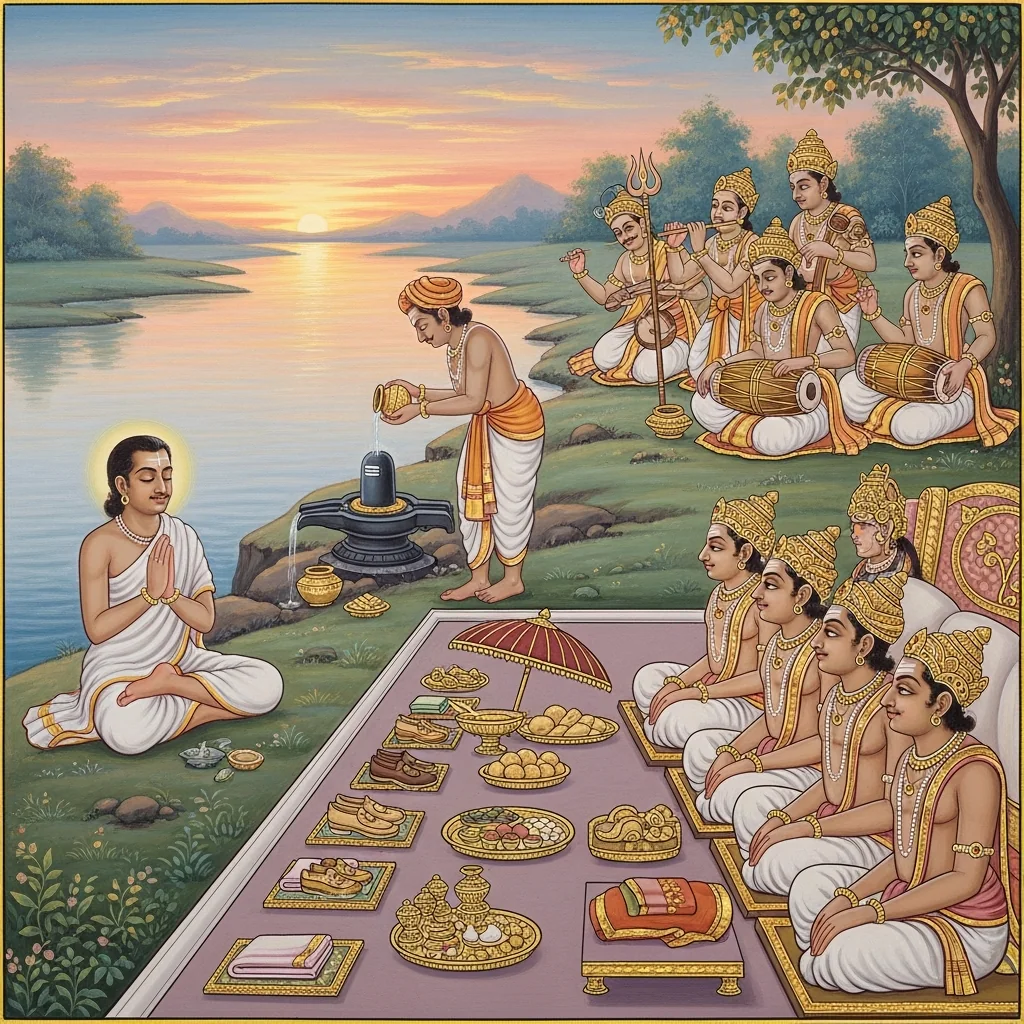
Adhyaya 68
धनदतीर्थमाहात्म्य (Glory of Dhanada Tīrtha on the Southern Bank of the Narmadā)
Mārkaṇḍeya instructs Yudhiṣṭhira to go to Dhanadā’s tīrtha on the southern bank of the Narmadā, praised as a universal destroyer of sin and as granting the fruit of all tīrthas. A timed observance is taught: on Trayodaśī of the bright fortnight in the month of Caitra, one should be self-controlled, fast, and keep a night-long vigil. Dhanadā is to be ritually bathed with pañcāmṛta, a ghee-lamp is to be offered, and devotion is to be supported with song and instruments. At dawn, one should honor worthy Brahmins—fit to accept gifts, grounded in learning and śāstric discourse, devoted to śrauta/smārta conduct, and ethically restrained. Gifts include cows, gold, clothing, footwear, and food, with optional umbrella and bed; this is said to remove sins completely across three births. The phalāśruti distinguishes results by disposition: heaven for the undisciplined, liberation for the disciplined. The poor gain repeated access to food; innate noble status and relief from suffering are obtained; and Narmadā water destroys disease. Special merit is given to gifting knowledge (vidyā-dāna) at Dhanadā’s tīrtha, leading to the “world of the Sun” free of ailments; and those who make abundant offerings at Devadroṇī on Revā’s southern bank attain the “world of Śaṅkara,” devoid of sorrow.
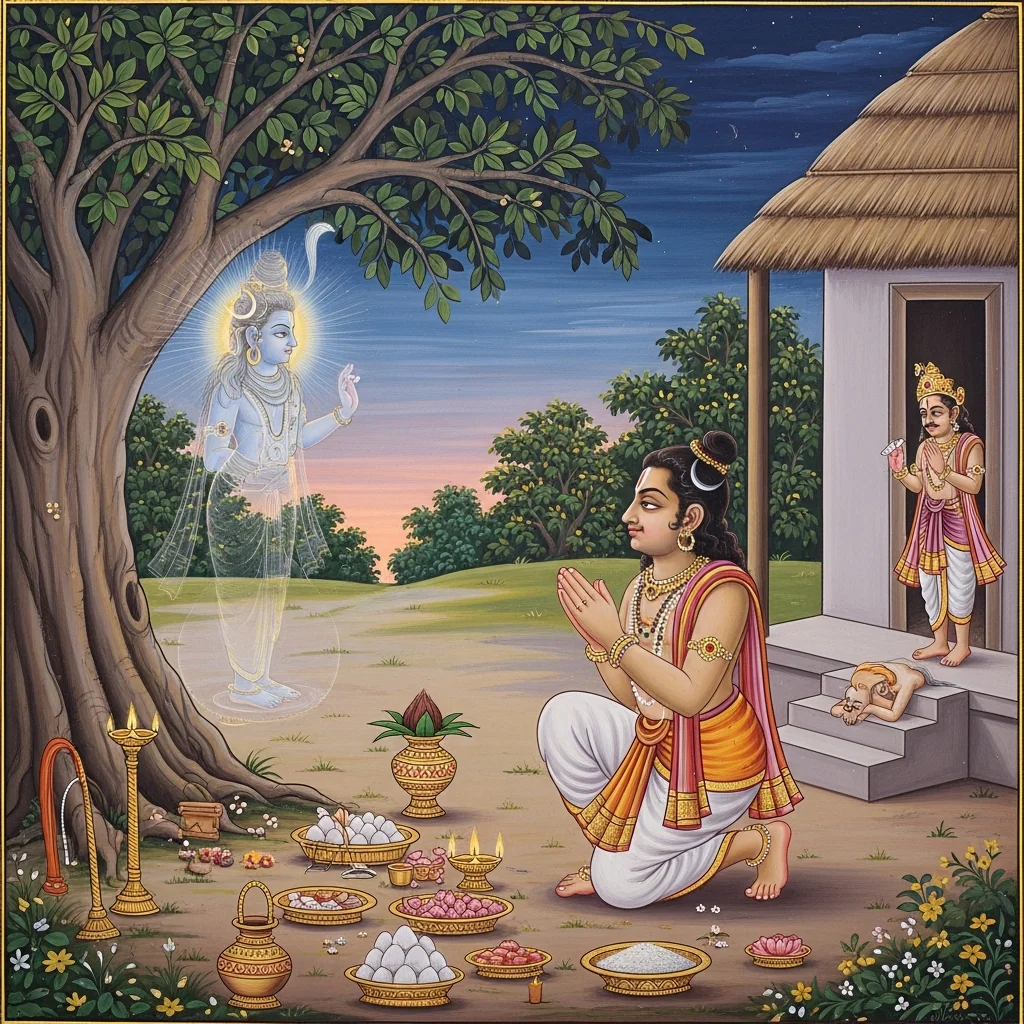
Adhyaya 69
Maṅgaleśvara-liṅga Pratiṣṭhā and Aṅgāraka-vrata (मङ्गलेश्वरलिङ्गप्रतिष्ठा तथा अङ्गारकव्रत)
Mārkaṇḍeya describes a sequence of pilgrimage that leads to the excellent Maṅgaleśvara. The shrine is said to have been established by Bhūmiputra (Maṅgala/Aṅgāraka) out of compassion for the welfare of all beings. On the fourteenth lunar day, Śiva (Śaṅkara, Śaśiśekhara) manifests as Maṅgaleśvara, responds to intense devotion, and grants a boon. Maṅgala asks for enduring favor across births, declaring that he was born from Śiva’s bodily perspiration and dwells among the grahas (planetary deities). He also seeks recognition and worship by the gods. Śiva grants that, in this place, the Lord will be known by Maṅgala’s name, and then disappears. Maṅgala installs the liṅga and worships it through yogic power. The chapter then gives prescriptive guidance: the Maṅgaleśvara liṅga removes suffering; the wise should satisfy brāhmaṇas at the tīrtha—especially with spouse-inclusive rites—and observe the Aṅgāraka-related vow. It details concluding gifts for Śiva (cows/bulls, red garments, animals of specified colors, and items such as an umbrella, bed, and red garlands/anointing), all offered with inner purity. It also instructs śrāddha on the fourth and eighth tithis in both fortnights, avoiding financial deceit. The stated fruits include ancestral satisfaction for a yuga, auspicious progeny and repeated birth with favorable status, bodily radiance through the tīrtha’s influence, and the removal of sin for those who regularly recite this account with devotion.
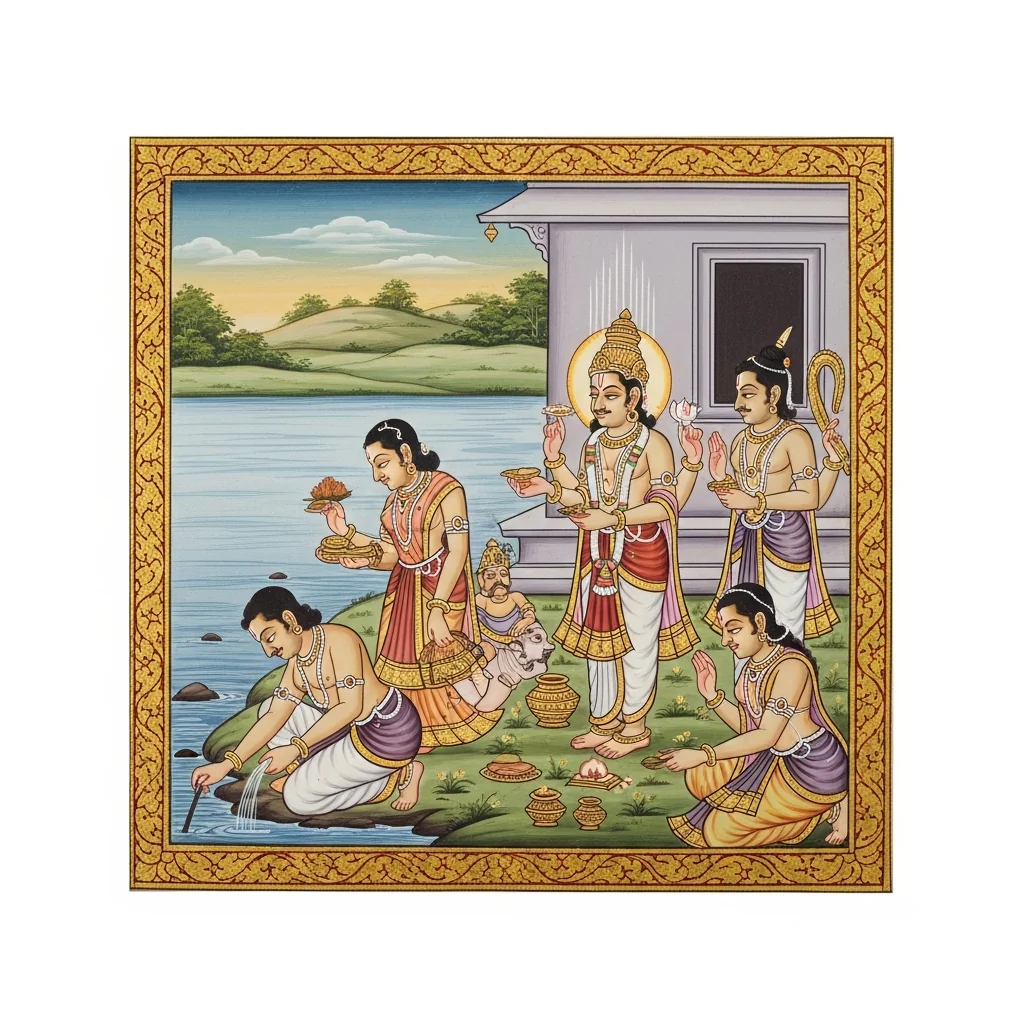
Adhyaya 70
Ravi-kṛta Tīrtha on the Northern Bank of Revā (रविणा निर्मितं तीर्थम् — रेवोत्तरतीरमाहात्म्यम्)
Mārkaṇḍeya describes a “supremely splendid” tīrtha on the northern bank of the Revā (Narmadā), said to have been established by Ravi, the Sun. It is praised as a means of pāpa-kṣaya (the wearing away of sin) and as a site of enduring solar presence, for Bhāskara is declared to abide there by a portion of himself (svāṁśena) upon the northern shore. A calendrical discipline is then given: perform sacred bathing (snāna) on specified lunar days—especially the sixth (ṣaṣṭhī), eighth (aṣṭamī), and fourteenth (caturdaśī)—and offer śrāddha with devotion for the departed (preteṣu bhaktitaḥ). The fruit is stated in stages: immediate purification and exaltation in Sūrya-loka, followed by return from heaven to birth in a “pure family,” endowed with wealth and freedom from disease across many lives. Thus the chapter binds place, time, rite, and karmic outcome into a compact tīrtha-māhātmya instruction.
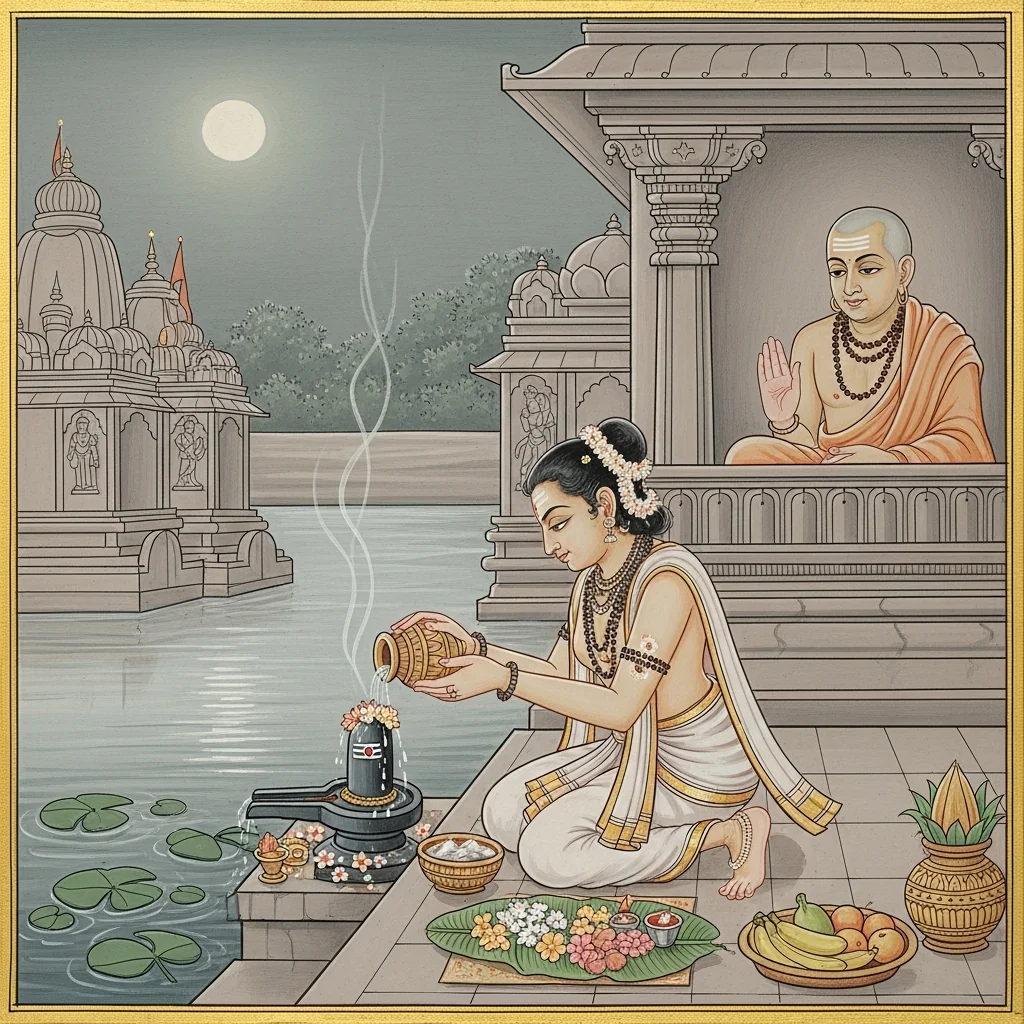
Adhyaya 71
Kāmeśvara-tīrtha Māhātmya (कामेश्वरतीर्थमाहात्म्य) / The Glory of the Kāmeśvara Sacred Site
Mārkaṇḍeya continues instruction to Yudhiṣṭhira by introducing a sacred locus associated with Kāmeśvara, described as a place where the gaṇādhyakṣa—Gaurī’s powerful son—stands as a siddha presence. The chapter’s procedural core prescribes a devotional regimen: a worshipper characterized by bhakti and self-restraint should bathe (snāna) and perform abhiṣeka with pañcāmṛta, followed by incense and food-offerings (dhūpa, naivedya) and formal pūjā. The stated outcome is moral-ritual purification—release from ‘all sins’—and a calendrical specification highlights the eighth lunar day (aṣṭamī) of Mārgaśīrṣa as a potent time for bathing at this tīrtha. The closing doctrinal claim is pragmatic and intention-based: the result aligns with the worshipper’s aim—‘one attains the desire for which one worships’—thus integrating ethical discipline, ritual correctness, and intentionality within a phalaśruti economy.
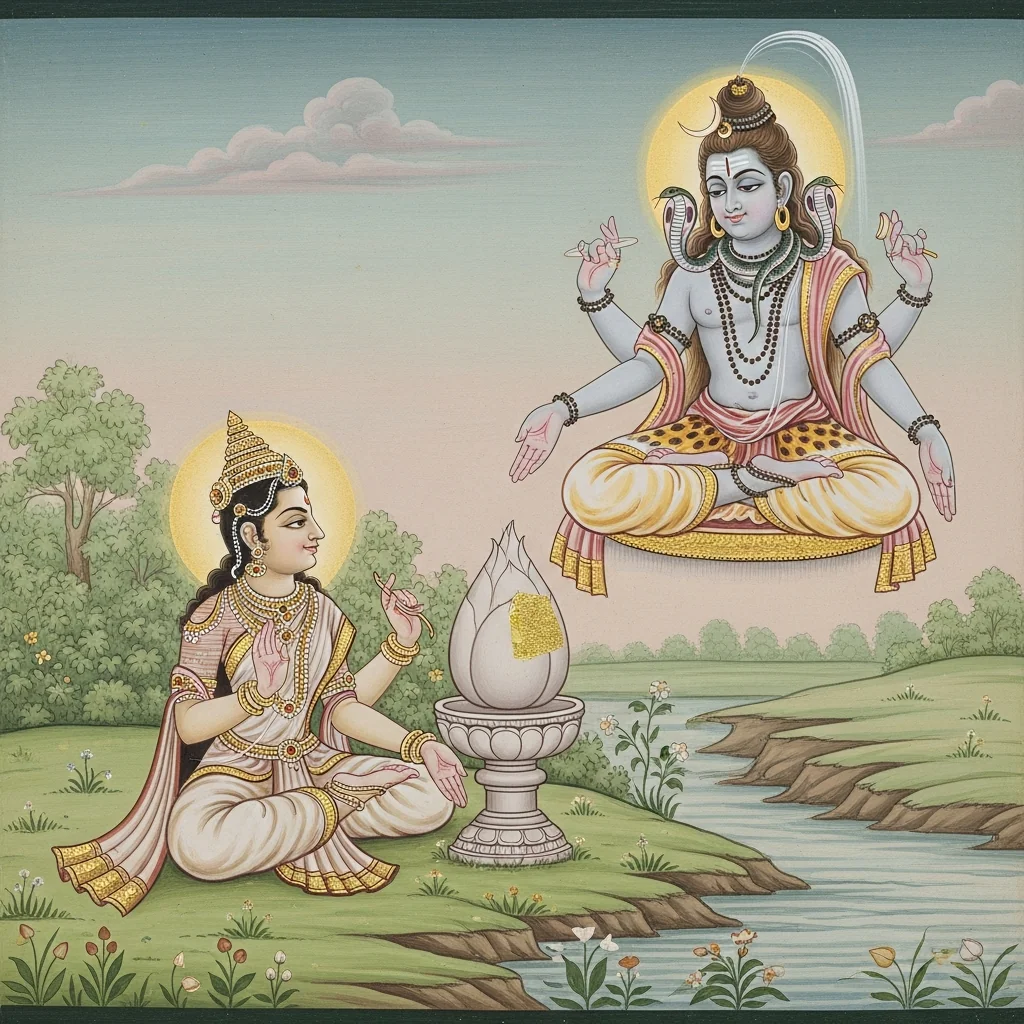
Adhyaya 72
Maṇināgeśvara-tīrtha Māhātmya (मणिनागेश्वरतीर्थमाहात्म्य) — Origin Legend and Ritual Merits
Mārkaṇḍeya directs the royal hearer to Maṇināgeśvara, an auspicious (śubha) shrine on the northern bank of the Narmadā, founded by the nāga Maṇināga for the welfare of beings and praised as a destroyer of sins. Yudhiṣṭhira asks how a venomous serpent could please Īśvara, and an ancient lineage tale is told: Kaśyapa’s wives Kadrū and Vinatā wager over the color of Uccaiḥśravas; through deceit and coercion Kadrū orders the serpents to darken the horse’s hairs to enslave Vinatā. Some comply, while others flee in fear of their mother’s curse, scattering across waters and regions. Fearing the curse’s consequences, Maṇināga performs severe austerities on the Narmadā’s northern bank, meditating on the Imperishable. Śiva (Tripurāntaka) appears, praises his devotion, grants protection from the threatened fate, and promises an exalted abode and benefits for his lineage. At Maṇināga’s request, Śiva agrees to abide there by a fractional presence and commands the स्थापना of a liṅga, thereby establishing the tīrtha’s authority. The chapter then lists ritual times (notably certain tithis), abhiṣeka substances—dadhi, madhu, ghṛta, kṣīra—along with śrāddha guidelines, dāna items, and conduct norms for officiants. The phalaśruti concludes with the fruits: release from sins, auspicious posthumous paths, and protection from serpent-related fear, with special merit in hearing or reciting the tīrtha’s account.
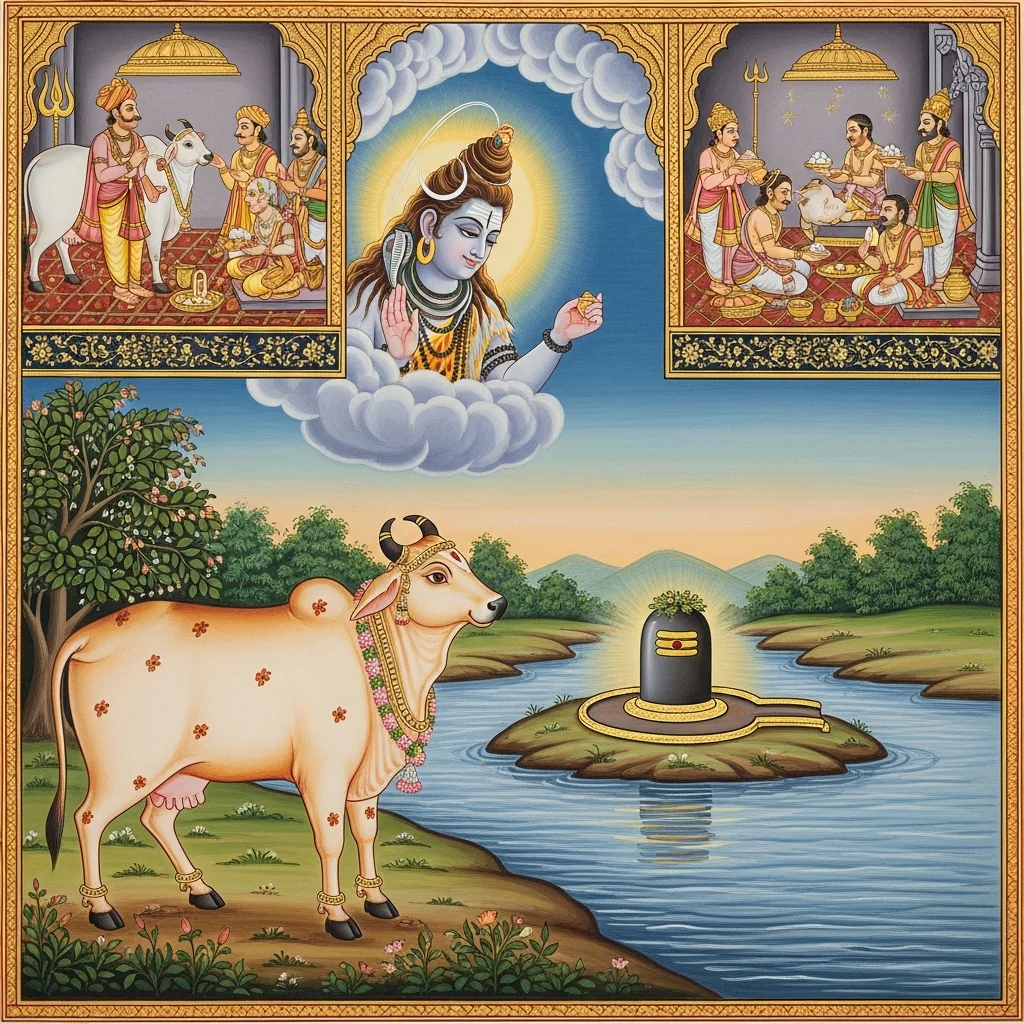
Adhyaya 73
गोपारेश्वरतीर्थमाहात्म्य (Gopāreśvara Tīrtha Māhātmya)
This chapter unfolds as a theological question–response. Yudhiṣṭhira asks Mārkaṇḍeya to explain briefly why a liṅga said to have “emerged from a cow’s body” is established on the southern bank of the Narmadā near Maṇināga, and why it is famed as a destroyer of sin. Mārkaṇḍeya relates that Surabhi/Kapilā, the archetypal cow, performed devotion and deep contemplation of Maheśvara for the welfare of the worlds; Śiva, pleased, manifested and consented to dwell at that tīrtha, making it renowned for swift purification through a single bath. The chapter then lays down ethical norms for ritual giving: the “Gopāreśvara go-dāna” should be done with faith, gifting an eligible cow—adorned with gold/ornaments as prescribed—to a qualified brāhmaṇa, with calendrical notes (such as kṛṣṇa pakṣa caturdaśī/aṣṭamī and special emphasis on Kārttika). It also lists supporting rites: piṇḍadāna for the uplift of a preta, daily Rudra-namaskāra as a dissolver of sin, and vṛṣotsarga (release/donation of a bull) benefiting the pitṛs and granting prolonged honor in Śiva-loka in proportion to the bull’s hairs, followed by auspicious rebirth. The discourse closes by reaffirming the site as Gopāreśvara on the Narmadā’s southern bank, with the liṅga’s extraordinary origin marking the tīrtha’s sanctity.
Adhyaya 74
Gautameśvara-tīrtha Māhātmya (गौतमेश्वरतीर्थमाहात्म्य) — Revā’s Northern Bank
Chapter 74 gives a brief tīrtha-māhātmya as a dialogic report spoken by the sage Mārkaṇḍeya. It centers on a supremely splendid sacred ford on the northern bank of the Revā, called Gautameśvara, said to have been founded by the seer Gautama for the welfare of all people and praised as a “stairway to heaven” in Purāṇic terms of merit. The chapter urges pilgrimage to this site with heightened bhakti, where the deity—hailed as the “teacher of the world”—is present, promising the destruction of sins, moral purification, and residence in heaven. It also lists worldly boons such as victory, relief from suffering, and growth of auspicious fortune, and declares that a single piṇḍa offering can uplift three generations of one’s lineage. Finally, it states that whatever is given there with devotion, whether small or great, is greatly magnified by Gautama’s authority. Gautameśvara is ranked as supreme among tīrthas and affirmed as Rudra’s utterance, strengthening its Śaiva sanctity.
Adhyaya 75
Śaṅkhacūḍa-tīrtha-māhātmya (Glory of the Śaṅkhacūḍa Tīrtha on the Narmadā)
Mārkaṇḍeya describes a greatly revered tīrtha on the southern bank of the Narmadā, known as Śaṅkhacūḍa. The chapter affirms that Śaṅkhacūḍa abides there, seeking safety from the fear of Vainateya (Garuḍa). A ritual discipline is then prescribed: the devotee should approach in purity and focused mind, bathe/perform abhiṣeka for Śaṅkhacūḍa with auspicious substances in order—milk, honey, and ghee—and keep nocturnal vigil (jāgaraṇa) before the deity. Worship is completed by honoring brāhmaṇas of praised vows with offerings such as dadhibhakta (rice with curd), and it culminates in go-dāna, the gift of a cow, extolled as a purifier that destroys all sins. The discourse closes with a specific merit: one who, at this tīrtha, comforts or satisfies a person afflicted by snakebite is said to attain the supreme realm, in accordance with Śaṅkara’s utterance—thus joining sacred place, compassion, and salvific fruit.
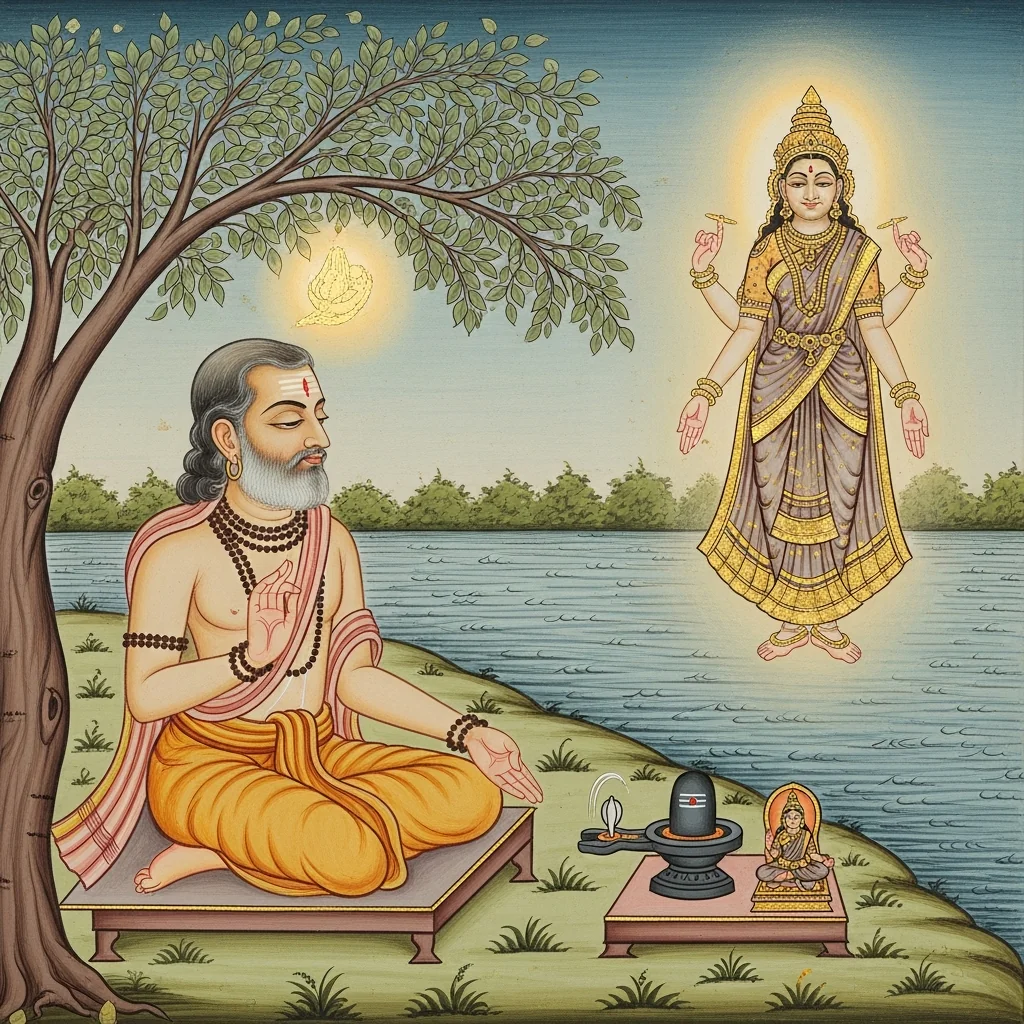
Adhyaya 76
Pāreśvara-Tīrtha Māhātmya and Parāśara’s Vrata on the Narmadā (Chapter 76)
Mārkaṇḍeya relates that the sage Parāśara performs severe austerities on the auspicious bank of the Narmadā, seeking a worthy son. The Goddess—known as Gaurī Nārāyaṇī, the consort of Śaṅkara—appears, praises his devotion, and grants a boon: a son endowed with truthfulness and purity, devoted to Vedic study and skilled in the śāstras. Parāśara further prays that the Goddess remain at that spot for the welfare of all people; she agrees and becomes unmanifest there. He then establishes Pārvatī and also installs Śaṅkara, declaring the deity inviolable and difficult to approach even for the gods. The chapter prescribes a tīrtha-based observance for devotees—women or men—who are pure, disciplined in mind, and free from desire and anger. It names auspicious months and the bright fortnight as preferred times, and details fasting, night vigil, lamp-offering, and customary devotional arts. It also instructs honoring brāhmaṇas with gifts (wealth, gold, cloth, umbrella, bedding, betel, food) and gives guidance for śrāddha, including distinctions for women and śūdras (āmā-śrāddha) and directional seating rules, concluding with a phalaśruti promising release from grave sins to faithful listeners.
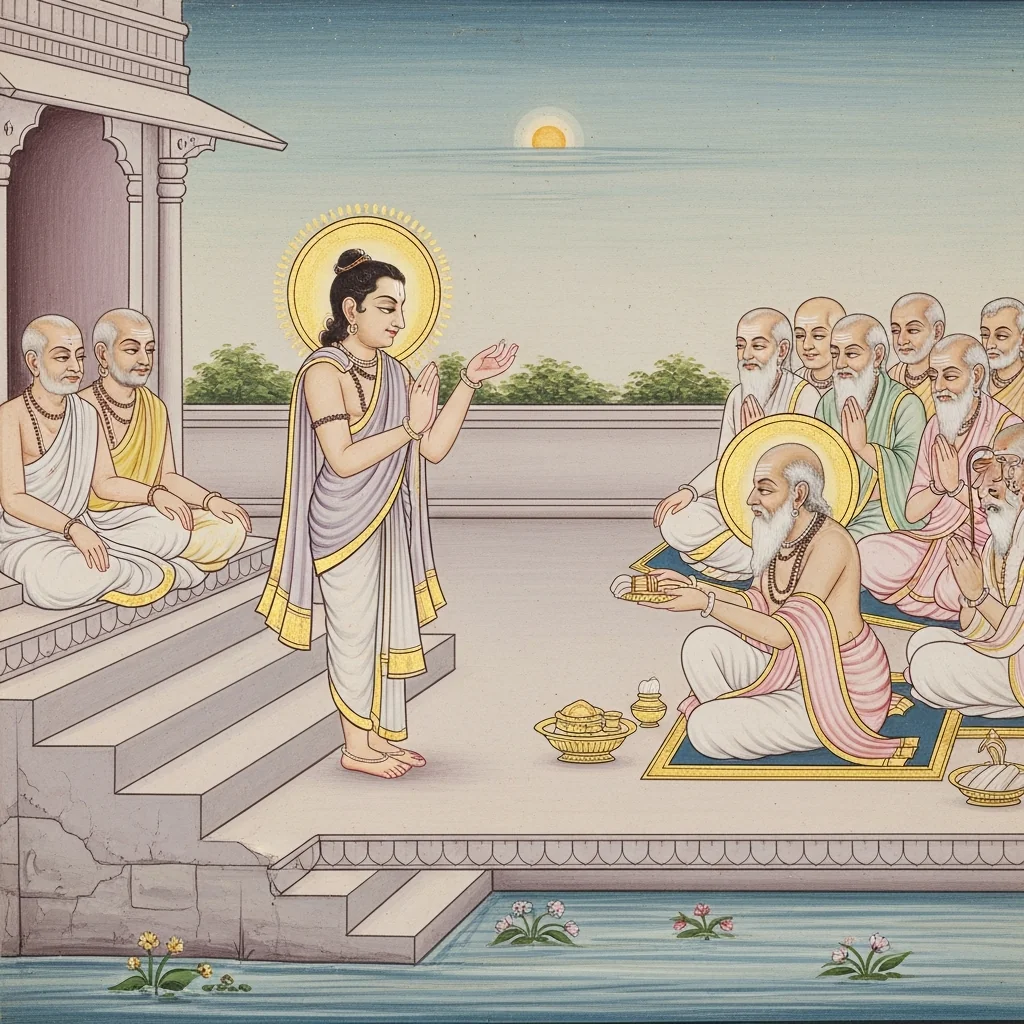
Adhyaya 77
भीमेश्वरतीर्थे जपदानव्रतफलप्रशंसा | Bhīmeśvara Tīrtha: Praise of Japa, Dāna, and Vrata-Fruits
This adhyāya gives Śrī Mārkaṇḍeya’s theological and ritual instruction concerning Bhīmeśvara, praised as a tīrtha that brings pāpa-kṣaya (the removal of sin) and is visited by gatherings of sages devoted to auspicious disciplines. It sets out a sequence of practice: approach Bhīmeśvara, bathe at the tīrtha, maintain upavāsa (fasting) and jitendriyatā (restraint of the senses), and perform mantra-japa—especially the “one-syllable mantra” (ekākṣara) with arms raised while the sun is present, as a strict daytime observance. The discourse then states graded phala (fruits) regarding the destruction of accumulated wrongdoing, even sins gathered over many births, and extols the purificatory power of Gāyatrī-japa. It generalizes the efficacy of repeated recitation—Vedic or worldly (vaidika/laukika)—likening mantra’s power to fire that burns away impurities as it consumes dry grass. An ethical warning is added: one should not commit wrong by taking “divine power” as a pretext; ignorance may be swiftly destroyed, but wrongdoing is not thereby justified. The chapter concludes by affirming that charity given according to one’s capacity at this tīrtha yields imperishable (akṣayya) results.
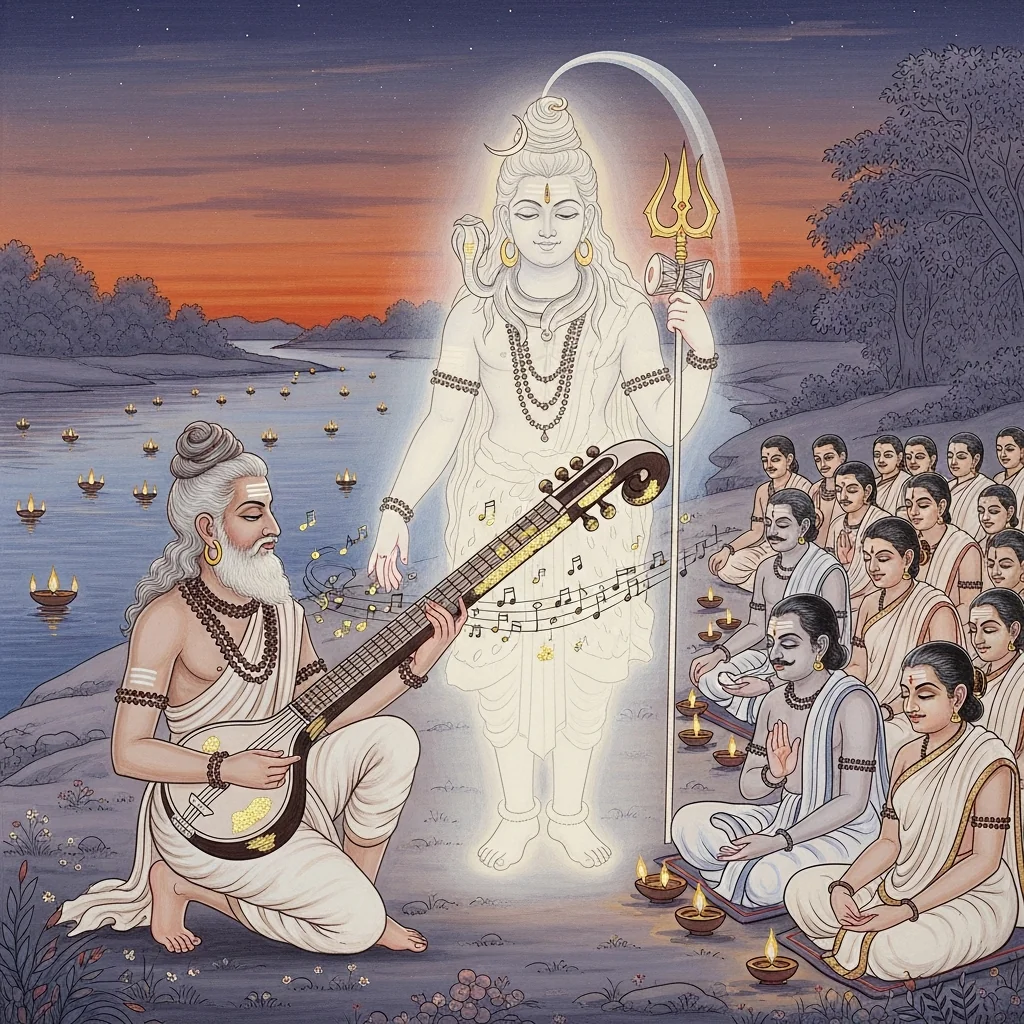
Adhyaya 78
नारदतीर्थ-नारदेश्वर-माहात्म्य (Glory of Nārada’s Tīrtha and Nāradeśvara)
Chapter 78 unfolds as a dialogue. Mārkaṇḍeya points out a supreme tīrtha said to have been founded by Nārada, and Yudhiṣṭhira asks how it came to be. The account turns to Nārada’s austerities on the northern bank of the Revā, ending in a divine audience where Īśvara grants boons: success in yoga, unwavering devotion, free movement across the worlds, knowledge of past, present, and future, and mastery of musical systems (svara, grāma, mūrcchanā). He also declares that Nārada’s tīrtha will become world-renowned and destroy sins. After Śiva vanishes, Nārada installs Śūlin (a form of Śiva) for the welfare of all beings and thus establishes the tīrtha. The chapter then lays down pilgrimage conduct and rites: self-control, fasting and night-vigil on Bhādrapada kṛṣṇa caturdaśī, gifts such as an umbrella to a worthy brāhmaṇa, śrāddha for those slain by weapons, gifting a kapilā cow for the ancestors, donations and feeding of brāhmaṇas, lamp-offering, and devotional music and dance in the temple. It further links homa and worship of Havyavāhana/Agni (with deities led by Citrabhānu) to relief from poverty and the gaining of prosperity, concluding by reaffirming this Revā north-bank tīrtha as a remover of great sins.
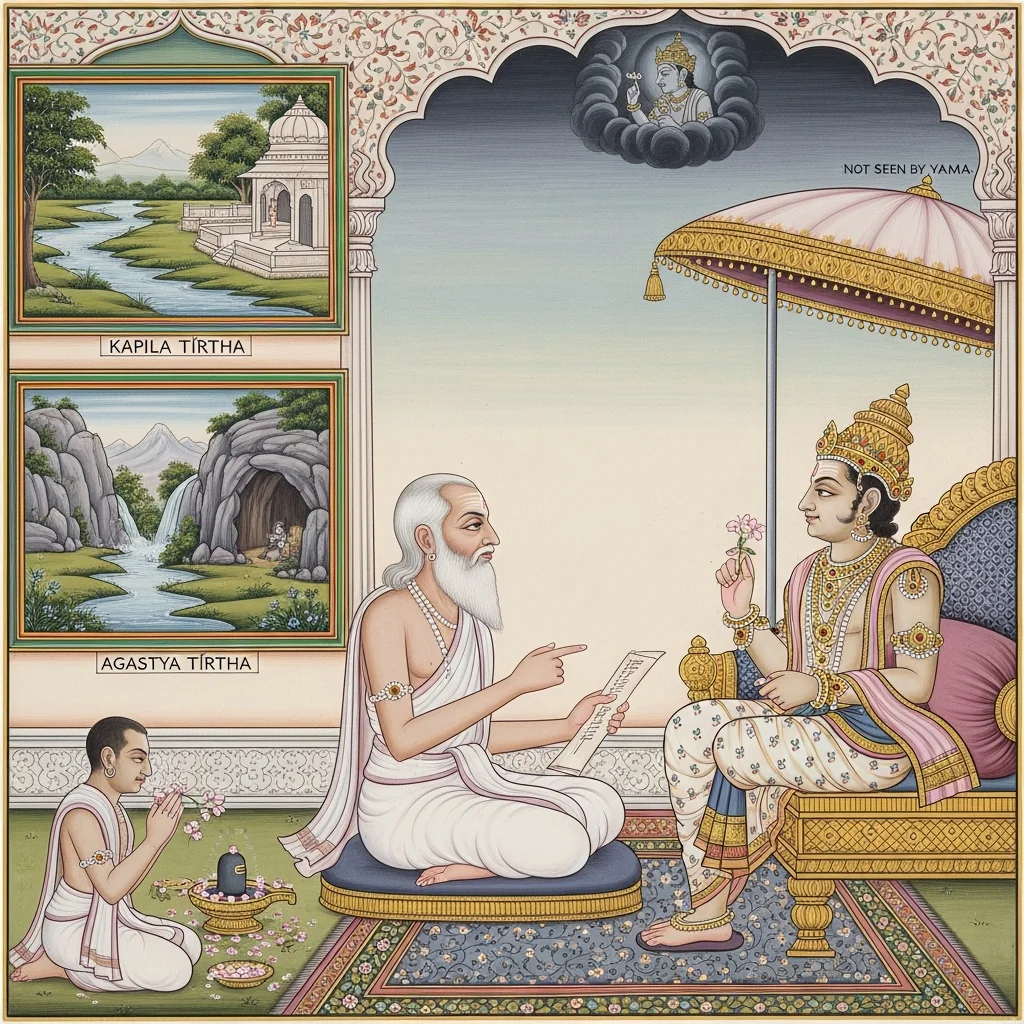
Adhyaya 79
दधिस्कन्द-मधुस्कन्दतीर्थमाहात्म्य / The Māhātmya of Dadhiskanda and Madhuskanda Tīrthas
This adhyāya is cast as a theological instruction given by Śrī Mārkaṇḍeya to a royal listener. He directs the seeker to two greatly praised tīrthas—Dadhiskanda and Madhuskanda—declared to be causes of pāpa-kṣaya, the diminishing of moral impurity. At Dadhiskanda, the sacred bath is joined with a gift of curd (dadhi) to a dvija (Brahmin). The promised fruit spans many births: freedom from disease, afflictions of old age, grief, and envy, and continued birth in a “pure” lineage for a long period. At Madhuskanda, gifting sesame mixed with honey, and separately offering a honey-mixed piṇḍa, is said to keep one from Yama’s realm or vision for many lives and to sustain prosperity through descendants, including grandchildren and great-grandchildren. The chapter ends with another piṇḍa rule (mixed with curd) and a procedural note: after bathing, rites are performed facing south (dakṣiṇāmukha), by which father, grandfather, and great-grandfather are satisfied for twelve years—an explicit statement of ancestral-rite efficacy.
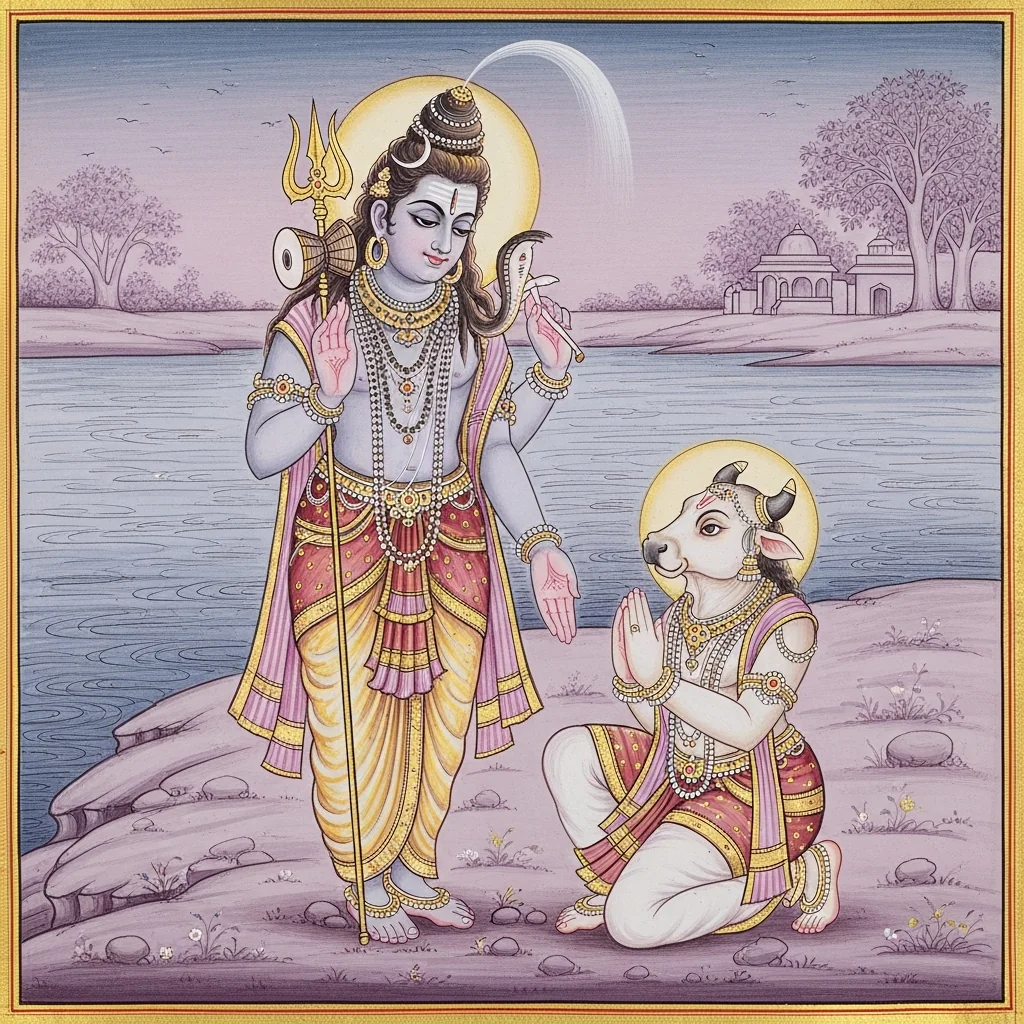
Adhyaya 80
नन्दिकेश्वरतीर्थमाहात्म्य — Nandikeśvara Tīrtha Māhātmya
Mārkaṇḍeya, speaking to a royal listener, points to the eminent Nandikeśvara tīrtha associated with the siddha Nandī. Nandī is portrayed as the model of disciplined pilgrimage: placing the Revā river foremost in devotion, he moves from tīrtha to tīrtha while performing tapas. Pleased with this sustained ascetic journey, Śiva offers a boon. Nandī refuses wealth, progeny, and sensory aims, asking only for unwavering bhakti to Śiva’s lotus-feet across births—even if reborn in non-human forms—thus affirming devotion as continuity beyond a single life. Śiva grants this and leads the accomplished devotee to His abode, establishing the tīrtha’s sacred authority. The phalaśruti declares that bathing and worship of the three-eyed Śiva here yields merit equal to an Agniṣṭoma sacrifice. Death at the tīrtha is said to bring Śiva’s companionship and long enjoyment in an imperishable aeon, followed by auspicious rebirth in a pure lineage with Vedic knowledge and longevity. The chapter closes by stressing the tīrtha’s rarity and its power to destroy sin.
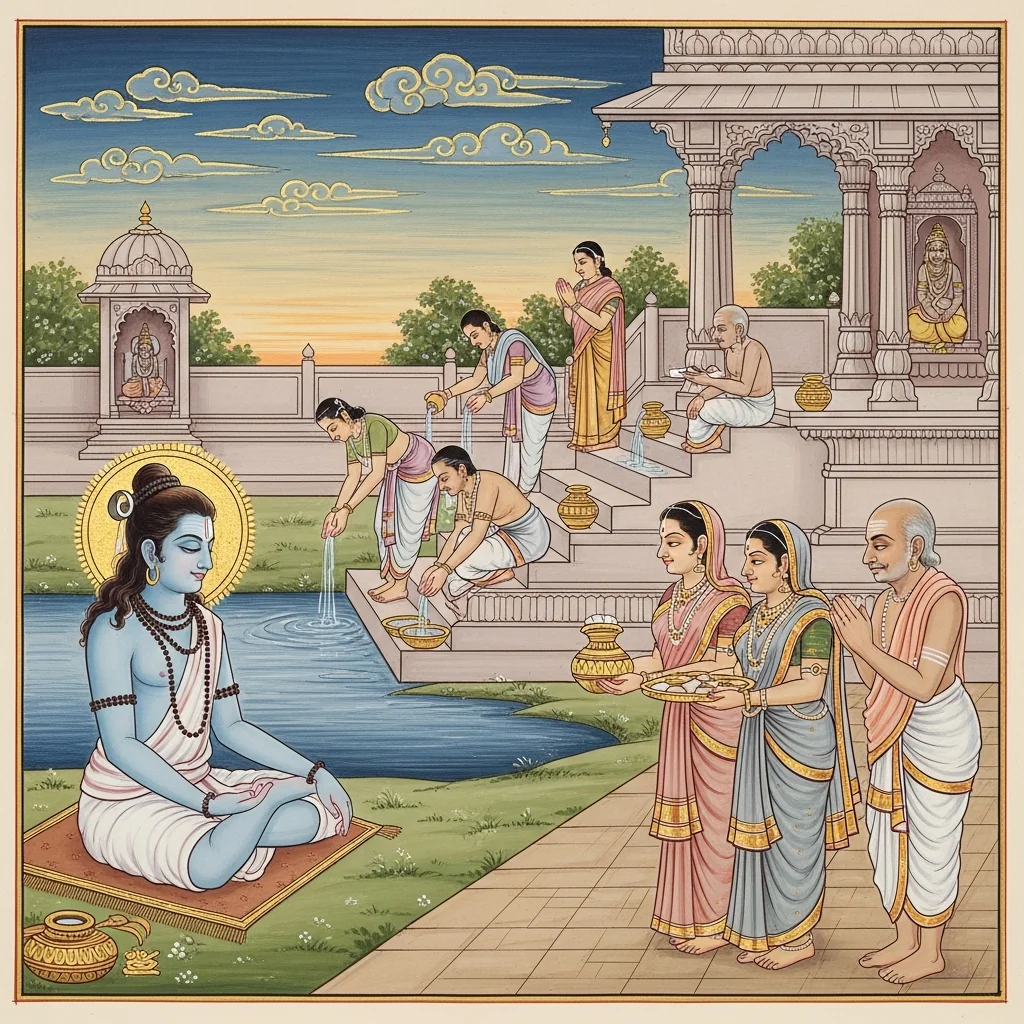
Adhyaya 81
Varuṇeśvara-tīrtha Māhātmya (Glory of Varuṇeśvara Shrine and Charity)
Mārkaṇḍeya instructs a king to visit the exalted Varuṇeśvara tīrtha, praised as the place where Varuṇa attained siddhi by propitiating Girijā-nātha (Śiva) through severe austerities, including observances such as kṛcchra and cāndrāyaṇa. The chapter then lays down the tīrtha discipline: one who bathes there, offers tarpana to satisfy the pitṛs and the deities, and worships Śaṅkara with devotion is said to attain the supreme state (paramā gati). A pointed teaching on charity follows—gifting a water vessel (kuṇḍikā, vardhanī, or a large water container) together with food is extolled, its fruit declared equal to the merit of a twelve-year sacrificial session (satra). It further proclaims that among gifts, the gift of food is foremost and immediately pleasing. Those who die at the tīrtha with a cultivated disposition are said to dwell in Varuṇa’s city until cosmic dissolution; thereafter they are reborn among humans, become steady donors of food, and live for a hundred years.
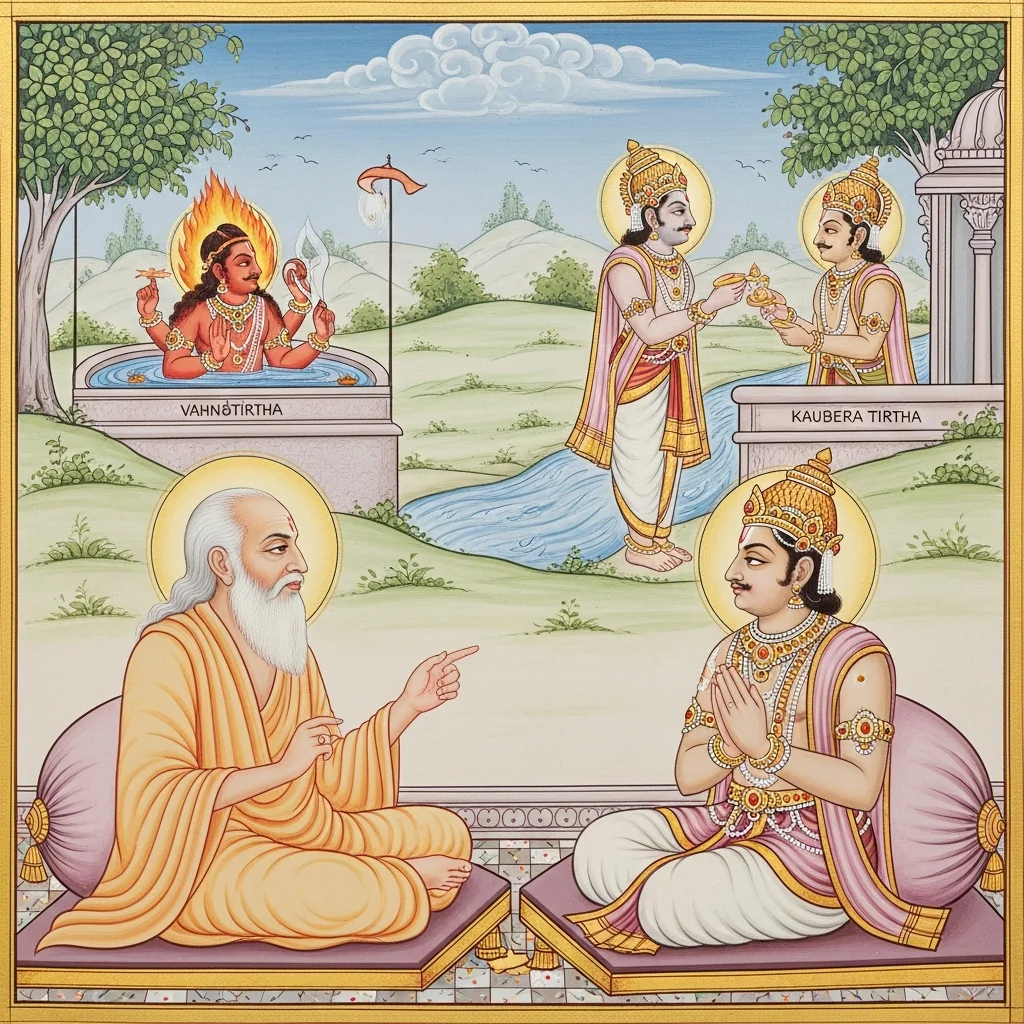
Adhyaya 82
Vahnītīrtha–Kauberatīrtha Māhātmya (Glory of the Fire Tīrtha and Kubera Tīrtha)
Chapter 82 is a prescriptive tīrtha teaching spoken by Śrī Mārkaṇḍeya to a royal listener. It first directs him to Vahnītīrtha on the bank of the Narmadā, an exceptional place where Hutāśana (Agni) is said to have attained purification after an earlier episode connected with the Daṇḍaka setting. The chapter then sets out rites and their fruits: bathing and worship of Maheśvara, devotional observances, and offerings to pitṛs and deities. A clear phala-logic governs the account, assigning specific rewards to specific acts, including merits held equal to major Vedic sacrifices. It next turns to Kaubera Tīrtha, linked to Kubera’s attainment as lord of the Yakṣas, prescribing bathing, worship of Jagadguru with Umā, and charitable gifts—especially gold to a brāhmaṇa—with stated, measurable merit. The chapter concludes by praising the “Narmadā tīrtha pañcaka,” affirming lofty post-mortem destinations and the enduring sanctity of the Revā even when other waters wane at cosmic dissolution.
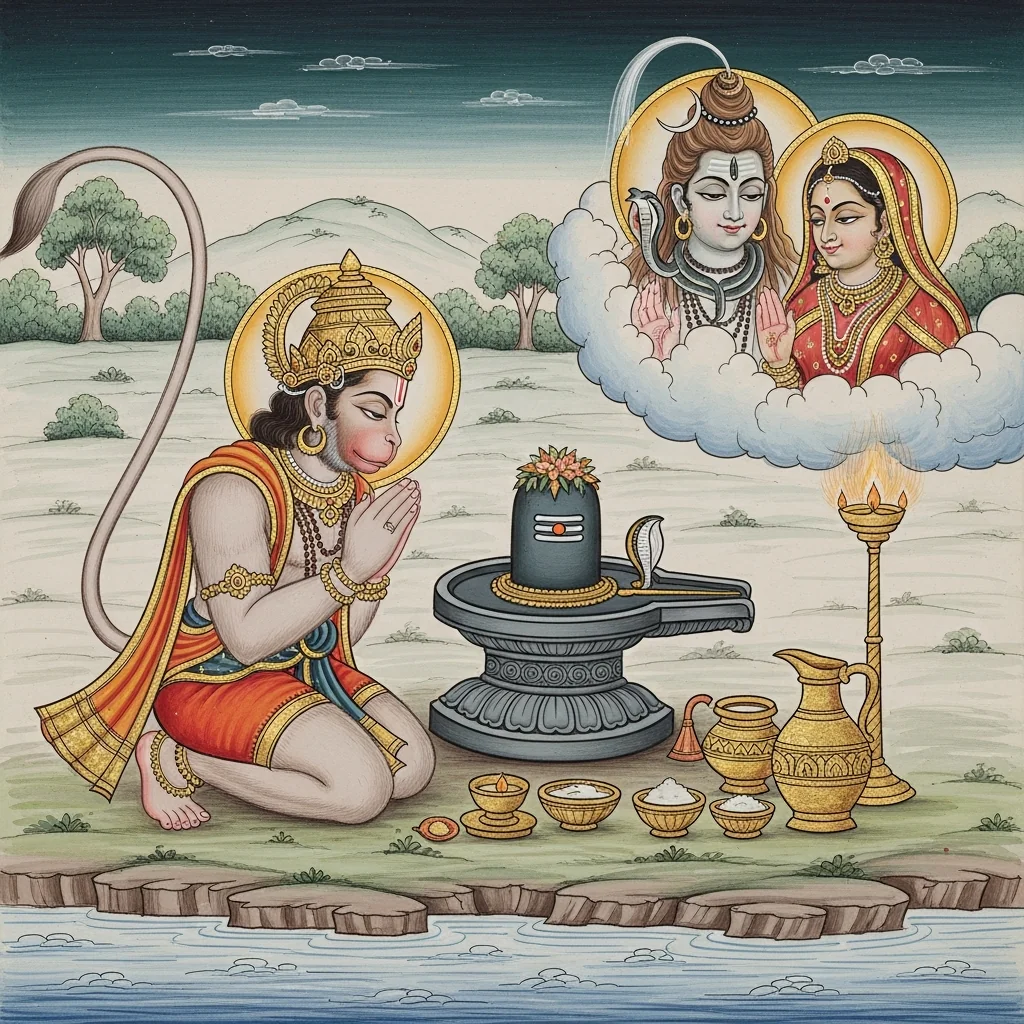
Adhyaya 83
हनूमन्तेश्वरतीर्थमाहात्म्य (Hanūmanteśvara Tīrtha Māhātmya)
This chapter is a theological dialogue between Mārkaṇḍeya and Yudhiṣṭhira on a Revā/Narmadā-bank tīrtha called Hanūmanta/Hanūmanteśvara, praised as able to remove grave demerit, even brahmahatyā-like impurity. It first identifies the site as a distinguished liṅga on the southern bank of the Revā, and Yudhiṣṭhira asks how the name Hanūmanteśvara arose. Mārkaṇḍeya recounts the epic origin: after the Rāma–Rāvaṇa war and the destruction of rākṣasas, Nandinī warns Hanumān that extensive killing has left him burdened with impurity and directs him to the Narmadā for austerity and sacred bathing. Hanumān worships for a long time; Śiva appears with Umā, grants darśana, assures him of purification through the Narmadā’s māhātmya, and bestows further boons, including honorific names of Hanumān. Hanumān then establishes the liṅga Hanūmānīśvara/Hanūmanteśvara, described as indestructible and wish-fulfilling. A second narrative offers “visible proof” through King Supārva and his son Śatabāhu, a morally wayward ruler, who meets a brāhmaṇa charged with immersing bone-remains at Hanūmanteśvara. The brāhmaṇa relates a princess’s memory of a former life: her body was killed in the forest, and a bone fragment fell into the Narmadā at this tīrtha, yielding a meritorious rebirth and a firm ethical resolve against remarriage. The text prescribes the bone-collection and immersion rite in Aśvina month, the dark fortnight, and a Śiva-related tithi, with night vigil and post-rite bathing, while warning that greed and mental attachment can obstruct purification. The chapter closes with ritual directions: aṣṭamī and caturdaśī (especially Aśvina kṛṣṇa caturdaśī), abhiṣeka with honey-milk, ghee, sugared curd, and kuśa-water; sandal anointing, bilva and seasonal flowers, lamp offering, śrāddha with qualified brāhmaṇas, and strong emphasis on go-dāna as the highest gift, since the cow is “sarvadevamayī.” Even distant remembrance of Hanūmanteśvara is said to relieve demerit.
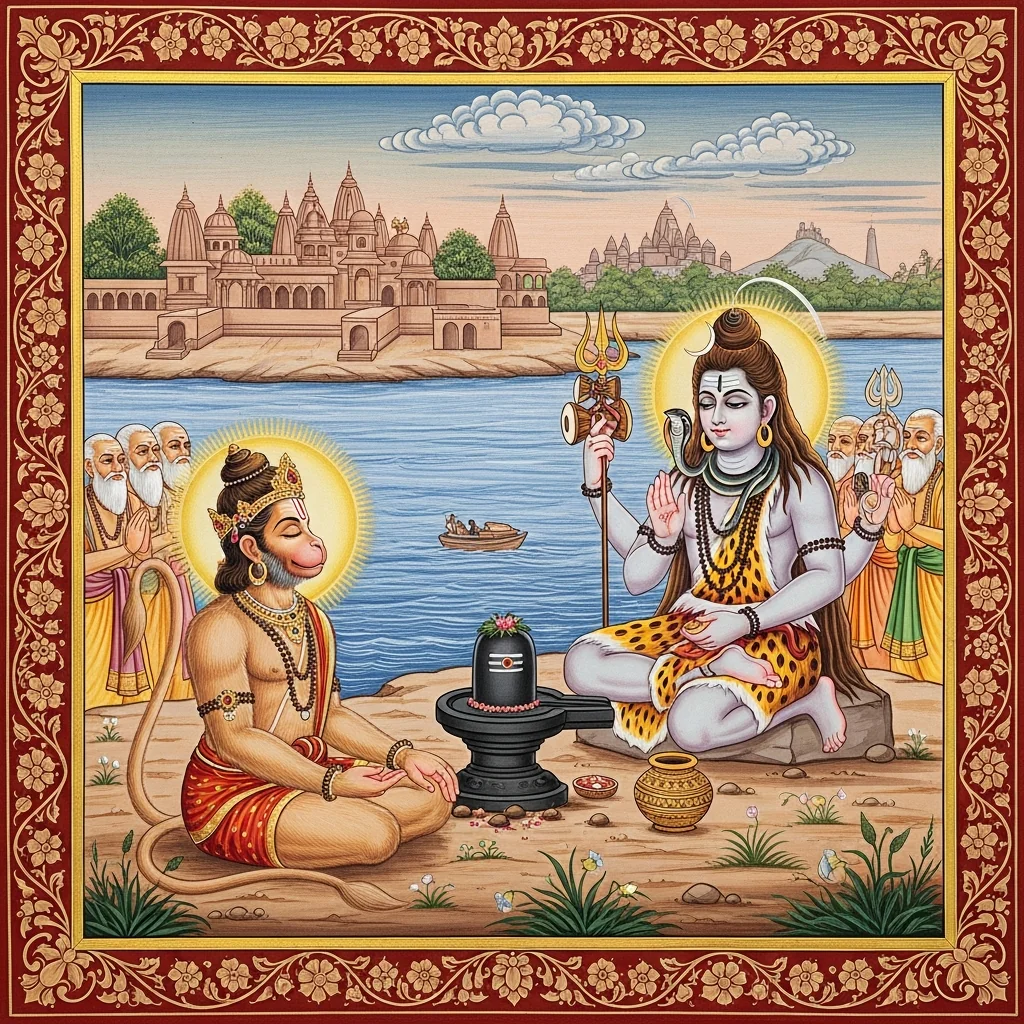
Adhyaya 84
Kapitīrtha–Hanūmanteśvara–Kumbheśvara Māhātmya (कपितीर्थ–हनूमन्तेश्वर–कुम्भेश्वर माहात्म्य)
Chapter 84 is framed as an ancient remembrance by Mārkaṇḍeya within a Kailāsa setting where divine instruction is sought and bestowed. After Rāvaṇa’s fall and the destruction of the rākṣasas, Hanumān approaches Kailāsa but is first checked by Nandī, prompting a moral inquiry into the lingering taint of rākṣasa-slaying and its remedy through prescribed pilgrimage. Śiva names purifying rivers and sends Hanumān to a renowned tīrtha on the southern bank of the Revā near Somanātha, where sacred bathing and severe austerity dispel that darkness. Śiva embraces Hanumān, grants a boon, and establishes the place as Kapitīrtha, with the liṅga titled Hanūmanteśvara, declaring its power to remove sin, fulfill ancestral śrāddha, and multiply the fruit of gifts. The chapter then widens the tīrtha’s glory by recounting Rāma’s own Revā-side tapas (notably for twenty-four years), the installation of liṅgas by Rāma and Lakṣmaṇa, and the arising of Kumbheśvara (Kalākumbha) through a kumbha-water motif as sages gather tīrtha-waters. A detailed phalāśruti follows: the merits of Revā-snāna, liṅga-darśana (including a “triple-liṅga” viewing motif), śrāddha results measured in enduring uplift of ancestors, and injunctions on dāna—especially go-dāna and precious gifts—whose rewards are said to remain lasting. The chapter concludes by urging disciplined visitation to Kumbheśvara and associated liṅgas near Jyotiṣmatīpurī, presenting this tīrtha as a key pilgrimage node within the sacred landscape of Revākhaṇḍa.
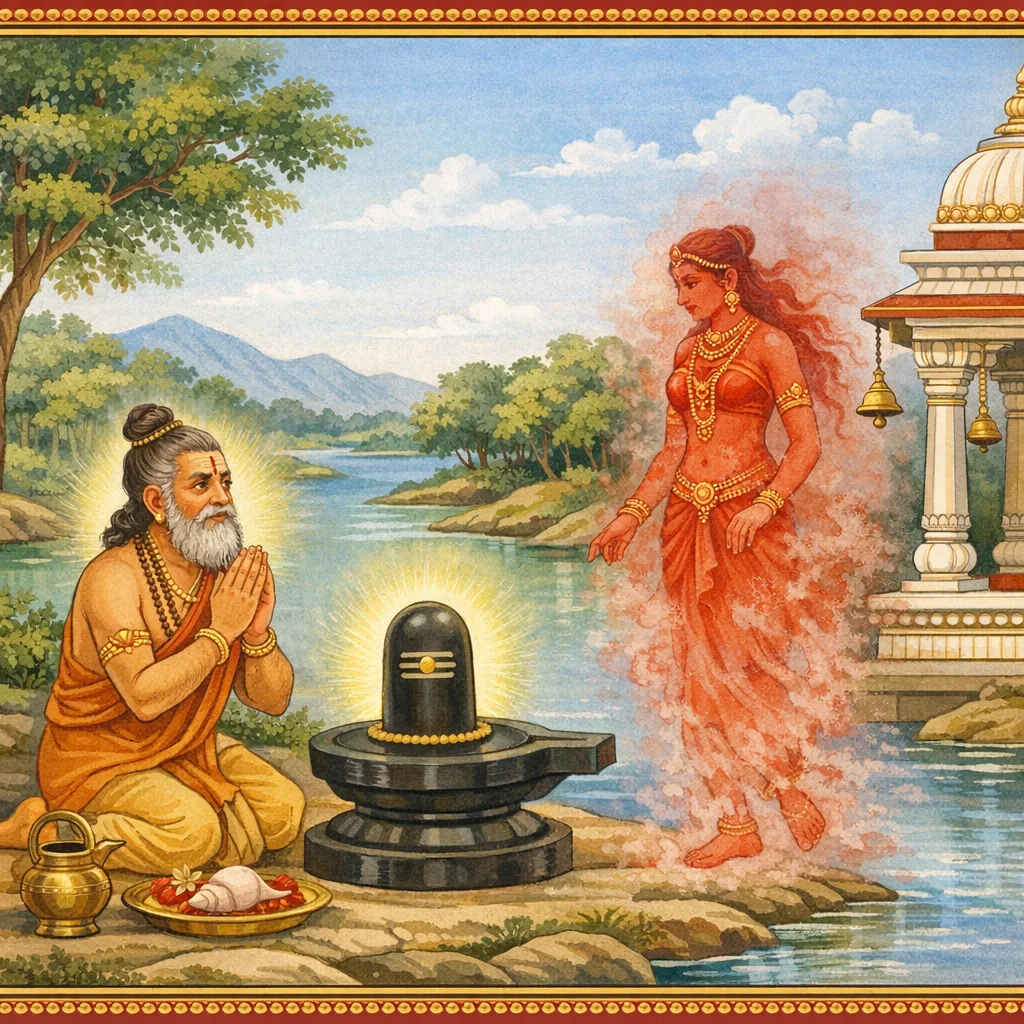
Adhyaya 85
सोमनाथतीर्थमाहात्म्य (Somānātha Tīrtha Māhātmya at Revā-saṅgama)
This chapter unfolds as a dialogue: Yudhiṣṭhira asks Mārkaṇḍeya about a Narmadā (Revā) tīrtha praised as equal to Vārāṇasī in merit and as a remover of brahmahatyā. Mārkaṇḍeya recounts a cosmogonic lineage culminating in Dakṣa and the lunar deity Soma, then tells how Dakṣa’s curse causes Soma’s decline. Seeking relief, Soma approaches Brahmā, who directs him to Revā’s rare sacred nodes—especially the river confluence—where austerity and worship should be performed. Soma undertakes prolonged devotion to Śiva; Śiva appears and a potent liṅga named Somanātha is established, said to dispel suffering and grave sin. An exemplar follows: King Kaṇva, afflicted by brahmahatyā for killing a brāhmaṇa in deer form, reaches the Revā confluence, bathes, worships Somanātha, and encounters Brahmahatyā personified as a red-clad maiden; by the tīrtha’s power he is released. The chapter then prescribes vrata observances—fasting on specified lunar days, night vigil, pañcāmṛta abhiṣeka, offerings, lamps, music, honoring worthy brāhmaṇas, and disciplined ethical conduct. Its phalaśruti declares that circumambulation, hearing, and regulated practice at Somanātha’s tīrtha purge major sins and grant health, prosperity, and higher worlds; it also notes Soma’s installation of multiple liṅgas at distinct sites, linking local pilgrimage to a wider Śaiva sacred geography.
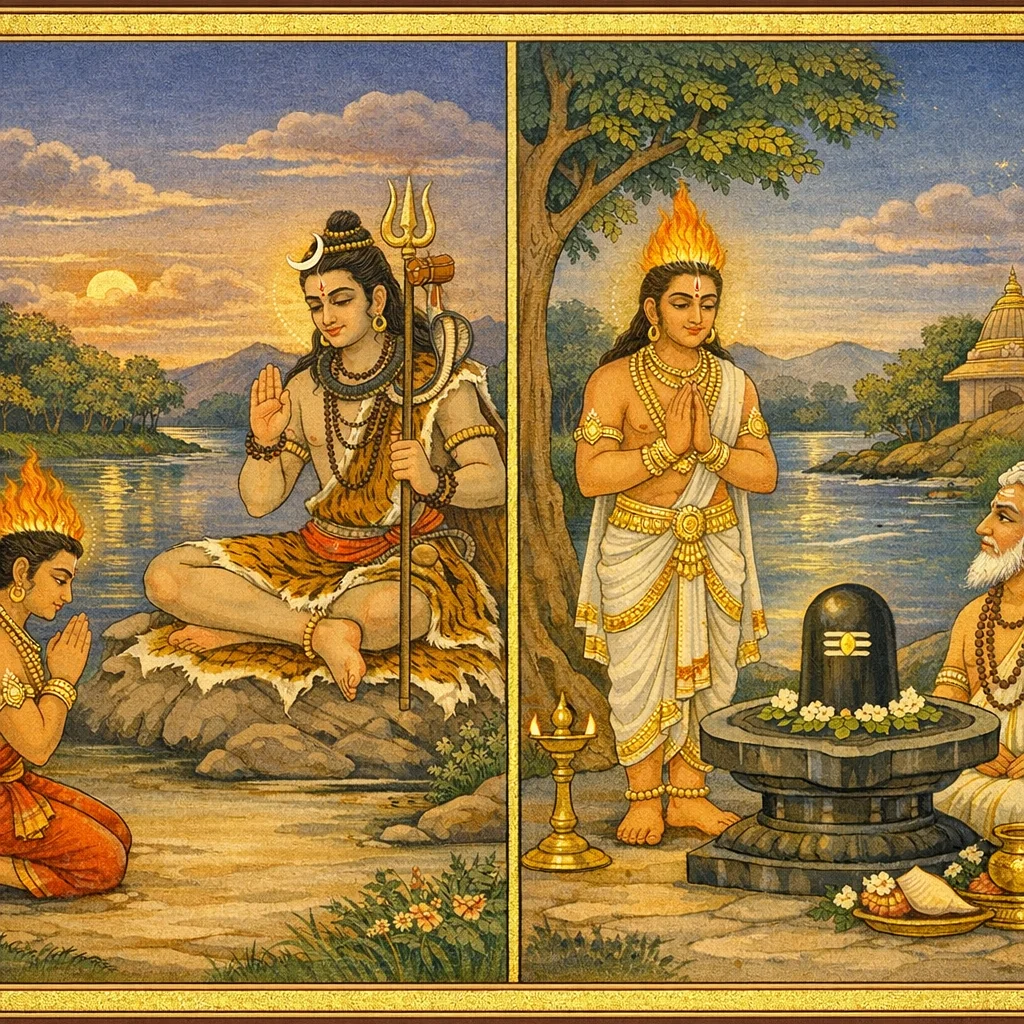
Adhyaya 86
Piṅgaleśvara-pratiṣṭhā at Piṅgalāvarta (Agni’s Cure at Revā)
This adhyāya unfolds as a dialogue: Yudhiṣṭhira asks Mārkaṇḍeya about the origin of Piṅgaleśvara at Piṅgalāvarta, a sacred spot near a confluence on the northern bank of the Revā. Mārkaṇḍeya relates that Havyavāhana (Agni) is stricken—burned by Rudra’s potent seed—and falls into disease. Agni then undertakes a devout pilgrimage, reaches the Revā, and performs fierce austerities for a long time, even sustaining himself on wind alone. Pleased, Śiva grants a boon; Agni begs release from his affliction. Śiva instructs him to bathe at that tīrtha, and Agni is immediately restored to his divine form. In gratitude, Agni establishes the deity by pratiṣṭhā as Piṅgaleśvara and worships through the sacred Name with hymns of praise. The chapter ends with phalaśruti and ethical-ritual counsel: one who fasts there, having conquered anger, gains extraordinary merit culminating in Rudra-like attainment; and the gift of a decorated kapilā cow with her calf to a worthy brāhmaṇa is extolled as leading to the highest goal.
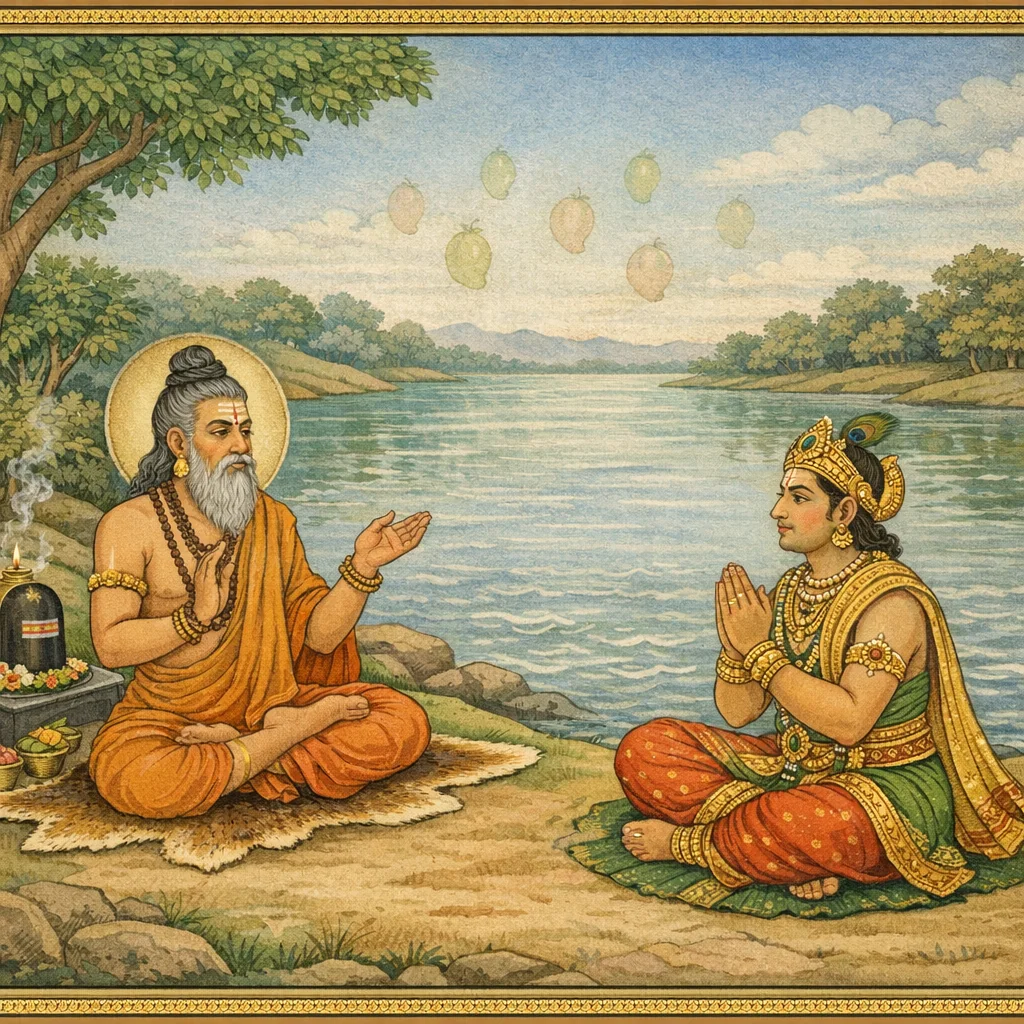
Adhyaya 87
ऋणमोचनतीर्थमाहात्म्य (R̥ṇamocana Tīrtha Māhātmya) — The Glory of the Debt-Removing Pilgrimage Site
Mārkaṇḍeya instructs the king to go to an exceedingly auspicious tīrtha on the bank of the Revā (Narmadā) called R̥ṇamocana, famed for removing spiritual “debts.” The chapter presents the site as founded by assemblies of sages of Brahmā’s lineage, thereby affirming its ritual authority and sanctity. The teaching focuses on the release from debts (ṛṇa) through devotional observance. One who, for six months, performs pitṛ-tarpaṇa (water-offerings to the ancestors) with faith and bathes in the waters of the Narmadā is said to be freed from obligations owed to gods, ancestors, and human beings. The text further declares that the fruits of actions—even demerit—become “visible” there like fruit on a tree, underscoring moral causality. The prescribed conduct is single-mindedness, restraint of the senses, ritual bathing, charitable giving, and worship of Girijā-pati (Śiva). The promised result is liberation from the “three debts” (ṛṇa-traya) and a radiant, deva-like state in heaven.
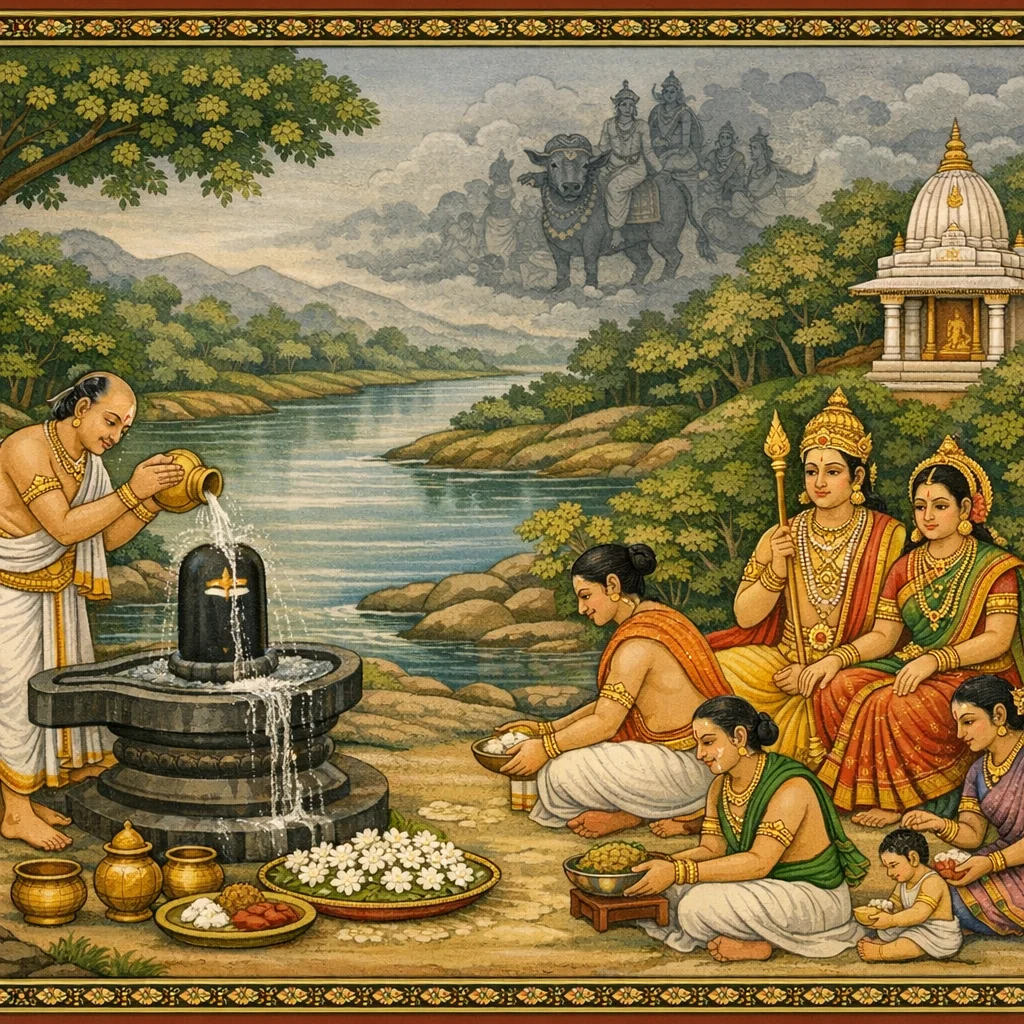
Adhyaya 88
Kapila-Tīrtha and Kapileśvara Pūjā (कापिलतीर्थ–कपिलेश्वरपूजा)
The chapter gives a rite-and-fruit guide for worship at Kāpilatīrtha, said to have been established by Kapila and praised as a destroyer of all sins (sarvapātakanāśana). Mārkaṇḍeya instructs a king to perform ritual bathing and divine service on prescribed lunar dates—especially the bright fortnight’s aṣṭamī and caturdaśī—and to offer abhiṣeka with the milk and ghee of a kapilā cow. It prescribes fragrant anointing with śrīkhaṇḍa sandal paste and worship with sweet-smelling white flowers, requiring the worshipper to restrain anger (jitakrodha). A protective phalaśruti follows: devotees of Kapileśvara are said to avoid Yama’s punitive realms, and the dreadful visions of torment are not encountered by the learned through this worship. The chapter then joins pilgrimage ethics to social duty: after bathing in the meritorious waters of the Revā, one should feed auspicious brāhmaṇas and give dānas—cow, cloth, sesame, umbrella, and bed—by which the king becomes dhārmika. Concluding benefits include vigor and tejas, a stable lineage with living children (jīvatputra), pleasant speech, and freedom from hostile factions.
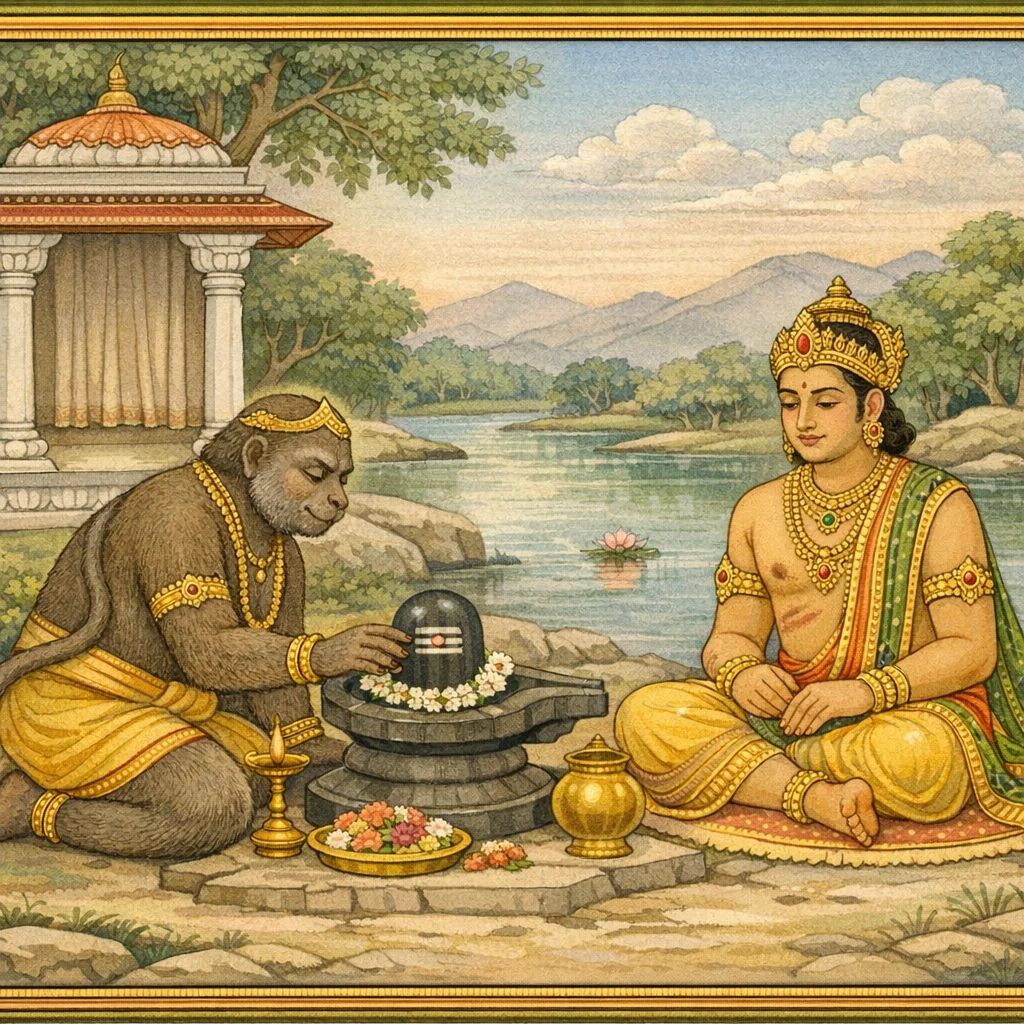
Adhyaya 89
पूतिकेश्वरमाहात्म्य (Glory of Pūtikēśvara)
Chapter 89 presents a concise tīrtha-māhātmya in which Mārkaṇḍeya instructs a ruler to visit the eminent shrine of Pūtikēśvara on the southern bank of the Narmadā, described as efficacious for the attenuation of all pāpa. The discourse anchors the site’s authority in a foundation narrative: Jāmbavān establishes the liṅga for the welfare of beings (lokānāṃ hitārthinā). A linked etiological episode references King Prasenajit and a jewel associated with his chest; when the gem is forcefully removed or cast away, a wound manifests, and the tīrtha becomes the setting where austerity (tapas) leads to healing—becoming ‘woundless’ (nirvraṇa). The chapter then shifts from legend to prescription: devotees who bathe there with bhakti and worship Parameśvara are said to obtain desired aims. It highlights calendrical devotion—especially on Kṛṣṇāṣṭamī and Caturdaśī—stating that those who regularly worship the deity do not go to Yama’s abode, a standard phalaśruti-style assurance framed within Purāṇic moral causality.
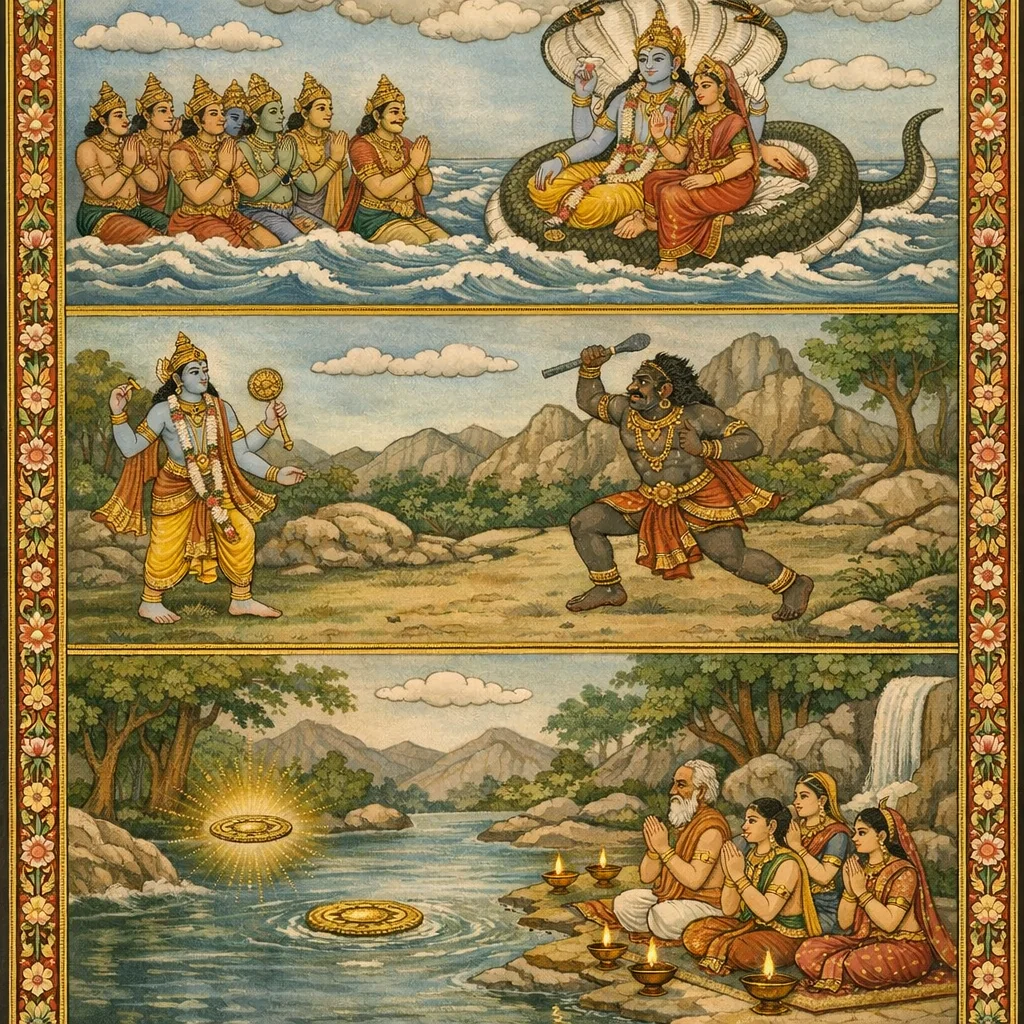
Adhyaya 90
चक्रतीर्थ-माहात्म्य (Cakratīrtha Māhātmya) and जलशायी-तीर्थ (Jalśāyī Tīrtha) on the Revā/Narmadā
This adhyāya is framed as a dialogue in which Mārkaṇḍeya answers Yudhiṣṭhira’s questions about the origin of Cakratīrtha, the incomparable might of Śrī Viṣṇu, and the merit gained in connection with the Revā/Narmadā. An origin-myth is woven in: the fierce daitya Tālamēgha subdues the devas, who seek refuge first with Brahmā and then with Viṣṇu in the Kṣīroda (ocean of milk), praising him as Jalśāyī, the Lord who rests upon the waters. Viṣṇu agrees to restore cosmic order, rides forth on Garuḍa, and defeats the daitya through an escalating contest of weapons, culminating in the release of the Sudarśana cakra. After the victory, the discus is said to fall into the waters of the Revā near Jalśāyī-tīrtha and become “purified,” thereby establishing the tīrtha’s name and sacred efficacy. The latter half gives ritual guidance: auspicious times (especially Mārgasīrṣa and the bright-fortnight Ekādaśī), devotional restraint, bathing and beholding the deity (darśana), night vigil, circumambulation, offerings, and śrāddha with qualified brāhmaṇas. It further explains the tiladhenu (sesame-cow) donation rite, donor ethics, and the promised post-mortem passage beyond fearful realms, concluding with a phalaśruti that hearing or reciting this chapter brings purification and merit.
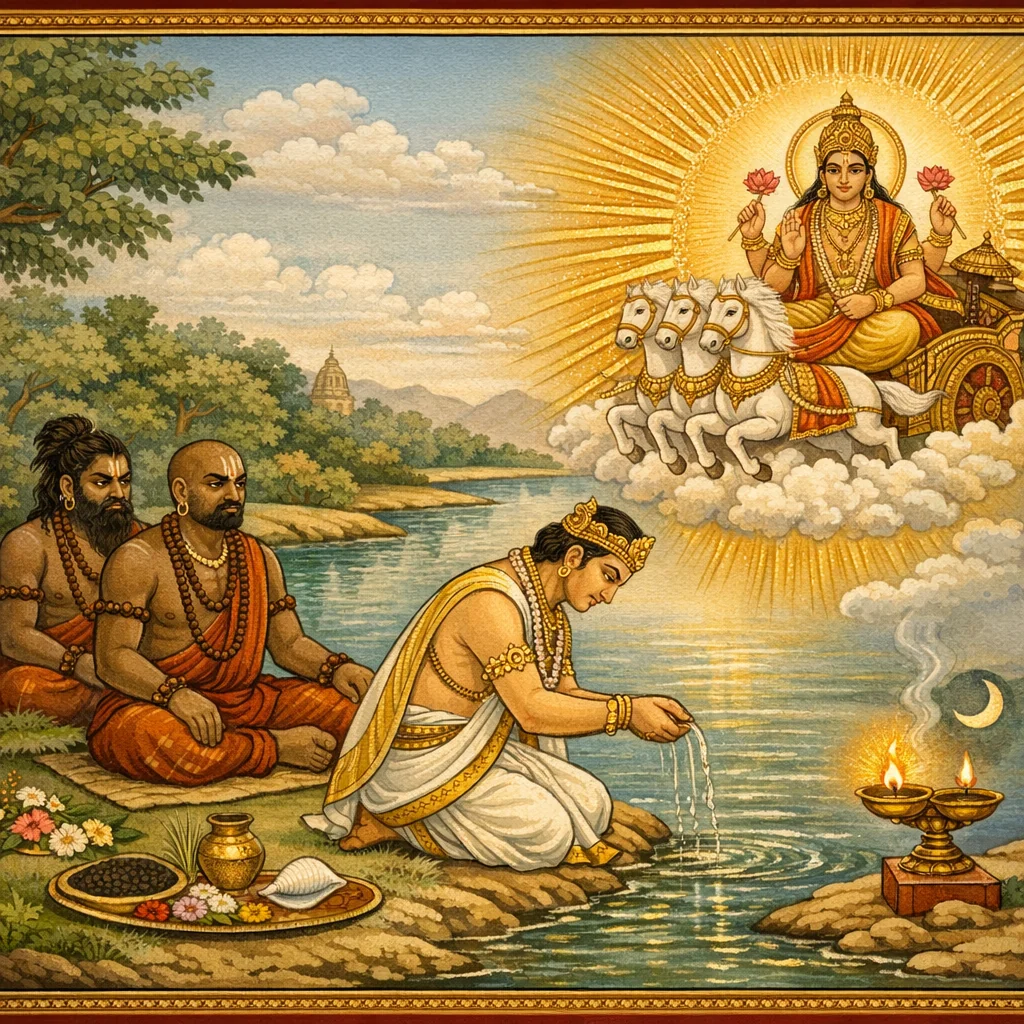
Adhyaya 91
चण्डादित्य-तीर्थ-माहात्म्य (Glory of the Caṇḍāditya Tīrtha)
Mārkaṇḍeya tells a king of a supremely purifying tīrtha linked with Caṇḍāditya—an installed, worshipful form of the Sun (Bhāskara). He explains its origin: the fierce daityas Caṇḍa and Muṇḍa perform long tapas on the auspicious bank of the Narmadā, meditating on the Sun as the dispeller of darkness throughout the three worlds. Pleased, Sahasrāṃśu, the thousand-rayed Sun, offers a boon. They ask to be invincible against all devas and to be free from disease at all times. The Sun grants this, and through their devotional installation (sthāpanā) becomes associated with that place as Caṇḍabhānu/Caṇḍāditya. The chapter then teaches pilgrimage observances and rewards: one should come seeking self-attainment (ātma-siddhi), perform tarpaṇa for gods, humans, and ancestors, and offer a ghee lamp—especially on the sixth lunar day (ṣaṣṭhī). The phalaśruti promises release from sins, attainment of the Sun’s city or realm, and enduring victory and freedom from illness for those who hear Caṇḍabhānu’s origin narrative.
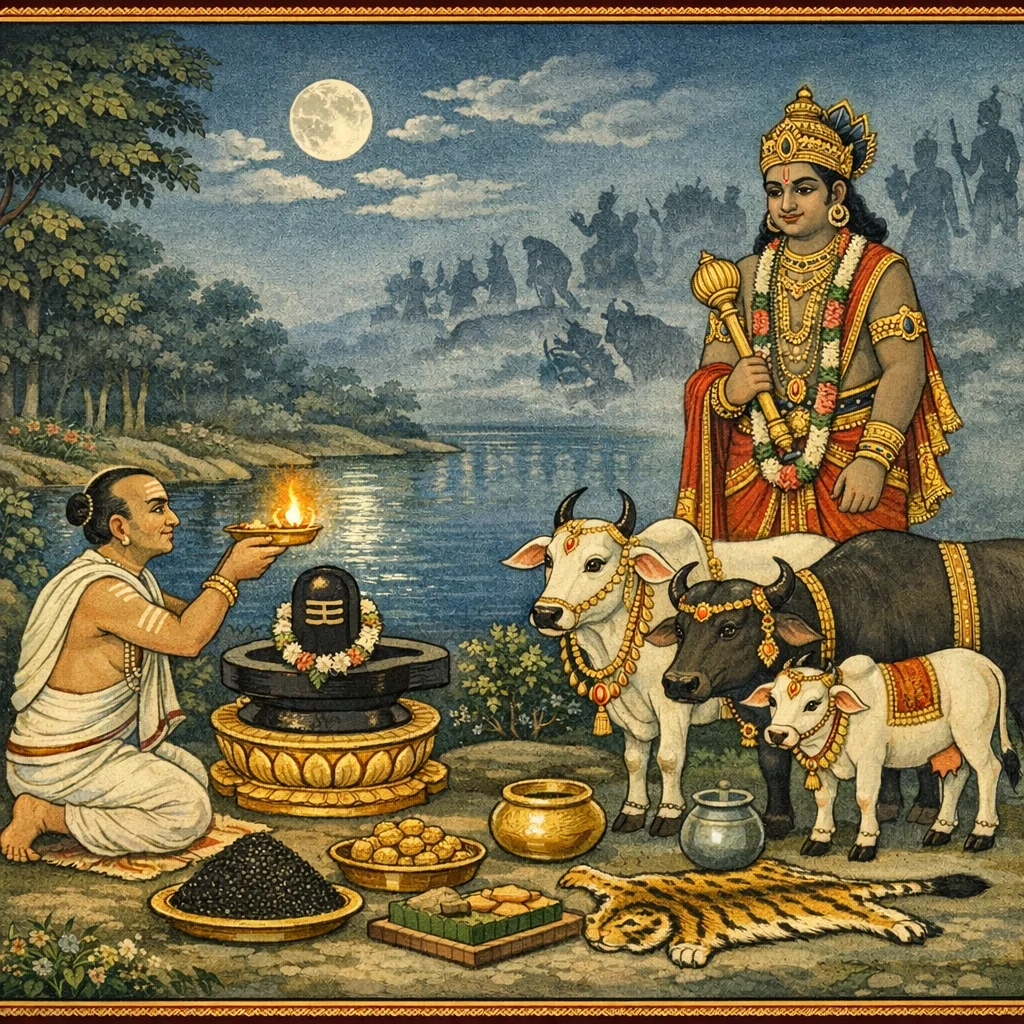
Adhyaya 92
Yamahāsya-tīrtha Māhātmya (यमहास्यतीर्थमाहात्म्य) — Theological Discourse on the ‘Yamahāsya’ Shrine on the Narmadā
This adhyāya unfolds as a dialogue: Yudhiṣṭhira asks Mārkaṇḍeya to tell the origin of a Narmadā-bank tīrtha called Yamahāsya (“Yama’s laughter”). Mārkaṇḍeya relates that Yama (Dharmarāja), arriving early to bathe in the Revā, witnesses the purifying power of even a single immersion. He ponders the paradox that wrongdoers still reach his realm, while Revā-snāna is praised as leading to an auspicious, even Vaiṣṇava, state; laughing at those who can yet fail to behold the sacred river, he establishes the deity Yamahāseśvara there and departs. The chapter then prescribes an observance: in the month of Aśvina, on kṛṣṇa-pakṣa caturdaśī, one should fast with devotion, keep night vigil, and awaken the deity with a ghee lamp—said to remove many kinds of faults. It also sets forth dāna-based ethical guidance, especially honoring brāhmaṇas on amāvāsyā with conquered anger (jita-krodha) and prescribed gifts (gold/land/sesame, black antelope skin, a sesame-cow, and notably a buffalo-cow gift with detailed ritual arrangement). A didactic list of feared torments in Yama’s world is included, reinterpreted as nullified by the efficacy of the tīrtha and of dāna; the closing phalaśruti declares that even hearing this account frees one from faults and prevents the vision of Yama’s abode.
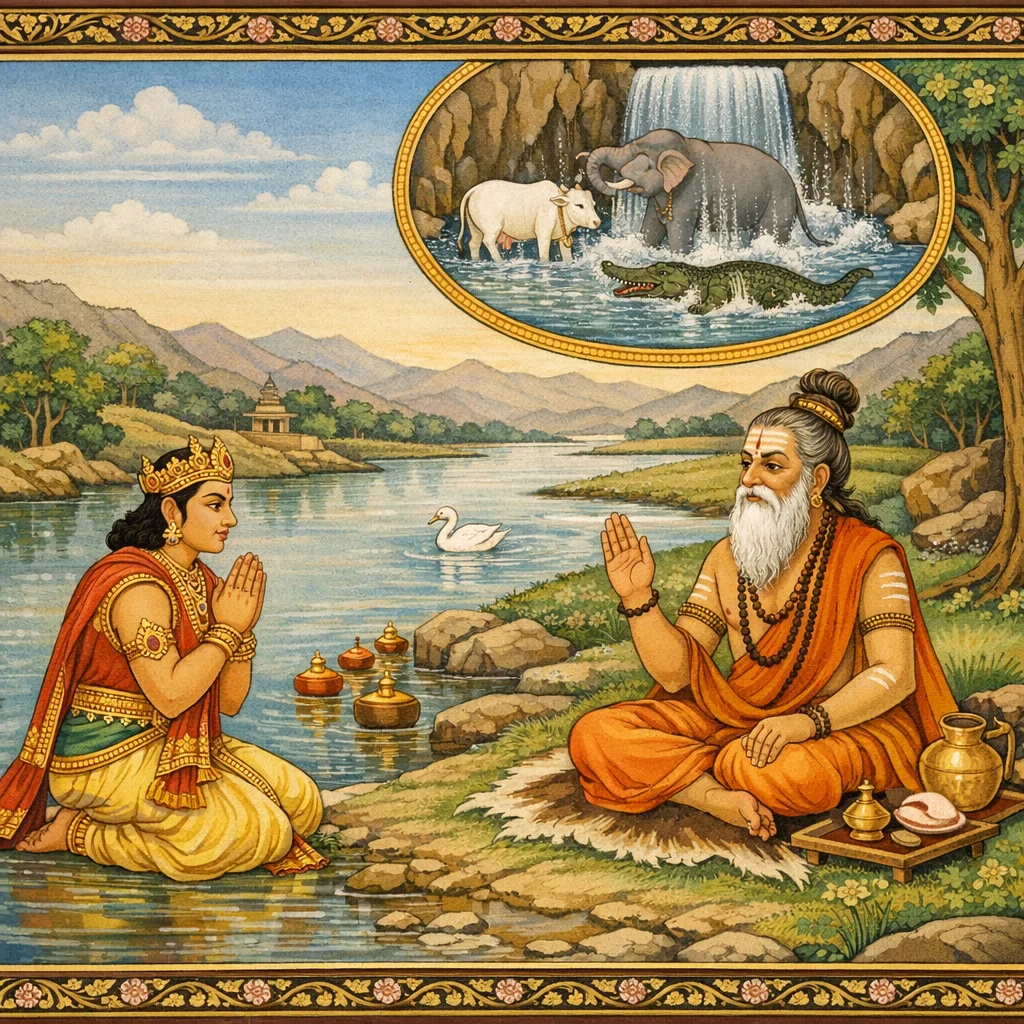
Adhyaya 93
कल्होडीतीर्थमाहात्म्य (Kalhoḍī Tīrtha Māhātmya)
This chapter records Mārkaṇḍeya’s instruction to Yudhiṣṭhira about the eminent pilgrimage ford called Kalhoḍī-tīrtha on the bank of the Revā (Narmadā). It is famed throughout Bhārata as a remover of sin, its purifying power likened to the Gaṅgā, and it is said to be difficult for ordinary people to reach, highlighting its exceptional sanctity. Its authority is affirmed as Śūlin (Śiva)’s own declaration—“this is a holy tīrtha”—and an origin-tale adds that Jāhnavī (Gaṅgā) once came there to bathe in an animal form, explaining the site’s renown. A discipline is prescribed: a three-night observance at the full moon, together with the deliberate abandonment of inner faults—rajas, tamas, anger, hypocrisy/ostentation, and envy. The devotional rite includes bathing the deity three times daily for three days with cow’s milk from a cow with a calf, in a copper vessel mixed with honey, while reciting the Śaiva mantra “oṃ namaḥ śivāya.” The promised fruits are heavenly attainment (companionship of divine women) and, for those who bathe properly and give gifts on behalf of the departed, the satisfaction of the ancestors. A specific dāna is emphasized: gifting a white cow with calf, adorned with cloth and set upon gold, to a purified brāhmaṇa devoted to household fidelity, granting access to Śāmbhava-loka, a realm associated with Śiva.
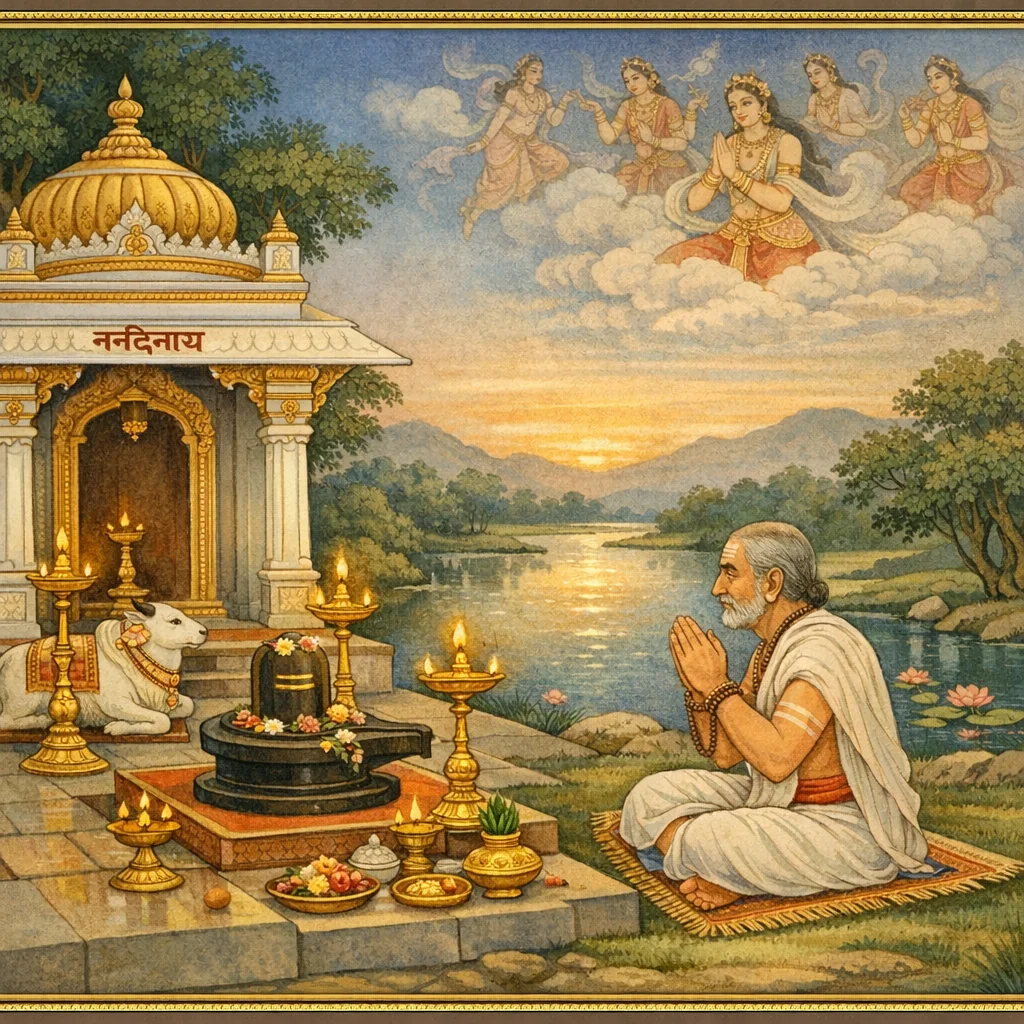
Adhyaya 94
नन्दितीर्थ-माहात्म्य (Nanditīrtha Māhātmya)
This chapter, spoken by Śrī Mārkaṇḍeya to Yudhiṣṭhira, lays down the proper sequence of pilgrimage to Nanditīrtha on the bank of the Narmadā. The tīrtha is praised as auspicious and universally sin-destroying, its sanctity traced to an earlier establishment by Nandin, the attendant of Śiva. The teaching enjoins a full night-and-day stay (ahorātra-ūṣita) at Nandinātha, presenting time-bound residence as a means of intensifying ritual merit. Devotion is to be performed through pañcopacāra-pūjā to Nandikeśvara, and dāna is recommended—especially the gifting of gems to brāhmaṇas—so that pilgrimage is joined with righteous giving. The promised fruit is exalted: attainment of the supreme abode where Pinākin (Śiva) dwells, together with complete well-being and heavenly enjoyment in the company of apsarases, blending Purāṇic liberation-language with paradisal reward.
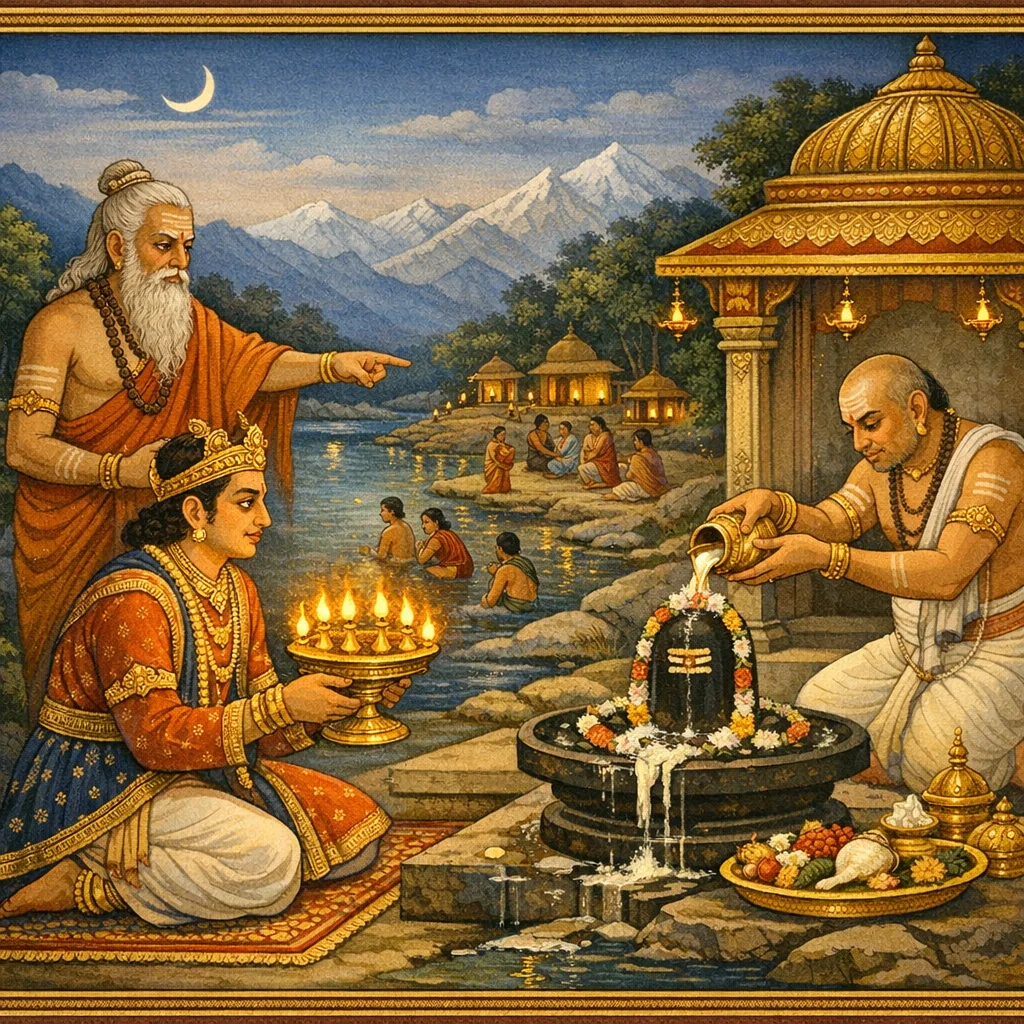
Adhyaya 95
Badrikāśrama–Narmadā-tīra: Śiva-liṅga-sthāpana, Vrata, and Śrāddha-Vidhi (Chapter 95)
Mārkaṇḍeya instructs the king to go to the eminent Badrikāśrama tīrtha, a supreme sacred ford once praised by Śambhu. The place is linked with Nara–Nārāyaṇa, and a bhakti-joined-with-gnosis attitude is taught: one who is devoted to Janārdana and sees the same Self in all beings—even across social extremes—is pleasing to the Divine. Nara–Nārāyaṇa are said to have founded the āśrama, and Śaṅkara was installed there for the welfare of the worlds; a tri-mūrti-associated liṅga is described as granting heavenly paths and liberation. The chapter prescribes observance: purity, a one-night fast, abandoning rajas and tamas for a sāttvika orientation, and night-vigil on specified lunar dates (aṣṭamī in Madhu-māsa and caturdaśī in either fortnight, with special emphasis on Aśvin). Śiva’s abhiṣeka is detailed with pañcāmṛta—milk, honey, curd, sugar, and ghee. The phala promises closeness to Śiva and Indra-world results for sincere witnesses; even imperfect salutations to Śūlapāṇi loosen bondage, while steady japa of “namaḥ śivāya” makes merit firm. It further outlines śrāddha using Narmadā water, stressing qualified Brahmin recipients and excluding unethical or unfit officiants. Gifts such as gold, food, cloth, cow, bull, land, umbrella, and suitable items are recommended, with heavenly attainment declared. Finally, death at or near the tīrtha (including by water) is said to lead to Śiva’s abode, long residence in divine realms, and eventual return as a capable ruler who remembers the tīrtha and comes again.
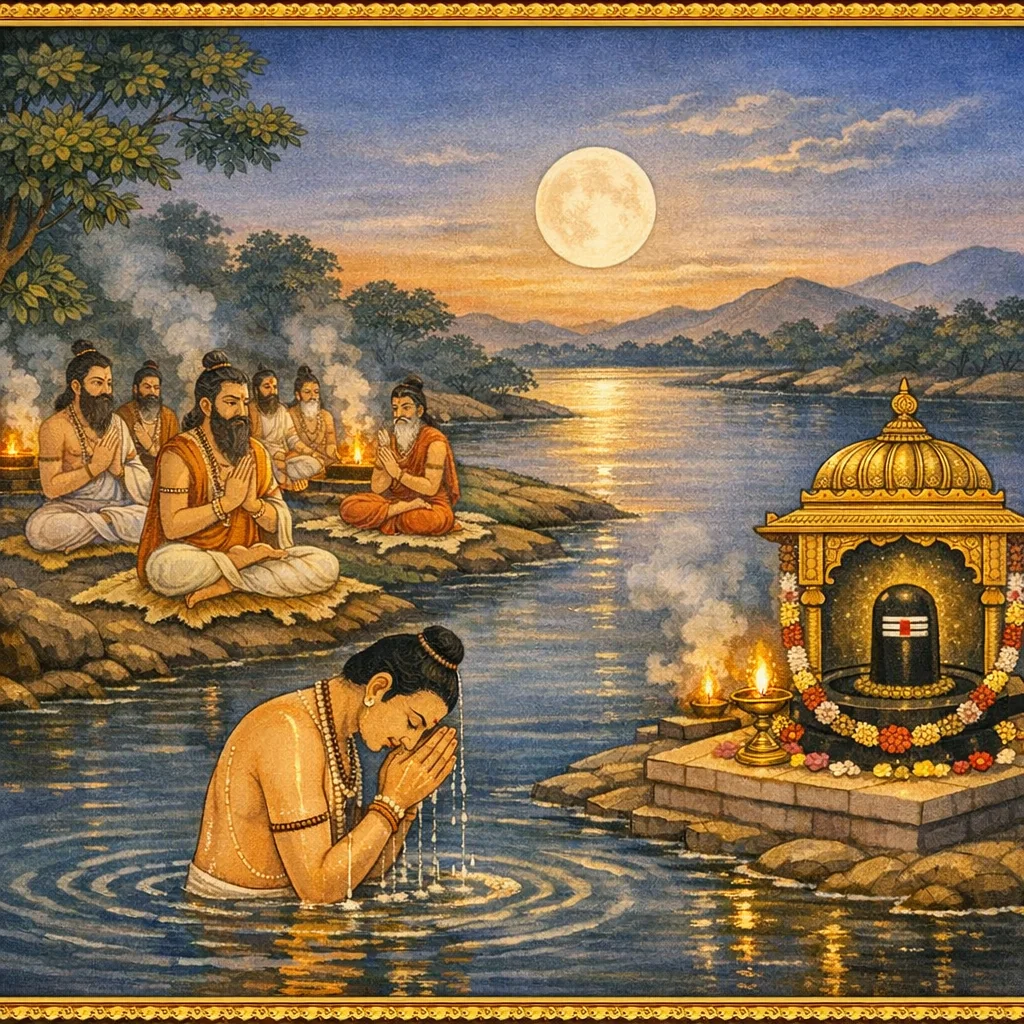
Adhyaya 96
Koṭīśvara-tīrtha Māhātmya (कोटीश्वरतीर्थमाहात्म्य) — Theological Account of the Koṭīśvara Pilgrimage Site
Mārkaṇḍeya instructs a royal interlocutor to go to the supreme tīrtha called Koṭīśvara. The chapter establishes the site’s sanctity by recalling that a “crore of ṛṣis” (ṛṣikoṭi) once assembled there, an archetypal gathering that confers authority upon the pilgrimage place. It further relates that eminent sages, after consultation with learned dvijas who recited auspicious Vedic passages, installed Śaṅkara—Śiva’s liṅga-presence—there for the welfare and protection of beings. The shrine is praised as a remover of bondage and a cutter of saṃsāra, easing the distress of living creatures. A specific observance is emphasized: devotional bathing (snāna) on the full-moon day, especially on Śrāvaṇa Pūrṇimā. After tarpaṇa and properly performed piṇḍadāna, the pitṛs are said to attain inexhaustible satisfaction lasting until cosmic dissolution. The chapter concludes by declaring the Revā riverbank location a “secret” and supreme ancestral locus, built by sages and described as granting mokṣa to all beings.
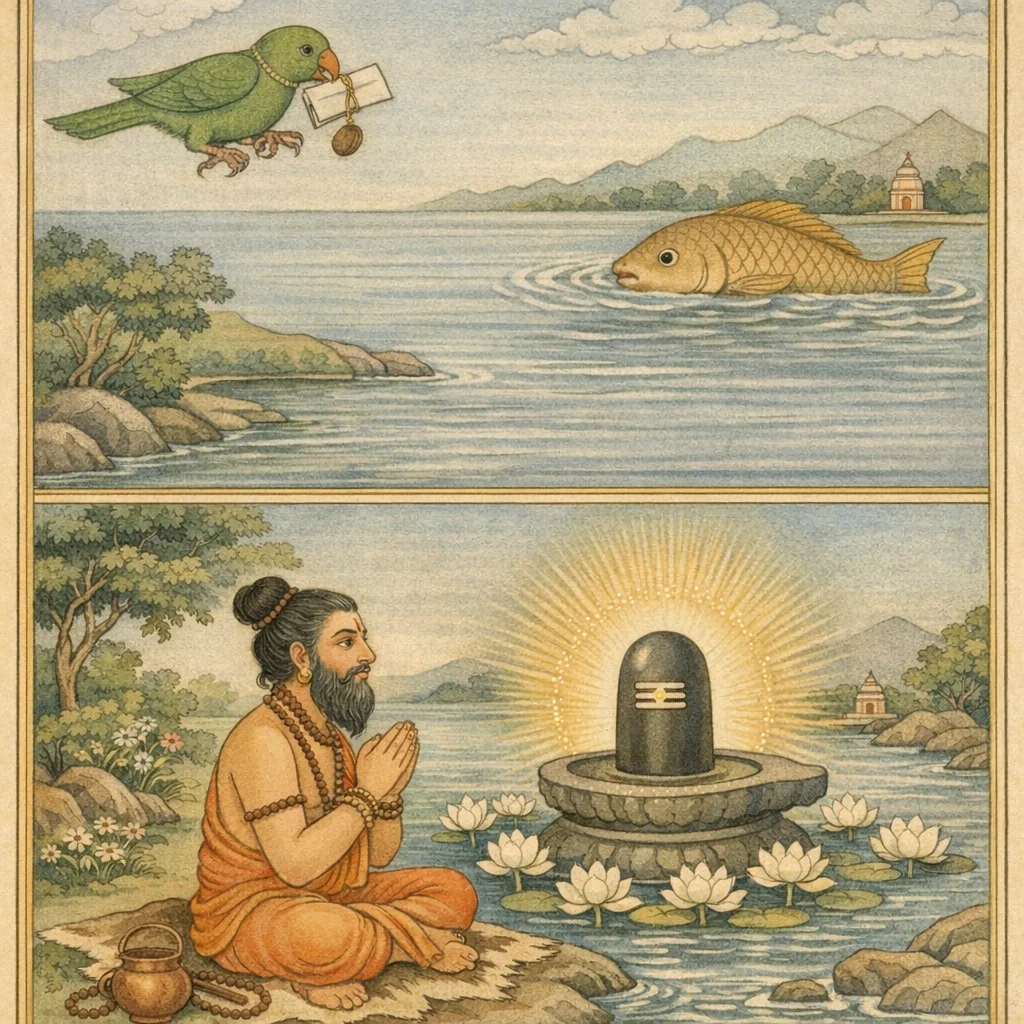
Adhyaya 97
Vyāsatīrtha-prādurbhāvaḥ — Origin and Merit of Vyāsa Tīrtha (व्यासतीर्थप्रादुर्भावः)
This chapter unfolds as a didactic dialogue: Mārkaṇḍeya instructs King Yudhiṣṭhira and proclaims Vyāsatīrtha as a rare, supremely meritorious sacred ford, said to be “situated in mid-air” (antarikṣe) through the wondrous agency of Revā/Narmadā. It then weaves an extended origin-tale: Parāśara’s austerities and his meeting with the ferrygirl, revealed as royal-born (Satyavatī/Yojaṇagandhā); the seed conveyed by a letter-bearing parrot, the parrot’s death and the seed’s entry into a fish, the girl’s emergence, and finally the birth of Vyāsa. Vyāsa later undertakes tīrtha-yātrā and performs tapas on the Narmadā’s bank. Śiva appears in response to worship, and Narmadā herself answers Vyāsa’s stotra. A ritual-ethical dilemma arises: sages wish to accept hospitality without breaking their vow by crossing to the southern bank; Vyāsa petitions Narmadā, meets refusal, faints, draws divine concern, and at last gains her compliance. Thereafter snāna, tarpaṇa, and homa are performed, a liṅga manifests, and the tīrtha’s name is established. The closing portion gives detailed prescriptions for high-fruit observances—especially in Kārttika on śukla caturdaśī and pūrṇimā—along with liṅga-abhiṣeka substances, flower offerings, mantra-japa options, qualifications of worthy brāhmaṇa recipients, and specific dāna items. The phalāśruti concludes with promises of protection from Yama’s realm, graded results according to offerings, and auspicious post-mortem attainments through the power of Vyāsatīrtha.
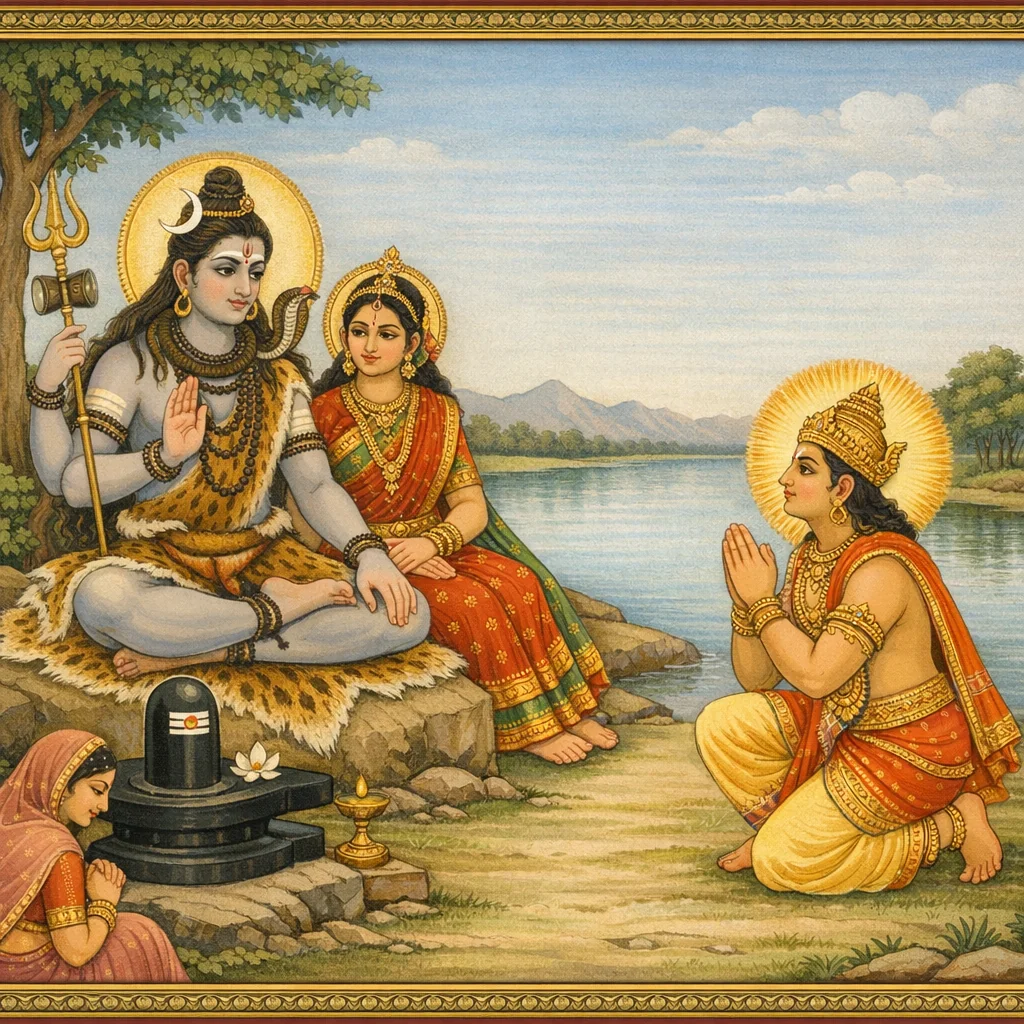
Adhyaya 98
प्रभासेश्वर-माहात्म्य (Prabhāseśvara Māhātmya) — The Glory of the Prabhāseśvara Tīrtha
This chapter unfolds as a question-and-answer discourse: Mārkaṇḍeya directs Yudhiṣṭhira to visit the famed Prabhāseśvara tīrtha, praised across the three worlds as a “svarga-sopāna,” a stairway to heaven. Yudhiṣṭhira asks for a brief account of its origin and the fruits it bestows. The tīrtha’s origin is traced to Prabhā, the (unfortunate) wife of Ravi, the Sun, who performs fierce austerity—living on air and remaining absorbed in meditation for a year—until Śiva grants her a boon. Prabhā declares a social-ethical norm that for a woman her husband is her “deity,” whatever his qualities, and confesses her sorrow born of perceived ill fortune. Śiva promises, by his grace, to restore her marital favor; Umā (Pārvatī) questions how this can be practically fulfilled, whereupon Bhānu (Sūrya) arrives on the northern bank of the Narmadā. Śiva commands Sūrya to protect and satisfy Prabhā, and at Umā’s request Sūrya agrees to make Prabhā foremost among wives. Prabhā then asks that a portion (aṃśa) of Sūrya remain at the site to “open” the tīrtha, and a liṅga said to embody all the gods is established, becoming known as Prabhāseśa. The chapter turns to pilgrimage discipline: Prabhāseśvara is said to grant immediate desired results, especially on Māgha śukla saptamī, through rites performed under proper brahminical guidance—association with a horse, devotional bathing, and gifts to dvijas. Detailed dāna patterns follow, notably go-dāna with specified qualities; the phalaśruti proclaims that bathing and especially kanya-dāna at this tīrtha dissolve even grave transgressions, lead to the worlds of the Sun and Rudra, and yield merit comparable to great sacrifices, while the timeless merit of go-dāna is extolled with special emphasis on caturdaśī.
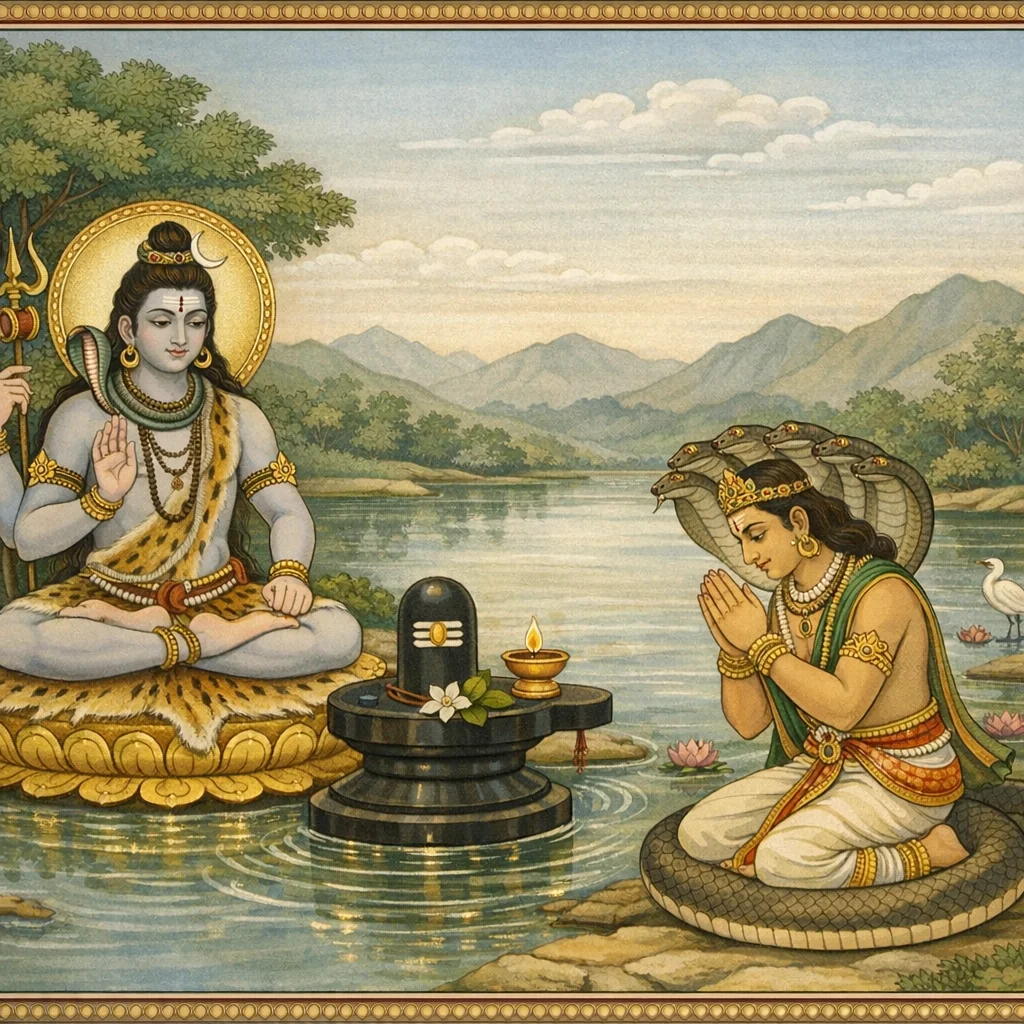
Adhyaya 99
Nāgeśvara-liṅga at the Southern Bank of Revā (Vāsuki’s Atonement and Tīrtha Procedure) / रेवायाः दक्षिणतटे नागेश्वरलिङ्गमाहात्म्यम्
This adhyāya unfolds through questions and answers: Yudhiṣṭhira asks why Vāsuki is established on the southern bank of the Revā (Narmadā). Mārkaṇḍeya relates the mythic cause: during Śambhu’s (Śiva’s) dance, sweat mixed with Gaṅgā-water issues from Śiva’s crown; a serpent drinks it, incurring Maṇḍākinī’s wrath and a curse-like fall into a low, encumbered condition (ajagara-bhāva). Vāsuki repents, praises the river’s power to purify, and begs for compassion. Gaṅgā instructs him to perform tapas to Śaṅkara at Vindhya; after long austerities, Śiva grants a boon and directs Vāsuki to the Revā’s southern bank for proper bathing. Entering the Narmadā, Vāsuki is purified, and a Śaiva स्थापना is described: the Nāgeśvara-liṅga, famed for removing wrongdoing. The chapter then sets ritual guidance and phalaśruti—on Aṣṭamī or Caturdaśī, bathe Śiva with honey; the childless who bathe at the saṅgama gain worthy offspring; śrāddha with fasting relieves departed ancestors; and by nāga-prasāda the lineage is protected from fear of serpents.
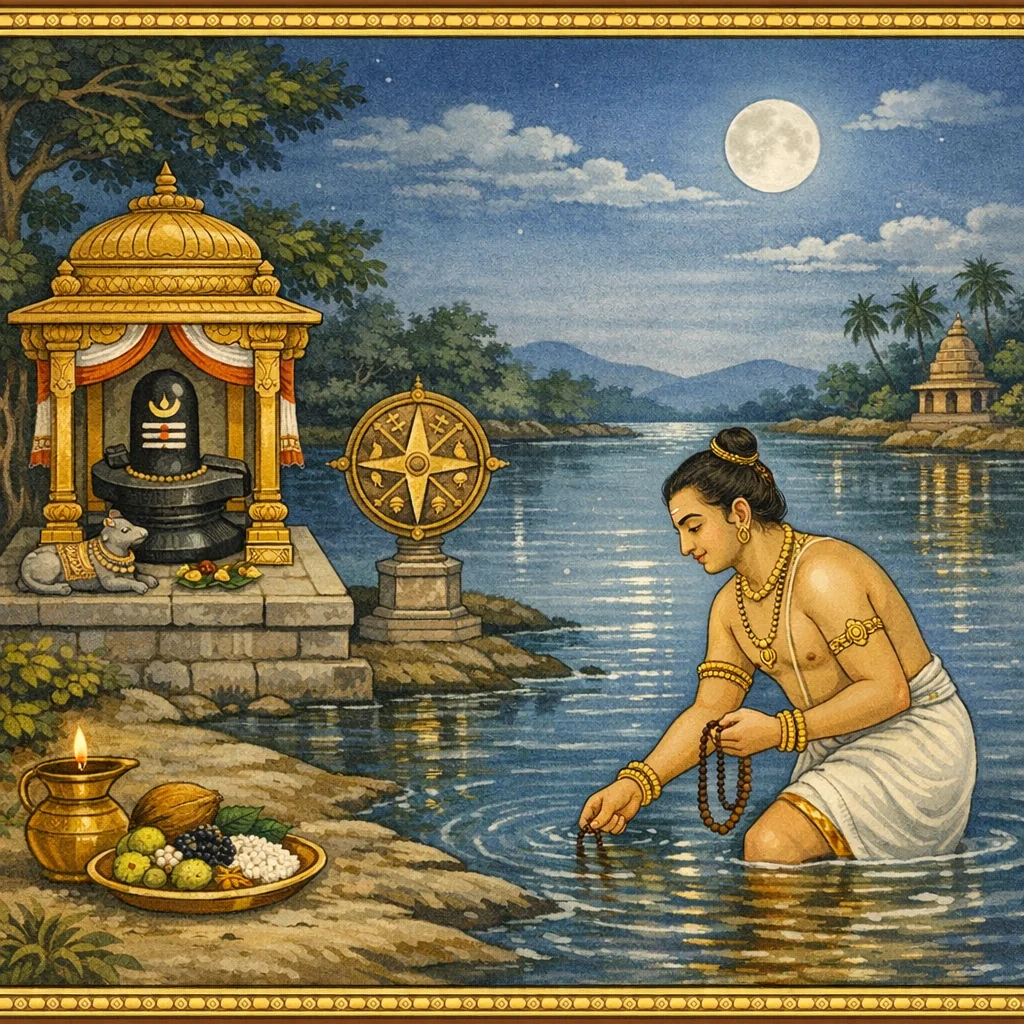
Adhyaya 100
Mārkaṇḍeśa Tīrtha Māhātmya (मार्कण्डेशतीर्थमाहात्म्य) — Summary of Merits and Ritual Observances
The chapter records Mārkaṇḍeya’s counsel to a king (addressed as “mahīpāla” and “Pāṇḍunandana”), urging pilgrimage to the greatly praised tīrtha called Mārkaṇḍeśa on the southern bank of the Narmadā. The place is extolled as supremely sacred—even revered by divine beings—and as a confidential seat of Śaiva worship. Mārkaṇḍeya adds a personal testimony: he had formerly established the sacred focus there, and through Śaṅkara’s grace liberating knowledge arose in him. The chapter then lays out observances and their fruits: japa performed while entering the water releases one from accumulated moral faults, purifying transgressions of mind, speech, and deed. A prescribed orientation and posture follows—standing facing south while holding a piṇḍikā—after which one should practice focused “yoga” or worship of Śūlin (Śiva) in his many forms, with the explicit promise of reaching Śiva at death. Further rites include lighting a ghee lamp at night on the eighth lunar day to attain heavenly worlds, performing śrāddha there to satisfy the ancestors until cosmic dissolution, and offering tarpaṇa with simple items (iṅguda, badara, bilva, akṣata, or water), said to bestow the “fruit of birth” upon one’s lineage.
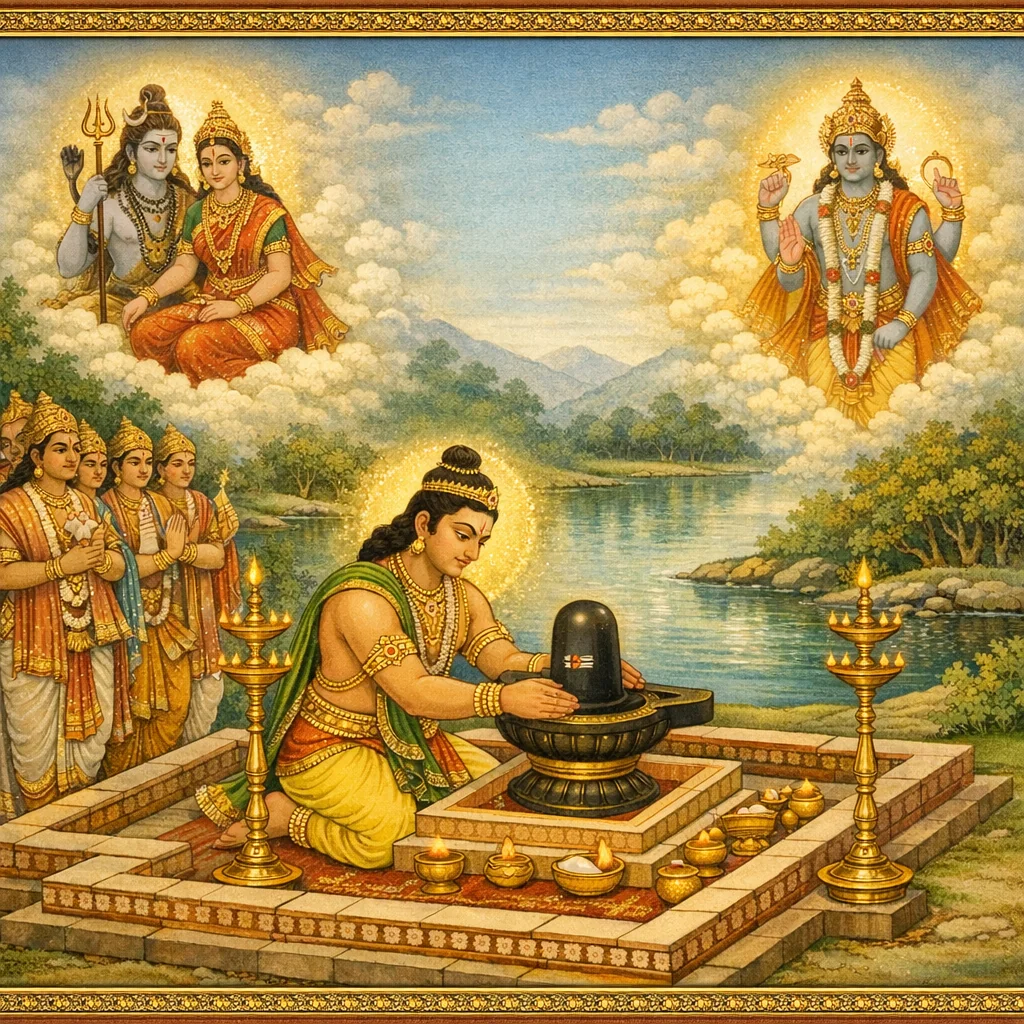
Adhyaya 101
Saṅkarṣaṇa-Tīrtha Māhātmya (संकर्षणतीर्थमाहात्म्य) — The Glory of Saṅkarṣaṇa Tīrtha
Chapter 101, spoken by the sage Mārkaṇḍeya to a royal listener, points to a supremely auspicious tīrtha on the northern bank of the Narmadā, situated at the very center of the sacrificial enclosure (yajñavāṭa). This place is called Saṅkarṣaṇa and is praised as a destroyer of sin and wrongdoing. Its holiness is said to arise from Balabhadra’s former ascetic practice (tapas) and from the abiding divine presence there: Śambhu (Śiva) with Umā, Keśava (Viṣṇu), and the host of gods are described as dwelling at that spot. For the welfare of living beings, Balabhadra established Śaṅkara there with supreme devotion, thereby confirming it as a ritual and worshipful center. The chapter then gives observances: one who bathes there, having conquered anger and restrained the senses, should worship Śiva on the bright fortnight’s Ekādaśī by performing abhiṣeka with honey. It also permits śrāddha offerings to the ancestors at this tīrtha, promising attainment of the highest state in accordance with Balabhadra’s declaration.
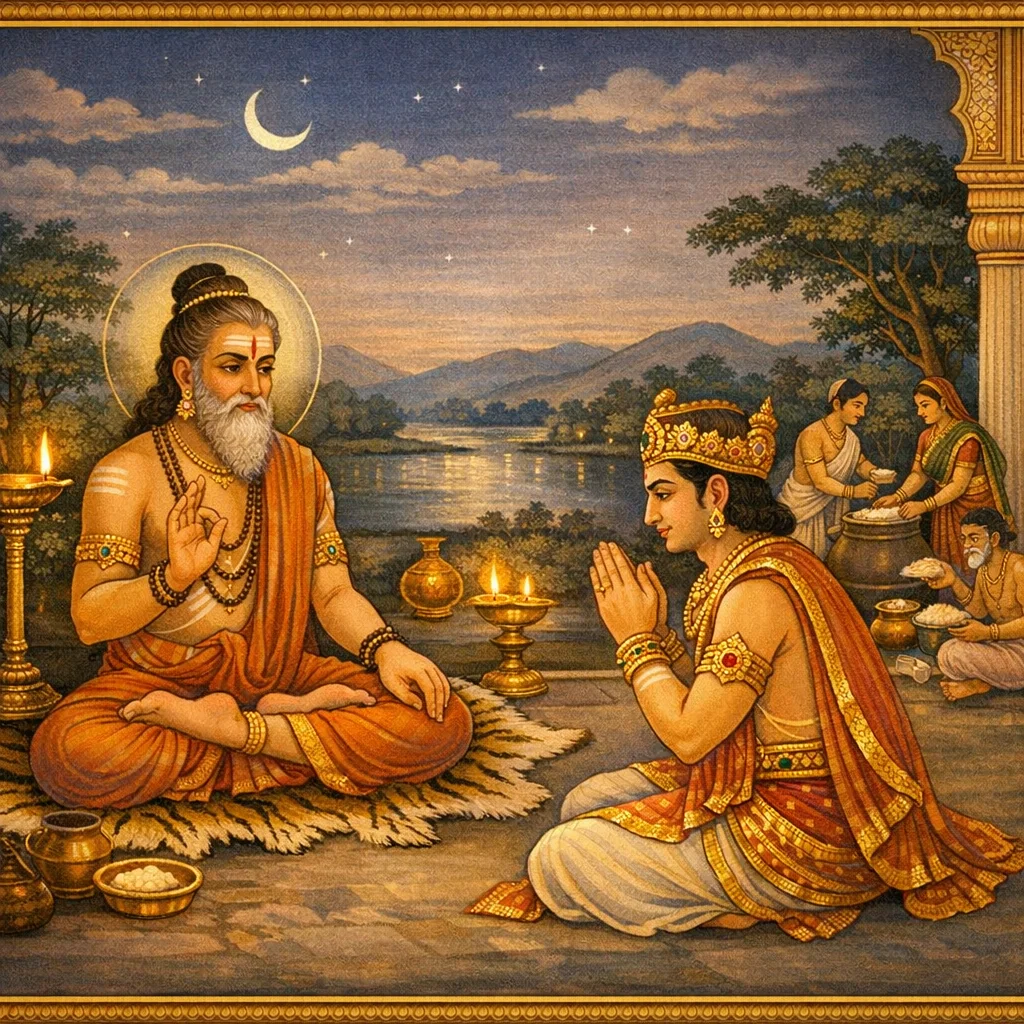
Adhyaya 102
मन्मथेश्वर-तीर्थमाहात्म्य (Glory of the Manmatheśvara Tīrtha)
This adhyāya presents Mārkaṇḍeya’s instructional discourse to a royal listener on the ritual and merit-logic of visiting Manmatheśvara, a Śaiva tīrtha praised as revered by the gods. The chapter outlines graded practices: mere bathing is framed as spiritually protective; bathing combined with mental purity and a one-night fast yields high merit; extended observances (three nights) are described with escalating results. It further prescribes devotional night activities—music, instruments, dance, and vigil before the deity—presented as acts that please Parameśvara. The narrative also situates Manmatheśvara as a ‘stairway’ (sopāna) to heaven, linking desire (kāma) to a sanctified devotional channel. Ancillary rites are included: śrāddha and dāna at twilight, annadāna as especially praised, and a specific calendrical instruction for go-dāna on trayodaśī in the bright half of Caitra, with lamp-offering in ghee during night vigil. The text closes by equalizing the stated merit for women and men.
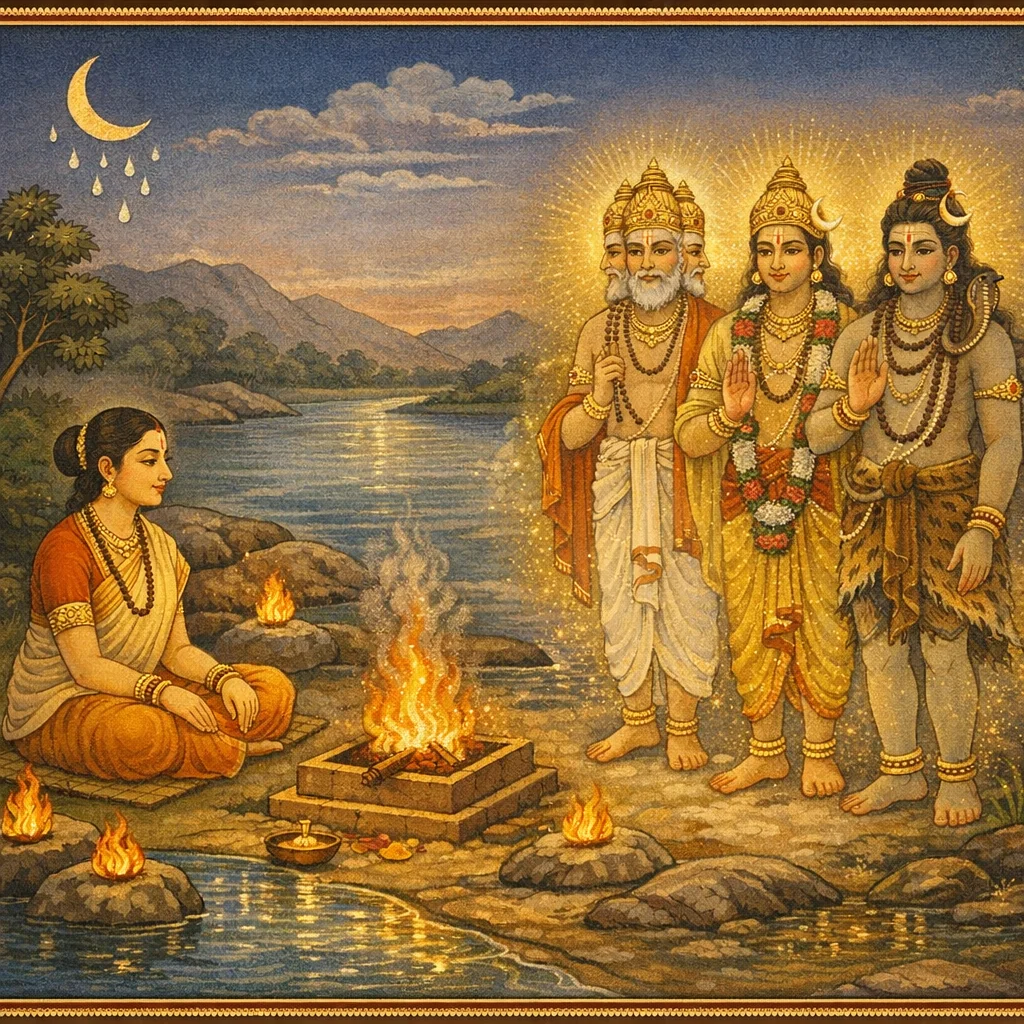
Adhyaya 103
एरण्डीसङ्गममाहात्म्य — The Māhātmya of the Eraṇḍī–Reva Confluence
The chapter unfolds as a layered dialogue: Mārkaṇḍeya directs a king to the Eraṇḍī–Reva confluence, recalling Śiva’s earlier disclosure to Pārvatī, praised as “more secret than secret.” Śiva tells of Atri and Anasūyā’s childlessness and teaches the ethical and theological worth of progeny as support for lineage-dharma and post-mortem welfare. Anasūyā then performs sustained tapas at the confluence on Reva’s northern bank, observing seasonal austerities (pañcāgni in summer, cāndrāyaṇa in the rains, water-dwelling in winter) along with daily rites—sacred bathing, sandhyā, devarṣi-tarpaṇa, homa, and worship. Brahmā, Viṣṇu, and Rudra appear in concealed dvija form, reveal their cosmic-seasonal identifications (rain/seed, winter/preservation, summer/withering), and grant boons, establishing the tīrtha’s perpetual sanctity and wish-fulfilling power. The chapter prescribes observances at the confluence—especially in Caitra—such as bathing, night vigil, feeding dvijas, pindadāna, circumambulation, and various dānas, with multiplied merit. A second exemplum follows: the householder Govinda accidentally causes a child’s death while gathering wood, later suffers bodily affliction understood as karmic fruition, and is relieved through confluence bathing and the associated worship and gifts—an ethical-doctrinal illustration of remedial pilgrimage discipline. The chapter closes with phalaśruti-like assurances for hearing or reciting the account and for specific residence and fasting at the site, extending merit even to incidental contact with the confluence’s water and earth.
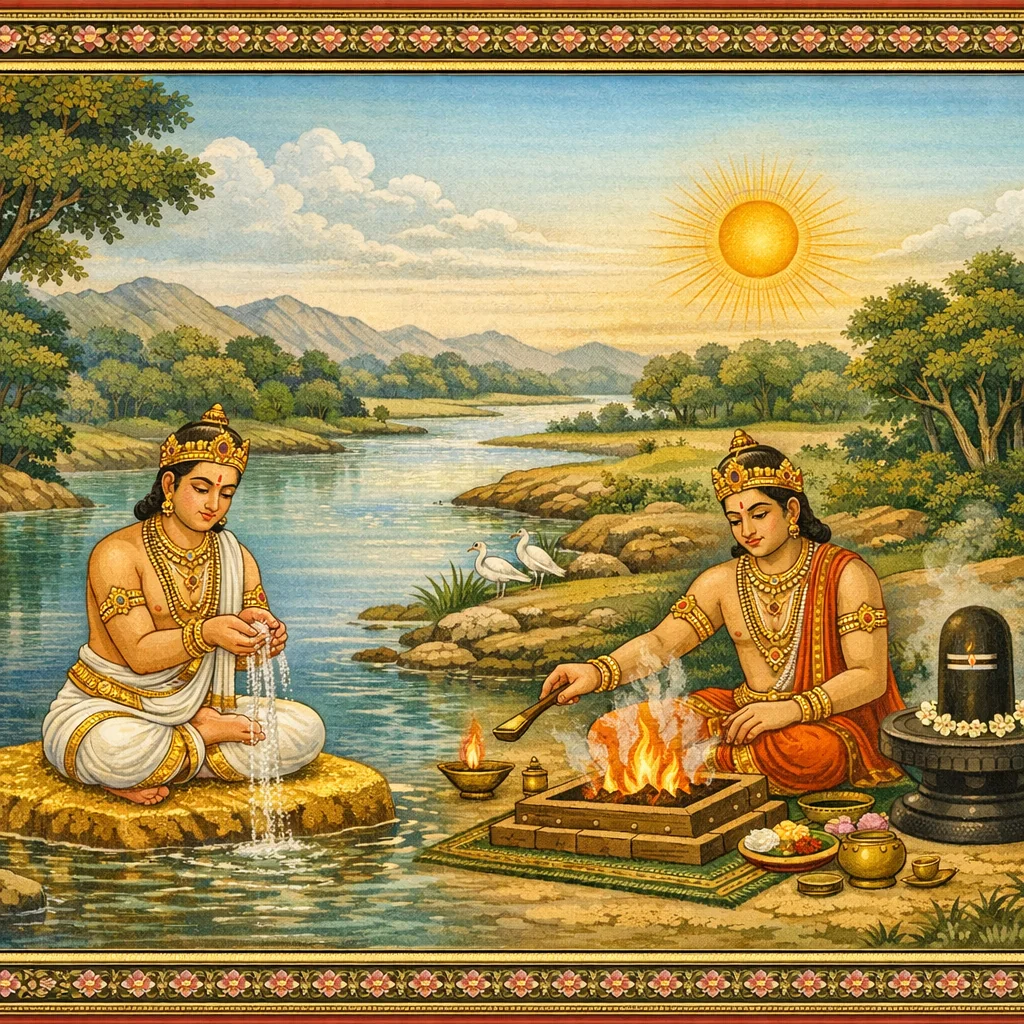
Adhyaya 104
सौवर्णशिला-तीर्थमाहात्म्य (Glory of the Sauvarṇaśilā Tīrtha)
Mārkaṇḍeya instructs a ruler to go to the eminent holy place called Sauvarṇaśilā, famed on the northern bank of the Revā as a remover of all demerit. Located near a saṅgama, it was ritually established in ancient times by groups of sages and is therefore said to be durlabha—hard to obtain—though small in extent, it is a highly potent field of merit. The observance is given in order: bathe at Sauvarṇaśilā; worship Maheśvara; bow to Bhāskara, the Sun; then offer into the sacred fire bilva mixed with ghee, or bilva leaves. A brief prayer is taught, asking that the Lord be pleased and that illness cease. The teaching then turns to dāna: giving gold to a worthy Brahmin is declared equal to the highest fruits of vast gold-gifts and great sacrifices. After death the donor ascends to heaven and remains long in Rudra’s company, then descends to be reborn auspiciously in a pure and prosperous lineage, retaining remembrance of that sacred water.
Adhyaya 105
करञ्जातीर्थगमनफलम् | The Merit of Going to the Karañjā Tīrtha
This chapter is a brief prescriptive teaching spoken by the sage Mārkaṇḍeya to a royal hearer (“rājendra”). He instructs the aspirant to go to the Karañjā Tīrtha while observing upavāsa (fasting) and jitendriyatā (restraint of the senses). After bathing at that sacred ford, the pilgrim is said to be freed from all pāpa (sin). One should then worship Mahādeva (Śiva) and give dāna with bhakti, with gifts listed in graded order—gold, silver, gems/pearls/coral, and also practical items such as footwear, an umbrella, a bed, and coverings. The phalāśruti declares the merit to be multiplied “koṭi-koṭi-guṇa,” uniting disciplined pilgrimage, Śaiva devotion, and charitable giving into a single path of spiritual fruition.
Adhyaya 106
Mahīpāla Tīrtha Māhātmya (Auspiciousness Rite to Umā–Rudra) | महीपालतीर्थमाहात्म्य (उमारुद्र-सौभाग्यविधिः)
Chapter 106 is a prescriptive tīrtha-māhātmya taught by Mārkaṇḍeya, instructing a king to visit Mahīpāla Tīrtha, praised as supremely beautiful and a giver of saubhāgya (auspicious good fortune). The place is said to benefit women and men alike, especially those afflicted by misfortune, and it enjoins a focused worship of Umā and Rudra. A structured observance is given: disciplined conduct with restraint of the senses, fasting on the third lunar day, and the devotional invitation of a worthy brāhmaṇa couple. They are to be honored with fragrances, garlands, and perfumed garments, and fed with pāyasa and kṛsara; then one should circumambulate and recite a prayer seeking the favor of Mahādeva with his consort, upholding the ideal of non-separation. The chapter contrasts results: neglect leads to prolonged ill-fortune—poverty, sorrow, and infertility across births—whereas correct performance, especially in the bright fortnight of Jyeṣṭha on the third day, grants release from sins and multiplies merit through gifts. It further prescribes honoring a brāhmaṇī and brāhmaṇa as embodiments of Gaurī and Śiva, applying sindūra and kuṅkuma, and donating ornaments, grains, food, and other offerings. The phalaśruti concludes with worldly and salvific rewards: increased merit, superior enjoyment aligned with Śaṅkara, abundant saubhāgya, a son for the childless, wealth for the poor, and Mahīpāla Tīrtha on the Narmadā as a wish-fulfilling sacred site.
Adhyaya 107
भण्डारीतीर्थमाहात्म्य (Bhaṇḍārī Tīrtha Māhātmya: The Glory of Bhaṇḍārī Pilgrimage Site)
Chapter 107, within the Revākhaṇḍa, gives a brief tīrtha-instruction spoken by Śrī Mārkaṇḍeya to a royal listener. He directs the hearer to go to the eminent Bhaṇḍārī-tīrtha, praised as a place whose sacred efficacy includes “the cutting off of poverty” (daridra-ccheda) over a vast span of time, stated as nineteen yugas. The chapter then offers an origin-validation: Kubera (Dhanada) performed austerities there, and when Brahmā (Padmasambhava) was pleased, Kubera received the boon that even a small gift given at that very site becomes protection for wealth. Finally, a practical rule is set forth: one who goes with devotion, bathes, and gives wealth in dāna will not suffer depletion or interruption of fortune (vitta-pariccheda). The teaching emphasizes a ritual-ethical economy—prosperity is stabilized not by hoarding, but by disciplined pilgrimage, devotional intent, and measured generosity at an authorized sacred place.
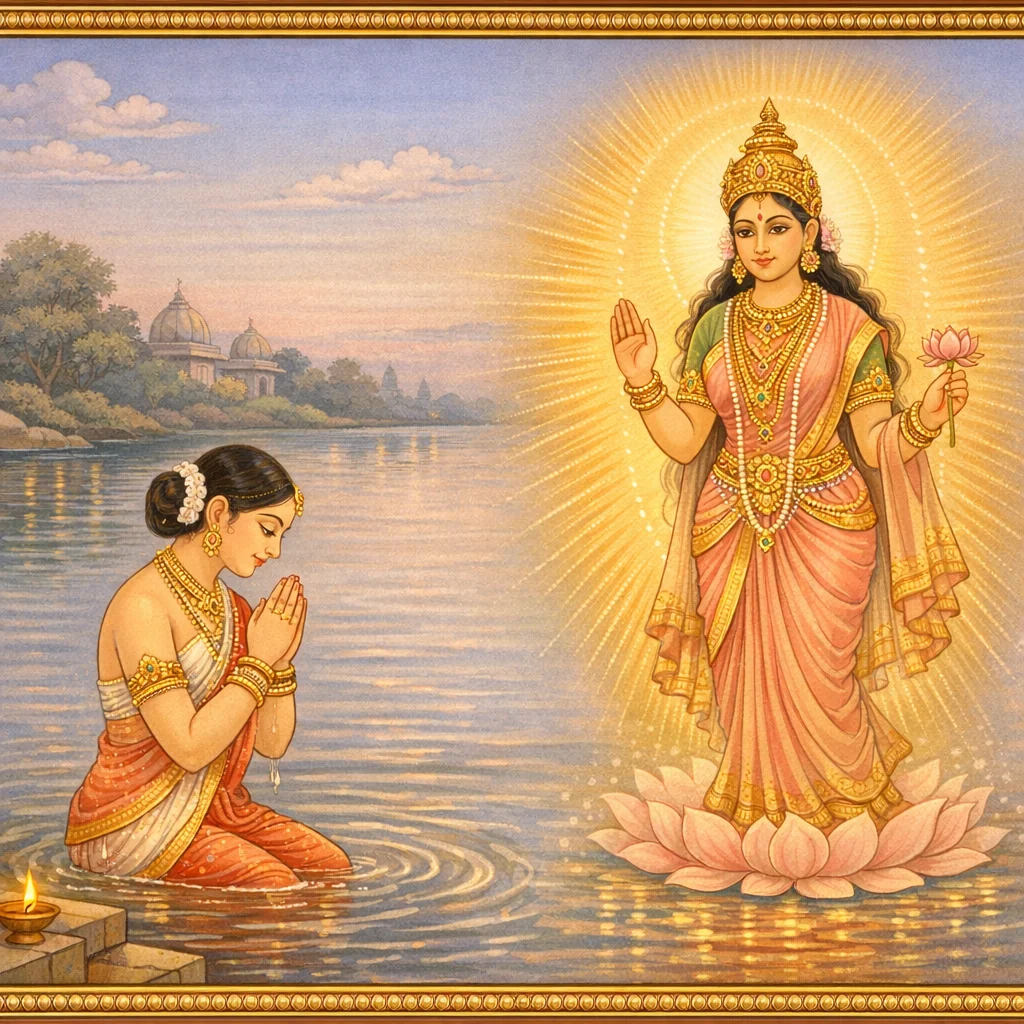
Adhyaya 108
रोहिणीतीर्थमाहात्म्य (Rohiṇī Tīrtha Māhātmya)
This chapter unfolds as an instructive dialogue: the sage Mārkaṇḍeya directs a kingly listener to Rohiṇī-tīrtha, famed in the three worlds and praised as a purifier of moral fault. When Yudhiṣṭhira asks for a precise account of its power, an origin narrative begins in the time of cosmic dissolution: Viṣṇu (Padmanābha/Cakrin) rests upon the waters; from His navel arises a radiant lotus, and from it Brahmā is born. Brahmā seeks guidance, Viṣṇu commissions creation, and the account proceeds through the rise of sages and the Dakṣa lineage, including Dakṣa’s daughters. Among the Moon’s wives, Rohiṇī is singled out as most beloved, yet a strain in relationship leads her to cultivate vairāgya (dispassion) and perform austerities on the bank of the Narmadā. She undertakes graded fasts, repeated ritual baths, and devoted worship of the Goddess Nārāyaṇī/Bhavānī, hailed as protector and remover of affliction. Pleased with her vow and restraint, the Goddess grants Rohiṇī’s request. Thereafter the place is named Rohiṇī-tīrtha and its phalaśruti is declared: those who bathe there become dear to their spouses like Rohiṇī, and one who dies there is promised freedom from conjugal separation for seven births. The chapter thus joins cosmological authority, exemplary asceticism, and a localized statement of results to authorize pilgrimage ethics at this Narmadā tīrtha.
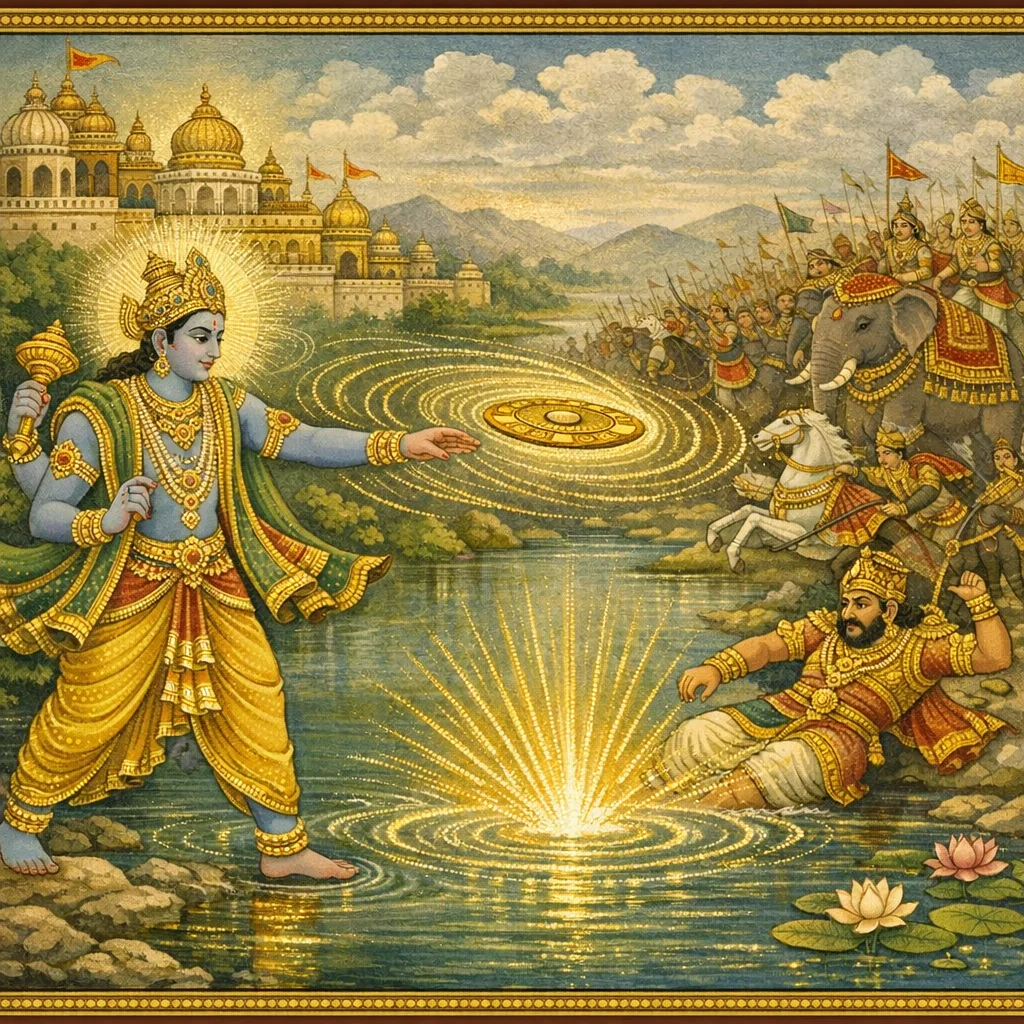
Adhyaya 109
चक्रतीर्थमाहात्म्य (Cakratīrtha Māhātmya) — The Glory of Cakra Tīrtha at Senāpura
In this adhyāya, spoken by Mārkaṇḍeya, a teaching on pilgrimage is set within a martial and theological origin tale. The listener is directed to Cakratīrtha at Senāpura, praised as an unsurpassed purifier of wrongdoing and a sanctifying holy ford. The narrative recalls Mahāsena’s military consecration as commander (senāpatyābhiṣeka), attended by the devas led by Indra to secure victory over the dānavas. A dānava named Ruru disrupts the rite and a vast battle erupts, described in Purāṇic fashion through weapons and formations. The turning point comes when Viṣṇu unleashes the Sudarśana-cakra: it severs Ruru’s head, removes the obstacle to consecration, then—released—splits the dānava and falls into pure waters, thereby establishing the tīrtha’s name and sacred function. The latter portion prescribes merits: bathing and worship of Acyuta there yields the fruit of a Puṇḍarīka-yajña; bathing and honoring disciplined brāhmaṇas grants “koṭi-fold” results. One who relinquishes the body there in devotion attains Viṣṇuloka, enjoys auspicious bliss, and is later reborn in an eminent lineage. The chapter closes by declaring the tīrtha blessed, pain-destroying, and sin-removing, and signals further teachings to follow.
Adhyaya 110
Cakratīrtha-Nikaṭa Vaiṣṇava-Tīrtha Māhātmya (Glorification of the Vaiṣṇava Tīrtha near Cakratīrtha)
Mārkaṇḍeya outlines a purificatory pilgrimage sequence that culminates at a Vaiṣṇava tīrtha near Cakratīrtha, believed to have been founded in ancient times by Viṣṇu (Janārdana). The site’s power is explained through a mythic-historical cause: after slaying formidable Dānava foes, Viṣṇu established this tīrtha to neutralize lingering fault and the consequences arising from that Dānava-born conflict. The chapter praises the ascetic discipline practiced there—conquest of anger (jitakrodha), rigorous tapas, and the vow of silence (mauna)—as something even divine and anti-divine beings cannot readily imitate. It then gives a concise ritual-ethical rule: bathing (snāna), gifting to worthy recipients (dāna to dvijāti), and properly regulated recitation (japa according to procedure) are said to transform at once, freeing even grave wrongdoing and leading the practitioner to the Vaiṣṇava state (vaiṣṇava pada), with a phalaśruti-like assurance of purification.
Adhyaya 111
स्कन्दतीर्थ-सम्भवः (Origin and Merits of Skanda-Tīrtha on the Narmadā)
The chapter unfolds as a dialogue: Yudhiṣṭhira asks Mārkaṇḍeya to recount Skanda’s life-context and to teach the proper observance and merit of a sacred tīrtha on the Narmadā. Mārkaṇḍeya explains that the gods, bereft of a commander, petition Śiva, and he narrates the divine chain of events behind Skanda’s manifestation—Śiva’s intention toward Umā, the gods’ intervention through Agni, Umā’s responsive curse affecting the gods’ progeny, and the transfer of celestial tejas. Agni cannot bear the tejas and places it in Gaṅgā; Gaṅgā, in turn, deposits it in a reed-thicket (śara-stamba). The Kṛttikās nurse the child, who appears as Ṣaṇmukha (six-faced) and is praised by many names—Kārttikeya, Kumāra, Gaṅgāgarbha, Agnija. After extensive tapas and tīrtha-circulation, Skanda performs severe austerities on the southern bank of the Narmadā; Śiva and Umā grant boons, appointing him the eternal senāpati of the gods and bestowing the peacock mount. The site becomes renowned as Skanda-tīrtha, rare and sin-destroying. The chapter concludes with stated fruits: bathing there and worshipping Śiva yields merit equal to sacrifice; ancestral rites with sesame-mixed water and a single proper piṇḍa offering satisfy the pitṛs for twelve years. Deeds done there become imperishable; and one who undertakes death according to śāstra-guided procedure attains Śiva’s abode, followed by auspicious rebirth endowed with Vedic learning, health, longevity, and continuity of lineage.
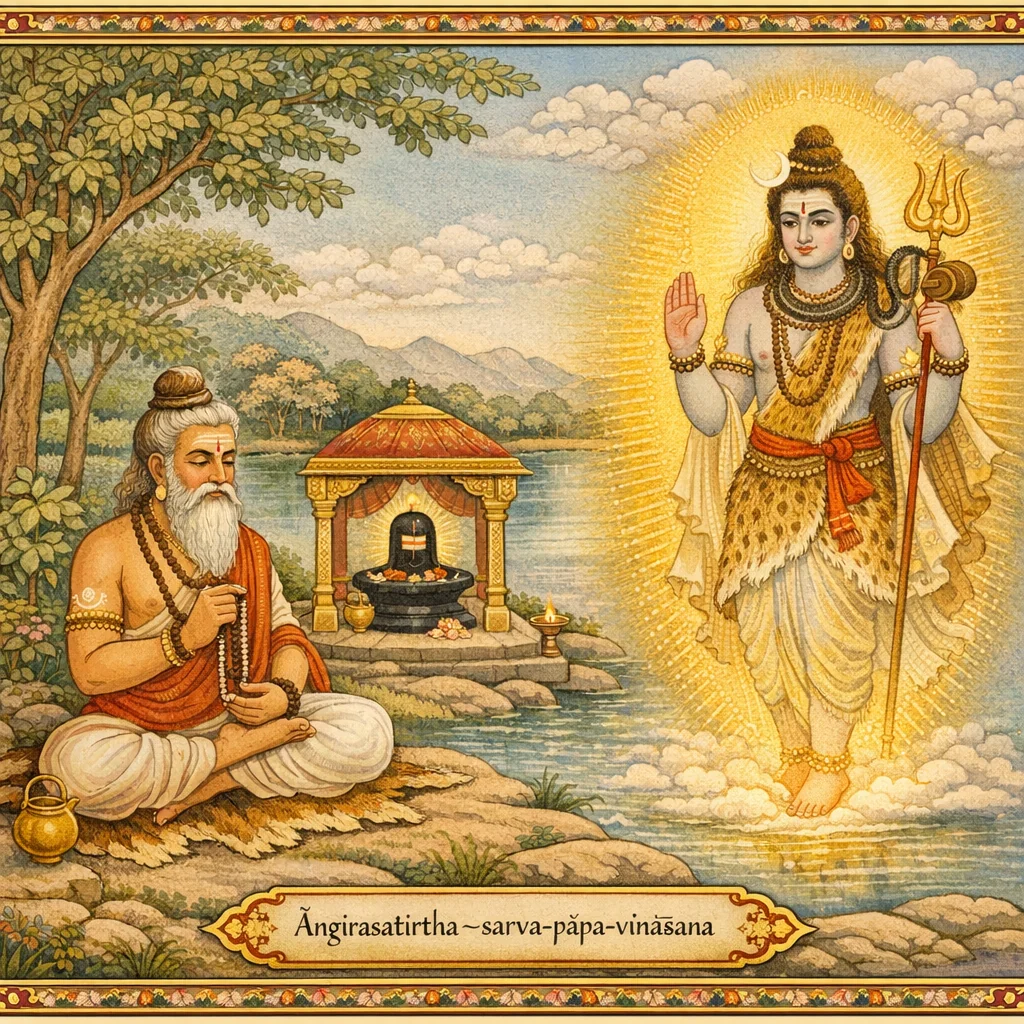
Adhyaya 112
Āṅgirasatīrtha-māhātmya (Glory of the Āṅgirasa Tīrtha)
Mārkaṇḍeya directs the royal interlocutor to Āṅgirasatīrtha on the northern bank of the Narmadā, praising it as a universal purifier that destroys all sins (sarva-pāpa-vināśana). An origin-legend follows: the Brāhmaṇa-sage Aṅgiras, learned in the Veda, undertakes long austerities at the dawn of an age to obtain a son. His observance is described in devotional terms—triṣavaṇa bathing, japa to the eternal deity, and worship of Mahādeva supported by ascetic vows such as kṛcchra and cāndrāyaṇa. After twelve years Śiva is pleased and grants a boon. Aṅgiras asks for an ideal son endowed with Vedic learning, disciplined conduct, and wide śāstric mastery, honored by all like a minister of the gods. Śiva grants this, and Bṛhaspati is born; in gratitude Aṅgiras establishes Śaṅkara at that very spot. The phalaśruti concludes that bathing at the tīrtha and worshiping Śiva removes sins, grants progeny and wealth to the needy, fulfills desired aims, and leads the devotee to Rudra’s realm.
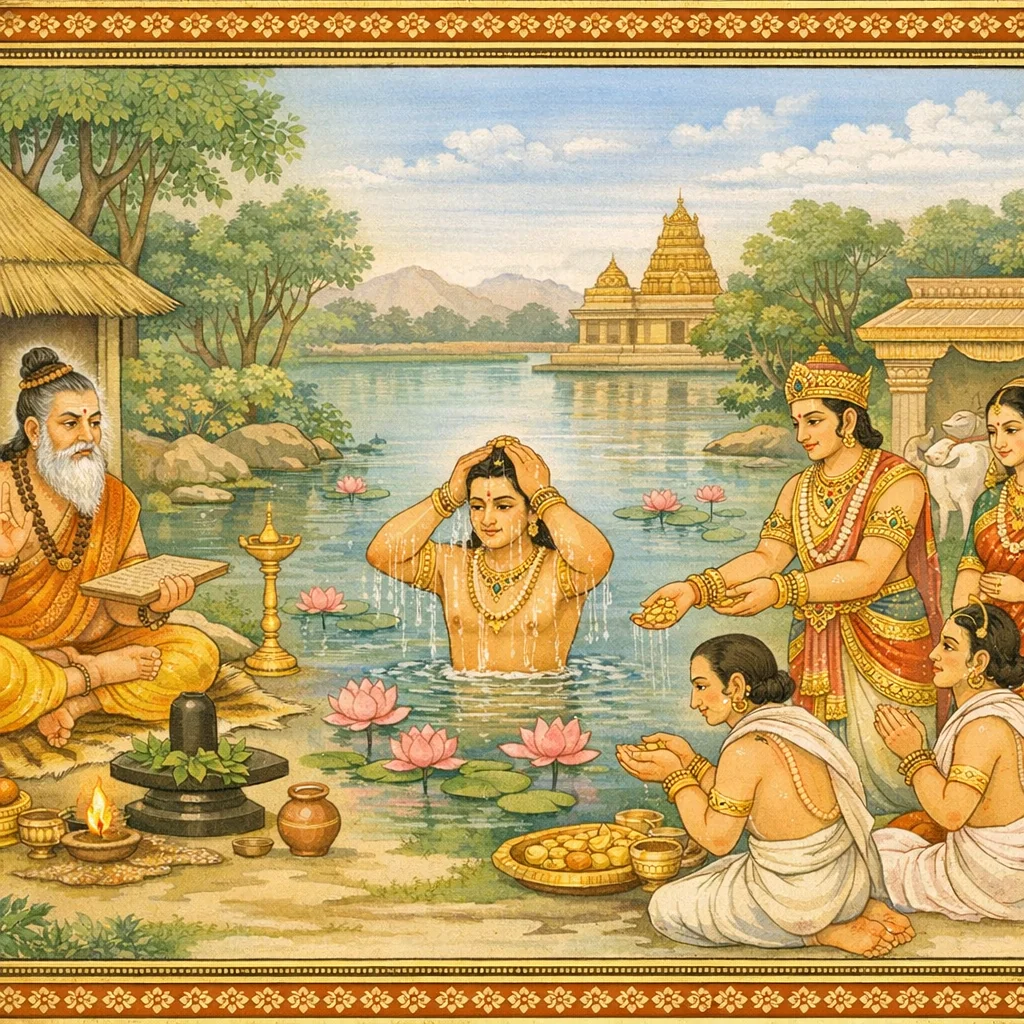
Adhyaya 113
Koṭitīrtha–Ṛṣikoṭi Māhātmya (Merit of Koṭitīrtha and Ṛṣikoṭi)
Spoken by Mārkaṇḍeya, this adhyāya guides a royal listener in itinerary-like fashion to Koṭitīrtha, praised as an unsurpassed sacred ford. The sanctity and authority of the place are affirmed by recalling the ṛṣis who attained supreme siddhi there, hence its fame as Ṛṣikoṭi. It then sets out three place-bound means of merit: (1) snāna at the tīrtha together with feeding Brahmins, where feeding even one Brahmin is extolled as equal to feeding a “koṭi” (ten million), signifying vast multiplication of merit; (2) snāna followed by honoring the pitṛ-devatās and forebears, bringing śrāddha-oriented duty into the pilgrimage; and (3) worship of Mahādeva at the site, promising the fruit of a Vājapeya sacrifice, thus equating localized devotion with the merit of exalted Vedic ritual. The chapter functions as a compact charter for Koṭitīrtha: place → prescribed acts → phalaśruti.
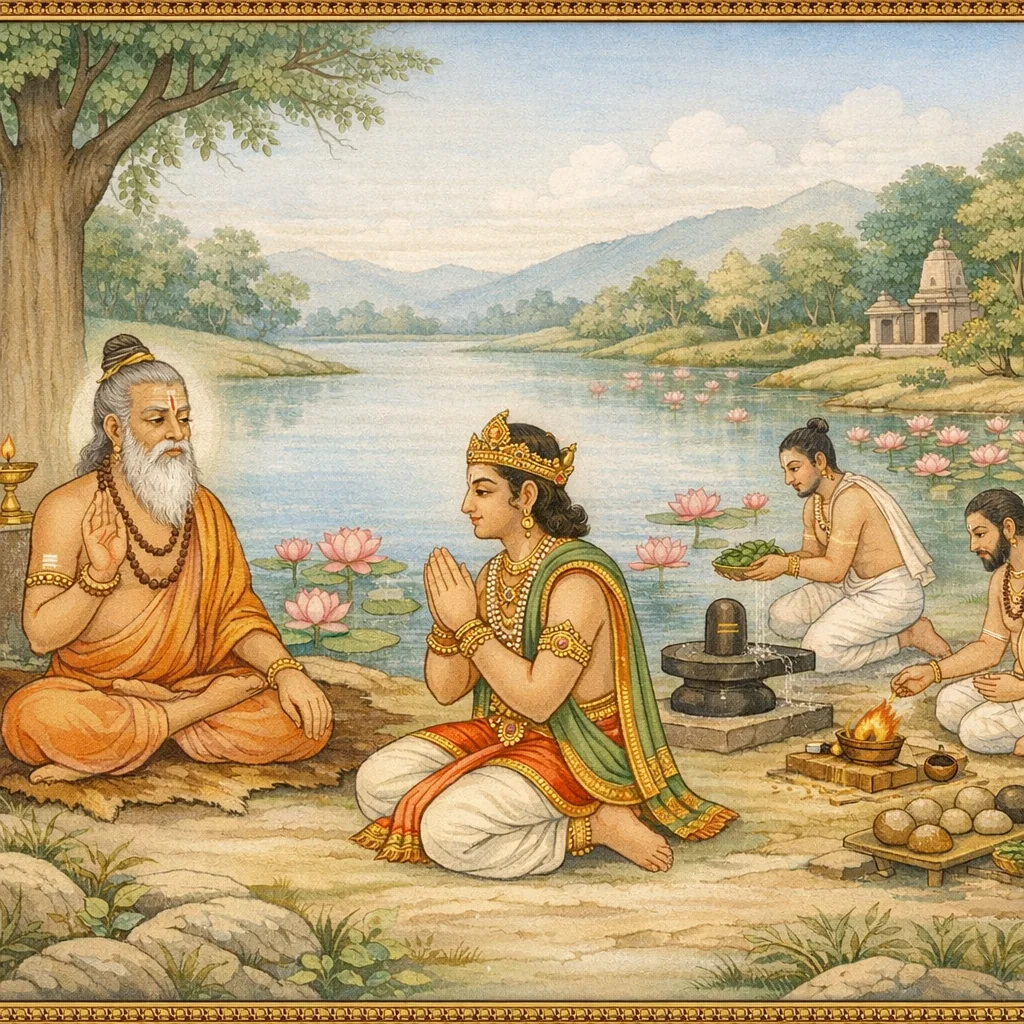
Adhyaya 114
अयोनिजतीर्थ-माहात्म्य (Ayonija Tīrtha: Ritual Procedure and Salvific Claim)
Chapter 114 presents Mārkaṇḍeya’s concise itinerary-style instruction to a royal addressee, directing him to a highly auspicious tīrtha named Ayonija. The discourse establishes the site’s defining attributes—exceptional beauty, great merit, and comprehensive removal of pāpa—then specifies a minimal ritual sequence: bathe at Ayonija, worship Parameśvara, and perform reverential rites for both ancestors (pitṛ) and deities (deva). The chapter culminates in a strong phala-claim: one who relinquishes life there according to proper procedure (vidhinā prāṇatyāga) is said to avoid the 'yoni-dvāra' (the gateway of rebirth), indicating a liberation-oriented assurance. The thematic lesson is the purāṇic linkage of place-based observance with ethical-ritual correctness, where tīrtha practice is framed as a disciplined pathway toward release from karmic bondage.
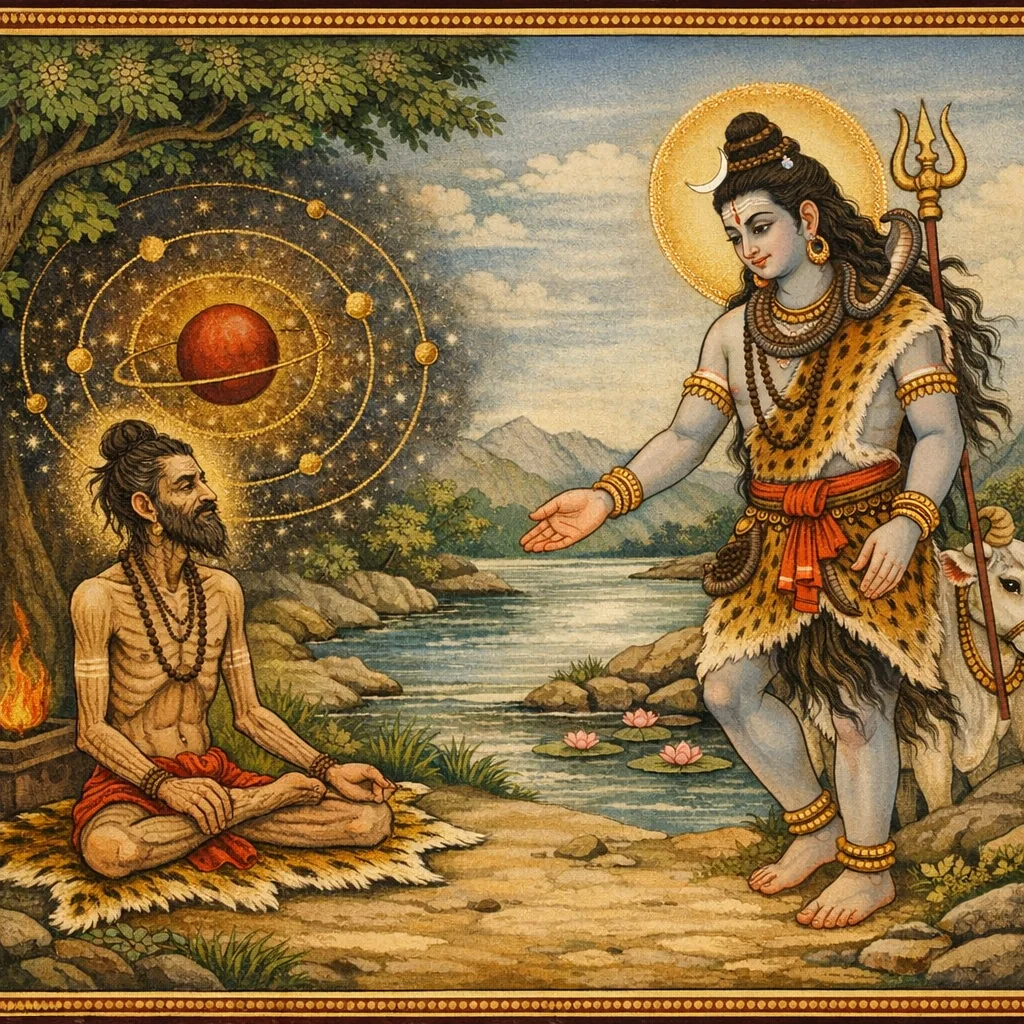
Adhyaya 115
अङ्गारकतीर्थमाहात्म्य (Aṅgāraka Tīrtha Māhātmya) — The Glory of the Aṅgāraka Tīrtha on the Narmadā
Mārkaṇḍeya instructs a king and points him to the supreme Aṅgāraka Tīrtha on the bank of the Narmadā, famed among people for granting beauty and form (rūpa). The chapter tells how Aṅgāraka—“earth-born,” associated with the graha Maṅgala (Mars)—performed prolonged austerities across immense spans of time. Pleased, Mahādeva (Śiva) appears directly and offers a boon, declaring it rare even among the gods. Aṅgāraka asks for an enduring, imperishable status: to move perpetually among the planets, and for the boon to last as long as mountains, sun and moon, rivers and oceans endure. Śiva grants it and departs, praised by gods and asuras. Aṅgāraka then installs Śaṅkara at that very site and afterward takes his place in the planetary order. The prescriptive teaching says that one who bathes at this tīrtha and worships Parameśvara—making offerings and fire-rites (homa) with anger conquered—attains the fruit of an Aśvamedha sacrifice. Further, on the fourth lunar day connected with Aṅgāraka, bathing and worshipping the graha according to rule yields auspicious results, spoken of as beauty and lasting benefit. Death at that place, whether intentional or not, is described as leading to companionship with Rudra and rejoicing in his presence.
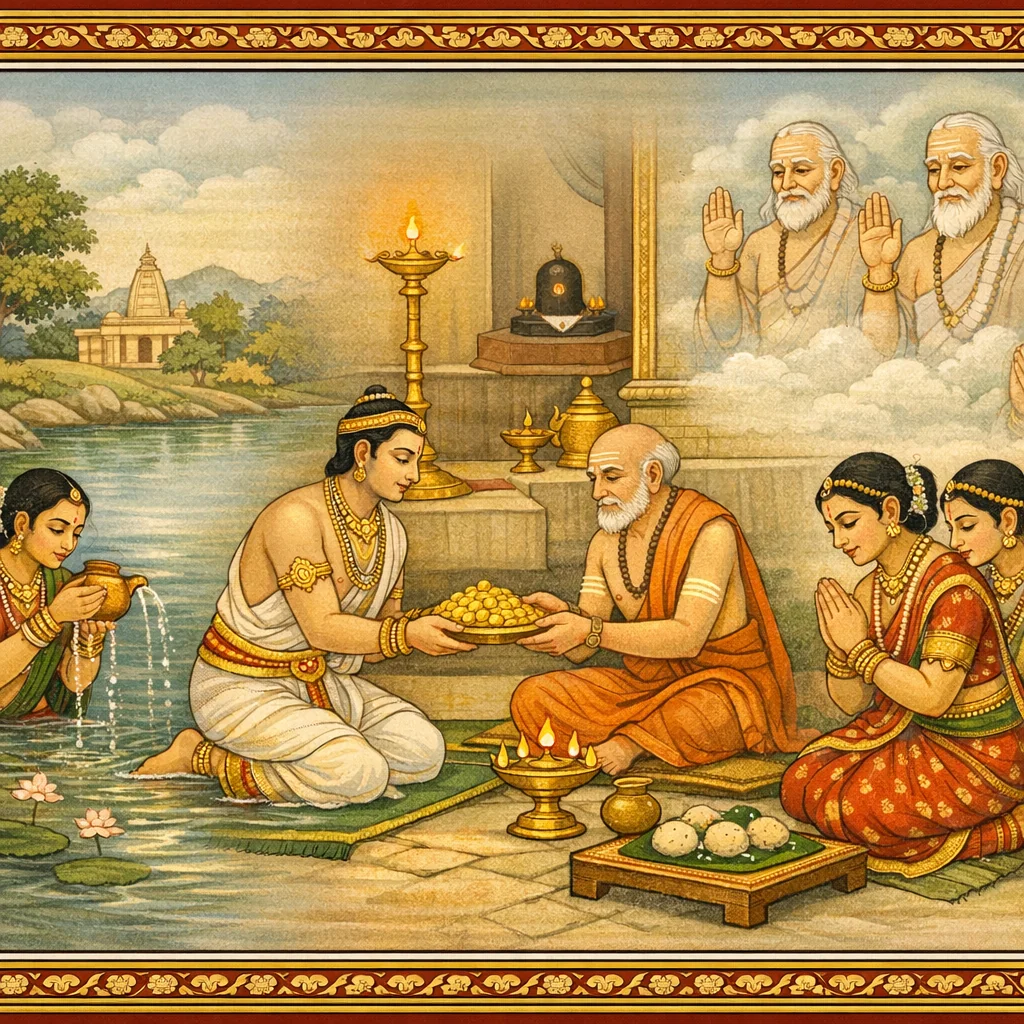
Adhyaya 116
Pāṇḍu-tīrtha Māhātmya (Glory of Pāṇḍu Tīrtha)
In this chapter, the sage Mārkaṇḍeya addresses a royal listener and gives a concise tīrtha-māhātmya of Pāṇḍu-tīrtha. The teaching is framed as clear prescriptions that link specific acts with definite ritual fruits. First, one is enjoined to go to Pāṇḍu-tīrtha, praised as universally purifying; bathing there frees a person from “all impurities and offenses” (sarva-kilbiṣa). Next, an ethical-ritual condition is added: after bathing, the purified devotee should offer a gift of gold (kāñcana-dāna), with a strong assurance that even grievous sins, including those typified by bhrūṇa-hatyā, are destroyed. Finally, the chapter highlights ancestral benefit: by offering piṇḍa and water (piṇḍodaka-pradāna), one gains fruit equal to the Vājapeya sacrifice, and the pitṛs and pitāmahas are said to rejoice. Overall, it serves as an instructional unit that unites pilgrimage, charity, and rites for the ancestors into a single salvific path centered on the named sacred site.
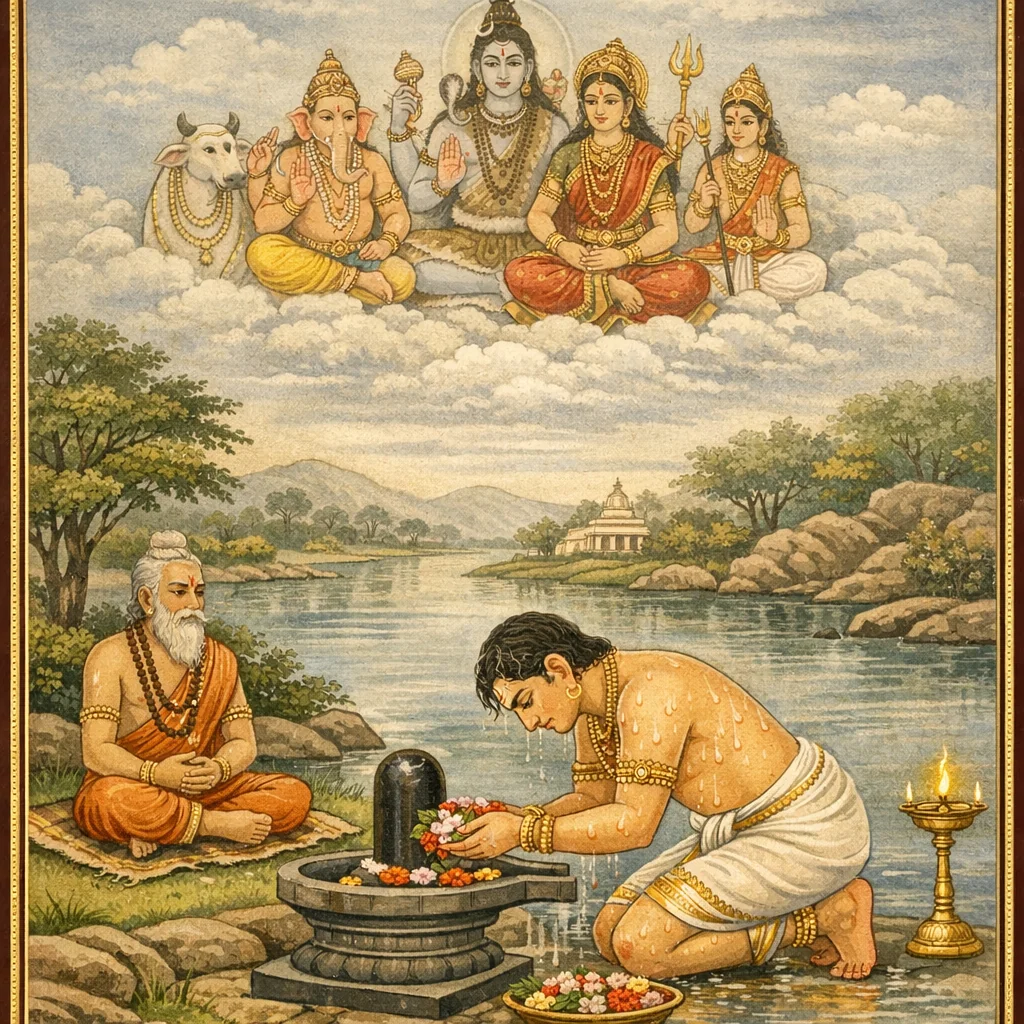
Adhyaya 117
त्रिलोचनतीर्थमाहात्म्य (Glory of the Trilocana Tīrtha)
In this adhyāya, Śrī Mārkaṇḍeya addresses a king (rājendra) and points him toward a highly meritorious pilgrimage place called Trilocana Tīrtha. It is praised as a puṇya tīrtha, a sacred locus where the Lord (Deveśa), revered by all the worlds, is present. The prescribed observance is simple: bathe at the tīrtha and then worship Śaṅkara (Śiva) with bhakti. The promised fruit is stated with certainty—one who dies after such worship attains Rudra’s abode, without doubt. The chapter further frames this reward in Purāṇic cosmology: after the end of a cosmic cycle (kalpa-kṣaya), the beneficiary is said to return, remain without separation in divine proximity, and be honored for a hundred years.
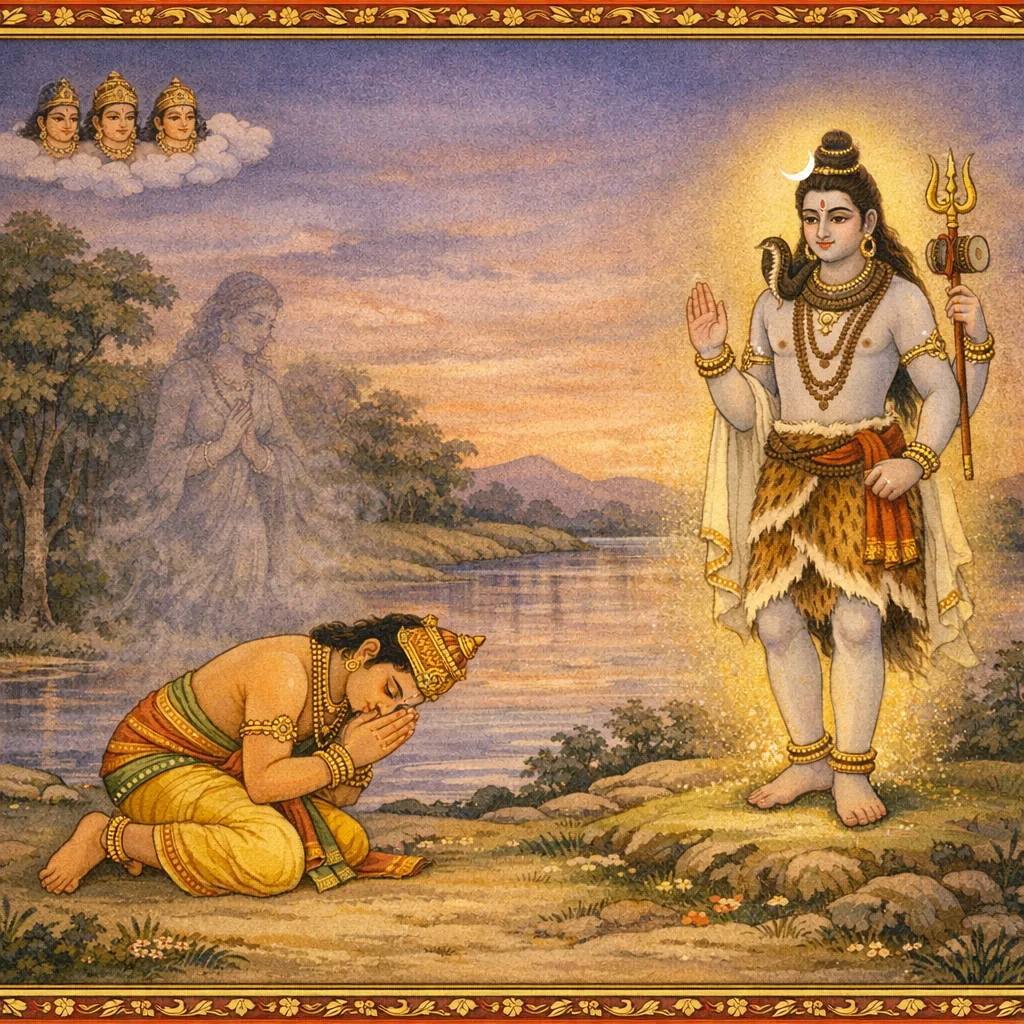
Adhyaya 118
इन्द्रतीर्थमाहात्म्य (Indratīrtha Māhātmya) — The Glory of Indra’s Ford on the Narmadā
This adhyāya unfolds as a theological dialogue: Yudhiṣṭhira asks how Indratīrtha arose on the southern bank of the Narmadā, and the sage Mārkaṇḍeya answers by recounting an ancient itihāsa. After Indra slays Vṛtra, the torment of brahmahatyā—a most grievous sin—pursues him relentlessly through sacred waters and pilgrimage places, revealing that ordinary tīrtha-circulation cannot easily cleanse a profound moral breach. Indra performs severe tapas—fasting, austerities, and long discipline—yet relief comes only when the gods assemble and Brahmā apportions the sin into four shares, distributing them among classes of beings and social functions (including water, earth, women, and occupational domains), offering an etiological account of certain ritual and social restrictions. At the Narmadā site Indra worships Mahādeva; Śiva, pleased, grants a boon. Indra asks for perpetual divine presence there, establishing Indratīrtha as a place where bathing, tarpaṇa, and worship of Parameśvara bestow purification and great sacrificial merit. The chapter ends with an explicit phalaśruti: even grave sinners are freed by bathing and worship at Indratīrtha, and hearing this māhātmya itself is declared purificatory.
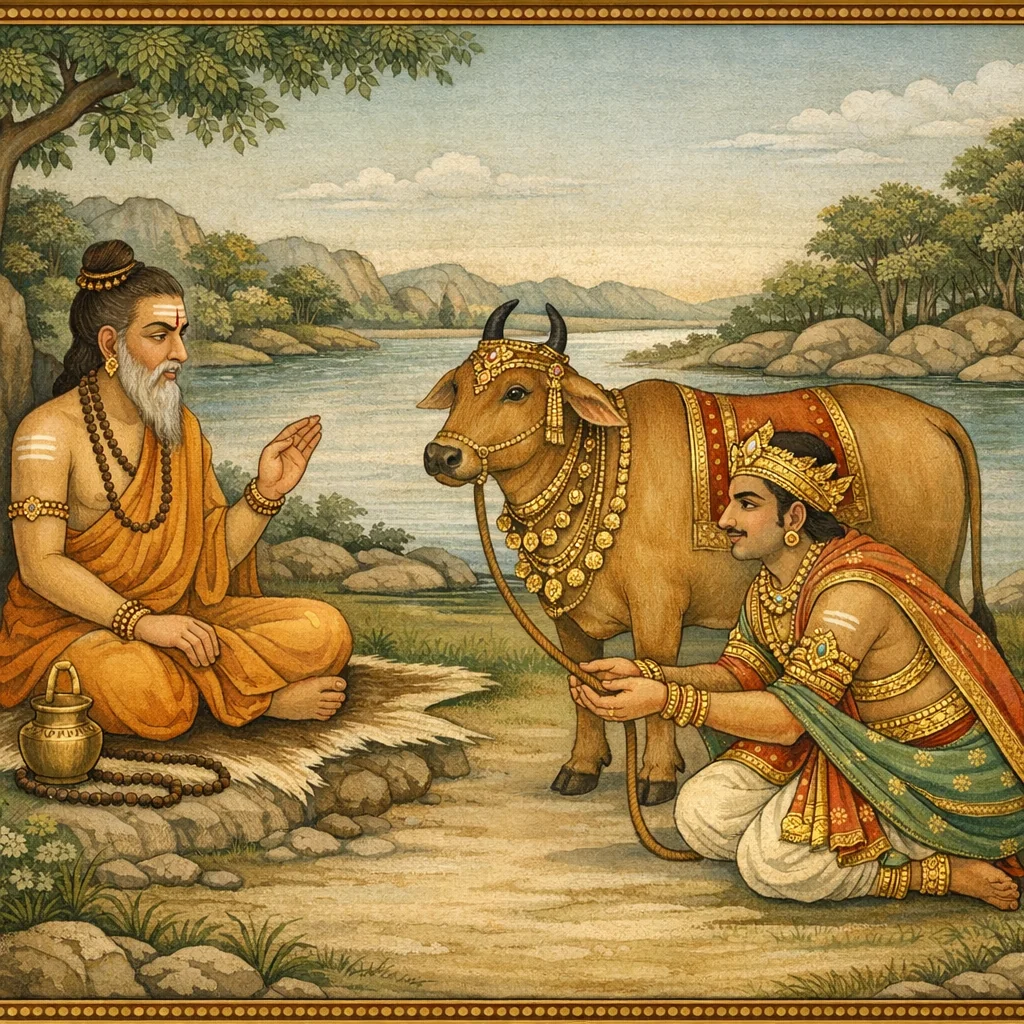
Adhyaya 119
कल्होडीतीर्थमाहात्म्यं तथा कपिलादानप्रशंसा (Kahlodī Tīrtha Māhātmya and the Eulogy of Kapilā-Dāna)
Mārkaṇḍeya instructs a ruler to go to the excellent Kahlodī-tīrtha on the northern bank of the Revā (Narmadā), praised as a universally sin-destroying holy ford. It is said to have been established by ancient sages for the welfare of all beings and exalted by ascetic power in connection with the Narmadā’s mighty waters. The discourse then highlights Kapilā-tīrtha and enjoins Kapilā-dāna: the gift of a kapilā cow, especially a recently calved, auspicious cow, offered with fasting and disciplined self-control—above all, conquest of anger. A hierarchy of gifts is presented, declaring kapilā-dāna superior to donations of land, wealth, grains, elephants, horses, and gold. In the phalaśruti, donation at this tīrtha is said to destroy sins of speech, mind, and body accumulated over seven births. The donor attains Viṣṇu’s realm, praised by apsarases, enjoys a heavenly duration proportionate to the cow’s hairs, and later returns to human birth in a prosperous lineage endowed with Vedic learning, śāstra-competence, health, and long life. The chapter closes by reaffirming Kahlodī-tīrtha’s unsurpassed efficacy for release from sins.
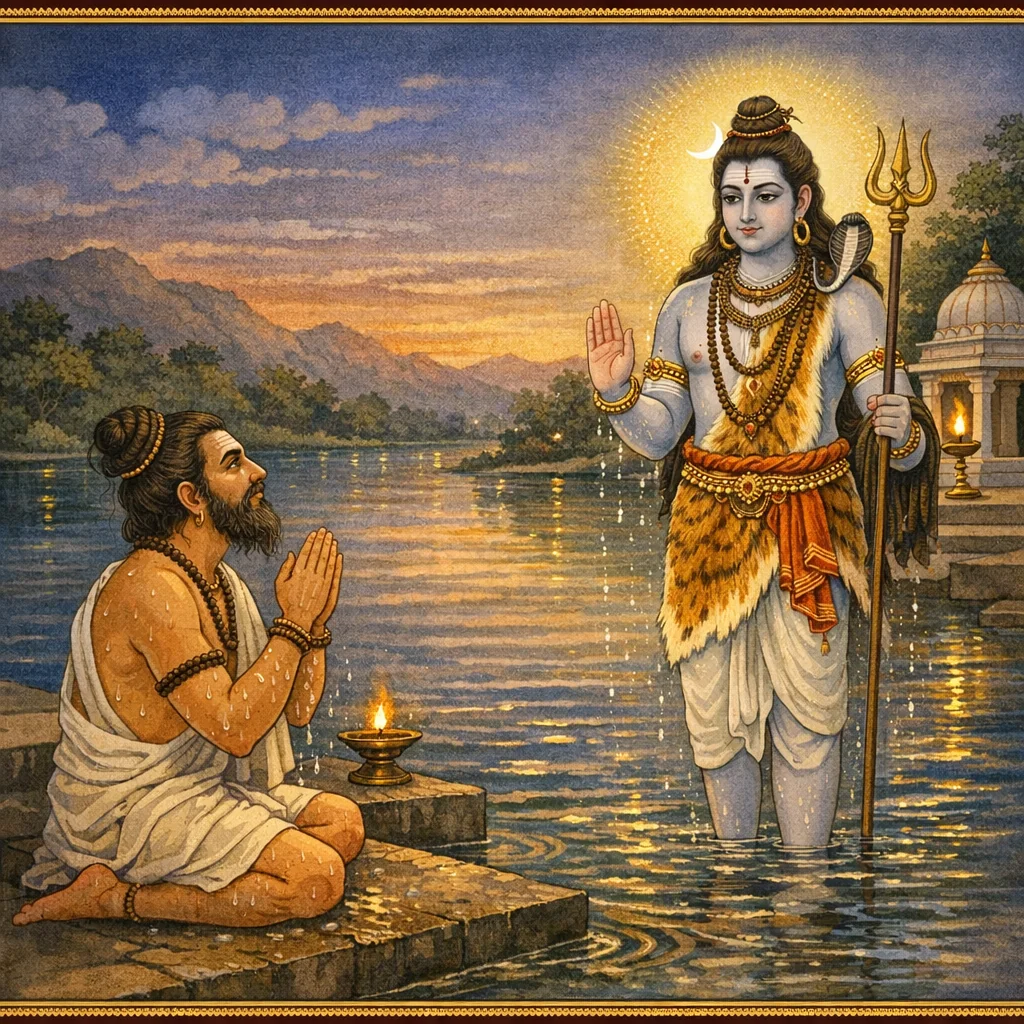
Adhyaya 120
कम्बुतीर्थ-स्थापनम् (Establishment and Merit of Kambu Tīrtha)
This chapter explains the origin and merit of Kambu Tīrtha, centered on Kambukeśvara/Kambu. Śrī Mārkaṇḍeya recounts the lineage from Hiraṇyakaśipu to Prahlāda, then through Virocana, Bali, Bāṇa, Śambara, and finally Kambu—an asura who awakens to an existential fear before Viṣṇu’s cosmic might and realizes that enmity toward Hari cannot yield lasting welfare. Kambu undertakes austerities on the waters of the Narmadā: mauna (sacred silence), disciplined bathing, austere dress and regimen, and prolonged worship of Mahādeva. Śiva, pleased, grants a boon yet states a theological limit: no being, even Śiva, can nullify Viṣṇu’s supremacy in cosmic conflict; hostility to Hari does not bring enduring good. After Śiva departs, Kambu establishes at that spot a pacific, disease-free form of Śiva, and the place becomes known as Kambu Tīrtha, praised as a destroyer of great faults. The phalaśruti concludes that bathing and worship—especially solar worship with Ṛg/Yajus/Sāman praises—bear fruit comparable to Vedic rites; ancestral offerings and worship of Īśāna yield Agniṣṭoma-like merit; and death there is said to lead to Rudra-loka.
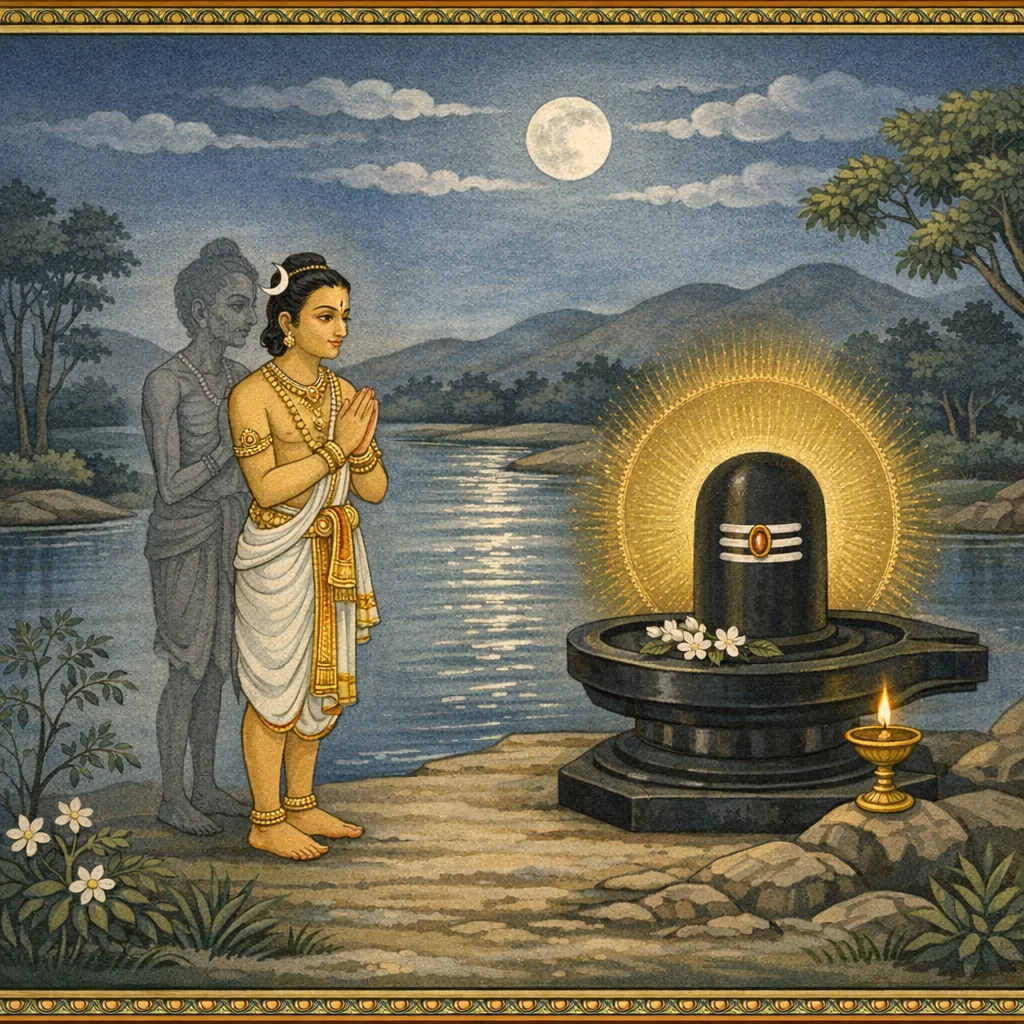
Adhyaya 121
Candrahāsa–Somatīrtha Māhātmya (Glory of Candrahāsa and Somatīrtha)
This chapter unfolds as Yudhiṣṭhira’s inquiry and Mārkaṇḍeya’s reply, offering a theological and ethical account of Soma (the Moon deity), the causes of affliction, and the means of relief. Candrahāsa is indicated as the next sacred destination, and Soma’s attainment of “supreme accomplishment” (parā-siddhi) is recalled. Mārkaṇḍeya explains Soma’s suffering as arising from Dakṣa’s curse, framed as a moral warning for householders: neglect of conjugal duty brings karmic consequence. Soma then wanders among holy tīrthas and finally reaches the Narmadā/Revā, praised as a remover of sins. Through twelve years of disciplined observances—fasting, gifts, vows, and restraints—Soma is freed from impurity. The narrative culminates in the bathing/abhiṣeka of Mahādeva and the establishment and worship of Śiva, yielding imperishable (akṣaya) religious fruit and an exalted destination. The chapter further sets out tīrtha procedures and auspicious timings: bathing at Somatīrtha and Candrahāsa, especially during lunar and solar eclipses and at calendrical junctions such as saṅkrānti, vyatīpāta, ayana, and viṣuva, grants purification, enduring merit, and a radiance likened to Soma. It closes by contrasting informed pilgrims with those unaware of Candrahāsa on the Revā, adding that renunciation undertaken there leads to an irreversible auspicious path associated with Soma’s realm.
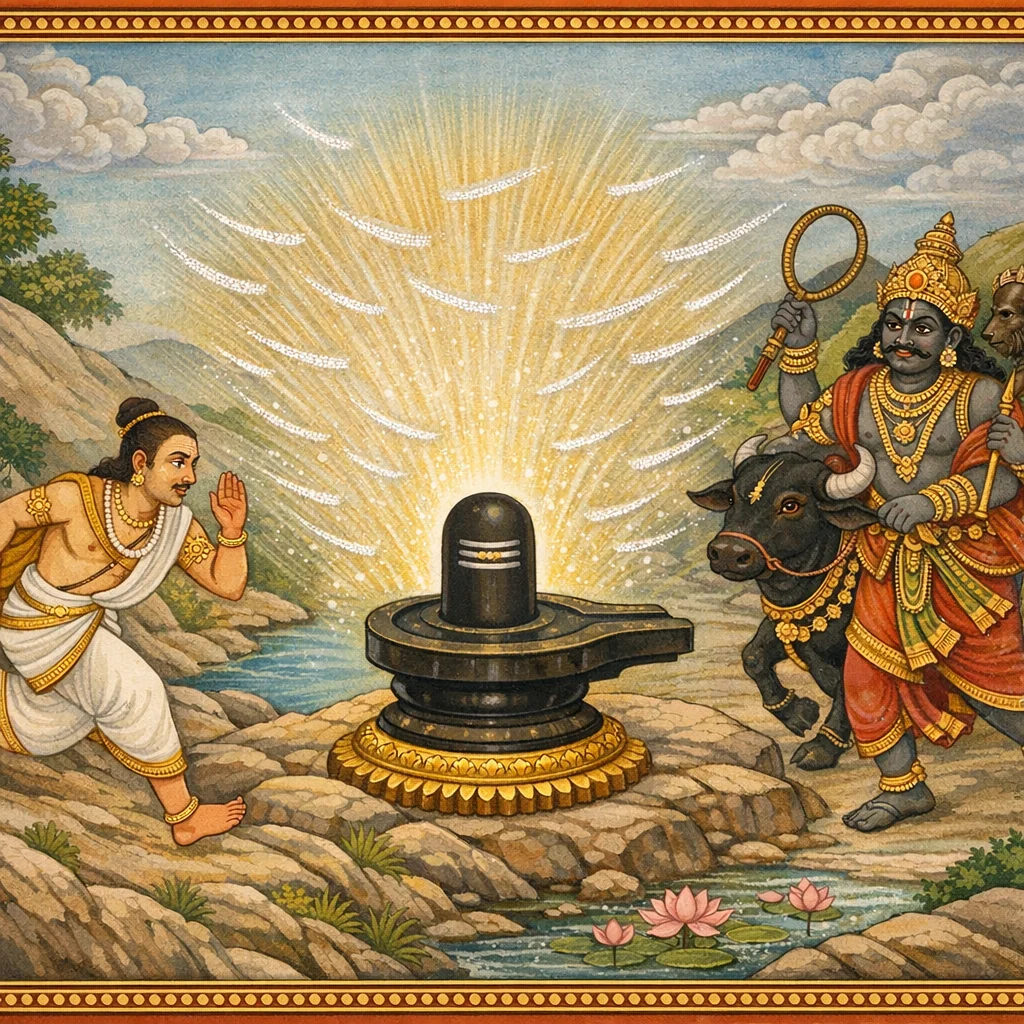
Adhyaya 122
Ko-hanasva Tīrtha Māhātmya and Varṇa–Āśrama Ethical Discourse (कोहनस्वतीर्थमाहात्म्य तथा वर्णाश्रमधर्मोपदेशः)
This chapter first proclaims the glory of the tīrtha called Ko-hanasva, praised as a place that removes sin and, in its saving promise, destroys the fear and power of death. Mārkaṇḍeya points it out, and Yudhiṣṭhira then asks about the karmic duties and origins of the four varṇas; the reply is cast in cosmogonic terms, with Brahmā as the primal cause and the familiar body-metaphor: brāhmaṇa from the mouth, kṣatriya from the arms, vaiśya from the thighs, and śūdra from the feet. The chapter lays down ethical patterns of life—householder duties, study and teaching, tending the ritual fires, the pañca-yajñas, and later-life ideals of withdrawal and renunciation—while distinguishing the kṣatriya’s obligations of rule and protection and the vaiśya’s agrarian and protective responsibilities. It also voices a restrictive, normative claim regarding śūdra access to mantra and saṃskāra. Next comes an exemplum of mortality and divine refuge: a learned brāhmaṇa hears the ominous command “hanasva,” encounters Yama with his attendants, and flees while reciting Rudra’s praise (the Śatarudrīya). He collapses beside a liṅga, where Śiva intervenes with a protective utterance and scatters Yama’s forces. The place becomes famed as Ko-hanasva, and the chapter ends with phala: bathing and worship there yield Agniṣṭoma-like merit; dying there prevents the vision of Yama; and specific afterlife results are stated for death by fire or by water, followed by a prosperous return.
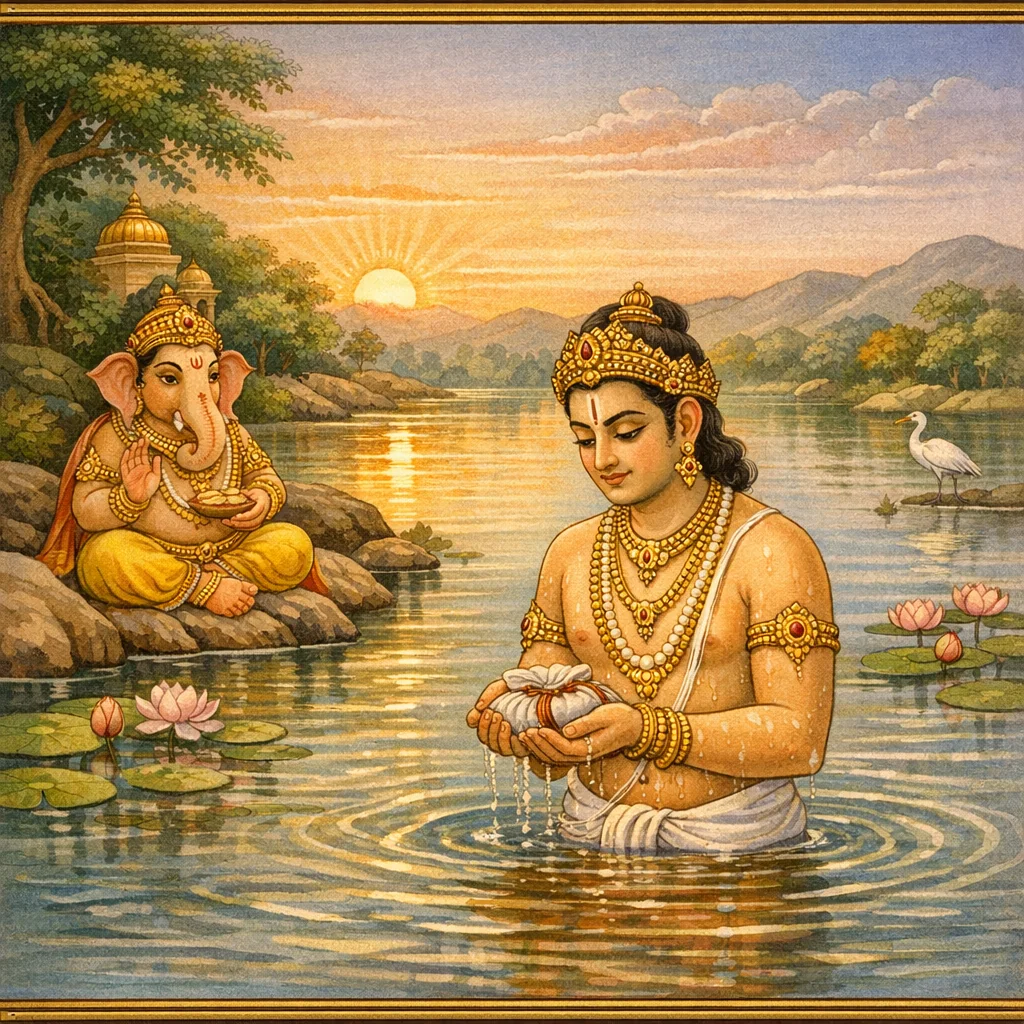
Adhyaya 123
कर्मदीतीर्थे विघ्नेशपूजा-फलप्रशंसा | Karmadī Tīrtha and the Merit of Vighneśa Observance
This adhyāya gives a brief tīrtha-māhātmya spoken by Mārkaṇḍeya to a royal listener. He directs the hearer to go to the eminent Karmadī-tīrtha, where Vighneśa (Gaṇanātha), mighty in strength (mahābala), is present. Bathing at this tīrtha—optionally joined with upavāsa on caturthī—is said to neutralize obstacles (vighna) across seven births. Dāna performed there yields akṣaya-phala, imperishable merit, affirmed as a doctrinal assurance beyond doubt.
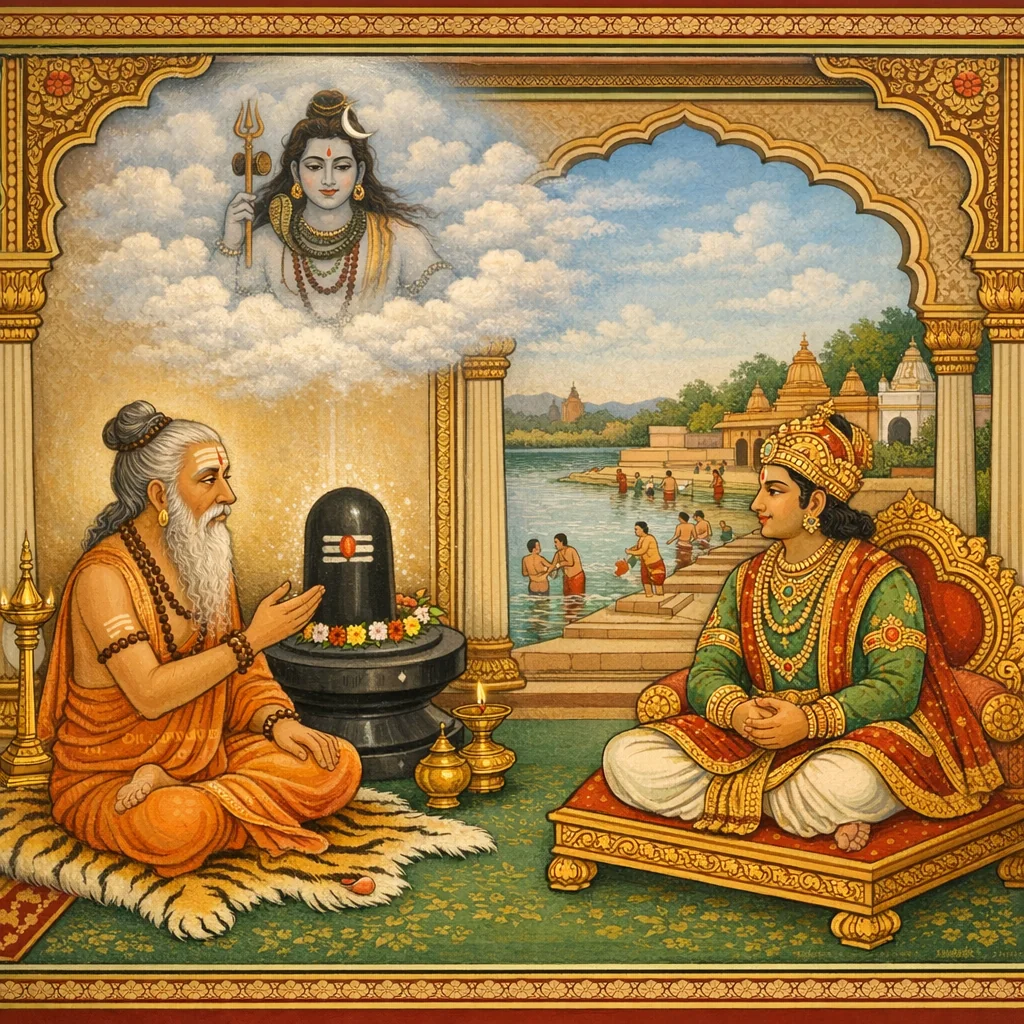
Adhyaya 124
नर्मदेश्वरतीर्थमाहात्म्य (The Māhātmya of Narmadeśvara Tīrtha)
Chapter 124 presents a concise tīrtha-instruction within a dialogue framework. Śrī Mārkaṇḍeya addresses a king (mahīpāla), directing him to proceed to Narmadeśvara, described as an eminent sacred site. The chapter’s core claim is soteriological and expiatory: a person who bathes at that tīrtha is released from all kilmbiṣas (moral/ritual demerits). It then adds a technical note on final outcomes, stating that whether one meets death by entering fire, by water, or by an “unanāśaka” (non-destructive/ineffective) death, the person’s trajectory is described as “anivartikā gati” (an irreversible course), a point attributed to Śaṅkara’s prior instruction. The passage thus combines (1) pilgrimage directive, (2) purification promise, and (3) an authority chain (Śiva → narrator) to stabilize the site’s salvific prestige.
Adhyaya 125
रवीतीर्थ-माहात्म्य एवं आदित्य-तपःकथा (Ravītīrtha Māhātmya and the Discourse on Āditya’s Tapas)
This chapter unfolds as a dialogue: Yudhiṣṭhira asks how the Sun—plainly visible in the world and revered by all the gods—can be called a tapasvin (ascetic), and how he attained the rank and names Āditya/Bhāskara. Mārkaṇḍeya replies by turning to cosmological narration: from an initial darkness a divine, incandescent principle manifests, is described as a personified presence, and the ensuing functions of the cosmos are set forth. The account then returns to the ritual landscape of Ravītīrtha on the bank of the Narmadā, portraying it as a place where solar worship is carried out through snāna (purificatory bathing), pūjā, mantra-japa, and pradakṣiṇā. A sustained emphasis is placed on mantra as the condition that makes rites effective, with analogies showing that action without mantra is fruitless. The chapter closes with calendrical and procedural details—saṅkrānti, vyatīpāta, ayana, viṣuva, eclipses, and Māgha saptamī—along with a litany of the Sun’s twelve names. The phalaśruti proclaims purification, well-being, health, and auspicious outcomes in social life.
Adhyaya 126
अयोनिज-महादेव-तीर्थमाहात्म्य (Glory of the Ayoni-ja Mahādeva Tīrtha)
Chapter 126 records Mārkaṇḍeya’s instruction on the supreme tīrtha called “Ayoni-ja” (“not born from a womb”), praised as a healing and purifying refuge for those afflicted by yoni-saṅkaṭa—the distress and constraint bound up with embodied birth. The chapter first enjoins pilgrimage to this place and ritual bathing, said to wash away the sense and burden of such yoni-related suffering. It then prescribes pūjā to Īśvara/Mahādeva with a specific refrain beseeching release from saṃbhava (recurrent becoming) and yoni-saṅkaṭa. Offerings of fragrance, flowers, and incense are declared means for the destruction of sin; devoted liṅga-service (liṅga-pūraṇa) yields prolonged nearness to Deva-deva, expressed hyperbolically by the “count of wax-drops” (siktha-saṅkhyā). Abhiṣeka of Mahādeva with scented water, honey, milk, or curd bestows vipulā śrī—abundant prosperity. The bright fortnight and the fourteenth lunar day (caturdaśī) are highlighted as auspicious times for worship with song and instrumental music; pradakṣiṇā is to be performed while continually repeating the petition. The chapter elevates the six-syllabled formula “namaḥ śivāya” above elaborate mantra collections, asserting that its recitation itself embodies study, hearing, and ritual completion. It concludes by honoring service to Śiva-yogins and righteous giving: along with bathing and worship, one should feed disciplined ascetics (dānta, jitendriya) and give alms and water, whose merit is likened to cosmic immensities such as Meru and the ocean.
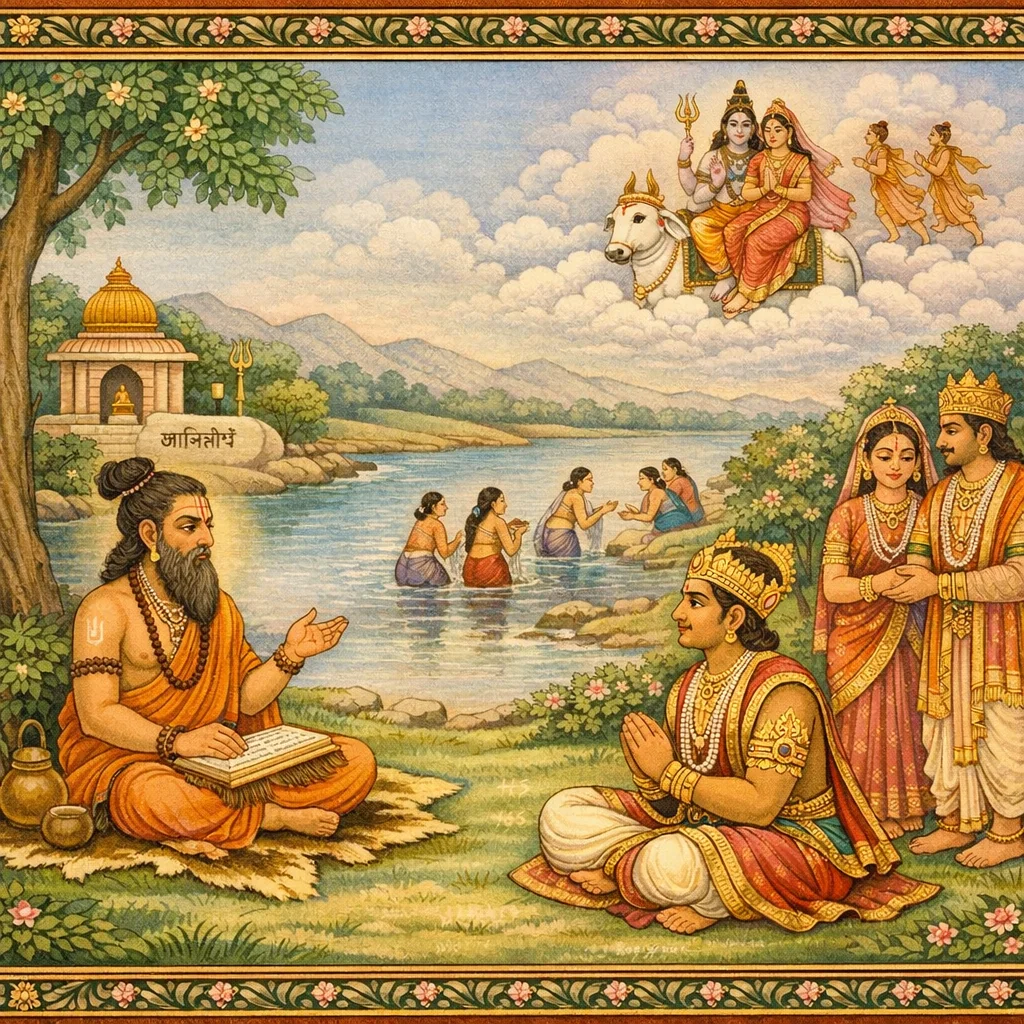
Adhyaya 127
अग्नितीर्थ-माहात्म्य तथा कन्यादान-फलश्रुति (Agni Tīrtha Māhātmya and the Merit of Kanyādāna)
In the Avantī Khaṇḍa of the Revākhaṇḍa, Mārkaṇḍeya instructs a king to proceed to Agnitīrtha, praised as an unsurpassed sacred ford. He first enjoins tīrtha-snāna—ritual bathing there at the beginning of a fortnight (pakṣa-ādau)—declaring that it removes every kind of moral and ritual impurity (kilbiṣa). The teaching then turns to the dharma of giving, centering on kanyādāna: the gifting of a maiden adorned according to one’s means (yathāśaktyā alaṅkṛtām). A phalaśruti compares its merit to the highest Vedic soma-sacrifices, such as Agnīṣṭoma and Atirātra, and proclaims the fruit to be multiplied beyond measure. Finally, the merit is extended through lineage: the donor’s ascent to Śiva-loka is described in proportion to the innumerable continuities of descendants, poetically measured by “hair-count” imagery. Thus the chapter binds social continuity, charitable duty, and soteriological promise within a Śaiva-leaning theological frame.
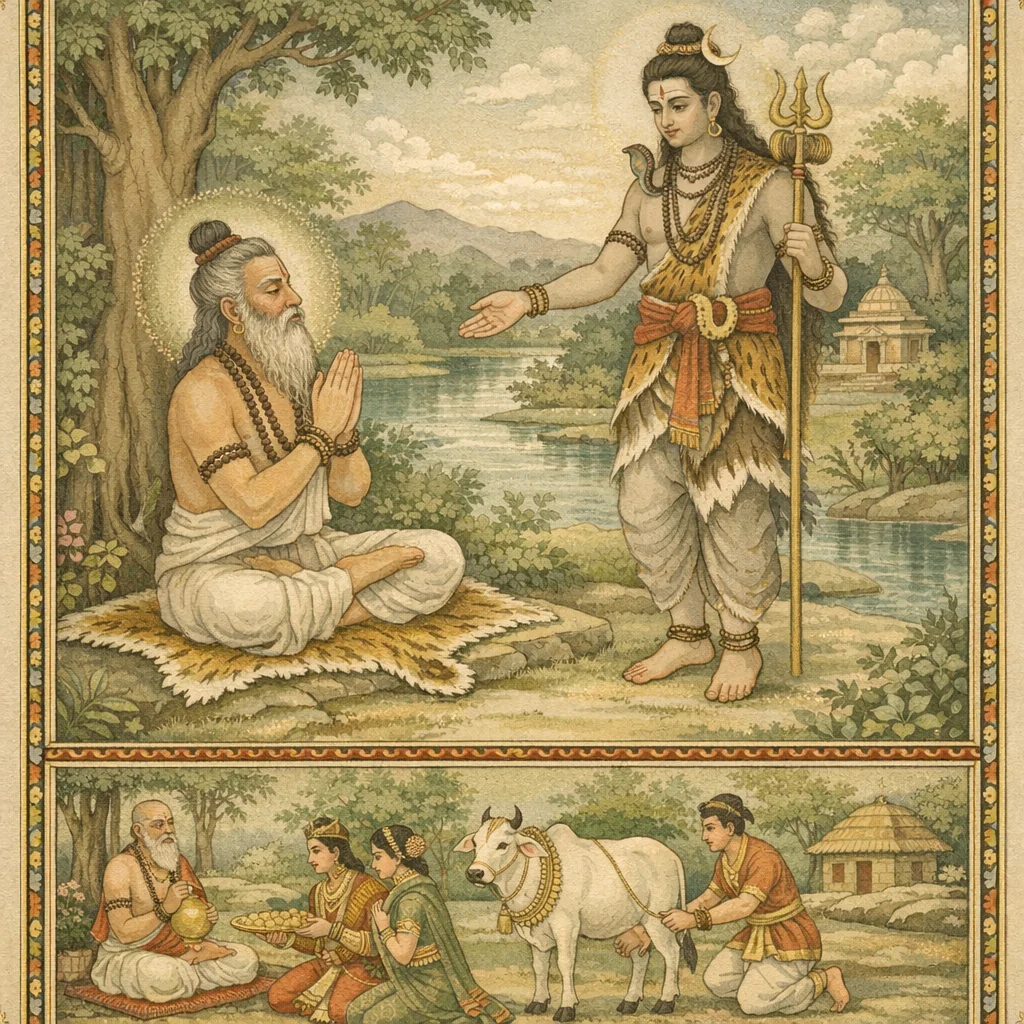
Adhyaya 128
भृकुटेश्वरतीर्थमाहात्म्य (Bhrikuṭeśvara Tīrtha Māhātmya)
This adhyāya is cast as Mārkaṇḍeya’s counsel to a royal listener, urging him to proceed to Bhṛkuṭeśvara, praised as an excellent tīrtha. The sanctity of the place is grounded in the austere life of the sage Bhṛgu—immensely powerful and severe—who undertook long tapas to obtain offspring. A boon is then granted by a deity hailed as “Andhakaghātin” (slayer of Andhaka), marking the tīrtha as under Śaiva divine agency. Specific rites and their fruits are taught: bathing at the tīrtha and worshipping Parameśvara yields eightfold the merit of the Agniṣṭoma sacrifice. One who seeks a child, if he ritually bathes (snāpayet) Bhṛkuṭeśa with ghee and honey, gains the desired son. The chapter further extols dāna: gifting gold to a brāhmaṇa—or alternatively cows and land—is declared equivalent to granting the entire earth with its seas, caves, mountains, forests, and groves. In closing, a social-cosmic logic of reward is affirmed: the donor enjoys heavenly pleasures and later attains high status on earth, as a king or a greatly honored brāhmaṇa, presenting an ethical economy of patronage and devotion tied to the sacred place.
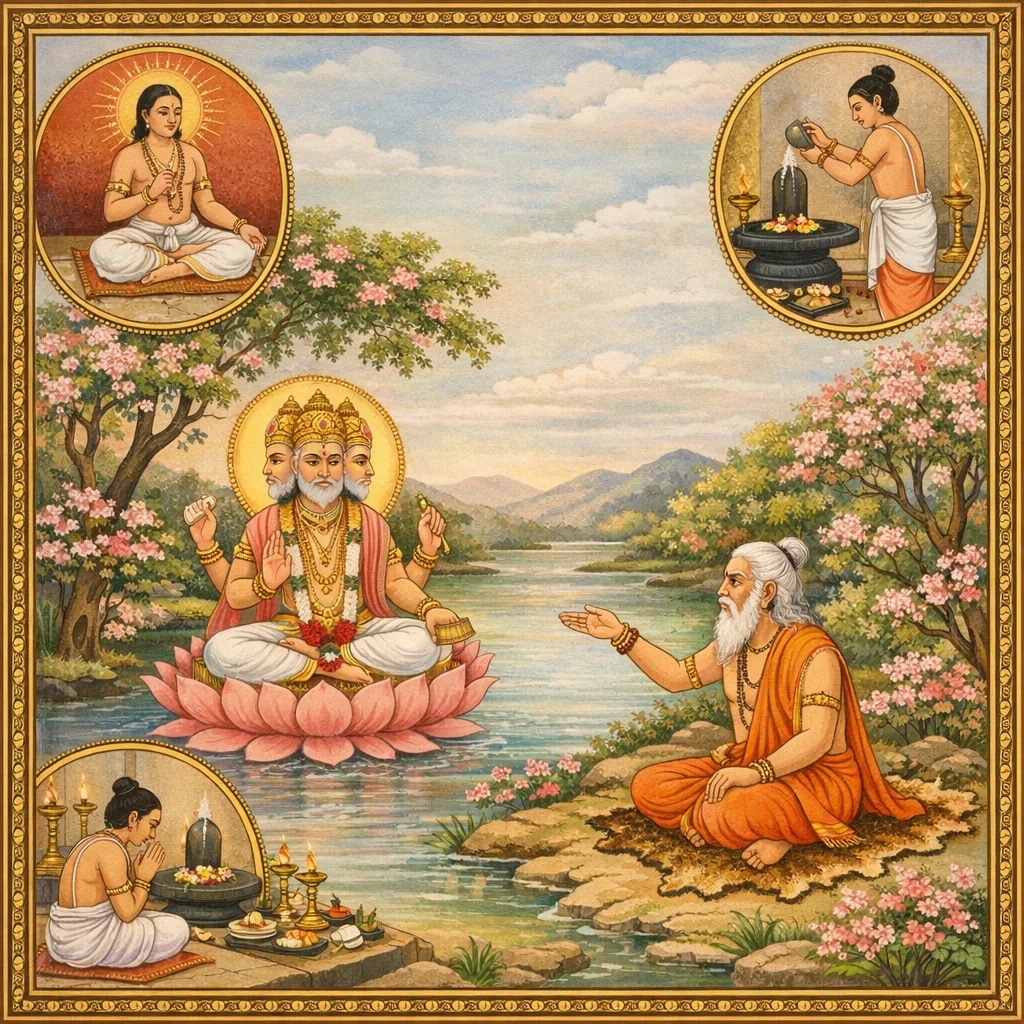
Adhyaya 129
ब्रह्मतीर्थमाहात्म्य (Glory of Brahmatīrtha on the Narmadā)
Chapter 129 is a tīrtha-māhātmya teaching spoken by Śrī Mārkaṇḍeya to a king, directing him to Brahmatīrtha on the bank of the Narmadā. It is praised as an unsurpassed sacred ford, greater than other tīrthas, with Brahmā portrayed as the eminent deity presiding there. Even mere darśana—reverent seeing and visiting—is said to purify. Purification is presented in graded form: wrongs born of speech, of mind, and of action. A normative ritual ethic is then set forth: those who bathe there and follow śruti-smṛti-based injunctions perform proper prāyaścitta and attain heavenly residence, while those who abandon śāstra through desire and greed are censured as straying from true expiation. The chapter lists further ritual fruits: worship of pitṛs and devas after bathing yields Agniṣṭoma-like merit; gifts dedicated to Brahmā are declared imperishable; even brief Gāyatrī-japa is magnified as encompassing the efficacy of Ṛg–Yajus–Sāman. The closing phala extends to death at the tīrtha (a non-returning path to Brahmaloka), merit connected with bodily remains left there, and auspicious rebirth as a Brahma-knower endowed with learning, honor, health, and longevity—culminating in “amṛtatva” (deathlessness) in a theological sense.
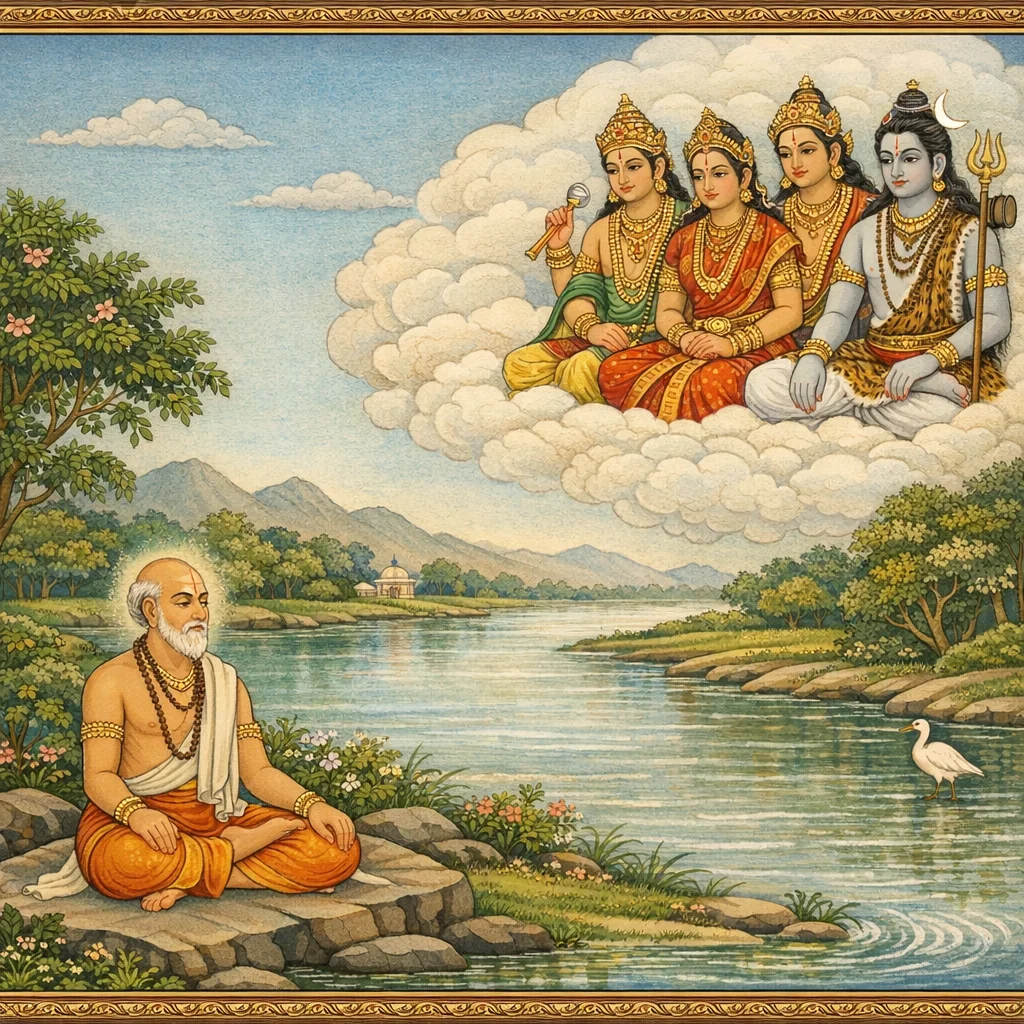
Adhyaya 130
Devatīrtha Māhātmya (Glory of Devatīrtha on the Southern Bank of the Narmadā)
This adhyāya, voiced by the sage Mārkaṇḍeya, identifies an unsurpassed sacred ford named Devatīrtha situated on the southern bank of the Narmadā (Revā). The chapter’s discourse is concise and technical in purāṇic style: (1) it establishes the site’s sacral status through a divine precedent—gods assemble there and Parameśvara is described as being pleased; (2) it prescribes an ethical qualification for the pilgrim—bathing at the tīrtha should be accompanied by freedom from kāma (desire) and krodha (anger); and (3) it provides a clear phalaśruti, asserting that such a bath yields a definite merit equivalent to the fruit of gifting a thousand cows (go-sahasra-phala). The thematic lesson links external rite (snāna at a tīrtha) with internal discipline (passion-restraint), presenting pilgrimage as an integrated ethical-theological practice rather than a purely mechanical ritual act.
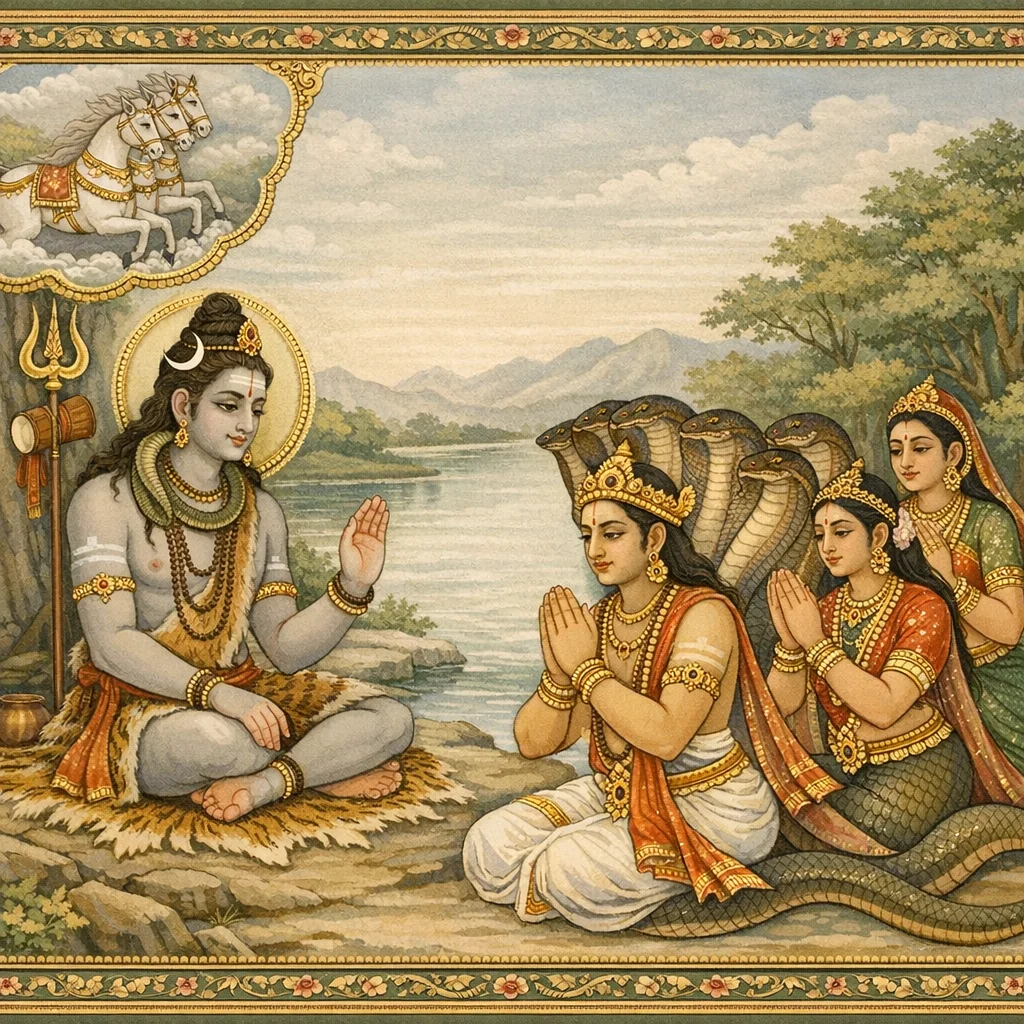
Adhyaya 131
Nāgatīrtha Māhātmya (Legend of the Nāgas’ Fear and Śiva’s Protection) / नागतीर्थमाहात्म्य
Chapter 131 unfolds as a dialogue between the sage Mārkaṇḍeya and King Yudhiṣṭhira. It first points to an “unsurpassed” Nāgatīrtha on the southern bank of the Narmadā and asks why mighty Nāgas, seized by intense fear, undertook severe tapas. Mārkaṇḍeya recounts a traditional itihāsa: Kaśyapa’s two wives, Vinatā (linked with Garuḍa) and Kadrū (linked with serpents), wager after beholding the celestial horse Uccaiḥśravas. Through Kadrū’s coercion, her serpent-sons attempt deception; some comply out of fear of their mother’s curse, while others seek different refuge. After prolonged austerities, Mahādeva (Śiva) grants grace: Vāsuki is established as a constant protector in Śiva’s proximity, and the Nāgas are assured safety—especially through immersion in the waters of the Narmadā. The chapter ends with ritual instruction and phala: worship of Śiva at this tīrtha on the fifth lunar day (pañcamī) ensures that eight Nāga lineages do not harm the worshipper, and that the departed attains the status of Śiva’s attendant for the desired duration.
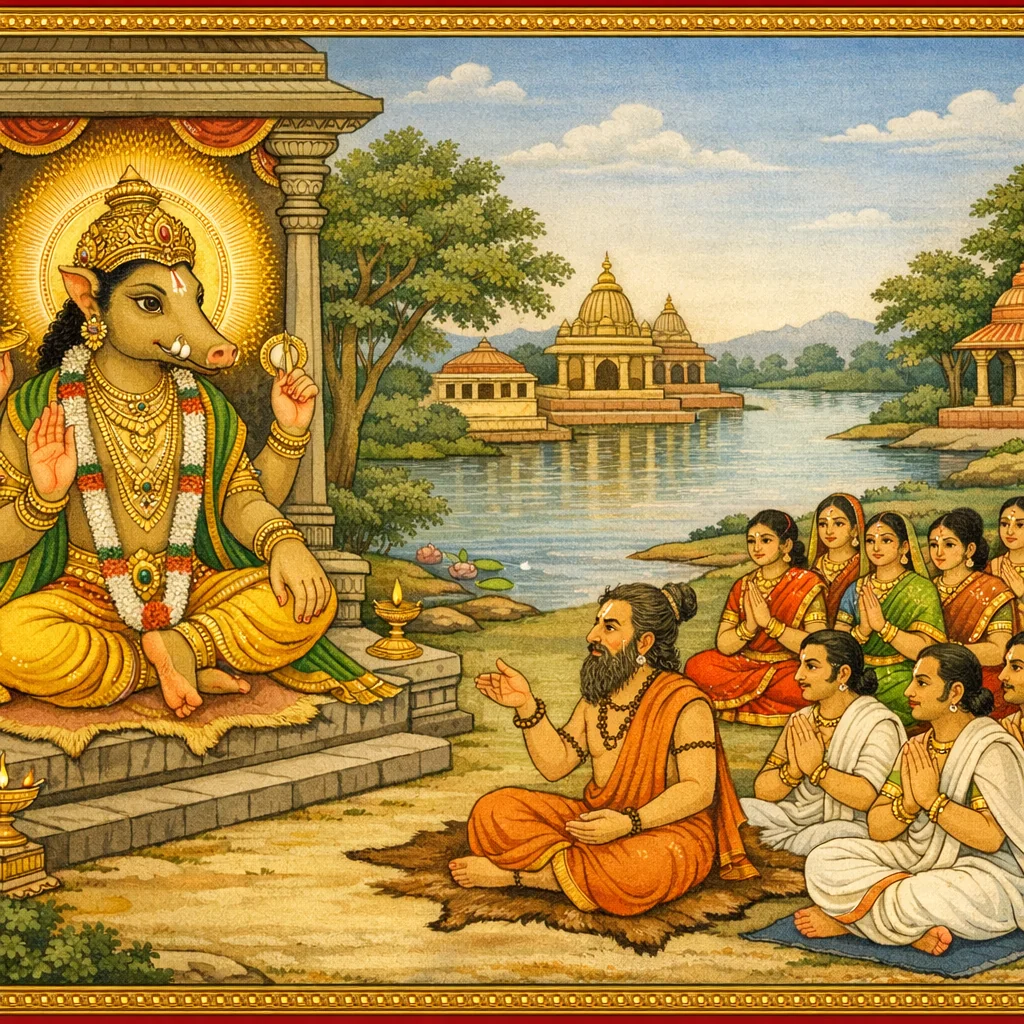
Adhyaya 132
वाराहतीर्थमाहात्म्यम् (Glory of Varāha Tīrtha on the Northern Bank of the Narmadā)
Mārkaṇḍeya instructs a royal hearer to go to the tīrtha called Varāha on the northern bank of the Narmadā, praised as “removing all sins.” Varāha/Dharāṇīdhara is extolled as the world-sustaining creator (jagaddhātā), abiding there for the welfare of beings (lokahita) and as a saving guide who ferries devotees across saṃsāra. The rite centers on bathing at the tīrtha, worshiping Varāha with fragrances and garlands, auspicious acclamations, and fasting—especially on the twelfth lunar day (dvādaśī)—followed by a night vigil with sacred narration. Social-ritual boundaries are also stated: one should avoid contact and shared eating with those engaged in sinful conduct, since impurity is said to pass through speech, touch, breath, and commensality; brāhmaṇas are to be honored according to one’s means and proper rule. The phala teaching declares that mere darśana of Varāha’s face swiftly destroys even stubborn sins, like serpents fleeing Garuḍa or darkness dispelled by the sun. Mantric simplicity is praised: “namo nārāyaṇāya” is presented as universally sufficient, and a single prostration to Kṛṣṇa is equated with great sacrificial merit and leads beyond rebirth. Finally, disciplined devotees who relinquish the body there are said to attain Viṣṇu’s supreme, stainless abode beyond the perishable/imperishable divide.
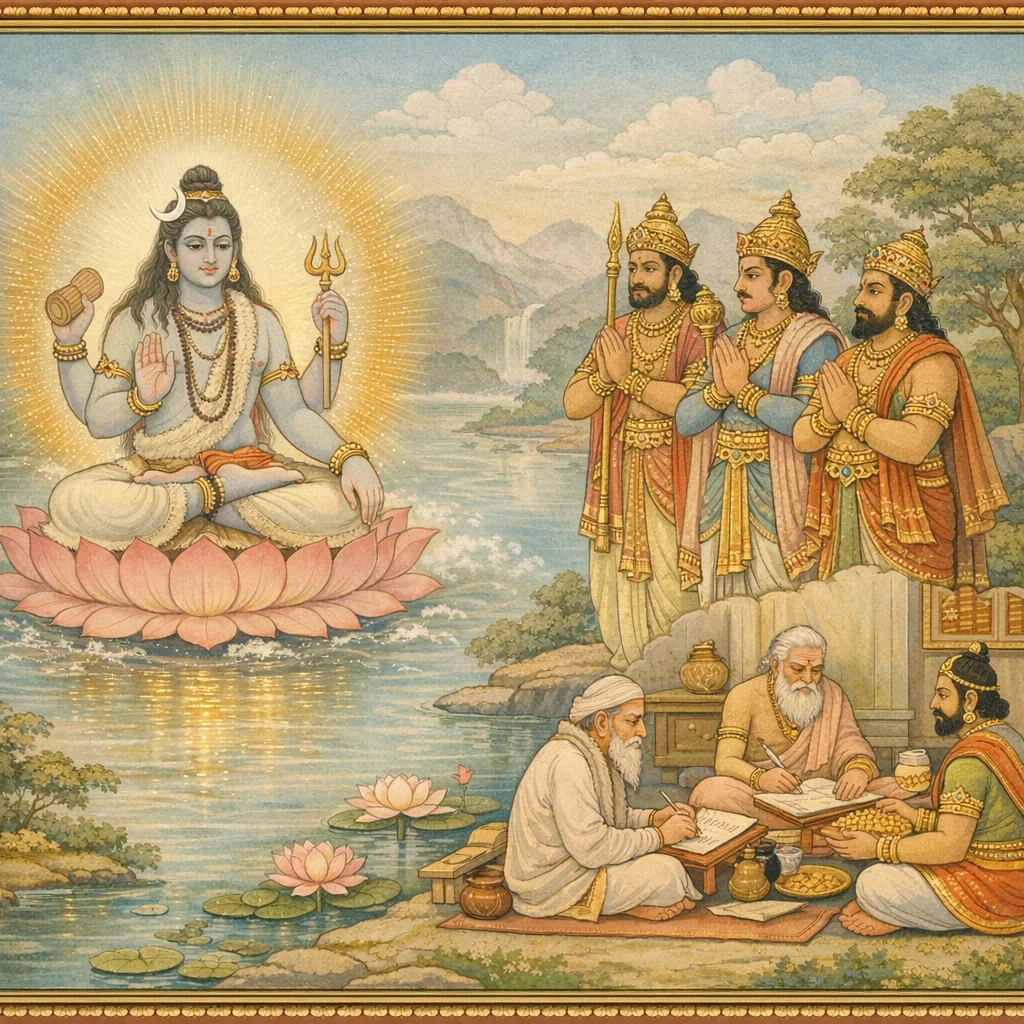
Adhyaya 133
लोकपालतीर्थचतुष्टयमाहात्म्य तथा भूमिदानपालन-उपदेशः (Glory of the Four Lokapāla Tīrthas and Counsel on Protecting Land-Gifts)
Mārkaṇḍeya points out a supreme set of four tīrthas whose mere darśana is said to destroy sin: the sacred stations of the lokapālas Kubera, Varuṇa, Yama, and Vāyu. When Yudhiṣṭhira asks why these guardians performed austerities on the bank of the Narmadā, Mārkaṇḍeya explains that, in an unstable world, they sought a firm foundation, and that Dharma is the sustaining support of all beings. The lokapālas undertake intense tapas and receive boons from Śiva: Kubera becomes lord of the yakṣas and of wealth; Yama gains authority over restraint and judgment; Varuṇa attains sovereignty in the realm of waters; and Vāyu becomes all-pervasive. Each establishes a shrine bearing his name and performs worship with offerings. The account then turns to social and ethical injunctions: learned brāhmaṇas are to be invited and honored with gifts, especially grants of land, with stern warnings against confiscation. Punishments are declared for those who annul such gifts, while protecting a grant is praised as greater than giving it. The specific tīrtha-fruits are listed: worship at Kubereśa yields merit like an Aśvamedha; at Yameśvara, release from sins gathered across births; at Varuṇeśa, merit like a Vājapeya; and at Vāteśvara, the fulfillment of life’s aims. The phalaśruti concludes that hearing or reciting this narrative removes sin and increases auspiciousness.
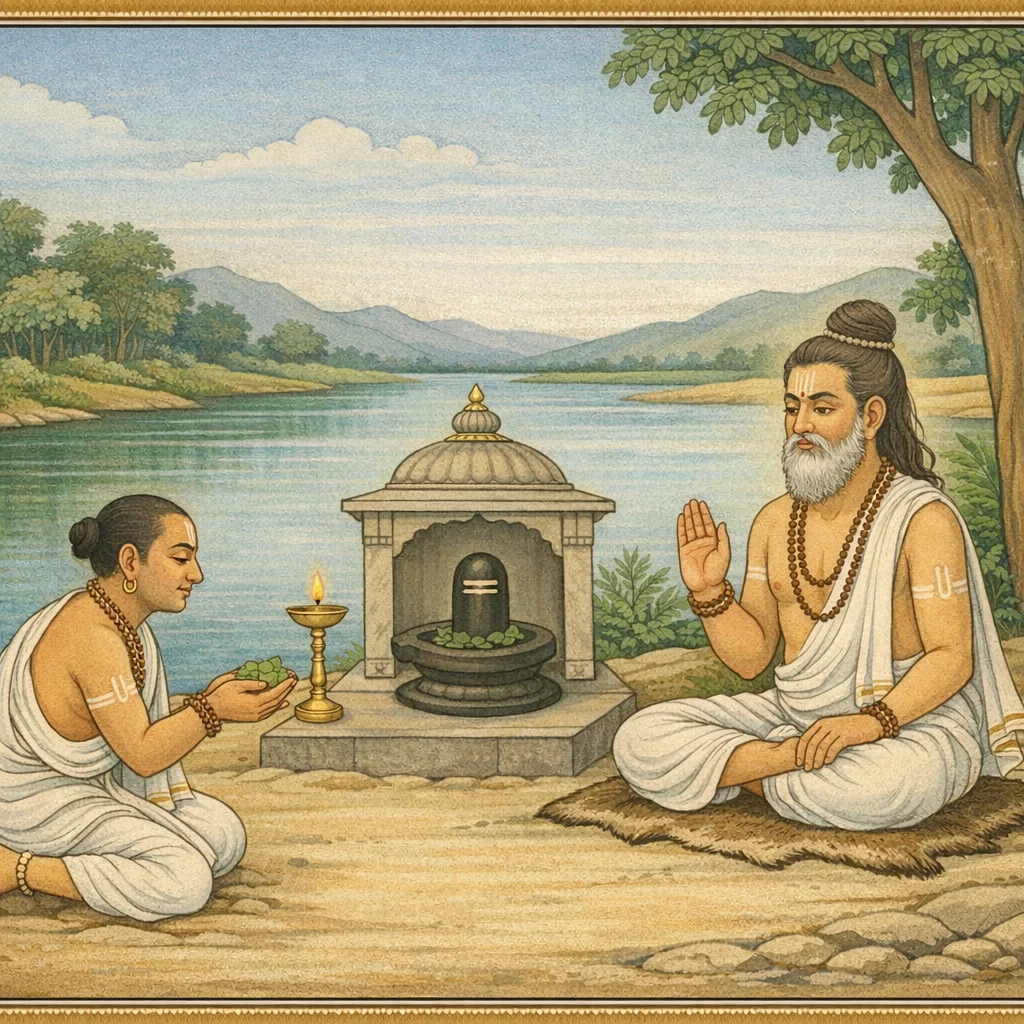
Adhyaya 134
Rāmeśvara-tīrtha Māhātmya (रामेश्वरतीर्थमाहात्म्य) — The Glory of Rāmeśvara on the Southern Bank of the Narmadā
This adhyāya is a concise tīrtha-māhātmya declaration spoken by Śrī Mārkaṇḍeya. It points to an ‘unsurpassed’ sacred place named Rāmeśvara, situated on the southern bank of the Narmadā (Revā). Rāmeśvara is praised as pāpa-hara (the remover of sin and ritual taint), as the giver of puṇya (merit), and as sarva-duḥkha-ghna (the destroyer of all affliction). The effective observance is then stated: whoever bathes there (snāna) and worships Maheśvara—addressed as Mahādeva and Mahātmā—is freed from all kilbiṣa (transgressions and impurities). Thus the text joins place, ritual order (bath → pūjā), and the promised fruit of purification into a compact guide for pilgrimage practice.
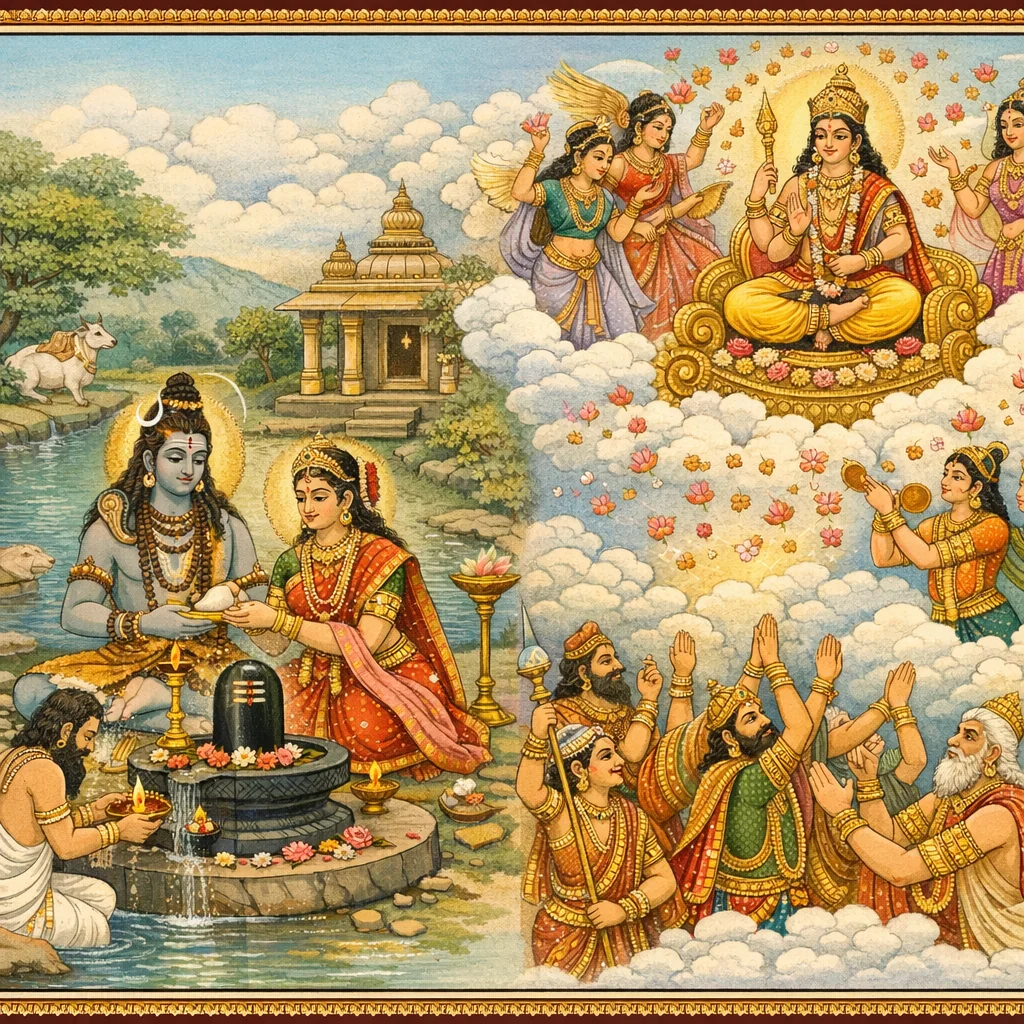
Adhyaya 135
सिद्धेश्वरतीर्थमाहात्म्य (Siddheśvara Tīrtha Māhātmya)
Markaṇḍeya describes an eminent tīrtha named Siddheśvara, characterized as supremely accomplished and worshipped across worlds. The chapter’s instructional core is a concise pilgrimage protocol: bathing at the tīrtha followed by worship of Umā-Rudra. The text then articulates a merit-equivalence claim—attaining the fruit of a Vājapeya sacrifice—thereby translating localized devotion into pan-Vedic prestige. A phalaśruti sequence follows: the practitioner’s accumulated puṇya yields heavenly ascent after death, accompanied by apsarās and auspicious acclamations; after enjoying heaven for an extended period, one is reborn into a prosperous and eminent lineage endowed with wealth and grain. The reborn person is portrayed as learned (versed in Veda and Vedāṅgas), socially honored, free from illness and sorrow, and living a full lifespan (a hundred autumns). The chapter thus links ritual action (snāna + pūjā) to a graded chain of cosmological, social, and bodily outcomes within a Śaiva devotional frame.
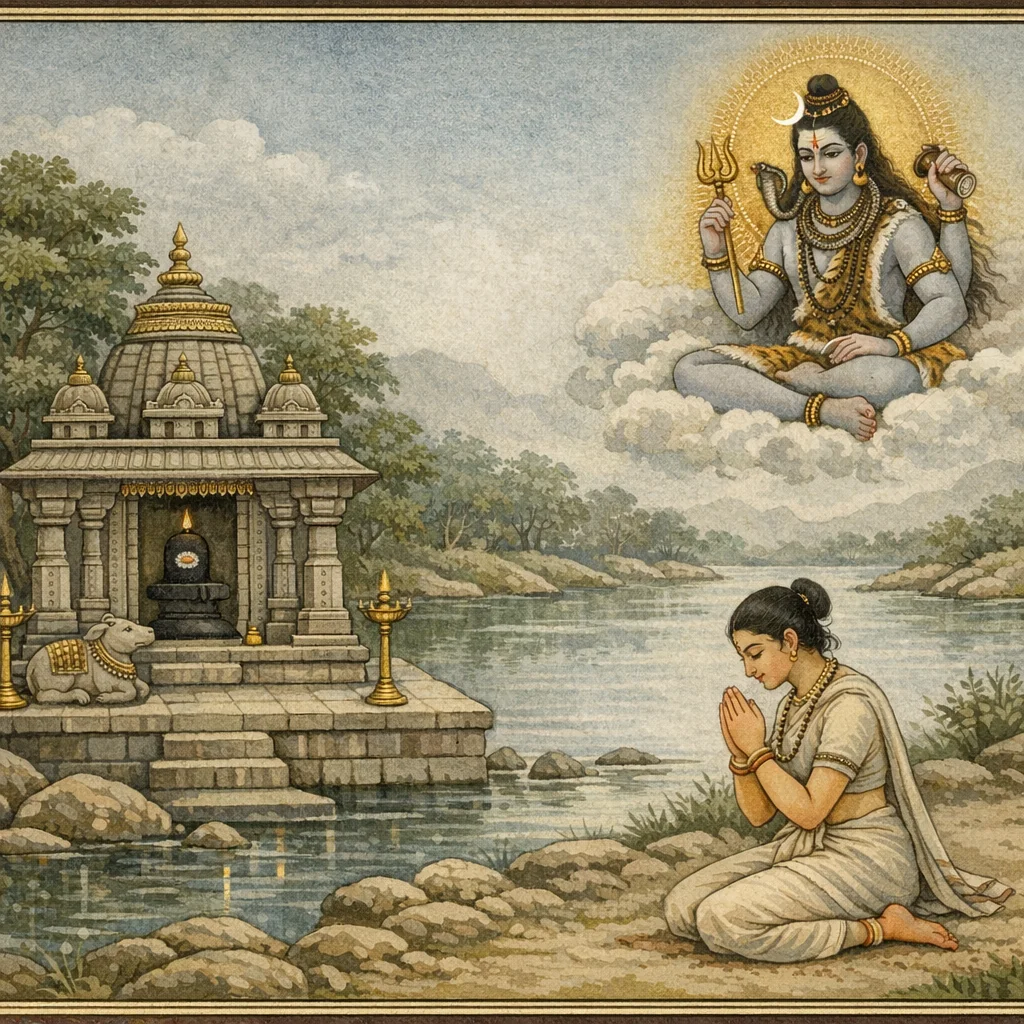
Adhyaya 136
अहल्येश्वरतीर्थमाहात्म्य (Ahalyeśvara Tīrtha Māhātmya)
Mārkaṇḍeya retells, in a place-centered manner, the Ahalyā–Gautama–Indra episode to establish the sanctity of the Ahalyeśvara shrine of Śiva and the adjoining tīrtha. Gautama is portrayed as an exemplary brāhmaṇa-ascetic, and Ahalyā as famed for beauty; Indra (Śakra), driven by desire, deceives Gautama by assuming a disguise and approaches Ahalyā near their dwelling. When Gautama arrives and recognizes the transgression, he curses Indra, leaving a bodily mark described as the manifestation of many bhagas; Indra then relinquishes sovereignty and undertakes austerities. Ahalyā too is cursed to become stone, yet her release is time-bound: after a thousand years she is purified upon seeing Rāma during a pilgrimage, accompanied by Viśvāmitra. Restored, Ahalyā performs rites on the bank of the Narmadā tīrtha—sacred bathing (snāna) and austerities, including cāndrāyaṇa and other kṛcchras. Pleased, Mahādeva grants a boon; Ahalyā installs Śiva as “Ahalyeśvara.” The phalaśruti concludes that those who bathe at the tīrtha and worship Parameśvara there attain heaven and, in due course, human rebirth endowed with prosperity, learning, health, longevity, and unbroken family lineage.
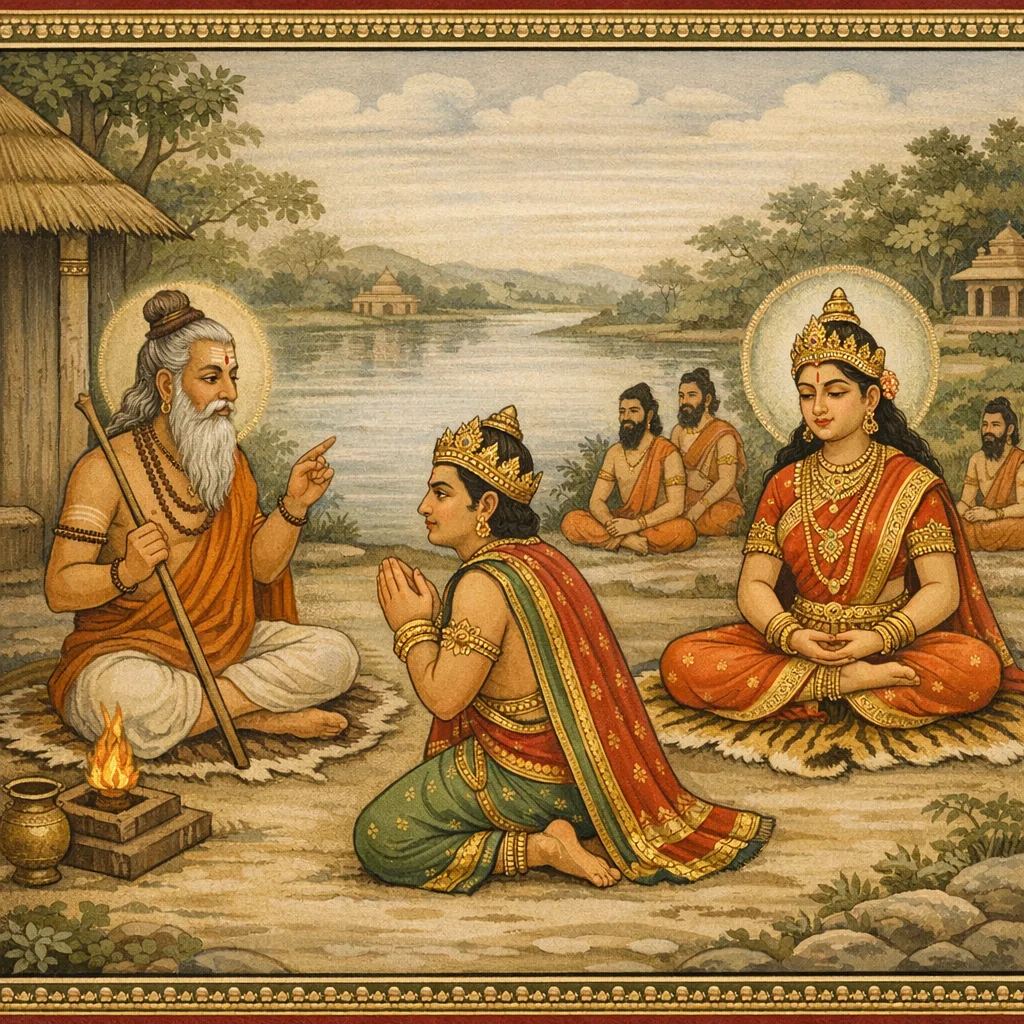
Adhyaya 137
कर्कटेश्वरतीर्थमाहात्म्य (Karkaṭeśvara Tīrtha-Māhātmya)
This adhyāya records Mārkaṇḍeya’s guidance to a royal hearer, directing the pilgrim to Karkaṭeśvara—an eminent Śaiva tīrtha on the northern bank of the Narmadā—praised as a place where sins are destroyed. It explains the prescribed rites and their fruits: bathing according to vidhi and worshipping Śiva grants, after death, an irreversible course toward Rudra’s realm. Though the speaker says the site’s greatness cannot be fully compressed into words, he states key doctrines: any deed—auspicious or inauspicious—performed there becomes “imperishable,” showing the intensified durability of karma in sacred space. This power is grounded in exemplary presences: the Vālakhilya sages and Marīci-linked ascetics who choose to delight there, and Devī Nārāyaṇī who continues severe tapas. Finally, ancestral offerings are prescribed: one who bathes and performs tarpana satisfies the forefathers for twelve years, uniting personal liberation, ethical conduct, and lineage duty in a single tīrtha-centered ritual path.
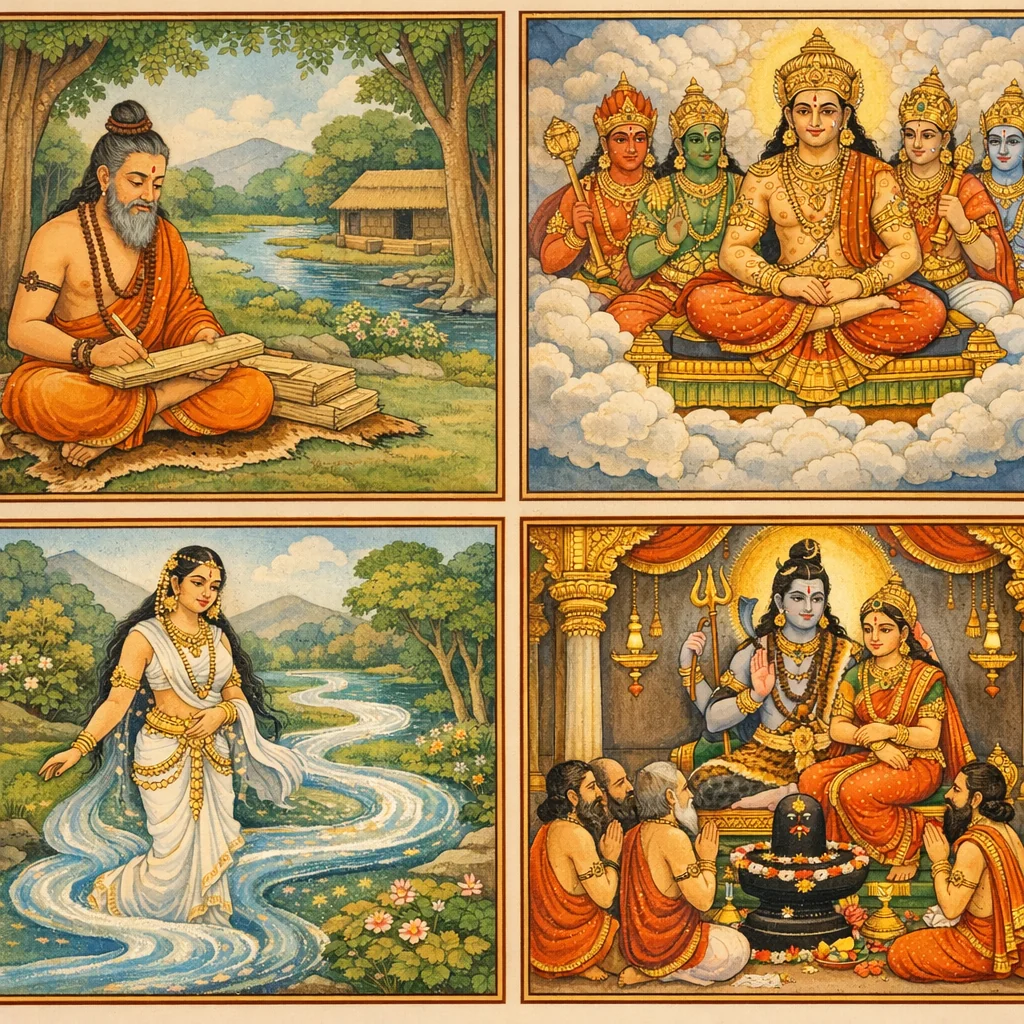
Adhyaya 138
Śakratīrtha Māhātmya (The Glory of Śakra-tīrtha) — Indra’s Restoration and the Merit of Śiva-Pūjā
Mārkaṇḍeya teaches that a pilgrim should go to the peerless Śakratīrtha. Its holiness is explained through an origin legend: Indra (Śakra), cursed by the sage Gautama for his own wrongdoing, loses his royal splendor and withdraws in shame. The gods and ascetic seers, distressed, approach Gautama with conciliatory words, arguing that a world without Indra is harmful to divine and human order, and they beg mercy for the afflicted deity. Gautama, praised as a foremost knower of the Veda, relents and grants a boon: what had been “a thousand marks” becomes “a thousand eyes” by the sage’s favor, restoring Indra’s dignity. Indra then goes to the Narmadā, bathes in pure water, establishes and worships Tripurāntaka (Śiva, destroyer of Tripura), and returns to the heavenly abode honored by apsarases. The chapter ends with a clear phala: one who bathes at this tīrtha and worships Parameśvara is freed from the sin connected with illicit approach to another’s spouse, presenting the site as a Śaiva remedy of ritual and ethical purification.
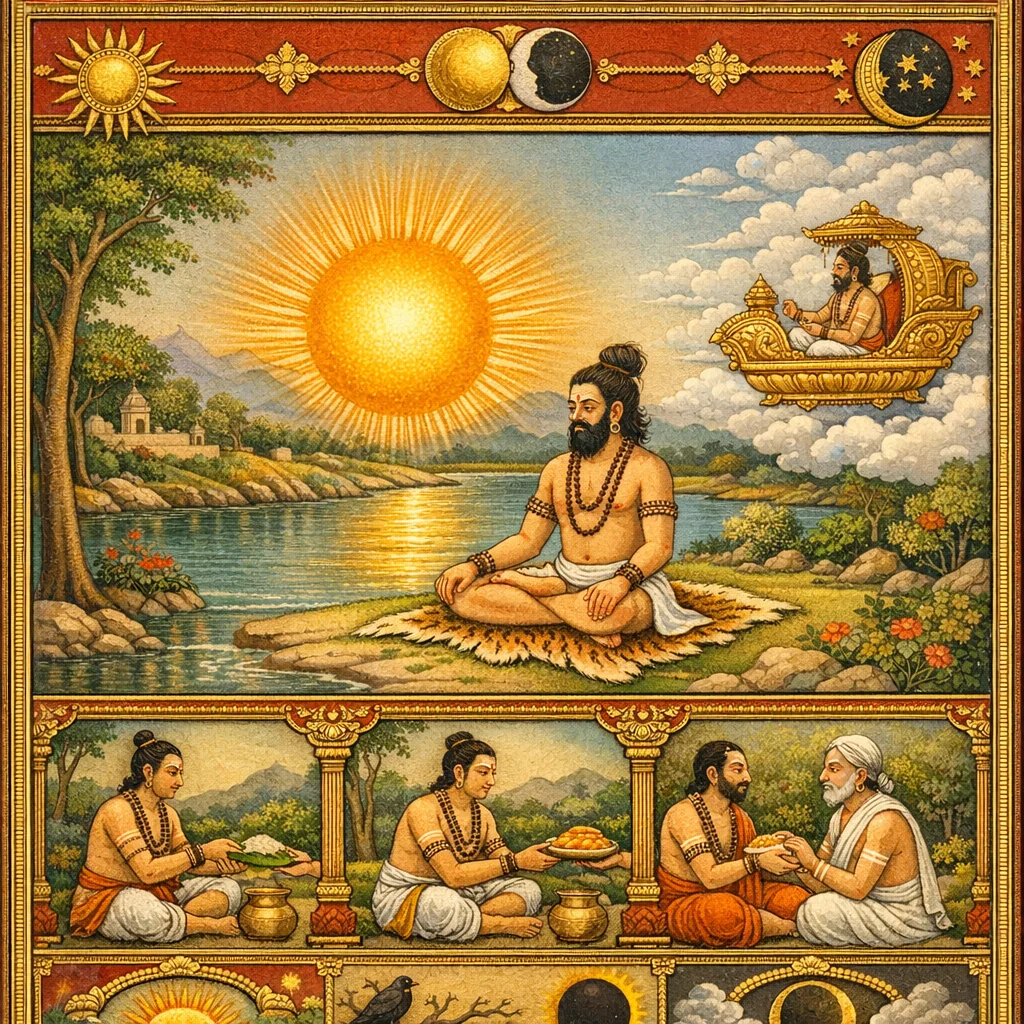
Adhyaya 139
Somatīrtha Māhātmya (Glory of Somatīrtha) — Ritual Bathing, Solar Contemplation, and Merit of Feeding the Learned
In this chapter, Mārkaṇḍeya gives itinerary-like guidance to Somatīrtha, praised as an unsurpassed sacred ford where Soma performed tapas and attained the heavenly path of the nakṣatras. He lays down a ritual sequence: bathe at the tīrtha, then perform proper ācamana and japa, and conclude with meditation upon Ravi, the Sun. The discourse then states comparative merits, declaring that practice at Somatīrtha yields fruit equal to that ascribed to recitation of the Vedic triad (Ṛg, Yajur, Sāma) and the Gāyatrī. It dwells on dharmic hospitality: feeding Brahmins of defined learning lineages (Bahvṛca, Adhvaryu, Chāndoga; those who have completed study) and giving gifts—footwear, sandals, umbrella, garments, blankets, horses—to leading Brahmins, each act extolled in “koti”-scale merit. It culminates in ascetic ethics: wherever a muni restrains the senses, that place is tantamount to Kurukṣetra, Naimiṣa, and Puṣkara; hence yogins are to be specially honored during eclipses, saṅkrānti, and vyatīpāta. One who undertakes renunciation at this tīrtha is said to ascend to heaven by vimāna, become an attendant of Soma, and share Soma’s celestial felicity.
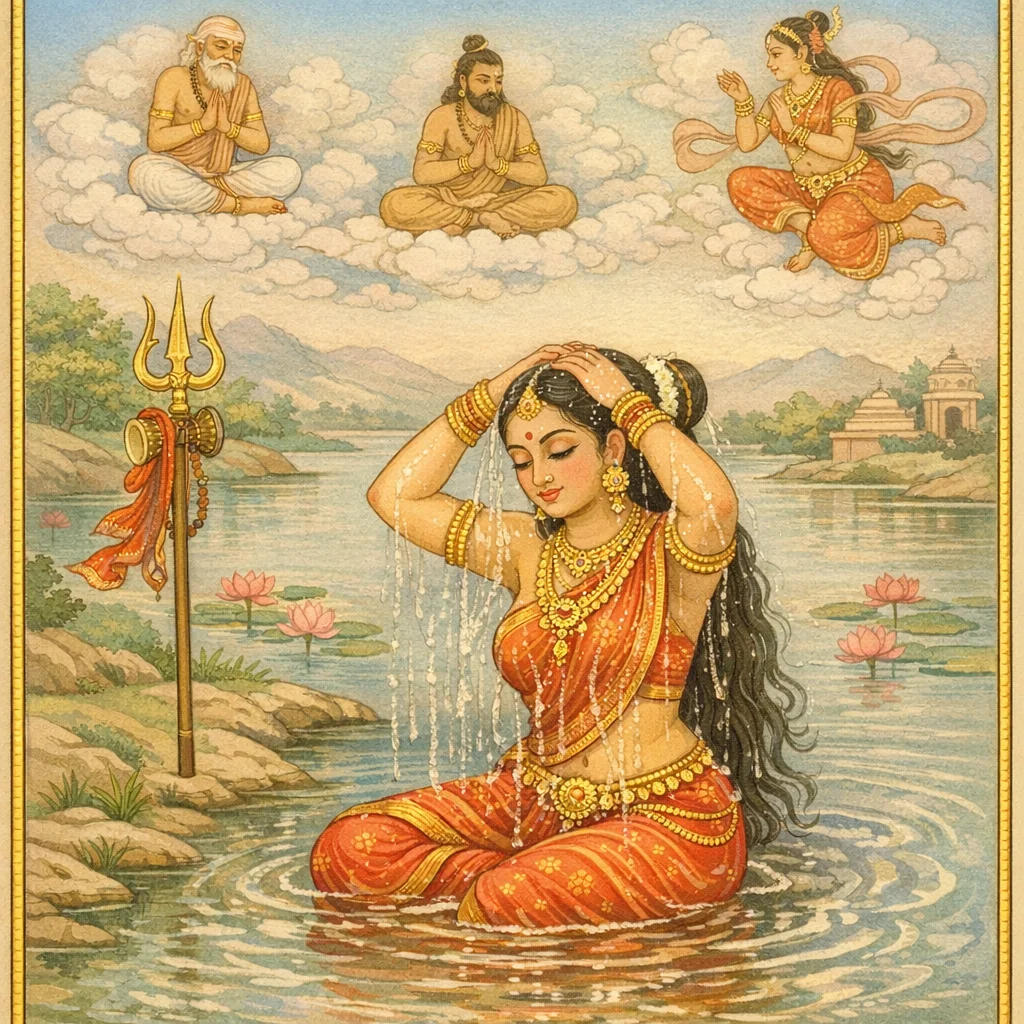
Adhyaya 140
नन्दाह्रदमाहात्म्य (Nandāhrada Māhātmya: The Glory of Nandā Lake)
The chapter is framed as an instructive pilgrimage itinerary within the Revākhaṇḍa. Mārkaṇḍeya directs the royal listener to go to Nandāhrada, an unsurpassed sacred lake where siddhas abide and where the goddess Nandā is revered as a bestower of boons. Its sanctity is grounded in a mythic battle: the formidable Mahīṣāsura, dreaded by the devas, is overcome when the Goddess—manifest as Śūlinī—pierces him with her trident. Thereafter the wide-eyed Goddess bathes there, and the lake comes to be known as Nandāhrada. The text then prescribes practice: bathing at this tīrtha with devotion to Nandā and giving gifts to brāhmaṇas is said to yield merit equal to an Aśvamedha. Nandāhrada is also counted among rare, supremely valued holy sites alongside Bhairava, Kedāra, and Rudra Mahālaya, though many fail to recognize it, distracted by desire and attachment. In the concluding phalaśruti, the claim is expanded: the combined fruits of bathing and gifting across the whole ocean-girdled earth are declared to accrue from bathing at Nandāhrada, presenting it as a concentrated locus of merit and righteous conduct.
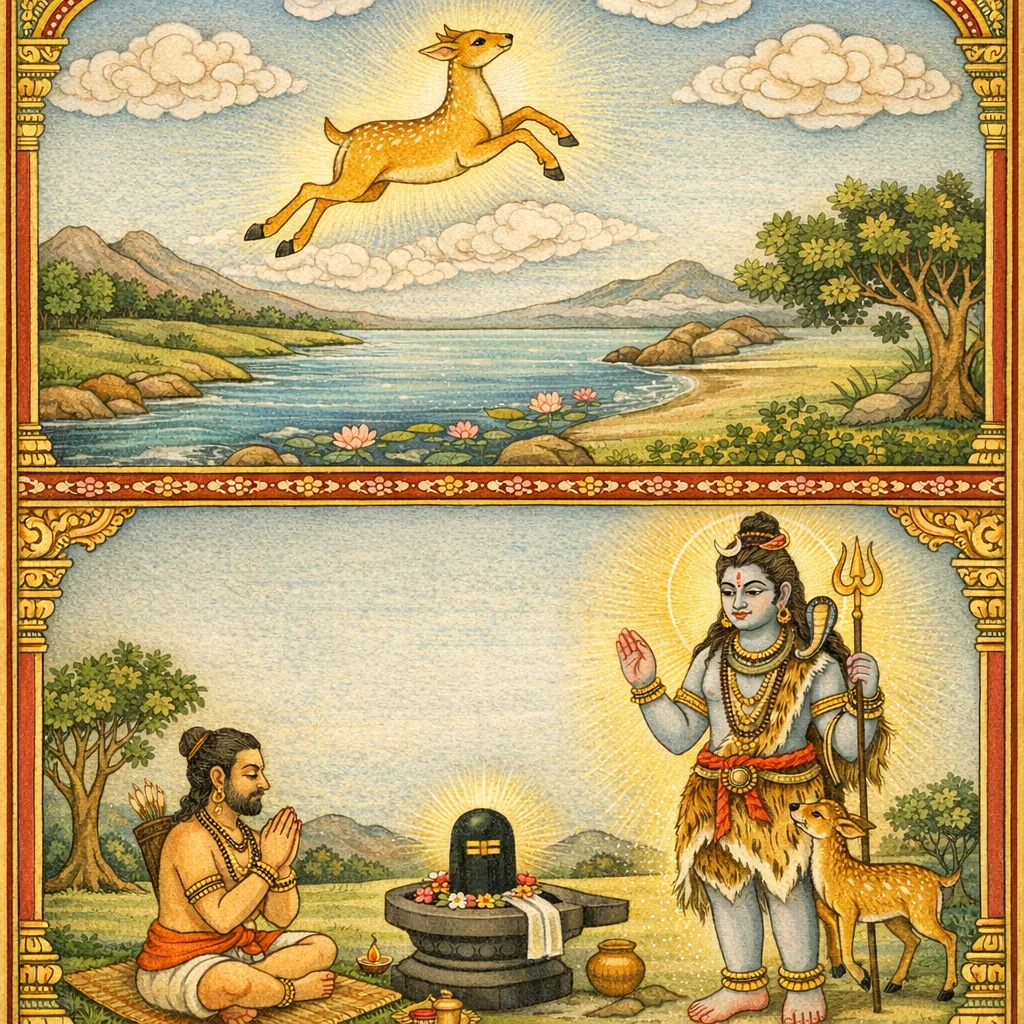
Adhyaya 141
Tāpeśvara Tīrtha Māhātmya (The Glory of the Tāpeśvara Ford)
Mārkaṇḍeya recounts the origin of the tīrtha known as Tāpeśvara. A hunter (vyādha) witnesses a doe escape fear by plunging into the water and then rising into the sky. Struck with wonder, he lays down his bow, turns toward renunciation, and performs prolonged austerity (tapas), said to last a thousand divine years. Pleased, Maheśvara (Śiva) appears and offers a boon. The hunter asks to dwell near Śiva; the Lord grants it and vanishes. The hunter then installs (sthapayitvā) Maheśvara, worships according to proper rite (pūjā-vidhāna), and attains heaven. From that time the ford becomes famed in the three worlds as “Tāpeśvara,” linked with the hunter’s burning remorse and penance (vyādha-anuttāpa). One who bathes there and worships Śaṅkara reaches Śiva-loka; those who bathe in the Narmadā waters at Tāpeśvara are freed from the three afflictions (tāpa-traya). Bathing observances are especially commended on Aṣṭamī, Caturdaśī, and Tṛtīyā for the pacification of all sins.
Adhyaya 142
रुक्मिणीतीर्थमाहात्म्य (Rukmiṇī Tīrtha Māhātmya) and the Naming of Yodhanīpura
This chapter is framed as a dialogue in which the sage Mārkaṇḍeya instructs Yudhiṣṭhira on the glory of Rukmiṇī-tīrtha. Mere bathing there is said to bestow beauty and auspicious prosperity, with special emphasis on the observances of Aṣṭamī, Caturdaśī, and most notably Tṛtīyā. An origin itihāsa then establishes the tīrtha’s authority: Bhīṣmaka of Kuṇḍina has a daughter, Rukmiṇī, and an incorporeal voice foretells she must be given to a four-armed deity. Political designs promise her to Śiśupāla, but Kṛṣṇa and Saṅkarṣaṇa arrive; Rukmiṇī meets Hari in a disguised form, and Kṛṣṇa carries her away. A martial pursuit follows—Baladeva’s battle is vividly evoked and Rukmī is confronted—yet at Rukmiṇī’s plea Kṛṣṇa restrains the Sudarśana, reveals his divine form, and reconciliation is achieved. The chapter then turns to ritual-legal and ethical instruction: Kṛṣṇa honors seven sage-figures (the mānasaputras tradition) and grants villages, while issuing a stern warning against seizing donated land (dāna-bhūmi), declaring severe karmic consequences. The concluding tīrtha-māhātmya lists meritorious acts—bathing, worship of Baladeva–Keśava, pradakṣiṇā, and gifts such as kapilā-dāna, gold and silver, footwear, and cloth—compares the tīrtha’s merit with famed pan-Indian holy sites, and sets forth post-mortem फलश्रuti, including the destinies of those who die by fire, water, or fasting within the tīrtha’s sacred sphere.
Adhyaya 143
Yojaneśvara Tīrtha Māhātmya and the Worship of Balakeśava
This chapter is a tīrtha-māhātmya discourse spoken by Śrī Mārkaṇḍeya to a king. It extols the eminent sacred ford called Yojaneśvara, where the Nara–Nārāyaṇa Ṛṣis performed tapas and won victory in a primordial struggle between devas and dānavas. The narrative compresses sacred history across the yugas: in Tretā-yuga the same divine principle is linked with Rāma–Lakṣmaṇa, who, after ritual bathing at the tīrtha, defeat Rāvaṇa. In Kali-yuga it manifests as Bala–Keśava (Balarāma–Kṛṣṇa), born in the Vāsudeva lineage, accomplishing arduous deeds such as slaying Kaṃsa, Cāṇūra, Muṣṭika, Śiśupāla, and Jarāsandha; it also gestures to the Kurukṣetra/Dharma-kṣetra war, where divine agency proves decisive in the fall of key warriors. Prescriptions follow: bathe at the tīrtha, worship Bala–Keśava, observe fasting and night-vigil (prajāgara), sing devotional praises, and honor brāhmaṇas with reverence. The phalaśruti promises the removal of sins—including grave transgressions—the akṣaya (imperishable) fruit of gifts and worship offered there, and freedom from pāpa for the righteous who hear, read, or recite this chapter.
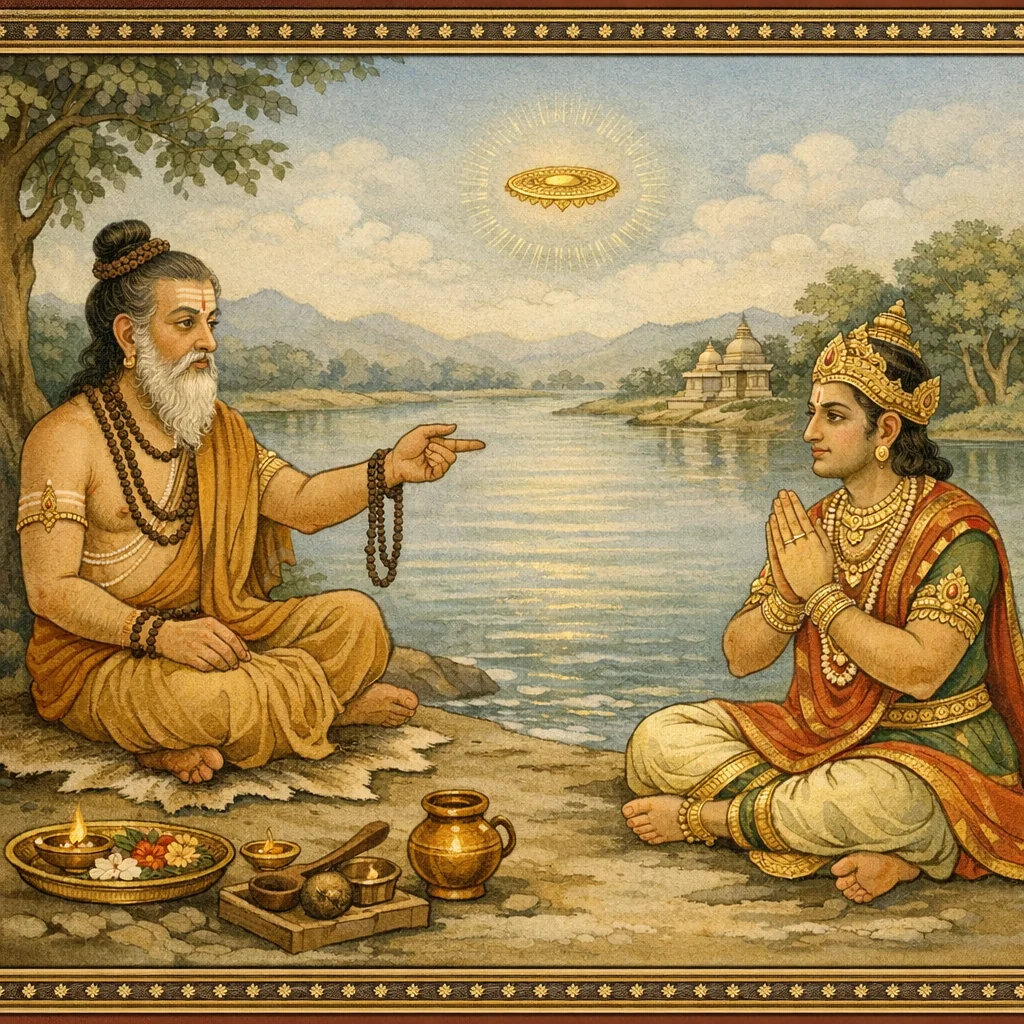
Adhyaya 144
Cakratīrtha–Dvādaśī Tīrtha Māhātmya (Non-diminishing Merit at Cakratīrtha)
This chapter is a brief, itinerary-like instruction spoken by Śrī Mārkaṇḍeya to a royal listener. He directs the hearer to proceed to an “excellent” Dvādaśī-tīrtha and highlights the exceptional standing of Cakratīrtha in contrast to ordinary ritual practice. It states that, in general, the fruits of giving (dāna), recitation (japa), fire-offerings (homa), and bali/ritual offerings may diminish or be exhausted over time. Yet deeds performed at Cakratīrtha are praised as undiminishing, their merit never waning. The chapter concludes by affirming that the tīrtha’s supreme māhātmya—embracing its significance for past and future—has been explained distinctly and completely, serving as the formal closing of this praise.
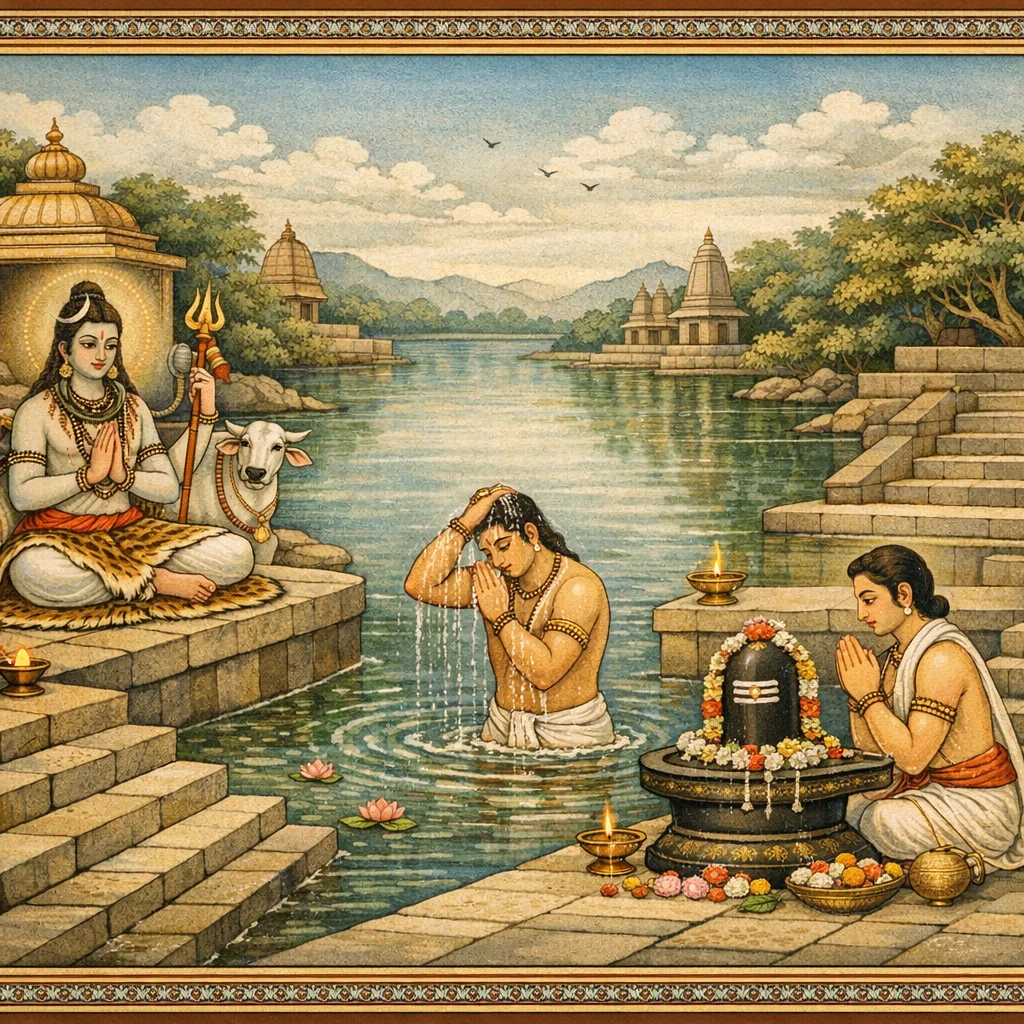
Adhyaya 145
Śivātīrtha Māhātmya (Glory of the Śiva Tīrtha)
This adhyāya gives a brief theological instruction attributed to Mārkaṇḍeya, addressing the seeker as a “guardian/leader of the land” and directing him to the unsurpassed Śivātīrtha. The teaching is framed as a prescriptive pilgrimage route with a graded sequence of religious observances. First, mere darśana of the deity at Śivātīrtha is said to erase all moral taints (sarva-kilbiṣa). Next, the text prescribes disciplined practice: bathing at the tīrtha while conquering anger and restraining the senses, followed by worship of Mahādeva, yielding merit equal to an Agniṣṭoma sacrifice. Finally, devotion joined with fasting (upavāsa) and Śiva-worship is praised as an irreversible spiritual course that culminates in Rudraloka. Thus the chapter unites self-restraint, ritual acts (snāna, pūjā, upavāsa), and promised fruits of purification and post-mortem ascent into a compact guide for pilgrimage.
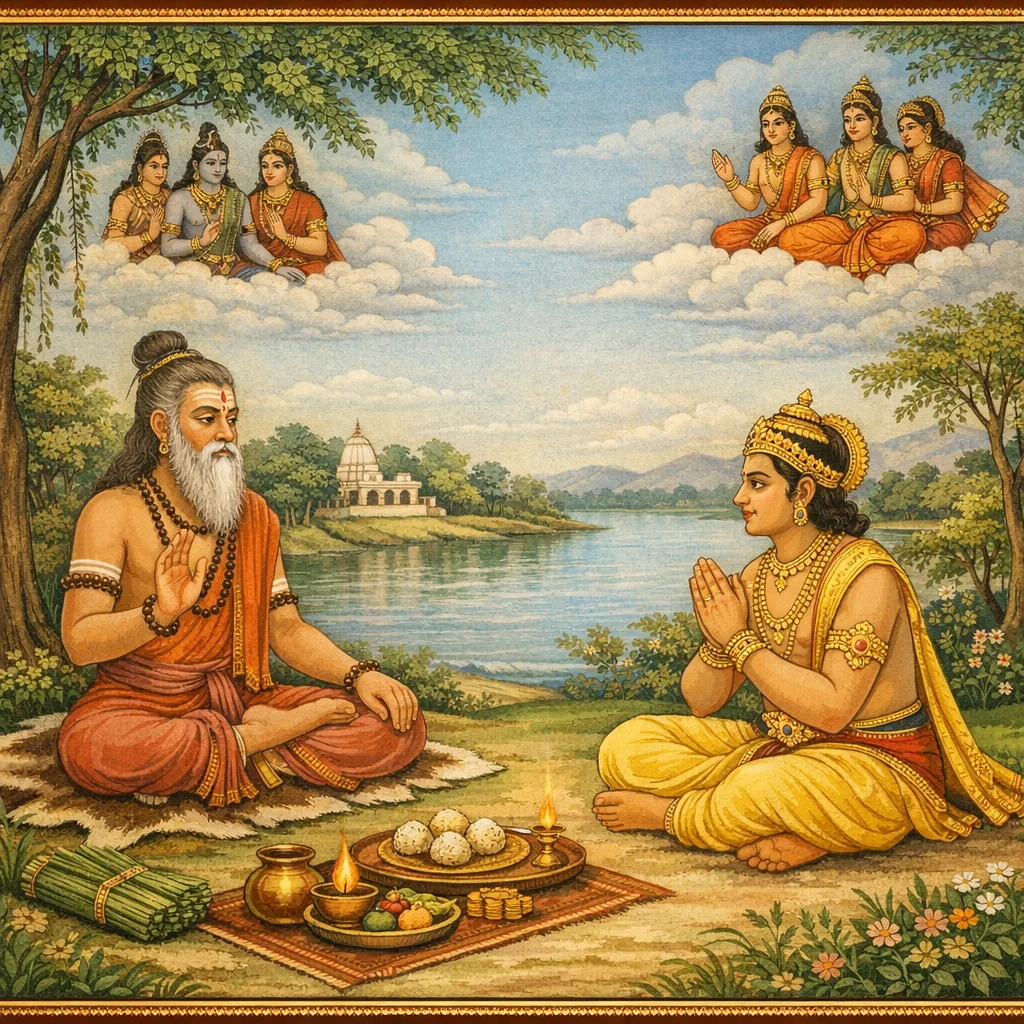
Adhyaya 146
Asmahaka Pitṛtīrtha Māhātmya and Piṇḍodaka-Vidhi (अस्माहक-पितृतीर्थ-माहात्म्य एवं पिण्डोदक-विधि)
Chapter 146 unfolds as a dialogue: Yudhiṣṭhira asks for the māhātmya (sacred greatness) of a foremost ancestral tīrtha named Asmahaka, and Mārkaṇḍeya replies by citing an earlier authoritative inquiry in an assembly of ṛṣis and devas. The teaching exalts Asmahaka above comparable pilgrimage complexes and ties its power to pitṛ-centered rites: even a single offering of piṇḍa and water can free ancestors from preta-affliction, grant long satisfaction, and yield enduring merit. Ethical counsel is woven in—upholding maryādā according to śruti–smṛti—along with karma doctrine: the embodied being departs “like the wind,” tasting results individually, while social-religious order is sustained through prescribed duties such as snāna, dāna, japa, homa, svādhyāya, deva-arcana, atithi-pūjana, and especially piṇḍodaka-pradāna. A substantial portion details auspicious timings and site-features: amāvāsyā, Vyatīpāta, Manv-ādi, Yug-ādi, ayana/viṣuva, and solar transitions; and a divinely made Brahma-śilā described as gaja-kumbha-nibhā. In Kali-yuga it is said to become especially manifest around Vaiśākha-amāvāsyā. The procedure includes bathing, mantra-praise of Nārāyaṇa/Keśava, feeding brāhmaṇas, śrāddha with darbha and dakṣiṇā, and optional offerings (milk, honey, curd, cool water) understood as directly sustaining the pitṛs. Cosmic witnesses—devas, pitṛs, rivers, oceans, and many ṛṣis—are enumerated to stabilize the site’s authority. The chapter closes with expansive phalāśruti: purification from grave faults, equivalence to great Vedic sacrifices, uplift of ancestors from hell-states, and worldly prosperity, while maintaining a neutral synthesis that treats Brahmā–Viṣṇu–Maheśvara as functionally unified powers.
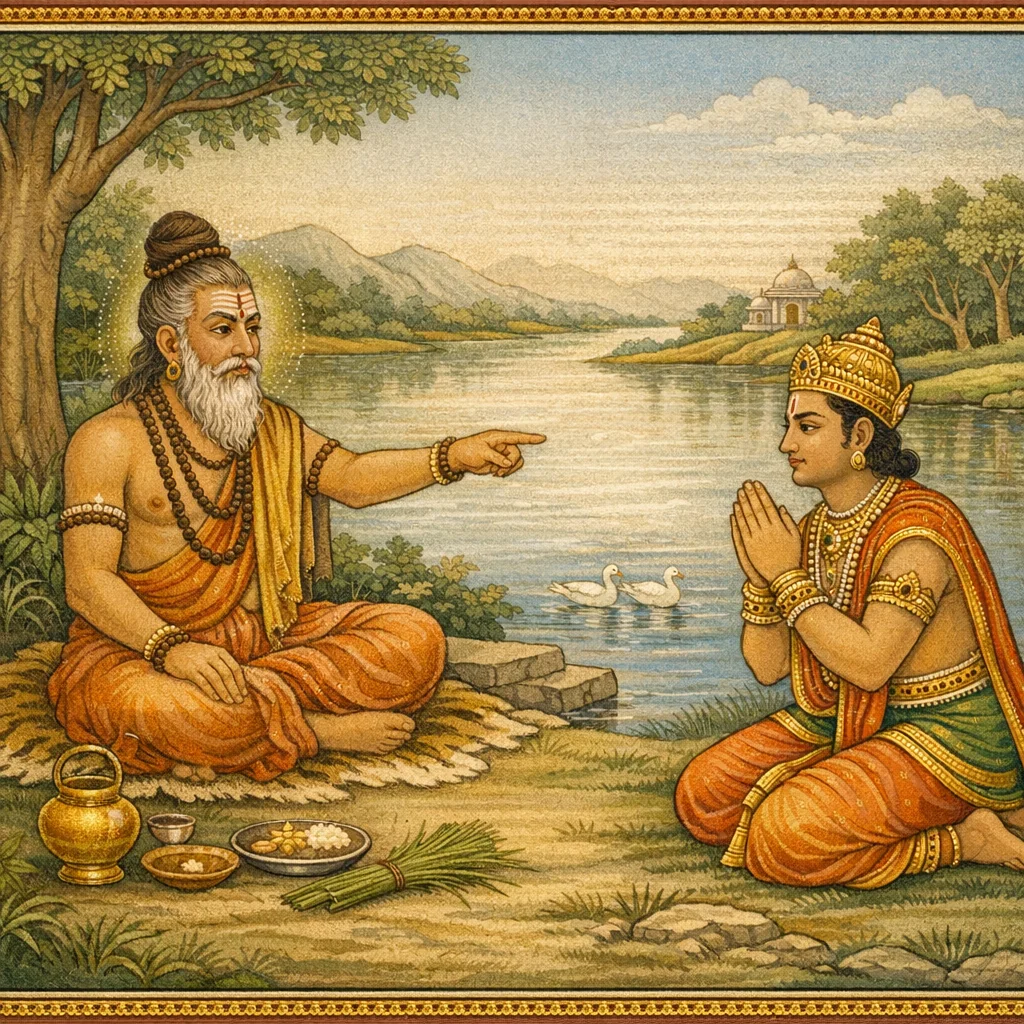
Adhyaya 147
Siddheśvara-tīrtha-māhātmya (सिद्धेश्वरतीर्थमाहात्म्य) — Merits of Bathing, Śiva Worship, and Śrāddha on the Narmadā’s Southern Bank
In this adhyāya, Mārkaṇḍeya instructs a king (addressed as mahīpāla/nṛpasattama) to go to the peerless Siddheśvara tīrtha on the southern bank of the Narmadā (Revā), declaring it an exceptionally auspicious and holy place. Bathing there and then worshipping Vṛṣabhadhvaja—Śiva, bearing the bull emblem—is said to destroy all pāpa and bestow merit comparable to that gained by performers of the Aśvamedha. Bathing and diligently performing śrāddha is likewise affirmed to be fully effective in bringing satisfaction to the pitṛs (ancestors). For beings who die at, or in connection with, this tīrtha, the text promises release from the recurrence of garbha-vāsa (confinement in the womb), described as inherently painful. The chapter closes by linking bathing in tīrtha-water with the cessation of punarbhava (rebirth), presenting river-ritual as a means of liberation within a Śaiva devotional frame.
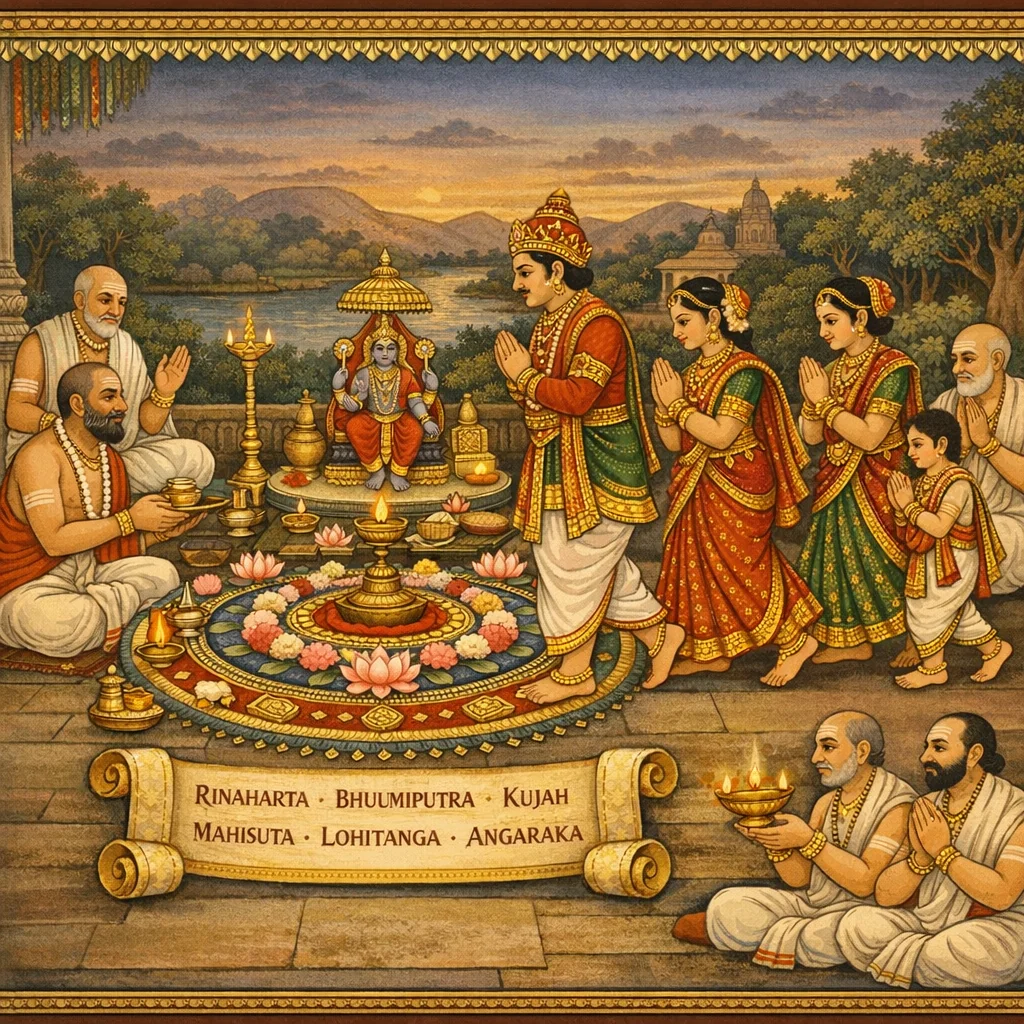
Adhyaya 148
Āṅgāraka-Śiva Tīrtha Vidhi on the Northern Bank of the Narmadā (अङ्गारक-शिवतीर्थविधिः)
Mārkaṇḍeya directs a king to go to an Āṅgāraka-associated Śiva-tīrtha on the northern bank of the Narmadā, praised as a place where sins diminish (pāpa-kṣaya). The chapter prescribes a time-bound vrata focused on Caturthī and Tuesday (the Caturthī–Āṅgāraka day), stressing firm resolve (saṅkalpa), bathing at sunset, and sustained sandhyā-upāsanā. It then lays out a detailed pūjā: establishing the rite on a sthaṇḍila, applying red sandal, worship in lotus/maṇḍala fashion, and invoking Kuja/Āṅgāraka by epithets such as Bhūmiputra and Svedaja. Arghya is offered in a copper vessel with red-sandal water, red flowers, tila, and rice. Dietary rules are given—avoid sour and salty foods, favoring gentle and wholesome fare. The observance may be expanded with a golden image as one can afford, multiple karakas set by direction, auspicious sounds of śaṅkha/tūrya, and honoring a qualified brāhmaṇa marked by learning, vows, and kindness. Gifts include a red cow and a red bull, followed by circumambulation, family participation, apology and closing rites, and dismissal. The phalaśruti promises beauty and prosperity across many lives, a post-mortem abode called Āṅgāraka-pura, divine enjoyments, and ultimately righteous kingship, health, and long life.
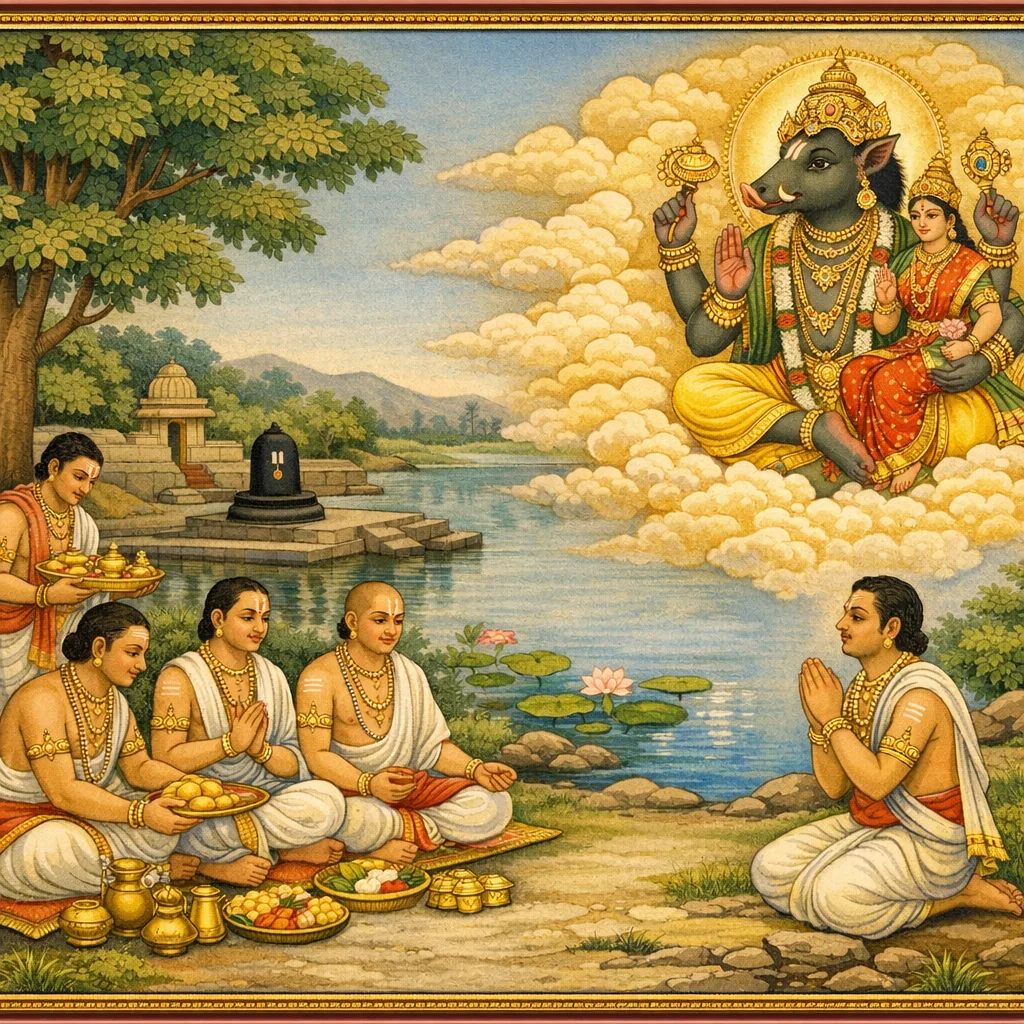
Adhyaya 149
Liṅgeśvara Tīrtha Māhātmya and Dvādaśī-Māsa-Nāma Kīrtana (लिङ्गेश्वरतीर्थमाहात्म्यं तथा द्वादशी-मासनामकीर्तनम्)
Mārkaṇḍeya describes a sacred tīrtha called Liṅgeśvara, where the darśana of the “Lord of gods” is said to destroy sin. The site is framed within Viṣṇu-centered devotion, recalling the Lord’s protecting power (including the Varāha motif), and laying down pilgrimage conduct: bathe at the tīrtha, bow to the deity, and honor Brahmins with gifts, reverence, and meals. A calendrical vow is then taught: on dvādaśī, with fasting and restraint, worship the Lord with fragrance and garlands, perform tarpaṇa for ancestors and deities, and recite twelve divine names. Monthly worship is systematized by linking each lunar month to a Viṣṇu epithet (from Keśava to Dāmodara), declaring name-recitation a purifying act that removes faults of speech, mind, and body. The chapter closes by praising the fortune of devotees and warning of the spiritual loss of a life without bhakti, giving instructions for ancestor offerings (sesame-mixed water) during eclipses and aṣṭakā periods, and ending with an exalted benediction to Hari in the boar form as a vision of peace.
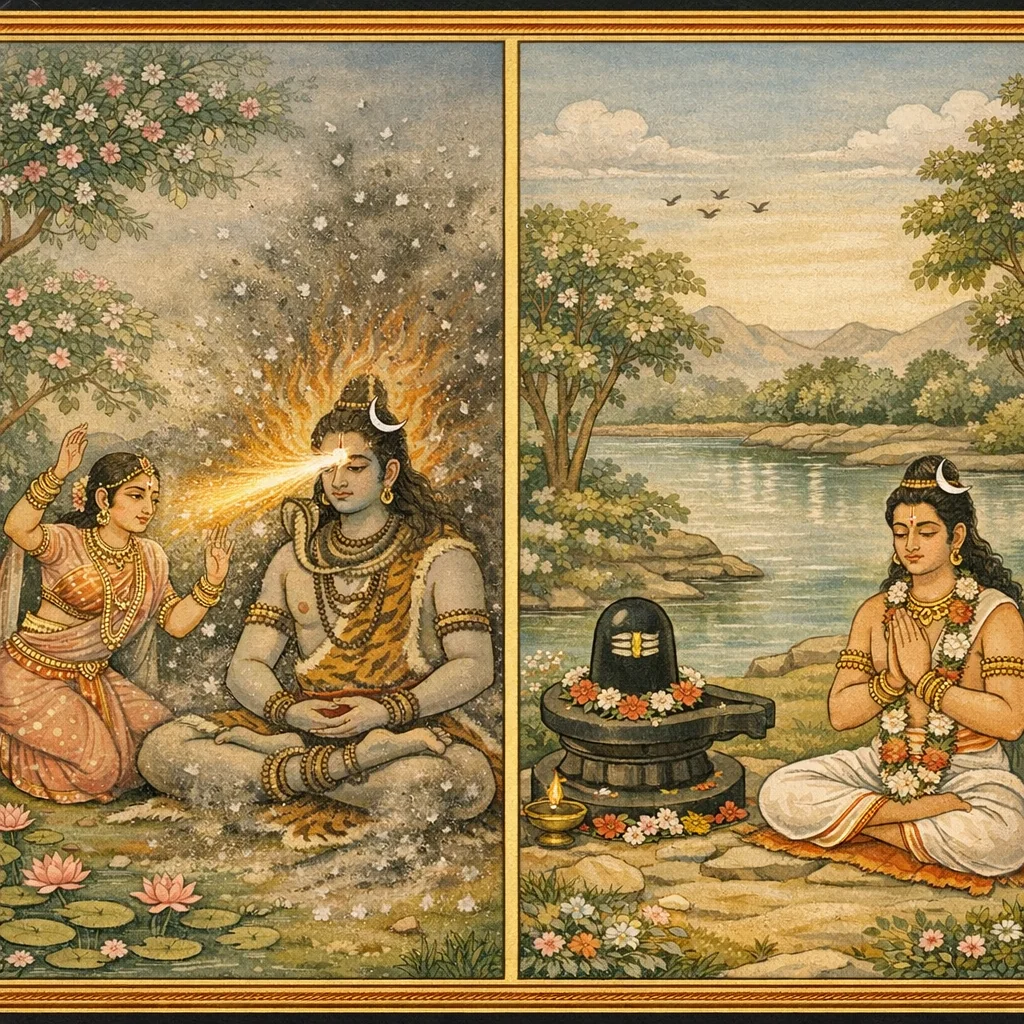
Adhyaya 150
कुसुमेश्वर-माहात्म्य (Kusumeśvara Māhātmya: Ananga, Kāma, and the Narmadā-bank Liṅga स्थापना)
Mārkaṇḍeya directs the king to the eminent shrine of Kusumeśvara on the southern bank of the Narmadā, praised as a purifier of minor transgressions. The deity there is identified as the liṅga installed by Kāma (Kāmadeva) and renowned throughout the worlds. Yudhiṣṭhira then asks how Ananga—Kāma “without a body”—could attain ‘aṅgitva’, the state of being re-embodied with limbs. The tale turns to Kṛtayuga: Mahādeva (Śiva) performs fierce tapas at Gaṅgāsāgara, unsettling the worlds. The gods appeal to Indra, who sends apsarases, Spring, the cuckoo, the southern breeze, and Kāma to disturb Śiva’s austerity. Amid the springtime allure, Śiva remains unmoved; his third eye opens in fire, reducing Kāma to ashes and leaving the worlds “kāma-less.” The gods seek Brahmā, who praises Śiva with Vedic and stotra hymns; Śiva is appeased and, though restoring Kāma’s embodiment is difficult, Ananga returns as a life-giver. Kāma then undertakes tapas on the Narmadā bank, invokes Kuṇḍaleśvara for protection from obstructive beings, and receives the boon of Śiva’s perpetual presence at that tīrtha. Kāma establishes the liṅga named Kusumeśvara. The chapter prescribes observances there—bathing and fasting, especially on Caitra caturdaśī (Madana’s day), morning worship of the Sun, tarpaṇa with sesame-mixed water, and piṇḍa offerings—declaring that piṇḍa-dāna here equals a twelve-year sattra, brings long satisfaction to ancestors, and grants saving merit even to small creatures dying at the site. Devotional renunciation and self-control at Kusumeśvara are said to yield joy in Śiva’s realm and a return to earth as an honored, healthy, eloquent ruler.
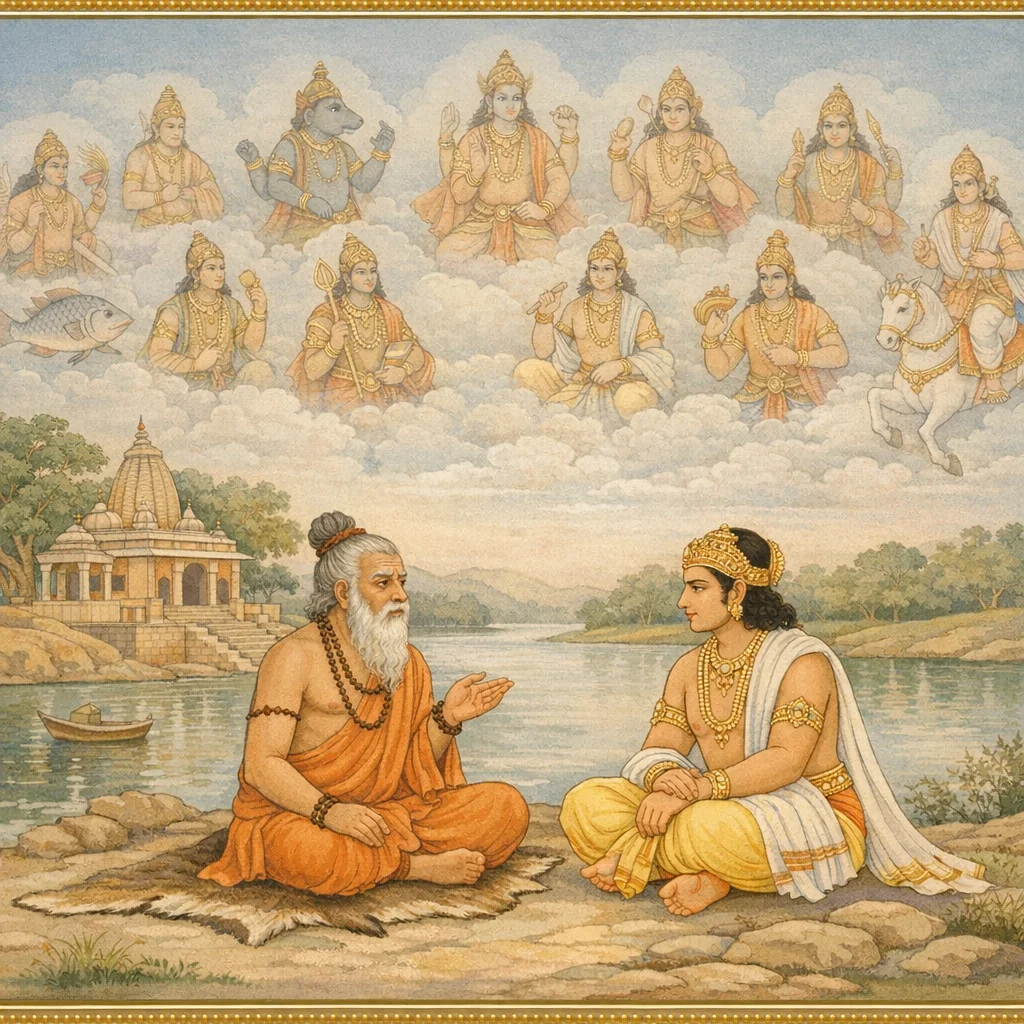
Adhyaya 151
जयवाराहतीर्थमाहात्म्य तथा दशावतारकथनम् (Jaya-Vārāha Tīrtha Māhātmya and the Account of the Ten Avatāras)
This adhyāya is cast as a dialogue in which Mārkaṇḍeya points out a greatly praised tīrtha on the northern bank of the Narmadā, associated with the name “Jaya-Vārāha.” Bathing there and receiving the darśana of Madhusūdana are said to cleanse sins, with special stress on the power of remembering or reciting the Lord’s ten divine births (daśa-janma). Yudhiṣṭhira then asks what deeds were performed in each of the ten avatāra manifestations, from Matsya to Kalki. Mārkaṇḍeya replies in a compact catalogue: Matsya rescues the submerged Vedas; Kūrma supports the churning of the ocean and steadies the earth; Varāha raises the earth from the nether realm; Narasiṃha destroys Hiraṇyakaśipu; Vāmana subdues Bali through measured strides and cosmic sovereignty; Paraśurāma chastises oppressive kṣatriya rulers and hands the earth to Kaśyapa; Rāma slays Rāvaṇa and restores righteous kingship; Kṛṣṇa descends to remove tyrannical rulers and foretells Yudhiṣṭhira’s success; Buddha is described as a later form that brings social-religious confusion in Kali-yuga; and Kalki is foretold as the tenth birth. The chapter closes by reaffirming that remembrance of the ten births destroys pāpa, weaving tīrtha-māhātmya together with avatāra theology and an ethical warning about decline in the age.
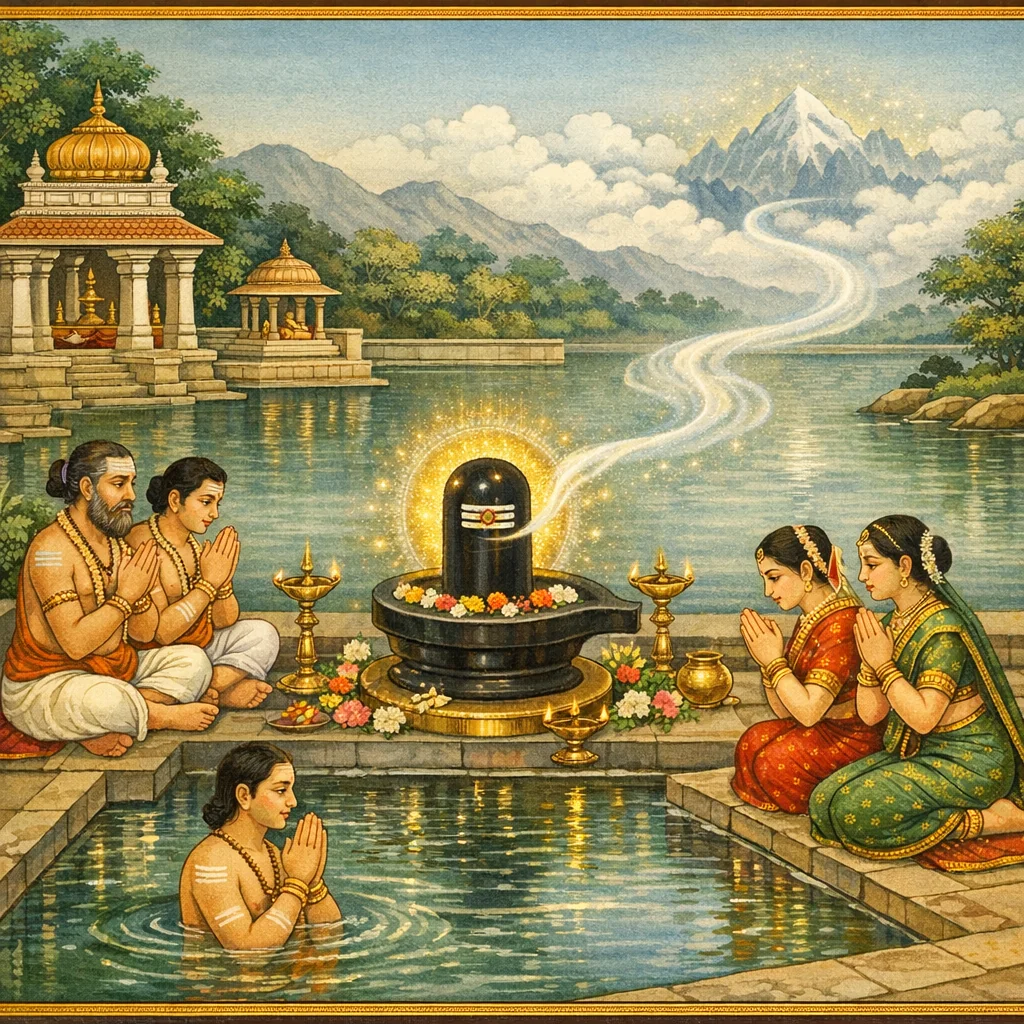
Adhyaya 152
भार्गलेश्वर-माहात्म्य (Bhārgaleśvara Māhātmya) — Merit of Worship and Final Passage at the Tīrtha
In this brief theological notice, Mārkaṇḍeya directs the pilgrim to proceed to the eminent shrine of Bhārgaleśvara. He proclaims Śaṅkara (Śiva) as “the life-breath of the world,” declaring that mere remembrance of Him destroys sin. The chapter then states two fruits tied to this tīrtha: (1) one who bathes there and worships Parameśvara gains the merit of an Aśvamedha sacrifice; (2) one who relinquishes life (prāṇatyāga) at that tīrtha attains an “anivartikā gati,” an irreversible course, and reaches Rudra-loka without doubt. Thus the Purāṇa presents devotion, sacred place, and remembrance as potent means of salvation within a Śaiva soteriology.
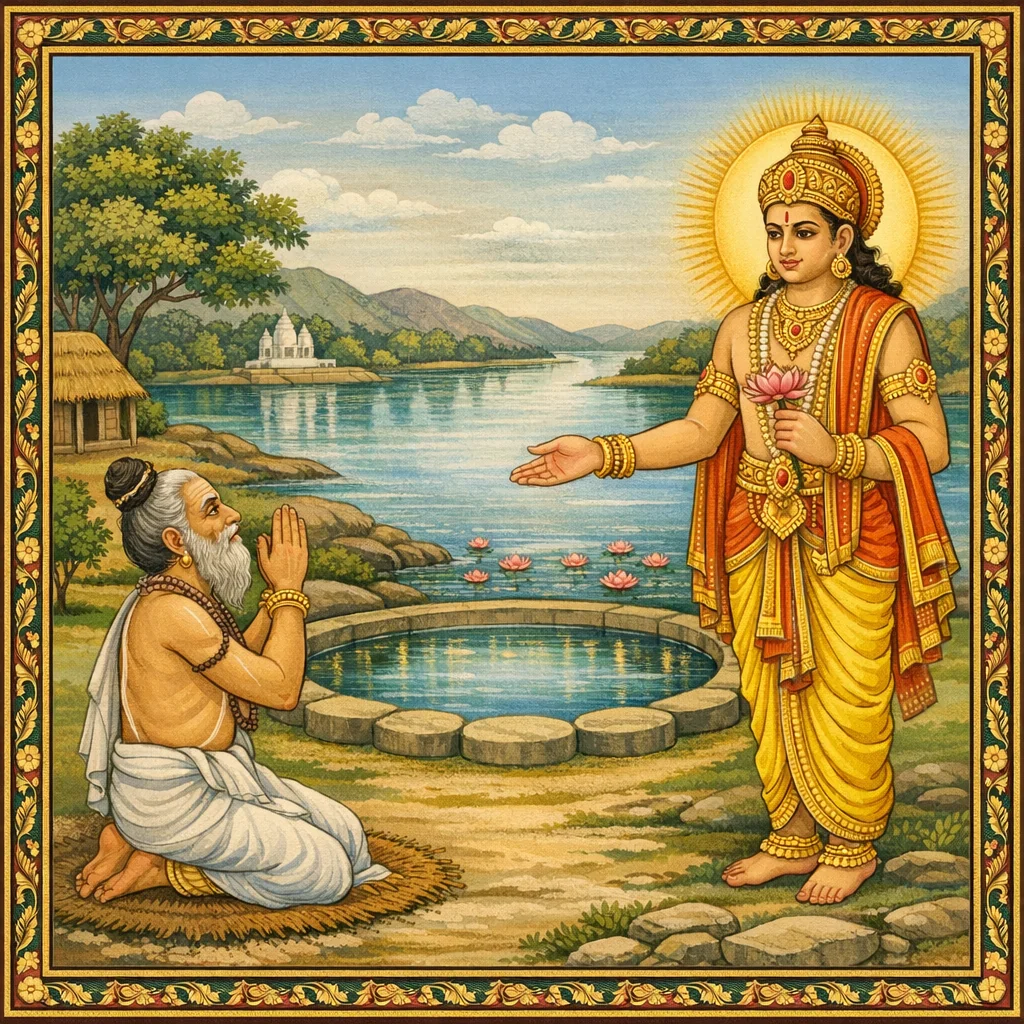
Adhyaya 153
रवितीर्थ-आदित्येश्वर-माहात्म्य (Ravi Tīrtha and Ādityeśvara: Theological Account and Merit Framework)
The chapter begins with Mārkaṇḍeya praising an “unsurpassed” Ravi Tīrtha, whose very sight is said to free one from sins. He sets out a scheme of merit: bathing at Ravi Tīrtha and beholding Bhāskara (the Sun) yields definite fruits; gifts and charity dedicated to Ravi, when properly bestowed upon a worthy Brahmin, give immeasurable results—especially at sacred times such as ayana, viṣuva, saṅkrānti, during solar or lunar eclipses, and at vyatīpāta. The Sun is taught as the “returner” of offerings, repaying gifts across time, even over many births, with merit graded by timing. When Yudhiṣṭhira asks why Ravi Tīrtha is exceptionally meritorious, Mārkaṇḍeya narrates its origin. In early Kṛtayuga, the learned Brahmin Jābāli repeatedly refuses conjugal union during his wife’s fertile period out of vow-observance; the distressed wife fasts and dies, and Jābāli, burdened by the resulting sin, is struck with a kuṣṭha-like skin disease and bodily decay. Seeking a cure, he learns of a Bhāskara Tīrtha on the Narmadā’s northern bank, linked with Ādityeśvara and famed for destroying all diseases; yet too ill to travel, he performs fierce austerities to bring Ādityeśvara to his own place. After a hundred years Sūrya grants a boon and manifests there, and the spot is proclaimed a tīrtha that removes sins and sorrows. A discipline is prescribed: for a full year, every Sunday one should bathe, perform seven circumambulations, offer worship, and gaze upon the Sun; this is said to quickly end skin diseases and to bestow worldly prosperity. Śrāddha performed there at saṅkrānti is declared to satisfy the ancestors, since Bhāskara is presented as connected with the Pitṛs. The chapter closes by reaffirming Ādityeśvara’s purifying and healing power.
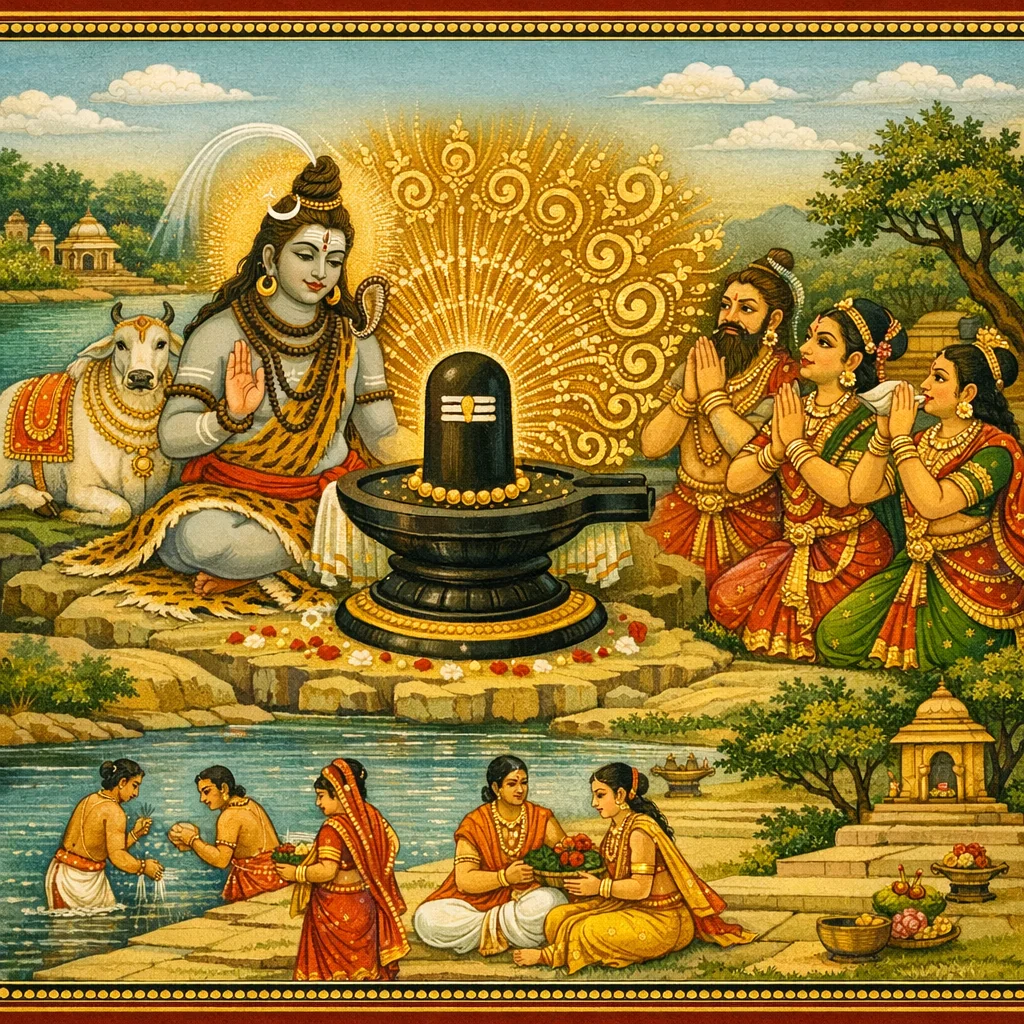
Adhyaya 154
कलकलेश्वरतीर्थमाहात्म्य (Glory of the Kalakaleśvara Tīrtha)
Voiced by Śrī Mārkaṇḍeya, this chapter points to a famed tīrtha called Kalakaleśvara on the southern bank of the Narmadā, said to be divinely established (svayaṃ devena nirmitam). In a Śaiva setting, after Mahādeva slays Andhaka in battle, devas, gandharvas, kinnaras, and great serpents honor Him amid resounding instruments and Vedic praises. The shrine’s name is explained as arising from the “kalakala” tumult made by the pramathas and bards at the very time the liṅga was installed. The prescribed rite teaches that bathing there and beholding Kalakaleśvara grants merit surpassing a Vājapeya sacrifice. The phalaśruti promises purification, ascent to heaven in a supreme chariot praised by apsarases, enjoyment of celestial delights, and eventual rebirth in a pure lineage as a learned, healthy, long-lived brāhmaṇa.
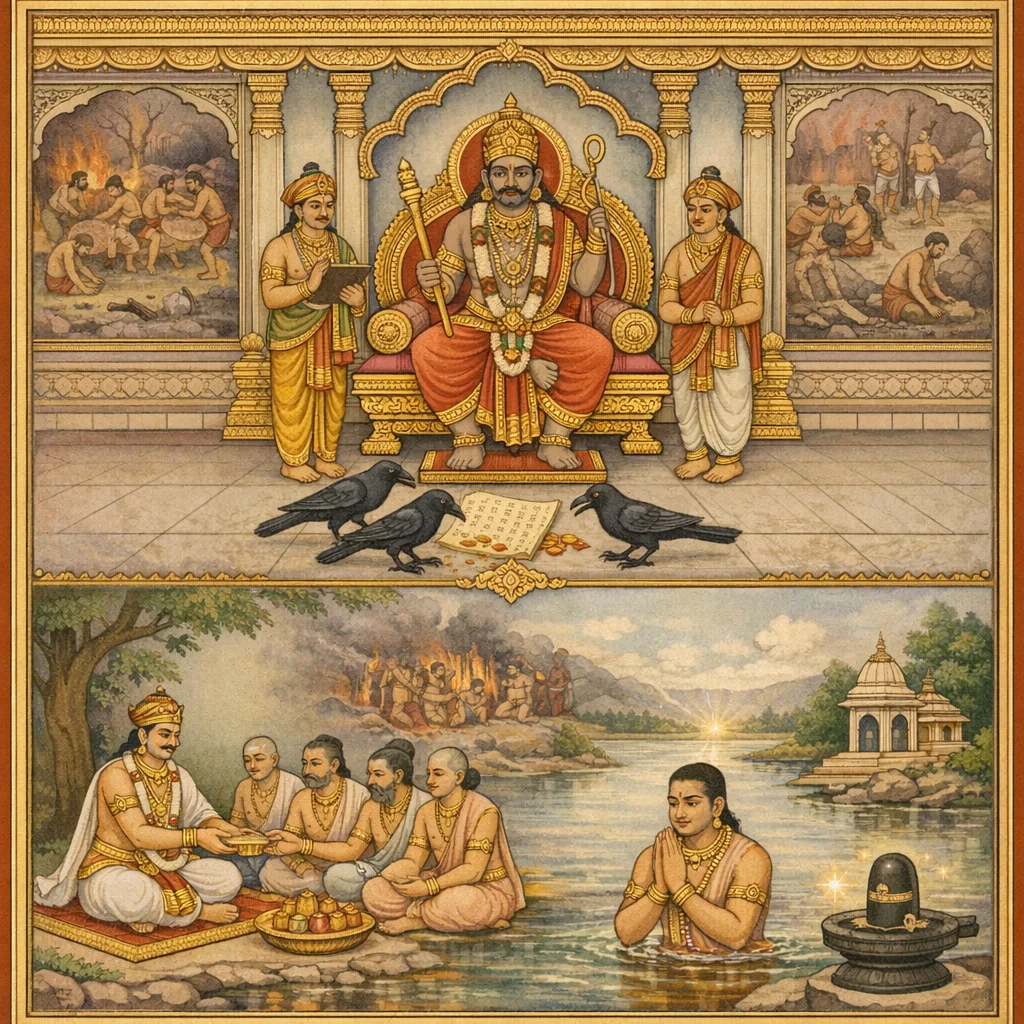
Adhyaya 155
शुक्लतीर्थमाहात्म्यम् (The Glory of Śukla Tīrtha on the Narmadā)
Chapter 155 is cast as a dialogue in which Mārkaṇḍeya points out Śukla Tīrtha on the northern bank of the Narmadā as an unsurpassed place of pilgrimage. A hierarchy of tīrthas is asserted, declaring that other holy places do not equal even a fraction of Śukla Tīrtha’s efficacy. This claim is grounded through three strands: doctrinal praise of the Narmadā as universally purificatory; an origin account in which Viṣṇu performs prolonged tapas at Śukla Tīrtha and Śiva manifests, consecrating a sacred zone that grants both worldly welfare and liberation; and an exemplum centered on King Cāṇakya. In that narrative, two cursed beings in crow-form are sent to Yama’s realm, where Yama proclaims that those who die at Śukla Tīrtha lie beyond his jurisdiction and attain a higher state without adjudication. The crows recount visions of Yama’s city, lists of hell-realms with their moral causality, and the enjoyment of dāna-fruits by donors. The chapter concludes with Cāṇakya renouncing passions, giving away his wealth, and attaining a Vaiṣṇava end after immersion at the tīrtha, reaffirming the chapter’s ethical and soteriological teaching.
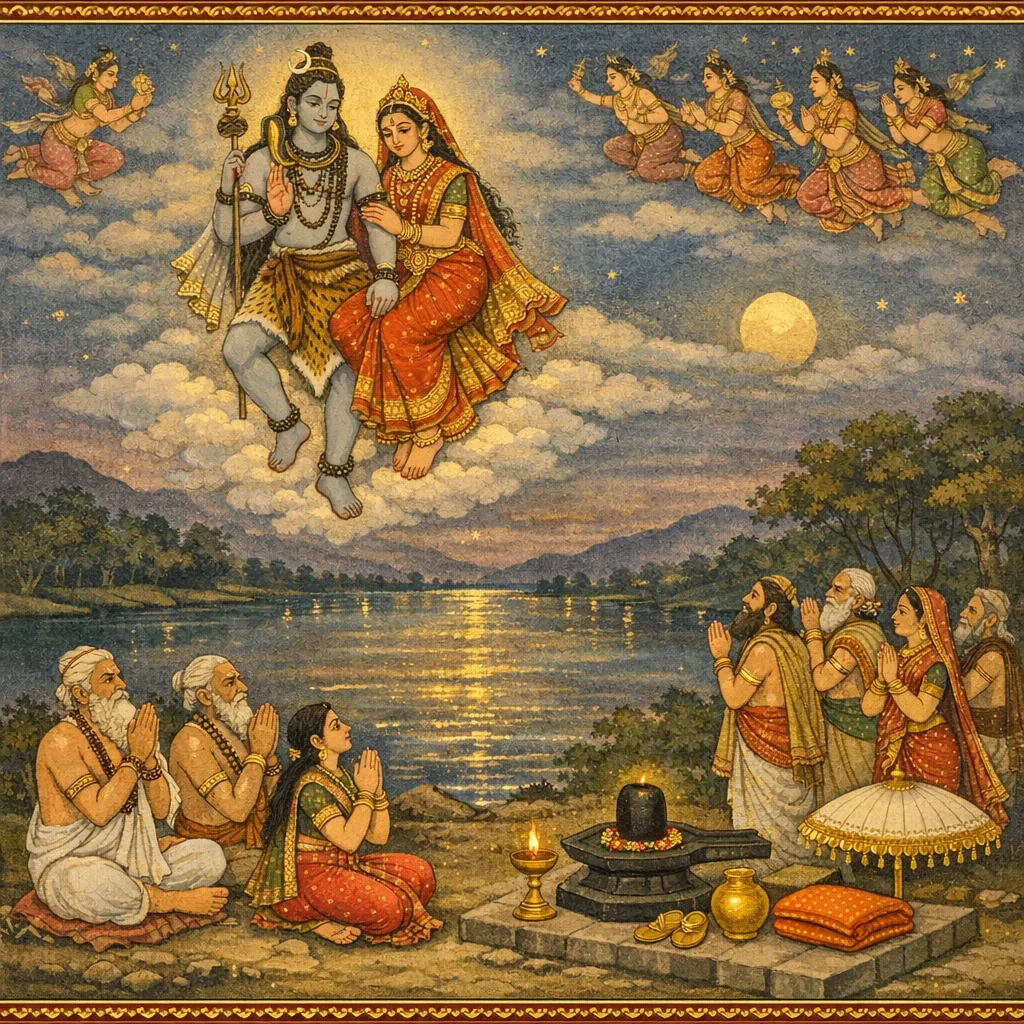
Adhyaya 156
शुक्लतीर्थमाहात्म्य (Śukla-tīrtha Māhātmya) — The Glory of Śukla Tīrtha on the Revā
Mārkaṇḍeya extols Śuklatīrtha on the Narmadā (Revā) as an unequalled place of pilgrimage, set on a directionally sloping terrain and frequented by sages. The chapter is framed by sacred time and divine manifestation: on Kṛṣṇapakṣa Caturdaśī—especially in Vaiśākha, and also emphasized in Kārttika—Śiva comes from Kailāsa with Umā, and after ritual bathing devotees are said to behold Him. Brahmā, Viṣṇu, Indra, and hosts of Gandharvas, Apsarases, Yakṣas, Siddhas, Vidyādharas, and Nāgas attend, sharing in the tīrtha’s purifying power. Again and again the text states an expiatory principle: bathing here is like cloth cleansed by a washerman, and even grave faults are removed through prescribed observances. Ancestor rites (tarpaṇa and offerings of Revā water) grant long satisfaction to the pitṛs. It further details gift-rituals—offering a ghee-soaked blanket, gold according to one’s means, and donations of footwear, umbrella, bed, seat, food, water, and grains—linking them to post-mortem destinations such as Śiva-loka/Rudra-loka, and in a distinct ascetic strand, Varuṇa’s city. Other practices include month-long fasting, circumambulation (equal to circumambulating the earth), vṛṣa-mokṣa (bull release), gifting an adorned maiden within one’s capacity, and worship of a “beautiful pair” dedicated to Rudra to prevent separation across births. The closing phalaśruti affirms that devoted hearing yields desired ends—offspring, wealth, or liberation—spoken in the authoritative tone of received tradition.
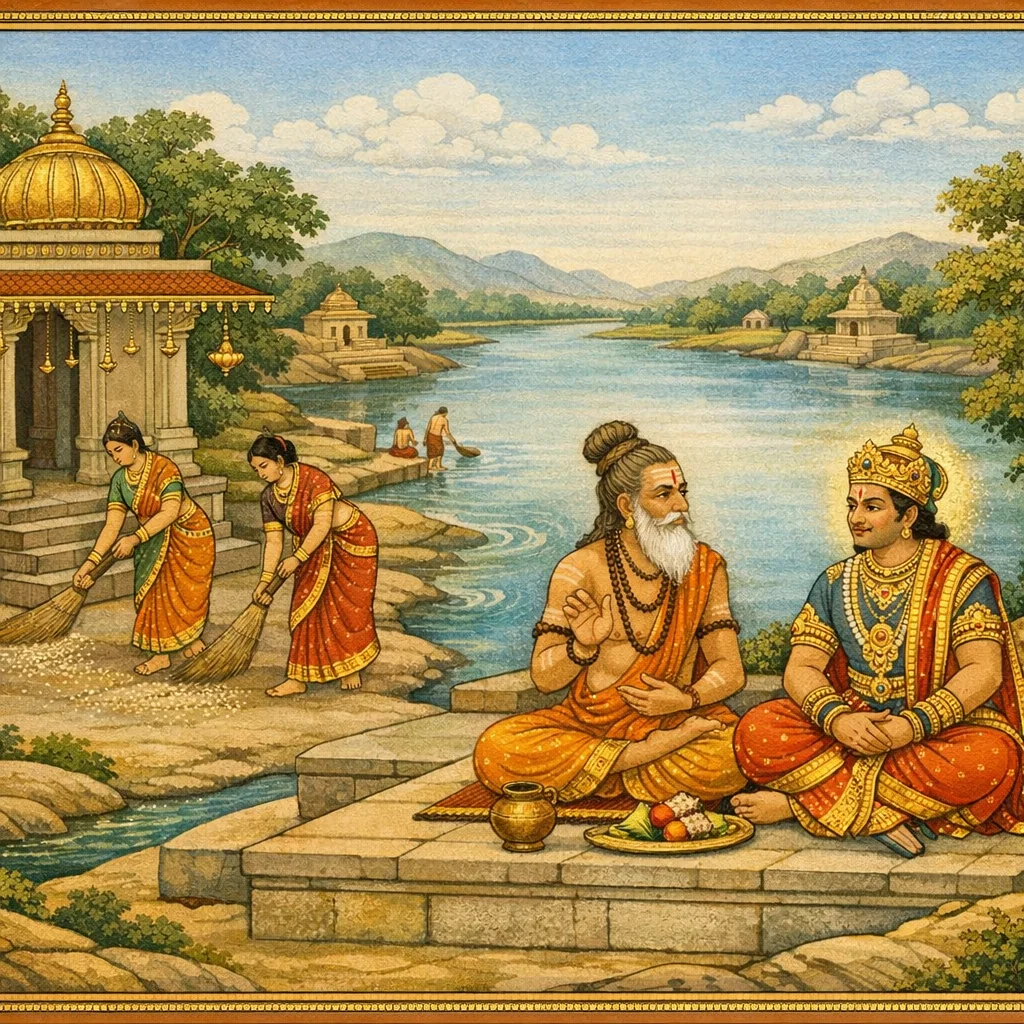
Adhyaya 157
हुङ्कारतीर्थ-माहात्म्य (Glory of Hūṅkāra Tīrtha and Vāsudeva’s Sacred Site)
This chapter records Mārkaṇḍeya’s teaching to a king near Śuklatīrtha and introduces the famed Vāsudeva-tīrtha on the Narmadā (Revā). It explains a sacred, name-giving event: by the mere utterance of “hūṅkāra,” the river is said to have shifted by a krośa, and the place becomes known as Hūṅkāra, with the bathing-spot called Hūṅkāratīrtha. Its theological focus is Vaiṣṇava devotion expressed through pilgrimage: bathing at Hūṅkāratīrtha and beholding the imperishable Acyuta is said to free one from demerit accumulated over many births. The text then offers ethical-devotional instruction—declaring that none rescues those sunk in saṃsāra like Nārāyaṇa, praising tongue, mind, and hands devoted to Hari, and calling blessed those with Hari established in the heart. It further claims that fruits sought through other deity-worship are gained by aṣṭāṅga-prostration to Hari, and that even incidental contact with temple dust or services such as sweeping, sprinkling, and plastering in the Lord’s abode destroy pāpa. A phalaśruti-like promise speaks of ascent to Viṣṇuloka and swift sin-dissolution even when a namaskāra lacks full sincerity. The chapter ends by stressing that deeds, good or otherwise, performed at Hūṅkāratīrtha endure in their consequences, highlighting the site’s heightened moral-ritual potency.
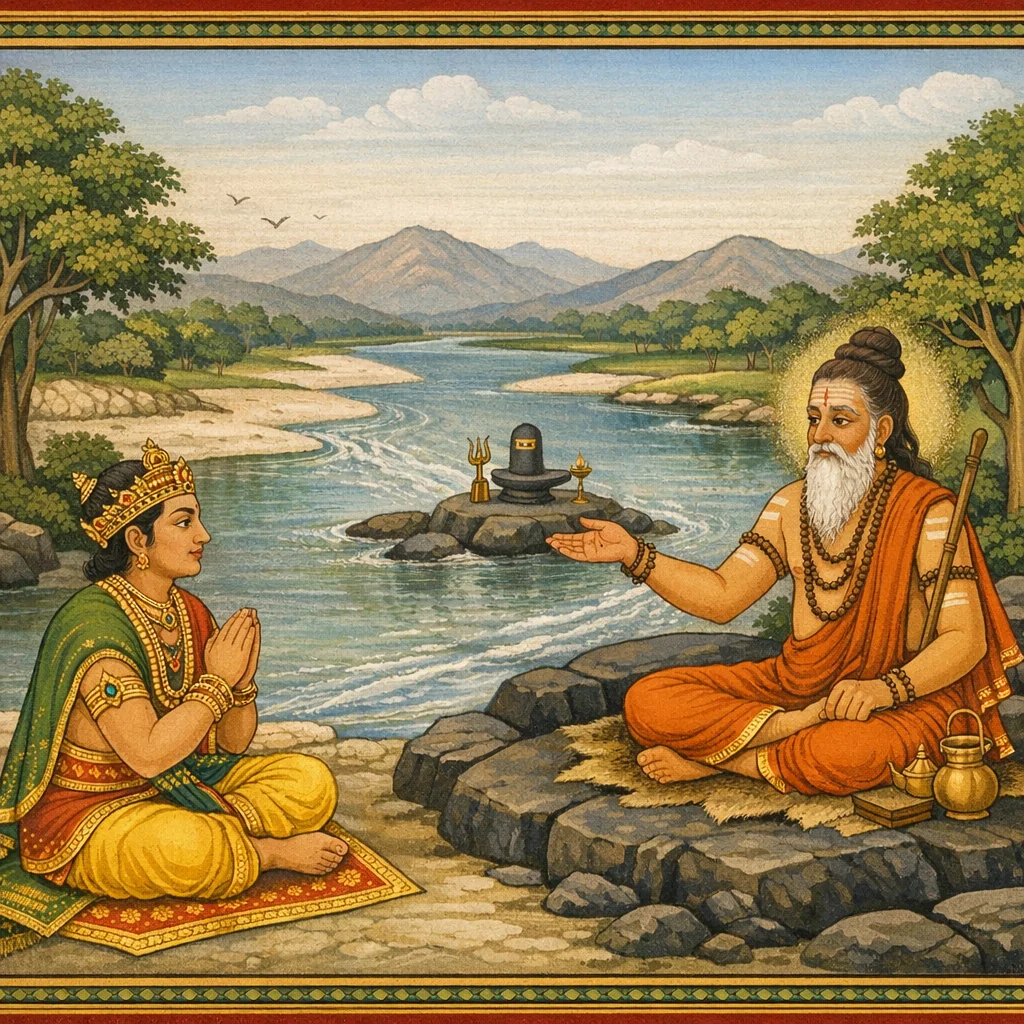
Adhyaya 158
Saṅgameśvara-Tīrtha Māhātmya (Glory of the Saṅgameśvara Confluence Shrine)
Chapter 158 records Mārkaṇḍeya’s theological and ritual instruction on the supreme tīrtha called Saṅgameśvara, on the southern bank of the Narmadā, praised as a remover of sin and fear. The sanctity of the site is first established through sacred geography and waters: a virtuous stream arising from the Vindhya joins the Narmadā at the confluence, and enduring signs—such as dark stones with crystalline brilliance—are cited as present testimony. The chapter then sets out graded devotional acts with their phalaśruti. Bathing at the confluence and worshiping Saṅgameśvara yields the merit of an Aśvamedha sacrifice; gifting ritual hangings like bells, banners, and canopies is linked to celestial conveyance and nearness to Rudra. “Filling” offerings to the liṅga with curd, coconut, and prescribed abhiṣeka substances (curd, honey, ghee) promise long residence in Śiva’s realm, heavenward results, and continuity of merit across multiple births (including “seven births” motifs). Ethical counsel accompanies ritual: Mahādeva is declared the supreme recipient (mahāpātra), brahmacarya-based worship is praised, and honoring Śiva-yogins is exalted—feeding even one such ascetic is said to surpass feeding multitudes of Veda-knowing brāhmaṇas. The chapter closes with an explicit salvific claim: relinquishing life at Saṅgameśvara prevents return; from Śivaloka there is no rebirth.
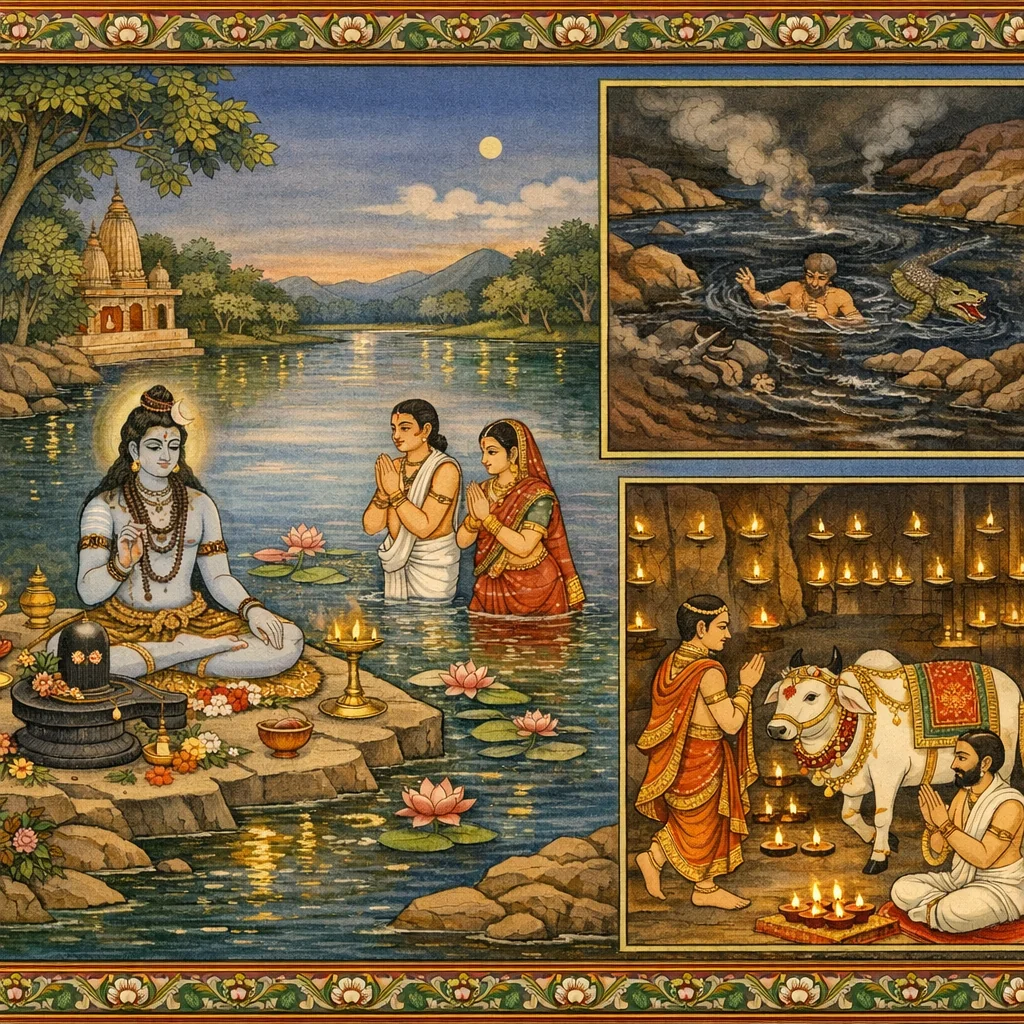
Adhyaya 159
नरकेश्वरतीर्थ-माहात्म्यं, वैतरणीदाना-विधानं च (Narakeśvara Tīrtha Glory and the Procedure of Vaitaraṇī-Gift)
The chapter begins with Mārkaṇḍeya directing the king to a rare, supremely purifying Narmadā tīrtha called Narakeśvara, praised as a protection against the dreadful vision of the “gateway of hell.” Yudhiṣṭhira then asks how beings, after undergoing the fruits of auspicious and inauspicious deeds, return with recognizable marks. Mārkaṇḍeya answers with an ordered account of karma, linking specific sins and moral failures to bodily defects, social deprivation, or non-human births, as a didactic register of ethical causality. The teaching turns to embodiment: the fetus’ formation month by month, the blending of the five elements, and the arising of faculties and senses under divine governance. The latter half describes the fearsome Vaitaraṇī river at Yama’s gate—foul, violent, and hard to cross—where suffering increases for those who dishonor mother, teacher, and guru, harm dependents, deceive in gifts and promises, and commit sexual and social transgressions. As a remedy it prescribes the Vaitaraṇī-dhenū dāna: fashioning and donating a properly adorned cow with mantras and circumambulation, so the river becomes “sukhavāhinī,” easy to ford. The chapter closes with calendrical guidance, especially Kṛṣṇa Caturdaśī in Āśvayuja, combining Narmadā bathing, śrāddha, night vigil, tarpaṇa, lamp-gift, feeding brāhmaṇas, and Śiva worship, promising release from naraka and attainment of exalted post-mortem states and favorable human rebirth.
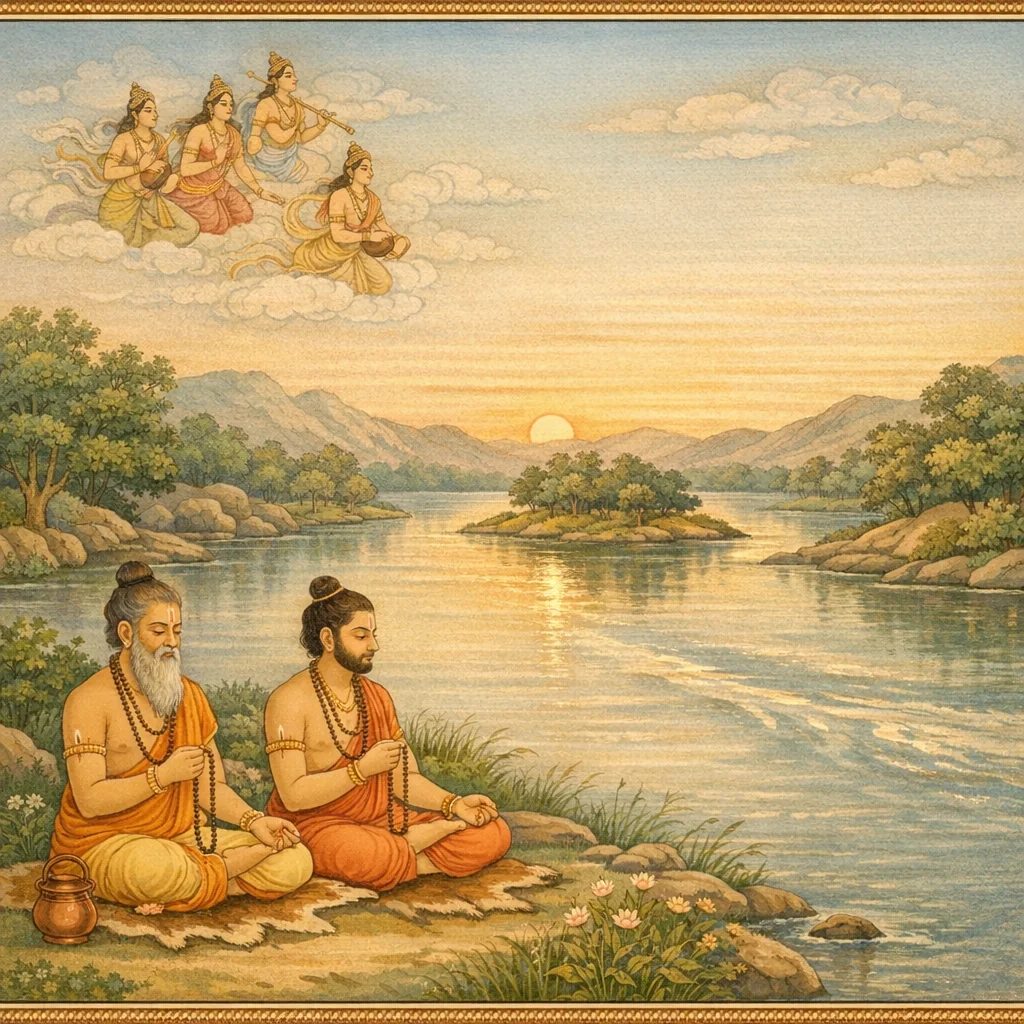
Adhyaya 160
मोक्षतीर्थमाहात्म्य (Mokṣatīrtha Māhātmya) — The Glory of the Liberation-Fording Place
Mārkaṇḍeya addresses a descendant of Pāṇḍu and directs him to the unsurpassed Mokṣatīrtha, a sacred ford frequented by devas, gandharvas, and ascetic sages. Many, he says, fail to recognize it through delusion born of Viṣṇu’s māyā, while accomplished ṛṣis have attained liberation there. A roll of eminent seers—Pulastya, Pulaha, Kratu, Prācetasa, Vasiṣṭha, Dakṣa, Nārada, and others—is given, followed by the claim that “seven thousand” great beings, together with their sons, reached mokṣa at this very tīrtha, establishing it as a giver of liberation. The chapter then points to a saṅgama: amid the current a river named Tamahā is said to fall in, and that confluence is praised as destroying all sins. Proper Gāyatrī japa there is equated with the fruits of extensive Vedic study (Ṛg/Yajus/Sāman), and gifts, oblations, and recitations performed at the site become imperishable, serving as a superior means to liberation. Finally, it declares that twice-born renunciants who die at this tīrtha attain a non-returning destiny (anivartikā gati) by the place’s power, concluding that the procedure has been stated briefly though the tīrtha’s fuller expanse is taught in the Purāṇa.
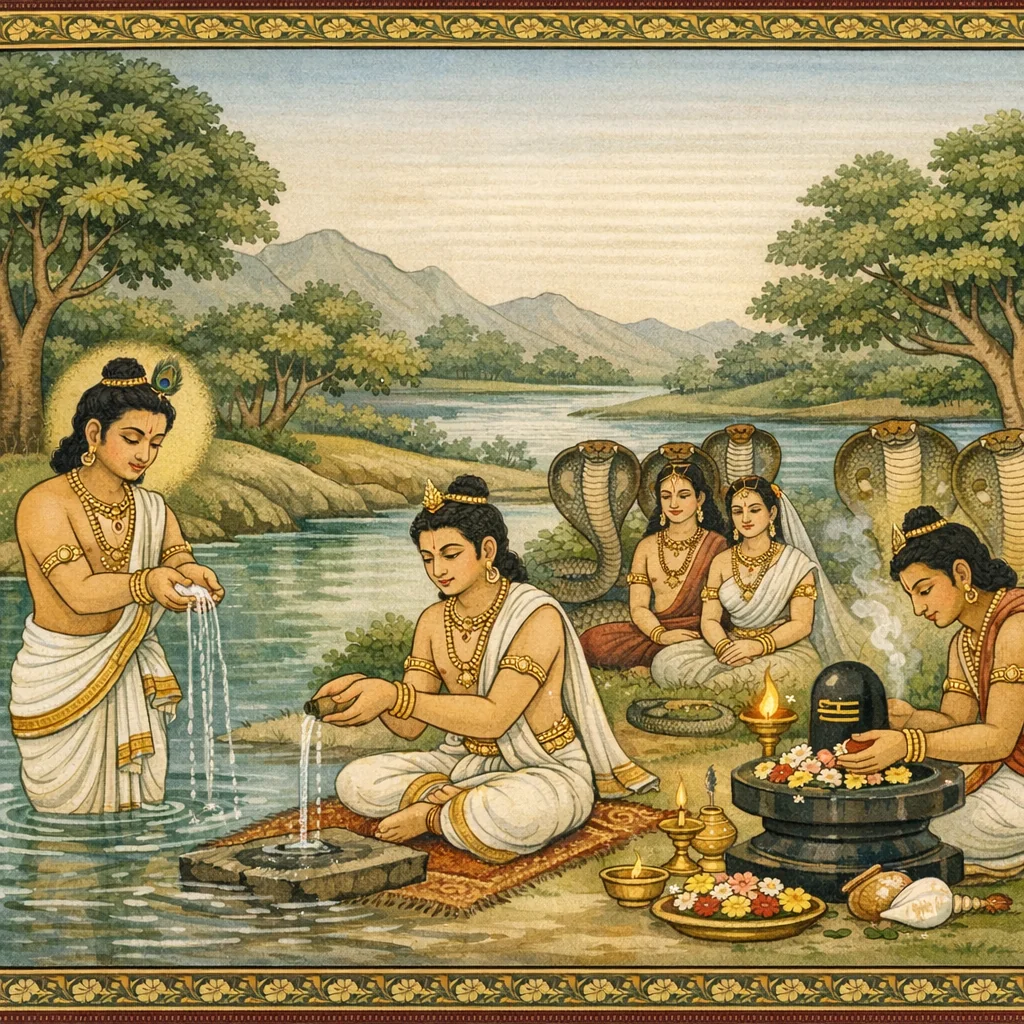
Adhyaya 161
सर्पतीर्थमाहात्म्य (Glory of Sarpa-tīrtha)
Chapter 161 records Mārkaṇḍeya’s counsel to King Yudhiṣṭhira on visiting Sarpa-tīrtha, an extraordinary sacred ford where great nāgas attained success through intense tapas. The chapter names renowned serpent beings—Vāsuki, Takṣaka, Airāvata, Kāliya, Karkoṭaka, Dhanañjaya, Śaṅkhacūḍa, Dhṛtarāṣṭra, Kulika, Vāmana, and their lineages—portraying the site as a living holy realm where ascetic accomplishment brings honor and delight. It then gives ritual and ethical instruction: bathing at Sarpa-tīrtha and offering tarpaṇa to ancestors and deities is said, by Śaṅkara’s earlier declaration, to yield merit equal to the Vājapeya sacrifice. A protective teaching follows, stating that those who bathe there become free from fear of snakes and scorpions. Finally, a specific observance for Mārgaśīrṣa kṛṣṇa aṣṭamī is prescribed: fasting and purity, filling a liṅga with sesame (tila), worship with fragrance and flowers, and then prostration with apology and atonement. The phalāśruti promises heavenly enjoyment in proportion to the sesame and offerings, and later rebirth in a pure family endowed with beauty, good fortune, and great wealth.
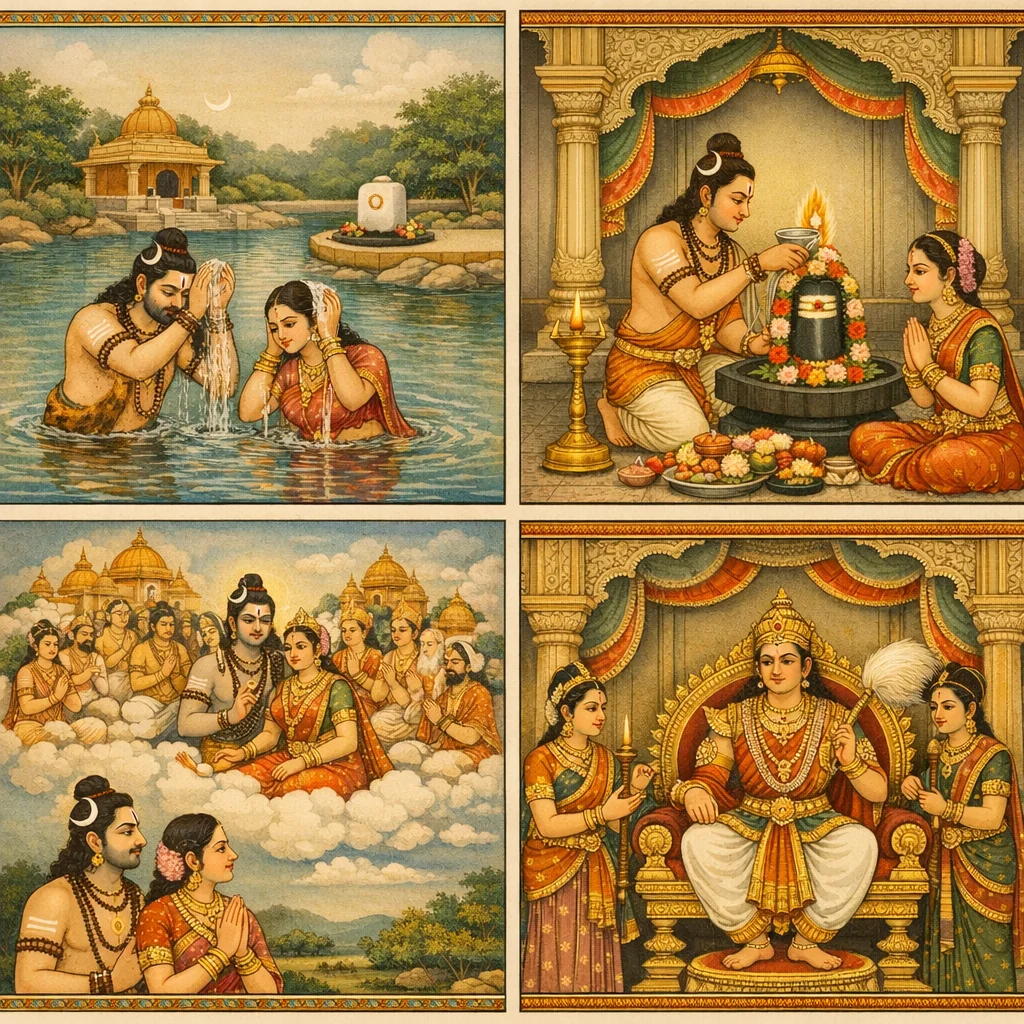
Adhyaya 162
गोपेश्वरतीर्थमाहात्म्य (Gopeśvara Tīrtha-Māhātmya)
This chapter gives a compact tīrtha-māhātmya in which Mārkaṇḍeya points to Gopeśvara as the next pilgrimage site after Sarpakṣetra, the Serpent-field. It sets out a graded path of purification tied to ritual: a single bath at this tīrtha is said to free a person from moral faults and sins (pātaka). An ethical boundary is then stated: one who bathes and afterward ends life by one’s own will is spoken of negatively; even if such a person reaches a Śiva-temple, they remain “connected with sin.” By contrast, bathing and then worshipping Īśvara brings release from all sins and entry into Rudra-loka. After enjoying bliss in Rudra-loka, the pilgrim is reborn as a righteous king. The worldly fruit (phala) is described as royal prosperity—elephants, horses, chariots, attendants, honor from other rulers, and a long, happy life—uniting ritual instruction, moral counsel, and phalaśruti in a pilgrimage-register style.
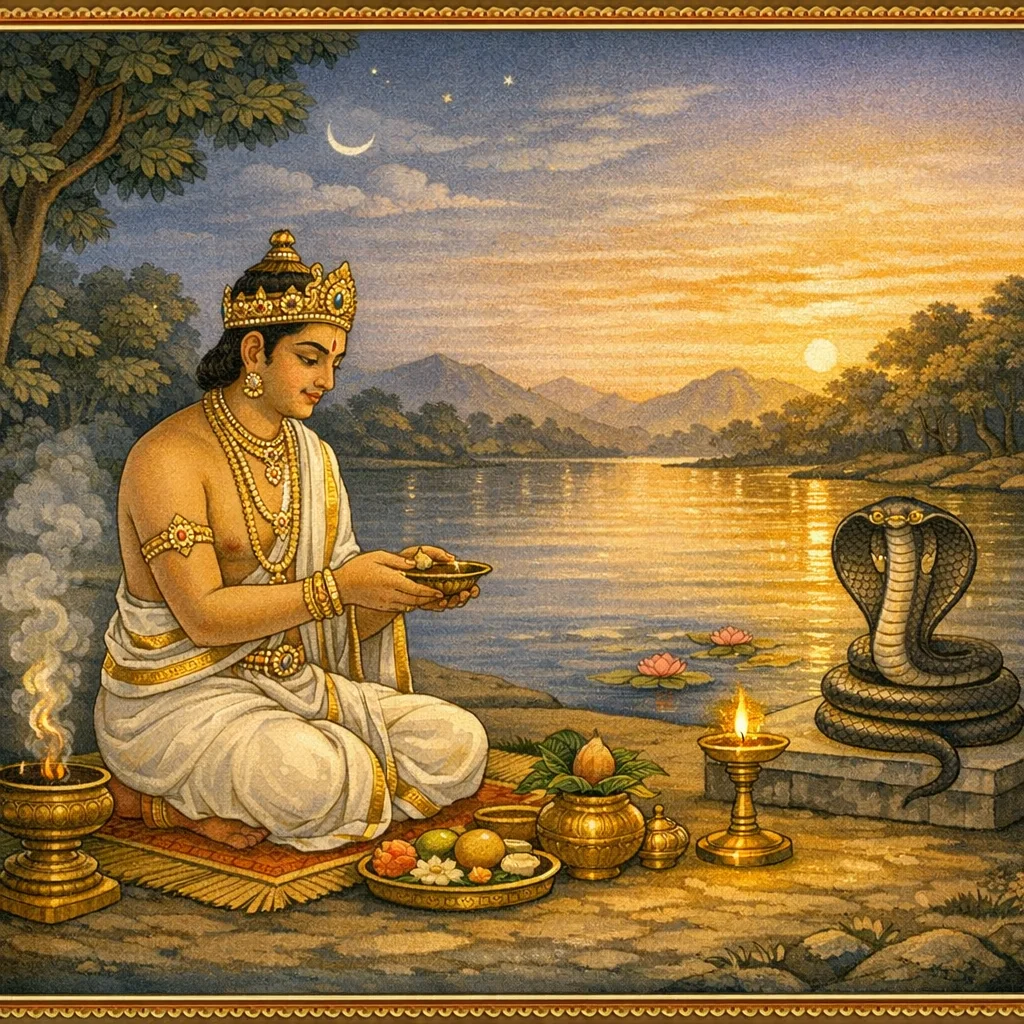
Adhyaya 163
नागतीर्थमाहात्म्य (Nāgatīrtha-māhātmya) — Observances at Nāga Tīrtha
Mārkaṇḍeya instructs a royal listener to go to the eminent Nāga Tīrtha and undertake a precisely timed observance in the bright fortnight of Āśvina, on the fifth lunar day (śukla-pañcamī). The chapter stresses purity, restraint, and disciplined conduct as the foundation. It lays out the ritual sequence: keep a night vigil (jāgaraṇa) with offerings of fragrance, incense, and fitting gifts; then, at dawn, bathe at the tīrtha in a purified state. Thereafter one should perform śrāddha according to rule (yathā-vidhi), fulfilling one’s duty to the ancestors. The discourse ends with the promised fruit: such practice is said to remove all sins, and it further declares—explicitly as Śiva’s word—that whoever relinquishes life at that tīrtha attains an irreversible destination (anivartikā gati). Thus calendrical discipline, devotional rite, and ancestral obligation are joined to the saving sacred geography of the Revā region.
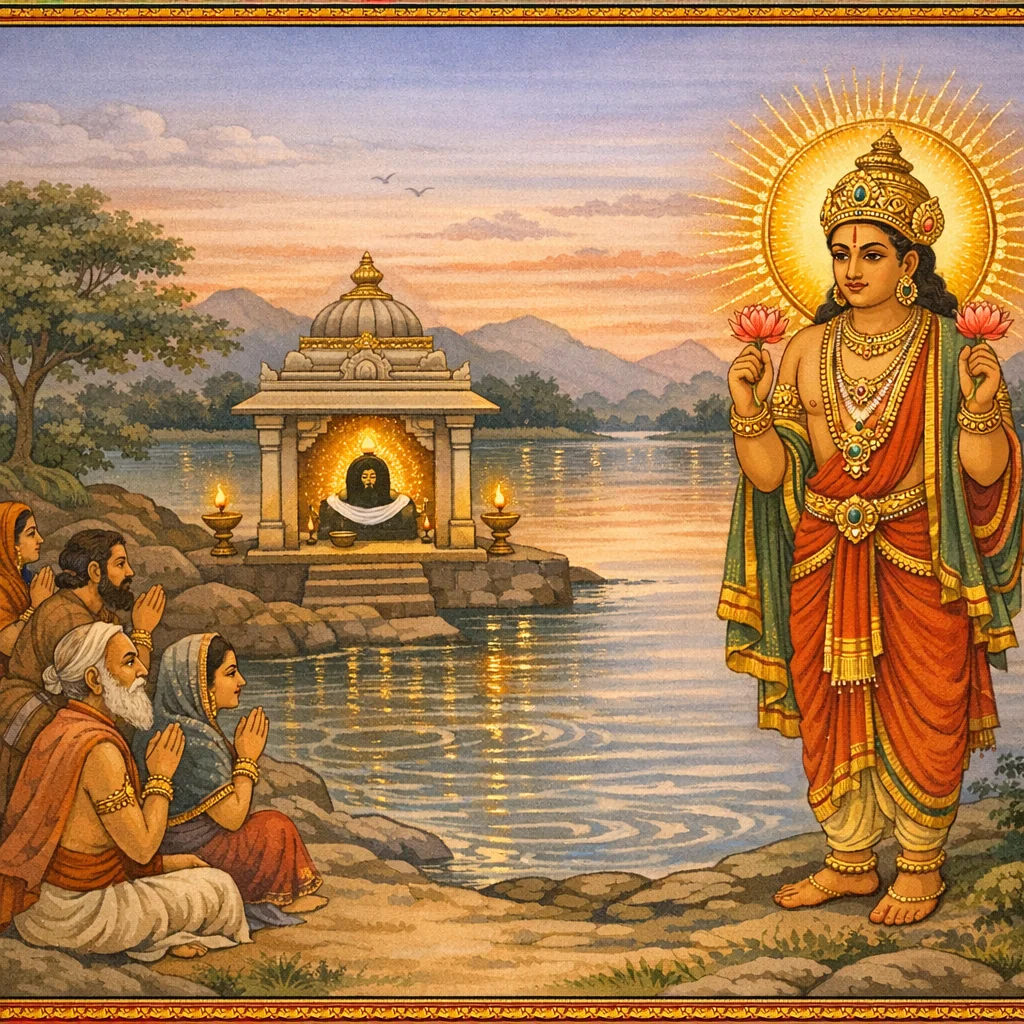
Adhyaya 164
सांवाौरतीर्थमाहात्म्य — The Māhātmya of the Sāṃvaura Tīrtha
Śrī Mārkaṇḍeya extols an ‘uttama’ pilgrimage site called Sāṃvaura, made unique by the special presence of Bhānu/Sūrya (the Sun), worshiped by devas and asuras alike. The tīrtha is portrayed as a refuge for those crushed by severe suffering—physical impairment, disease-like afflictions, abandonment, and social isolation—described as being “submerged in an ocean of sorrow.” Their protector is Sāṃvauranātha on the bank of the Narmadā, praised as the remover of distress (ārtihā) and destroyer of suffering. A discipline is prescribed: continuous bathing at the tīrtha for one month, together with worship of Bhāskara (the Sun). The merit is magnified through equivalence claims—likened to bathing in the seas of the various directions—and it is declared that sins accumulated in youth, adulthood, and old age are destroyed by bathing alone. Further fruits include freedom from disease, poverty, and separation from what one desires, extending across seven births. Fasting on Saptamī (the seventh lunar day) and offerings such as arghya with red sandal are especially lauded. The waters of the Narmadā are praised as universally sin-destroying, and those who bathe and behold Sāṃvaureśvara are called blessed, with the concluding promise of dwelling in the Sun-world until cosmic dissolution.
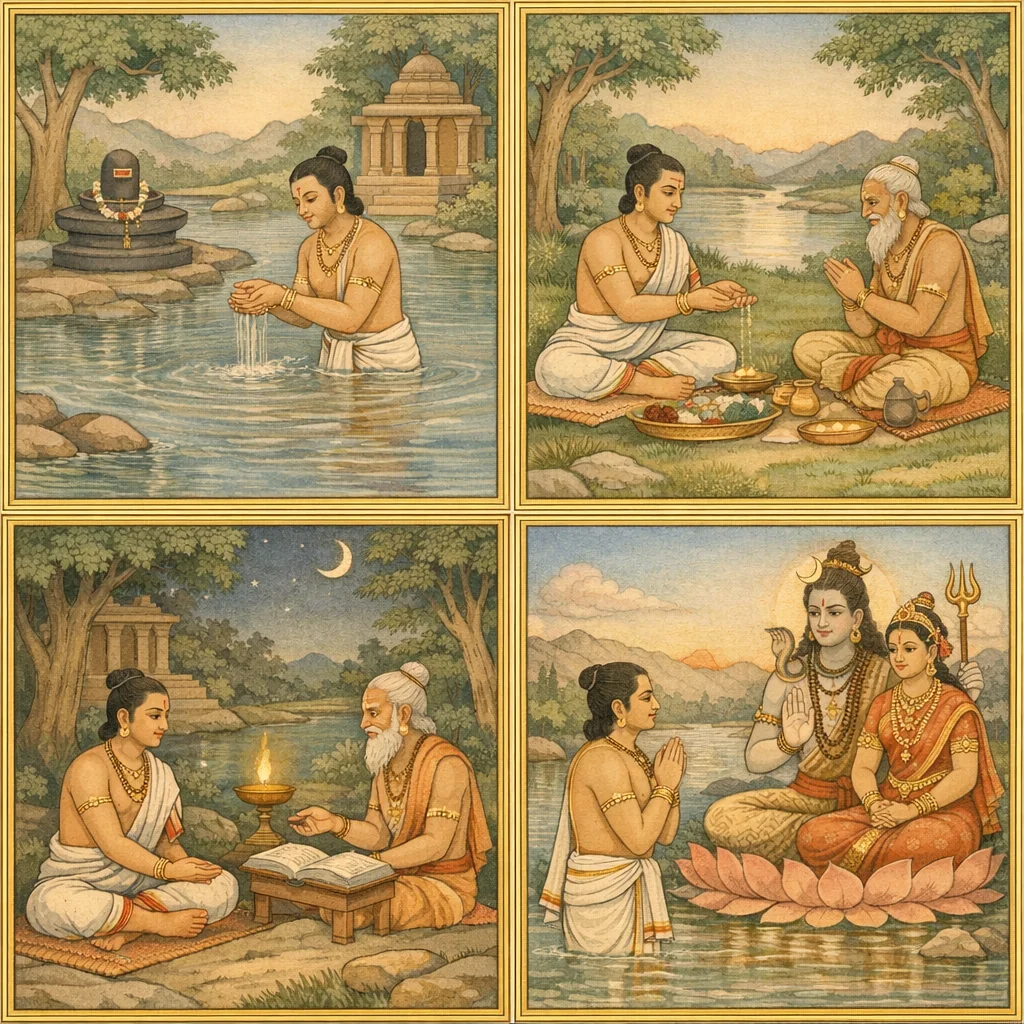
Adhyaya 165
सिद्धेश्वरतीर्थमाहात्म्य (Siddheśvara Tīrtha—Glory and Observances)
Mārkaṇḍeya describes a famed tīrtha called Siddheśvara on the southern bank of the Narmadā, extolling it as supremely purifying among sacred fords. He prescribes the proper sequence of rites: bathing at the tīrtha, offering tarpaṇa (water-libations) to the pitṛs and the deities, and performing śrāddha for one’s ancestors. A specific fruit is declared—śrāddha done there grants ancestral satisfaction for twelve years. The chapter then sets forth a Śaiva devotional observance: bathe with faith, worship Śiva, keep nocturnal vigil (jāgaraṇa), recite or hear purāṇic narration, and bathe again at the pure dawn according to rule. Its culmination is salvific: the devotee “beholds” Girijā-kānta (Śiva, consort of Pārvatī) and attains an exalted state. Finally, the tīrtha’s sanctity is affirmed by recalling ancient siddhas and sages such as Kapila—yogic adepts said to have attained supreme siddhi through the sacred potency of the Narmadā.
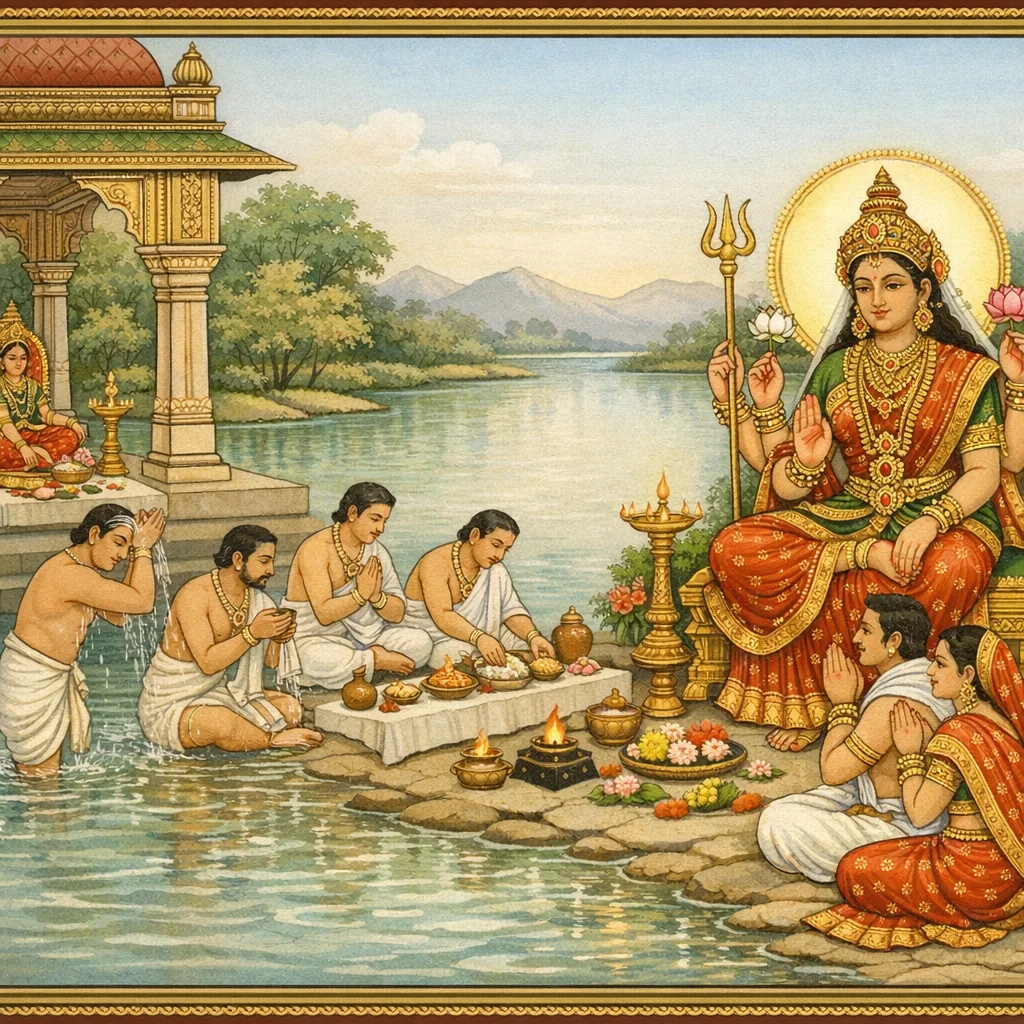
Adhyaya 166
Siddheśvarī-Vaiṣṇavī Tīrtha Māhātmya (सिद्धेश्वरी-वैष्णवी तीर्थमाहात्म्य) — Ritual Merits of Seeing and Worship
Mārkaṇḍeya describes a sacred tīrtha where the Goddess is revered as Siddheśvarī and also as Vaiṣṇavī, praised as the destroyer of moral impurity and the remover of sins (pāpa-nāśinī). Here, auspicious darśana—beholding the Devī—and proper ritual practice are declared especially meritorious. The chapter sets out a practical ritual order: bathe at the tīrtha, perform worship with offerings including rites for the ancestors and the deities (pitṛ-devatāḥ), and then approach the Devī with devotion. It proclaims the fruits: the devoted beholder is freed from sins; women who have lost children or are barren regain progeny; and men and women who bathe at the saṅgama (confluence) receive a son and wealth. The Goddess’s protective power is emphasized: she safeguards lineage and gotra (gotra-rakṣā) and continually protects children and the community when duly worshiped. Observances are prescribed for Aṣṭamī and Caturdaśī, and a distinct regimen for Navamī—bathing, fasting/discipline (upavāsa implied), and worship with intention purified by faith (śraddhā-pūta). The conclusion promises attainment of a supreme realm, difficult even for the gods, presenting the tīrtha as both ritual-ethical and liberating in scope.
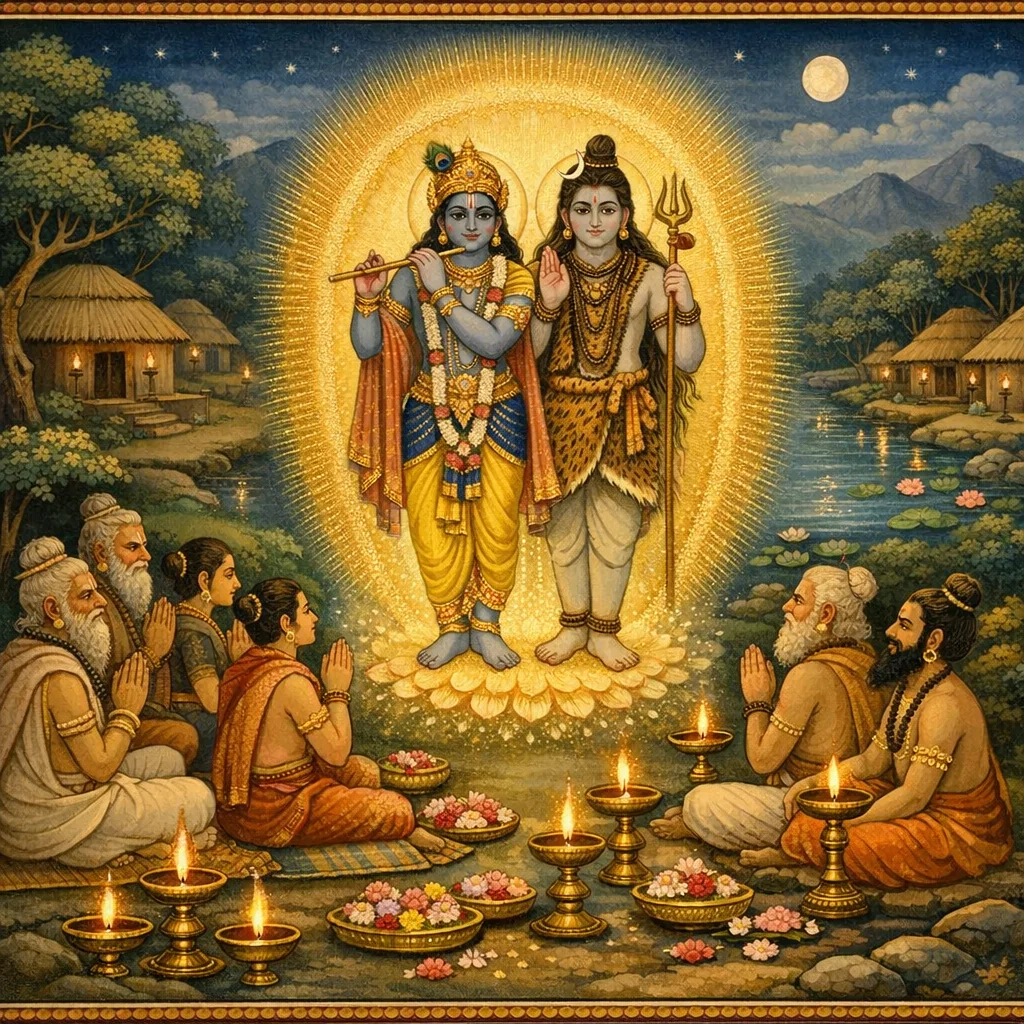
Adhyaya 167
Mārkaṇḍeya Tīrtha on the Southern Bank of the Narmadā (Śaiva–Vaiṣṇava Installation and Vrata Protocols)
Chapter 167 unfolds as a tīrtha inquiry: Yudhiṣṭhira asks Mārkaṇḍeya to point out a sign-marked riverbank holy place and tell its origin. Mārkaṇḍeya recalls his earlier ascetic dwelling near the Vindhya and Daṇḍaka region, then his return to the southern bank of the Narmadā, where he founds an āśrama inhabited by disciplined brahmacārins, householders, vānaprasthas, and yatis. After long tapas and devotion to Vāsudeva, two boon-bestowing deities—Kṛṣṇa and Śaṅkara—appear to him; he petitions them to abide there forever, youthful and free from illness, with their divine retinues. They consent and become unmanifest, whereupon Mārkaṇḍeya installs Śaṅkara and Kṛṣṇa and establishes their worship at the site. The chapter then gives ritual prescriptions: bathing at the tīrtha and worship of Parameśvara, especially under the name Mārkaṇḍeśvara, alongside honoring Viṣṇu as lord of the three worlds. It details offerings of ghee, milk, curd, honey, Narmadā water, fragrance, incense, flowers, and naivedya, with night-vigil (jāgara) and observance in the bright fortnight of Jyeṣṭha through fasting and pūjā. It also includes śrāddha/tarpaṇa for ancestors, sandhyā worship, Vedic mantra-japa (Ṛg/Yajus/Sāman), and a Rudra-mantra rite: placing a kalaśa to the south of the liṅga and bathing it with “Rudra-ekādaśa” mantras, promising progeny and long life. The phalaśruti concludes that hearing or reciting this account purifies sins and yields liberation-oriented fruits in both Vaiṣṇava and Śaiva terms.
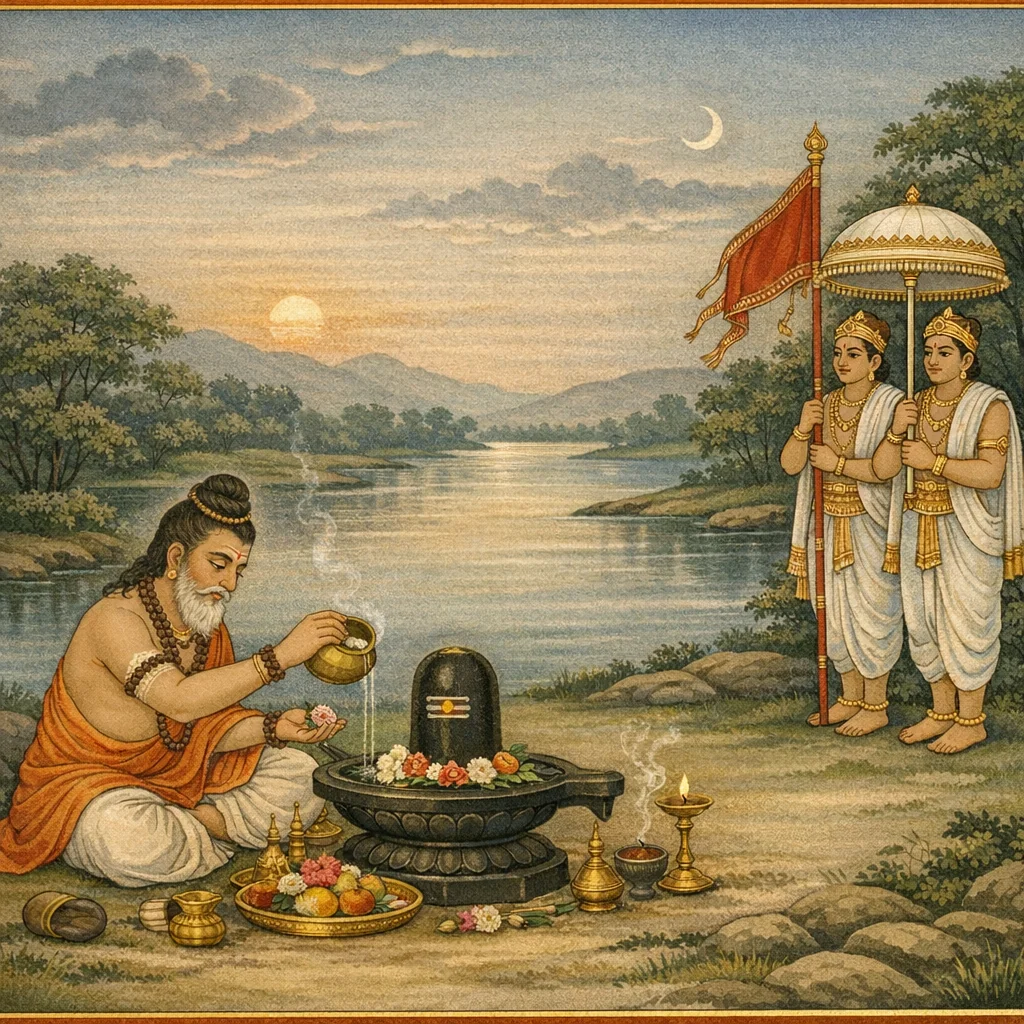
Adhyaya 168
अङ्कूरेश्वरतीर्थमाहात्म्य — The Glory and Origin of Aṅkūreśvara Tīrtha
The chapter unfolds as a dialogue in which Mārkaṇḍeya points out a supreme tīrtha on the southern bank of the Narmadā—Aṅkūreśvara, famed in the three worlds. When Yudhiṣṭhira asks about the rākṣasa connected with the site, a lineage is narrated: from Pulastya and Viśravas to Vaiśravaṇa (Kubera), then to Kaikasī’s sons—Rāvaṇa, Kumbhakarṇa, Vibhīṣaṇa—on to Kumbhakarṇa’s descendants Kumbha and Vikumbha, and finally to Aṅkūra, son of Kumbha. Aṅkūra, aware of his birth and observing Vibhīṣaṇa’s dharmic bent, undertakes severe austerities in all directions and at last on the Narmadā. Śiva appears and offers a boon; Aṅkūra asks (1) the difficult gift of immortality and (2) Śiva’s abiding presence at the tīrtha under Aṅkūra’s name. Śiva grants conditional nearness, to last so long as Aṅkūra maintains conduct aligned with Vibhīṣaṇa’s dharmic stance. After Śiva departs, Aṅkūra ritually establishes the Aṅkūreśvara liṅga and performs grand worship with offerings, banners, umbrellas, and auspicious acclamations. The chapter then prescribes pilgrimage discipline: bathing, sandhyā, japa, tarpaṇa to ancestors/deities/humans, fasting on Aṣṭamī or Caturdaśī, and regulated silence. It declares graded fruits—worship equal to an Aśvamedha, inexhaustible merit from properly offered dāna, and multiplied results for homa, japa, upavāsa, and snāna—extending salvation even to non-human beings who die at the tīrtha. It closes with a phalaśruti promising access to Śiva’s realm for those who hear with faith.
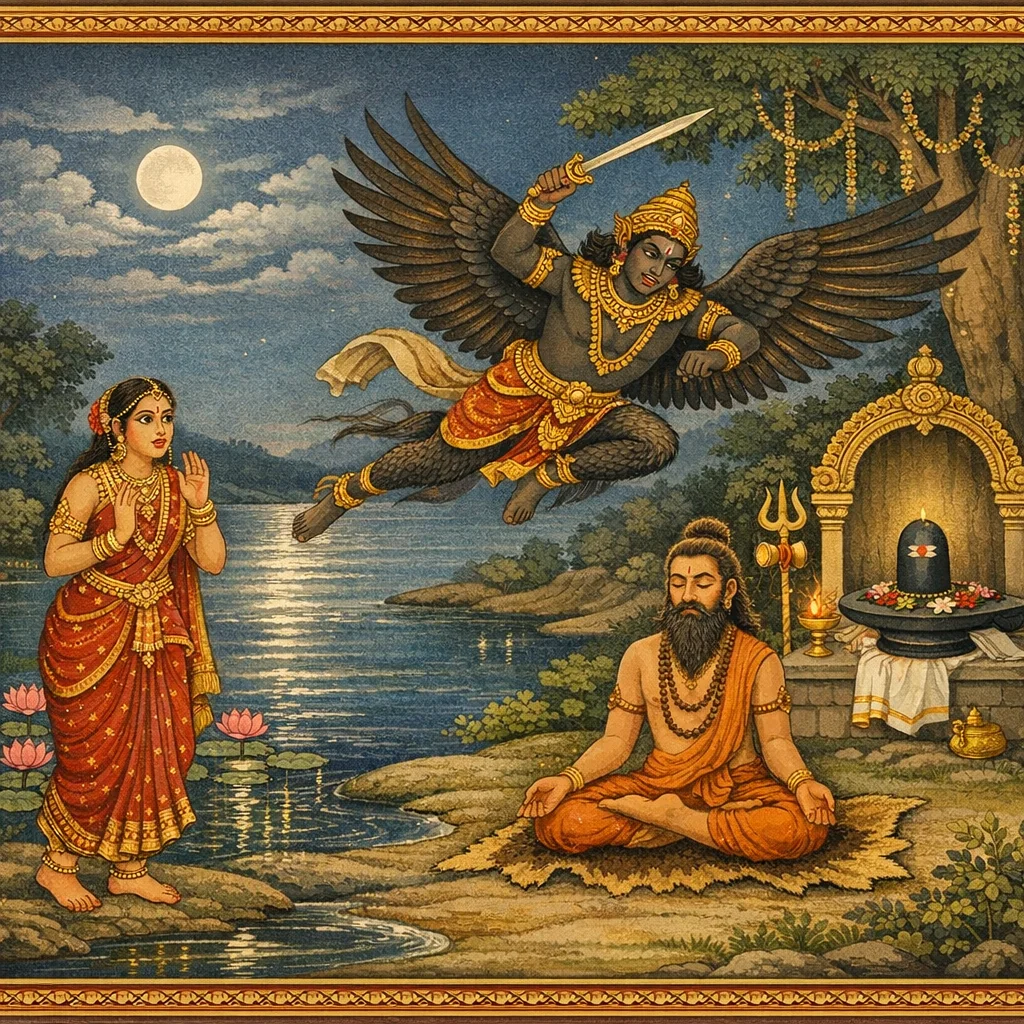
Adhyaya 169
माण्डव्यतीर्थमाहात्म्य-प्रस्तावः (Mandavya Tīrtha: Prologue to the Sacred Narrative)
The chapter opens with Mārkaṇḍeya pointing to a tīrtha of supreme merit, praised as pāpa-pranāśana, the destroyer of sins, and connected with the sage Māṇḍavya and with Lord Nārāyaṇa. He recalls an earlier episode of devoted service (śuśrūṣā) to Nārāyaṇa while “on a stake” (śūla-stha), a striking detail that astonishes Yudhiṣṭhira and prompts him to request the full account. Mārkaṇḍeya then begins a retrospective legend from the Tretā-yuga. King Devapanna—righteous, generous, and a protector of his people—though prosperous, grieves for want of offspring. With his queen Dātyāyanī he undertakes twelve years of disciplines: ritual bathing, homa, fasting, and vows, hymning the goddess Cāmuṇḍā. She grants an audience but declares that progeny will come only through worship of the Yajñapuruṣa; the king performs the rite, and a radiant daughter is born, named Kāmapramodinī. As the princess matures, her beauty is described in detail. During a visit to worship the goddess, she and her companions sport in a pond; the rākṣasa Śambara, assuming a bird-form, abducts her and seizes her ornaments. As he departs, some ornaments fall into waters near the Narmadā bank where Māṇḍavya abides in deep ascetic absorption at a Maheśvara-sthāna aligned with Nārāyaṇa’s highest station; the chapter closes by noting Māṇḍavya’s brother/attendant engaged in service and meditation on Janārdana, setting the stage for the tīrtha’s ensuing sacred narrative.
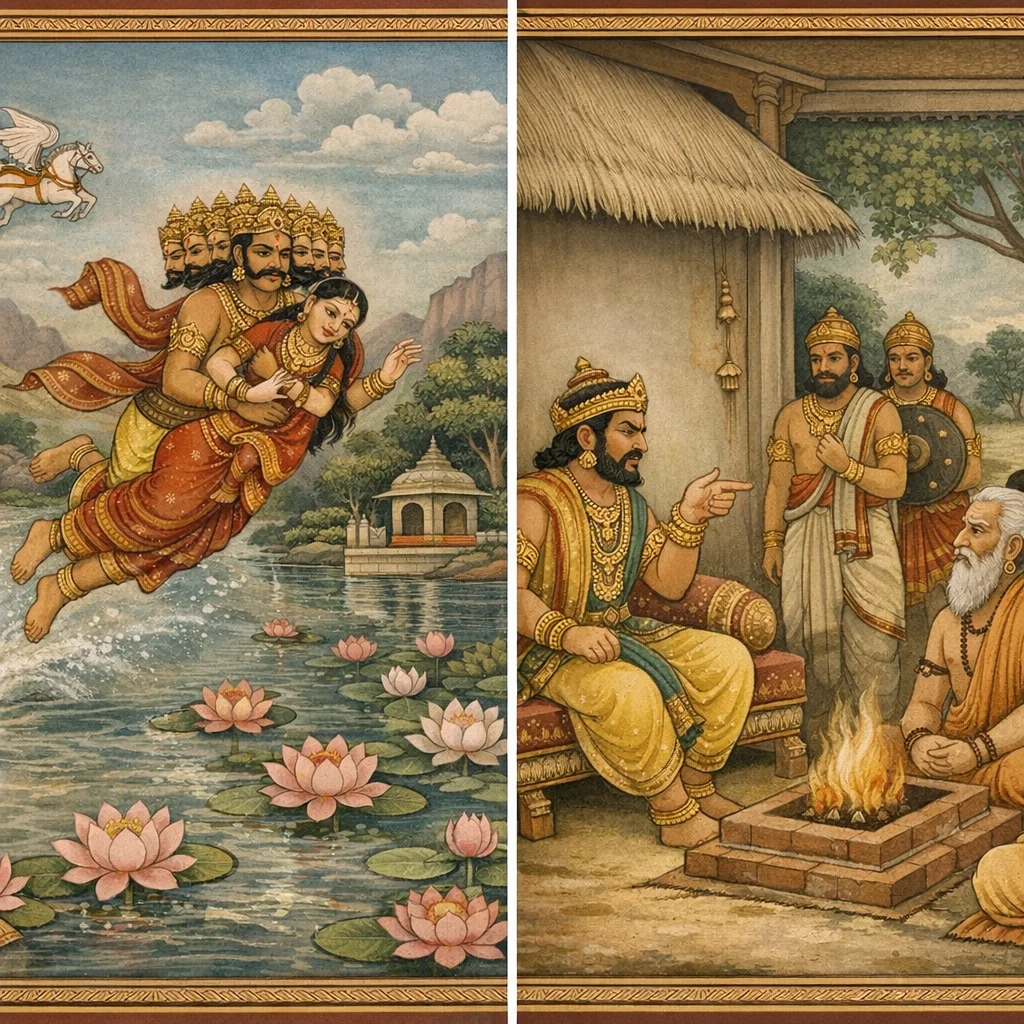
Adhyaya 170
कामप्रमोदिनी-हरणं तथा तपस्वि-दण्डविधान-विपर्यासः (Abduction of Kāmapramodinī and the Misapplied Punishment of an Ascetic)
Mārkaṇḍeya recounts a crisis arising at a sacred water-site (tīrtha). Kāmapramodinī, sporting in a tank near a divine presence, is seized by a bird (a śyena) and carried away. Her companions report the abduction to the king and urge an immediate search. The king mobilizes a vast fourfold army, and the city churns with martial preparations. A city-guard then produces the abducted woman’s ornaments and says they were seen near the hermitage of the ascetic Māṇḍavya, amid tapasvins. Blinded by anger and misrecognition, the king takes the ascetic for a disguised thief who assumed bird-form to escape, and—without discerning what is proper and improper (kārya–akārya-viveka)—orders the brahmin-ascetic to be impaled. Citizens and villagers lament and protest that a brahmin, especially one devoted to austerity, must not be executed; at most, exile is fitting even under accusation. The chapter thus highlights rājadharma under strain: the peril of rash punishment, uncertain evidence, and the heightened duty to protect ascetic sanctity within the tīrtha landscape.
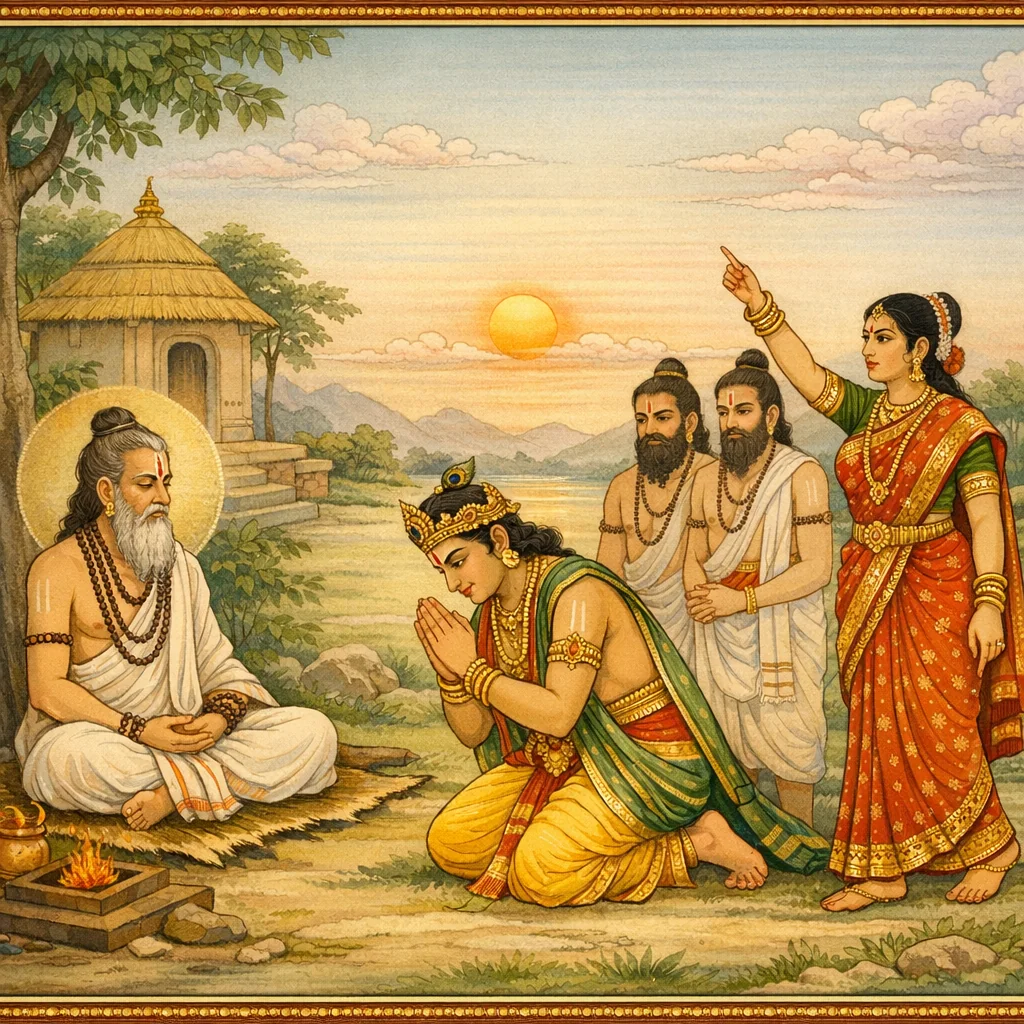
Adhyaya 171
माण्डव्य-शूलावस्था, कर्मविपाकोपदेशः, शाण्डिली-सत्यव्रत-प्रसङ्गश्च (Māṇḍavya on the Stake: Karmic Consequence Teaching and the Śāṇḍilī Episode)
This adhyāya unfolds as a multi-voiced theological discourse within Mārkaṇḍeya’s narration. A council of sages—Nārada, Vasiṣṭha, Jamadagni, Yājñavalkya, Bṛhaspati, Kaśyapa, Atri, Bharadvāja, Viśvāmitra, and others—approaches Nārāyaṇa after witnessing the ascetic Māṇḍavya impaled upon a stake (śūla). Though Nārāyaṇa turns toward punishing the king, Māṇḍavya restrains him and redirects the inquiry to karma-vipāka, the ripening of deeds. Māṇḍavya teaches that suffering arises from prior conduct and that each being experiences the results of one’s own actions, illustrated by analogies such as a calf finding its mother among many cows. He identifies the karmic seed of his present agony as a minor youthful act—placing a louse upon a thorn- or needle-like point—thereby affirming a rigorous ethic of accountability. The teaching expands into moral guidance: neglect of dāna, snāna, japa, homa, honoring guests, worship of the devas, and pitṛ-śrāddha is linked with degraded outcomes, while self-restraint, compassion, and purity of conduct lead to higher states. In the latter movement, Śāṇḍilī appears as a pativratā who inadvertently stumbles against the impaled sage while carrying her husband. Misunderstood and rebuked, she asserts her chastity and the dharma of hospitality, culminating in a vow-like declaration that if her husband is to die, the sun must not rise. Cosmic stasis follows, and ritual order—svāhā/svadhā, pañca-yajña, snāna, dāna, japa, and śrāddha-related offerings—is described as disrupted. The chapter thus juxtaposes karmic determinism with the Purāṇic power of vow, chastity, and ethical resolve, emphasizing moral causality and the sanctity of ritual sequence.
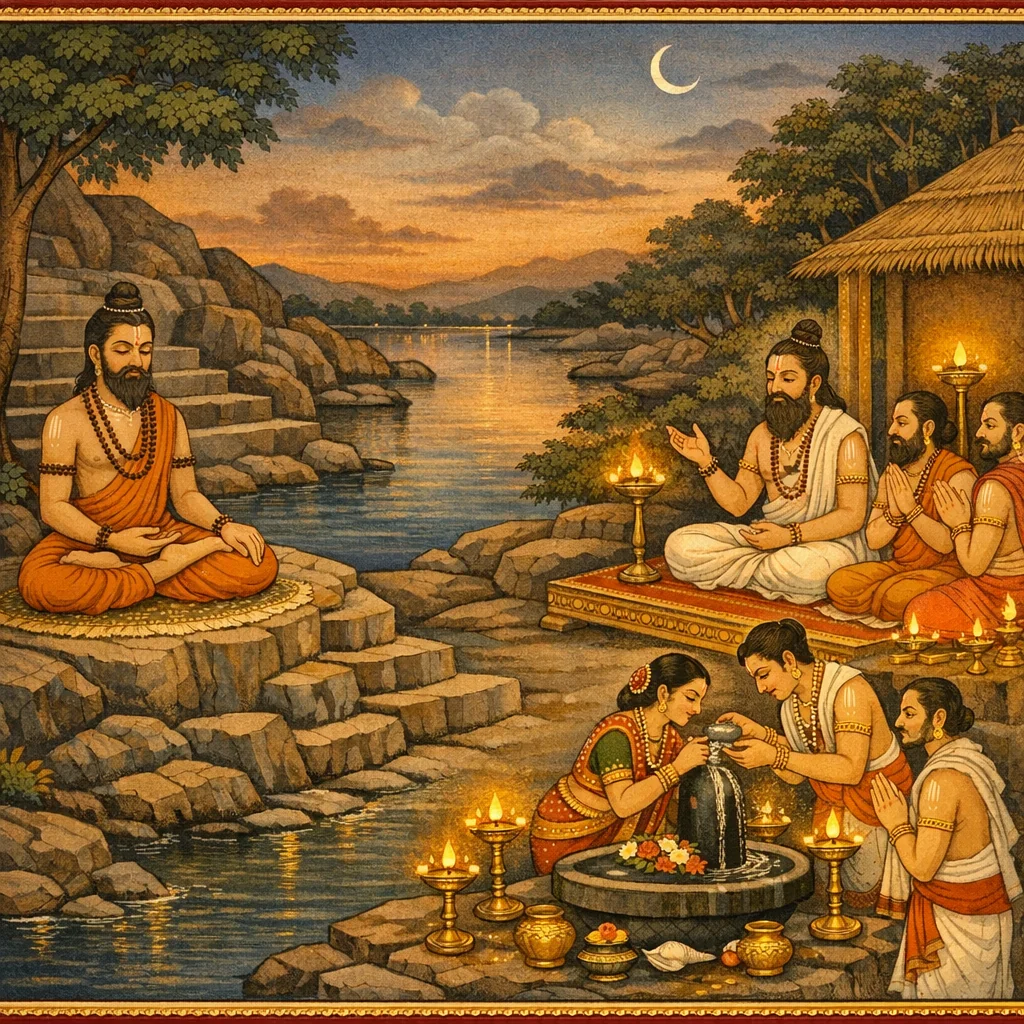
Adhyaya 172
माण्डव्यतीर्थमाहात्म्यं — Māṇḍavya Tīrtha Māhātmya (Glory of the Māṇḍavya Sacred Ford)
This adhyāya unfolds in two movements. First, devas and ṛṣis gather at the holy āśrama of Māṇḍavya on the bank of the Narmadā, praising his tapas and affirming the siddhi born of austerity, and granting him boons. An ensuing episode turns on a rākṣasa-linked curse motif and the offering of a maiden to Māṇḍavya, culminating in marriage, communal exchanges of honor, and royal patronage with gifts. Second, it sets forth the tīrtha-māhātmya and ritual phalaśruti of Māṇḍavyeśvara/Māṇḍavya-Nārāyaṇa and associated sites such as Devakhāta, prescribing bathing, abhiṣeka, worship, lamp-lighting (dīpa), circumambulation, feeding brāhmaṇas, śrāddha timings, and vrata observances—especially the caturdaśī night vigil. Merit is measured through equivalences to great yajñas and famed tīrthas, and the chapter closes by assuring release from pāpa and auspicious post-mortem destinies for those who hear and practice.
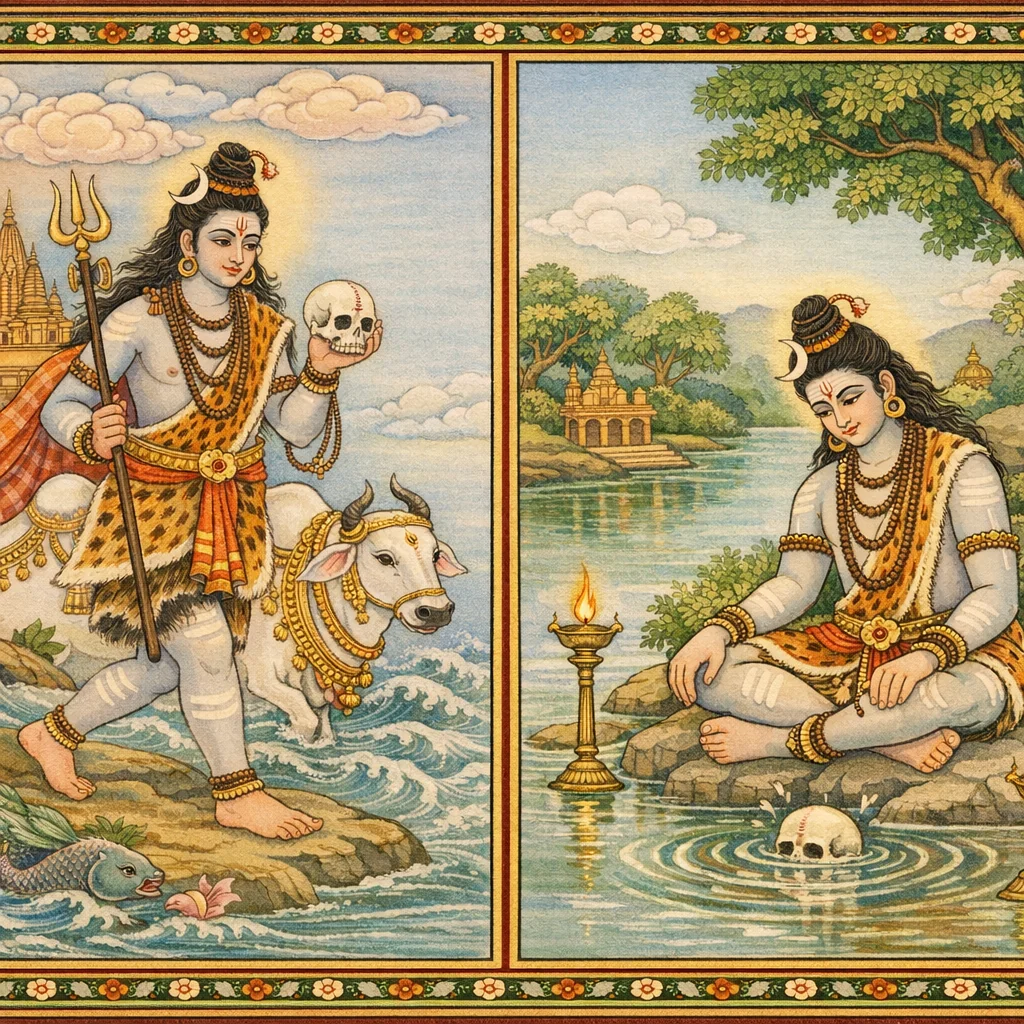
Adhyaya 173
शुद्धरुद्रतीर्थ-माहात्म्य (Māhātmya of Śuddharudra Tīrtha / Siddheśvara on the Southern Bank of the Narmadā)
Mārkaṇḍeya instructs the king about a supremely auspicious tīrtha on the southern bank of the Narmadā, praised as a destroyer of all sins, even grave transgressions. The chapter explains its origin: Śiva (Triśūladhṛk, bearer of the trident) incurs the burden of brahmahatyā after severing Brahmā’s head in a mythic episode connected with Brahmā’s untruthful speech. The skull clings to Śiva’s hand and will not fall away, despite extensive pilgrimages—to Vārāṇasī, to the ocean in every direction, and to many other tīrthas. Only when Śiva reaches this Narmadā tīrtha near Kulakoṭi does he perform expiation and become free from impurity. Thereafter the place is famed as Śuddharudra, renowned in the three worlds as the supreme remover of brahmahatyā. The chapter prescribes a recurring observance: on each amāvāsyā (new-moon day) in the bright fortnight, one should bathe there according to rule, offer tarpaṇa to the pitṛs and the deities, and present piṇḍa with inwardly consecrated intention. Worship of Parameśvara with fragrance, incense, and lamps is commended; the deity is called Śuddheśvara and is honored in Śiva-loka. The concluding phala declares that those who follow this discipline and remember the tīrtha are released from all sins and attain Rudra-loka.
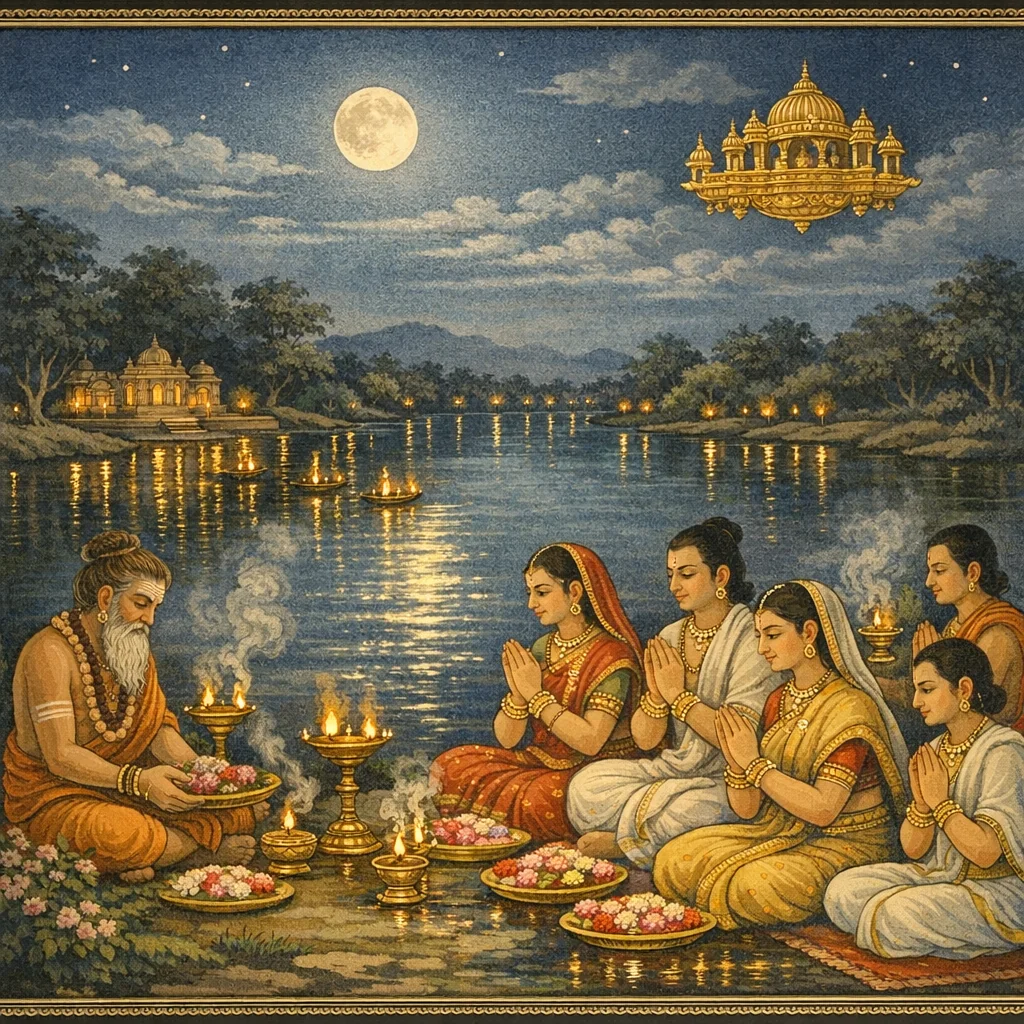
Adhyaya 174
गोपेश्वरतीर्थमाहात्म्य (Gopeśvara Tīrtha Māhātmya) — Lamp-offering and Śaiva Merit on the Northern Narmadā Bank
This chapter is a prescriptive mahātmya spoken by Mārkaṇḍeya to a king. It sends the pilgrim to Gopeśvara Tīrtha on the northern bank of the Narmadā, declaring that a single bath there frees one from moral taints and faults. It then sets out a sequence of merit: first, snāna at the tīrtha; second, optionally, prāṇasaṃkṣaya (voluntary death) at the spot, said to carry one by a celestial conveyance to Śiva’s abode; third, enjoyment in Śiva-loka followed by an auspicious rebirth as a powerful, prosperous, long-lived king; and fourth, a Kārttika vrata on the bright ninth (śukla navamī) involving fasting, purity, lamp-giving, worship with fragrance and flowers, and an all-night vigil. The phala is stated quantitatively: the number of lamps offered corresponds to thousands of yugas of honor in Śiva-loka. Other offerings are also listed—liṅga-pūraṇa rite, lotus offerings, and dadhy-anna (curd-rice)—with merit measured by the count of sesame seeds and lotuses. The chapter concludes that any gift at this tīrtha is multiplied “a koṭi-fold,” beyond calculation, affirming Gopeśvara’s unsurpassed status among sacred fords.
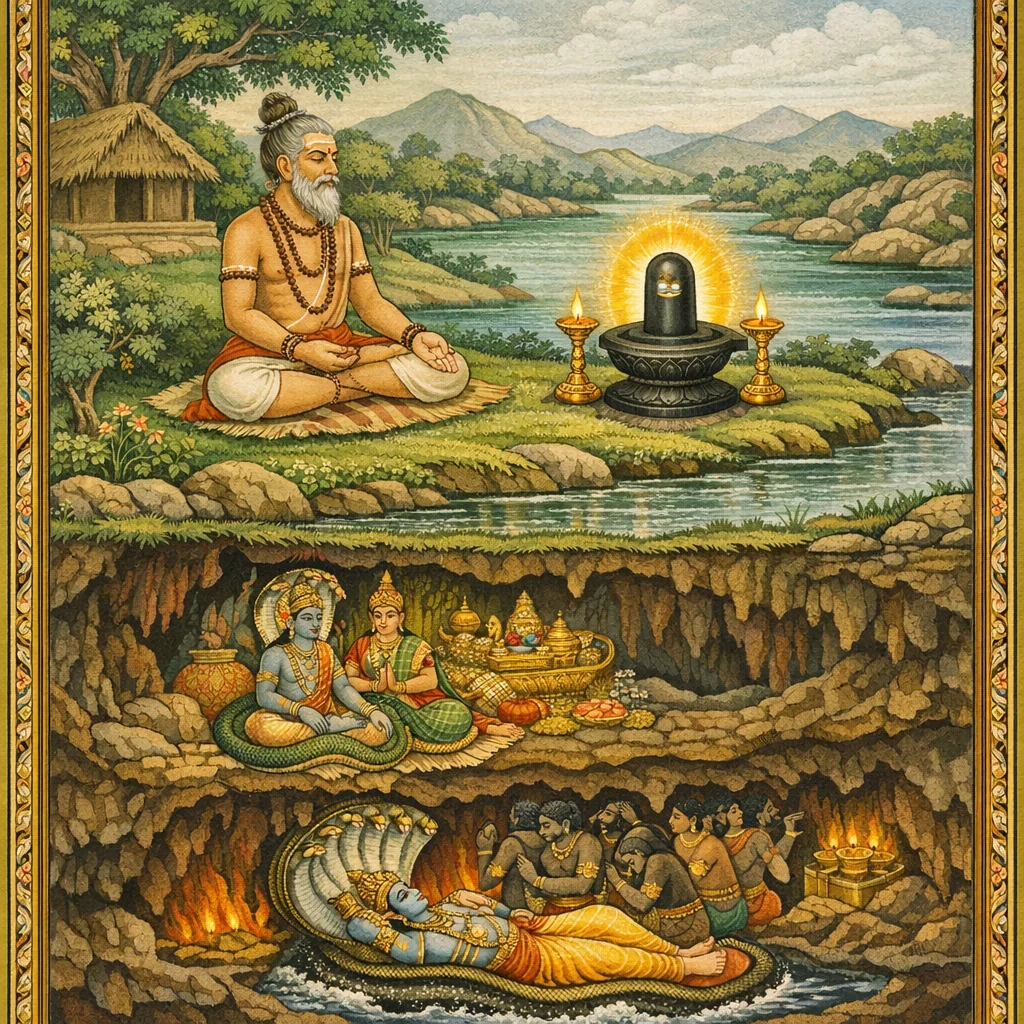
Adhyaya 175
कपिलेश्वरतीर्थमाहात्म्य (Kapileśvara Tīrtha Māhātmya)
Mārkaṇḍeya points out Kapileśvara—on the northern bank of the Narmadā amid Bhṛgu-kṣetra—as an eminent tīrtha for pāpa-nāśana, the removal of sin. He presents Kapila as a manifestation of Vāsudeva/Jagannātha and situates the deity within a cosmic descent through subterranean realms, culminating in the great seventh Pātāla where the ancient Parameśvara abides. The narrative recalls the sudden destruction of Sagara’s sons in Kapila’s presence, followed by Kapila’s grief and moral reflection. With a mind turned toward renunciation, he deems such mass destruction “inappropriate” and seeks expiation through the Kapila tīrtha. He then performs intense tapas on the Narmadā bank, worships the imperishable Rudra, and attains a supreme, nirvāṇa-like state. Ritual observances and their merits are enumerated: bathing and worship grant the fruit of “a thousand cows”; gifts made on the bright fourteenth of Jyeṣṭha become inexhaustible when given to a worthy brāhmaṇa. Fasting and bathing on specified lunar days (including Aṅgāraka-related observances) promise beauty, prosperity, and benefits to one’s lineage across many births. Offerings to ancestors on full and new moon satisfy them for twelve years and lead them to heavenly realms; lamp-offering bestows bodily radiance. Those who die at this tīrtha are said to take a path of no return, directed toward Śiva’s abode.
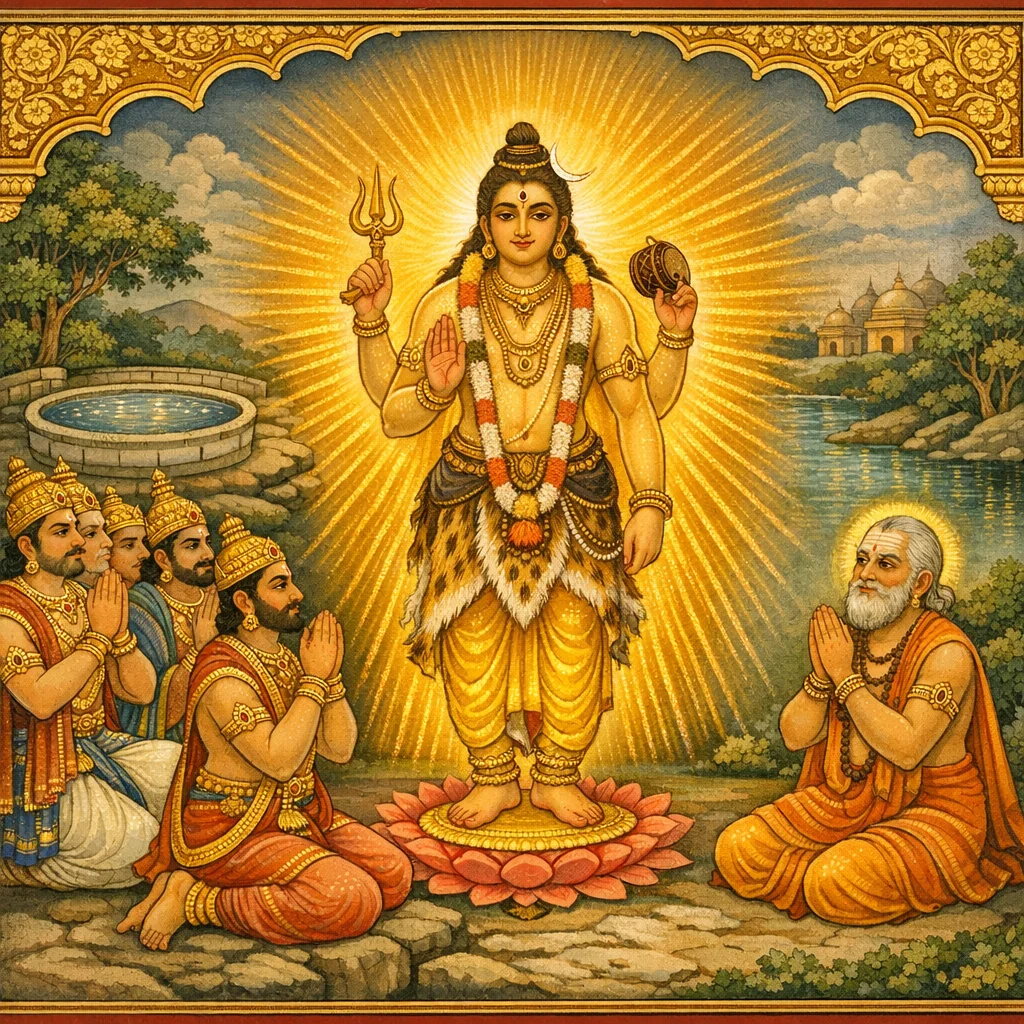
Adhyaya 176
देवखात-उत्पत्ति एवं पिङ्गलेश्वर-माहात्म्य (Origin of Devakhāta and the Māhātmya of Piṅgaleśvara)
Mārkaṇḍeya instructs the king to go to auspicious Piṅgalāvarta, a rare tīrtha upon the earth, where drawing near to Piṅgaleśvara dissolves sins born of speech, mind, and deed. He declares that bathing and gifting (dāna) in Devakhāta yield imperishable fruit, and then, answering Yudhiṣṭhira’s questions, explains the origin of that sacred basin. In an embedded tale, Rudra (Śiva), bearing a kamaṇḍalu, roams with the devas to purify his trident. The devas bathe at many tīrthas and gather the waters into a vessel; once the trident is purified, they reach Bhṛgukaccha and meet Agni and Piṅgala—tawny-eyed and diseased—performing fierce austerity and meditation on Maheśvara. At the devas’ request Śiva restores Piṅgala’s health, appearing in an Āditya-like radiance and removing the illness so his body is renewed. Piṅgala then begs Śiva to remain for the welfare of beings—pacifying diseases, destroying sins, and increasing well-being. Śiva commands the devas to dig a divine basin to his north and pour in the collected tīrtha-waters, which become universally purificatory and disease-destroying. The chapter sets forth observances—Sunday bathing, bathing with Narmadā water, śrāddha and dāna, and worship of Piṅgeśa—promising heavenly abode, and it lists specific therapeutic and expiatory benefits (fevers, skin disorders, leprosy-like ailments), including repeated Sunday baths and gifting a sesame-vessel to a twice-born. It concludes by praising Devakhāta bathing as supreme and declaring that worship of Piṅgaleśvara after ancestral offerings yields merit equal to great soma sacrifices such as the Aśvamedha and Vājapeya.
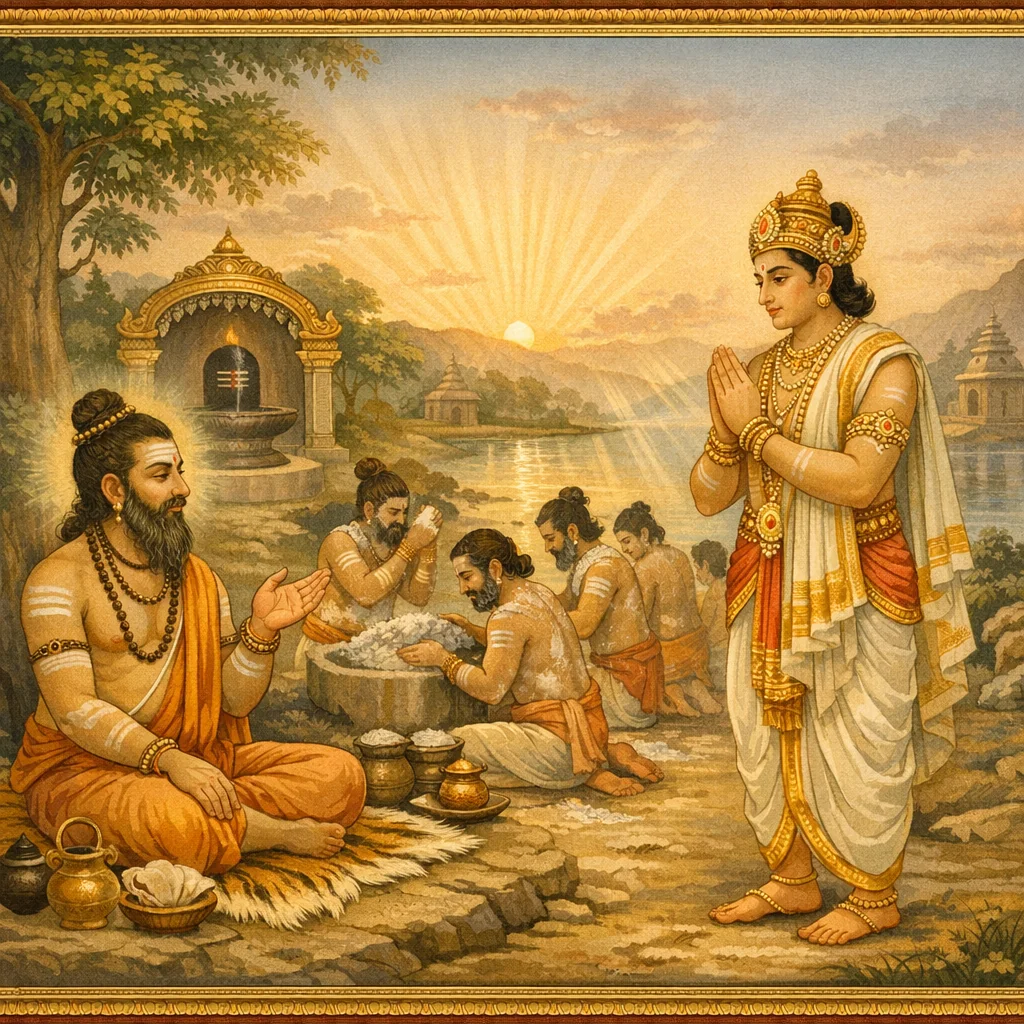
Adhyaya 177
Bhūtīśvara-tīrtha Māhātmya and the Taxonomy of Purificatory Snānas (भूतीश्वरतीर्थमाहात्म्यं स्नानविधिवर्गीकरणं च)
The chapter unfolds as a didactic dialogue in which Mārkaṇḍeya instructs Yudhiṣṭhira about Bhūtīśvara, an eminent tīrtha whose mere darśana diminishes pāpa. Its name is explained through an origin tale: Śiva (Śūlin) performed uddhūlana, the smearing of sacred ash, at that very spot. It then turns to ritual guidance: bathing at Bhūtīśvara—especially on occasions connected with Puṣya in one’s natal asterism and on amāvāsyā—is said to bring expansive benefit for the uplift of ancestors. A focused phala sequence is given for aṅga-guṇṭhana, the application of ash: each ash-particle that clings to the body corresponds to prolonged honor in Śiva’s realm. Bhasma-snāna is praised as a superior purification, and a ranked taxonomy of snānas is introduced: āgneya, vāruṇa, brāhmya, vāyavya, and divya. Mārkaṇḍeya defines them as ash-bath, water-immersion, bathing with the “Āpo hi ṣṭhā” formula, cow-dust bathing, and bathing upon sighting the sun—whose merit is equated with bathing in Gaṅgā-water. The conclusion integrates outer practice with inner discipline: snāna and Īśāna-pūjā yield external and internal purity; japa cleanses sin, and dhyāna leads toward the infinite. A Śiva-stotra presents a non-anthropomorphic theological vision, and the tīrtha’s fruit for those who bathe there is compared to the merit of an Aśvamedha-yajña.
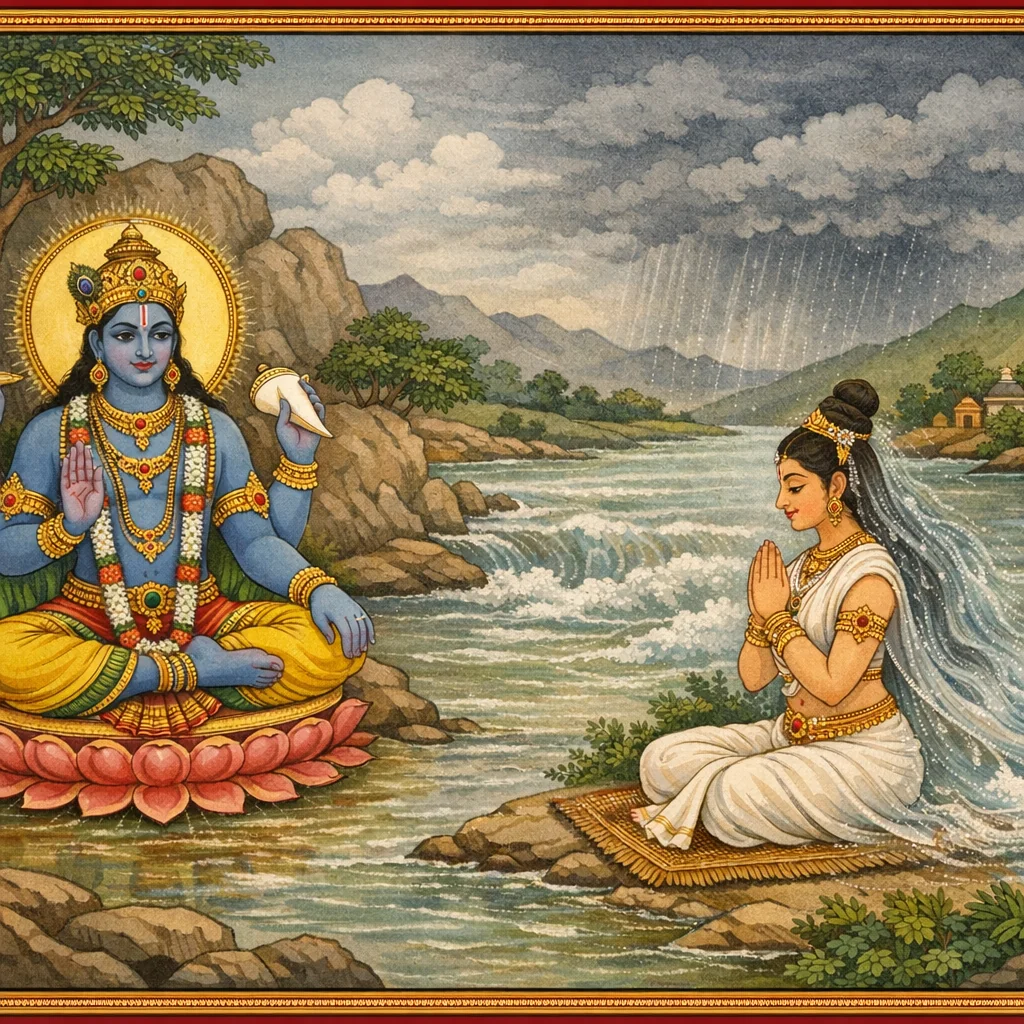
Adhyaya 178
Gaṅgāvāhaka-tīrtha Māhātmya (The Glory of the Gaṅgāvāhaka Ford)
Mārkaṇḍeya points to an eminent tīrtha named Gaṅgāvāhaka on the Narmadā/Revā, near Bhṛgutīrtha. The chapter unfolds a theological dialogue: Gaṅgā performs long austerities and addresses Viṣṇu (Janārdana/Nārāyaṇa), recounting her descent and the social-ritual fact that many heavily burdened by sin seek purification in her waters; she grieves that, as purifier, she is symbolically “heated” by accumulated demerit. Viṣṇu answers by establishing a localized sacred order: he declares his presence there (with Gaṅgādhara as helper) and instructs Gaṅgā to enter the Revā in embodied form, creating the sanctity of mixed waters. A special parvan is defined in connection with monsoon swelling and Viṣṇu’s conch motif, exalted above ordinary calendrical junctions. The chapter prescribes rites—snāna in the mixed waters, tarpaṇa and śrāddha at the tīrtha, worship of Bāla-Keśava, and night vigil—and states their fruits: the ending of sin-aggregates, enduring satisfaction of the ancestors, and an irreversible auspicious post-mortem course for devoted persons who die at the site.
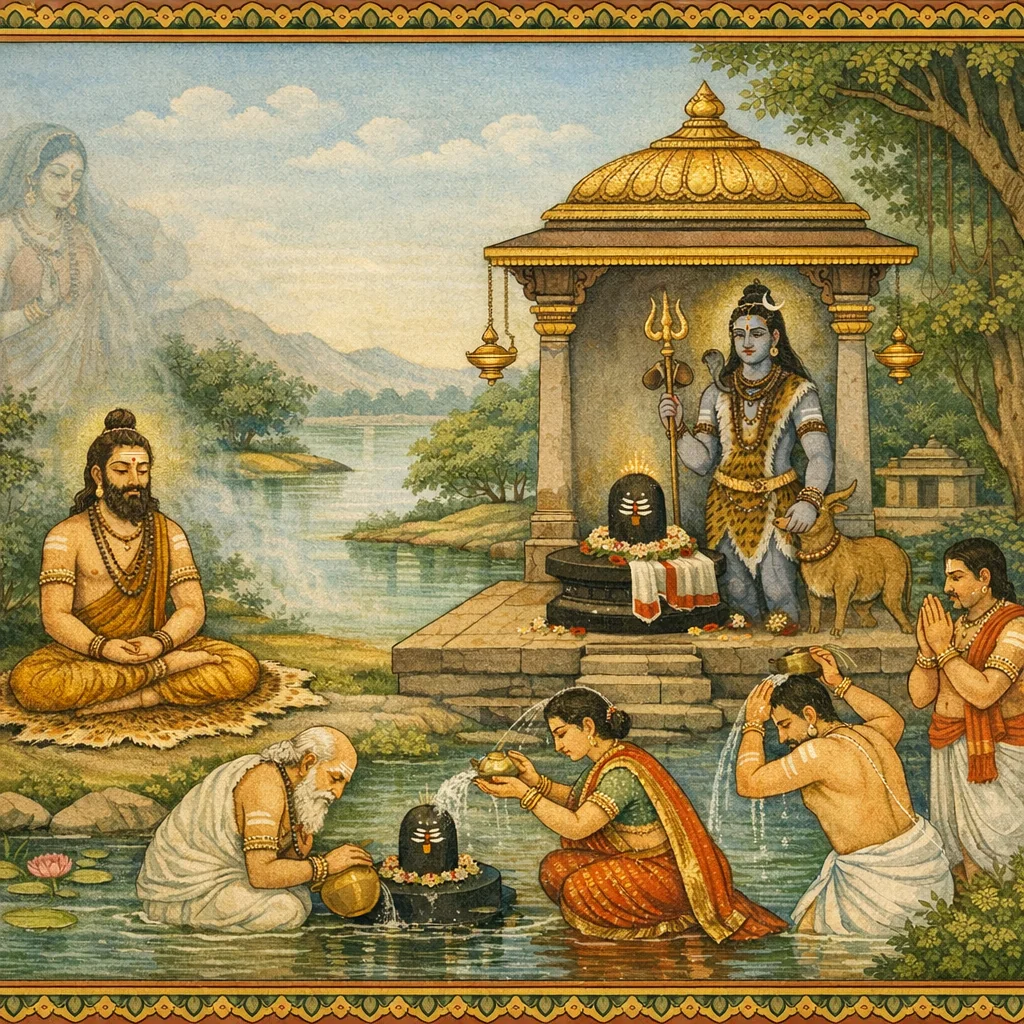
Adhyaya 179
Gautameśvara-tīrtha Māhātmya (गौतमेश्वरतीर्थमाहात्म्य) — Rituals, Offerings, and Phala
Mārkaṇḍeya instructs Yudhiṣṭhira to proceed to the famed Gautameśvara tīrtha, celebrated as a powerful purifier of sins. The sanctity of the place is traced to the long tapas of the sage Gautama; pleased thereby, Maheśvara is installed there, and thus the deity is known as Gautameśvara. The account then turns from origin to practice: devas, gandharvas, ṛṣis, and pitṛ-associated divinities are said to have gained superior attainment by worshiping Parameśvara at this site. Bathing at the tīrtha, honoring the pitṛ-devatās, and performing Śiva-pūjā are prescribed as means to be released from pāpa. Though many remain unaware, deluded by Viṣṇu-māyā, Śiva is declared to be present there. Special disciplines are praised: brahmacarya together with snāna and arcana yields merit like an Aśvamedha; dāna to a dvijātiya bears inexhaustible fruit. Calendar rites are specified—on Aśvayuja kṛṣṇa caturdaśī, the gifting of a hundred lamps; on Kārttika aṣṭamī and caturdaśī, fasting and abhiṣeka with ghee, pañcagavya, honey, curd, or cool water. Offerings of flowers and leaves, especially unbroken bilva leaves, are commended; continuous worship for six months is said to fulfill desires and culminate in reaching Śiva’s realm.
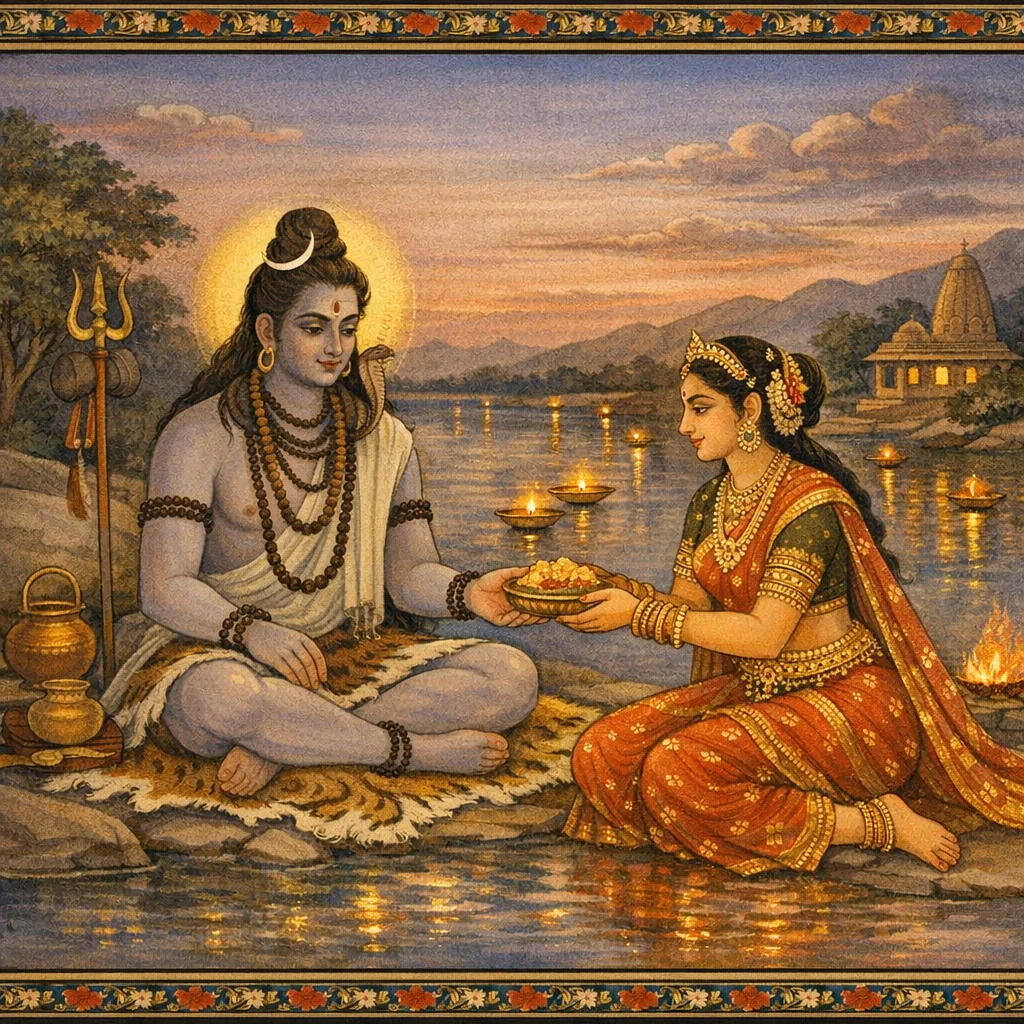
Adhyaya 180
Daśāśvamedhika Tīrtha Māhātmya (दशाश्वमेधिकतीर्थमाहात्म्यम्) — Merit of Ten Aśvamedhas through Narmadā Worship
Chapter 180 unfolds as a theological and ethical inquiry in the dialogue between King Yudhiṣṭhira and the sage Mārkaṇḍeya. Mārkaṇḍeya points out the Daśāśvamedhika tīrtha on the Narmadā, declaring that disciplined observance there yields merit equal to ten Aśvamedha sacrifices. Yudhiṣṭhira raises a methodological doubt: since the Aśvamedha is costly and generally beyond ordinary people, how can its fruit be gained by common practitioners? Mārkaṇḍeya answers with an illustrative episode: Śiva and Pārvatī come to the tīrtha; Śiva, disguised as a hungry ascetic-brāhmaṇa, tests people’s social and ritual conduct. Many dismiss him or fail to grasp the Purāṇic intent, but a learned brāhmaṇa, trusting Veda–Smṛti–Purāṇa testimony, performs the prescribed acts—snāna, japa, śrāddha, dāna, and the gift of a kapilā cow—and hospitably receives the hidden Śiva. Śiva then grants a boon, and the brāhmaṇa asks for Śiva’s perpetual presence at the tīrtha, establishing its sacral authority. The chapter next gives procedural guidance centered on Āśvina śukla daśamī: fasting, worship of Śiva as Tripurāntaka, honoring Sarasvatī’s presence at the site, circumambulations, gifting a cow, night vigil with lamps, recitation and music, and feeding brāhmaṇas and Śiva-devotees. Phala statements list purification, attainment of Rudraloka, auspicious rebirth, and various post-mortem destinations for those who die there under differing conditions, all contingent upon āstikya (affirmative faith) and correct observance.
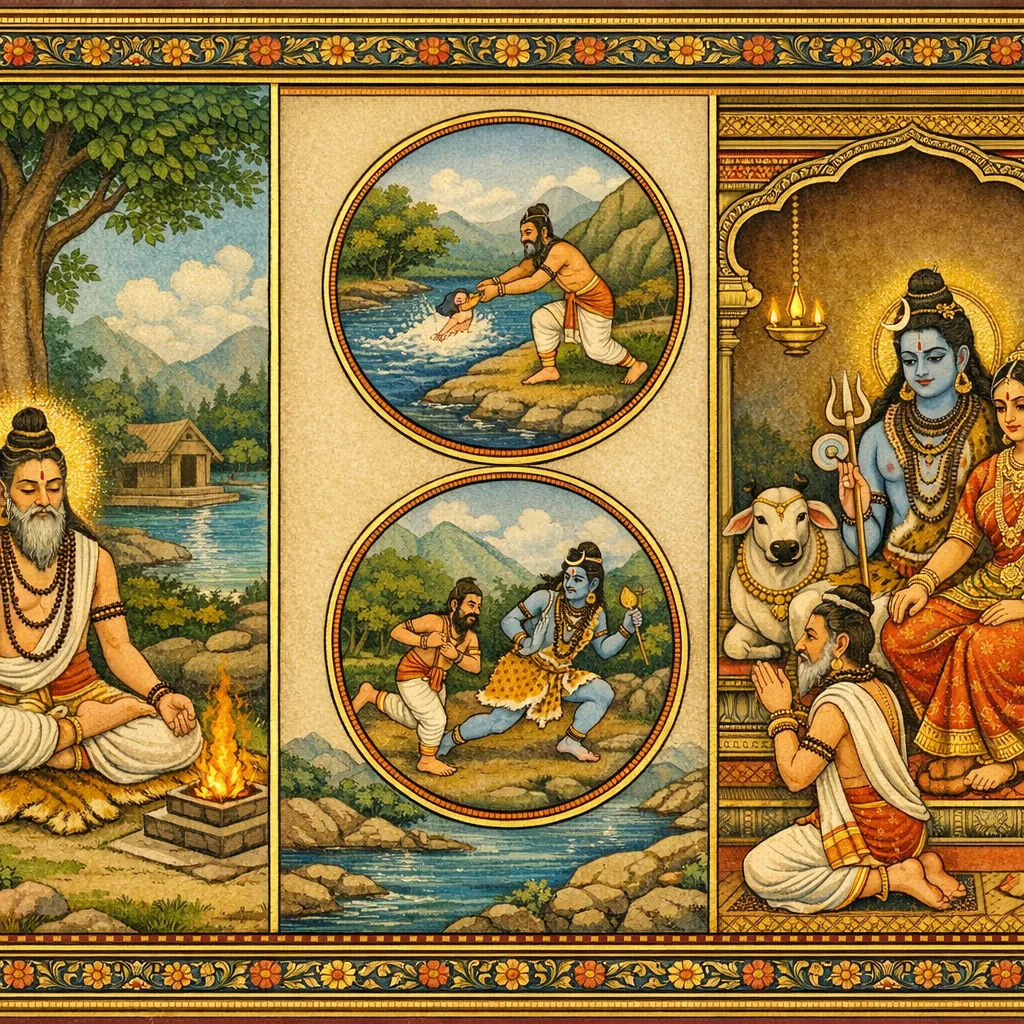
Adhyaya 181
Bhṛgutīrtha–Vṛṣakhāta Māhātmya (भृगुतीर्थ–वृषखात माहात्म्य)
The chapter unfolds as a dialogue: Mārkaṇḍeya answers Yudhiṣṭhira’s question about a renowned tīrtha near the Narmadā, mentioning the place-name “Vṛṣakhāta” and Bhṛgu’s presence at Bhṛgukaccha. He recounts Bhṛgu’s fierce austerities and introduces a divine scene in which Śiva and Umā observe the sage. When Umā asks why no boon is granted, Śiva teaches that anger undermines tapas and obstructs spiritual attainment. To demonstrate, Śiva manifests/sends a bull-form agent (vṛṣa) to provoke Bhṛgu; the bull hurls him into the Narmadā, igniting Bhṛgu’s wrath and a relentless pursuit. The fleeing vṛṣa ranges through cosmic realms—continents, netherworlds, and higher worlds—revealing the far-reaching consequences of uncontrolled anger. At last the vṛṣa takes refuge with Śiva, and Umā requests that a boon be given before the sage’s anger subsides. Śiva declares the spot a “krodha-sthāna,” a place marked by anger. Bhṛgu then offers an extended stotra, including the hymn named “Karuṇābhyudaya,” and Śiva grants boons. Bhṛgu asks that the site become a siddhi-kṣetra bearing his name and endowed with divine presence; the narrative concludes with his further consultation with Śrī (Lakṣmī) on establishing an auspicious sacred place, rooting the tīrtha’s identity in devotional practice and the theology of place-making.
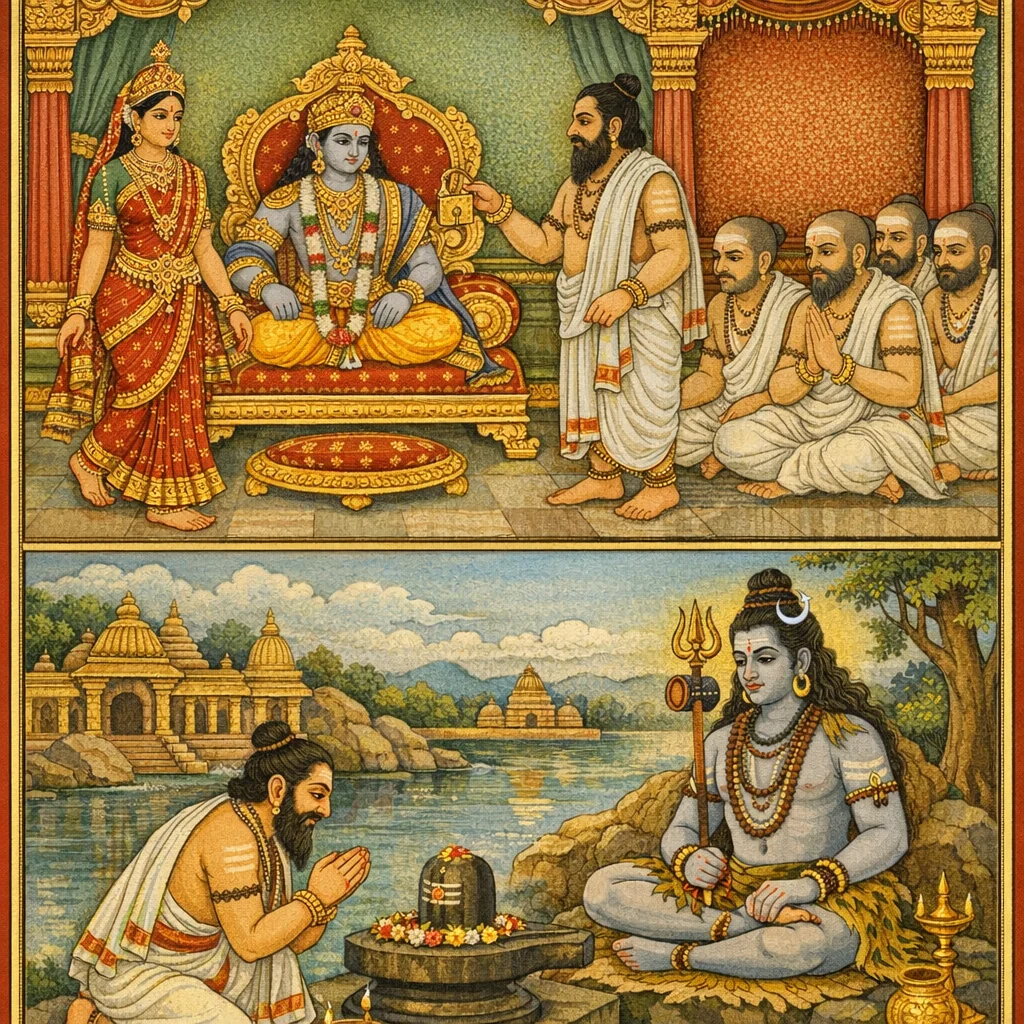
Adhyaya 182
Bhṛgukaccha-utpattiḥ and Koṭitīrtha Māhātmya (भृगुकच्छोत्पत्तिः / कोटितीर्थमाहात्म्यम्)
Adhyāya 182, narrated through Mārkaṇḍeya, recounts the origin of Bhṛgukaccha on the northern bank of the Revā. Bhṛgu, accompanied by Śrī/Lakṣmī, approaches the Kūrmāvatāra and seeks permission to found a chāturvidya-based settlement; Kūrma grants assent and foretells a long-enduring city bearing a name connected with him. The kṣetra is then located with auspicious calendrical and astrological detail (Māgha season, favorable lunar conditions) and with topographic markers (north bank, deep waters, association with Koṭitīrtha), followed by a description of varṇa duties within the new community. Conflict arises when Lakṣmī departs for devaloka and entrusts Bhṛgu with a key and lock (kūñcikā-ṭṭāla); upon her return, ownership is disputed. The Brahmins asked to judge remain silent out of fear of Bhṛgu’s anger and propose a procedural rule favoring whoever holds the lock. Lakṣmī responds with a curse that undermines learning, stability, and ethical clarity among the dvijas, blaming greed and the abandonment of truth. Distressed, Bhṛgu propitiates Śaṅkara; Śiva interprets the site as a krodha-sthāna yet assures that future Brahmins will regain learning by divine grace, and he exalts the place as Koṭitīrtha, able to destroy sins. Śiva then declares the rites and merits of the tīrtha: snāna and pūjā yield fruits equal to great sacrifices; tarpaṇa benefits ancestors; abhiṣeka with milk, curd, ghee, and honey grants heavenly residence; gifts and observances during celestial events such as a solar eclipse are praised; and vows, renunciation, even death within the kṣetra lead to auspicious post-mortem outcomes. Śiva proclaims his continual presence there with Ambikā (Soubhāgya-sundarī), while Bhṛgu finally departs for Brahmaloka. The chapter ends by reaffirming the narrative’s purificatory power and its phalaśruti for listeners.
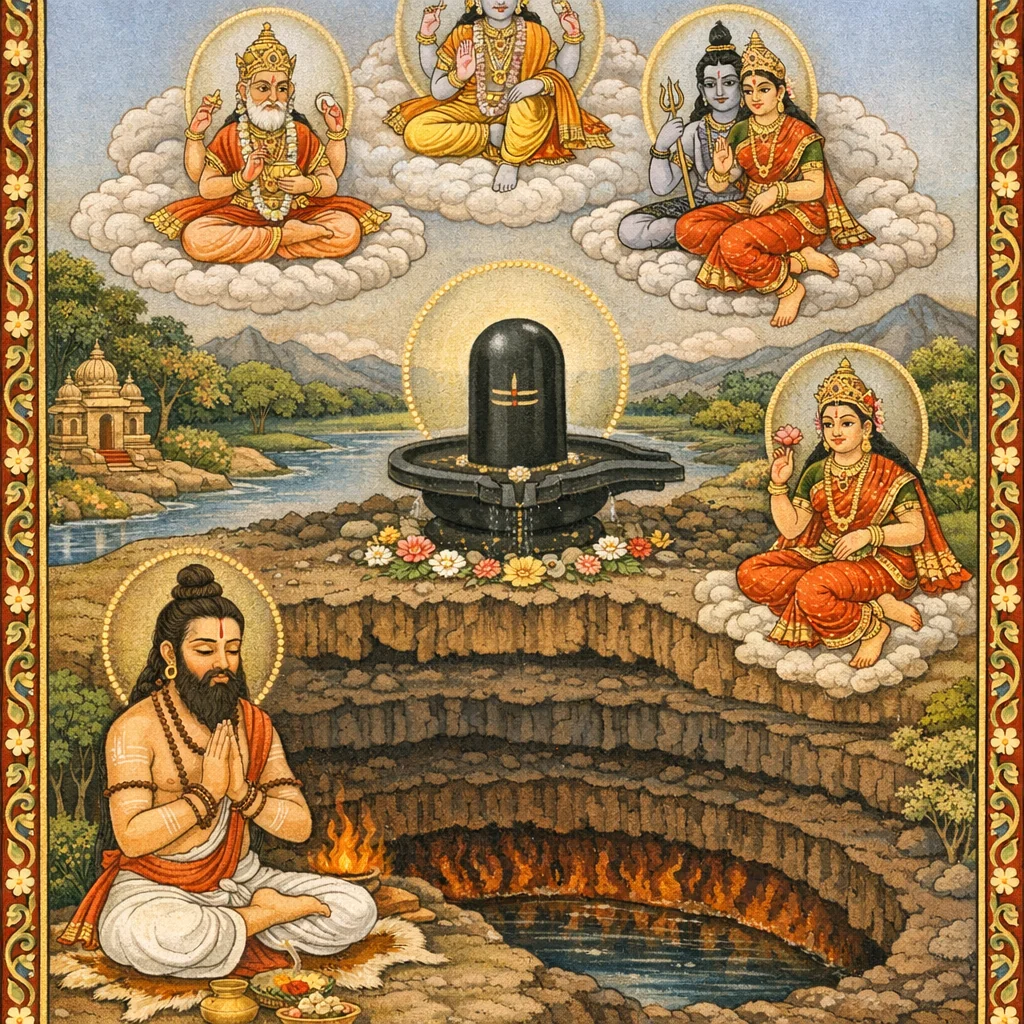
Adhyaya 183
Kedāra-tīrtha Māhātmya on the Northern Bank of the Narmadā (केदारतीर्थमाहात्म्य)
This chapter unfolds as a dialogue in which the sage Mārkaṇḍeya instructs Yudhiṣṭhira about the Kedāra tīrtha on the northern bank of the Narmadā. It first sets out the pilgrimage order: one should go to Kedāra, perform śrāddha, drink the tīrtha water, and worship the Lord, Devadeveśa, thereby gaining merit born of Kedāra. Asked how Kedāra came to be established there, Mārkaṇḍeya recounts an origin legend from early Kṛtayuga. Through a curse connected with Padmā/Śrī, Bhṛgu’s region becomes impure, as though “deprived of the Vedas.” Bhṛgu undertakes austerities for a thousand years, and Śiva manifests as a liṅga rising up through the strata of the netherworld. Bhṛgu praises Śiva as Sthāṇu and Tryambaka and petitions for the kṣetra’s purity to be restored. Śiva proclaims the स्थापना of an ādi-liṅga named Kedāra, followed by ten further liṅgas, with an eleventh, invisible presence at the center that purifies the entire field. The chapter also describes a protective sacred retinue abiding there: twelve Ādityas, eighteen Durgās, sixteen Kṣetrapālas, and Mothers associated with Vīrabhadra. It concludes with phala: disciplined morning bathing in the month of Nāgha, worship of Kedāra, and properly performed śrāddha at the tīrtha gladden the ancestors and bestow sin-removing, sorrow-destroying benefit.
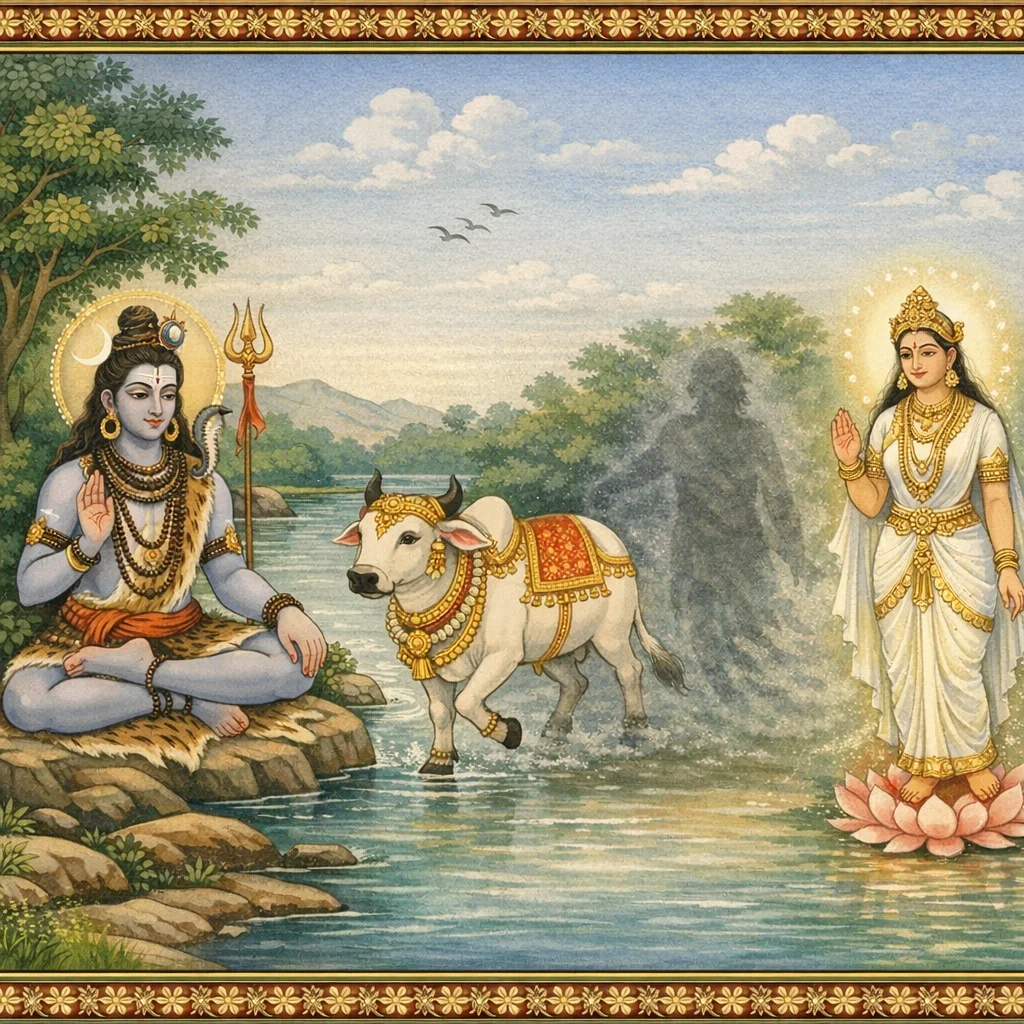
Adhyaya 184
धौतपापतीर्थमाहात्म्यम् (Māhātmya of the Dhoutapāpa Tīrtha)
Chapter 184 delivers a tīrtha-māhātmya centered on Dhoutapāpa (also called Vidhoutapāpa) near Bhṛgu-tīrtha on the northern bank of the Narmadā. Mārkaṇḍeya praises the place as famed for washing away sin and says that Śiva abides there to honor the sage Bhṛgu. Bathing at this tīrtha is said to free one from sins even when the intention is flawed; when done properly—ritual bath, worship of Śiva, and offerings to the devas and the pitṛs—its purification becomes complete. Yudhiṣṭhira asks how brahmahatyā, the gravest impurity, can fail to enter or be destroyed there. Mārkaṇḍeya answers with a cosmogonic legend: Śiva incurs brahmahatyā after severing one head of Brahmā; the taint follows him until it is “shaken off” by Dharma embodied as a bull (vṛṣa), and the goddess Dhauteśvarī is established as a brahmahatyā-destroying power. Brahmahatyā is personified as fearful and kept at a distance from the tīrtha. The chapter also prescribes observance on Āśvayuja śukla navamī, with a three-day period beginning from saptamī, along with fasting, Vedic recitation (Ṛg/Yajus/Sāman), and Gāyatrī-japa as expiatory disciplines. Its phalaśruti promises release from severe transgressions, boons concerning progeny, and ascent after death; it further records the extraordinary claim, within the text’s tīrtha theology, that a self-chosen death at the site leads to celestial attainment.
Adhyaya 185
Ēraṇḍī-tīrtha Māhātmya (एरण्डीतीर्थमाहात्म्य) — Ritual Bathing, Upavāsa, and Tarpaṇa on Āśvayuja Śukla Caturdaśī
In this adhyāya, Śrī Mārkaṇḍeya gives a concise theological and ritual instruction to a ruler (mahīpāla). He directs the king to go to the revered Ēraṇḍī-tīrtha, declaring that mere bathing there is a supremely powerful act of purification, capable of removing even extreme demerit. He then prescribes a calendrical observance: in the month of Āśvayuja, on the bright-fortnight fourteenth lunar day (śukla-pakṣa caturdaśī), one should fast (upavāsa), bathe with disciplined intent (prayataḥ snātaḥ), and perform tarpaṇa offerings to the pitṛs and the deities. The phalaśruti promises layered fruits—worldly flourishing (a son endowed with prosperity and beauty, and long life) and, after death, attainment of Śivaloka—ending with an emphatic assurance that these results are beyond doubt.
Adhyaya 186
Garuḍa-tapas, Mahādeva-varadāna, and Cāmuṇḍā–Kanakeśvarī-stuti at a Tīrtha
Mārkaṇḍeya recounts a tīrtha-centered episode: Garuḍa performs austerities and worship of Maheśvara (Śiva) at an eminent sacred site, whereupon Śiva appears and grants a boon dialogue. Garuḍa asks for two rare attainments—to become Viṣṇu’s vehicle and to gain lordship among birds. Śiva notes the doctrinal difficulty by invoking cosmic hierarchy (Nārāyaṇa as all-containing, Indra’s station as unique), yet grants a qualified fulfillment: Garuḍa will bear the Lord who holds conch, discus, and mace, and will be chief among birds. After Śiva departs, Garuḍa propitiates the fierce Devī Cāmuṇḍā, portrayed with cremation-ground imagery and yoginī associations, and offers an extended stuti. The praise also reveals her luminous protective identity as Kanakeśvarī, lauding her as Para-Śakti active in creation, preservation, and dissolution. Cāmuṇḍā grants Garuḍa invulnerability and victory over suras and asuras, and agrees to remain near the tīrtha. The chapter ends with tīrtha-phala: bathing and worship there yield sacrificial merit, yogic success, and an auspicious post-mortem destination accompanied by yoginī hosts.
Adhyaya 187
कालाग्निरुद्र-स्वयम्भू-लिङ्गमाहात्म्य (Kālāgnirudra Svayambhū Liṅga Māhātmya)
This adhyāya is cast as Mārkaṇḍeya’s instruction to a king, outlining a pilgrimage sequence and the theological greatness of a famed liṅga. The pilgrim is directed to Jāleśvara at Bhṛgukaccha, declared to be an ancient self-manifest (svayambhū) liṅga known as Kālāgnirudra. The site is praised as a compassionate, remedial sacred center that pacifies sins and dissolves afflictions, specifically removing “kṣetra-pāpa” (defilements bound to a place). A mythic account places its arising in a former kalpa, when asuras overwhelmed the three worlds and Vedic rites and dharma declined. From Kālāgnirudra issues primordial smoke (dhūma), and from that smoke the liṅga manifests, piercing the seven nether regions and establishing itself with a southern avata (pit). The chapter also notes associated hydro-ritual features: a flame-born kuṇḍa (jvālā-origin kuṇḍa) linked to Śiva’s burning of a city/pura, and a whirlpool-like formation called dhūmāvarta. Enjoined practices include bathing at the tīrtha and in Narmadā’s waters, performing śrāddha for ancestors, worshiping Trilocana (Śiva), and reciting Kālāgnirudra’s names, with the promise of paramā gati (the supreme destination). It further states the tīrtha’s potency: desire-driven rites, apotropaic/abhicāra acts, aims of diminishing enemies, and lineage-related intentions performed here are said to succeed swiftly—presented as a claim of sacred efficacy rather than an ethical endorsement of every use.
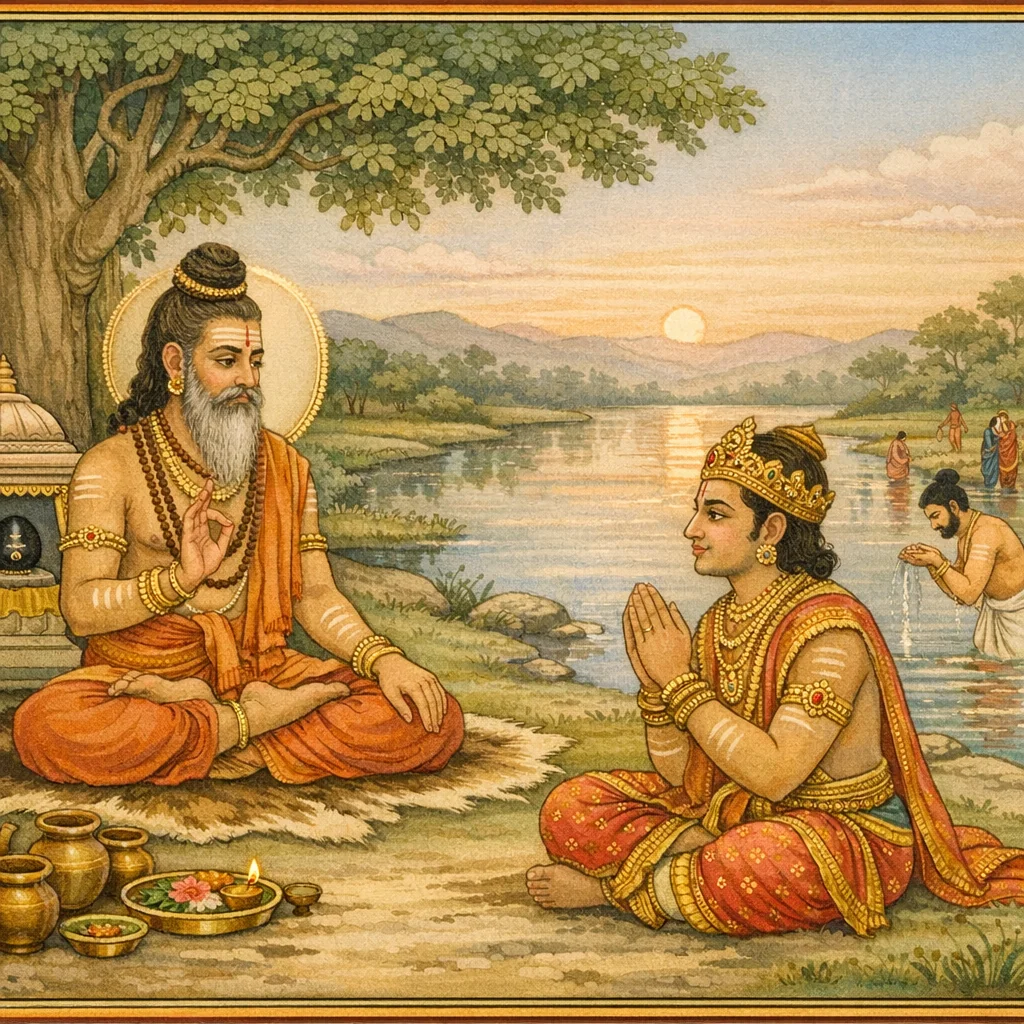
Adhyaya 188
Śālagrāma-tīrtha Māhātmya (शालग्रामतीर्थमाहात्म्य) — Observances on the Revā/Narmadā Bank
Mārkaṇḍeya instructs the king to proceed to the sacred site called Śālagrāma on the bank of the Revā/Narmadā. It is praised as worshipped by all deities and as the place where Bhagavān Vāsudeva—known also as Trivikrama and Janārdana—abides for the welfare of all beings. Its sanctity is linked to ascetic precedent and to the establishment of a proper ritual sphere for dvijas and spiritual seekers. A calendrical observance is then prescribed: when the bright-half Ekādaśī of Mārgaśīrṣa arrives, one should bathe in the Revā, fast, and keep a night vigil worshipping Janārdana. On the following morning, Dvādaśī, one bathes again, offers tarpaṇa to devas and ancestors, and completes a duly performed śrāddha. Brāhmaṇas are to be honored according to one’s means with gifts such as gold, cloth, and food, forgiveness is sought, and devotion is offered to the Lord, including under the epithet khaga-dhvaja. The phalaśruti declares freedom from sorrow, release from grievous sins (even brahmahatyā), and a liberation-oriented state through repeated darśana of Śālagrāma and remembrance of Nārāyaṇa; renunciants devoted to contemplative discipline are also said to attain Murāri’s supreme station there.
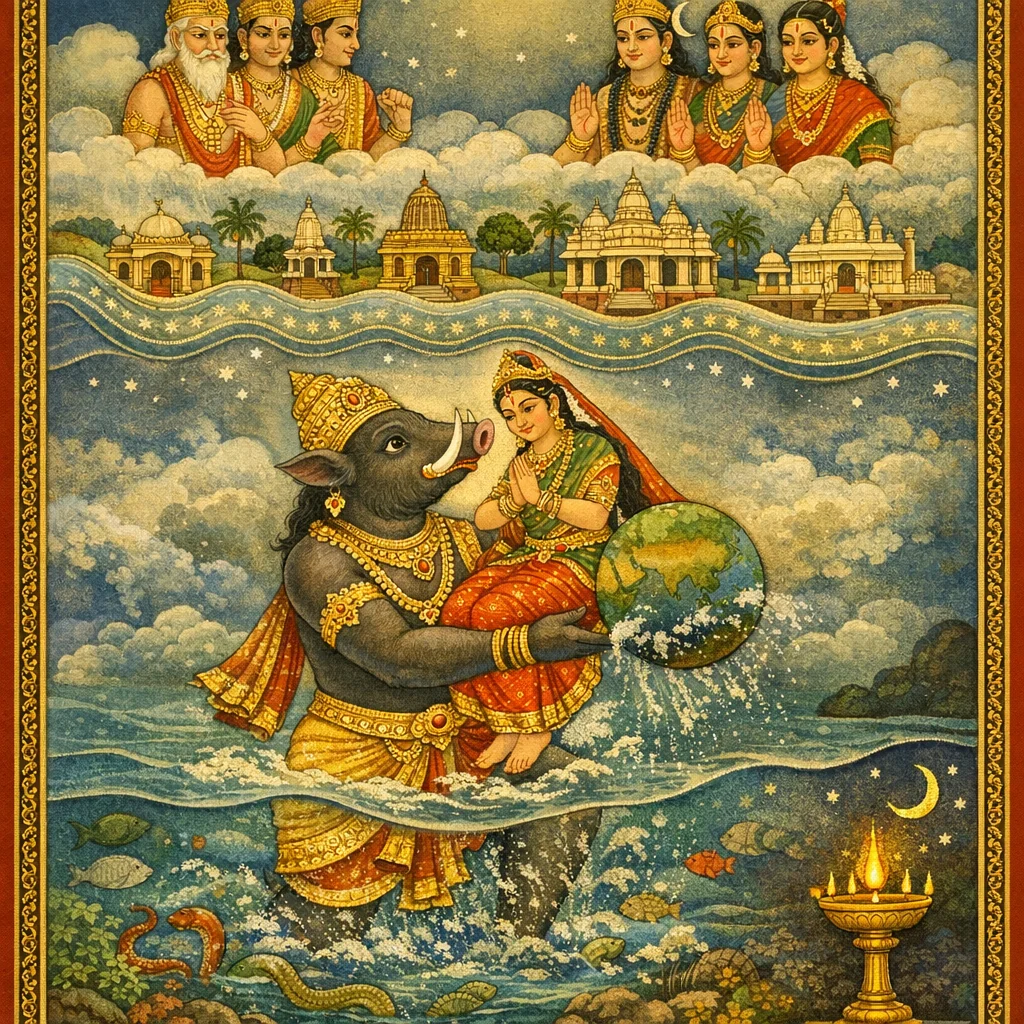
Adhyaya 189
पञ्चवराहदर्शन-व्रत-फलश्रुति (Vision of the Five Varāhas: Vrata Procedure and Promised Fruits)
Mārkaṇḍeya directs Yudhiṣṭhira to a “most splendid” tīrtha, where Varāha (Viṣṇu) is remembered as the Upholder and Lifter of the Earth (dharaṇīdhara). In an embedded cosmogonic account, Hari lies in yoganidrā upon the serpent-bed in the Milk Ocean; when the Earth sinks under its burden, the distressed Devas petition him to restore cosmic stability. Viṣṇu then assumes the formidable, tusked form of Varāha and raises the Earth upon his tusk. The chapter next describes a fivefold manifestation of Varāha connected with the northern bank of the Narmadā and specific named sites for the first through fifth forms, culminating in the fifth, Udīrṇa-Varāha, associated with Bhṛgukaccha. It then prescribes the vrata: in the month of Jyeṣṭha, bright fortnight, especially on Ekādaśī, the pilgrim observes haviṣya dietary restraint, keeps night vigil (jāgaraṇa), bathes in the river, offers sesame and barley to ancestors and deities, and gives graded gifts (cow, horse, gold, land) to worthy brāhmaṇas, worshipping at each Varāha station. The phalaśruti declares that simultaneous darśana of the five Varāhas, together with Narmadā rites and remembrance of Nārāyaṇa, destroys even grave sins and grants liberation; a Śaṅkara-authority statement adds that timely darśana of Loṭaṇeśvara brings release from embodied existence.
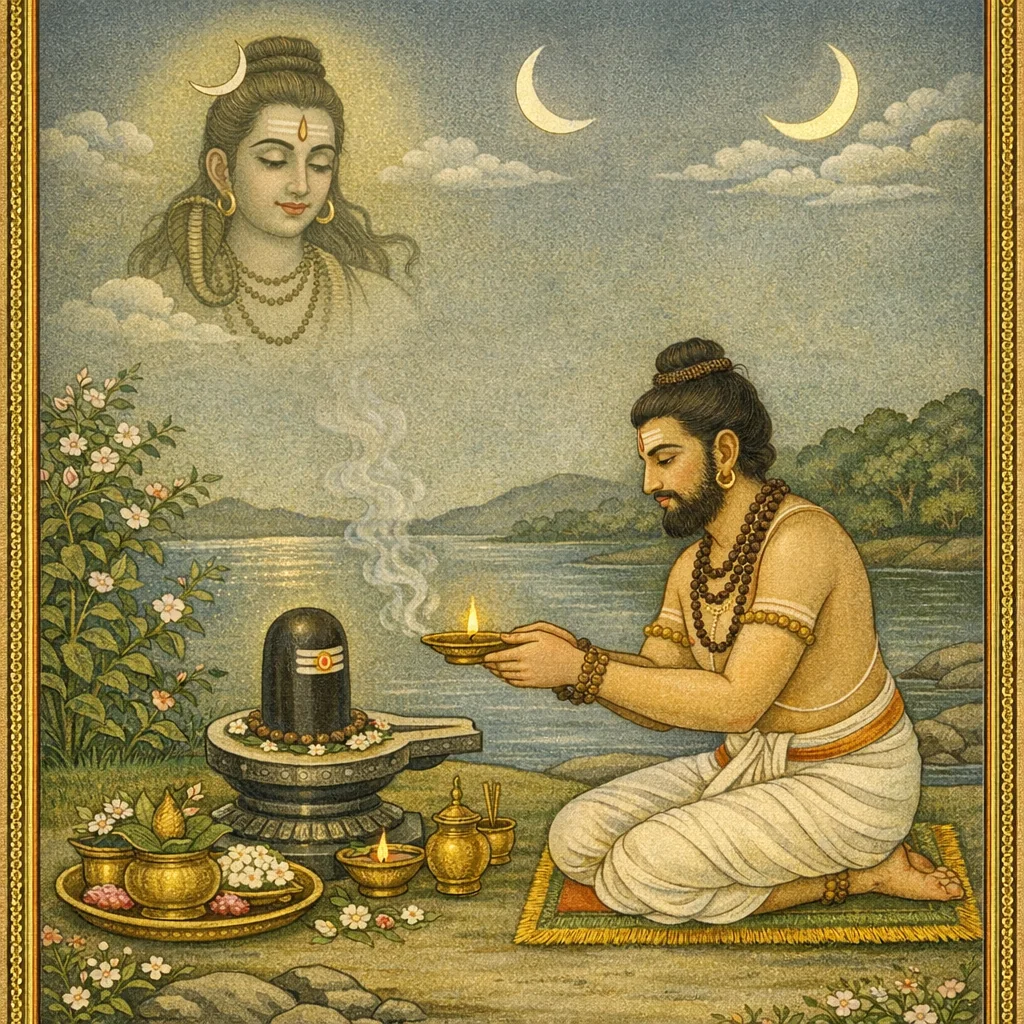
Adhyaya 190
चन्द्रहास-समतीर्थमाहात्म्य (Chandra-hāsa & Somatīrtha Māhātmya)
This chapter unfolds as a dialogue: Yudhiṣṭhira asks Mārkaṇḍeya how Soma (the lunar deity and king) attained the highest success (siddhi) at Somatīrtha, also called Chandra-hāsa, a tīrtha revered by all the gods. Mārkaṇḍeya relates the origin-story: Dakṣa curses Soma with a wasting disease (kṣaya-roga) for neglecting conjugal duty, and the teaching expands into an ethical account of household dharma and the karmic results of negligence. The narrative then turns to pilgrimage and discipline. Soma wanders through many tīrthas, reaches the Narmadā, and for twelve years practices fasting, gifts (dāna), vows (vrata), and restraint, until he is freed from affliction. Soma installs Mahādeva (Śiva) as the remover of great sins and returns to an exalted realm, with the chapter affirming that deity-installation and worship yield enduring merit. Finally, it gives ritual prescriptions and phala statements for bathing and worship at Chandra-hāsa/Somatīrtha—especially on lunar dates, Mondays, and during eclipses—promising purification, well-being, and release from faults and defilements.
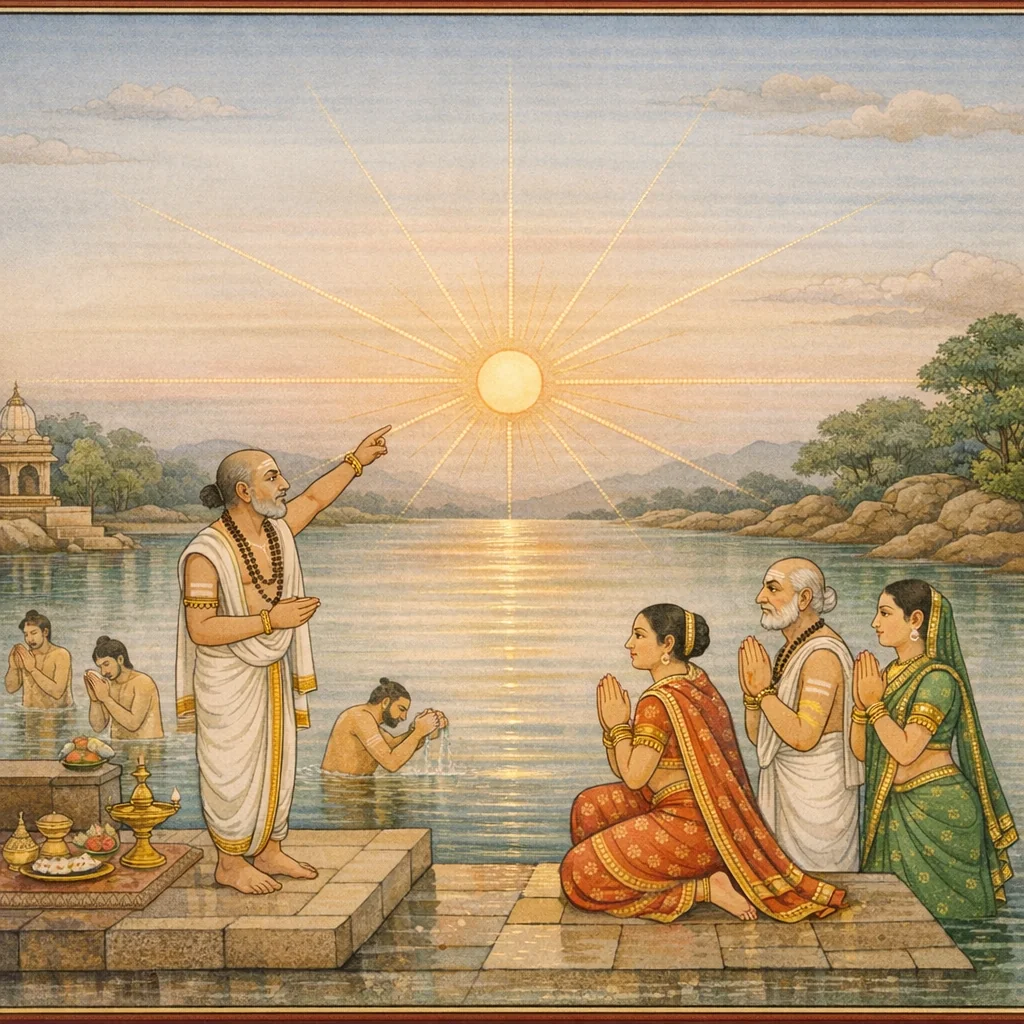
Adhyaya 191
सिद्धेश्वर-लिङ्गमाहात्म्यं तथा द्वादशादित्य-तपःफल-प्रशंसा (Siddheśvara Liṅga Māhātmya and the Merit of the Twelve Ādityas’ Austerity)
The chapter begins with Mārkaṇḍeya guiding the pilgrim to Siddheśvara and to a nearby self-manifest (svāyambhuva) liṅga praised as “amṛta-srāvin,” nectar-flowing. Mere immediate darśana of this sacred spot is said to bestow great merit, establishing the tīrtha’s exceptional holiness. Yudhiṣṭhira then asks how the gods attained siddhi at Siddheśvara, especially regarding the “twelve Ādityas.” Mārkaṇḍeya names the Dvādaśa Ādityas—Indra, Dhātā, Bhaga, Tvaṣṭā, Mitra, Varuṇa, Aryaman, Vivasvān, Savitṛ, Pūṣan, Aṃśumān, and Viṣṇu—and explains that, longing for solar status, they performed intense tapas on the bank of the Narmadā at Siddheśvara. Their success is marked by establishing Divākara at that tīrtha through the distribution of solar aṃśas (portions), after which the place becomes renowned. The discourse further links the Ādityas to cosmic functions at dissolution and to their deployment by directions, presenting a directional order (dik-vyavasthā) of solar powers. Finally it teaches pilgrimage discipline and phala: a morning bath followed by Dvādaśāditya-darśana destroys wrongs of speech, mind, and deed; pradakṣiṇā is equated with circumambulating the earth; fasting on saptamī here yields extraordinary results; and repeated circumambulations bring freedom from ailments and prosperity—health and progeny—set forth as the phalaśruti of steadfast devotion.
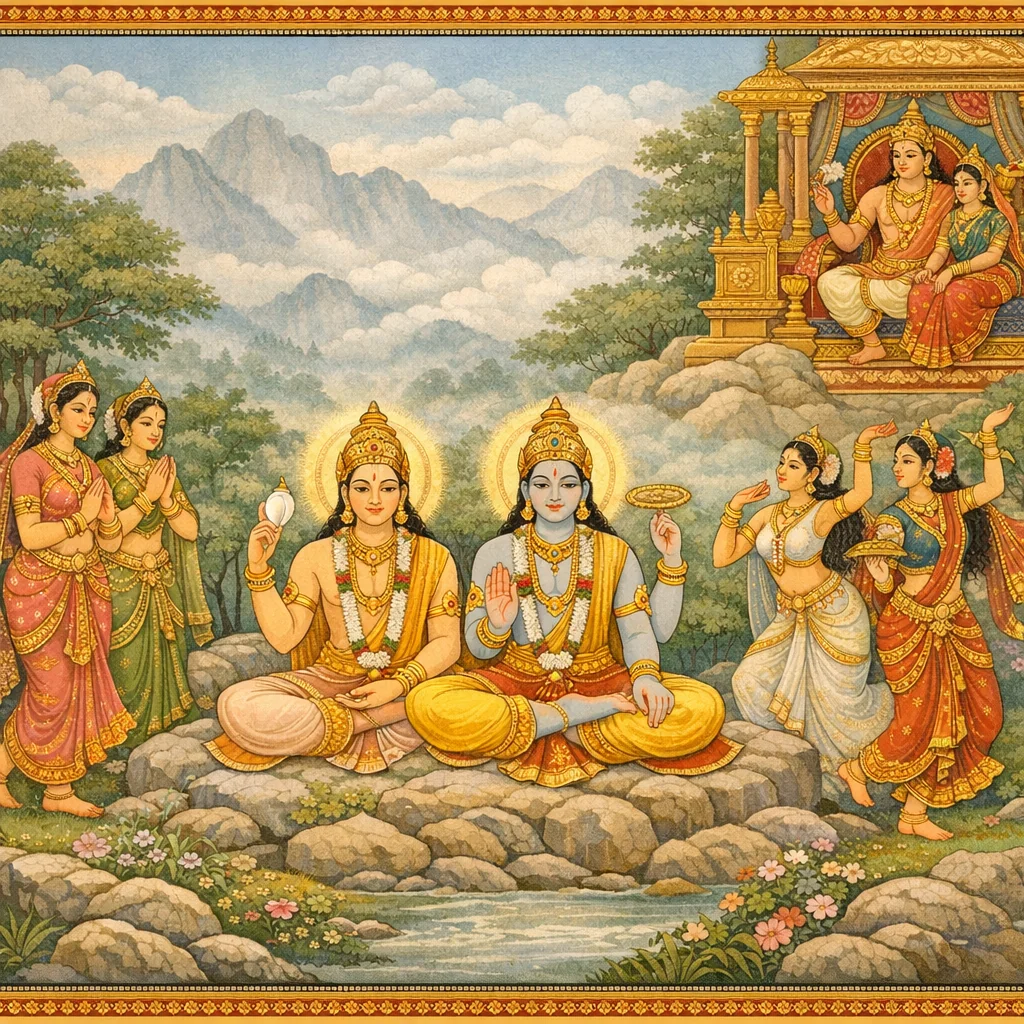
Adhyaya 192
देवतीर्थ-दर्शनम्, नरनारायण-तपः, उर्वश्युत्पत्तिः (Devatīrtha, the Nara–Nārāyaṇa Austerity, and the Origin of Urvaśī)
Chapter 192 begins with Mārkaṇḍeya pointing out an exalted Devatīrtha, whose very sight is said to cleanse sin. In response to Yudhiṣṭhira’s question, he explains who “Śrīpati” (the Lord of Śrī) is and how Keśava is connected with Bhṛgu’s lineage, then turns to a cosmogonic genealogy: Brahmā arises from Nārāyaṇa, and the line proceeds through Dakṣa to Dharma. Dharma’s ten wives (the Daśa-dharmapatnīs) are named, and from them the Sādhyas beget sons known as Nara, Nārāyaṇa, Hari, and Kṛṣṇa—declared to be portions of Viṣṇu. Nara and Nārāyaṇa undertake fierce tapas at Gandhamādana, stirring cosmic disturbance. Alarmed, Indra sends apsarases along with Kāma and Vasantā to distract them through dance, music, beauty, and sensory allure. The stratagem fails: the sages remain steady like a windless lamp and a tranquil ocean. Nārāyaṇa then manifests from his thigh an incomparable woman, Urvaśī, whose beauty surpasses the apsarases. The celestial visitors praise Nara–Nārāyaṇa, and Nārāyaṇa teaches a broad, non-divisive vision: since the Supreme Self pervades all beings, rāga–dveṣa (attachment and aversion) and other separating passions find no foothold in one established in right discernment. He instructs that Urvaśī be taken to Indra, affirming that their tapas is for showing the right path and protecting the world, not for sensual enjoyment or rivalry with the gods.
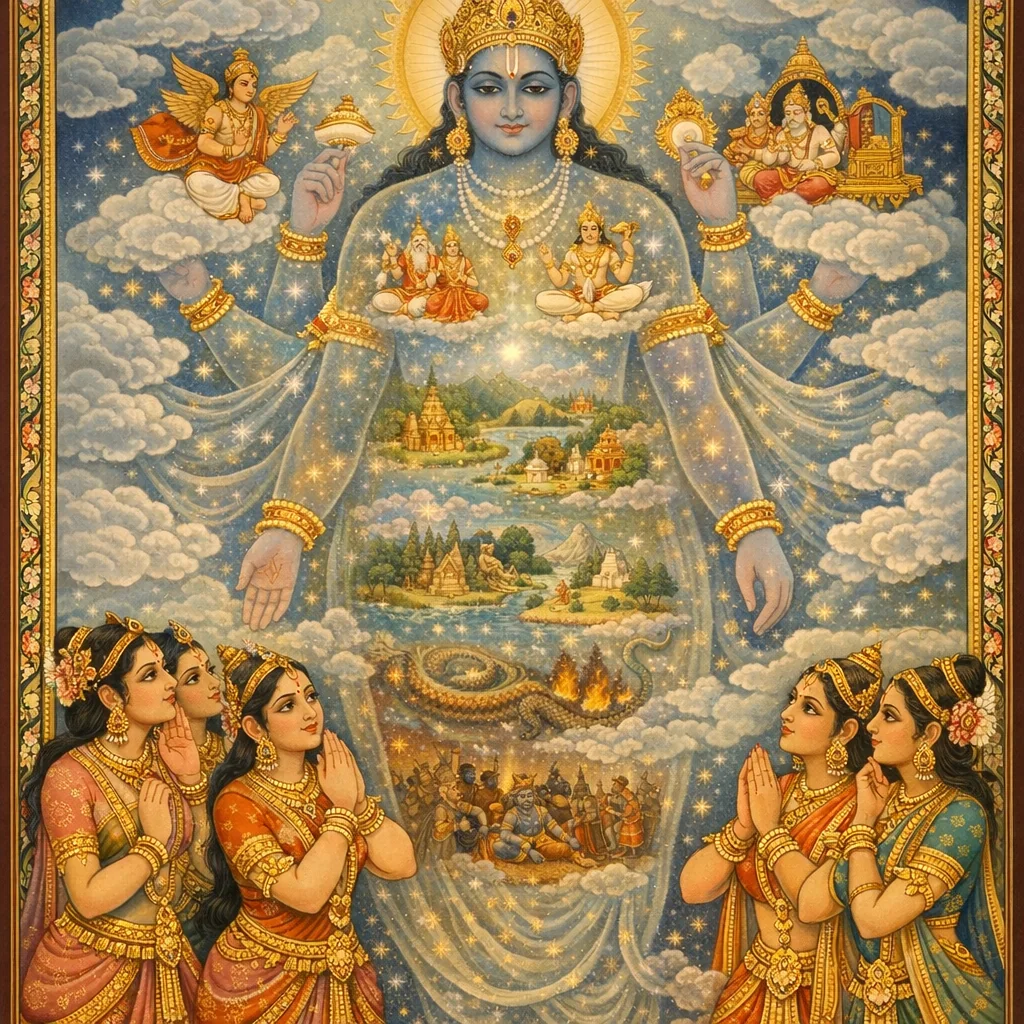
Adhyaya 193
नारायणस्य विश्वरूपदर्शनम् (Nārāyaṇa’s Vision of the Cosmic Form)
Chapter 193 presents a theological discourse through the narration of Śrī Mārkaṇḍeya. A group of apsarases—especially Vasantakāmā and Urvaśī—repeatedly bow and petition Nārāyaṇa for a direct vision of his cosmic form, affirming that his earlier teaching has already clarified the doctrine they sought. Nārāyaṇa grants their request by revealing that all worlds and beings abide within his own body. The vision is described in detail, listing divine orders—Brahmā, Indra, the Rudras, Ādityas, and Vasus—along with semi-divine classes such as yakṣas, gandharvas, and siddhas, and then humans, animals, plants, rivers, mountains, oceans, islands, and the celestial sphere, all seen within him. The apsarases respond with extended hymns, praising him as the substratum of the elements and senses, the one knower and perceiver, and the source in whom all beings participate as partial aspects. Overwhelmed by the intensity and vastness of the revelation, they ask that the cosmic form be withdrawn. Nārāyaṇa reabsorbs the manifestation, teaches that all beings are his portion, and urges an equal vision (samatā) toward gods, humans, and animals. The chapter concludes, in Mārkaṇḍeya’s voice to a king, that meditation on Keśava present in all beings supports liberation, and that hostility and other divisive moods fade when the world is understood as constituted by Vāsudeva.
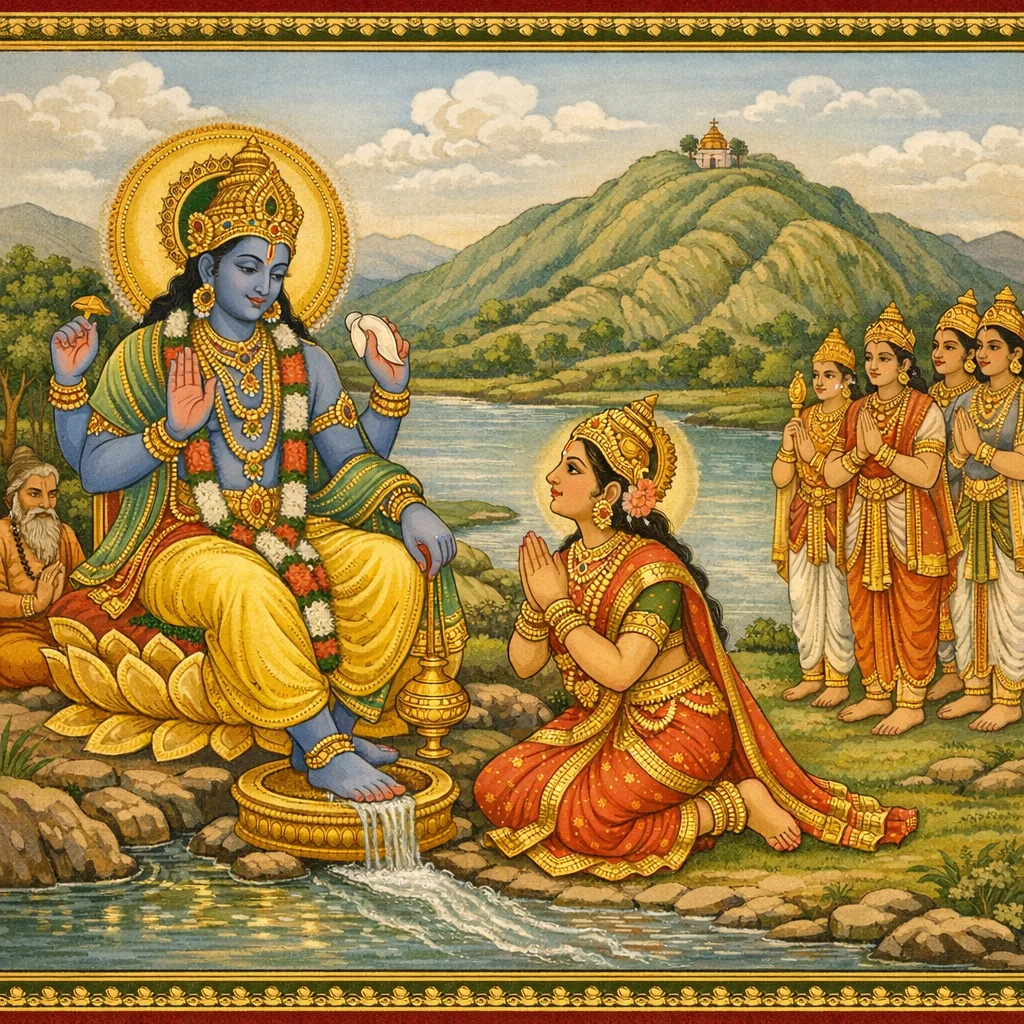
Adhyaya 194
मूलश्रीपतिवैश्वानरूपदर्शनम् तथा नारायणगिरि-देवतीर्थ-प्रादुर्भावः (Vision of the Vaiśvarūpa, the cult of Mūlaśrīpati, and the arising of Nārāyaṇagiri & Devatīrtha)
Markaṇḍeya tells Yudhiṣṭhira of events in which the devas are struck with wonder at the proclamation of a Vaiṣṇava viśvarūpa (cosmic form) and at the appearance of Urvaśī. Śrī (Lakṣmī), born in Bhṛgu’s lineage, resolves to gain Nārāyaṇa as her Lord through rigorous tapas, weighing vows, gifts, discipline, and service; she performs severe austerities on the ocean’s shore for a thousand divine years. Unable to reveal the viśvarūpa themselves, the devas report to Nārāyaṇa. Viṣṇu comes to Śrī, grants her request, and displays the cosmic form, then teaches worship in a Pañcarātra-like mode of devotion: daily worship brings prosperity and honor, while brahmacarya is praised as a foundational austerity. The deity is linked with the epithet “Mūlaśrīpati,” and bathing in Revā’s waters with restrained conduct is said to yield desired results and multiply the merit of dāna. Śrī asks for a dharmic orientation toward the household āśrama; Nārāyaṇa establishes the place-name “Nārāyaṇagiri,” explaining the saving power of remembering it. A divine wedding-sacrifice follows—Brahmā and sages officiate, oceans offer treasures, Kubera supplies wealth, and Viśvakarmā builds jewel-like dwellings—ending with the arising of a tīrtha for avabhṛtha bathing: from Viṣṇu’s foot-water a pure stream reaches the Revā, called Devatīrtha, lauded as supremely purifying, with merit declared to surpass many aśvamedha avabhṛthas.
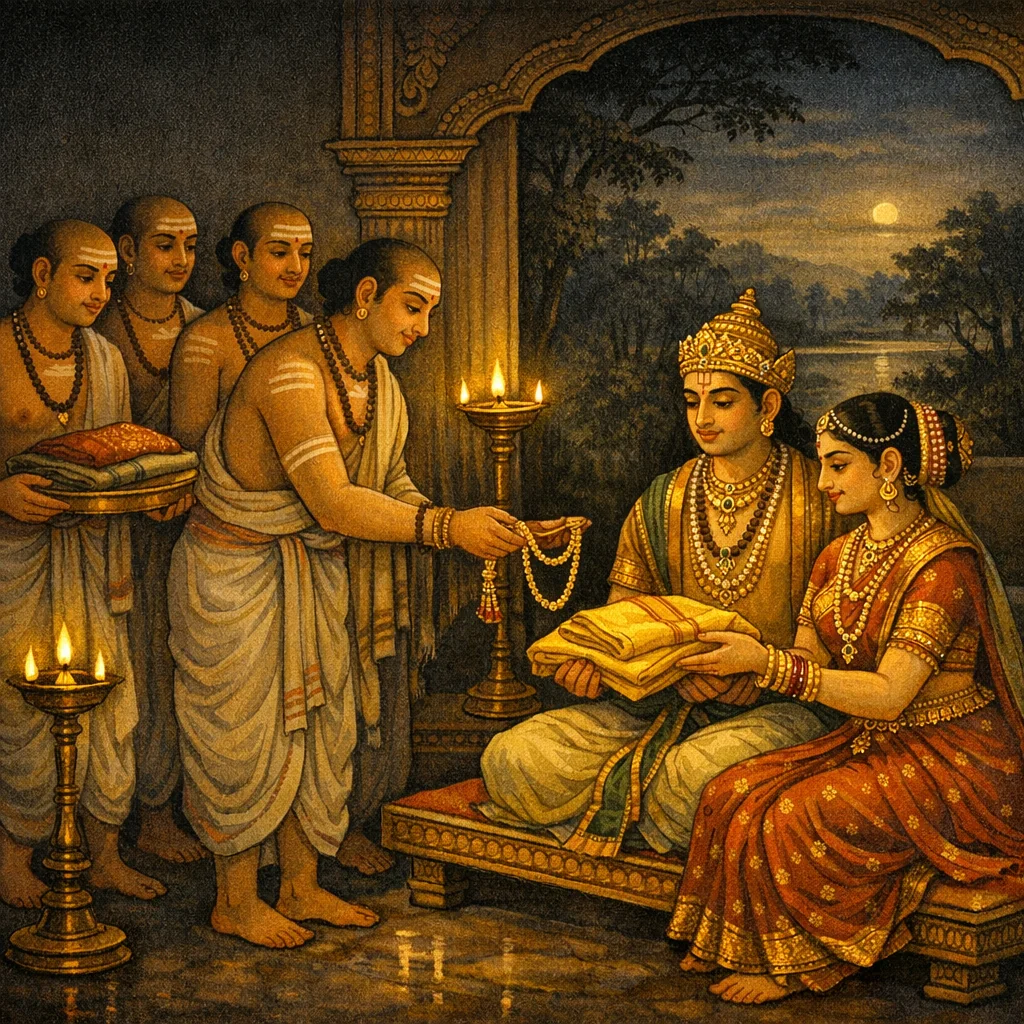
Adhyaya 195
Devatīrtha Māhātmya and Ekādaśī–Nīrājana Observances (देवतीर्थमाहात्म्य तथा एकादशी-नीराजनविधानम्)
This adhyāya opens with Yudhiṣṭhira asking the name, greatness (māhātmya), and the fruits of bathing and giving gifts at Devatīrtha, after which Mārkaṇḍeya offers a theological exposition. He declares that all tīrthas revered by devas and sages are contemplated by Viṣṇu and become unified there, establishing Devatīrtha as a preeminent Vaiṣṇava pilgrimage-center. Hence, bathing at Devatīrtha is proclaimed equal to bathing in all tīrthas and is said to be incomparable. A section on ritual merit follows: acts performed during a grahaṇa (eclipse) yield “ananta,” infinite fruit. Many forms of dāna—gold, land, cow, and more—are listed with deva-linked valuations, culminating in the teaching that any śraddhā-filled gift at Devatīrtha becomes inexhaustible in result. The chapter then prescribes Ekādaśī-centered devotion: bathing (including with Narmadā water), fasting, worship of Śrīpati, an all-night vigil, and lamp-awakening with ghee; on the next day (Dvādaśī) morning, one honors Brahmins and couples with garments, ornaments, betel, flowers, incense, and unguents. It further details pūjā materials (milk products, tīrtha-water, fine cloth, fragrances, naivedya, lamps) and describes the devotee’s post-mortem ascent to Viṣṇuloka with Vaiṣṇava emblems. The closing phalaśruti praises daily nīrājana for protection and health, the use of the lamp’s remainder for the eyes, and the merit of hearing/reciting the māhātmya—also affirming ancestral satisfaction when it is recited in śrāddha rites.
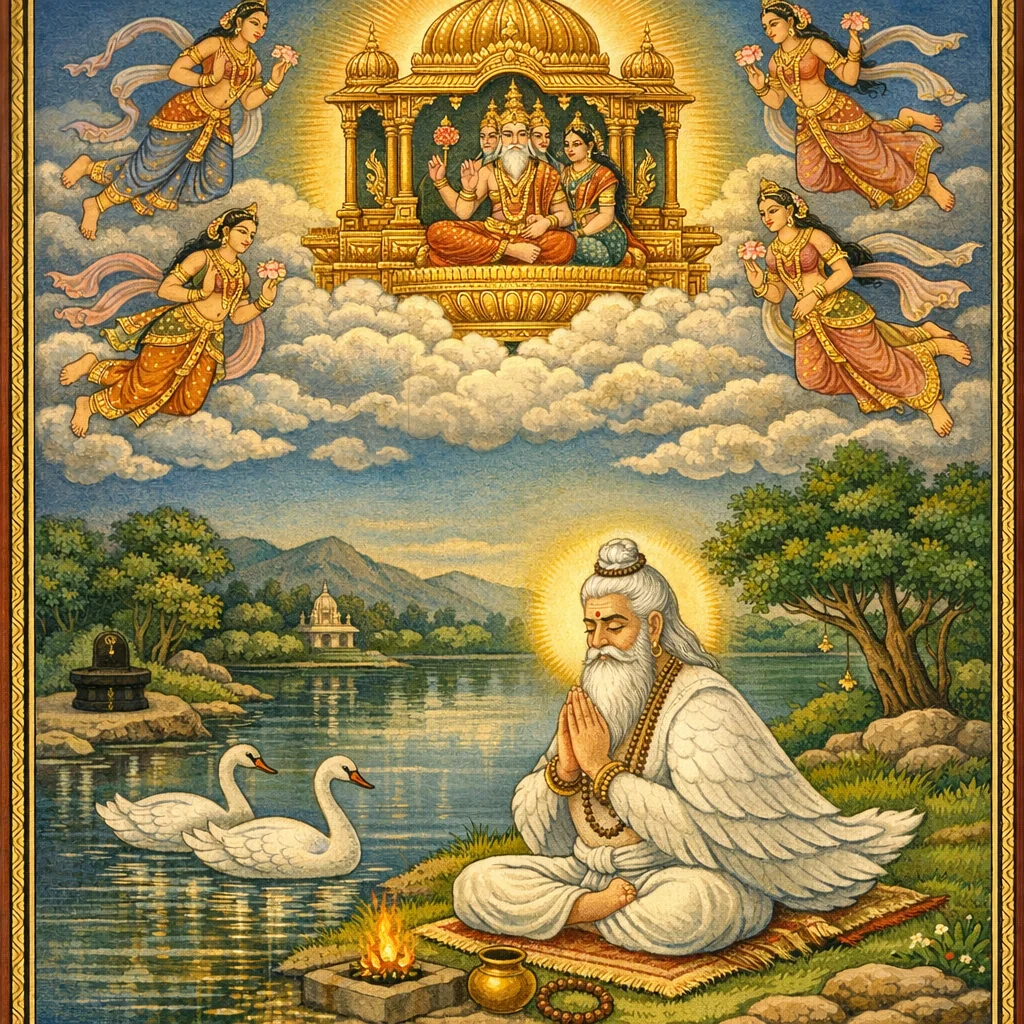
Adhyaya 196
हंसतीर्थमाहात्म्य (Hamsa Tīrtha Māhātmya) — Merit of Bathing, Donation, and Renunciation
Chapter 196 records Mārkaṇḍeya’s guidance on pilgrimage, directing the listener to Haṃsatīrtha, praised as an unsurpassed sacred ford. Its authority is grounded in an origin legend: a Haṃsa performed tapas there and attained the status of Brahmā’s vehicle (brahma-vāhanatā), establishing the site’s mythic potency. The chapter then lays down the ritual-ethical observance: one who bathes at Haṃsatīrtha and gives a gift of gold (kāñcana-dāna) is proclaimed freed from all sins and destined for Brahmaloka. The reward is pictured in luminous visions—travel in a swan-yoked celestial conveyance, radiant like the young sun, enjoying all desired pleasures, attended by companies of apsarases. After experiencing enjoyments according to desire, the soul is said to return to human birth with jāti-smaraṇa (memory of former lives), implying moral continuity across lifetimes. The conclusion offers a soteriological summit: whoever relinquishes the body through saṃnyāsa attains mokṣa, and the tīrtha’s fruit is summed up as sin-destroying, merit-bestowing, and sorrow-dispelling.
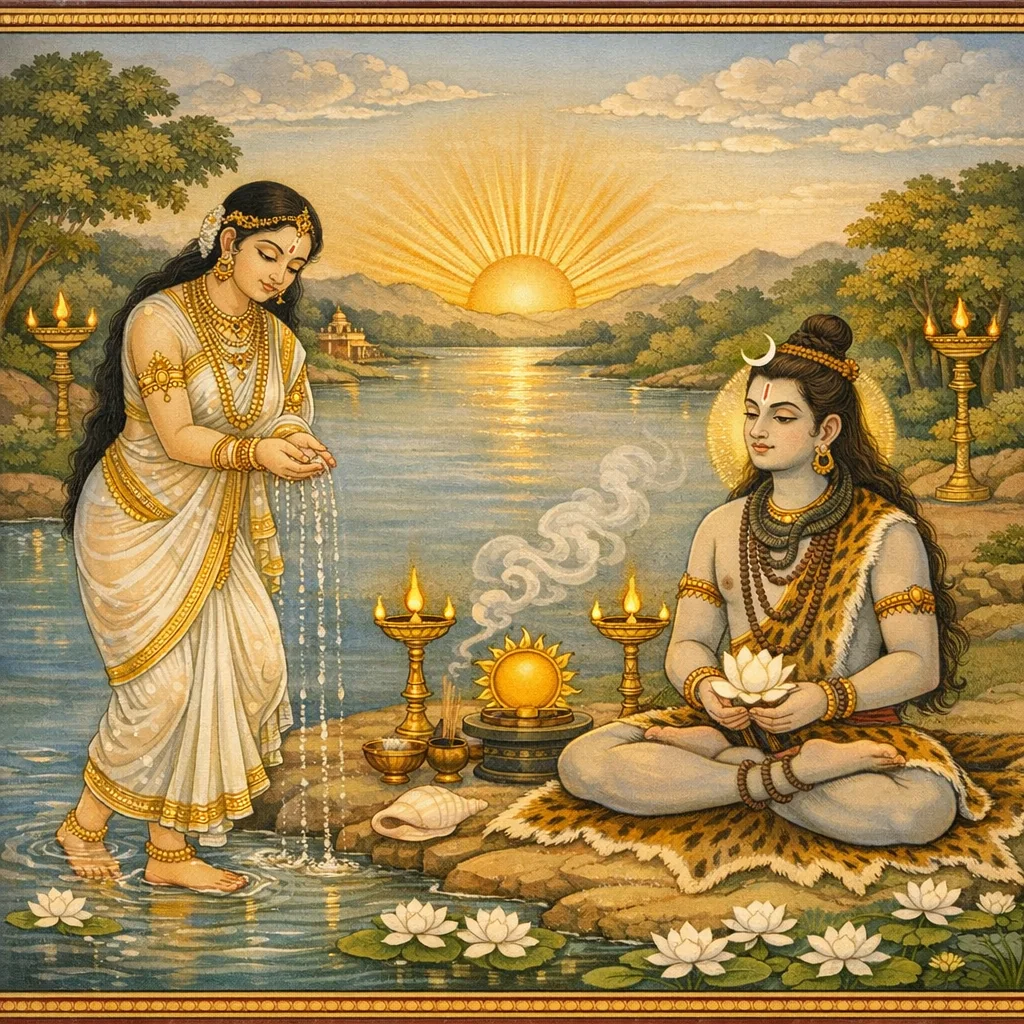
Adhyaya 197
Mūlasthāna-Sūryatīrtha Māhātmya (Glorification of the Mūlasthāna Solar Tīrtha)
Chapter 197 records Mārkaṇḍeya’s praise of a foremost Sūryatīrtha named Mūlasthāna, an auspicious “root-site” connected with Padmajā (Brahmā) and the installation of Bhāskara (the Sun). On the bank of the Narmadā (Revā), the disciplined pilgrim bathes with a regulated mind, offers piṇḍa and water to ancestors and deities, and then beholds the Mūlasthāna shrine. A special calendrical observance is taught: when Śukla Saptamī falls on Sunday (Ādityavāsara), one should bathe in Revā water, perform tarpaṇa, give gifts according to one’s means, bring karavīra flowers and red sandal-water, and devoutly install/worship Bhāskara. Incense is offered (notably with kundā flowers), lamps are lit in all directions, one fasts, and keeps night-vigil with devotional music. The promised fruit is freedom from intense suffering and long residence in the solar realm, attended by gandharvas and apsarases.
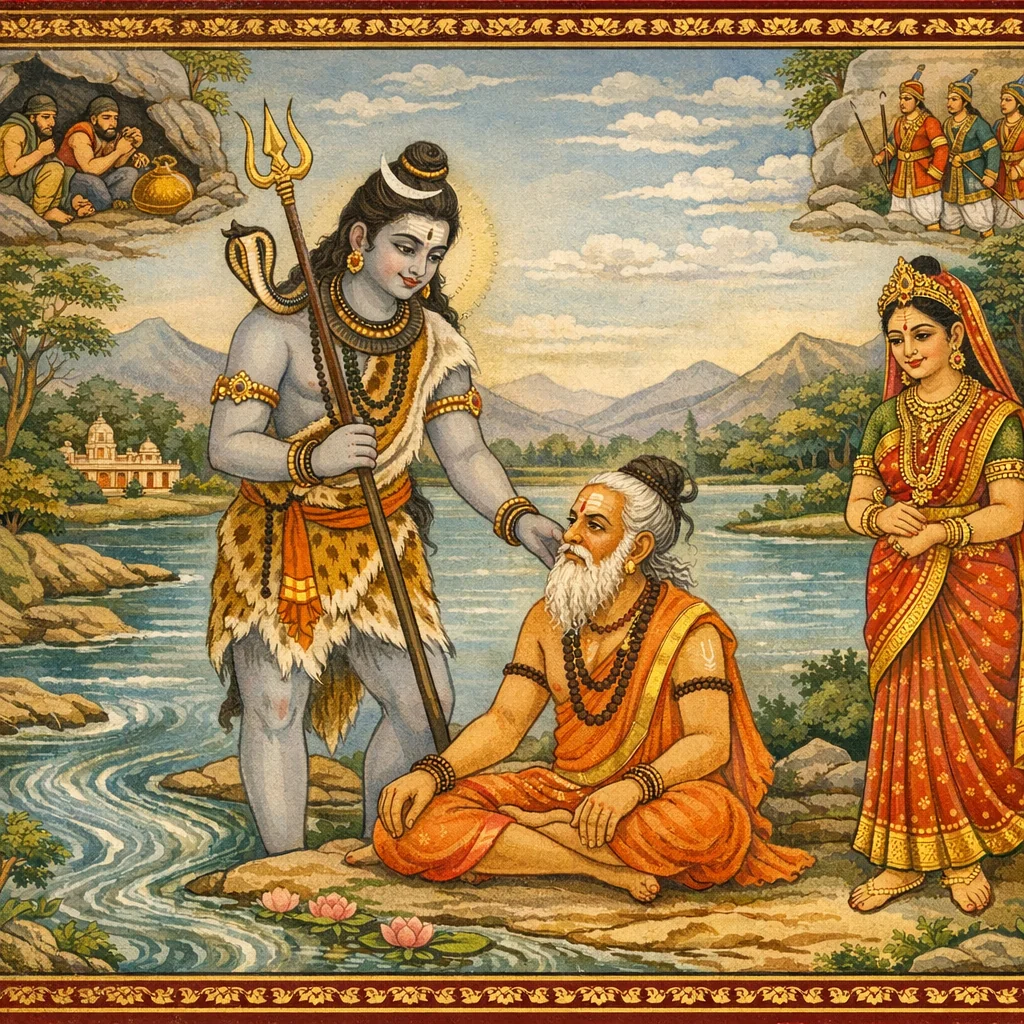
Adhyaya 198
Śūlatīrtha–Śūleśvarī–Śūleśvara Māhātmya (Origin of the Shula Tirtha and the Manifestation of Devī and Śiva)
Mārkaṇḍeya directs the listener to Bhadrakālī-saṅgama, famed as Śūlatīrtha, a divinely established ford ever visited by the devas. Its power is praised: mere darśana—especially when joined with snāna and dāna—is said to remove misfortune, evil omens, the effects of curses, and other demerit. Yudhiṣṭhira asks why, on the bank of the Narmadā, Devī is called Śūleśvarī and Śiva Śūleśvara. Mārkaṇḍeya recounts the tale of the brāhmaṇa ascetic Māṇḍavya, steadfast in severe tapas and silence, whose hermitage is compromised when thieves hide stolen goods there. Royal guards, receiving no reply from the silent sage, punish him by impalement upon a śūla; yet he endures and lives through unwavering inner remembrance of Śiva. Śiva appears, cuts the śūla, and teaches karmavipāka: varied suffering and fortune arise from past actions, and patient endurance without dharma-nindā is itself tapas. Māṇḍavya asks the secret of the śūla’s nectar-like effect and requests that Śiva and Umā abide at its root and tip; immediately sacred forms manifest—Śiva as a liṅga at the base and Devī’s image to the left—establishing the worship of Śūleśvara and Śūleśvarī. Devī then lists many of her named manifestations across holy sites, and the chapter ends with phalāśruti and ritual guidance—worship, offerings, pitṛ rites, and fasts with night-vigil—promising purification and nearness to Śiva-loka, as the tīrtha becomes renowned as Śūleśvarī-tīrtha.
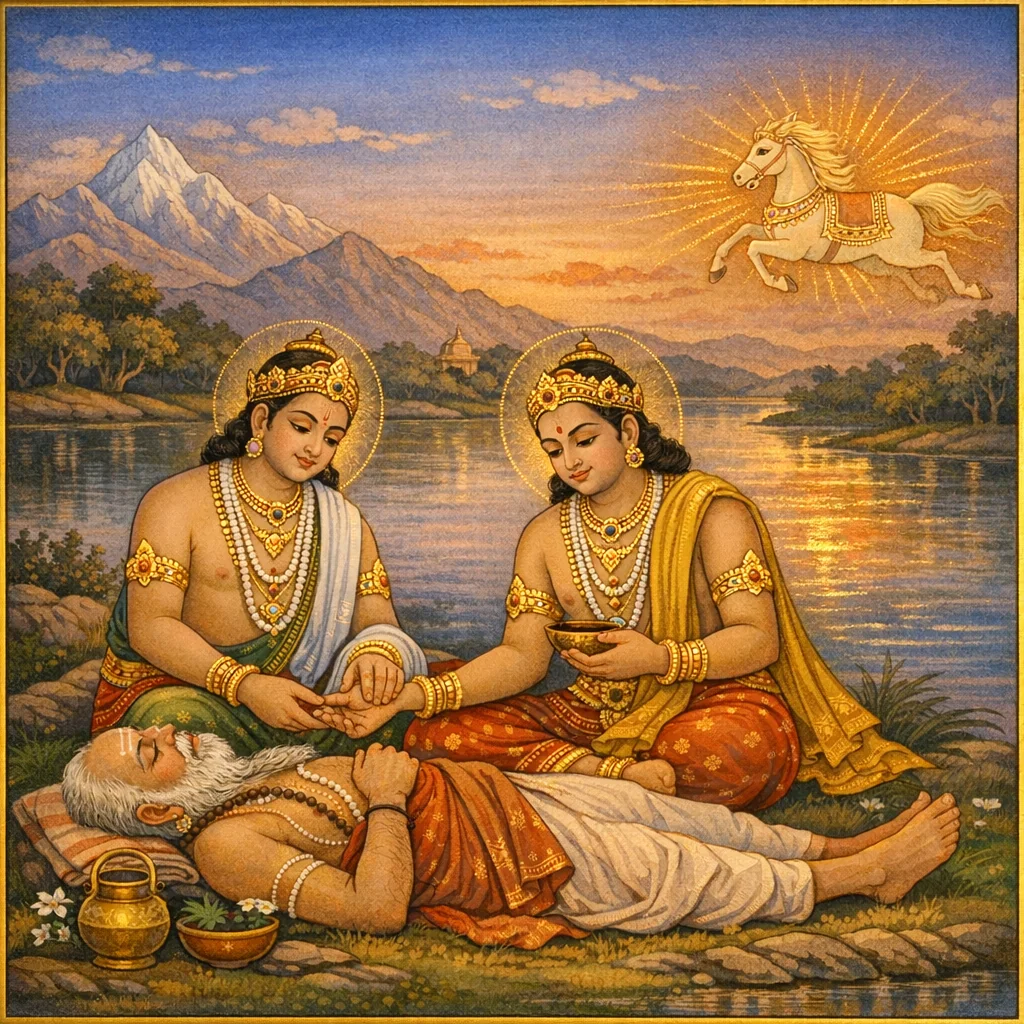
Adhyaya 199
Aśvinī Tīrtha Māhātmya (The Glory of the Aśvinī Pilgrimage Ford)
Mārkaṇḍeya continues his catalogue of tīrthas, introducing Aśvinī Tīrtha as an eminent pilgrimage ford, praised as “kāmika” (aimed at fulfilling one’s wishes) and as bestowing siddhi upon living beings. The Aśvin twins (Nā́satyau) are portrayed as exemplary divine physicians who performed great tapas at this ford; by that austerity they became entitled to shares in sacrifice (yajña) and won broad approval among the gods. When Yudhiṣṭhira asks why they are called the Sun’s sons, Mārkaṇḍeya gives a compressed myth: a queen, unable to endure the Sun’s excessive radiance, undertakes severe austerities in a Meru region; the Sun, stirred by desire, assumes a horse-form; conception occurs through the nasal route, and the famed Nā́satyau are born. The chapter then returns to the Narmadā landscape, stating that the twins practiced difficult austerities near Bhṛgukaccha on the riverbank and attained supreme accomplishment. It concludes with a merit statement: one who bathes at this tīrtha and offers tarpaṇa to pitṛs and deities gains beauty and good fortune wherever they are born.
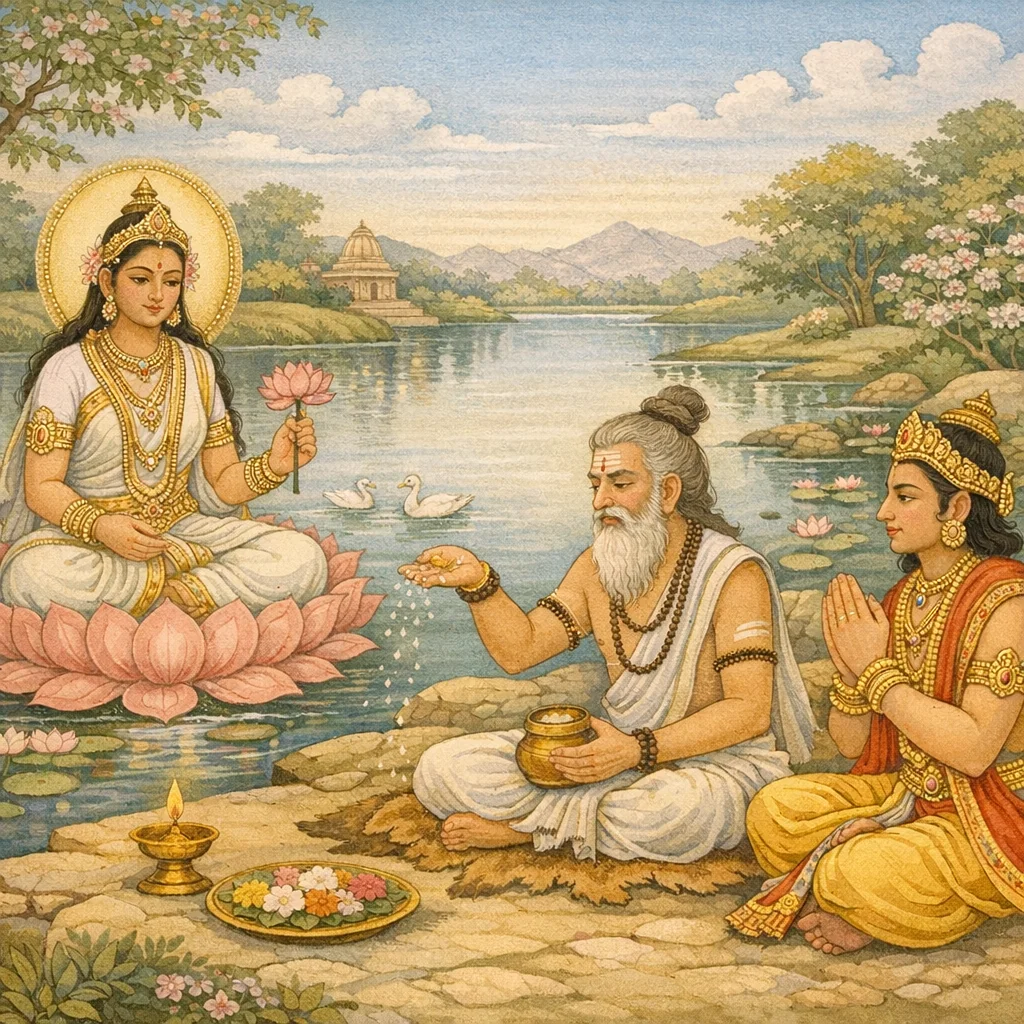
Adhyaya 200
Sāvitrī-tīrtha Māhātmya and Sandhyā–Gāyatrī Discipline (सावित्रीतीर्थमाहात्म्यं तथा सन्ध्यागायत्रीविधानम्)
The chapter unfolds as a dialogue in which Mārkaṇḍeya proclaims Sāvitrī-tīrtha an eminent holy place and answers Yudhiṣṭhira’s questions about Sāvitrī—who she is, how her form is to be contemplated, and how she is to be worshipped. Sāvitrī is praised as Veda-mātṛ, the Mother of the Vedas, linked with lotus imagery and with meditative visualizations prescribed for the three sandhyā times—dawn, noon, and dusk—each with its own contemplation in accord with the ritual order of time. It then sets out a precise discipline of purification for pilgrims: bathing and ācamana, prāṇāyāma to burn away accumulated faults, sprinkling with the “Āpo hi ṣṭhā” mantra, and the use of Aghamarṣaṇa and other Vedic mantras for removing demerit. The text strongly emphasizes disciplined Gāyatrī-japa after sandhyā as a central practice, promising pāpa-kṣaya and attainment of higher worlds. Further fruits are declared for ancestral rites performed at the tīrtha and for final observances undertaken there, culminating in assurances of exalted post-mortem states and an auspicious rebirth thereafter.
Adhyaya 201
देवतीर्थमाहात्म्यम् | Devatīrtha Māhātmya (Glorification of Devatīrtha)
This chapter is framed as an instructive discourse on sacred fords (tīrthas) spoken by Śrī Mārkaṇḍeya to King Mahīpāla, with Yudhiṣṭhira invoked as the exemplar of righteous kingship. He directs the pilgrim to the unsurpassed Devatīrtha, a holy place graced by siddhas and the devas, with Indra among them. It lists the standard merit-bearing observances—snāna (ritual bathing), dāna (charity), japa (mantra-recitation), homa (fire-offering), svādhyāya (sacred study), and devatā-arcana (worship of the deities)—and declares that, by the tīrtha’s innate power, these acts yield ananta, limitless fruit. A specific sacred time is emphasized: the Kṛṣṇa-pakṣa trayodaśī of Bhādrapada, praised as foremost among tīrtha-occasions and remembered as once inhabited by the gods. The rite culminates in bathing on trayodaśī, performing śrāddha according to rule, and worshipping the deity established by the devas—Vṛṣabhadhvaja (Śiva). The promised result is purification from all sins and attainment of Rudra-loka, making the chapter both a pilgrimage guide and a soteriological assurance.
Adhyaya 202
Śikhitīrtha-māhātmya (The Glory of Śikhitīrtha) / शिखितीर्थमाहात्म्य
Mārkaṇḍeya extols an eminent pilgrimage place called Śikhitīrtha, praised as a principal tīrtha and as an excellent pañcāyatana worship-setting centered on a main deity with associated devotions. He relates its origin: Havyavāhana (Agni) performs austerities there to obtain a śikhā (crest/flame/tuft), becomes known as Śikhī, and establishes Śiva’s presence at the spot under the epithet Śikha-ākhyā. A calendrical rite is then prescribed: at a specified lunar time in Āśvayuja, the pilgrim should go to the tīrtha, bathe in the waters of the Narmadā, and offer tarpaṇa to the gods, sages, and ancestors with sesame-water; give gold to a brāhmaṇa, and honor and satisfy the sacred fire. The observance culminates in Śiva-pūjā with fragrance, garlands, and incense. The phalaśruti declares that proper worship leads to ascent to Rudra’s realm in a sun-colored aerial vehicle, accompanied by apsaras and praised by gandharvas, and also grants worldly fruit—destruction of enemies and the attainment of one’s own tejas, radiant spiritual vigor.
Adhyaya 203
कोटितीर्थमाहात्म्य (Koṭitīrtha Māhātmya) — Ritual Efficacy of the Koṭitīrtha
Mārkaṇḍeya proclaims Koṭitīrtha as an “unsurpassed” pilgrimage site, filled with the presence of many siddhas and thronged by great sages. Its authority is grounded in a founding account: after long tapas, the sages establish Śiva there, and also install the Devī as Koṭīśvarī and as Cāmuṇḍā (Mahīṣārdinī), revealing a sacred complex that unites Śaiva and Śākta sanctity. A precise ritual time is then prescribed: on the kṛṣṇa-pakṣa caturdaśī of Bhādrapada, when the Hasta nakṣatra prevails, this tīrtha is praised as universally sin-destroying. The chapter lists key rites—snāna at the tīrtha, offering tilodaka, and performing śrāddha—declaring powerful salvific results and benefits for ancestors, including swift uplift from naraka for a specified number of persons. Finally, it states a general rule of multiplied efficacy: bathing, gifting, japa, homa, svādhyāya, and deity-archana performed by the virtue of this tīrtha become “koṭi-guṇa,” increased a crore-fold, expressing a place-based doctrine of amplified religious merit.
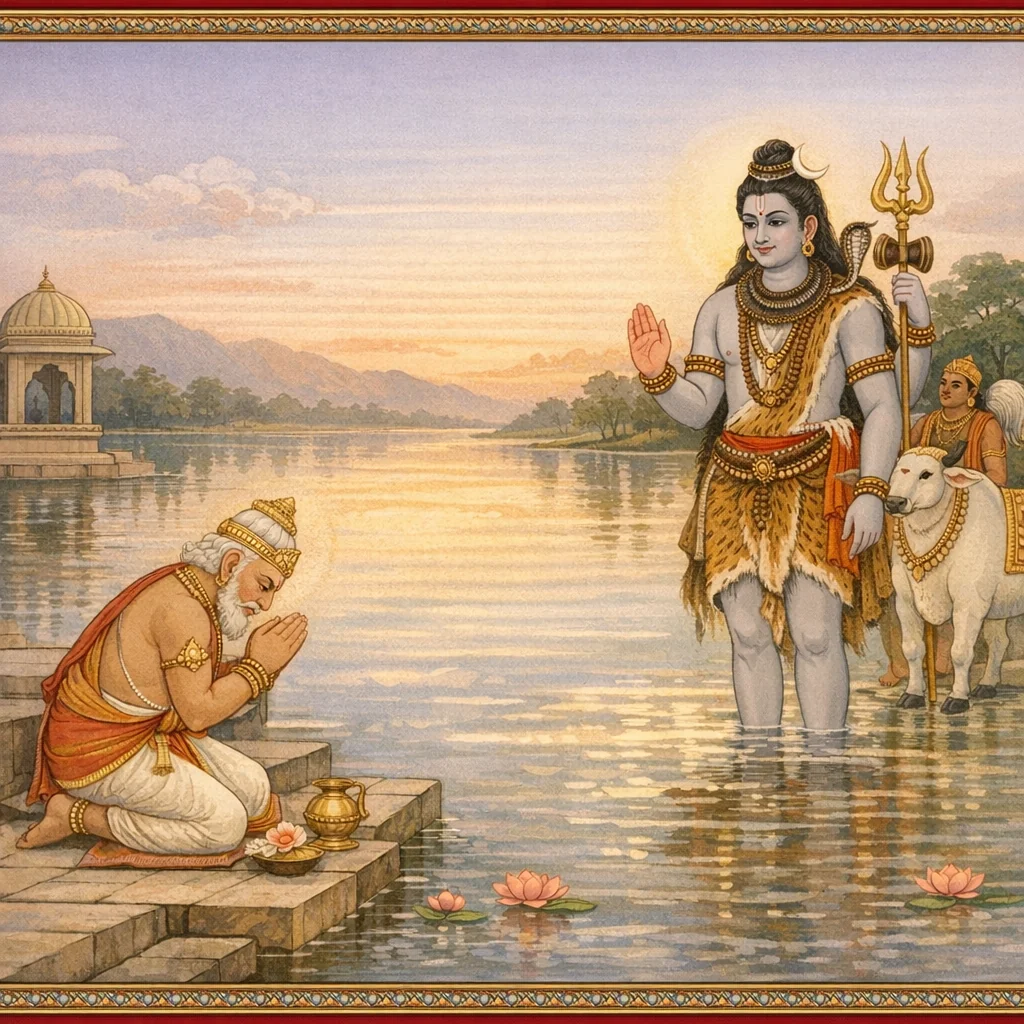
Adhyaya 204
Paitāmaha Tīrtha (Bhṛgu Tīrtha) Māhātmya — ब्रह्मशाप-शमनं, श्राद्ध-फलश्रुति, रुद्रलोक-गति
Chapter 204 is a dialogue in which Mārkaṇḍeya points to Bhṛgu Tīrtha, famed as the supremely meritorious Paitāmaha Tīrtha that destroys sin and moral demerit. Yudhiṣṭhira asks why Brahmā, the cosmic grandsire, worshipped Maheśvara (Śiva) with such intense devotion. Mārkaṇḍeya recounts an ancient itihāsa: Brahmā, desiring to approach his own daughter, was cursed by Śiva, whereby his Vedas and knowledge declined and his public status as worthy of worship was diminished. Stricken with grief, Brahmā undertook long austerities on the northern bank of the Revā, bathing and propitiating Śiva for three hundred years. Pleased, Śaṅkara restored Brahmā’s worship-worthiness at recurring festival times and proclaimed his own abiding presence there along with the gods and the pitṛs (ancestors). Thus the tīrtha became renowned as Paitāmaha, the best among sacred fords. The chapter then states ritual timings and fruits: bathing especially on amāvāsyā (new-moon day) in the dark fortnight of Bhādrapada, followed by tarpaṇa to pitṛs and deities, grants long-lasting ancestral satisfaction even with minimal offerings (a single piṇḍa or sesame-water). It also emphasizes śrāddha observance when the sun is in Kanyā (Virgo), declaring that the full fruit of śrāddha across all pitṛ-tīrthas is obtained here on amāvāsyā. Finally, it promises release from major and minor faults for one who bathes and worships Śiva, and an assured, non-returning passage to Rudra-loka for those who die at this tīrtha with a disciplined mind.
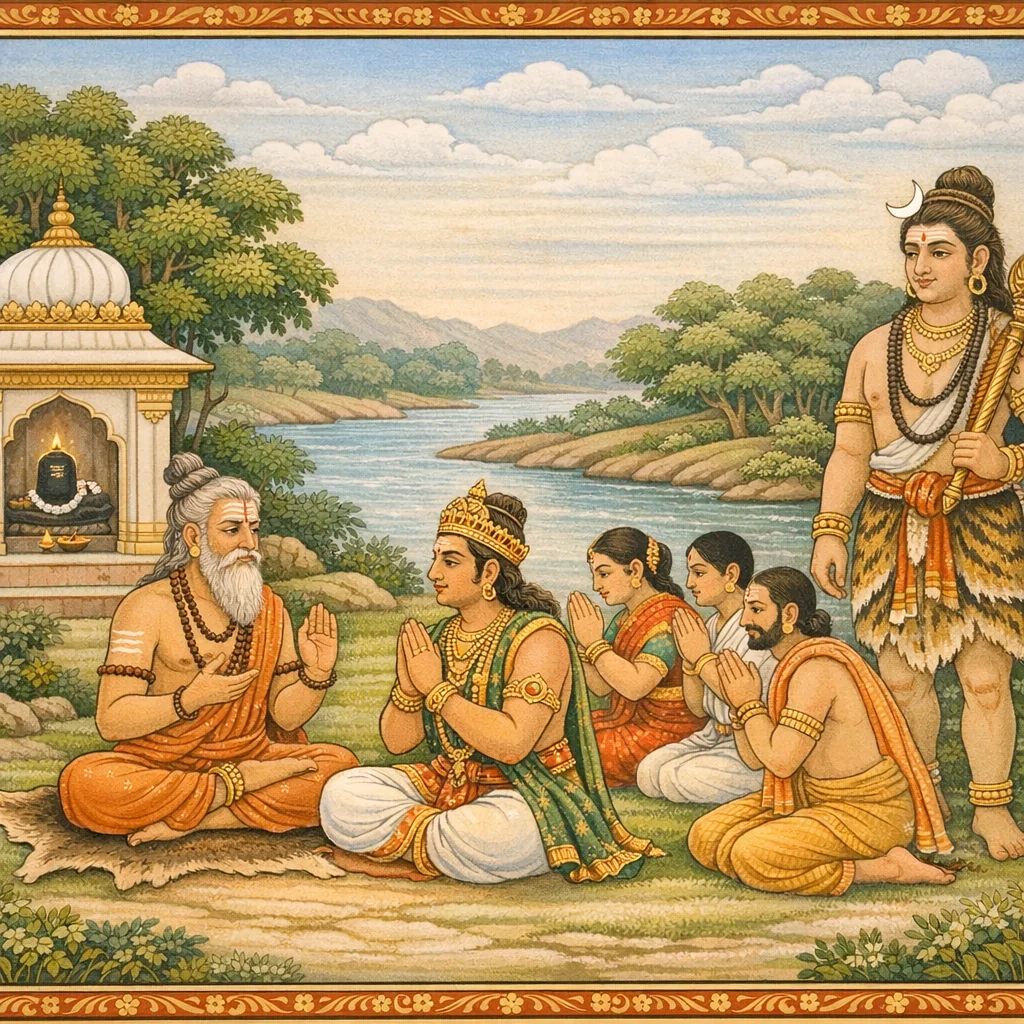
Adhyaya 205
कुर्कुरीतीर्थमाहात्म्य (Kurkuri Tīrtha Māhātmya)
This chapter gives a brief account of a sacred tīrtha in the Revā Khaṇḍa. Śrī Mārkaṇḍeya instructs the king to go to the supremely auspicious pilgrimage place called Kurkurī, famed as the destroyer of all sin (sarva-pāpa-praṇāśana). The chapter explains the site’s power through its presiding deity: Kurkurī as the tīrtha-devatā grants sought aims—such as livestock, sons, and wealth—showing the tīrtha as a place where devotion ripens into tangible and righteous outcomes. It also names a resident guardian, the kṣetrapāla Ḍhauṇḍheśa, whose worship is recommended for both women and men. In phalaśruti form it promises that even veneration lessens misfortune, removes childlessness, relieves poverty, and fulfills desires. Finally, it emphasizes that touching and beholding the tīrtha according to proper procedure (vidhi-pūrvakam) is the means by which these benefits are realized, uniting place, rite, and moral-cosmic consequence.
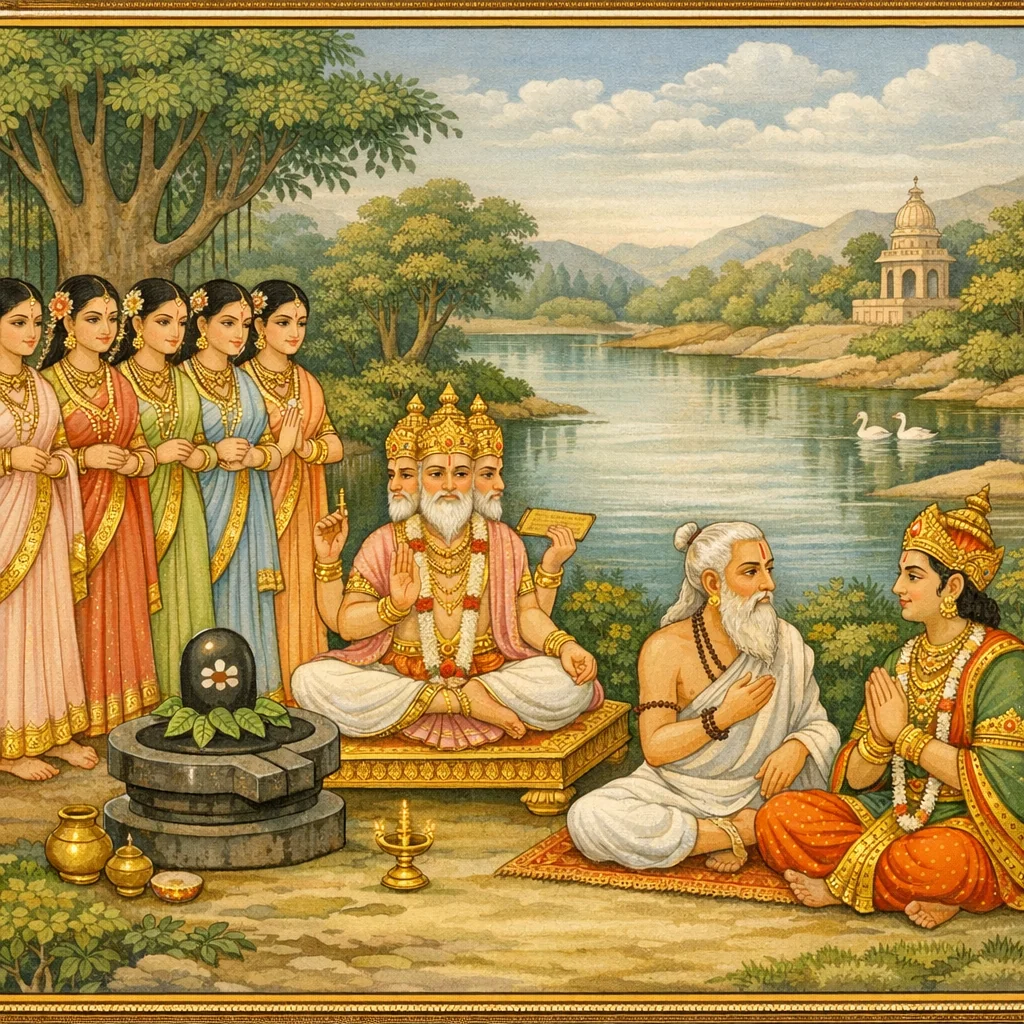
Adhyaya 206
Daśakanyā-Tīrtha Māhātmya (The Glory of the ‘Ten Maidens’ Sacred Ford)
Mārkaṇḍeya addresses a king and directs him to an exceedingly auspicious tīrtha called Daśakanyā, praised as supremely beautiful and universally sin-destroying. The chapter establishes the site’s sanctity through a Śaiva origin-legend: at this ford Mahādeva is linked with ten virtuous maidens, and their marriage arrangement with Brahmā causes the place to become renowned by the name “Daśakanyā.” The teaching then turns from naming to prescribed conduct. Performing kanyādāna there—giving a richly adorned maiden in marriage—yields vast merit, said hyperbolically to grant residence near Śiva for “hair-count” years, followed by a rare human rebirth culminating in great wealth. It also extols devotional bathing (snāna) and the gift of gold to a peaceful brāhmaṇa; even a tiny amount is said to dissolve faults of speech, mind, and body. The phalāśruti concludes with ascent to heaven, honor among Vidyādharas and Siddhas, and abode until cosmic dissolution, presenting the tīrtha as a meeting point of rite, righteous intention, and cosmological reward.
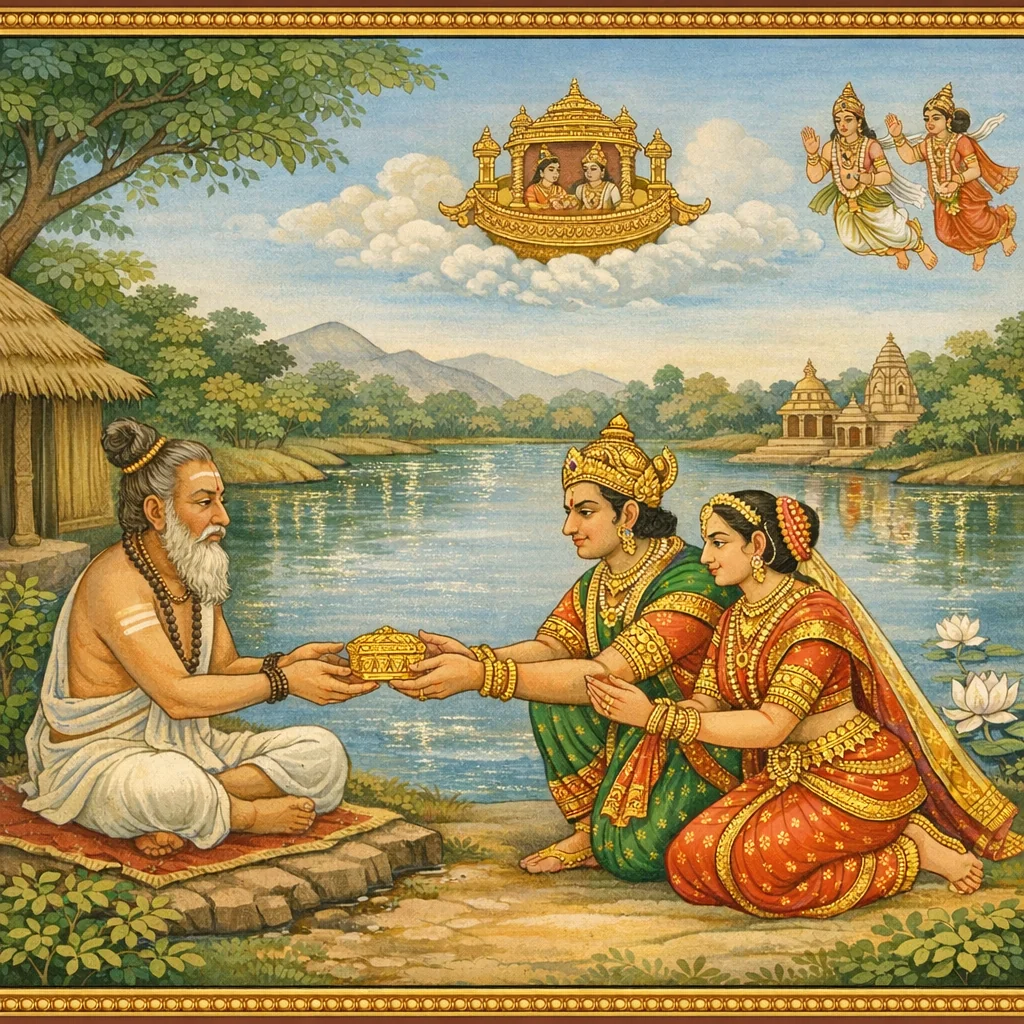
Adhyaya 207
स्वर्णबिन्दुतीर्थमाहात्म्य (Glory of the Svarṇabindu Tīrtha)
Mārkaṇḍeya points out a purifying pilgrimage site called Svarṇabindu (“Golden Drop”) and explains its ritual practice and promised rewards. The chapter centers on snāna (sacred bathing) at this tīrtha and on gifting gold (kāñcana) as dāna to a brāhmaṇa recipient, praised as an act of supreme merit. Gold is taught to be the śreṣṭha ratna, the highest gem, born from the radiance of fire and therefore uniquely powerful as a gift. It declares that even the smallest offering of gold—no more than the tip of a hair—when made in connection with this tīrtha, grants ascent to heaven if one dies there. The phalaśruti goes beyond heaven: the devotee is honored among Vidyādharas and Siddhas, dwells in an excellent aerial vehicle until cosmic dissolution, and then returns to an outstanding human birth as a dvija in a wealthy household. The ethical thrust is karmic cleansing, for wrongs of mind, speech, and body are said to be swiftly destroyed through gold-giving performed ritually at this sacred ford.
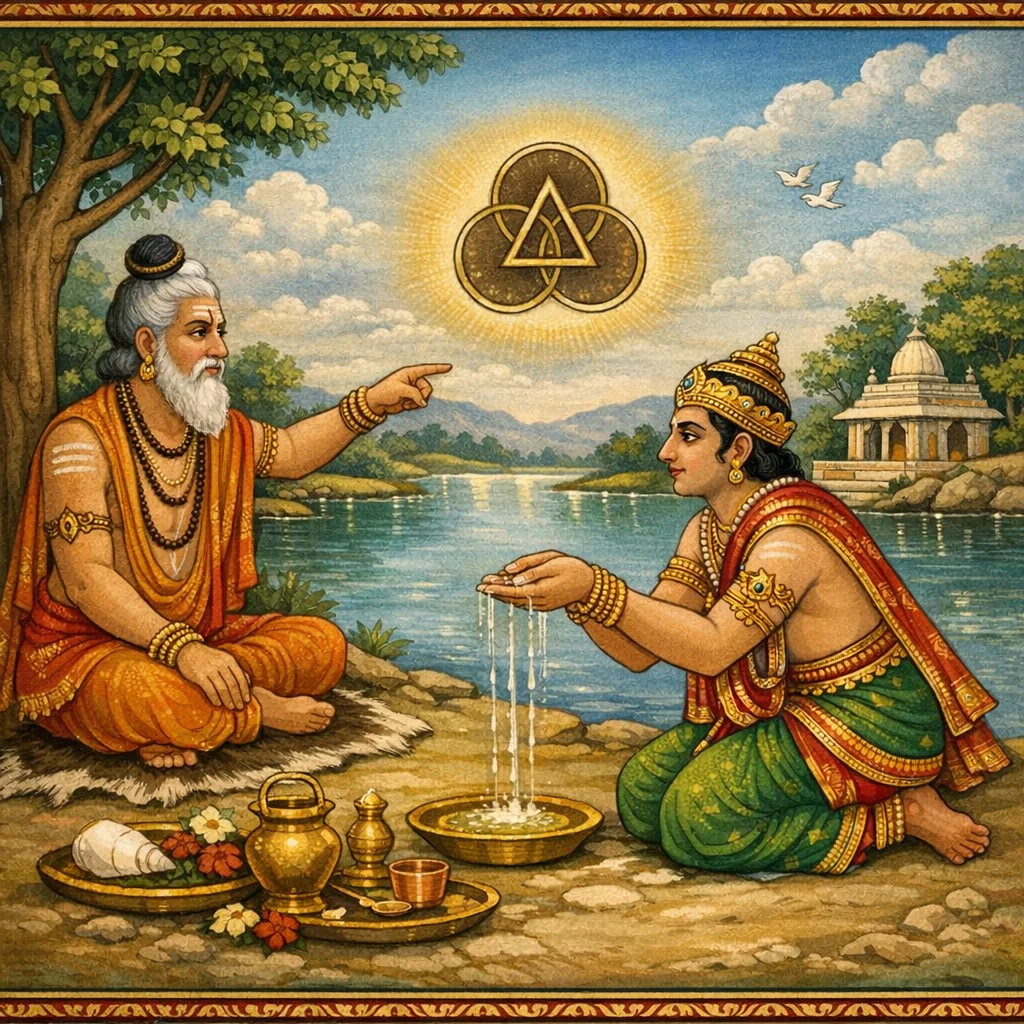
Adhyaya 208
पितृऋणमोचनतीर्थप्रशंसा — Praise of the Tīrtha that Releases Ancestral Debt (Pitṛ-ṛṇa-mocana)
This chapter records Mārkaṇḍeya’s instruction to a ruler concerning the famed tīrtha called “Pitṛ-ṛṇa-mocana,” renowned in the three worlds for releasing one from ancestral debt and obligation. It sets forth the proper ritual order: bathe according to vidhāna, satisfy the pitṛ-deities through tarpaṇa, and give dāna—by which one becomes anṛṇa, free of debt. The teaching then explains why progeny and ritual continuity are upheld: ancestors long for a son, for the son is regarded as the liberator from the “Puṇnāmā” hell, a standard Purāṇic basis for filial-ritual duty. Obligations are classified as the three debts (ṛṇa-traya): pitṛ-ṛṇa through piṇḍadāna and water offerings, deva-ṛṇa through agnihotra and yajñas, and human/social debt through promised gifts and duties toward brahmins, tīrthas, and temple works. The chapter ends with a phalaśruti, declaring that offerings made and teachers satisfied at this tīrtha yield inexhaustible merit benefiting the departed across seven births.
Adhyaya 209
भारभूतीतीर्थ-माहात्म्य / The Māhātmya of Bhārabhūti Tīrtha (Bhāreśvara) on the Revā (Narmadā)
Mārkaṇḍeya points out successive tīrthas on the Revā (Narmadā), including Puṣkalī and Kṣamānātha, and then recounts the origin of the Bhārabhūti tīrtha, where Śiva abides as Rudra-Maheśvara. Yudhiṣṭhira asks why it is called “Bhārabhūti.” In the first exemplum, the virtuous brāhmaṇa Viṣṇuśarman lives by ethical discipline and austere simplicity. Mahādeva comes in the form of a student (baṭu) to study with him; a quarrel with other students over food preparation leads to a wager. Śiva manifests abundant food, and later, at the river, enacts the wager: the students are thrown into the Narmadā with a “burden” (bhāra), but Śiva rescues them, establishes a liṅga known as Bhārabhūti, and removes the brāhmaṇa’s fear of sin. The second exemplum tells of a merchant who betrays and murders a trusting friend; after death he endures harsh punishments and many transmigrations, finally becoming a burden-bearing ox in the household of a righteous king. During Kārttika/Śivarātri at Bhāreśvara, the king performs snāna, offerings, fourfold liṅga “filling” (pūraṇa) through the night-watches, dāna (gold, sesame, cloth, cow-gift), and jāgaraṇa; the ox is purified and ascends. The chapter ends with phala: bathing and observance at Bhārabhūti destroy even great sins; even a small gift yields imperishable merit; death at the tīrtha grants uninterrupted Śiva-loka, or an auspicious rebirth that leads again to liberation.
Adhyaya 210
पुङ्खतीर्थमाहात्म्य (Puṅkha Tīrtha Māhātmya)
This adhyāya, spoken by Śrī Mārkaṇḍeya, introduces Puṅkha Tīrtha as an “excellent” place of pilgrimage and establishes its sanctity through exemplary precedent. It recalls an earlier attainment of siddhi connected with Puṅkha at this tīrtha, and then links the site’s renown to the tapas of Jāmadagnya (Paraśurāma), the mighty figure famed for ending kṣatriya dominance, who performed extensive austerities on the northern bank of the Narmadā. The chapter then sets out a structured phalaśruti: bathing at the tīrtha with worship of Parameśvara grants strength in this world and liberation in the next; honoring devas and pitṛs frees one from ancestral debt; giving up life (prāṇatyāga) there ensures an irreversible post-mortem course culminating in Rudra-loka. Bathing yields the fruit of an Aśvamedha; feeding brāhmaṇas multiplies merit immensely; and worship of Vṛṣabhadhvaja (Śiva, “bannered by the bull”) bestows the fruit of a Vājapeya sacrifice. Overall, the adhyāya serves as a devotional, place-based guide to high-yield ritual conduct within a Śaiva horizon.
Adhyaya 211
Atithi-dharma Parīkṣā on the Narmadā Bank and the Māheśvara Āyatana ‘Muṇḍināma’ (अतिथिधर्मपरीक्षा तथा ‘मुण्डिनाम’ आयतनमाहात्म्यम्)
Mārkaṇḍeya recounts to Yudhiṣṭhira an incident on the bank of the Narmadā during the śrāddha season of feeding brāhmaṇas. Maheśvara, disguised as a foul-smelling brāhmaṇa afflicted with leprosy (kūṣṭhī), approaches a brāhmaṇa household and asks to dine with the assembled brāhmaṇas. The hosts and participants reject him with harsh words, deeming his appearance ritually polluting. After the disguised Lord departs, the meal is mysteriously ruined: worms appear in the food vessels, and all are astonished. A discerning brāhmaṇa explains this as vipāka—the consequence of insulting an atithi (guest)—and recognizes the visitor as the Supreme Lord testing their conduct. He reiterates the rule that an atithi must not be judged by beauty or ugliness, cleanliness or uncleanness, or outward social appearance; neglect during śrāddha invites destructive forces to consume the offering. The group searches and finds the figure standing motionless like a pillar, then offers supplication. Maheśvara responds with compassion, restores/provides the food, and instructs them to continue worship of his maṇḍala. The chapter concludes by praising the trident-bearing Lord’s shrine/āyatana called “Muṇḍināma,” auspicious and sin-destroying, especially efficacious in Kārttika and equal in merit to Gayā-tīrtha.
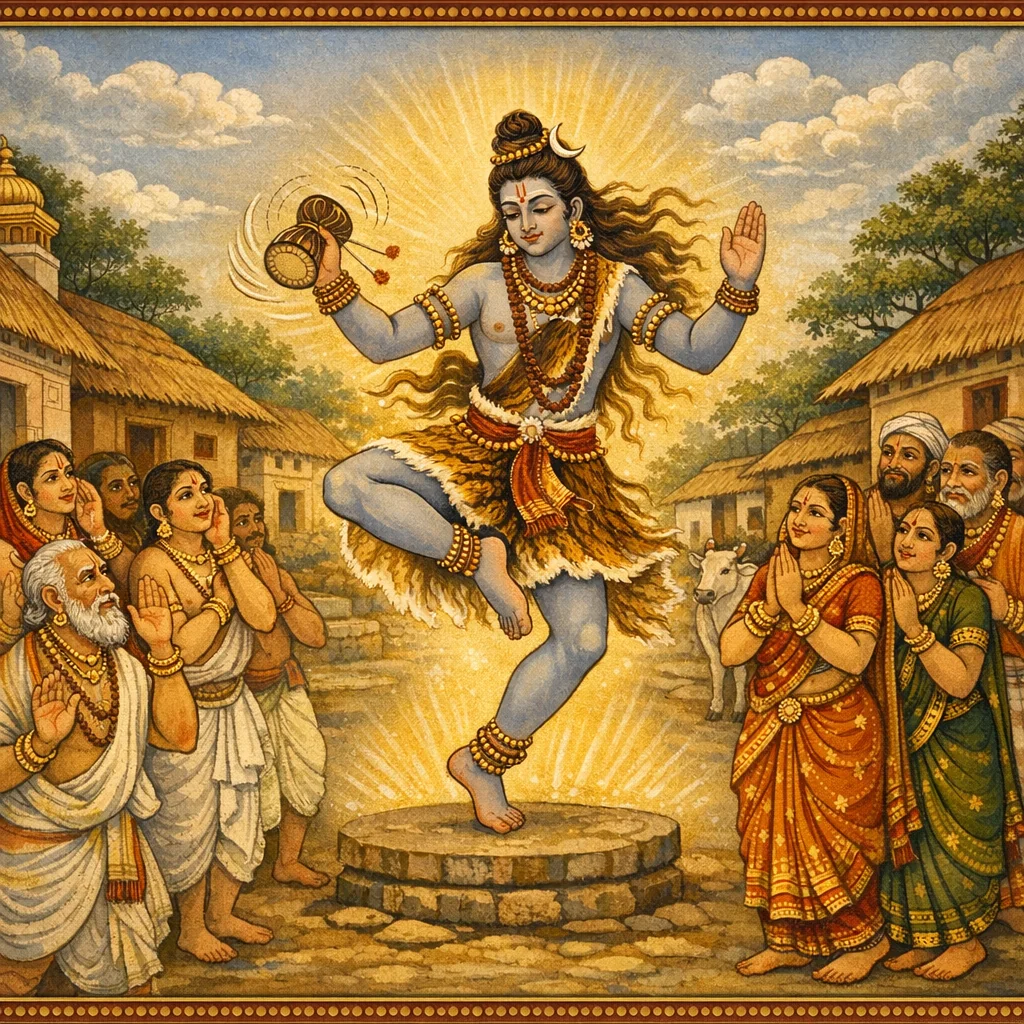
Adhyaya 212
Dīṇḍimeśvaranāmotpattiḥ (Origin of the Name Dīṇḍimeśvara) / The Etiology of Dindimeshvara
Mārkaṇḍeya recounts a theological episode in which Maheśvara (Śiva) assumes the guise of a mendicant (bhikṣu-rūpa) and enters a village, hungry and thirsty. Marked by ascetic emblems—ash-smeared body, akṣasūtra, trident, matted hair, and ornaments—he sounds a ḍamaru whose beat is likened to a dindima (kettle-drum). Surrounded by children and townsfolk, he alternates song, laughter, speech, and dance, moving so that he seems to appear and vanish before their eyes. A warning motif follows: wherever the Lord playfully sets down the drum, that house becomes “burdened” and is said to perish—an ethical and ritual caution against disrespect, misrecognition of the divine, and the destabilizing force of an uncontrolled encounter with the sacred. When the people begin praising Śaṅkara with devotion, the Lord becomes visible in a “dindima-form,” and from then on he is known as Dīṇḍimeśvara. The chapter ends with a phalaśruti: by darśana and sparśana of this form or site, one is freed from all sins.
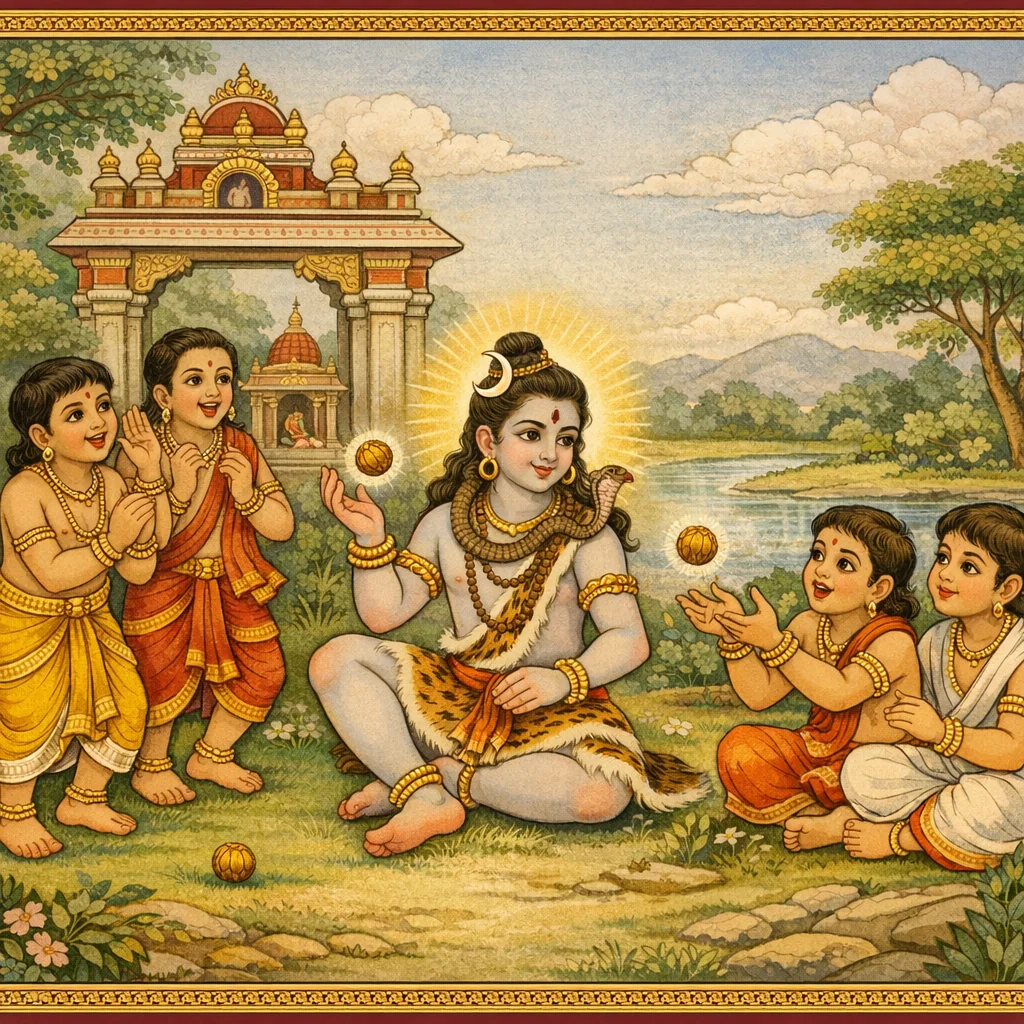
Adhyaya 213
Āmaleśvara-Māhātmya: Śambhu in Child-Form and the Fruit of Worship (आमलेश्वर-माहात्म्य)
Śrī Mārkaṇḍeya recounts a brief theological episode meant to praise a sacred site and impart ethical instruction. He introduces a “great deed” (caritaṃ mahat) of the Lord, declaring that merely hearing it frees one from all sins, thus setting a phalaśruti frame of promised spiritual fruit. Śambhu (Śiva) appears in the form of a child and plays with village boys using āmalaka fruits. The boys repeatedly throw the fruits; the deity instantly retrieves them and throws them back, extending the play in every direction, until the participants realize that the āmalaka is none other than Parameśvara. The chapter concludes by proclaiming Āmaleśvara as the supreme place among holy places, and asserts that worship there—even once—bestows attainment of the “highest state” (paramaṃ padam). In this way it binds a local shrine’s identity to the doctrine of divine immanence and to the salvific power of minimal yet sincere worship.
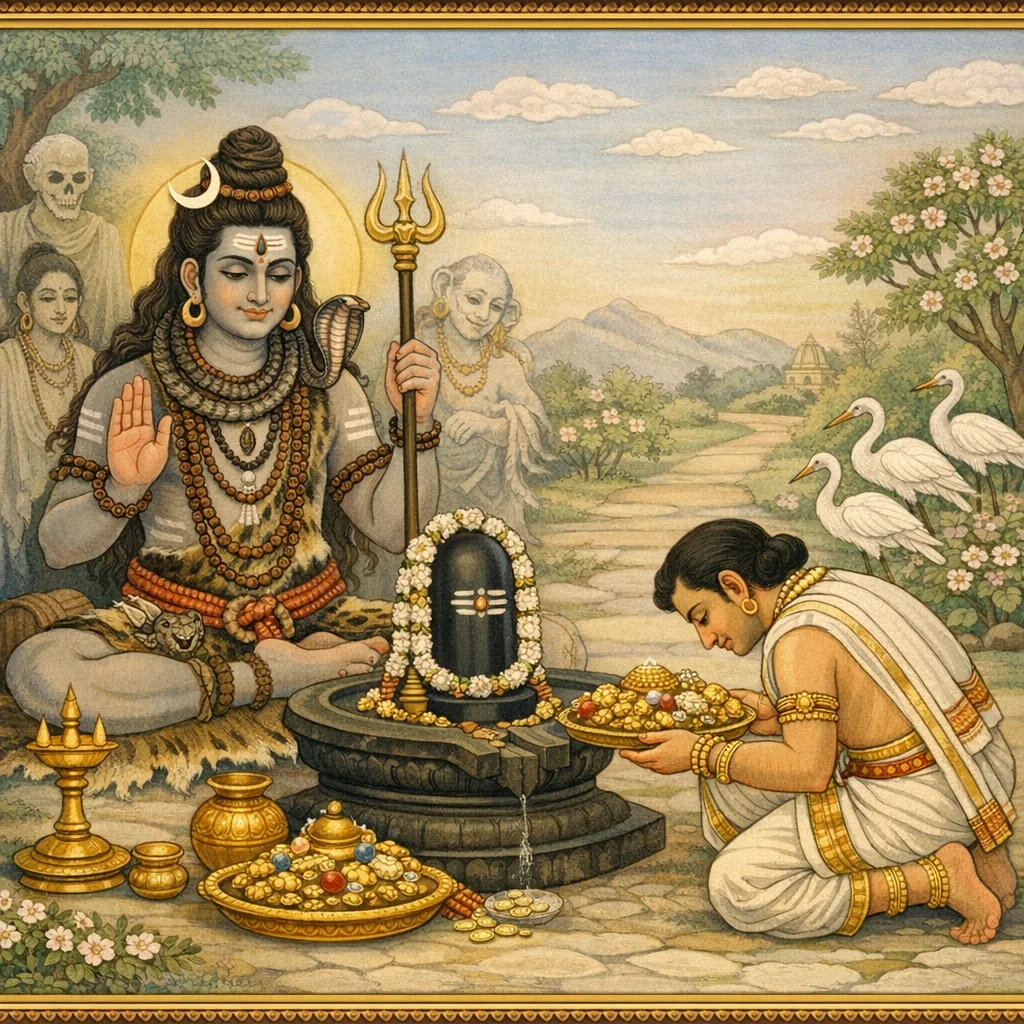
Adhyaya 214
Devamārga–Balākeśvara Māhātmya (कन्थेश्वर–बलाकेश्वर–देवमार्ग माहात्म्य)
Chapter 214 is narrated by Mārkaṇḍeya as a theological account of the origin of a Śaiva sacred place. It begins with a phalāśruti: merely hearing this story frees one from all sins. Śiva appears in fearsome ascetic imagery—Kapālī/Kānthika—surrounded by piśācas, rākṣasas, bhūtas, ḍākinīs, and yoginīs, seated as Bhairava upon a preta-seat, yet granting fearlessness to the three worlds while performing immense tapas. When a famed “āṣāḍhī” observance occurs and Śiva’s kanthā (cloak) is released elsewhere, the deity becomes known as Kantheśvara, whose darśana yields merit like an Aśvamedha. The narrative then turns to Devamārga, teaching about desire and grace. Śiva meets a merchant and tests him by asking him to fill/raise the liṅga using “balāka” (understood as cranes/herons as ornament and/or a named implement or measure in local tradition). Driven by greed and confusion, the merchant exhausts his wealth; Śiva playfully fragments the liṅga and challenges the very notion of “completion,” then, upon confession and remorse, grants inexhaustible riches. The liṅga remains as a public proof (pratyaya) for the welfare of beings, adorned with balāka, and the place becomes renowned as Devamārga. The chapter closes with soteriological assurances: seeing or worshiping there removes sins; worship of Balākeśvara on Devamārga within a pañcāyatana setting leads to Rudraloka; and for the spiritually intent, death on Devamārga entails no return from Rudraloka.
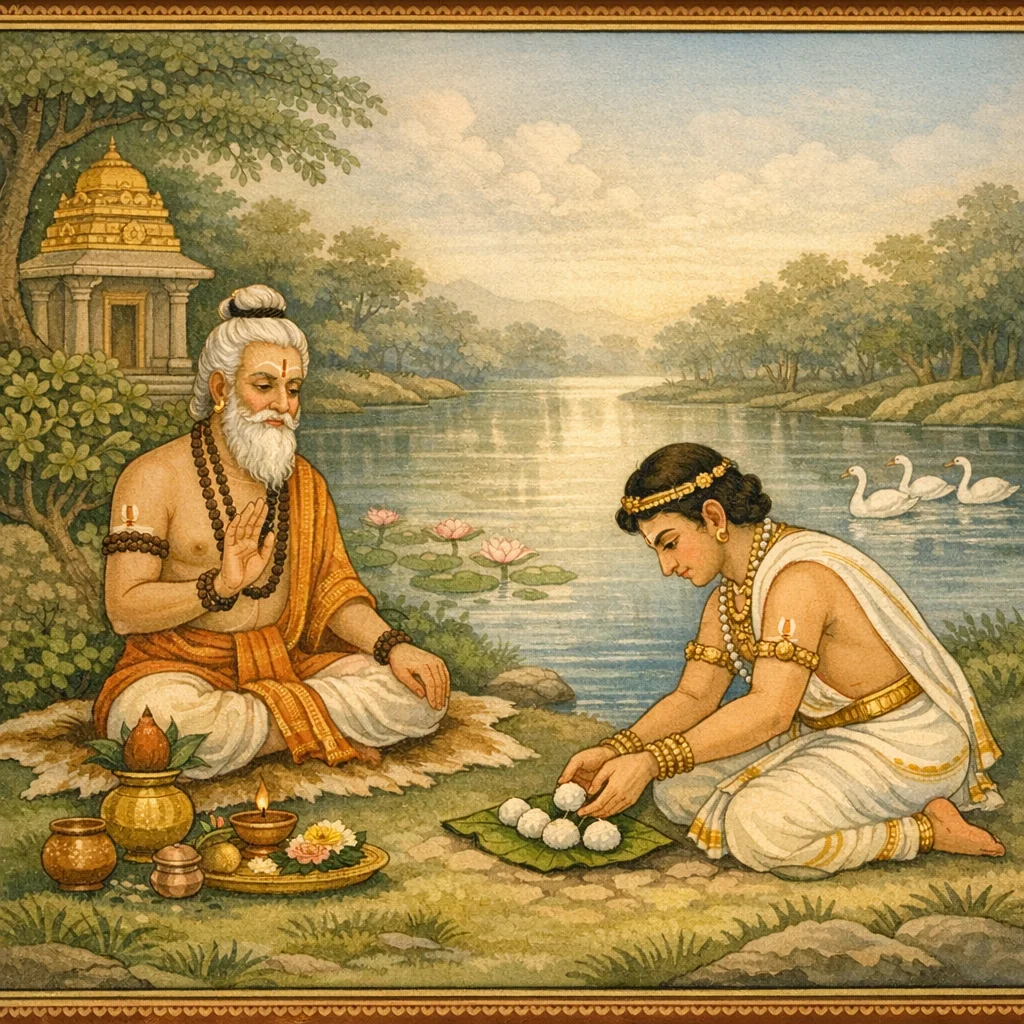
Adhyaya 215
Śṛṅgitīrtha-Māhātmya (Glory of Śṛṅgī Tīrtha): Mokṣa and Piṇḍadāna
This adhyāya sets forth a brief instruction attributed to Śrī Mārkaṇḍeya, urging pilgrimage to Śṛṅgitīrtha and praising its saving power. The tīrtha is proclaimed “mokṣada,” a bestower of liberation for embodied beings, with the explicit assurance that whoever dies there attains mokṣa without doubt. The chapter then joins this same place to ancestral duty: by performing piṇḍadāna one becomes anṛṇa, freed from debt to the pitṛs, and through the merit thus gained the purified person is said to reach “gāṇeśvarī gati,” an exalted post-mortem destination associated with the Gāṇas within a Śaiva cosmological frame. In this way it unifies mokṣa, filial responsibility, and pilgrimage discipline into a single, place-centered sacred guideline.
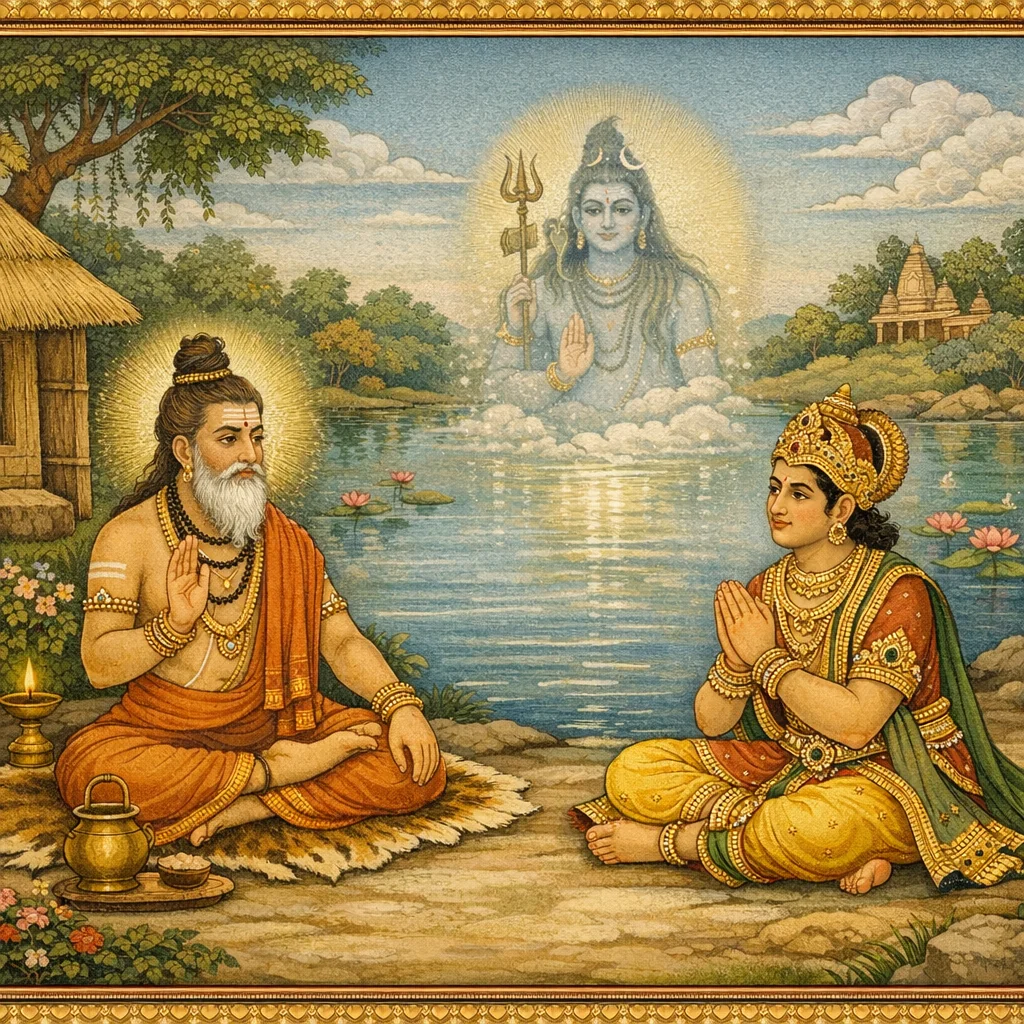
Adhyaya 216
Aṣāḍhī Tīrtha Māhātmya (Glory of the Aṣāḍhī Sacred Ford)
Mārkaṇḍeya instructs a kingly listener to approach the Aṣāḍhī tīrtha, declaring it a place where Maheśvara (Śiva) is present in a “kāmika” form that fulfills worthy desires. He then extols the tīrtha as “cāturyuga,” effective through all four yugas, and as unsurpassed among sacred places. A brief phalaśruti follows: bathing (snāna) there makes one an attendant of Rudra, signifying nearness to Śiva’s sphere and service to Him. Finally, the chapter affirms that one who relinquishes life at this tīrtha attains an irreversible destiny—reaching Rudraloka without doubt.
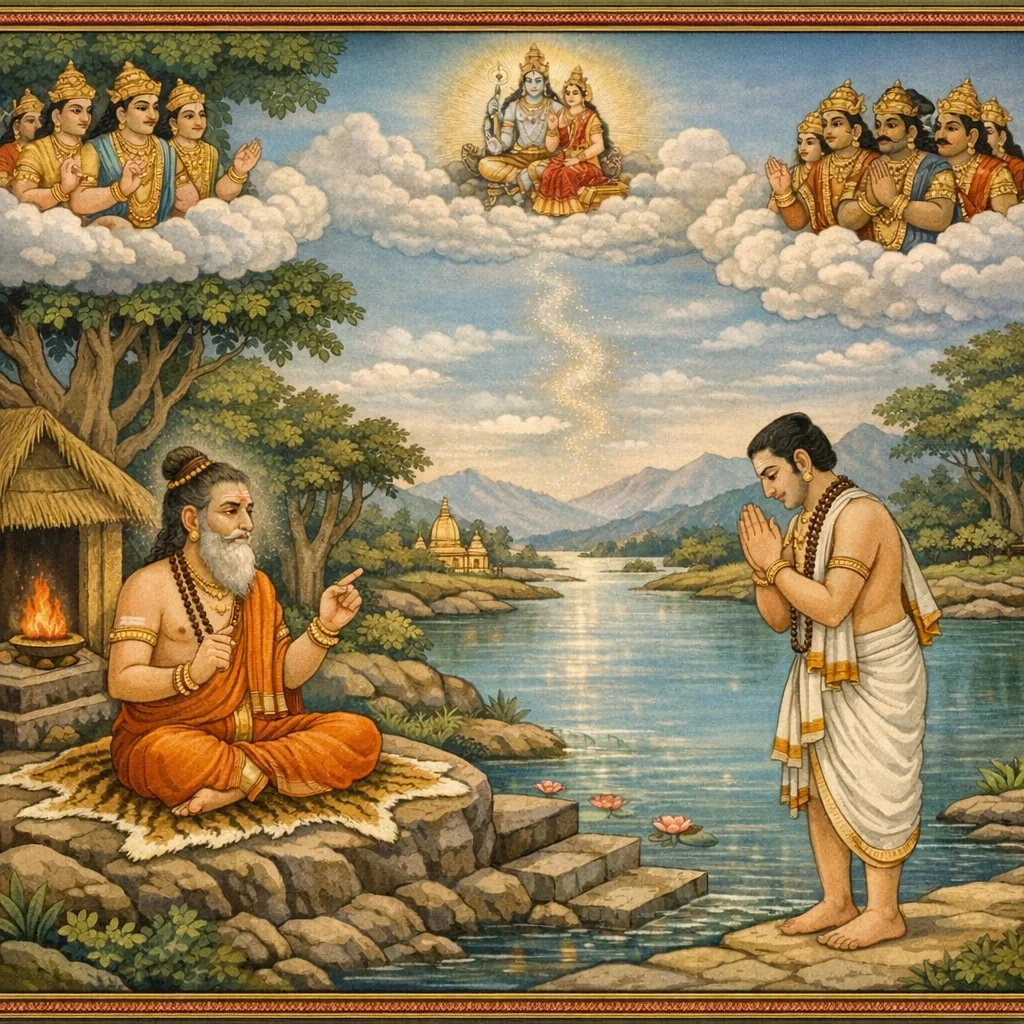
Adhyaya 217
एरण्डीसङ्गमतīर्थमाहात्म्य (Glory of the Eraṇḍī Confluence Tīrtha)
This adhyāya gives a concise tīrtha-instruction spoken by the sage Mārkaṇḍeya. It proclaims Eraṇḍī-saṅgama as a supremely revered confluence, worshipped by devas and asuras alike, thereby establishing its exceptional sanctity. It then lays down an ethical and ritual discipline: the pilgrim should observe upavāsa (fasting) with senses and mind restrained, and perform snāna according to proper vidhāna. The teaching emphasizes purification, declaring that such observance at this site frees one from the grave burden of brahmahatyā. Finally, the phalaśruti affirms that one who relinquishes life at this tīrtha attains anivartikā gati (the non-returning course) and reaches Rudra-loka without doubt.
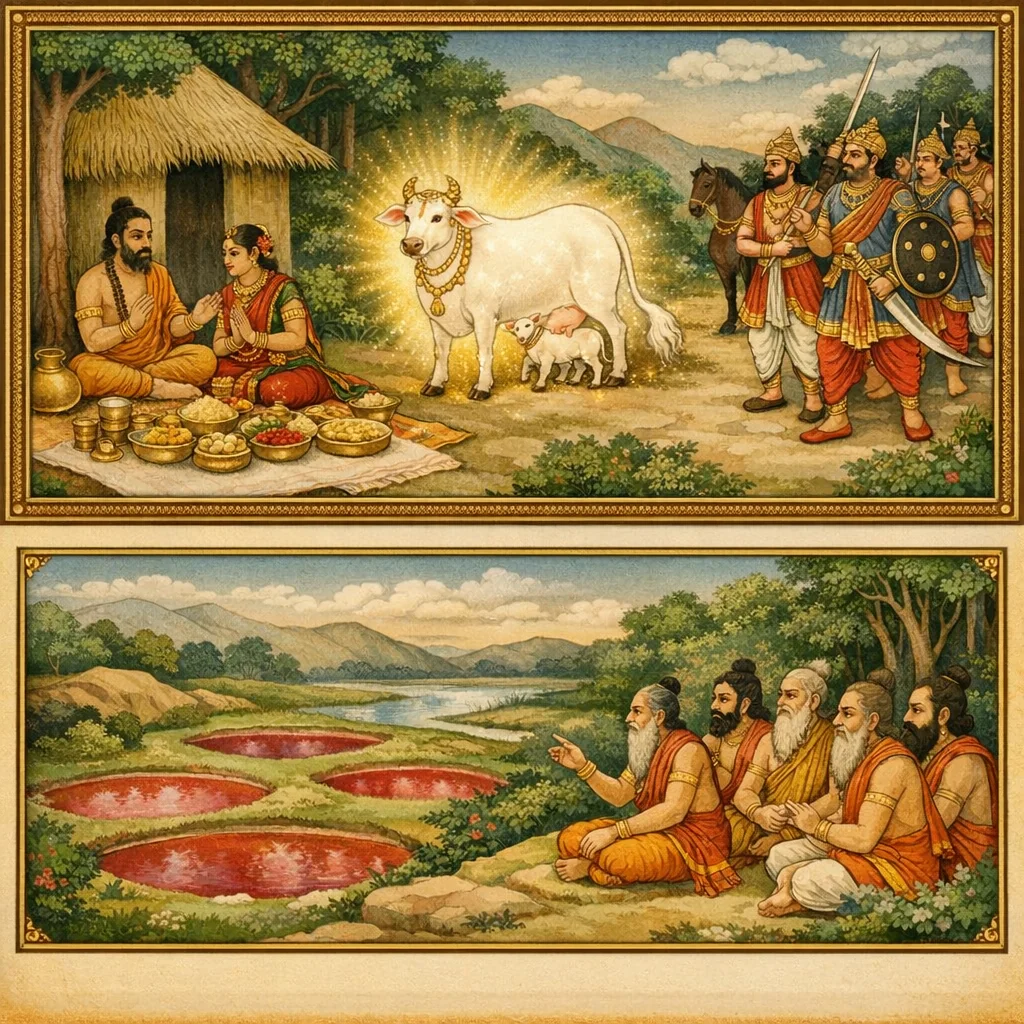
Adhyaya 218
जमदग्नितीर्थ-माहात्म्यं तथा कार्तवीर्यार्जुन-परशुराम-चरितम् (Jamadagni Tīrtha Māhātmya and the Kārtavīrya–Paraśurāma Narrative)
Mārkaṇḍeya directs Yudhiṣṭhira to the highly lauded pilgrimage site called Jamadagni-tīrtha, presenting it as a seat of siddhi (spiritual accomplishment) arising from the gracious activity of Janārdana/Vāsudeva manifested in human form. The sanctity of the tīrtha and the merit of devoted visitation are thus set forth. The discourse then recounts how the Haihaya ruler Kārtavīrya Arjuna—mighty and renowned—arrives at Jamadagni’s hermitage while hunting. The sage offers lavish hospitality through the miracle-working cow Kāmadhenu/Surabhī; learning the source of such abundance, the king demands the cow, offering countless ordinary cows in exchange, but Jamadagni refuses. A fierce conflict ensues: Jamadagni wields the ascetic power of the brahma-daṇḍa, and from the cow’s own body armed hosts manifest, driving the struggle into violent escalation. Jamadagni is slain by Kārtavīrya and allied kṣatriyas, and Paraśurāma vows retribution—repeatedly destroying kṣatriya lineages and creating five blood-filled lakes at Samantapañcaka to fulfill ancestral rites. Later, the pitṛs and sages counsel restraint, and the region around these lakes is consecrated as a highly meritorious sacred tract. The chapter closes with procedural guidance for rites at the Narmadā–ocean confluence: cautions against direct touch, mantras for ritual contact (sparśana), immersion, arghya offering, and dismissal (visarjana), promising purification, uplift of ancestors, and auspicious residence in a divine realm for devotees who behold Jamadagni and Reṇukā and perform the rites with devotion.
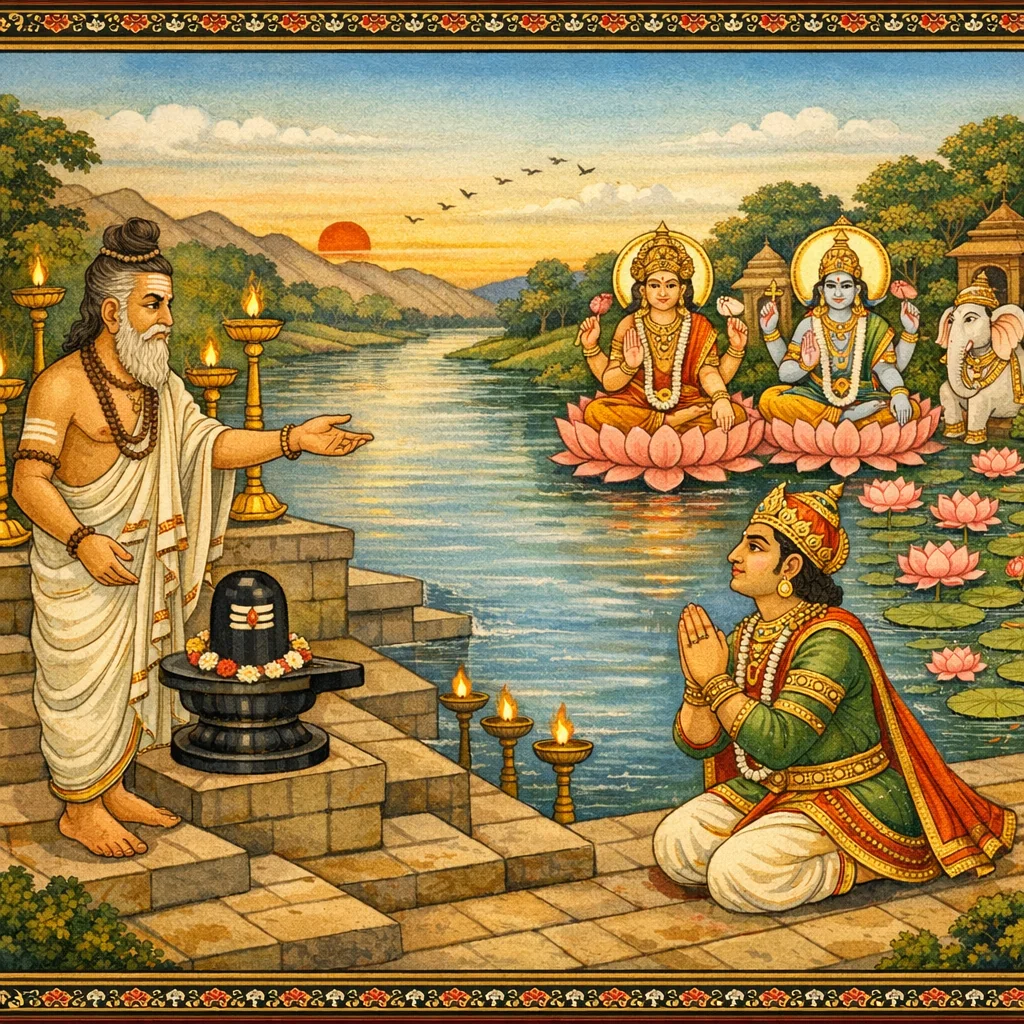
Adhyaya 219
Koṭīśvara Tīrtha Māhātmya (कोटीश्वरतीर्थमाहात्म्य) — Multiplication of Merit at Koṭīśvara on the Narmadā
This chapter records Mārkaṇḍeya’s theological teaching on Koṭīśvara, the foremost tīrtha on the southern bank of the Narmadā. Its central doctrine is ritual efficacy: bathing (snāna), gifting (dāna), and indeed any deed performed there—auspicious or inauspicious—is said to become “koṭi-guṇa,” multiplied a koṭi-fold, by a crore. Koṭitīrtha’s authority is affirmed through sacred precedents: devas, gandharvas, and purified ṛṣis are said to have attained rare siddhis at this place. The site is further established as a Śaiva center, for Mahādeva abides there as Koṭīśvara; mere darśana of the “deva-deveśa” is praised as a means to unsurpassed attainment. Finally, the chapter sets forth a directional ritual geography: ascetics on the southern route are linked with pitṛloka, while exemplary sages on the northern bank of the Narmadā are linked with devaloka, as determined by śāstra. Thus it weaves together tīrtha-glorification, the ethics of action-in-place, and a structured riverbank cosmology.
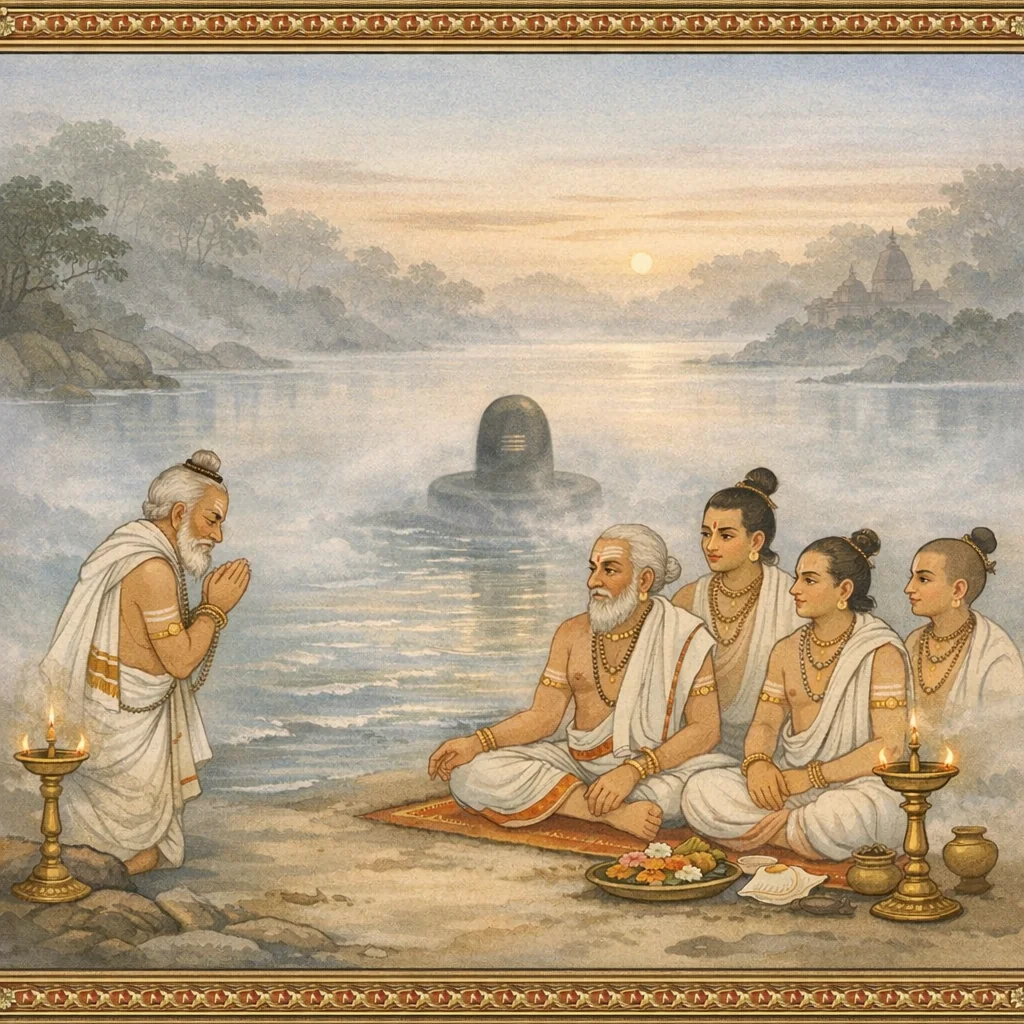
Adhyaya 220
लोटणेश्वर-रेवासागर-सङ्गम-माहात्म्य (Lotaneśvara at the Revā–Sāgara Confluence: Ritual Procedure and Merit)
Mārkaṇḍeya directs the royal listener to Lotaneśvara, praised as the supreme Śaiva tīrtha on the northern bank of the Narmadā (Revā), where darśana and worship dissolve accumulated wrongdoing, even from many births. Yudhiṣṭhira, awed by the Narmadā’s purifying power, asks for the single most eminent tīrtha that grants the fruit of all tīrthas. The reply centers on the Revā–Sāgara saṅgama: the ocean is portrayed as reverently receiving the river, and a liṅga is said to arise within the sea, joining Narmadā’s sanctity to liṅga-origin teaching. The chapter then lays out the observance: Kārttika vrata (especially caturdaśī fasting), bathing in the Narmadā, tarpaṇa and śrāddha, night vigil (jāgaraṇa) with Lotaneśvara pūjā, and a morning rite with mantras to invite the ocean and for bathing. A distinctive ethical “test” follows: after bathing, the pilgrim “rolls/turns” (luth-) to discern whether one bears pāpa-karmā or dharma-karmā, then makes a confession-like declaration of past misdeeds before learned brāhmaṇas and lokapāla representations, bathes again, and performs śrāddha properly. The phalaśruti promises Aśvamedha-equivalent merit for saṅgama snāna with Lotaneśvara worship, vast heavenly reward through dāna and śrāddha, and liberation-oriented attainment of Rudra-loka for devoted hearing and recitation.
Adhyaya 221
Haṃseśvara-Tīrtha Māhātmya (The Glory of the Haṃseśvara Sacred Ford)
Mārkaṇḍeya directs Yudhiṣṭhira to an excellent tīrtha on the southern bank of the Revā, two krośas from Matṛtīrtha, called Haṃseśvara, famed as a destroyer of mental discord and dejection (vaimanasyavināśana). An origin-legend is told: a Haṃsa of Kaśyapa’s line, known as Brahmā’s vehicle, acts without proper direction and, amid the upheaval when Dakṣa’s sacrifice is disrupted, flees in fear and later grieves. Brahmā, displeased that the bird does not return when summoned, utters a curse that causes its fall. The Haṃsa approaches Brahmā, pleads the limits of animal nature, confesses the fault of abandoning the master, and offers an extended praise of Brahmā as the sole Creator, source of knowledge, of dharma and adharma, and wielder of both curse and grace. Brahmā instructs the Haṃsa to purify himself by tapas, to serve the Revā through sacred bathing, and to establish Mahādeva/Trayambaka (Śiva) on the riverbank. Establishing Śiva there is declared to yield the fruit of many completed sacrifices and vast gifts, and even grave transgressions are said to be released by such स्थापना on Revā’s shore. The Haṃsa performs austerity, installs Śaṅkara under his own name as Haṃseśvara, worships, and attains a higher state. The closing phalaśruti enjoins pilgrimage to Haṃseśvara: bathing, worship, hymns of praise, śrāddha, lamp-offering, feeding brāhmaṇas, and optional time-regulated Śiva pūjā. It promises freedom from sins, avoidance of despair, heavenly honor, and long residence in Śiva’s realm when accompanied by fitting gifts.
Adhyaya 222
तिलादा-तीर्थमाहात्म्य / Tilādā Tīrtha Māhātmya (The Glory of the Tilādā Pilgrimage Site)
Mārkaṇḍeya extols an excellent tīrtha named Tilādā, within a one-krośa journey, where Jābāli attains purification through tilaprāśana (partaking of sesame) and sustained ascetic discipline. Yet Jābāli is first portrayed as ethically fallen—abandoning parents, pursuing illicit desire, practicing deception, and committing socially condemned acts—so that he is publicly censured and cast out. Seeking expiation, he undertakes arduous pilgrimage and repeated immersions in the Narmadā, finally settling on the southern bank near Aṇivāpa-anta. There he performs graded sesame-based austerities: one-meal and alternate-day regimens, three/six/twelve-day patterns, fortnightly and monthly cycles, and major vratas such as kṛcchra and cāndrāyaṇa, continued for many years. Pleased, Īśvara grants him purification and sālokya (abiding in the same divine realm). Jābāli establishes a deity known as Tilādeśvara, and Tilādā is proclaimed famed as a destroyer of sin. The chapter prescribes observances on caturdaśī, aṣṭamī, and Hari’s day, with sesame rites—homa, unction, sesame-bathing, sesame-water—along with filling the liṅga with sesame and lighting a lamp with sesame oil, promising Rudra-loka and the purification of seven generations. It further extends merit to ancestors through tila-piṇḍa in śrāddha, granting lasting satisfaction to forebears and uplifting the three lineages (kula-traya): paternal, maternal, and the wife’s family line.
Adhyaya 223
Vāsava Tīrtha Māhātmya (वसवतीर्थमाहात्म्य) — Foundation by the Eight Vasus and the Merit of Śiva-Pūjā
Mārkaṇḍeya describes a supreme tīrtha called Vāsava, within a one-krośa range, renowned as having been founded by the Eight Vasus. The Vasus—Dhara, Dhruva, Soma, Āpa, Anila, Anala, Pratyūṣa, and Prabhāsa—are afflicted by a paternal curse and driven toward “garbha-vāsa” (womb-residence/embodiment). Seeking release, they come to the Narmadā tīrtha and perform disciplined tapas while worshipping Bhavānīpati (Śiva). After twelve years Mahādeva manifests directly and grants their boon. The Vasus establish Śiva there in their own name and depart through the sky, and the place becomes famed as Vāsava-tīrtha. The chapter then sets out practical devotional conduct: worship Śiva here with whatever offerings are available, especially dīpa-dāna (offering of lamps), with special emphasis on the bright fortnight’s eighth lunar day (śukla-aṣṭamī) or regular practice as one is able. The phalaśruti promises long nearness to Śiva, avoidance of garbha-vāsa, freedom from poverty and sorrow, heavenly honor, and destruction of sins even by a single day’s residence, concluding with duties such as feeding brāhmaṇas and giving garments and dakṣiṇā.
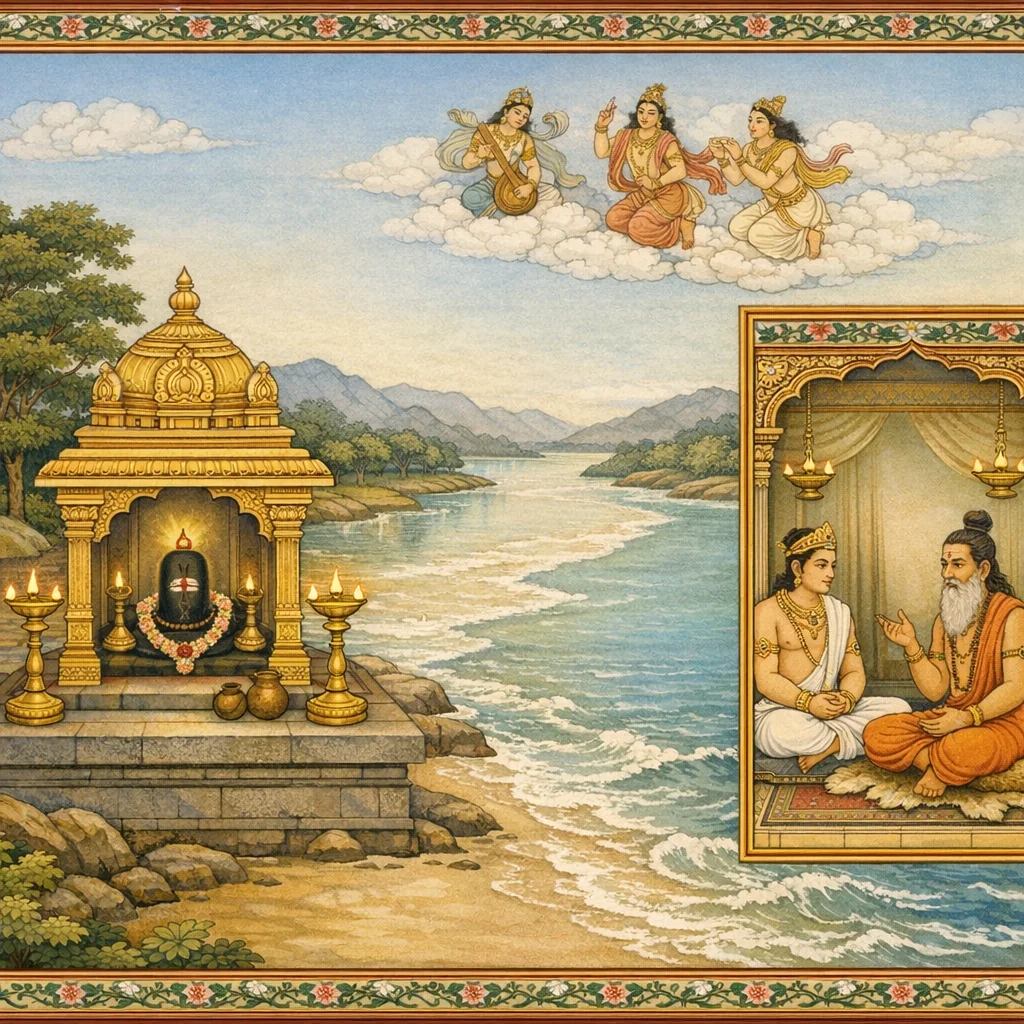
Adhyaya 224
Koṭīśvara Tīrtha Māhātmya (कोटीश्वरतीर्थमाहात्म्य) — The Merit of Koṭīśvara at the Revā–Ocean Confluence
Mārkaṇḍeya tells Yudhiṣṭhira of a supreme tīrtha called Koṭīśvara, lying within a one-krośa range at the Revā (Narmadā) where it meets the ocean. The chapter’s doctrinal core is a principle of merit-amplification: snāna (sacred bathing), dāna (giving), japa (mantra-recitation), homa (fire-offering), and arcana (worship) performed there with devotion are said to become “koṭi-guṇa,” multiplied manifold. The tīrtha is set within a cosmological pilgrimage ecology: devas, gandharvas, ṛṣis, siddhas, and cāraṇas gather at the Revā–ocean confluence to behold the extraordinary sight of river and sea meeting. A ritual sequence is given—after bathing, one should establish and worship Śiva as Koṭīśvara according to one’s bhakti, offering bilva leaves, arka flowers, seasonal gifts, dhattūra, kuśa, and other prescribed materials, with mantra-led upacāras, incense, lamps, and naivedya. An ethical-ritual itinerary is also promised: travelers and ascetics connected with this tīrtha attain elevated destinies, including pitṛ-loka and deva-loka. A calendrical note highlights Pauṣa kṛṣṇa aṣṭamī as especially potent for worship, alongside regular observances on caturdaśī and aṣṭamī, with feeding of worthy brāhmaṇas.
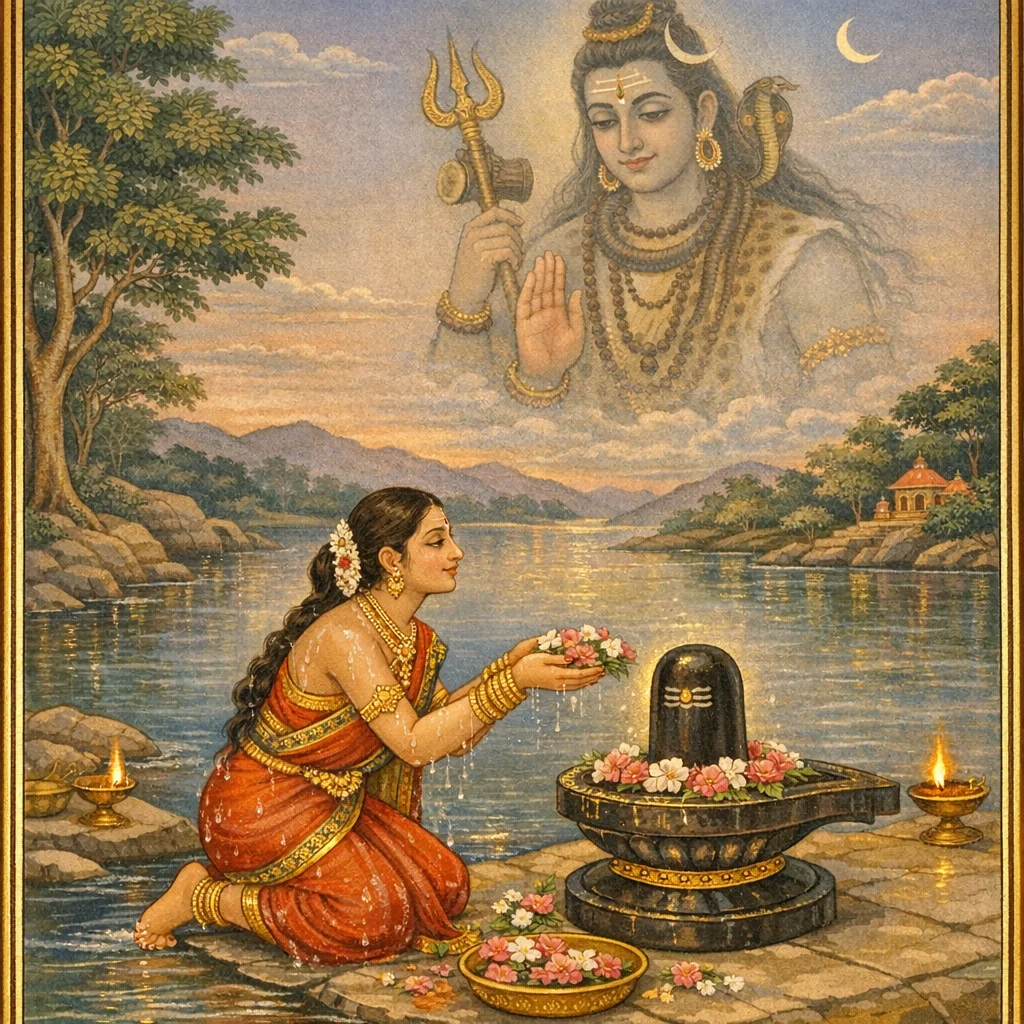
Adhyaya 225
Alikā’s Austerity at Revā–Sāgara Saṅgama and the Manifestation of Alikeśvara (अलिकेश्वर-माहात्म्य)
Mārkaṇḍeya tells Yudhiṣṭhira of a moral crisis centered on a tīrtha and its redemptive resolution. Alikā, a Gandharvī of Citraseṇa’s line, lives for ten years with the ṛṣi Vidyānanda, yet later—under unstated circumstances—kills her husband as he sleeps. When she reports to her father Ratnavallabha, both parents denounce and expel her, branding her a grievous transgressor (patighnī, garbhaghnī, brahmaghnī). Stricken with remorse, she consults brāhmaṇas about expiatory tīrthas and learns of a sin-destroying site at the confluence of the Revā and the sea. At that saṅgama she undertakes sustained tapas: fasting (nirāhāra), strict vrata discipline, and penances such as kṛcchra/atikṛcchra and cāndrāyaṇa, joined with Śiva-dhyāna and worship. Pleased—at Pārvatī’s prompting—Śiva appears, declares her purified, and grants a boon: she is to establish him there under her own name and thereafter attain heaven. Alikā bathes, installs Śaṅkara as Alikeśvara, gives gifts to brāhmaṇas, is reconciled with her family, and finally ascends in a divine vimāna to Gaurī’s realm. The phalaśruti proclaims that those who bathe at this tīrtha and worship Mahādeva with Umā are freed from sins of mind, speech, and body; feeding dvijas and offering lamps relieve disease. Specific gifts—an incense vessel, a model vimāna, a bell, and a kalaśa—bestow exalted heavenly attainments.
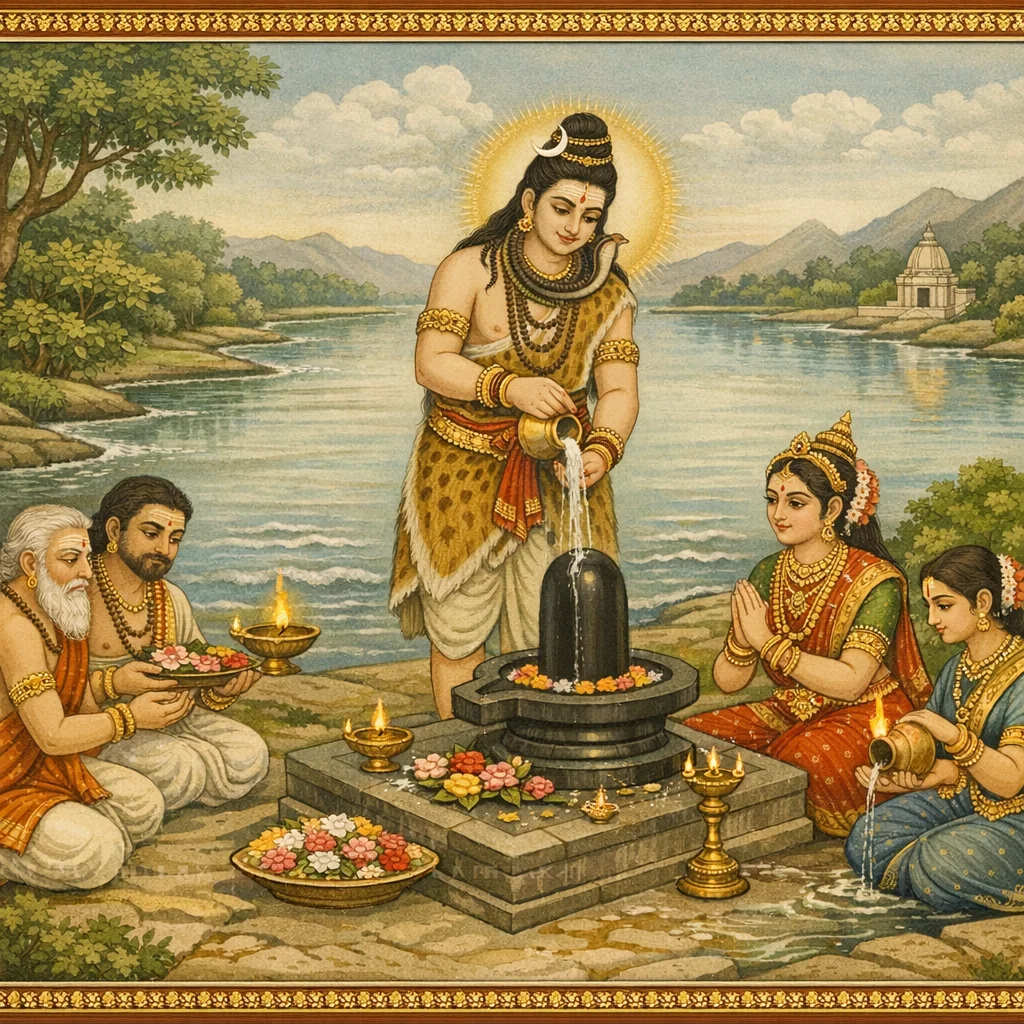
Adhyaya 226
Vimaleśvara-Tīrtha Māhātmya (विमलेश्वरतीर्थमाहात्म्य) — The Glory of the Vimaleśvara Sacred Site
Mārkaṇḍeya extols a highly meritorious tīrtha named Vimaleśvara, lying within a one-krośa circuit, as a ritual-ethical means of purification and wish-fulfillment. Its power is affirmed through exempla: Indra is cleansed after slaying Triśiras, Tvaṣṭṛ’s son; an ascetic brāhmaṇa becomes radiant and stainless through tapas; Bhānu is healed of a disfiguring affliction by austerity and Śiva’s grace; and Vibhaṇḍaka’s son attains “vaimalya” after discerning the impurity born of social entanglements and undertaking a twelve-year discipline with his wife Śāntā at the Revā–ocean junction, observing kṛcchra and cāndrāyaṇa to please Tryambaka. A Daruvana episode relates that Śiva, urged by Śarvāṇī, establishes a purified station at the Narmadā–sea confluence and explains the name Vimaleśvara as a beneficent, world-sustaining presence. Brahmā’s creation of Tilottamā and the ensuing moral disturbance are resolved by silence, triple bathing, remembrance of Śiva, and worship at the confluence, culminating in restored purity. The chapter ends with prescriptions: bathing and Śiva-worship destroy sins and raise one to Brahmaloka; fasting and darśana on aṣṭamī, caturdaśī, and festival days cast off long-accumulated pāpa and grant access to Śiva’s abode; śrāddha performed by rule relieves ancestral debt. Gifts of gold, grain, garments, umbrella, footwear, and kamaṇḍalu are commended, along with devotional arts—song, dance, recitation—and temple-building, praised as a royal merit.
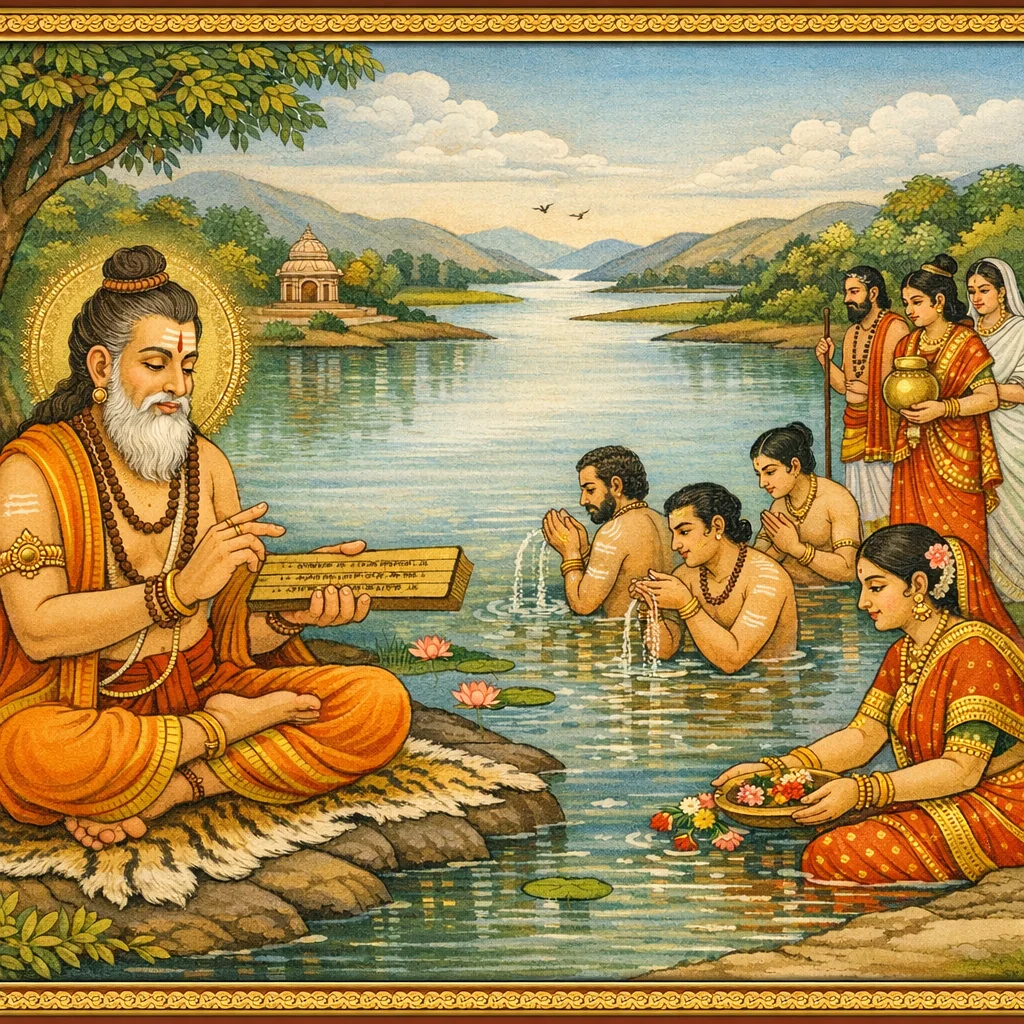
Adhyaya 227
Revā-Māhātmya and Narmadā-Yātrā Vidhi (Expiatory Rules and Yojana Measure)
This chapter unfolds as a dialogue in which Mārkaṇḍeya teaches Yudhiṣṭhira the extraordinary sanctity of the Narmadā (Revā). Revā is praised as “Mahādeva’s beloved” and as the “Māheśvarī Gaṅgā” (the “Southern Gaṅgā”), with a warning that disbelief and irreverence diminish spiritual fruit. It then states that ritual efficacy rests on śraddhā (intentional faith) and śāstra-guided discipline, not on arbitrary, desire-driven practice. A yātrā code of conduct is given—brahmacarya, moderation in food, truthfulness, avoidance of deceit, humility, and shunning harmful company—along with standard tīrtha duties: bathing, worship of deities, śrāddha/piṇḍa offerings where appropriate, and feeding brāhmaṇas according to one’s means. A graded expiatory scheme follows, linking pilgrimage distances (notably 24 yojanas) to kṛcchra-type results, with increased multipliers at confluences and named sacred sites. The chapter concludes by defining traditional measures (aṅgula, vitasti, hasta, dhanu, krośa, yojana) and ranking rivers by breadth, reinforcing a calibrated, procedural path of purification through Revā pilgrimage.
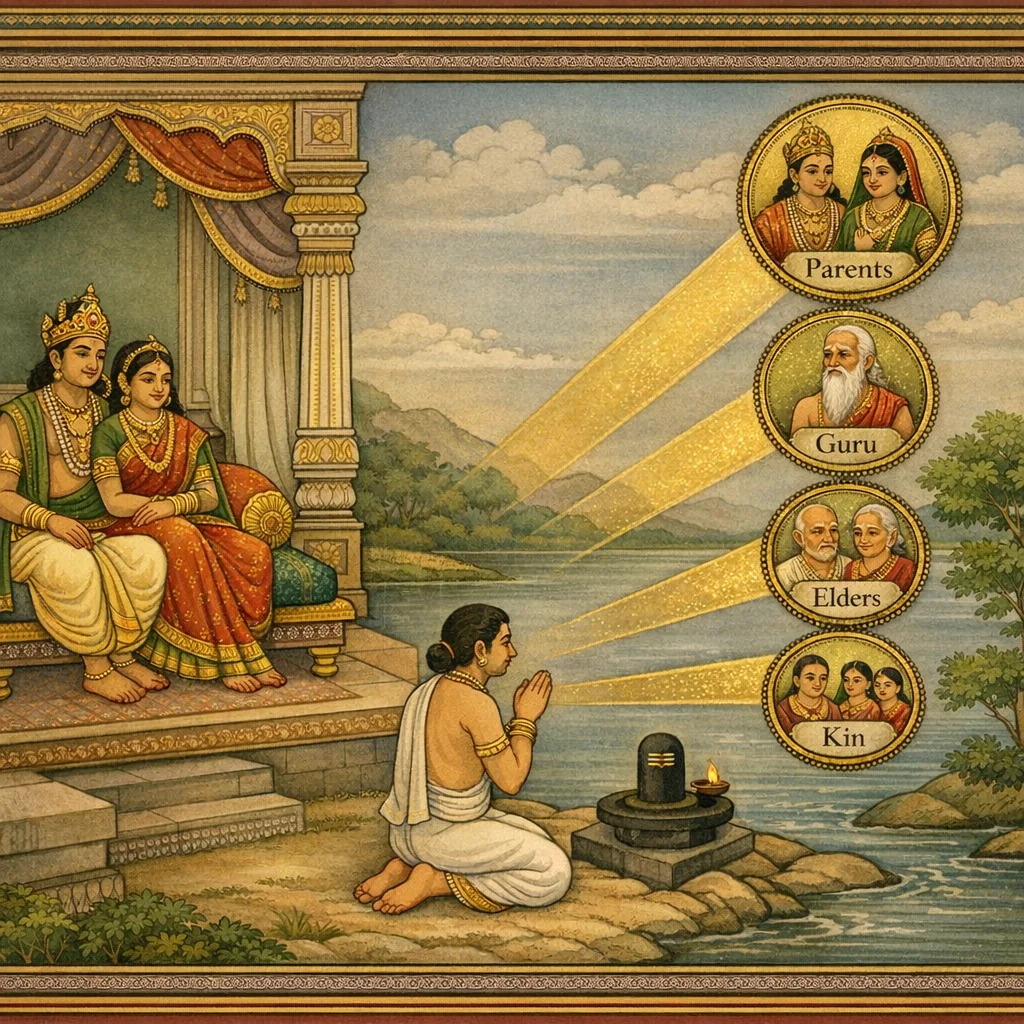
Adhyaya 228
परार्थतीर्थयात्राफलनिर्णयः | Determining the Merit of Pilgrimage Performed for Another
Chapter 228 frames a dharma-centered dialogue in which Yudhiṣṭhira asks the sage Mārkaṇḍeya to assess the merit of tīrtha-yātrā undertaken for another’s benefit (parārtha). The sage teaches a graded view of ritual agency: the highest course is to perform dharma oneself; when one is constrained, one may arrange performance through a suitable social equivalent (savarṇa) or close kin, while warning that improper delegation diminishes the fruit. The chapter then states proportional results for proxy pilgrimage and for incidental pilgrimage, distinguishing a full yātrā from the lesser merit of mere bathing. It lists eligible beneficiaries—parents, elders, teachers, and extended relatives—and assigns fractional shares of merit according to relational proximity (greater for one’s parents, reduced for wider kin). It closes with a seasonal note that at certain times rivers are regarded as rajāsvalā (ritually constrained), with named exceptions, highlighting calendrical sensitivity in water-related rites.
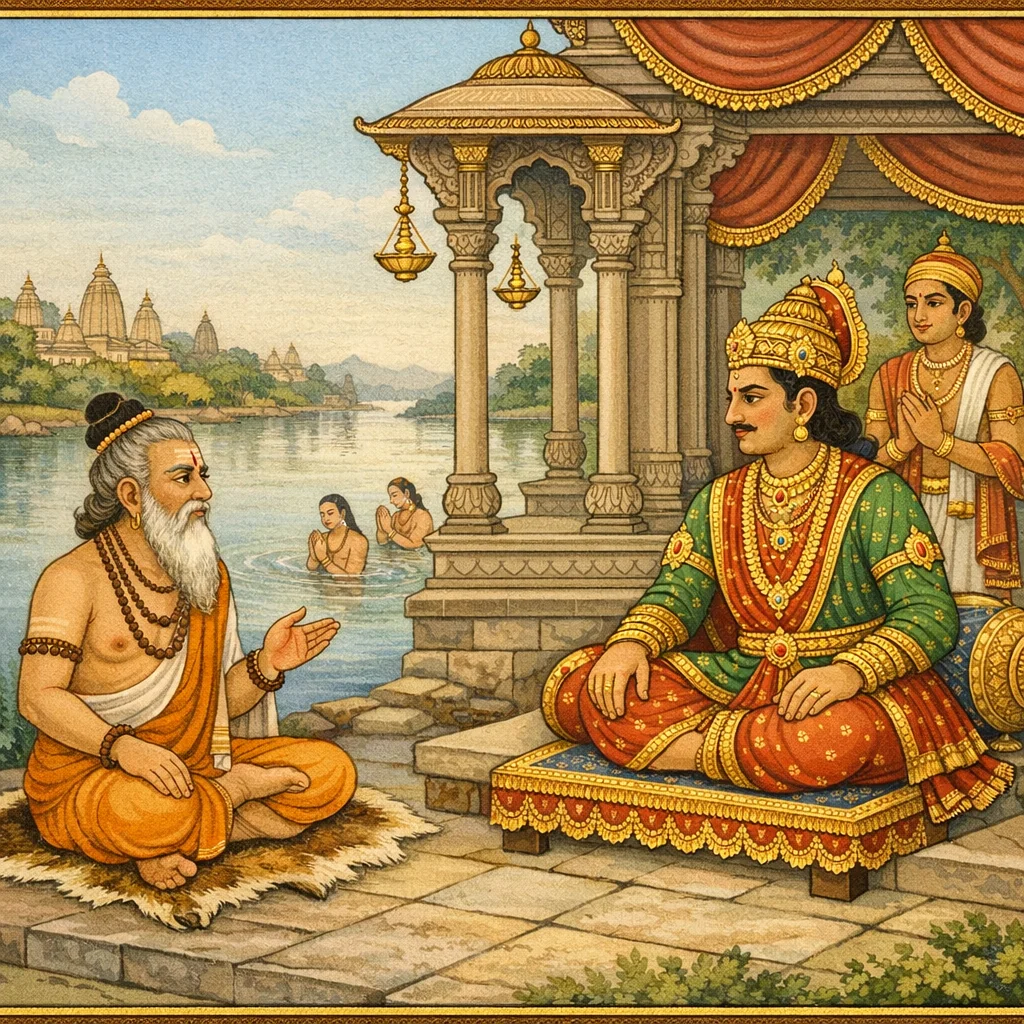
Adhyaya 229
नर्मदाचरितश्रवणफलप्रशंसा | Praise of the Fruits of Hearing the Narmadā Narrative
This adhyāya gives Mārkaṇḍeya’s concluding theological address to a king (rājan/bhūpāla), stating that the Purāṇic account—uttered in a divine assembly and pleasing to Śiva—has now been handed down in concise form. It then proclaims the tīrthas of the Narmadā (Revā) to be innumerable, pervading the river’s entire course from beginning through middle to end. In the phalaśruti it declares that hearing the Narmadā-carita yields merit surpassing extensive Vedic recitation and great sacrificial rites, and is equal to bathing in many sacred fords. Salvific fruits are described: attaining Śiva’s abode and dwelling among Rudra’s attendants; and it is stressed that even seeing, touching, praising, or hearing of these tīrthas removes sins. A social-ethical layer follows, mapping benefits across the varṇas and for women, and asserting that even grave transgressions are purified by hearing the Narmadā-māhātmya. The chapter closes by recommending worship with offerings, praising the merit of writing and gifting the text to a twice-born (dvija), and ending with a benedictory prayer for universal well-being, extolling Revā/Narmadā as world-purifying and dharma-bestowing.
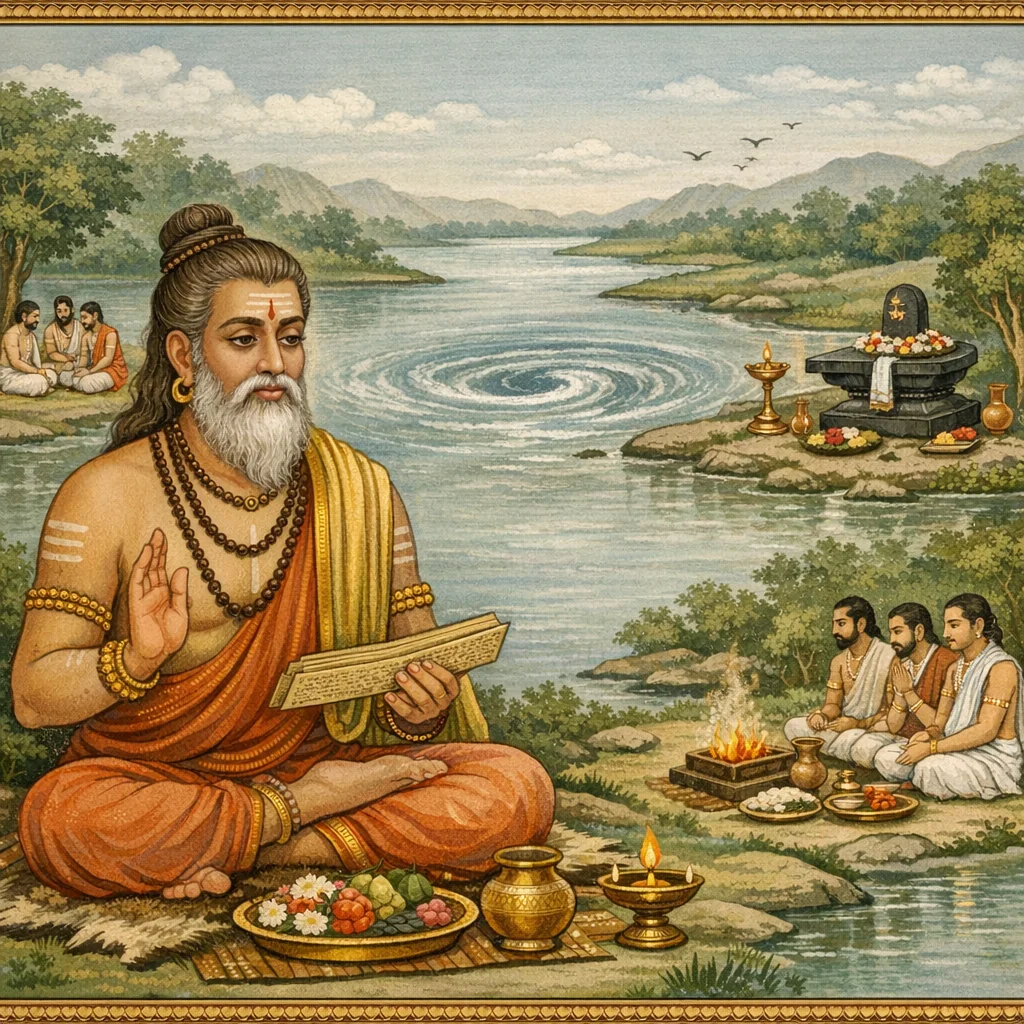
Adhyaya 230
Revā-Tīrthāvalī-Prastāvaḥ (Introduction to the Catalogue of Revā Tīrthas)
Chapter 230 functions as a programmatic preface and compressed index to a large catalogue of Revā (Narmadā) tīrthas. Sūta, conveying a discourse attributed to Mārkaṇḍeya, closes the preceding narration, notes that the Revā-māhātmya has already been communicated in essence, and announces an auspicious forthcoming “tīrthāvalī” beginning from Oṅkāra. The chapter opens with reverent invocations to Śoma, Maheśa, Brahmā, Acyuta, Sarasvatī, Gaṇeśa, and the Goddess, followed by salutations to Narmadā as a divine purifier. It then rapidly enumerates a dense sequence of tīrtha names and saṅgamas (confluences), āvarta sites, liṅga-stations, and associated sacred forests and āśramas, serving as a navigational register rather than extended storytelling. The latter portion gives a recitation protocol and phalaśruti: composed for the welfare of the virtuous, the tīrthāvalī’s recitation is said to neutralize sins accrued over daily, monthly, seasonal, and annual spans, and to be efficacious in śrāddha (ancestral rites) and pūjā (worship). It promises broad purification of one’s family line and merit comparable to established ritual benchmarks.
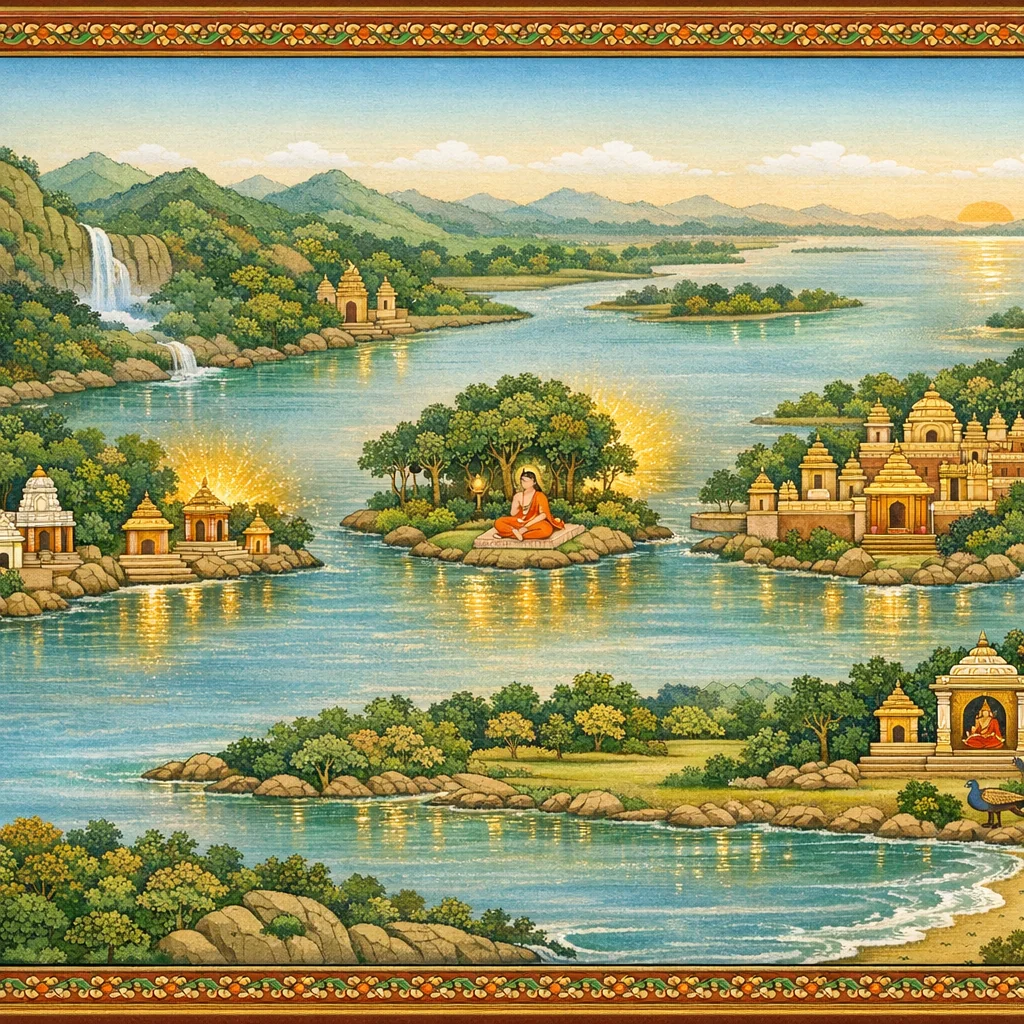
Adhyaya 231
Revātīrtha-stabaka-nirdeśaḥ (Enumeration of Tīrtha Clusters on the Revā)
This adhyāya is a technical, catalogue-like exposition in which Sūta conveys Mārkaṇḍeya’s condensed instruction to Pārtha on the “tīrtha-stabakas”—clustered groupings of pilgrimage sites along both banks of the Revā (Narmadā). It opens by praising the Revā as a wish-fulfilling kalpalatā whose blossoms are the tīrthas. It then presents a structured count of saṅgamas from Oṅkāratīrtha to the western ocean, distinguishing northern and southern bank distributions and declaring the Revā’s confluence with the sea as preeminent. Broad totals are given (including four hundred known tīrthas), and the sites are classified by deity-type and foundation—especially large Śaiva sets, alongside Vaiṣṇava, Brāhma, and Śākta groupings. A second layer of indexing assigns many locations quantitative magnitudes of hidden and manifest tīrthas—from hundreds to lakhs and koṭis—at specific confluences, groves, villages, and named shrines such as Kapilā-saṅgama, Aśokavanikā, Śuklatīrtha, Mahīṣmatī, Luṅkeśvara, Vaidyanātha, Vyāsadvīpa, Karañjā-saṅgama, Dhūtapāpa, and Skandatīrtha, concluding that the full extent surpasses exhaustive narration.
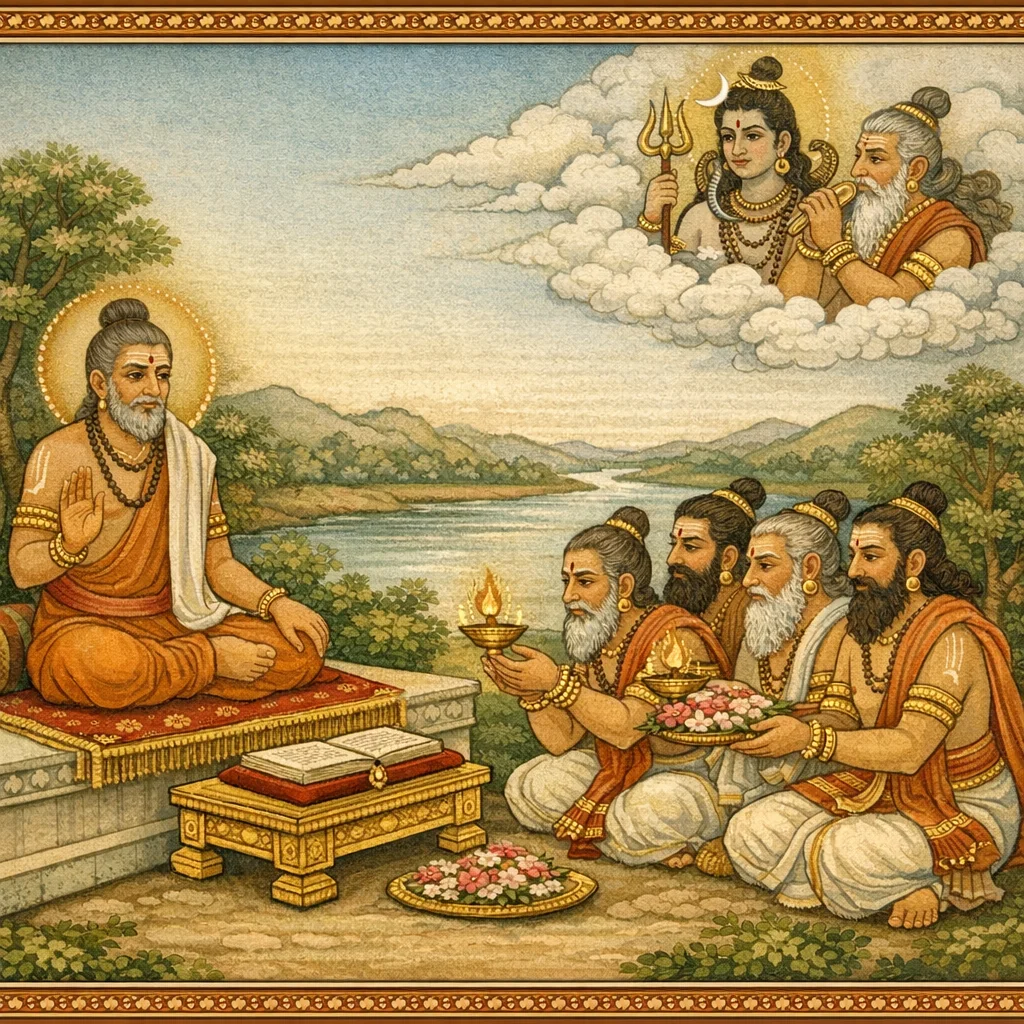
Adhyaya 232
रेवामाहात्म्य-समापनम् (Conclusion of the Revā/Narmadā Māhātmya and Phalaśruti)
This adhyāya formally concludes the Revā/Narmadā-centered sacred geography in the Avanti Khaṇḍa. Sūta addresses the assembled brāhmaṇas, stating that the Revā-māhātmya has been related exactly as Mārkaṇḍeya earlier taught it to Pāṇḍu’s son, and that the clusters of tīrthas have been described in proper sequence. It proclaims the unsurpassed purity and sin-destroying power of both Revā’s waters and her sacred narrative, presenting the river as a Śaiva emanation established for the welfare of the world. Remembrance, hearing, recitation, and service of Revā are praised as especially potent in the Kali age. A major phalaśruti follows: listening to or reciting this text yields fruits surpassing Vedic study and prolonged sacrifices, and equals the merits of renowned tīrthas such as Kurukṣetra, Prayāga, and Vārāṇasī. The chapter also enjoins reverence for the written work—keeping the book at home and honoring the reciter and the manuscript with offerings—promising prosperity, social well-being, and nearness to Śiva-loka after death. Even grievous transgressions are said to be mitigated through sustained listening. It ends by reaffirming the transmission lineage from Śiva to Vāyu to the sages, and now through Sūta’s narration.
FAQs about Reva Khanda
The section emphasizes the glory of the Revā/Narmadā as a purifying sacred presence whose banks and waters are treated as tīrtha-space, integrating hymn, doctrine, and pilgrimage cartography.
The discourse repeatedly frames Revā’s waters and riverbanks as instruments of removing dūrīta (moral and ritual impurity), presenting bathing, remembrance, and reverential approach as merit-generating ethical guidelines.
Chapter 1 introduces the inquiry into Revā’s location and Rudra-linked origin (śrī-rudra-sambhavā), setting up subsequent tīrtha narratives; it also embeds a meta-legend on Purāṇic authority and compilation attributed to Vyāsa and earlier divine transmission.