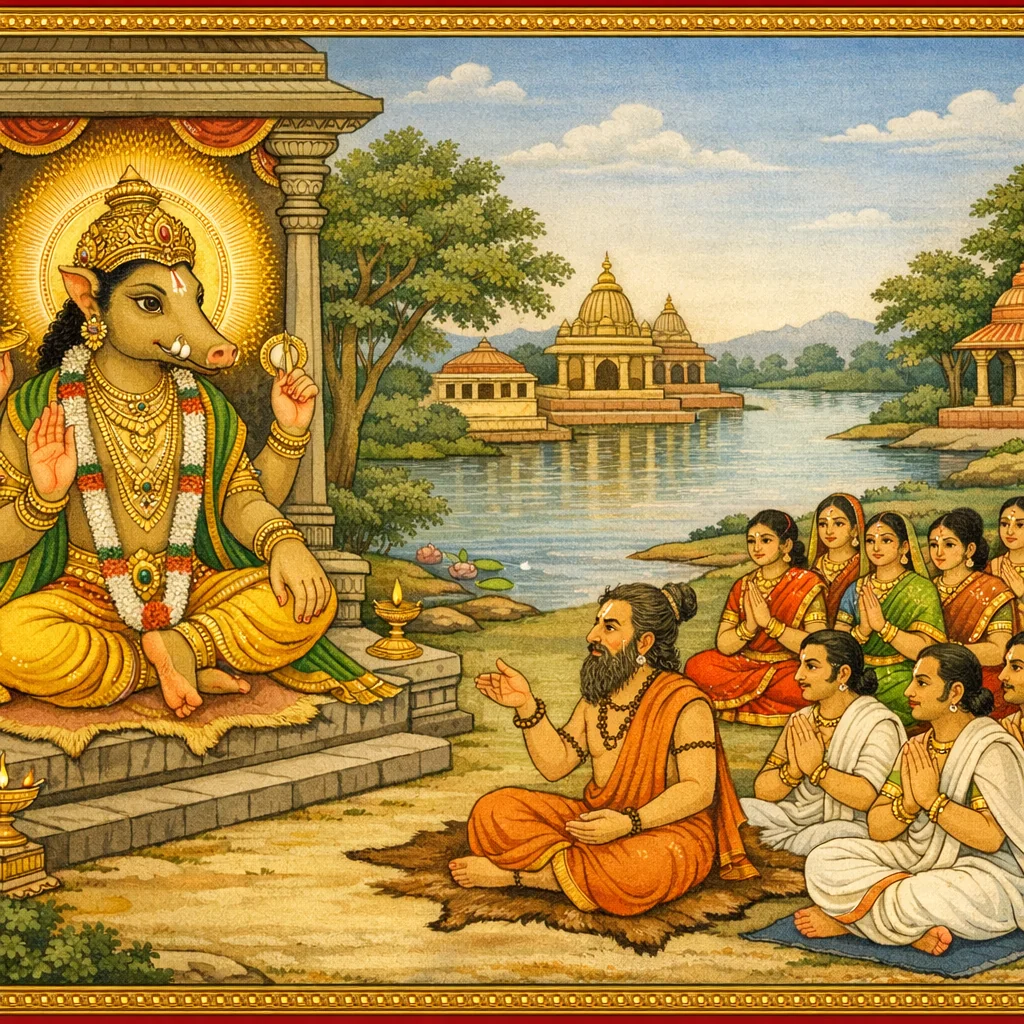
Adhyaya 132
Mārkaṇḍeya instructs a royal hearer to go to the tīrtha called Varāha on the northern bank of the Narmadā, praised as “removing all sins.” Varāha/Dharāṇīdhara is extolled as the world-sustaining creator (jagaddhātā), abiding there for the welfare of beings (lokahita) and as a saving guide who ferries devotees across saṃsāra. The rite centers on bathing at the tīrtha, worshiping Varāha with fragrances and garlands, auspicious acclamations, and fasting—especially on the twelfth lunar day (dvādaśī)—followed by a night vigil with sacred narration. Social-ritual boundaries are also stated: one should avoid contact and shared eating with those engaged in sinful conduct, since impurity is said to pass through speech, touch, breath, and commensality; brāhmaṇas are to be honored according to one’s means and proper rule. The phala teaching declares that mere darśana of Varāha’s face swiftly destroys even stubborn sins, like serpents fleeing Garuḍa or darkness dispelled by the sun. Mantric simplicity is praised: “namo nārāyaṇāya” is presented as universally sufficient, and a single prostration to Kṛṣṇa is equated with great sacrificial merit and leads beyond rebirth. Finally, disciplined devotees who relinquish the body there are said to attain Viṣṇu’s supreme, stainless abode beyond the perishable/imperishable divide.
Shlokas
Verse 1
श्रीमार्कण्डेय उवाच । ततो गच्छेत्तु राजेन्द्र उत्तरे नर्मदातटे । सर्वपापहरं तीर्थं वाराहं नाम नामतः
Śrī Mārkaṇḍeya said: Then, O best of kings, one should go to the northern bank of the Narmadā, to the tīrtha famed by name as Vārāha, the remover of all sins.
Verse 2
तत्र देवो जगद्धाता वाराहं रूपमास्थितः । स्थितो लोकहितार्थाय संसारार्णवतारकः
There the divine Creator and Sustainer of the world abides, having assumed the form of Vārāha—standing for the welfare of beings, the one who ferries souls across the ocean of saṃsāra.
Verse 3
तत्र तीर्थे तु यः स्नात्वा पूजयेद्धरणीधरम् । गन्धमाल्यविशेषैश्च जयशब्दादिमङ्गलैः
Whoever bathes at that tīrtha and worships the Bearer of the Earth (Vārāha), offering choice fragrances and garlands, and performing auspicious acclamations beginning with cries of victory—
Verse 4
उपवासपरो भूत्वा द्वादश्यां नृपसत्तम । वृषलाः पापकर्माणस्तथैवान्धपिशाचिनः
Becoming devoted to fasting on the twelfth lunar day (dvādaśī), O best of kings—(one should avoid) the impure and the sinful-doers, and likewise the ‘blind’ piśācas, debased tamasic company.
Verse 5
आलापाद्गात्रसंपर्कान्निःश्वासात्सहभोजनात् । पापं संक्रमते यस्मात्तस्मात्तान् परिवर्जयेत्
For through conversation, bodily contact, even shared breath and eating together, sin is said to pass over; therefore one should avoid such persons.
Verse 6
ब्राह्मणान् पूजयेद्भक्त्या यथाशक्त्या यथाविधि । रात्रौ जागरणं कार्यं कथायां तत्र भारत
One should honor the brāhmaṇas with devotion, according to one’s capacity and in the proper manner. At night, there, one should keep vigil, absorbed in sacred kathā, O Bhārata.
Verse 7
प्रभाते विमले स्नात्वा तत्र तीर्थे जगद्गुरुम् । ये पश्यन्ति जितक्रोधास्ते मुक्ताः सर्वपातकैः
At pure dawn, having bathed in that stainless tīrtha, those who—having conquered anger—behold the Jagadguru there are freed from all sins and downfalls.
Verse 8
यथा तु दृष्ट्वा भुजगाः सुपर्णं नश्यन्ति मुक्त्वा विषमुग्रतेजः । नश्यन्ति पापानि तथैव शीघ्रं दृष्ट्वा मुखं शूकररूपिणस्तु
Just as serpents, on seeing Garuḍa, perish—abandoning their dreadful poison and fierce power—so too do sins swiftly perish on beholding the face of the Lord who assumed the Boar-form (Varāha).
Verse 9
नभोगतं नश्यति चान्धकारं दृष्ट्वा रविं देववरं तथैव । नश्यन्ति पापानि सुदुस्तराणि दृष्ट्वा मुखं पार्थ धराधरस्य
As the darkness in the sky vanishes upon seeing the sun, the best among gods, so too, O son of Pṛthā, do even hard-to-cross sins vanish when one beholds the face of Dharādhara (Viṣṇu), the Bearer of the Earth.
Verse 10
किं तस्य बहुभिर्मन्त्रैर्भक्तिर्यस्य जनार्दने । नमो नारायणायेति मन्त्रः सर्वार्थसाधकः
What need has one of many mantras if one has devotion to Janārdana? The mantra “namo nārāyaṇāya” accomplishes all aims.
Verse 11
एकोऽपि कृष्णस्य कृतः प्रणामो दशाश्वमेधावभृथेन तुल्यः । दशाश्वमेधी पुनरेति जन्म कृष्णप्रणामी न पुनर्भवाय
Even a single act of obeisance offered to Kṛṣṇa equals the concluding bath of ten Aśvamedha sacrifices. One who has performed ten Aśvamedhas returns to birth again, but one who bows to Kṛṣṇa does not return to rebirth.
Verse 12
ध्यायमाना महात्मानो रूपं नारायणं हरेः । ये त्यजन्ति स्वकं देहं तत्र तीर्थे जितेन्द्रियाः
Those great souls—sense-controlled—who meditate upon Hari in His Nārāyaṇa-form and who relinquish their bodies at that very tīrtha,
Verse 13
ते गच्छन्त्यमलं स्थानं यत्सुरैरपि दुर्लभम् । क्षराक्षरविनिर्मुक्तं तद्विष्णोः परमं पदम्
They attain the stainless abode—hard to gain even for the gods—beyond both the perishable and the imperishable: that is Viṣṇu’s supreme station.
Verse 132
अध्याय
“Chapter” (a section header marker).