Adhyaya 36
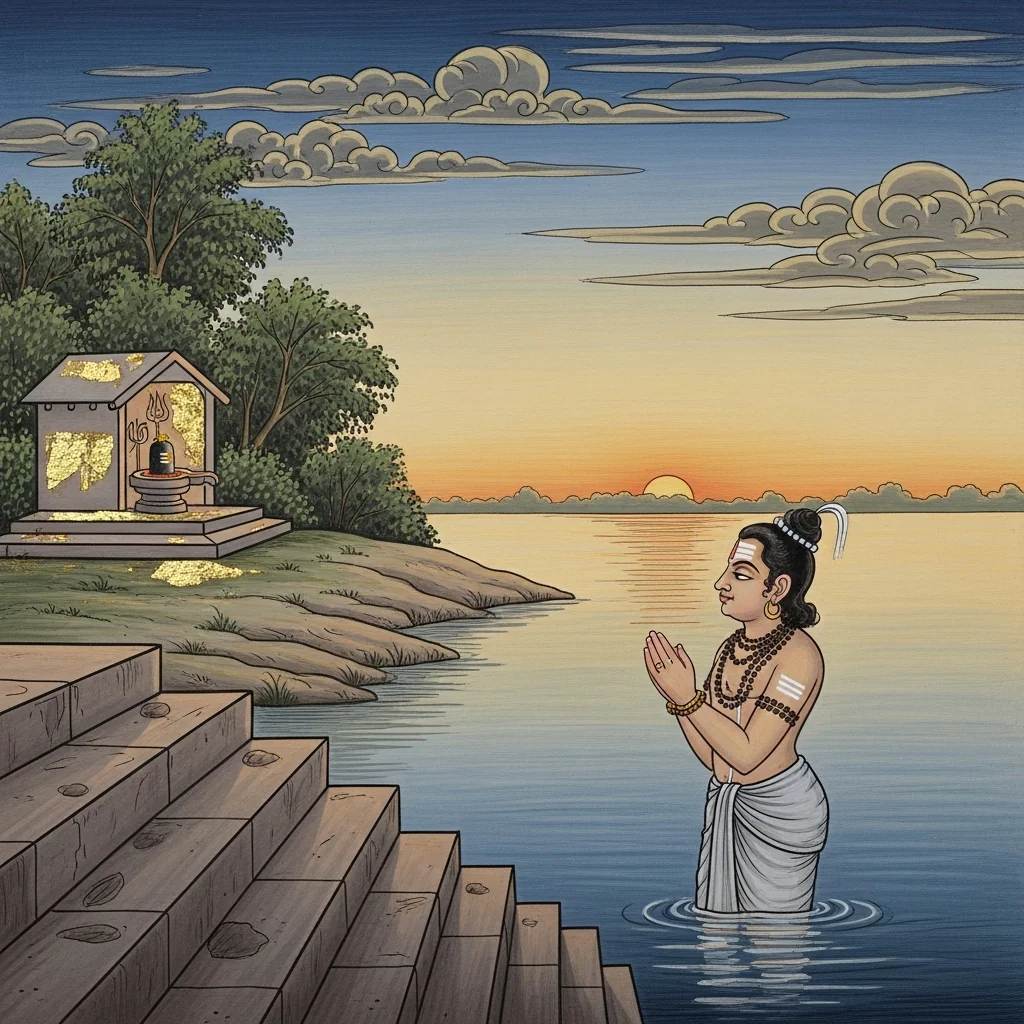
This chapter unfolds as a didactic dialogue. Mārkaṇḍeya answers Yudhiṣṭhira’s question about Darutīrtha, an eminent tīrtha on the Narmadā. It first gives an origin account: Mātali, Indra’s charioteer, once curses his son; the afflicted one seeks Indra’s protection. Indra directs him to live long in austerity on the Narmadā’s bank, devotedly worshipping Maheśvara (Śiva), and foretells rebirth as the famed ascetic Dāruka, who will also cultivate bhakti to the Supreme Lord praised with Vaiṣṇava epithets as the bearer of conch, discus, and mace (śaṅkha-cakra-gadā-dhara), thereby attaining siddhi and a blessed post-mortem destiny. The latter half states the proper observances and their merits. One who bathes duly, performs sandhyā, worships Śiva, and pursues Vedic study gains great sacrificial merit, explicitly likened to an Aśvamedha. Feeding brāhmaṇas yields high fruit, and acts such as bathing, giving, japa, homa, svādhyāya, and deity worship become fully efficacious when performed with purified intention.
Shlokas
Verse 1
मार्कण्डेय उवाच । ततो गच्छेच्च राजेन्द्र दारुतीर्थमनुत्तमम् । दारुको यत्र संसिद्ध इन्द्रस्य दयितः पुरा
Mārkaṇḍeya said: “Then, O king of kings, one should go to the unsurpassed sacred ford called Dārutīrtha—where Dāruka, formerly dear to Indra, attained perfect accomplishment.”
Verse 2
युधिष्ठिर उवाच । दारुकेण कथं तात तपश्चीर्णं पुरानघ । विधानं श्रोतुमिच्छामि त्वत्सकाशाद्द्विजोत्तम
Yudhiṣṭhira said: “How, revered sir—O ancient, sinless one—did Dāruka perform ascetic practice in former times? I wish to hear from you the proper procedure, O best of the twice-born.”
Verse 3
श्रीमार्कण्डेय उवाच । हन्त ते कथयिष्यामि विचित्रं यत्पुरातनम् । वृत्तं स्वर्गसभामध्ये ऋषीणां भावितात्मनाम्
Śrī Mārkaṇḍeya said: “Come, I shall tell you a wondrous ancient account—an event that took place in the assembly hall of Svarga, among sages whose souls were disciplined.”
Verse 4
सूतो वज्रधरस्येष्टो मातलिर्नाम नामतः । स पुत्रं शप्तवान्पूर्वं कस्मिंश्चित्कारणान्तरे
There was a charioteer dear to Vajradhara (Indra), known by name as Mātali. On a certain occasion, for some reason, he once cursed his own son.
Verse 5
शापाहतो वेपमान इन्द्रस्य चरणौ शुभौ । प्रपीड्य मूर्ध्ना देवेशं विज्ञापयति भारत
Struck by the curse and trembling, he pressed his head upon Indra’s auspicious feet and made his plea to the Lord of the gods, O Bhārata.
Verse 6
तमुवाचाभिशप्तं चाप्यनाथं च सुरेश्वरः । कर्मणा केन शापस्य घोरस्यान्तो भविष्यति
To him—cursed and without refuge—the Lord of the gods spoke: “By what action will there be an end to this dreadful curse?”
Verse 7
नर्मदातटमाश्रित्य तोषयन्वै महेश्वरम् । तिष्ठ यावद्युगस्यान्तं पुनर्जन्म ह्यवाप्स्यसि
Taking refuge on the bank of the Narmadā and truly pleasing Maheśvara (Śiva), remain there until the end of the age (yuga); then you shall indeed obtain rebirth.
Verse 8
पुनर्भूत्वा तु पूतस्त्वं दारुको नाम विश्रुतः । संसेव्य परमं देवं शङ्खचक्रगदाधरम्
And when you are reborn, purified, you shall become renowned as Dāruka; and by devoted service to the Supreme God—He who bears conch, discus, and mace—you shall go onward.
Verse 9
मानुषं भावमापन्नस्ततः सिद्धिमवाप्स्यसि । एवमुक्तस्तु देवेन सहस्राक्षेण धीमता
Having attained the human condition, then you shall obtain accomplishment. Thus did the wise god Sahasrākṣa (Indra), the Thousand-Eyed, address him.
Verse 10
प्रणम्य शिरसा भूमिमागतोऽसौ ह्यचेतनः । नर्मदातटमाश्रित्य कर्षयन्निजविग्रहम्
Bowing with his head to the earth, he came there as though senseless; taking refuge on the bank of the Narmadā, he dragged his own body along.
Verse 11
व्रतोपवाससंखिन्नो जपहोमरतः सदा । महादेवं महात्मानं वरदं शूलपाणिनम्
Worn down by vows and fasts, yet ever devoted to japa and homa, he worshipped Mahādeva—the great-souled Lord, the giver of boons, the One who bears the trident in his hand.
Verse 12
भक्त्या तु परया राजन्यावदाभूतसम्प्लवम् । अंशावतरणाद्विष्णोः सूतो भूत्वा महामतिः
O King, with supreme devotion—until the end of the cosmic dissolution—through a partial descent of Viṣṇu, that great-minded one became a sūta, a sacred bard and charioteer.
Verse 13
तोषयन् वै जगन्नाथं ततो यातो हि सद्गतिम्
Having truly pleased Jagannātha, he then indeed attained the good and blessed destiny.
Verse 14
एष तत्सम्भवस्तात दारुतीर्थस्य सुव्रत । कथितोऽयं मया पूर्वं यथा मे शङ्करोऽब्रवीत्
Dear one, O steadfast in good vows, this is precisely the origin of Dārutīrtha, as I have related it—just as Śaṅkara once told it to me.
Verse 15
ततो युधिष्ठिरः श्रुत्वा विस्मयं परमं गतः । भ्रात्ःन् विलोकयामास हृष्टरोमा मुहुर्मुहुः
Then Yudhiṣṭhira, hearing this, was filled with the highest wonder; his hair standing on end, he kept looking again and again at his brothers.
Verse 16
श्रीमार्कण्डेय उवाच । तस्मिंस्तीर्थे नरः स्नात्वा विधिपूर्वं नरेश्वर । उपास्य संध्यां देवेशमर्चयेद्यश्च शङ्करम्
Śrī Mārkaṇḍeya said: O lord of men, in that tīrtha, after bathing according to proper rule, one should perform the sandhyā worship and then adore Śaṅkara, the Lord of the gods.
Verse 17
वेदाभ्यासं तु तत्रैव यः करोति समाहितः । सोऽश्वमेधफलं राजंल्लभते नात्र संशयः
But whoever, concentrated in mind, studies the Vedas right there, O King, obtains the merit of an Aśvamedha sacrifice—of this there is no doubt.
Verse 18
तस्मिंस्तीर्थे तु यो भक्त्या भोजयेद्ब्राह्मणाञ्छुचिः । स तु विप्रसहस्रस्य लभते फलमुत्तमम्
At that tīrtha, whoever—being pure—feeds brāhmaṇas there with devotion attains the supreme merit, equal to the fruit of feeding a thousand learned priests.
Verse 19
स्नानं दानं जपो होमः स्वाध्यायो देवतार्चनम् । यत्कृतं शुद्धभावेन तत्सर्वं सफलं भवेत्
Bathing, charity, japa, homa, sacred study, and worship of the deity—whatever is done with a purified intention, all of it becomes truly fruitful.