Adhyaya 77
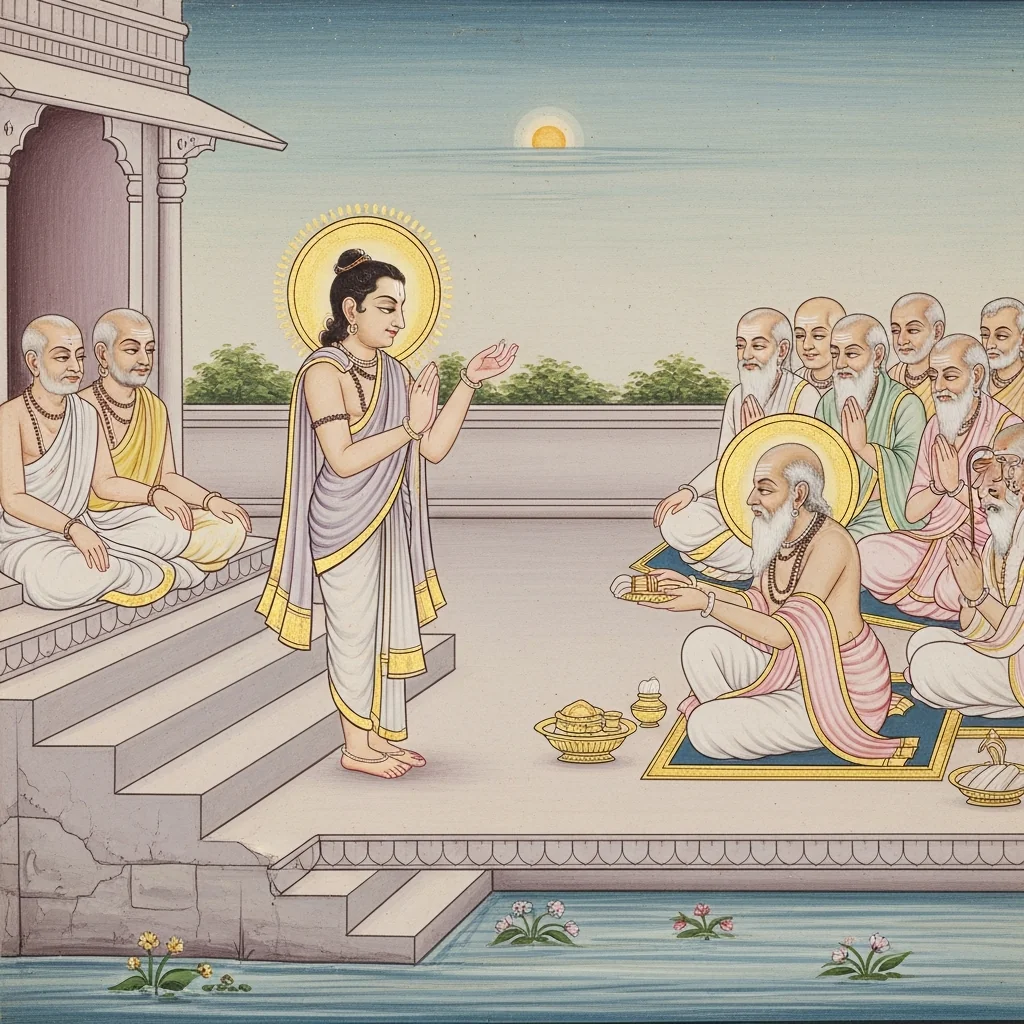
This adhyāya gives Śrī Mārkaṇḍeya’s theological and ritual instruction concerning Bhīmeśvara, praised as a tīrtha that brings pāpa-kṣaya (the removal of sin) and is visited by gatherings of sages devoted to auspicious disciplines. It sets out a sequence of practice: approach Bhīmeśvara, bathe at the tīrtha, maintain upavāsa (fasting) and jitendriyatā (restraint of the senses), and perform mantra-japa—especially the “one-syllable mantra” (ekākṣara) with arms raised while the sun is present, as a strict daytime observance. The discourse then states graded phala (fruits) regarding the destruction of accumulated wrongdoing, even sins gathered over many births, and extols the purificatory power of Gāyatrī-japa. It generalizes the efficacy of repeated recitation—Vedic or worldly (vaidika/laukika)—likening mantra’s power to fire that burns away impurities as it consumes dry grass. An ethical warning is added: one should not commit wrong by taking “divine power” as a pretext; ignorance may be swiftly destroyed, but wrongdoing is not thereby justified. The chapter concludes by affirming that charity given according to one’s capacity at this tīrtha yields imperishable (akṣayya) results.
Shlokas
Verse 1
श्रीमार्कण्डेय उवाच । भीमेश्वरं ततो गच्छेत्सर्वपापक्षयंकरम् । सेवितं ऋषिसङ्घैश्च भीमव्रतधरैः शुभैः
Śrī Mārkaṇḍeya said: “Thereafter one should go to Bhīmeśvara, the sacred place that brings about the destruction of all sins. It is worshipped by hosts of ṛṣis and by auspicious observers of the Bhīma-vrata.”
Verse 2
तत्र तीर्थे तु यः स्नात्वा सोपवासो जितेन्द्रियः । जपेदेकाक्षरं मन्त्रमूर्ध्वबाहुर्दिवाकरे
At that tīrtha, whoever bathes and then, fasting and with senses restrained, recites the one-syllabled mantra with arms raised toward the Sun—
Verse 3
तस्य जन्मार्जितं पापं तत्क्षणादेव नश्यति । सप्तजन्मार्जितं पापं गायत्र्या नश्यते ध्रुवम्
For him, sin accumulated in this very life is destroyed at that very moment; and sin amassed over seven births is surely destroyed by the Gāyatrī.
Verse 4
दशभिर्जन्मभिर्जातं शतेन तु पुरा कृतम् । सहस्रेण त्रिजन्मोत्थं गायत्री हन्ति किल्बिषम्
The Gāyatrī strikes down sin: that which has arisen through ten births, that which was done long ago over a hundred births, and that which has sprung from three births even when accumulated a thousandfold.
Verse 5
वैदिकं लौकिकं वापि जाप्यं जप्तं नरेश्वर । तत्क्षणाद्दहते सर्वं तृणं तु ज्वलनो यथा
O lord of men, whether the japa is Vedic or worldly, once recited it burns everything at once—just as fire burns dry grass.
Verse 6
न देवबलमाश्रित्य कदाचित्पापमाचरेत् । अज्ञानान्नश्यते क्षिप्रं नोत्तरं तु कदाचन
One should never commit sin relying on ‘the power of the gods’. If done in ignorance, it may be destroyed quickly; but thereafter there is never any excuse.
Verse 7
तत्र तीर्थे तु यो दानं शक्तिमाश्रित्य चाचरेत् । तदक्षय्यफलं सर्वं जायते पाण्डुनन्दन
At that tīrtha, whoever performs charity according to his capacity—its entire fruit becomes imperishable, O son of Pāṇḍu.
Verse 77
। अध्याय
Chapter (colophon/heading marker).