Adhyaya 103
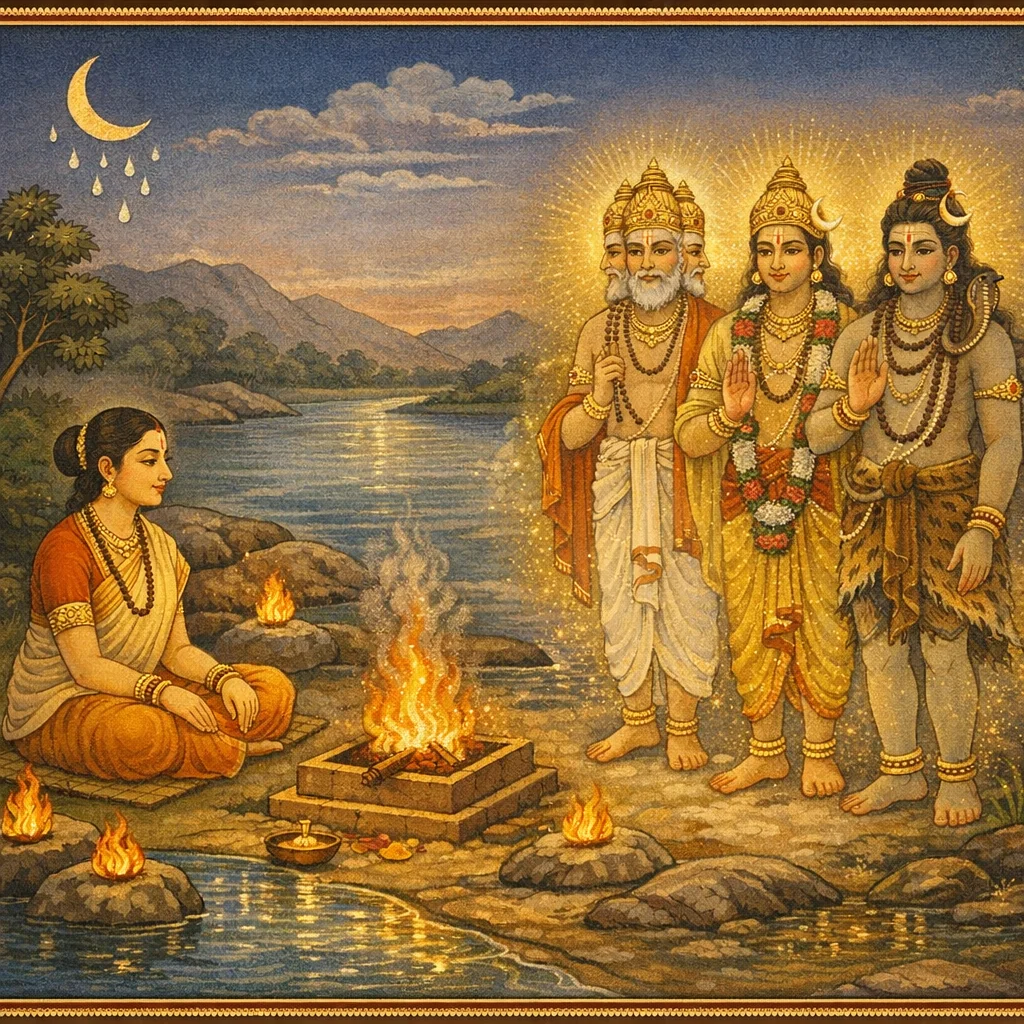
The chapter unfolds as a layered dialogue: Mārkaṇḍeya directs a king to the Eraṇḍī–Reva confluence, recalling Śiva’s earlier disclosure to Pārvatī, praised as “more secret than secret.” Śiva tells of Atri and Anasūyā’s childlessness and teaches the ethical and theological worth of progeny as support for lineage-dharma and post-mortem welfare. Anasūyā then performs sustained tapas at the confluence on Reva’s northern bank, observing seasonal austerities (pañcāgni in summer, cāndrāyaṇa in the rains, water-dwelling in winter) along with daily rites—sacred bathing, sandhyā, devarṣi-tarpaṇa, homa, and worship. Brahmā, Viṣṇu, and Rudra appear in concealed dvija form, reveal their cosmic-seasonal identifications (rain/seed, winter/preservation, summer/withering), and grant boons, establishing the tīrtha’s perpetual sanctity and wish-fulfilling power. The chapter prescribes observances at the confluence—especially in Caitra—such as bathing, night vigil, feeding dvijas, pindadāna, circumambulation, and various dānas, with multiplied merit. A second exemplum follows: the householder Govinda accidentally causes a child’s death while gathering wood, later suffers bodily affliction understood as karmic fruition, and is relieved through confluence bathing and the associated worship and gifts—an ethical-doctrinal illustration of remedial pilgrimage discipline. The chapter closes with phalaśruti-like assurances for hearing or reciting the account and for specific residence and fasting at the site, extending merit even to incidental contact with the confluence’s water and earth.
Shlokas
Verse 1
श्रीमार्कण्डेय उवाच । ततो गच्छेन्महीपाल एरण्डीसङ्गमं परम् । यच्छ्रुतं वै मया राजञ्छिवस्य वदतः पुरा
Śrī Mārkaṇḍeya said: Then, O King, one should go to the supreme confluence called Ēraṇḍī-saṅgama—what I once heard long ago as Śiva himself was speaking, O King.
Verse 2
एतदेव पुरा प्रश्नं गौर्या पृष्टस्तु शङ्करः । प्रोवाच नृपशार्दूल गुह्याद्गुह्यतरं शुभम्
This very question was once asked by Gaurī to Śaṅkara. And he, O tiger among kings, revealed an auspicious secret—more hidden than the hidden.
Verse 3
ईश्वर उवाच । शृणु देवि परं गुह्यं नाख्यातं कस्यचिन्मया । रेवायाश्चोत्तरे कूले तीर्थं परमशोभनम् । भ्रूणहत्याहरं देवि कामदं पुत्रवर्धनम्
Īśvara said: “Listen, O Devī, to a supreme secret—one I have not disclosed to anyone. On the northern bank of the Revā there is a most splendid tīrtha: it destroys the sin of foeticide, grants desired boons, and increases progeny.”
Verse 4
पार्वत्युवाच । कथयस्व महादेव तीर्थं परमशोभनम् । भ्रूणहत्याहरं कस्मात्कामदं स्वर्गदर्शनम्
Pārvatī said: “Tell me, O Mahādeva, about that supremely splendid tīrtha. How does it remove the sin of foeticide, grant desires, and bestow the vision of heaven?”
Verse 5
ईश्वर उवाच । अत्रिर्नाम महादेवि मानसो ब्रह्मणः सुतः । अग्निहोत्ररतो नित्यं देवतातिथिपूजकः
Īśvara said: “O great Goddess, there was a sage named Atri, a mind-born son of Brahmā. Ever devoted to the Agnihotra, he was constant in honoring the gods and guests.”
Verse 6
सोमसंस्थाश्च सप्तैव कृता विप्रेण पार्वति । अनसूयेति विख्याता भार्या तस्य गुणान्विता
O Pārvatī, that brāhmaṇa performed all seven Soma-sacrifices. His wife, famed as Anasūyā, was endowed with virtues.
Verse 7
पतिव्रता पतिप्राणा पत्युः कार्यहिते रता । एवं याति ततः काले न पुत्रा न च पुत्रिका
She was a pativratā, holding her husband as her very life, intent on what benefited his duties. Yet, as time passed, they had neither son nor daughter.
Verse 8
अपराह्णे महादेवि सुखासीनौ तु सुन्दरि । वदन्तौ सुखदुःखानि पूर्ववृत्तानि यानि च
In the afternoon, O great Goddess, the lovely pair sat at ease, speaking of joys and sorrows, and of events that had occurred before.
Verse 9
अत्रिरुवाच । सौम्ये शुभे प्रिये कान्ते चारुसर्वाङ्गसुन्दरि । विद्याविनयसम्पन्ने पद्मपत्रनिभेक्षणे
Atri said: “O gentle one, O auspicious one, beloved, dear wife—O beauty of lovely limbs; accomplished in learning and humility, lotus-petalled in your gaze—”
Verse 10
पूर्णचन्द्रनिभाकारे पृथुश्रोणिभरालसे । न त्वया सदृशी नारी त्रैलोक्ये सचराचरे
Your form is like the full moon; with broad hips and graceful heaviness—there is no woman like you in the three worlds, among all that moves and all that is still.
Verse 11
रतिपुत्रफला नारी पठ्यते वेदवादिभिः । पुत्रहीनस्य यत्सौख्यं तत्सौख्यं मम सुन्दरि
The learned expound that a woman bears the fruits of love and of sons. The happiness that belongs to one without a son—such happiness is mine, O beautiful one.
Verse 12
यथाहं न तथा पुत्रः समर्थः सर्वकर्मसु । पुन्नामनरकाद्भद्रे जातमात्रेण सुन्दरि
Unlike me, a son is not necessarily competent in every duty; yet, O auspicious and beautiful one, merely by being born he delivers (his father) from the hell called Punnāma.
Verse 13
पतन्तं रक्षयेद्देवि महापातकिनं यदि । महाघोरे गता वापि दुष्टकर्मपितामहाः
O Goddess, if (a son) can protect even one who is falling—though a great sinner—then even grandfathers of wicked deeds, though gone to the most dreadful state, may be saved.
Verse 14
तद्धरन्ति सुपुत्राश्च वैतरण्यां गतानपि । पुत्रेण लोकाञ्जयति पौत्रेण परमा गतिः
That burden is borne away by virtuous sons—even for those who have reached the Vaitaraṇī. By a son one conquers the worlds; by a grandson there is the supreme destination.
Verse 15
अथ पुत्रस्य पौत्रेण प्रगच्छेद्ब्रह्म शाश्वतम् । नास्ति पुत्रसमो बन्धुरिह लोके परत्र च
And then, through a son’s grandson, one proceeds to the eternal Brahman. There is no friend equal to a son—neither in this world nor in the world beyond.
Verse 16
अहश्च मध्यरात्रे च चिन्तयानस्य सर्वदा । शुष्यन्ति मम गात्राणि ग्रीष्मे नद्युदकं यथा
By day and even at midnight, as I brood constantly, my limbs dry up—like the water of a river in summer.
Verse 17
अनसूयोवाच । यत्त्वया शोचितं विप्र तत्सर्वं शोचयाम्यहम् । तवोद्वेगकरं यच्च तन्मे दहति चेतसि
Anasūyā said: ‘O brāhmaṇa, all that you grieve for—I grieve for it as well. And whatever causes you distress, that too burns within my heart.’
Verse 18
येन पुत्रा भविष्यन्ति आयुष्मन्तो गुणान्विताः । तत्कार्यं च समीक्षस्व येन तुष्येत्प्रजापतिः
Consider that course of action by which sons will be born—long-lived and endowed with virtues; consider the deed by which Prajāpati will be pleased.
Verse 19
अत्रिरुवाच । तपस्तप्तं मया भद्रे जातमात्रेण दुष्करम् । व्रतोपवासनियमैः शाकाहारेण सुन्दरि
Atri said: ‘O auspicious one, from the very beginning I have performed arduous tapas, truly difficult—through vows, fasts, disciplines, and a diet of herbs and greens, O beautiful one.’
Verse 20
क्षीणदेहस्तु तिष्ठामि ह्यशक्तोऽहं महाव्रते । तेन शोचामि चात्मानं रहस्यं कथितं मया
“Worn in body, I remain standing; I am powerless in this great vow. Therefore I grieve for myself—this secret I have spoken to you.”
Verse 21
अनसूयोवाच । भर्तुः पतिव्रता नारी रतिपुत्रविवर्धिनी । त्रिवर्गसाधना सा च श्लाघ्या च विदुषां जने
Anasūyā said: “A wife devoted to her husband—one who nurtures marital harmony and offspring—accomplishes the three aims of life, and she is praised among the learned.”
Verse 22
जपस्तपस्तीर्थयात्रा मृडेज्यामन्त्रसाधनम् । देवताराधनं चैव स्त्रीशूद्रपतनानि षट्
Japa, austerity, pilgrimage to sacred fords, worship of Rudra, disciplined practice of mantras, and the propitiation of deities—these six are declared here to be acts that lead to a fall for women and for Śūdras.
Verse 23
ईदृशं तु महादोषं स्त्रीणां तु व्रतसाधने । वदन्ति मुनयः सर्वे यथोक्तं वेदभाषितम्
Such, indeed, is the great fault spoken of regarding women in the undertaking of vows; all the sages declare it, just as it is stated in the Veda’s teaching.
Verse 24
अनुज्ञाता त्वया ब्रह्मंस्तपस्तप्स्यामि दुष्करम् । पुत्रार्थित्वं समुद्दिश्य तोषयामि सुरोत्तमान्
“Permitted by you, O Brahmin, I shall undertake difficult austerity; desiring a son, I will propitiate the highest of the gods.”
Verse 25
अत्रिरुवाच । साधु साधु महाप्राज्ञे मम संतोषकारिणि । आज्ञाता त्वं मया भद्रे पुत्रार्थं तप आश्रय
Atri said: “Well done, well done, O great-minded one, delight of my heart. O auspicious lady, you are authorized by me—take refuge in austerity (tapas) for the sake of a son.”
Verse 26
देवतानां मनुष्याणां पित्ःणामनृणो भवे । न भार्यासदृशो बन्धुस्त्रिषु लोकेषु विद्यते
By such righteous conduct one becomes free of debt to the gods, to human beings, and to the ancestors; for in the three worlds there is no relative comparable to a wife.
Verse 27
तेन देवाः प्रशंसन्ति न भार्यासदृशं सुखम् । सन्मुखे मन्मुखाः पुत्राः विलोमे तु पराङ्मुखाः
Therefore the gods praise this truth: there is no happiness like that which comes through a wife. When things are favorable, sons are devoted and face one; but when reversed, they turn away.
Verse 28
तेन भार्यां प्रशंसन्ति सदेवासुरमानुषाः । महाव्रते महाप्राज्ञे सत्त्ववति शुभेक्षणे
Therefore wifehood is praised by gods, asuras, and humans alike—O woman of great vows, great wisdom, inner strength, and auspicious gaze.
Verse 29
तपस्तपस्व शीघ्रं त्वं पुत्रार्थं तु ममाज्ञया । एतद्वाक्यावसाने तु साष्टाङ्गं प्रणताब्रवीत्
“Practice austerity—quickly—by my command, for the sake of a son.” When these words ended, she bowed with her eight limbs and then spoke.
Verse 30
त्वत्प्रसादेन विप्रेन्द्र सर्वान्कामानवाप्नुयाम् । हंसलीलागतिः सा च मृगाक्षी वरवर्णिनी
“By your grace, O best of Brahmins, may I obtain all my desires.” And she—moving with the playful gait of a swan—was doe-eyed, of excellent complexion.
Verse 31
नियमस्था ततो भूत्वा सम्प्राप्ता नर्मदां नदीम् । शिवस्वेदोद्भवां देवीं सर्वपापप्रणाशनीम्
Then, established in disciplined observances, she reached the river Narmadā—the goddess said to have arisen from Śiva’s sweat—who destroys all sins.
Verse 32
यस्या दर्शनमात्रेण नश्यते पापसञ्चयः । स्नानमात्रेण वै यस्या अश्वमेधफलं लभेत्
By merely beholding her, the amassed store of sins is destroyed; and by merely bathing in her, one attains the fruit of the Aśvamedha sacrifice.
Verse 33
ये पिबन्ति महादेवि श्रद्दधानाः पयः शुभम् । सोमपानेन तत्तुल्यं नात्र कार्या विचारणा
O Mahādevī, those who drink her auspicious waters with faith—this is equal to drinking Soma; of this there is no need for doubt or debate.
Verse 34
ये स्मरन्ति दिवा रात्रौ योजनानां शतैरपि । मुच्यन्ते सर्वपापेभ्यो रुद्रलोकं प्रयान्ति ते
Even from hundreds of yojanas away, those who remember her by day and by night are freed from all sins, and they go to the world of Rudra.
Verse 35
नर्मदायाः समीपे तु तावुभौ योजनद्वये । न पश्यन्ति यमं तत्र ये मृता वरवर्णिनि
But within two yojanas on either side of the Narmadā, those who die there, O fair-complexioned one, do not behold Yama.
Verse 36
ततस्तदुत्तरे कूले एरण्ड्याः सङ्गमे शुभे । नियमस्था विशालाक्षी शाकाहारेण सुन्दरि
Then, on her northern bank, at the auspicious confluence with the Eraṇḍī, O large-eyed beautiful one, she remained devoted to strict observances, living on a diet of vegetables.
Verse 37
तोषयन्ती त्रींश्च देवाञ्छुभैः स्तोत्रैर्व्रतैस्तथा । ग्रीष्मेषु च महादेवि पञ्चाग्निं साधयेत्ततः
Pleasing the Thirty Gods with auspicious hymns and vows, she then, O Mahādevī, would undertake the five-fire austerity during the summer.
Verse 38
वर्षाकाले चार्द्रवासाश्चरेच्चान्द्रायणानि च । हेमन्ते तु ततः प्राप्ते तोयमध्ये वसेत्सदा
In the rainy season she would wear damp garments and observe Cāndrāyaṇa vows; and when winter arrived, she would always dwell in the midst of the water.
Verse 39
प्रातःस्नानं ततः सन्ध्यां कुर्याद्देवर्षितर्पणम् । देवानामर्चनं कृत्वा होमं कुर्याद्यथाविधि
She would bathe at dawn; then perform the Sandhyā rites and offer tarpaṇa libations to the gods and seers. Having worshipped the deities, she would perform the homa fire-offering according to rule.
Verse 40
यजते वैष्णवांल्लोकान् स्नानजाप्यहुतेन च । एवं वर्षशते प्राप्ते रुद्रविष्णुपितामहाः
By sacred bathing, japa-recitation, and oblations she worships and attains the Vaiṣṇava worlds. Thus, when a hundred years were fulfilled, Rudra, Viṣṇu, and Pitāmaha (Brahmā) arrived and appeared.
Verse 41
सम्प्राप्ता द्विजरूपैस्तु एरण्ड्याः सङ्गमे प्रिये । पुरतः संस्थितास्तस्या वेदमभ्युद्धरन्ति च
They arrived there in the guise of brāhmaṇas, O beloved, at the confluence of the Eraṇḍī. Standing before her, they exalted and proclaimed the Veda.
Verse 42
अनसूया जपं त्यक्त्वा निरीक्ष्य तान्मुहुर्मुहुः । उत्थिता सा विशालाक्षी अर्घं दत्त्वा यथाविधि
Anasūyā, pausing her japa, gazed upon them again and again. Then the large-eyed lady rose and, according to proper rite, offered them arghya—the respectful water-offering.
Verse 43
अद्य मे सफलं जन्म अद्य मे सफलं तपः । दर्शनेन तु विप्राणां सर्वपापैः प्रमुच्यते
“Today my birth is fulfilled; today my tapas is fulfilled. For by the very sight of holy brāhmaṇas one is released from all sins.”
Verse 44
प्रदक्षिणं ततः कृत्वा साष्टाङ्गं प्रणताब्रवीत् । कन्दमूलफलं शाकं नीवारानपि पावनान् । प्रयच्छाम्यहमद्यैव मुनीनां भावितात्मनाम्
Then, having circumambulated them in pradakṣiṇā and bowed in the eight-limbed prostration, she said: “This very day I shall offer to the munis of purified souls roots and tubers, fruits, greens, and even the purifying wild grains, nīvāra.”
Verse 45
विप्रा ऊचुः । तपसा तु विचित्रेण तपःसत्येन सुव्रते । तृप्ताः स्म सर्वकामैस्तु सुव्रते तव दर्शनात्
The brāhmaṇas said: “O woman of excellent vows, by your wondrous tapas and the truth of your austerity, we are fulfilled in every desire—indeed, simply by beholding you.”
Verse 46
अस्माकं कौतुकं जातं तापसेन व्रतेन यत् । स्वर्गमोक्षसुतस्यार्थे तपस्तपसि दुष्करम्
“A curiosity has arisen in us about this ascetic vow of yours: for the sake of heaven, liberation (mokṣa), and a son, you undertake arduous tapas upon tapas.”
Verse 47
अनसूयोवाच । तपसा सिध्यते स्वर्गस्तपसा परमा गतिः । तपसा चार्थकामौ च तपसा गुणवान्सुतः । तप एव च मे विप्राः सर्वकामफलप्रदम्
Anasūyā said: “By tapas, heaven is attained; by tapas, the highest goal is reached. By tapas, prosperity and desire are gained; by tapas, a virtuous son is obtained. Tapas alone, O brāhmaṇas, bestows the fruits of all aims.”
Verse 48
विप्रा ऊचुः । तन्वी श्यामा विशालाक्षी स्निग्धाङ्गी रूपसंयुता । हंसलीलागतिगमा त्वं च सर्वाङ्गसुन्दरी
The brāhmaṇas said: “You are slender and dark-hued, large-eyed, with graceful limbs and endowed with beauty; your gait is like the playful movement of a swan, and you are lovely in every part.”
Verse 49
किं च ते तपसा कार्यमात्मानं शोच्यसे कथम्
“And what need have you of austerity? Why do you grieve for yourself?”
Verse 50
अनसूयोवाच । यदि रुद्रश्च विष्णुश्च स्वयं साक्षात्पितामहः । गूढरूपधराः सर्वे तच्चिह्नमुपलक्षये
Anasūyā said: “If you are Rudra and Viṣṇu—and Pitāmaha (Brahmā) himself—each assuming a concealed form, then I recognize the sign of that truth.”
Verse 51
तस्या वाक्यावसाने तु स्वरूपं दर्शयन्ति ते । स्वस्वरूपैः स्थिता देवाः सूर्यकोटिसमप्रभाः
When her words ended, they revealed their true forms. The gods stood in their own divine natures, radiant like ten million suns.
Verse 52
चतुर्भुजो महादेवि शङ्खचक्रगदाधरः । अतसीपुष्पवर्णस्तु पीतवासा जनार्दनः
O Great Goddess, Janārdana appeared four-armed, bearing the conch, discus, and mace; his complexion was like the flax flower, and he was clad in yellow garments.
Verse 53
गरुत्मान्वाहनं यस्य श्रिया च सहितो हरिः । प्रसन्नवदनः श्रीमान्स्वयंरूपो व्यवस्थितः
Hari, whose mount is Garuḍa, stood there in his own manifest form—radiant and auspicious—accompanied by Śrī, with a serene and gracious face.
Verse 54
पीतवासा महादेवि चतुर्वदनपङ्कजः । हंसोपरि समारूढो ह्यक्षमालाकरोद्यतः
O Great Goddess, Brahmā—lotus-faced with four faces—appeared wearing yellow garments, mounted upon a swan, his hand raised holding a rosary.
Verse 55
आगतो नर्मदातीरे ब्रह्मा लोकपितामहः । योऽसौ सर्वजगद्व्यापी स्वयं साक्षान्महेश्वरः
On the bank of the Narmadā came Brahmā, the grandsire of the worlds; and also that One who pervades the entire universe—Maheśvara himself, directly manifest.
Verse 56
वृषभं तु समारूढो दशबाहुसमन्वितः । भस्माङ्गरागशोभाढ्यः पञ्चवक्त्रस्त्रिलोचनः
Mounted upon the bull, endowed with ten arms, adorned with the splendor of sacred ash upon his limbs—five-faced and three-eyed—the Lord appeared.
Verse 57
जटामुकुटसंयुक्तः कृतचन्द्रार्द्धशेखरः । एवंरूपधरो देवः सर्वव्यापी महेश्वरः
With a crown of matted locks, bearing the half-moon as his crest—thus formed stood the God, Maheśvara, the all-pervading Lord.
Verse 58
अनसूया निरीक्ष्यैतद्देवानां दर्शनं परम् । वेपमाना ततः साध्वी सुरान्दृष्ट्वा मुहुर्मुहुः
Beholding this supreme vision of the gods, the virtuous Anasūyā began to tremble, gazing again and again upon the deities.
Verse 59
अनसूयोवाच । किं व्यापारस्वरूपास्तु विष्णुरुद्रपितामहाः । एतद्वै श्रोतुमिच्छामि ह्यशेषं कथयन्तु मे
Anasūyā said: “What are the essential functions and natures of Viṣṇu, Rudra, and the Grandsire (Brahmā)? I wish to hear this in full—tell me without omission.”
Verse 60
ब्रह्मोवाच । प्रावृट्कालो ह्यहं ब्रह्मा आपश्चैव प्रकीर्तिताः । मेघरूपो ह्यहं प्रोक्तो वर्षयामि च भूतले
Brahmā said: “I am the season of rains (prāvṛṭ), and I am also proclaimed as the waters. I am spoken of as cloud-formed, and I cause rain to fall upon the earth.”
Verse 61
अहं सर्वाणि बीजानि प्राक्सन्ध्यासूदिते रवौ । एतद्वै कारणं सर्वं रहस्यं कथितं परम्
“I am all the seeds,” said Brahmā, “when the sun rises in the dawn before full sunrise. This is the universal cause—this supreme secret has been declared.”
Verse 62
विष्णुरुवाच । हेमन्तश्च भवेद्विष्णुर्विश्वरूपं चराचरम् । पालनाय जगत्सर्वं विष्णोर्माहात्म्यमुत्तमम्
Viṣṇu said: “In the season of Hemanta (early winter), I, Viṣṇu, become the cosmic form that pervades all moving and unmoving beings. For the protection and sustenance of the entire world, this is the supreme greatness of Viṣṇu.”
Verse 63
रुद्र उवाच । ग्रीष्मकालो ह्यहं प्रोक्तः सर्वभूतक्षयंकरः । कर्षयामि जगत्सर्वं रुद्ररूपस्तपस्विनि
Rudra said: “I am declared to be the season of Grīṣma (summer), the time that brings decline to all beings. In my Rudra-form, O ascetic lady, I parch and draw out the strength of the entire world.”
Verse 64
एवं ब्रह्मा च विष्णुश्च रुद्रश्चैव महाव्रते । त्रयो देवास्त्रयः सन्ध्यास्त्रयः कालास्त्रयोऽग्नयः
Thus, O lady of great vow, Brahmā, Viṣṇu, and Rudra are three deities; likewise there are three sandhyās (twilight-junctions), three divisions of time, and three sacred fires.
Verse 65
तथा ब्रह्मा च विष्णुश्च रुद्रश्चैकात्मतां गतः । वरं दद्युश्च ते भद्रे यस्त्वया मनसीप्सितम्
So too, Brahmā, Viṣṇu, and Rudra became of one essence; and, O auspicious lady, they were ready to grant you the boon your heart desired.
Verse 66
अनसूयोवाच । धन्या पुण्या ह्यहं लोके श्लाघ्या वन्द्या च सर्वदा । ब्रह्मा विष्णुश्च रुद्रश्च प्रसन्नवदनाः शुभाः
Anasūyā said: “Truly I am blessed and full of merit in this world—ever worthy of praise and reverence—since Brahmā, Viṣṇu, and Rudra stand before me with serene and auspicious faces.”
Verse 67
यदि तुष्टास्त्रयो देवा दयां कृत्वा ममोपरि । अस्मिंस्तीर्थे तु सांनिध्याद्वरदाः सन्तु मे सदा
“If the three gods are pleased and have shown compassion toward me, then by their abiding presence at this sacred ford, may they ever remain boon-givers to me.”
Verse 68
रुद्र उवाच । एवं भवतु ते वाक्यं यत्त्वया प्रार्थितं शुभे । प्रत्यक्षा वैष्णवी माया एरण्डीनाम नामतः
Rudra said: “So be it; let your request be fulfilled, O auspicious one. Here the Vaiṣṇavī power (māyā) will become manifest, known by name as Eraṇḍī.”
Verse 69
यस्या दर्शनमात्रेण नश्यते पापसञ्चयः । चैत्रमासे तु सम्प्राप्ते अहोरात्रोषितो भवेत्
“By the mere sight of her, the accumulation of sins is destroyed. And when the month of Caitra arrives, one should stay there for a full day and night.”
Verse 70
एरण्ड्याः सङ्गमे स्नात्वा ब्रह्महत्यां व्यपोहति । रात्रौ जागरणं कुर्यात्प्रभाते भोजयेद्द्विजान्
Having bathed at the confluence of Eraṇḍī, one casts off even the sin of brahmin-slaying. At night one should keep vigil, and at dawn one should feed the twice-born (brāhmaṇas).
Verse 71
यथोक्तेन विधानेन पिण्डं दद्याद्यथाविधि । प्रदक्षिणां ततो दद्याद्धिरण्यं वस्त्रमेव च
According to the procedure as stated, one should duly offer piṇḍa (funerary oblations). Thereafter one should perform circumambulation, and then give gifts—gold and also garments.
Verse 72
रजतं च तथा गावो भूमिदानमथापि वा । सर्वं कोटिगुणं प्रोक्तमिति स्वायम्भुवोऽब्रवीत्
Whether one gives silver, cows, or even the gift of land—here all such offerings are declared to yield merit a crore-fold,” thus said Svāyambhuva (Manu).
Verse 73
ये म्रियन्ति नरा देवि एरण्ड्याः सङ्गमे शुभे । यावद्युगसहस्रं तु रुद्रलोके वसन्ति ते
O Goddess, those men who die at the auspicious confluence of Eraṇḍī remain in Rudra’s world for as long as a thousand yugas.
Verse 74
अहोरात्रोषितो भूत्वा जपेद्रुद्रांश्च वैदिकान् । एकादशैकसंज्ञांश्च स याति परमां गतिम्
Having stayed for a full day and night, one should recite the Vedic Rudra-hymns—those known as the ‘Eleven’—and by that he attains the supreme state.
Verse 75
विद्यार्थी लभते विद्यां धनार्थी लभते धनम् । पुत्रार्थी लभते पुत्रांल्लभेत्कामान् यथेप्सितान्
The seeker of learning gains learning; the seeker of wealth gains wealth. The seeker of sons gains sons—and desires are obtained exactly as wished.
Verse 76
एरण्ड्याः सङ्गमे स्नात्वा रेवाया विमले जले । महापातकिनो वापि ते यान्ति परमां गतिम्
Bathing at the confluence of Eraṇḍī in the pure waters of Revā (Narmadā), even those burdened with great sins attain the supreme destination.
Verse 77
अनसूयोवाच । यदि तुष्टास्त्रयो देवा मम भक्तिप्रचोदिताः । मम पुत्रा भवन्त्वेव हरिरुद्रपितामहाः
Anasūyā said: “If the three gods—moved by my devotion—are pleased, then let Hari (Viṣṇu), Rudra (Śiva), and Pitāmaha (Brahmā) indeed become my sons.”
Verse 78
विष्णुरुवाच । पूज्या यत्पुत्रतां यान्ति न कदाचिच्छ्रुतं मया । शुभे ददामि पुत्रांस्ते देवतुल्यपराक्रमान् । रूपवन्तो गुणोपेतान्यज्विनश्च बहुश्रुतान्
Viṣṇu said: “O venerable lady, never have I heard of the worshipful entering into sonship. Yet, O auspicious one, I grant you sons—equal to the gods in valor, handsome, endowed with virtues, devoted to sacrifice, and greatly learned.”
Verse 79
अनसूयोवाच । ईप्सितं तच्च दातव्यं यन्मया प्रार्थितं हरे । नान्यथा चैव कर्तव्या मम पुत्रैषणा तु या
Anasūyā said: “O Hari, what I have sought must be granted exactly as desired. My longing for sons must not be fulfilled in any other way.”
Verse 80
विष्णुरुवाच । पूर्वं तु भृगुसंवादे गर्भवास उपार्जितः । तस्याहं चैव पारं तु नैव पश्यामि शोभने
Viṣṇu said: “Formerly, in the dialogue with Bhṛgu, the merit of dwelling in the womb was spoken of. Of that, O fair one, I do not behold the farthest limit.”
Verse 81
स्मरमाणः पुरावृत्तं चिन्तयामि पुनःपुनः । एवं संचिन्त्य ते देवाः पितामहमहेश्वराः
“Remembering what happened in the past, I reflect upon it again and again.” Thus pondering, those gods—Pitāmaha (Brahmā) and Maheśvara (Śiva)—also deliberated.
Verse 82
अयोनिजा भविष्यामस्तव पुत्रा वरानने । योनिवासे महाप्राज्ञि देवा नैव व्रजन्ति च
O fair-faced one, we shall become your sons, born not from a womb. For, O great wise lady, the gods do not enter womb-bound birth.
Verse 83
सांनिध्यात्सङ्गमे देवि लोकानां तु वरप्रदाः । एरण्डी वैष्णवी माया प्रत्यक्षा त्वं भविष्यसि
O Goddess, by your very presence at the sacred confluence, you shall become a bestower of boons to the worlds. As Eraṇḍī—Vaiṣṇavī Māyā—you will become directly manifest.
Verse 84
त्रयो देवाः स्थिताः पाथ रेवाया उत्तरे तटे । वरप्राप्ता तु सा देवी गता माहेन्द्रपर्वतम्
O dear one, three gods remained stationed on the northern bank of the Revā. But the Goddess, having obtained her boon, went to Mount Māhendra.
Verse 85
क्षीणाङ्गी शुक्लदेहा च रूक्षकेशी सुदारुणा । कृतयज्ञोपवीता सा तपोनिष्ठा शुभेक्षणा
Her limbs were emaciated; her body was pale; her hair was rough, and her austerity was formidable. Wearing the sacred yajñopavīta, she was steadfast in tapas, her gaze auspicious.
Verse 86
शिलातलनिविष्टोऽसौ दृष्टः कान्तो महायशाः । हृष्टचित्तोऽभवद्देवि उत्तिष्ठोत्तिष्ठ साब्रवीत्
Seated upon a stone slab, that illustrious and radiant lord was seen. O Goddess, he became joyful at heart and said, “Rise, rise!”
Verse 87
अत्रिरुवाच । साधु साधु महाप्राज्ञे ह्यनसूये महाव्रते । अचिन्त्यं गालवादीनां वरं प्राप्तासि दुर्लभम्
Atri said: “Well done, well done, O great wise Anasūyā, O woman of mighty vows. You have attained an inconceivable boon—rare even among sages such as Gālava and others.”
Verse 88
अनसूयोवाच । त्वत्प्रसादेन देवर्षे वरं प्राप्तास्मि दुर्लभम् । तेन देवाः प्रशंसन्ति सिद्धाश्च ऋषयोऽमलाः
Anasūyā said: “By your favor, O divine seer, I have obtained a boon that is hard to gain. Because of that, the gods praise me, and so do the Siddhas and the stainless sages.”
Verse 89
एवमुक्ता तु सा देवी हर्षेण महता युता । आलोकयेत्ततः कान्तं तेनापि शुभदर्शना
Thus addressed, that Goddess—filled with great joy—then looked upon her beloved; and she, of auspicious appearance, was also beheld by him.
Verse 90
ईक्षणाच्चैव संजातं ललाटे मण्डलं शुभम् । नवयोजनसाहस्रं मण्डलं रश्मिभिर्वृतम्
And from that very glance, a splendid and auspicious disk arose upon the forehead—an orb extending nine thousand yojanas, encircled by rays of light.
Verse 91
कदम्बगोलकाकारं त्रिगुणं परिमण्डलम् । तस्य मध्ये तु देवेशि पुरुषो दिव्यरूपधृक्
It was round like a kadamba-blossom sphere, triple-layered and perfectly circular. And within it, O Sovereign Goddess, was a Person bearing a divine form.
Verse 92
हेमवर्णोऽमृतमयः सूर्यकोटिसमप्रभः । आद्यः पुत्रोऽनसूयायाः स्वयं साक्षात्पितामहः
Golden-hued and nectar-like in essence, radiant like ten million suns—he is famed as the first son of Anasūyā, indeed none other than Pitāmaha (Brahmā) himself manifest.
Verse 93
चन्द्रमा इति विख्यातः सोमरूपो नृपात्मज । इष्टापूर्ते च संपाति कलाषोडशकेन तु
He is renowned as ‘Candramā’—the Moon—having the form of Soma, O prince’s son; and he is connected with the fruits of iṣṭa and pūrta through the cycle of the sixteen lunar digits (kalās).
Verse 94
प्रतिपच्च द्वितीया च तृतीया च महेश्वरि । चतुर्थी पञ्चमी चैव अव्यया षोडशी कला
Pratipat, Dvitīyā, and Tṛtīyā, O Maheśvarī—likewise Caturthī and Pañcamī—these tithis are spoken of in relation to the imperishable sixteenth lunar digit (ṣoḍaśī-kalā).
Verse 95
चतुर्विधस्य लोकस्य सूक्ष्मो भूत्वा वरानने । आप्रीणाति जगत्सर्वं त्रैलोक्यं सचराचरम्
Becoming subtle within the fourfold world, O fair-faced one, he nourishes the entire universe—indeed the three worlds with all that moves and all that is unmoving.
Verse 96
सर्वे ते ह्युपजीवन्ति हुतं दत्तं शशिस्थितम् । वनस्पतिगते सोमे धनवांश्च वरानने
All beings indeed live supported by what is offered in fire and what is given in charity, established under the Moon; and when Soma abides in vegetation, one becomes endowed with prosperity, O fair-faced one.
Verse 97
भुञ्जन् परगृहे मूढो ददेदब्दकृतं शुभम् । वनस्पतिगते सोमे यस्तु छिन्द्याद्वनस्पतीन् । तेन पापेन देवेशि नरा यान्ति यमालयम्
Even a deluded man who eats in another’s house may still give away the merit gathered through a year’s good deeds; but, O Devī, one who cuts down trees when Soma is present in vegetation—by that sin, O Lady of the Gods, people go to Yama’s abode.
Verse 98
वनस्पतिगते सोमे मैथुनं यो निषेवते । ब्रह्महत्यासमं पापं लभते नात्र संशयः
When Soma is present in vegetation, whoever engages in sexual union incurs sin equal to brahma-hatyā; of this there is no doubt.
Verse 99
वनस्पतिगते सोमे मन्थानं योऽधिवाहयेत् । गावस्तस्य प्रणश्यन्ति याश्च वै पूर्वसंचिताः
When Soma is present in vegetation, whoever sets the churning-rod to work (for churning) loses his cattle—indeed even those previously amassed.
Verse 100
वनस्पतिगते सोमे ह्यध्वानं योऽधिगच्छति । भवन्ति पितरस्तस्य तं मासं रेणुभोजनाः
When Soma abides in vegetation, whoever sets out on a journey—during that month his ancestors become “dust-eaters,” deprived of the proper offerings.
Verse 101
अमावस्यां महादेवि यस्तु श्राद्धप्रदो भवेत् । अब्दमेकं विशालाक्षि तृप्तास्तत्पितरो ध्रुवम्
On the new-moon day, Amāvasyā, O Mahādevī—whoever offers śrāddha, O wide-eyed one—his ancestors are surely satisfied for a full year.
Verse 102
हिरण्यं रजतं वस्त्रं यो ददाति द्विजातिषु । सर्वं लक्षगुणं देवि लभते नात्र संशयः
O Devī, whoever gives gold, silver, and garments as charity to the twice-born attains merit a hundred-thousand-fold in every respect—of this there is no doubt.
Verse 103
। अध्याय
Chapter marker: “Adhyāya” (Chapter).
Verse 104
द्वितीयस्तु महादेवि दुर्वासा नाम नामतः । सृष्टिसंहारकर्ता च स्वयं साक्षान्महेश्वरः
O great Devī, the second (son) is named Durvāsā. He is Maheśvara himself made manifest, the one who brings about creation and dissolution.
Verse 105
ऋषिमध्यगतो देवि तपस्तपति दुष्करम् । सोऽपि रुद्रत्वमायाति सम्प्राप्ते भूतविप्लवे
O Devī, dwelling among the sages, he performs austere and difficult tapas. And when the upheaval of beings arrives, he too assumes the state of Rudra.
Verse 106
इन्द्रोऽपि शप्तस्तेनैव दुर्वाससा वरानने । द्वितीयस्य तु पुत्रस्य सम्भवः कथितो मया
O fair-faced one, Indra too was cursed by that very Durvāsā. Thus I have related to you the birth-account of the second son.
Verse 107
दत्तात्रेयस्वरूपेण भगवान्मधुसूदनः । जगद्व्यापी जगन्नाथः स्वयं साक्षाज्जनार्दनः
In the form of Dattātreya, the Blessed Lord Madhusūdana appeared—Janārdana himself in person, the Lord of the universe who pervades all worlds.
Verse 108
एते देवास्त्रयः पुत्रा अनसूयाया महेश्वरि । वरदानेन ते देवा ह्यवतीर्णा महीतले
O Maheśvarī, these three sons of Anasūyā are indeed gods; through the granting of a boon, those deities descended upon the earth.
Verse 109
पुत्रप्राप्तिकरं तीर्थं रेवायाश्चोत्तरे तटे । अनसूयाकृतं पार्थ सर्वपापक्षयं परम्
O Pārtha, on the northern bank of the Revā is a sacred ford that grants the attainment of offspring. Established by Anasūyā, it is supremely efficacious for the destruction of all sins.
Verse 110
श्रीमार्कण्डेय उवाच । आश्चर्यभूतं लोकेऽस्मिन्नर्मदायां पुरातनम् । भ्रूणहत्या गता तत्र ब्राह्मणस्य नराधिप
Śrī Mārkaṇḍeya said: O king, in this world there is an ancient marvel upon the sacred Narmadā; there, the sin of foeticide that had befallen a brāhmaṇa was removed.
Verse 111
युधिष्ठिर उवाच । इतिहासं द्विजश्रेष्ठ कथयस्व ममानघ । सर्वपापहरं लोके दुःखार्तस्य च कथ्यताम्
Yudhiṣṭhira said: O best of brāhmaṇas, O sinless one, tell me that sacred history which in the world removes all sins; let it be narrated also for one afflicted by sorrow.
Verse 112
श्रीमार्कण्डेय उवाच । सुवर्णशिलके ग्रामे गौतमान्वयसम्भवः । कृषीवलो महादेवि भार्यापुत्रसमन्वितः
Śrī Mārkaṇḍeya said: In the village called Suvarṇaśilaka there lived a farmer, born in the lineage of Gautama, O Mahādevī, together with his wife and son.
Verse 113
वसते तत्र गोविन्दः संजातो विपुले कुले । पुत्रदारसमोपेतो गृहक्षेत्ररतः सदा
There lived Govinda, born into a prosperous family, ever devoted to his home and fields, attended by his wife and children.
Verse 114
शकटं पूरयित्वा तु काष्ठानामगमद्गुहम् । प्रक्षिप्तानि च काष्ठानि ह्येकाकी क्षुधयान्वितः
After filling his cart with firewood, he went to the cave; and, being alone and afflicted by hunger, he threw the wood inside.
Verse 115
रिङ्गमाणस्तदा पुत्रः पितुः शब्दात्समागतः । न दृष्टस्तेन वै पुत्रः काष्ठैः संछादितोऽवशः
Then the little son, crawling, came there on hearing his father’s voice; yet the father did not see the child, who lay helpless, covered by the logs.
Verse 116
आगतस्त्वरितो गेहे पिपासार्तो नराधिप । शकटं मोच्य तद्द्वारि सवृषं रज्जुसंयुतम्
Hurrying home, tormented by thirst, O king, he unyoked the cart at the doorway, with the bull still harnessed by the rope.
Verse 117
भार्या तस्यैव या दृष्टा चित्तज्ञा वशवर्तिनी । दृष्ट्वा निपातितं पुत्रं काष्ठैर्निर्भिन्नमस्तकम्
His wife—perceptive and devoted to her husband’s will—saw the child lying fallen, his head crushed by the logs.
Verse 118
अजल्पमानाकरुणं निक्षिप्तं ज्ञोलिकां शिशुम् । शुश्रूषणे रता साध्वी प्रियस्य च नराधिप
Without speaking, and without outward lament, she placed the child into a bag; ever intent on service, that virtuous woman remained devoted to her beloved—O king.
Verse 119
ततः स्नानादिकं कृत्वा भोजनाच्छयनं शुभम् । पुत्रं पुत्रवतां श्रेष्ठा ह्युत्थापयति शासनैः
Then, after completing bathing and the like, and after arranging good food and a proper bed, that best of mothers sought to rouse her son with commands, as though he were alive.
Verse 120
यदा च नोत्थितः सुप्तः पुत्रः पञ्चत्वमागतः । तदा सा दीनवदना रुरोद च मुमोह च
But when the sleeping child did not rise—having truly gone to the state of the five elements (death)—then she, her face cast down in misery, wept and swooned into delusion.
Verse 121
तच्छ्रुत्वा रुदितं शब्दं गोविन्दस्त्रस्तमानसः । किमेतदिति चोक्त्वा तु पतितो धरणीतले
Hearing that sound of weeping, Govinda—his mind shaken with fear—cried, “What is this?” and fell down upon the earth.
Verse 122
द्वावेतौ मुक्तकेशौ तु भूमौ निपतितौ नृप । विलेपाते च राजेन्द्र निःश्वासोच्छ्वासितेन च
O King, these two—hair unbound—have fallen upon the ground; and, O best of kings, they are smeared and stained as their breath heaves in and out.
Verse 123
कं पश्ये प्राङ्गणे पुत्रं दृष्ट्वा क्रीडन्तमातुरम् । संधारयिष्ये हृदयं स्फुटितं तव कारणे
Whom shall I see in the courtyard as my son—restlessly playing—after seeing you? How shall I hold together my heart, shattered because of you?
Verse 124
त्वज्जन्मान्तं यशो नित्यमक्षयां कुलसन्ततिम् । दृष्ट्वा किमनृणीभूतो यास्यामि परमां गतिम्
After witnessing the end of your life’s course, your enduring fame, and an unbroken line of descendants, shall I then—freed of my debt—attain the supreme path?
Verse 125
मम वृद्धस्य दीनस्य गतिस्त्वं किल पुत्रक । एते मनोरथाः सर्वे चिन्तिता विफला गताः
For me—old and helpless—you alone were spoken of as the refuge, dear son. Yet all those cherished hopes, long pondered, have come to ruin.
Verse 126
इमां तु विकलां दीनां विहीनां सुतबान्धवैः । रुदन्तीं पतितां पाहि मातरं धरणीतले
Protect this mother—broken and poor, bereft of son and kin—who weeps and has fallen upon the earth.
Verse 127
पुन्नाम्नो नरकाद्यस्मात्पितरं त्रायते सुतः । तेन पुत्र इति प्रोक्तः स्वयमेव स्वयम्भुवा
Because a son delivers his father from the hell called Punnāma, therefore he is termed ‘putra’—so declared by Svayambhū (Brahmā) himself.
Verse 128
अपुत्रस्य गृहं शून्यं दिशः शून्या ह्यबान्धवाः । मूर्खस्य हृदयं शून्यं सर्वशून्यं दरिद्रता
For one without a son, the home is empty; for one without kin, the very directions are empty. The fool’s heart is empty; and poverty is emptiness in every way.
Verse 129
मृषायं वदते लोकश्चन्दनं किल शीतलम् । पुत्रगात्रपरिष्वङ्गश्चन्दनादपि शीतलः
People speak falsely when they say sandalwood is cooling; the embrace of a son’s body is even more cooling than sandalwood.
Verse 130
श्मश्रुग्रहणक्रीडन्तं धूलिधूसरिताननम् । पुण्यहीना न पश्यन्ति निजोत्सङ्गसमास्थितम्
The meritless do not behold the child seated in their own lap—playing at tugging the beard, his face greyed by dust.
Verse 131
दिगम्बरं गतव्रीडं जटिलं धूलिधूसरम् । पुण्यहीना न पश्यन्ति गङ्गाधरमिवात्मजम्
The meritless do not behold their own son—sky-clad, shameless, matted-haired, dust-grey—like Gaṅgādhara (Śiva) himself.
Verse 132
वीणावाद्यस्वरो लोके सुस्वरः श्रूयते किल । रुदितं बालकस्यैव तस्मादाह्लादकारकम्
In the world, the sound of the vīṇā is indeed heard as exquisitely melodious; yet, for that very reason, even the cry of one’s own child becomes a source of delight.
Verse 133
मृगपक्षिषु काकेषु पशूनां स्वरयोनिषु । पुत्रं तेषु समस्तेषु वल्लभं ब्रुवते बुधाः
Among deer and birds, among crows, and among beasts of every kind and species, the wise declare that for all of them alike, the child is what is most beloved.
Verse 134
मत्स्याश्वप्रकराश्चैव कूर्मग्राहादयोऽपि वा । पुत्रोत्पत्तौ च हृष्यन्ति विपत्तौ यान्ति दुःखिताम्
Fish and the many kinds of horses, and even turtles, crocodiles, and the rest, rejoice at the birth of offspring and fall into sorrow when calamity befalls them.
Verse 135
देवगन्धर्वयक्षाश्च हृष्यन्ते पुत्रजन्मनि । पञ्चत्वे तेऽपि शोचन्ति मन्दभाग्योऽस्मि पुत्रक
Even devas, gandharvas, and yakṣas rejoice at a son’s birth; yet when he reaches the “state of five” (death), even they grieve, saying, “My child, I am ill-fated.”
Verse 136
ऋषिमेलापकं चक्रे पुत्रार्थे राघवो नृप । इन्द्रस्थाने स्थितस्तस्य प्रोक्षते ह्यासनं यतः
For the sake of obtaining a son, King Rāghava convened an assembly of ṛṣis; and, standing in Indra’s station, he had the seat duly sprinkled, as the rite enjoins.
Verse 137
स्वर्गवासं सुताद्बाह्यं विद्यते न तु पाण्डव । चक्रे दशरथस्तस्मात्पुत्रार्थं यज्ञमुत्तमम्
O Pāṇḍava, there is no dwelling in heaven apart from a son; therefore Daśaratha performed an excellent sacrifice (yajña) to obtain offspring.
Verse 138
रामो लक्ष्मणशत्रुघ्नौ भरतस्तत्र सम्भवात् । कार्तवीर्यो जितो येन रामेणामिततेजसा
From that (sacrifice) were born Rāma, Lakṣmaṇa, Śatrughna, and Bharata; and by that Rāma of immeasurable splendor, Kārtavīrya was conquered.
Verse 139
स रामो रामचन्द्रेण अष्टवर्षेण निर्जितः । एकाकिना हतो वाली प्लवगः शत्रुदुर्जयः
That Rāma (Paraśurāma) was overcome by Rāmacandra when he was but eight years old; and Vālī—the plavaga, hard for enemies to defeat—was slain by him single-handedly.
Verse 140
रावणो ब्रह्मपुत्रो यस्त्रैलोक्यं यस्य शङ्कते । हतः स रामचन्द्रेण सपुत्रः सहबान्धवः
Rāvaṇa—called a “son of Brahmā,” before whom the three worlds trembled—was slain by Rāmacandra, together with his sons and his kinsmen.
Verse 141
एवं पुत्रं विना सौख्यं मर्त्यलोके न विद्यते । वंशार्थे मैथुनं यस्य स्वर्गार्थे यस्य भारती
Thus, without a child there is no happiness in the human world. For one, union is for the sake of continuing the lineage; for another, sacred speech (recitation and study) is for the sake of heaven.
Verse 142
मृष्टान्नं ब्राह्मणस्यार्थे स्वर्गे वासं तु यान्ति ते । ब्रह्महत्याश्वमेधाभ्यां न परं पापपुण्ययोः
Those who provide choice, well-prepared food for the sake of a brāhmaṇa attain a dwelling in heaven. For in the scale of sin and merit, there is nothing beyond brahma-hatyā (the killing of a brāhmaṇa) and the Aśvamedha (horse-sacrifice).
Verse 143
पुत्रोत्पत्तिविपत्तिभ्यां न परं सुखदुःखयोः । किं ब्रवीमीति भो वत्स न तु सौख्यं सुतं विना
From the gaining of a son and the loss of a son arise the highest happiness and the deepest sorrow. ‘What can I say, dear child? There is no true comfort without a son.’
Verse 144
एवं बहुविधं दुःखं प्रलपित्वा पुनःपुनः । जनैश्चाश्वासितो विप्रो बालं गृह्य बहिर्गतः
Having again and again lamented in many ways over his sorrow, the brāhmaṇa—consoled by the people—took the child and went out.
Verse 145
ततः संस्कृत्य तं बालं विधिदृष्टेन कर्मणा । समवेतौ तु दुःखार्तावागतौ स्वगृहं पुनः
Then, having performed for that child the prescribed saṃskāra according to the rite enjoined by rule, the two—stricken with grief—returned again to their own home.
Verse 146
एवं गृहागते विप्रे रात्रिर्जाता युधिष्ठिर । भूमौ प्रसुप्तो गोविन्दः पुत्रशोकेन पीडितः
When the brāhmaṇa had thus come home, night fell, O Yudhiṣṭhira. Govinda, tormented by grief for his son, lay asleep upon the ground.
Verse 147
यावन्निरीक्षते भार्या भर्तारं दुःखपीडितम् । कृमिराशिगतं सर्वं गोविन्दं समपश्यत
When his wife looked upon her husband, afflicted with sorrow, she saw Govinda wholly covered—overrun as it were by a heap of worms.
Verse 148
दुःखाद्दुःखतरे मग्ना दृष्ट्वा तं पातकान्वितम् । एवं दुःखनिमग्नायाः शर्वरी विगता तदा
Sinking from sorrow into even deeper sorrow, on seeing him tainted with sin, she remained immersed in grief; and thus the night passed away for her.
Verse 149
पशुपालस्तु महिषीमुक्त्वारण्येऽगमद्गृहात् । अरण्ये महिषीः सर्वा रक्षयित्वा गृहागतः
The herdsman, having driven the buffaloes out into the forest from the house, went with them. Having guarded all the buffaloes in the forest, he returned home.
Verse 150
विज्ञप्तः पशुपालेन गोविन्दो ब्राह्मणोत्तमः । यावद्भोक्ष्याम्यहं स्वामिन्महिषीस्त्वं च रक्षसे
The herdsman informed Govinda, the most excellent brāhmaṇa: “Master, while I take my meal, you should watch over the buffaloes.”
Verse 151
ततः स त्वरितो विप्रो जगाम महिषीः प्रति । न तत्र महिषीः पश्येत्पश्चात्क्षेत्राभिसम्मुखम्
Then the brāhmaṇa hurried toward the buffaloes, but he did not see them there; afterward he looked toward the fields ahead.
Verse 152
धावमानश्च विप्रस्तु एरण्डीसङ्गमे गतः । ततः प्रविष्टस्तु जले रेवैरण्ड्योस्तु सङ्गमे
Running swiftly, the brāhmaṇa reached the confluence of the Eraṇḍī. There he entered the waters at the meeting-place of the Revā and the Eraṇḍī.
Verse 153
तज्जलं पीतमात्रं तु त्वरया चातितर्षितः । अकामात्सलिलं पीत्वा प्रक्षाल्य नयने शुभे
Parched with thirst and in haste, he drank only a little of that water. Then, though unintentionally, after drinking he washed his auspicious eyes.
Verse 154
आजगाम ततः पश्चाद्भवनं दिवसक्षये । भुक्त्वा दुःखान्वितो रात्रौ गोविन्दः शयनं ययौ
After that, at the close of day, he returned home. Having eaten, Govinda—burdened with sorrow—went at night to his bed.
Verse 155
निद्राभिभूतः शोकेन श्रमेणैव तु खेदितः । पुनस्तच्चार्धरात्रे तु तस्य भार्या युधिष्ठिर
Overcome by sleep, and wearied by grief and exhaustion, he lay down. Then, at midnight, his wife—O Yudhiṣṭhira—looked upon him again.
Verse 156
कृमिभिर्वेष्टितं गान्त्रं क्वचित्पश्यत्यवेष्टितम् । पुनः सा विस्मयाविष्टा तस्य भार्या गुणान्विता । उवाच दुष्कृतं तस्य साध्वसाविष्टचेतसा
At times she saw his body wrapped about with worms, and at times she saw it unwrapped. Then his virtuous wife, struck with astonishment and fear, spoke of his misdeed.
Verse 157
भार्योवाच । अतीते पञ्चमे चाह्नि त्विन्धनं क्षिपतस्तु ते । गृहपश्चाद्गतो बालो ह्यज्ञानाद्घातितस्त्वया
The wife said: “On the fifth day, when you were throwing firewood, a boy went behind the house; through ignorance, he was killed by you.”
Verse 158
मया तत्पातकं घोरं रहस्यं न प्रकाशितम् । तेन प्रच्छन्नपापेन दह्यमाना दिवानिशम्
“I did not reveal that dreadful sin, keeping it secret. Because that sin was concealed, I have been burning within, day and night.”
Verse 159
न सुखं तव गात्रस्य पश्यामि न हि चात्मनः । निद्रा मम शमं याता रतिश्चैव त्वया सह
“I see no well-being in your body—and none in myself either. My sleep has come to an end, and so has joy with you.”
Verse 160
श्रूयते मानवे शास्त्रे श्लोको गीतो महर्षिभिः । स्मृत्वा स्मृत्वा तु तं चित्ते परितापो न शाम्यति
In the Dharma-śāstras for mankind, a verse sung by the great ṛṣis is heard. Remembering it again and again within my heart, my anguish does not subside.
Verse 161
कीर्तनान्नश्यते धर्मो वर्धतेऽसौ निगूहनात् । इह लोके परे चैव पापस्याप्येवमेव च
By being spoken of, dharma is not diminished; rather, by concealment it grows. And in this world and the next, the same is true of sin as well.
Verse 162
एवं संचित्यमानाहं स्थिता रात्रौ भयातुरा । कृमिराशिगतं त्वां हि कस्याहं कथयामि किम्
Thus I remained through the night, gathering myself in fear. I saw you sunk amid a heap of worms— to whom could I speak of it, and what could I even say?
Verse 163
पुनस्त्वं चाद्य मे दृष्टो भ्रूणहत्याकृमिश्रितः । क्वचिद्भिन्दन्ति ते गात्रं क्वचिन्नष्टाः समन्ततः
And again today I saw you—mingled with worms born of the sin of embryo-slaying. In places they tear into your limbs; in places they vanish all around.
Verse 164
एतत्संस्मृत्य संस्मृत्य विमृशामि पुनःपुनः । न जाने कारणं किंचित्पृच्छन्त्याः कथयस्व मे
Remembering this again and again, I reflect on it repeatedly. I do not know the cause at all—tell me, as I ask you.
Verse 165
तडागं वा सरिद्वापि तीर्थं वा देवतार्चनम् । यं गतोऽसि प्रभावोऽयं तस्य नान्यस्य मे स्थितम्
Was it a pond, or a river, or some sacred ford, or the worship of a deity that you went to? This change I see can only be the power of that—of nothing else, I am sure.
Verse 166
एवमुक्तस्तु विप्रोऽसौ कथयामास भारत । भार्याया यद्दिवा वृत्तं शङ्कमानो नृपोत्तम
Thus addressed, that brāhmaṇa began to recount, O Bhārata, what had happened by day—while the noble king, suspecting something, listened on.
Verse 167
अद्याहं महिषीसार्थं एरण्डीसङ्गमं गतः । नाभिमात्रे जले गत्वा पीतवान्सलिलं बहु
Today I went with the herd of buffaloes to the Eraṇḍī confluence. Entering the water up to my navel, I drank much of that water.
Verse 168
नान्यत्तीर्थं विजानामि सरितं सर एव वा । सत्यं सत्यं पुनः सत्यं कथितं तव भामिनि
I know of no other holy place—no other river or lake. Truly, truly—again truly—I have told you the truth, O passionate one.
Verse 169
एवं ज्ञात्वा तु सा सर्वमुपवासकृतक्षणा । सपत्नीको गतस्तत्र सङ्गमे वरवर्णिनि
Knowing everything thus, she at once undertook a fast. Then he, together with his wife, went there to that confluence, O fair-complexioned lady.
Verse 170
स्नात्वा तत्र जले रम्ये नत्वा देवं तु भास्करम् । स्नापयामास देवेशं शङ्करं चोमया सह
Bathing in those delightful waters and bowing to Bhāskara, the Sun, she then bathed the Lord of the gods—Śaṅkara—together with Umā.
Verse 171
पञ्चगव्यघृतक्षीरैर्दधिक्षौद्रघृतैर्जलैः । गन्धमाल्यादिधूपैश्च नैवेद्यैश्च सुशोभनैः
With pañcagavya, with ghee and milk, with curd, honey, ghee and waters; and with fragrances, garlands, and incense, and with beautiful offerings of food—
Verse 172
पूज्य त्रयीमयं लिङ्गं देवीं कात्यायनीं शुभाम् । रात्रौ जागरणं कृत्वा पत्यासि पतिव्रता
Worshipping the liṅga that embodies the three Vedas and the auspicious Goddess Kātyāyanī, and keeping a night-long vigil, you will attain a husband and be established as a devoted, chaste wife (pativratā).
Verse 173
ततः प्रभाते विमले द्विजान्सम्पूज्य यत्नतः । गोदानेन हिरण्येन वस्त्रेणान्नेन भारत
Then, on the pure morning, O Bhārata, one should carefully honor the twice-born with full reverence—by gifting a cow, gold, garments, and food.
Verse 174
गोविन्दः पूजयामास स्वशक्त्या ब्राह्मणाञ्छुभान् । मुक्तपापो गृहायातः स्वभार्यासहितो नृप
Govinda, according to his means, honored the virtuous brāhmaṇas; freed from sin, he returned home together with his wife, O King.
Verse 175
एवं यः शृणुते भक्त्या गोविन्दाख्यानमुत्तमम् । पठते परया भक्त्या भ्रूणहत्या प्रणश्यति
Thus, whoever listens with devotion to this excellent account of Govinda, or recites it with supreme devotion— the sin of foeticide is destroyed.
Verse 176
क्रीडते शांकरे लोके यावदाभूतसम्प्लवम् । यश्चैवाश्वयुजे मासि चैत्रे वा नृपसत्तम
He rejoices in Śaṅkara’s world until the cosmic dissolution. And, O best of kings, whoever (undertakes this observance) in the month of Āśvayuja, or in Caitra...
Verse 177
सप्तम्यां च सिते पक्षे सोपवासो जितेन्द्रियः । सात्त्विकीं वासनां कृत्वा यो वसेच्छिवमन्दिरे
On the seventh lunar day of the bright fortnight, fasting and self-restrained, cultivating a sāttvic intention, whoever dwells in a Śiva temple...
Verse 178
ध्यायमानो विरूपाक्षं त्रिशूलकरसंस्थितम् । कंसासुरनिहन्तारं शङ्खचक्रगदाधरम्
Meditating on the wide-eyed Lord bearing a trident in his hand, and (also) on the slayer of the demon Kaṃsa, who holds conch, discus, and mace...
Verse 179
पक्षिराजसमारूढं त्रैलोक्यवरदायकम् । पितामहं ततो ध्यायेद्धंसस्थं चतुराननम्
Meditate on the Lord mounted upon the king of birds, the giver of boons to the three worlds; then meditate upon the Grandfather (Brahmā), seated upon a swan, the four-faced one.
Verse 180
सर्गप्रदं समस्तस्य कमलाकरशोभितम् । यो ह्येवं वसते तत्र त्रियमे स्थान उत्तमे
(Meditate on Brahmā), the bestower of creation upon all, adorned with a splendor like a grove of lotuses. Whoever thus abides there for the three watches of the night, in that most excellent place…
Verse 181
ततः प्रभाते विमले ह्यष्टम्यां च नराधिप । ब्राह्मणान् पूजयेद्भक्त्या सर्वदोषविवर्जितान्
Then, on the pure morning—on the eighth lunar day, O ruler of men—one should, with devotion, honor brāhmaṇas who are free from every fault.
Verse 182
सर्वावयवसम्पूर्णान्सर्वशास्त्रविशारदान् । वेदाभ्यासरतान्नित्यं स्वदारनिरतान्सदा
One should choose brāhmaṇas who are sound in every limb, well-versed in all śāstras, ever devoted to the practice of the Vedas, and always faithful to their own lawful wives.
Verse 183
श्राद्धे दाने व्रते योग्यान् ब्राह्मणान् पाण्डुनन्दन । प्रेतानां पूजनं तत्र देवपूर्वं समारभेत्
O son of Pāṇḍu, in śrāddha rites, in charity, and in vows, one should employ worthy brāhmaṇas; and there, worship for the departed should be begun only after first honoring the Devas.
Verse 184
प्रेतत्वान्मुच्यते शीघ्रमेरण्ड्यां पिण्डतर्पणैः । दानानि तत्र देयानि ह्यन्नमुख्यानि सर्वदा
By offering piṇḍa and tarpaṇa at Eraṇḍī, one is quickly freed from the state of being a preta. Therefore, gifts should always be given there—especially gifts in the form of food.
Verse 185
हिरण्यभूमिकन्याश्च धूर्वाहौ शुभलक्षणौ । सीरेण सहितौ पार्थ धान्यं द्रोणकसंख्यया
O Pārtha, one should give gold, land, and even maidens (as a customary marriage-gift), together with a pair of auspicious, well-marked bullocks along with a plough, and grain measured in droṇas.
Verse 186
अलंकृतां सवत्सां च क्षीरिणीं तरुणीं सिताम् । रक्तां वा कृष्णवर्णां वा पाटलां कपिलां तथा
One should offer a cow that is adorned and accompanied by her calf—milk-giving and young—whether white, or red, or black in color, or tawny, or kapilā (brownish-golden) as well.
Verse 187
कांस्यदोहनसंयुक्तां रुक्मखुरविभूषणाम् । स्वर्णशृङ्गीं सवत्सां च ब्राह्मणायोपपादयेत्
He should present to a Brāhmaṇa a cow with her calf, furnished with a bronze milking-vessel, adorned with golden ornaments for the hooves, and having horns plated with gold.
Verse 188
प्रीयतां मे जगन्नाथा हरकृष्णपितामहाः । संसाररक्षणी देवी सुरभी मां समुद्धरेत्
May the Lords of the worlds—Hara, Kṛṣṇa, and the Pitāmaha—be pleased with me; and may the goddess Surabhī, protectress amid saṃsāra, lift me up and deliver me.
Verse 189
पुत्रार्थं याः स्त्रियः पार्थ ह्येरण्डीसङ्गमे नृप । स्नाप्यन्ते रुद्रसूक्तैश्च चतुर्वेदोद्भवैस्तथा
O Pārtha, O king, women who desire a son are bathed at the Eraṇḍī confluence while Rudra-sūktas and other hymns born of the four Vedas are recited.
Verse 190
चतुर्भिर्ब्राह्मणैः शस्तं द्वाभ्यां योग्यैश्च कारयेत् । एकेन सार्द्रकुम्भेन दाम्पत्यमभिषेचयेत्
It is praised that the rite be performed by four Brāhmaṇas, or, if need be, by two who are qualified. With a single pot filled with water, one should bestow abhiṣeka upon husband and wife together.
Verse 191
दैवज्ञेनैव चैकेन अथवा सामगेन वा । पञ्चरत्नसमायुक्तं कुम्भे तत्रैव कारयेत्
There itself, the kumbha should be prepared by a single daivajña (astrologer-priest), or else by a chanter of the Sāma-veda; and it should be furnished with the pañcaratnas, the five gems.
Verse 192
गन्धतोयसमायुक्तं सर्वौषधिविमिश्रितम् । आम्रपल्लवसंयुक्तमश्वत्थमधुकं तथा
Scented water should be prepared, mixed with all medicinal herbs, and combined with mango leaves—along with aśvattha and madhuka as well.
Verse 193
गुण्ठितं सितवस्त्रेण सितचन्दनचर्चितम् । सितपुष्पैस्तु संछन्नं सिद्धार्थकृतमध्यमम्
It should be wrapped in a white cloth, anointed with white sandal paste, covered with white flowers, and with siddhārthaka placed in the middle.
Verse 194
कांस्यपात्रे तु संस्थाप्य पुत्रार्थी देशिकोत्तमः । अङ्गलग्नं तु यद्वस्त्रं कटकाभरणं तथा
Placing it in a bronze vessel, the excellent officiant—on behalf of one desiring a son—should also set down the garment worn upon the body, and likewise the bracelet-ornaments.
Verse 195
तत्सर्वं मण्डले त्याज्यं सिद्ध्यर्थं चात्मनस्तदा । प्रणम्य भास्करं पश्चादाचार्यं रुद्ररूपिणम्
Then, for one’s own attainment and success, all of that should be placed within the ritual maṇḍala. Having bowed to Bhāskara, the Sun, one should next bow to the ācārya, who is Rudra’s very form.
Verse 196
मधुरं च ततोऽश्नीयाद्देव्या भुवन उत्तमे । फलदानं च विप्राय छत्रं ताम्बूलमेव च
Then one should partake of something sweet in the most excellent realm of the Goddess. One should also give fruits to a brāhmaṇa, and offer an umbrella and betel (tāmbūla) as well.
Verse 197
उपानहौ च यानं च स भवेद्दुःखवर्जितः । भास्करे क्रीडते लोके यावदाभूतसम्प्लवम्
And by giving footwear and a conveyance, he becomes free from sorrow; he sports in the world of Bhāskara, the Sun, until the cosmic dissolution.
Verse 198
दानं कोटिगुणं सर्वं शुभं वा यदि वाशुभम् । यथा नदीनदाः सर्वे सागरे यान्ति संक्षयम्
Every act of giving becomes a millionfold, whether the offering is excellent or not, just as all rivers and streams reach their consummation in the ocean.
Verse 199
एवं पापानि नश्यन्ति ह्येरण्डीसङ्गमे नृणाम् । समन्ताच्छस्त्रपातेन ह्येरण्डीसङ्गमे नृप
Thus, at Eraṇḍī-saṅgama, the confluence called Eraṇḍī, the sins of people perish, O King, as though weapons were falling all around at that very Eraṇḍī-saṅgama.
Verse 200
भ्रूणहत्यासमं पापं नश्यते शङ्करोऽब्रवीत् । प्राणत्यागं च यो भक्त्या जातवेदसि कारयेत्
Even sin equal to the killing of an embryo is destroyed—so Śaṅkara declared. And whoever, with devotion, undertakes the relinquishing of life at the sacred tīrtha of Jātavedas…