Adhyaya 49
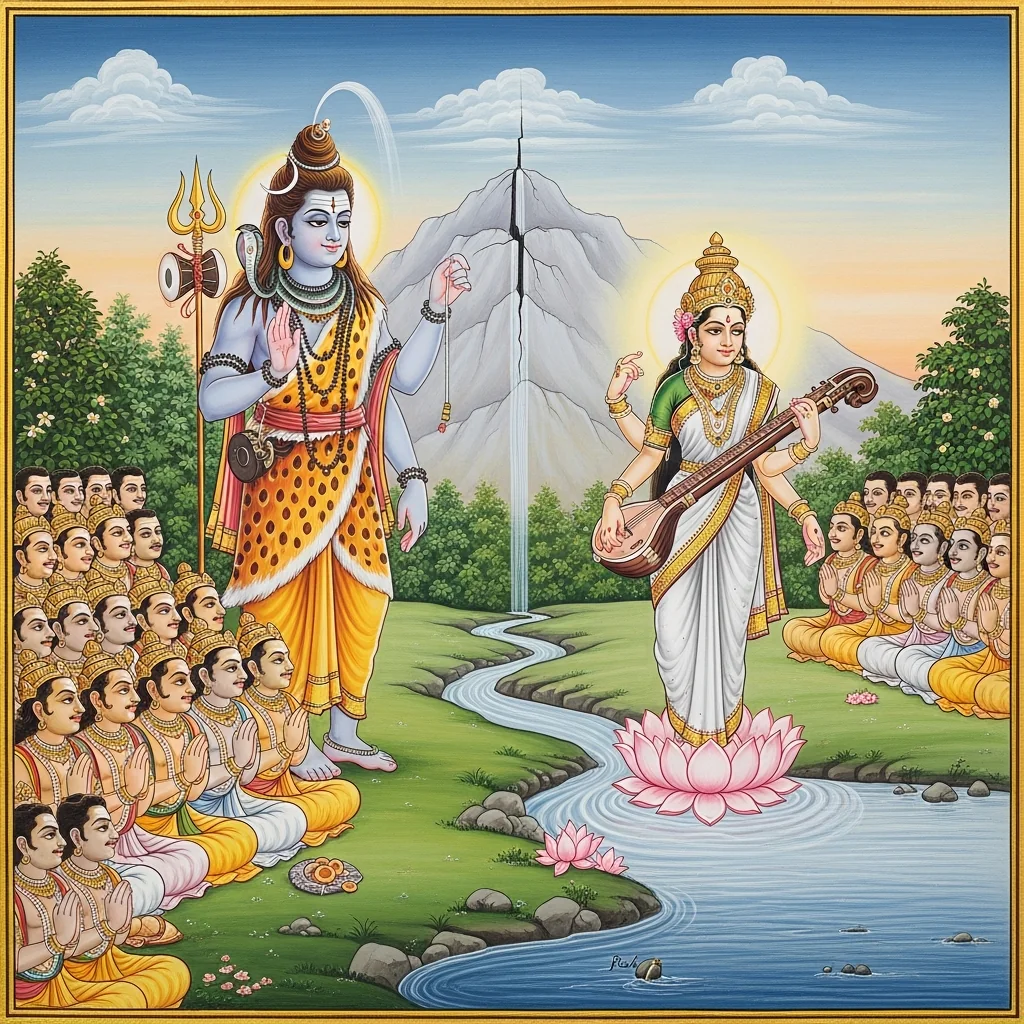
Mārkaṇḍeya relates that after slaying Andhaka, Mahādeva returns with Umā to Kailāsa, where the gods assemble and are seated in due order. Śiva declares that though the demon is dead, his trident remains stained and cannot be purified by customary observances alone; therefore he resolves, with the gathered deities, to undertake a systematic pilgrimage to tīrthas. After bathing at many sacred places from Prabhāsa to the Gaṅgā-sāgara region without attaining the sought purity, he proceeds to the Revā (Narmadā), bathes on both banks, and reaches a mountain associated with Bhṛgu. Resting there in weariness, Śiva discerns a uniquely beautiful, ritually marked spot. He pierces the mountain with his trident, opening a deep fissure, and the trident becomes visibly stainless—thus establishing the purificatory basis of the Śūlabheda tīrtha. Sarasvatī then emerges from the mountain as a supremely meritorious presence, forming a second confluence likened (by analogy) to the famed “white-and-dark” meeting at Prayāga. Brahmā installs an eminent liṅga (Brahmeśa/Brahmeśvara) that removes suffering, while Viṣṇu is said to abide enduringly in the southern part of the site. The chapter details the ritual landscape: a line traced by the trident’s tip channels water into a sacred flow toward the Revā; the tīrtha is named and described, including a “water-liṅga” and three swirling pools (kuṇḍas). It prescribes bathing rules, mantra options (a ten-syllable formula and Vedic mantras), and procedures applicable across varṇas and to both women and men, linking the bath with tarpaṇa, śrāddha-like rites, and dāna. Guardians (vināyakas and kṣetrapālas) and obstacles for those of misaligned conduct are mentioned, presenting pilgrimage as ethical discipline. The phalāśruti proclaims purification, relief from faults, and the uplift of ancestors through correctly performed rites at Śūlabheda.
Shlokas
Verse 1
मार्कण्डेय उवाच । अन्धकं तु निहत्याथ देवदेवो महेश्वरः । उमया सहितो रुद्रः कैलासमगमन्नगम्
Mārkaṇḍeya said: After slaying Andhaka, Maheśvara—the God of gods—Rudra, accompanied by Umā, went to Mount Kailāsa.
Verse 2
आगताश्च ततो देवा ब्रह्माद्याश्च सवासवाः । हृष्टास्तुष्टाश्च ते सर्वे प्रणेमुः पार्वतीपतिम्
Then the gods arrived—Brahmā and the others, along with Indra. All of them, delighted and satisfied, bowed down to the Lord of Pārvatī.
Verse 3
ईश्वर उवाच । उपाविशन्तु ते सर्वे ये केचन समागताः । निहतो दानवो ह्येष गीर्वाणार्थे पितामह
Īśvara said: “Let all those who have assembled here take their seats. This dānava has indeed been slain for the sake of the gods, O Pitāmaha.”
Verse 4
रक्तेन तस्य मे शूलं निर्मलं नैव जायते । शुभव्रततपोजप्यरतो ब्रह्मन्मया हतः
“By his blood my trident does not become purified at all. O Brahman, though he was devoted to auspicious vows, austerity, and recitation, he has been slain by me.”
Verse 5
कर्तुमिच्छाम्यहं सम्यक्तीर्थयानं चतुर्मुख । आगच्छन्तु मया सार्द्धं ये यूयमिह संगताः
“O Four-faced One, I wish to undertake a proper pilgrimage to sacred tīrthas. Let all of you who have gathered here come along with me.”
Verse 6
इत्युक्त्वा देवदेवेशः प्रभासं प्रतिनिर्ययौ । प्रभासाद्यानि तीर्थानि गङ्गासागरमध्यतः
Having spoken thus, the Lord of the gods set out toward Prabhāsa, and (visited) the sacred tīrthas beginning with Prabhāsa, situated in the region between the Gaṅgā and the ocean.
Verse 7
अवगाह्यापि सर्वाणि नैर्मल्यं नाभवन्नृप । नर्मदायां ततो गत्वा देवो देवैः समन्वितः
O King, even after bathing in all of them, purity did not arise. Then the Lord, accompanied by the gods, went to the Narmadā.
Verse 8
उत्तरं दक्षिणं कूलमवागाहत्प्रियव्रतः । गतस्तु दक्षिणे कूले पर्वते भृगुसंज्ञितम्
The noble one bathed at both the northern and southern banks. Then he went to the southern bank, to the mountain known as Bhṛgu.
Verse 9
तत्र स्थित्वा महादेवो देवैः सह महीपते । भ्रान्त्वा भ्रान्त्वा चिरं श्रान्तो निर्विण्णो निषसाद ह
O king, having remained there together with the gods, Mahādeva wandered about again and again; and after a long time, weary and dispassionate, he sat down.
Verse 10
मनोहारि यतः स्थानं सर्वेषां वै दिवौकसाम् । तीर्थं विशिष्टं तन्मत्वा स्थितो देवो महेश्वरः
Because that place was enchanting to behold for all the dwellers of heaven, Maheśvara, knowing it to be an exceptional tīrtha, took his stand there.
Verse 11
गिरिं विव्याध शूलेन भिन्नं तेन रसातलम् । निर्मलं चाभवच्छूलं न लेपो दृश्यते क्वचित्
With his trident he pierced the mountain, splitting it down to Rasātala; yet the trident remained stainless—no trace of defilement was seen anywhere upon it.
Verse 12
देवैराह्वानिता तत्र महापुण्या च भारती । पर्वतान्निःसृता तत्र महापुण्या सरस्वती
There, invoked by the gods, the holy Bhāratī appeared; and from the mountain issued forth the greatly meritorious river Sarasvatī.
Verse 13
द्वितीयः सङ्गमस्तत्र यथा वेण्यां सितासितः । तत्र ब्रह्मा स्वयं देवो ब्रह्मेशं लिङ्गमुत्तमम्
There is a second confluence there, like the mingling of the fair and dark streams at Prayāga’s Veṇī. At that very spot, Brahmā himself established the supreme liṅga called Brahmeśa.
Verse 14
संस्थापयामास पुण्यं सर्वदुःखघ्नमुत्तमम् । तस्य याम्ये दिशो भागे स्वयं देवो जनार्दनः
He installed that supremely holy liṅga, the highest, which destroys all sorrow. And on its southern side, Janārdana himself (Viṣṇu) is present.
Verse 15
तिष्ठते च सदा तत्र विष्णुपादाग्रसंस्थिता । अम्भसो न भवेन्मार्गः कुण्डमध्यस्थितस्य च
There it ever remains, stationed at the forepart of Viṣṇu’s feet. And for one who stands in the middle of the kuṇḍa, there is no passage for the water to escape.
Verse 16
शूलाग्रेण कृता रेखा ततस्तोयं वहेन्नृप । तत्तोयं च गतं तत्र यत्र रेवा महानदी
O king, a furrow was made with the tip of the trident; from that, water began to flow. And that water went on to the place where the great river Revā runs.
Verse 17
जललिङ्गं महापुण्यं चकतीर्थं नृपोत्तम । शूलभेदे च देवेशः स्नानं कुर्याद्यथाविधि
O best of kings, the Water-Liṅga is of great merit—this is Cakatīrtha. And at Śūlabheda one should worship the Lord of the gods and bathe according to the prescribed rite.
Verse 18
आत्मानं मन्यते शुद्धं न किंचित्कल्मषं कृतम् । तस्यैवोत्तरकाष्ठायां देवदेवो जगद्गुरुः
He deems himself purified, as though no sin whatsoever had been committed. And on the northern side of that very tīrtha abides the God of gods, the Teacher of the world.
Verse 19
आत्मना देवदेवेशः शूलपाणिः प्रतिष्ठितः । सर्वतीर्थेषु तत्तीर्थं सर्वदेवमयं परम्
There the Lord of lords—Śiva, the Trident-bearer—established that sacred presence by his own divine power. Among all tīrthas, that very tīrtha is supreme, for it is pervaded by all the gods.
Verse 20
सर्वपापहरं पुण्यं सर्वदुःखघ्नमुत्तमम् । तत्र तीर्थे प्रतिष्ठाप्य देवदेवं जगद्गुरुः
That holy place removes all sins—most auspicious and excellent, the destroyer of all sorrow. There, at that tīrtha, the Teacher of the world consecrated the God of gods.
Verse 21
रक्षापालांस्ततो मुक्त्वा शतं साष्टविनायकान् । क्षेत्रपालाः शतं साष्टं तद्रक्षन्ति प्रयत्नतः
Then, having appointed guardian-protectors—one hundred and eight Vināyakas—one hundred and eight Kṣetrapālas carefully protect that sacred place with vigilant effort.
Verse 22
विघ्नास्तस्योपजायन्ते यस्तत्र स्थातुमिच्छति । केचित्कुटुम्बात्ततासु व्याग्राः केचित्कृषीषु च
Obstacles arise for the one who wishes to remain there. For some, troubles come from family; for others, from the river-banks—like tigers—and for others, from their farming and fields.
Verse 23
केचित्सभां प्रकुर्वन्ति केचिद्द्रव्यार्जने रताः । परोक्षवादं कुर्वन्ति केऽपि हिंसारताः सदा
Some become absorbed in assemblies and disputes; some delight in acquiring wealth. Some engage in backbiting, and others are ever devoted to violence.
Verse 24
परदाररताः केचित्केचिद्वृत्तिविहिंसकाः । अन्ये केचिद्वदन्त्येवं कथं तीर्थेषु गम्यते
Some are addicted to others’ spouses; some destroy their own right livelihood. Others say in this way: ‘How can one even go on pilgrimage to the tīrthas?’
Verse 25
क्षुधया पीड्यते भार्या पुत्रभृत्यादयस्तदा । मोहजालेषु योज्यन्ते एवं देवगणैर्नराः
Then the wife, children, servants, and others are afflicted by hunger. Thus men are drawn into nets of delusion—so it is wrought by the hosts of gods (as a restraining force).
Verse 26
पापाचाराश्च ये मर्त्याः स्नानं तेषां न जायते । संरक्षन्ति च तत्तीर्थं देवभृत्यगणाः सदा
For mortals of sinful conduct, the good fortune of bathing there does not arise. And the retinues of the divine attendants ever protect that tīrtha.
Verse 27
धन्याः पुण्याश्च ये मर्त्यास्तेषां स्नानं प्रजायते । सरस्वत्या भोगवत्या देवनद्या विशेषतः
Blessed and virtuous are those mortals; for them bathing there truly becomes possible—especially in the sacred rivers Sarasvatī, Bhogavatī, and the Devā-nadī.
Verse 28
अयं तु सङ्गमः पुण्यो यथा वेण्यां सितासितः । दृष्ट्वा तीर्थं तु ते सर्वे गीर्वाणा हृष्टचेतसः
This confluence is holy—like the mingling of white and dark strands in a braided lock. On beholding that tīrtha, all the Gīrvāṇas, the gods, became joyful at heart.
Verse 29
देवस्य सन्निधौ भूत्वा वर्णयामासुरुत्तमम् । इदं तीर्थं तु देवेश गयातीर्थेन ते समम्
Standing in the very presence of the Lord, they extolled this supreme glory: “O Lord of gods, this sacred tīrtha is equal in merit to the famed Gayā-tīrtha.”
Verse 30
गुह्याद्गुह्यतमं तीर्थं न भूतं न भविष्यति । शूलपाणिः समभ्यर्च्य इन्द्राद्यैरप्सरोगणैः
More secret than the secret, this tīrtha has neither existed before nor will it exist again. There Śūlapāṇi (Śiva) is duly worshipped by Indra and the hosts of Apsarases and others.
Verse 31
यक्षकिन्नरगन्धर्वैर्दिक्पालैर्लोकपैरपि । नृत्यगीतैस्तथा स्तोत्रैः सर्वैश्चापि सुरासुरैः
There He is honored by Yakṣas, Kinnaras, and Gandharvas; by the guardians of the directions and the world-protectors as well—through dance and song, and likewise through hymns—by all, both gods and asuras.
Verse 32
पूज्यमानो गणैः सर्वैः सिद्धैर्नागैर्महेश्वरः । देवेन भेदितं तत्र शूलाग्रेण नराधिप
While Maheśvara was being worshipped by all the Gaṇas, by the Siddhas, and by the Nāgas, O king, there the Lord cleft that place with the tip of His trident.
Verse 33
त्रिधा यत्रेक्ष्यतेऽद्यापि ह्यावर्तः सुरपूरितः । कुण्डत्रयं नरव्याघ्र महत्कलकलान्वितम्
There, even today, the whirlpool is seen as threefold, filled with divine presence. O tiger among men, there are three sacred pools, resonant with a great, rushing murmur.
Verse 34
सर्वपापक्षयकरं सर्वदुःखघ्नमुत्तमम् । तत्र तीर्थे तु यः स्नाति उपवासपरायणः
Supreme indeed is that tīrtha, bringing the destruction of all sins and the removal of all sorrow. Whoever bathes at that sacred ford, devoted to fasting, attains that fruit.
Verse 35
दीक्षामन्त्रविहीनोऽपि मुच्यते चाब्दिकादघात् । ये पुनर्विधिवत्स्नान्ति मन्त्रैः पञ्चभिरेव च
Even one who lacks dīkṣā (initiation) and mantras is freed from the sin accrued over a year. But those who bathe again according to proper rule, using precisely five mantras, gain the fuller fruit of the rite.
Verse 36
वेदोक्तैः पञ्चभिर्मन्त्रैः सहिरण्यघटैः शुभैः । अक्षरैर्दशभिश्चैव षड्भिर्वा त्रिभिरेव वा
With five Veda-enjoined mantras, together with auspicious golden vessels; and with (mantras) of ten syllables, or of six, or even of three syllables—thus the rite is performed.
Verse 37
पृथग्भूतैर्द्विजातीनां तीर्थे कार्यं नराधिप । ब्रह्मक्षत्रविशां वापि स्त्रीशूद्राणां तथैव च
O king, at the tīrtha the rites should be performed separately for the twice-born; likewise for Brāhmaṇas, Kṣatriyas, and Vaiśyas—and in the same manner for women and Śūdras as well.
Verse 38
पुरुषाणां त्रयीं ध्यात्वा स्नानं कुर्याद्यथाविधि । दशाक्षरेण मन्त्रेण ये पिबन्ति जलं नराः
For men, having meditated on the Vedic triad, one should bathe according to the prescribed rule. Those men who drink the water with the ten-syllabled mantra do so as a sanctioned observance.
Verse 39
ते गच्छन्ति परं लोकं यत्र देवो महेश्वरः । केदारे च यथा पीतं रुद्रकुण्डे तथैव च
They go to the supreme world where the Lord Maheśvara abides. Just as merit is gained by drinking at Kedāra, so it is likewise by drinking at Rudrakuṇḍa.
Verse 40
पञ्चरेफसमायुक्तं क्षकारं सुरपूजितम् । ओङ्कारेण समायुक्तमेतद्वेद्यं प्रकीर्तितम्
The syllable ‘kṣa’, joined with the five ‘ra’s and worshipped by the gods, and conjoined with Oṃkāra—this is declared to be the sacred formula that is to be known.
Verse 41
यस्तत्र कुरुते स्नानं विधियुक्तो जितेन्द्रियः । तिलमिश्रेण तोयेन तर्पयेत्पितृदेवताः
Whoever bathes there in the prescribed manner, self-controlled, should offer tarpaṇa—libations—to the Pitṛs and the deities with water mixed with sesame.
Verse 42
कुलानां तारयेद्विंशं दशपूर्वान्दशापरान् । गयादिपञ्चस्थानेषु यः श्राद्धं कुरुते नरः
A man who performs śrāddha at the five holy places beginning with Gayā redeems twenty generations of his lineage—ten before and ten after.
Verse 43
स तत्र फलमाप्नोति शूलभेदे न संशयः । यस्तत्र विधिना युक्तो दद्याद्दानानि भक्तितः
There, at Śūlabheda, he surely attains that fruit—of this there is no doubt. And whoever, observing the proper rules, gives gifts there with devotion gains that merit.
Verse 44
तुदक्षयं फलं तत्र सुकृतं दुष्कृतं तथा । गयाशिरो यथा पुण्यं पितृकार्येषु सर्वदा
There, the fruit of the rites is imperishable—whether arising from good deeds or serving as expiation for evil deeds. Just as Gayāśiras is ever meritorious for ancestral rites, so too is this place.
Verse 45
शूलभेदं तथा पुण्यं स्नानदानादितर्पणैः । भक्त्या ददाति यस्तत्र काञ्चनं गां महीं तिलान्
So too is Śūlabheda exceedingly meritorious through bathing, charity, and offerings of tarpaṇa. Whoever there gives with devotion—gold, a cow, land, or sesame—wins great merit.
Verse 46
आसनोपानहौ शय्यां वराश्वान् क्षत्रियस्तथा । वस्त्रयुग्मं च धान्यं च गृहं पूर्णं प्रयत्नतः
With due effort, one should also give seats, footwear, beds, excellent horses, and even a kṣatriya as a retainer; as well as a pair of garments, grain, and a well-provisioned house.
Verse 47
सयोक्त्रं लाङ्गलं दद्यात्कृष्टां चैव वसुंधराम् । दानान्येतानि यो दद्याद्ब्राह्मणे वेदपारगे
One should give a yoke with its harness, a plough, and even cultivated land. Whoever offers these gifts to a Brāhmaṇa learned in the Vedas attains great merit.
Verse 48
श्रोत्रिये कुलसम्पन्ने शुचिष्मति जितेन्द्रिये । श्रुताध्ययनसम्पन्ने दम्भहीने क्रियान्विते । त्रयोदशाहःस्वेकैकं त्रयोदशगुणं भवेत्
When given to a śrotriya—of good family, pure, self-controlled, endowed with sacred learning and study, free from hypocrisy, and devoted to right conduct—each gift offered during the thirteen-day rite yields a result thirteenfold.
Verse 49
। अध्याय
“Adhyāya”—“Chapter,” a colophon-style marker indicating a chapter heading or transition.