Adhyaya 20
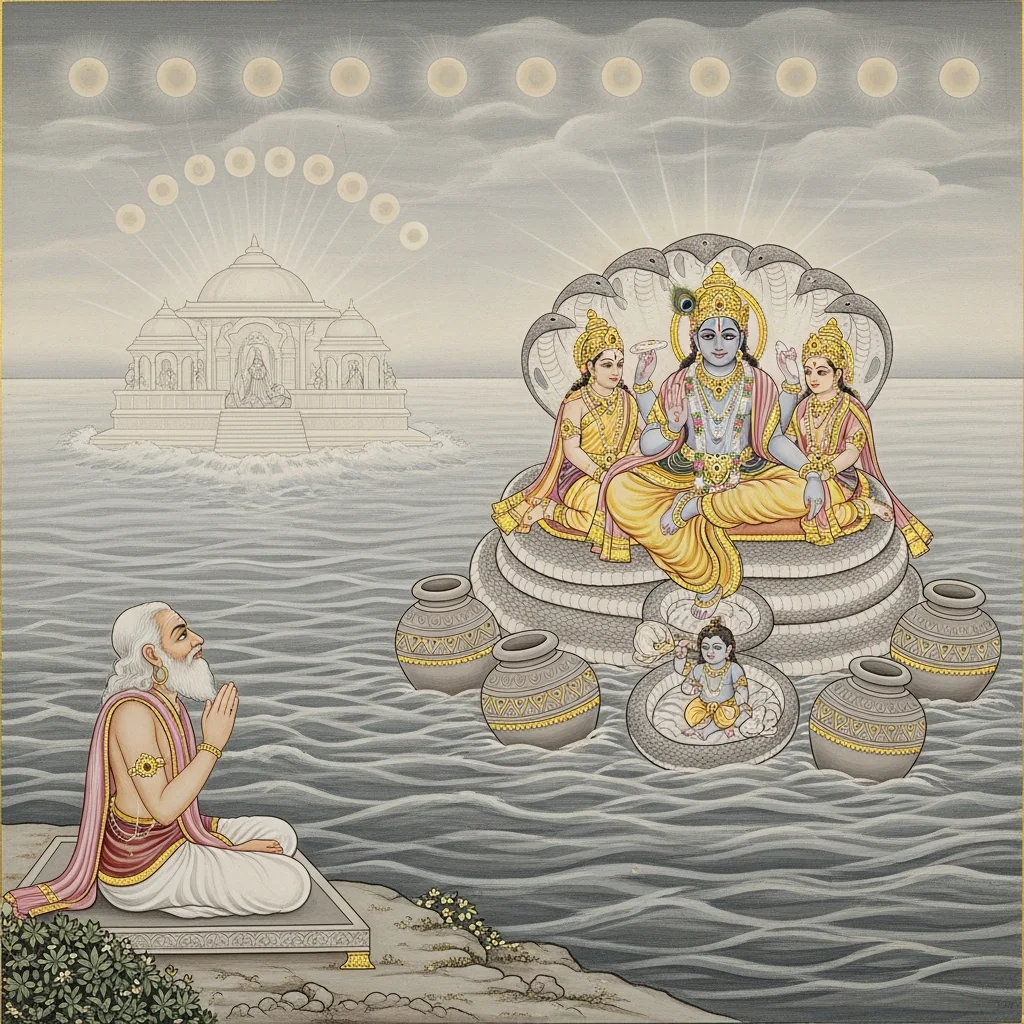
Chapter 20 is framed as a dialogue in which Yudhiṣṭhira asks Mārkaṇḍeya to recount the experienced might (prabhāva) of Śārṅgadhanvan, Viṣṇu. Mārkaṇḍeya describes the omens of pralaya—meteors, earthquakes, dust-rain, dreadful sounds—and the dissolution of beings and landscapes. He then beholds a vision of twelve suns scorching the worlds, with nothing seeming unburnt except Revā and himself. Tormented by thirst, he ascends and reaches a vast, ornamented cosmic abode, where he sees the Supreme Person (puruṣottama) reclining with divine emblems such as conch, discus, and mace. He offers a long hymn praising Viṣṇu as the support of worlds, time, the yugas, creation, and dissolution. A second figure (Hara/Śiva) appears, followed by a manifestation of the Devī, which brings an ethical dilemma about drinking breast-milk to prevent a child’s death. The discourse introduces brāhmaṇa saṃskāra norms (culminating in the traditional forty-eight saṃskāras) to argue ritual propriety, balanced by the Devī’s warning of grave sin in neglecting a child. After a prolonged, dreamlike interval, the Devī reveals the identifications: the sleeper is Kṛṣṇa/Viṣṇu, the second is Hara, the four jars are the oceans, the child is Brahmā, and she herself is the Earth with seven continents; Revā is named Narmadā and declared undestroyed. The chapter closes by affirming the purifying value of hearing this account and inviting further inquiry.
Shlokas
Verse 1
। युधिष्ठिर उवाच । श्रुता मे विविधा धर्माः संहारास्त्वत्प्रसादतः । कृता देवेन सर्वेण ये च दृष्टास्त्वयानघ
Yudhiṣṭhira said: By your grace I have heard of many dharmas and of the dissolutions wrought by the all-encompassing Deity—those very events which you, O sinless one, have witnessed.
Verse 2
साम्प्रतं श्रोतुमिच्छामि प्रभावं शार्ङ्गधन्वनः । त्वयानुभूतं विप्रेन्द्र तन्मे त्वं वक्तुमर्हसि
Now I wish to hear of the majesty of the wielder of Śārṅga (Viṣṇu). O best of brāhmaṇas, you have experienced it—therefore you should tell it to me.
Verse 3
श्रीमार्कण्डेय उवाच । अतः परं प्रवक्ष्यामि प्रजासंहारलक्षणम् । यच्चिह्नं दृश्यते तत्र यथा कल्पो विधीयते
Śrī Mārkaṇḍeya said: Hereafter I shall declare the marks of the dissolution of beings—what signs are seen then, and how the cycle of the kalpa proceeds and is set in order.
Verse 4
उल्कापाताः सनिर्घाता भूमिकम्पस्तथैव च । पतते पांशुवर्षं च निर्घोषश्चैव दारुणः
Meteors fall amid thunder; the earth likewise quakes. Dust rains down, and a dreadful roaring resounds.
Verse 5
यक्षकिन्नरगन्धर्वाः पिशाचोरगराक्षसाः । सर्वे ते प्रलयं यान्ति युगान्ते समुपस्थिते
Yakṣas, Kinnaras, Gandharvas, Piśācas, serpentine beings, and Rākṣasas—all of them pass into dissolution when the end of the age arrives.
Verse 6
पर्वताः सागरा नद्यः सरांसि विविधानि च । वृक्षाः शेषं समायान्ति वल्लीजातं तृणानि च
Mountains, oceans, rivers, and the many kinds of lakes—trees too are reduced to what remains; creepers and grasses also come to that remnant state.
Verse 7
एवं हि व्याकुलीभूते सर्वौषधिजलोज्झिते । काष्ठभूते तु संजाते त्रैलोक्ये सचराचरे
Thus, when everything is thrown into turmoil—when all herbs and waters are driven away—and when the three worlds, with all that moves and does not move, become as though dry wood,
Verse 8
यावत्पश्यामि मध्याह्ने स्नानकाल उपस्थिते । त्रैलोक्यं ज्वलनाकारं दुर्निरीक्षं दुरासदम्
As I looked at midday, when the time for bathing had arrived, I saw the three worlds take the form of blazing fire—impossible to gaze upon and impossible to approach.
Verse 9
द्वौ सूर्यौ पूर्वतस्तात पश्चिमोत्तरयोस्तथा । तथैव दक्षिणे द्वौ च सूर्यौ दृष्टौ प्रतापिनौ
Two suns were seen in the east, dear one; likewise in the west and the north; and in the south as well, two radiant suns were seen.
Verse 10
द्वौ सूर्यौ नागलोकस्थौ मध्ये द्वौ गगनस्य च । इत्येते द्वादशादित्यास्तपन्ते सर्वतो दिशम्
Two suns were in the Nāga-world, and two more in the middle of the sky. Thus these twelve Ādityas scorched in every direction.
Verse 11
पृथिवीमदहन्सर्वां सशैलवनकाननाम् । नादग्धं दृश्यते किंचिदृते रेवां च मां तथा
They burned the entire earth, with its mountains, forests, and groves. Nothing at all was seen unburnt—except Revā, and me as well.
Verse 12
पृथिव्यां दह्यमानायां हविर्गन्धश्च जायते । ततो मे शुष्यते गात्रं तृषाप्येवं दुरासदा
As the earth was burning, the fragrance of sacrificial oblations arose; then my body dried up, and thirst—so hard to endure—overpowered me.
Verse 13
न हि विन्दामि पानीयं शोषितं च दिवाकरैः । यावत्कमण्डलुं वीक्षे शुष्कं तत्रापि तज्जलम्
I found no drinking water—it had been dried up by the suns. And when I looked at my water-pot, even there the water was dried up.
Verse 14
ततोऽहं शोकसंतप्तो विशेषात्क्षुत्तृषार्दितः । उत्पपात क्षितेरूर्ध्वं पश्यमानो दिवं प्रति
Then, scorched by grief—and especially tormented by hunger and thirst—I sprang upward from the earth, gazing toward the heavens.
Verse 15
तावत्पश्यामि गगने गृहं शृङ्गारभूषितम् । ततस्तज्ज्ञातुकामोऽहं प्रस्थितो राजसत्तम
Then I beheld in the sky a mansion adorned with splendid ornaments. Eager to know what it was, I set out toward it, O best of kings.
Verse 16
प्राकारेण विचित्रेण कपाटार्गलभूषितम् । विचित्रशिखरोपेतं द्वारदेशमुपागतः
It was encircled by a wondrous rampart, adorned with doors and bolts; crowned with marvelous pinnacles, I approached its gateway.
Verse 17
षडशीतिसहस्राणि योजनानां समुच्छ्रये । तदर्धं तु पृथक्त्वेन काञ्चनं रत्नभूषितम्
Its height rose to eighty-six thousand yojanas; and to half that measure in breadth, it stood apart—golden, and ornamented with jewels.
Verse 18
तत्र मध्ये परां शय्यां पश्यामि नृपसत्तम । शय्योपरि शयानं तु पुरुषं दिव्यमूर्धजम्
There, in the midst, I beheld a most excellent couch, O best of kings; and upon that couch lay a Person, crowned with divine hair.
Verse 19
विकुञ्चिताग्रकेशान्तं समस्तं योजनायतम् । मुकुटेन विचित्रेण दीप्तिकान्तेन शोभितम्
The tips of his hair were gracefully curled; his whole form extended a yojana in length, and he was adorned with a wondrous crown, radiant with shining beauty.
Verse 20
श्यामं कमलपत्राभं सुप्रभं च सुनासिकम् । सिंहास्यमायतभुजं गल्लश्मश्रुवराङ्कितम्
Dark-hued, lotus-petal-eyed, radiant, and handsome of nose—lion-faced and long-armed—his cheeks were graced with fine moustache and beard.
Verse 21
त्रिवलीभङ्गसुभगं कर्णकुण्डलभूषितम् । विशालाभं सुपीनाङ्गं पार्श्वस्वावर्तभूषितम्
Beautiful with the graceful folds of the triple line, adorned with ear-ornaments; broad in form and full-limbed, his sides were embellished with auspicious whorls.
Verse 22
शोभितं कटिभागेन विभक्तं जानुजङ्घयोः । पद्माङ्किततलं देवमाताम्रसुनखाङ्गुलिम्
Splendid at the waist, clearly defined at the knees and shins; the God’s soles bore lotus-marks, and his toes had nails of reddish copper hue.
Verse 23
मेघनादसुगम्भीरं सर्वावयवसुन्दरम् । शय्यामध्यगतं देवमपश्यं पुरुषोत्तमम्
Deep-voiced like thunderclouds, beautiful in every limb, I beheld the Supreme Person—the God abiding in the midst of the couch.
Verse 24
शङ्खचक्रगदापाणिं शयानं दक्षिणेन तु । अक्षसूत्रोद्यतकरं सूर्यायुतसमप्रभम्
Reclining, with conch, discus, and mace in His hands—and on the right, a hand raised holding a rosary—He shone with the splendor of ten thousand suns.
Verse 25
तं दृष्ट्वा भक्तिमान्देवं स्तोतुकामो व्यवस्थितः । जयेश जय वागीश जय दिव्याङ्गभूषण
Seeing that Lord and filled with devotion, he stood ready to praise Him: “Victory to You, Lord of triumph! Victory, Master of speech! Victory, O You whose divine limbs are adorned with celestial ornaments!”
Verse 26
जय देवपते श्रीमन्साक्षाद्ब्रह्म सनातन । तव लोकाः शरीरस्थास्त्वं गतिः परमेश्वर
Victory to You, Lord of the gods, O glorious One—you are Brahman itself, the Eternal. All the worlds abide within Your very body; You alone are the supreme refuge and final goal, O Lord of all.
Verse 27
त्वदाधारा हि देवेश सर्वे लोका व्यवस्थिताः । त्वं श्रेष्ठः सर्वसत्त्वानां त्वं कर्ता धरणीधरः
O Lord of the gods, all the worlds are established upon You as their support. You are the highest among all beings; You are the doer and the bearer who upholds the earth.
Verse 28
त्वं हौत्रमग्निहोत्राणां सूत्रमन्त्रस्त्वमेव च । गोकर्णं भद्रकर्णं च त्वं च माहेश्वरं पदम्
You are the priestly offering within the Agnihotra rites; You alone are the sūtra and the mantra. You are Gokarṇa and Bhadrakarṇa, and You are also the Māheśvara state—the supreme station of Śiva.
Verse 29
त्वं कीर्तिः सर्वकीर्तीनां दैन्यपापप्रणाशिनी । त्वं नैमिषं कुरुक्षेत्रं त्वं च विष्णुपदं परम्
You are the very glory of all glories, the destroyer of wretchedness and sin. You are Naimiṣa and Kurukṣetra, and You are the supreme Viṣṇu-abode as well.
Verse 30
त्वया तु लीलया देव पदाक्रान्ता च मेदिनी । त्वया बद्धो बलिर्देव त्वयेन्द्रस्य पदं कृतम्
O Lord, by Your mere play the earth was overstepped by Your foot. By You, Bali was bound; by You, the station of Indra was secured again.
Verse 31
त्वं कलिर्द्वापरं देव त्रेता कृतयुगं तथा । प्रलम्बदमनश्च त्वं स्रष्टा त्वं च विनाशकृत्
O Lord, You are Kali and Dvāpara; You are Tretā and Kṛta as well. You are the subduer of Pralamba; You are the creator, and You are also the bringer of dissolution.
Verse 32
त्वया वै धार्यते लोकास्त्वं कालः सर्वसंक्षयः । त्वया हि देव सृष्टास्ताः सर्वा वै देवयोनयः
By You indeed the worlds are upheld; You are Time, the universal dissolver. By You, O Lord, all those divine orders and celestial lineages have been created.
Verse 33
त्वं पन्थाः सर्वलोकानां त्वं च मोक्षः परा गतिः । ब्रह्मा त्वदुद्भवो देवो रजोरूपः सनातनः । रुद्रः क्रोधोद्भवोऽप्येवं त्वं च सत्त्वे व्यवस्थितः
You are the path of all worlds, and You are moksha— the supreme destination. From You arises Brahmā, the eternal deity whose nature is rajas; likewise Rudra is born of wrath. Yet You abide established in sattva.
Verse 34
एतच्चराचरं देव क्रीडनार्थं त्वया कृतम् । एवं संतप्तदेहेन स्तुतो देवो मया प्रभुः
O Lord, this entire moving and unmoving creation has been made by You for divine play (līlā). Thus, with a body afflicted by suffering, I have praised the Lord, the Master.
Verse 35
भक्त्या परमया राजन्सर्वभूतपतिः प्रभुः । स्तुवन्वै तत्र पश्यामि वारिपूर्णांस्ततो घटान्
O King, with supreme devotion, praising the Lord—the sovereign of all beings—I then beheld there pots filled to the brim with water.
Verse 36
ततो मया विस्मृता या तृषा सा वर्धिता पुनः । उपासर्पं ततस्तस्य पार्श्वं वै पुरुषस्य हि
Then the thirst that I had forgotten rose up again; so I approached the side of that man.
Verse 37
पानीयं पातुकामेन चिन्तितं च मया पुनः । नापश्यत हि मां चैष सुप्तोऽपि न च बुध्यते
Desiring to drink water, I thought again what to do. Yet he did not see me, and though asleep he did not awaken.
Verse 38
यस्तु पापेन संमूढः सुखं सुप्तं प्रबोधयेत् । जायते तस्य पापस्य ब्रह्महत्याफलं महत्
But one who, deluded by sin, awakens a person sleeping in peaceful ease—great indeed is the fruit of that offense, equal to the result of brahmahatyā, the slaying of a Brahmin.
Verse 39
एवं संचिन्त्यमाने तु द्वितीयो ह्यागतः पुमान् । नेक्षते जल्पते किंचिद्वामस्कन्धे मृगाजिनी
As I was pondering thus, a second man arrived. He neither looked at me nor spoke a word; upon his left shoulder was a deerskin.
Verse 40
जटी कमण्डलुधरो दण्डी मेखलया वृतः । भस्मोन्मृदितसर्वाङ्गो महातेजास्त्रिलोचनः
He was matted-haired, bearing a kamandalu water-pot, staff in hand, girded with a mekhalā waist-cord; his whole body was smeared with sacred ash—radiant with great splendor, and three-eyed.
Verse 41
यावत्तं स्तोतुकामोऽहमपश्यं स्वच्छचक्षुषा । तावत्सर्वाङ्गसम्भूत्यामहत्या रूपसम्पदा
Just as I wished to praise him and beheld him with clear sight, at that very moment there appeared—born from all his limbs—a great, goddess-like presence endowed with splendid beauty.
Verse 42
अपश्यं संवृतां नारीं सर्वाभरणभूषिताम् । दृष्ट्वा तां पतितो भूमौ जयस्वेति ब्रुवंस्ततः
I saw a veiled woman adorned with every ornament. On seeing her, I fell to the ground and then cried out, “Be victorious!”
Verse 43
जय रुद्राङ्गसम्भूते जयवाहिनि सनातनि । जय कौमारि माहेन्द्रि वैष्णवी वारुणी तथा
Victory to You, born from Rudra’s own body; victory to You, O eternal bearer of power. Victory to You as Kaumārī, as Māhendrī, as Vaiṣṇavī, and likewise as Vāruṇī.
Verse 44
जय कौबेरि सावित्रि जय धात्रि वरानने । तृष्णया तप्तदे हस्य रक्षां कुरु चराचरे
Victory to You as Kauberī; victory to You as Sāvitrī; victory to You, O Dhātrī, O beautiful-faced one. Protect me—my body scorched by thirst—amid all that moves and all that is still.
Verse 45
श्रीदेव्युवाच । प्रसन्ना विप्रशार्दूल तव वाक्यैः सुशोभनैः । वर्तते मानसे यत्ते मया ज्ञातं द्विजोत्तम
Śrī Devī said: “O tiger among brāhmaṇas, I am pleased by your beautiful words. O best of the twice-born, what is in your mind has been understood by me.”
Verse 46
शृणु विप्र ममाप्यस्ति व्रतमेतत्सुदारुणम् । स्त्रीलघुत्वान्मयारब्धं दुष्करं मन्दमेधया
“Listen, O brāhmaṇa—this very severe vow exists for me as well. Through the fickleness of a woman I began it; difficult indeed is this vow for one of dull understanding.”
Verse 47
यदि भावी च मे पुत्रो धर्मिष्ठो लोकविश्रुतः । विप्रस्य तु स्तनं दत्त्वा पश्चाद्दास्यामि बालके
“If a son is to be born to me—righteous and renowned in the world—then after giving my breast to the brāhmaṇa, I shall thereafter give it to the child.”
Verse 48
स मे पुत्रः समुत्पन्नो यथोक्तो मे महामुने । स्तनं पिब त्वं विप्रेन्द्र यदि जीवितुमिच्छसि
“That son of mine has now been born, just as I said, O great sage. O lord among brāhmaṇas, drink from the breast if you wish to live.”
Verse 49
श्रीमार्कण्डेय उवाच । अकार्यमेतद्विप्राणां यस्त्विमं पिबते स्तनम् । पुनश्चैवोपनयनं व्रतसिद्धिं न गच्छति
Śrī Mārkaṇḍeya said: “This is not a proper act for brāhmaṇas—whoever drinks from this breast must undergo upanayana again, and he does not attain the fulfillment of the vow.”
Verse 50
ब्राह्मणत्वं त्रिभिर्लोकैर्दुर्लभं पद्मलोचने । संस्कारैः संस्कृतो विप्रो यैश्च जायेत तच्छृणु
“Brāhmaṇa-hood is difficult to obtain even across the three worlds, O lotus-eyed one. A brāhmaṇa is refined by the saṃskāras—listen to which rites those are by which he truly becomes so.”
Verse 51
प्रथमं चैव नारीषु संस्कारैर्बीजवापतम् । बीजप्रक्षेपणादेव बीजक्षेपः स उच्यते
“First, among the saṃskāras relating to women, is the ‘sowing of seed’. Because it consists precisely in the placing of seed, it is called ‘seed-casting’.”
Verse 52
तदन्ते च महाभागे गर्भाधानं द्वितीयकम् । पुंसवनं तृतीयं तु सीमन्तं च चतुर्थकम्
“Thereafter, O greatly fortunate one, the second is Garbhādhāna; the third is Puṃsavana; and the fourth is the Sīmanta rite.”
Verse 53
पञ्चमं जातकर्म स्यान्नाम वै षष्ठमुच्यते । निष्क्रामः सप्तमश्चैव ह्यन्नप्राशनमष्टमम्
The fifth is Jātakarma; the sixth is indeed the naming rite (Nāmakaraṇa). The seventh is Niṣkramaṇa, the first going out, and the eighth is Annaprāśana, the first feeding of solid food.
Verse 54
नवमं वै चूडकर्म दशमं मौञ्जिबन्धनम् । ऐषिकं दार्विकं चैव सौमिकं भौमिकं तथा
The ninth is Cūḍākarman (tonsure), and the tenth is Mauñjī-bandhana (binding the muñja-girdle). Also there are rites connected with the sacred fuel (aiṣika), with wood (dārvika), with Soma (saumika), and with the earth (bhaumika).
Verse 55
पत्नीसंयोजनं चान्यद्दैवकर्म ततः परम् । मानुष्यं पितृकर्म स्याद्दशमाष्टासु शोभने
The rite of uniting with a wife—marriage—is another saṃskāra; thereafter come the divine rites. Then follow the human rites and the ancestral rites; thus, in auspicious reckoning, these are counted among the ten and the eight.
Verse 56
भूतं भव्यं तथेष्टं च पार्वणं च ततः परम्
Next come the offerings for beings (bhūta), the auspicious offering (bhavya), the iṣṭi-sacrifice, and thereafter the pārvaṇa rite.
Verse 57
श्राद्धं श्रावण्यामाग्रयणं च चैत्राश्वयुज्यां दशपौर्णमास्याम् । निरूढपशुसवनसौत्रामण्यग्निष्टोमात्यग्निष्टोमाः
Śrāddha in the month of Śrāvaṇa; the Āgrayaṇa rite; and the observances in Caitra and Āśvayuja at the full moon—along with the Nirūḍha-paśu, Savana, Sautrāmaṇi, Agniṣṭoma, and Atyagniṣṭoma sacrifices.
Verse 58
षोडषीवाजपेयातिरात्राप्तोर्यामोदशवाजपेयाः । सर्वभूतेषु क्षान्तिरनसूया शौचमङ्गलमकार्पण्यमस्पृहेति
Also counted are the Ṣoḍaśī, the Vājapeya, the Atirātra, the Āptoryāma, and the Oḍaśa and Vājapeya rites. And there are virtues: patience toward all beings, freedom from malice, purity, auspicious conduct, generosity (non-miserliness), and absence of craving.
Verse 59
एभिरष्टचत्वारिंशद्भिः संस्कारैः संकृतो ब्राह्मणो भवति
By being duly refined through these forty-eight saṃskāras, one becomes a (true) brāhmaṇa.
Verse 60
एवं ज्ञात्वा महाभागे न तु मां पातुमर्हसि । शिशुपेयं स्तनं भद्रे कथं वै मद्विधः पिबेत्
Knowing this, O noble lady, you should not nurse me. This breast is meant for an infant to drink—how could one like me drink it?
Verse 61
ममैतद्वचनं श्रुत्वा नारी वचनमब्रवीत्
Hearing these words of mine, the woman replied.
Verse 62
यदि त्वं न पिबेः स्तन्यं पयो बालो मरिष्यति । श्रूयते त्रिषु लोकेषु वेदेषु च स्मृतिष्वपि । मुच्यते सर्वपापेभ्यो भ्रूणहत्या न मुञ्चति
If you do not drink this breast-milk, the child will die. It is heard in the three worlds—in the Vedas and in the Smṛtis as well—that one may be freed from all sins, yet the sin of killing an embryo is not easily absolved.
Verse 63
भवित्री तव हत्या च महाभागवतः पुनः । जन्मानि च शतान्यष्टौ क्लिश्यते भ्रूणहत्यया
Your killing will indeed come to pass again, O greatly fortunate one; for through the sin of embryo-killing one is afflicted across eight hundred births.
Verse 64
मृतः शुनत्वं चाप्नोति वर्षाणां तु शतत्रयम् । ततस्तस्य क्षये जाते काकयोनिं व्रजेत्पुनः
After death, one attains the state of a dog for three hundred years; when that term is exhausted, one again goes to birth in the womb of a crow.
Verse 65
तत्रापि च शतान्यष्टौ क्लिश्यते पापकर्मणि । वराहो दश जन्मानि तदन्ते जायते कृमिः
Even there, for eight hundred years, the doer of sinful deeds is tormented. He is born as a boar for ten lifetimes, and at the end of that, he is born as a worm.
Verse 66
ततश्चारोहिणीं प्राप्य गोगजाश्वनृजन्मभाक् । श्रूयते श्रुतिशास्त्रेषु वेदेषु च परंतप
Then, attaining the ‘ascending course’, he takes births as a cow, an elephant, a horse, and a human—so it is heard in the Śruti, the śāstras, and the Vedas, O subduer of foes.
Verse 67
सर्वपापाधिकं पापं बालहत्या द्विजोत्तम । बालहत्यायुतो विप्रः पच्यते नरके ध्रुवम्
Child-killing is a sin surpassing all sins, O best of the twice-born. A brāhmaṇa tainted with child-killing is certainly cooked in hell.
Verse 68
वर्षाणि च शतान्यष्टौ प्राप्नोति यमयातनाम् । तस्मादल्पतरो दोषः पिबतो मे स्तनं तव
For eight hundred years he undergoes Yama’s punishments. Therefore, the fault is lesser if you drink the milk of my breast.
Verse 69
तथैवापिबतः पापं जायते बहुवर्षिकम् । क्षुधातृषाविरामस्ते पुण्यं च पिबतः स्तनम्
Likewise, if you do not drink, sin arises lasting many years. By drinking the breast, your hunger and thirst are relieved—and merit (puṇya) also accrues to you.
Verse 70
अतो न चेतः संदिग्धं कर्तव्यमिह कर्हिचित् । एहि विप्र यथाकामं बालार्थे पिब मे स्तनम्
Therefore, let there be no doubt in your mind here at any time. Come, O brāhmaṇa—drink my breast as you wish, for the sake of the child.
Verse 71
ततोऽहं वचनं श्रुत्वा स्तनं पातुं समुद्यतः । न च तृप्तिं विजानामि पिबतः स्तनमुत्तमम्
Then, having heard her words, I set myself to drink the breast. Yet, though drinking that excellent milk, I did not know satisfaction.
Verse 72
त्रिंशद्वर्षसहस्राणि भारतैवं शतानि च । ततः प्रबुद्धोत्सङ्गेऽहं मायानिद्राविमोहितः
For thirty thousand years—and likewise hundreds more, O Bhārata—then I awoke upon the lap, deluded by a sleep of illusion (māyā-nidrā).
Verse 73
निद्राविगतमोहोऽहं यावत्पश्यामि पाण्डव । तावत्सुप्तं न पश्यामि न च तं बालकं विभो
When the delusion of sleep left me, as long as I looked about, O Pāṇḍava, I saw none asleep, nor did I see that child, O Lord.
Verse 74
चतुरस्तांश्च वै कुम्भान् पश्यामि तत्र भारत । न च पश्यामि तां देवीं गता वै कुत्रचिच्च ते
There I saw four jars, O Bhārata. But I did not see that Goddess; indeed she had gone somewhere—unknown to you.
Verse 75
एवं विमृश्यमानस्य चिन्तयानस्य तिष्ठतः । ईषद्धसितया वाचा देवी वचनमब्रवीत्
As he stood there, deliberating and absorbed in thought, the Goddess—speaking with a gentle, faint smile—addressed him with these words.
Verse 76
श्रीदेव्युवाच । कृष्णः स पुरुषः सुप्तो द्वितीयोऽप्यागतो हरः । ये चत्वारश्च ते कुम्भाः समुद्रास्ते द्विजोत्तम
The Goddess said: “That dark-hued Person whom you saw lying asleep is Kṛṣṇa (Viṣṇu). The second who approached is Hara (Śiva). And those four jars—O best of Brahmins—are the four oceans.”
Verse 77
यश्च बालस्त्वया दृष्टो ब्राह्मा लोकपितामहः । अहं च पृथिवी ज्ञेया सप्तद्वीपा सर्वता
“And the child whom you saw is Brahmā, the grandsire of the worlds. And know Me to be the Earth itself—everywhere—together with all its seven continents.”
Verse 78
या गता त्वां परित्यज्य भूतले सुप्रतिष्ठिता । इमां च प्रेक्षसे विप्र नर्मदां सरितां वराम्
She who departed, leaving you behind, became firmly established upon the earth. And now, O Brāhmaṇa, you behold this Narmadā—foremost among rivers.
Verse 79
सर्वसत्त्वोपकाराय बृहते पुण्यलक्षणा । रेवानदी तु विख्याता न मृता तेन नर्मदा
Marked by holiness and vast in beneficence for the welfare of all beings, this river is famed as Revā. She is “not dead”—therefore she is called Narmadā.
Verse 80
एवं ज्ञात्वा शमं गच्छ स्वस्थो भव महामुने । इत्युक्त्वा मां तदा देवी तत्रैवान्तरधीयत
Knowing it thus, go to peace; be composed, O great sage.” Having spoken to me in this way, the Goddess then vanished from that very spot.
Verse 81
एवं हि शेते भगवान्सत्त्वस्थः प्रलये सदा । सत्त्वरूपो महादेवो यदाधारे जगत्स्थितम्
Thus indeed, at the time of dissolution, the Blessed Lord ever lies in the state of sattva. That Great God—whose form is sattva—is the very support upon which the universe abides.
Verse 82
एवं मयानुभूतं तु दृष्टमाश्चर्यमुत्तमम् । सर्वपापहरं पुण्यं कथितं ते नरोत्तम
Thus have I personally experienced and beheld this supreme wonder. This holy account—destroyer of all sins—has been narrated to you, O best of men.
Verse 83
विष्णोश्चरितमित्युक्तं यत्त्वया परिपृच्छितम् । भूय एव महाबाहो किमन्यच्छ्रोतुमिच्छसि
Thus has the account of Viṣṇu that you asked about been told. Now again, O mighty-armed one—what else do you wish to hear?