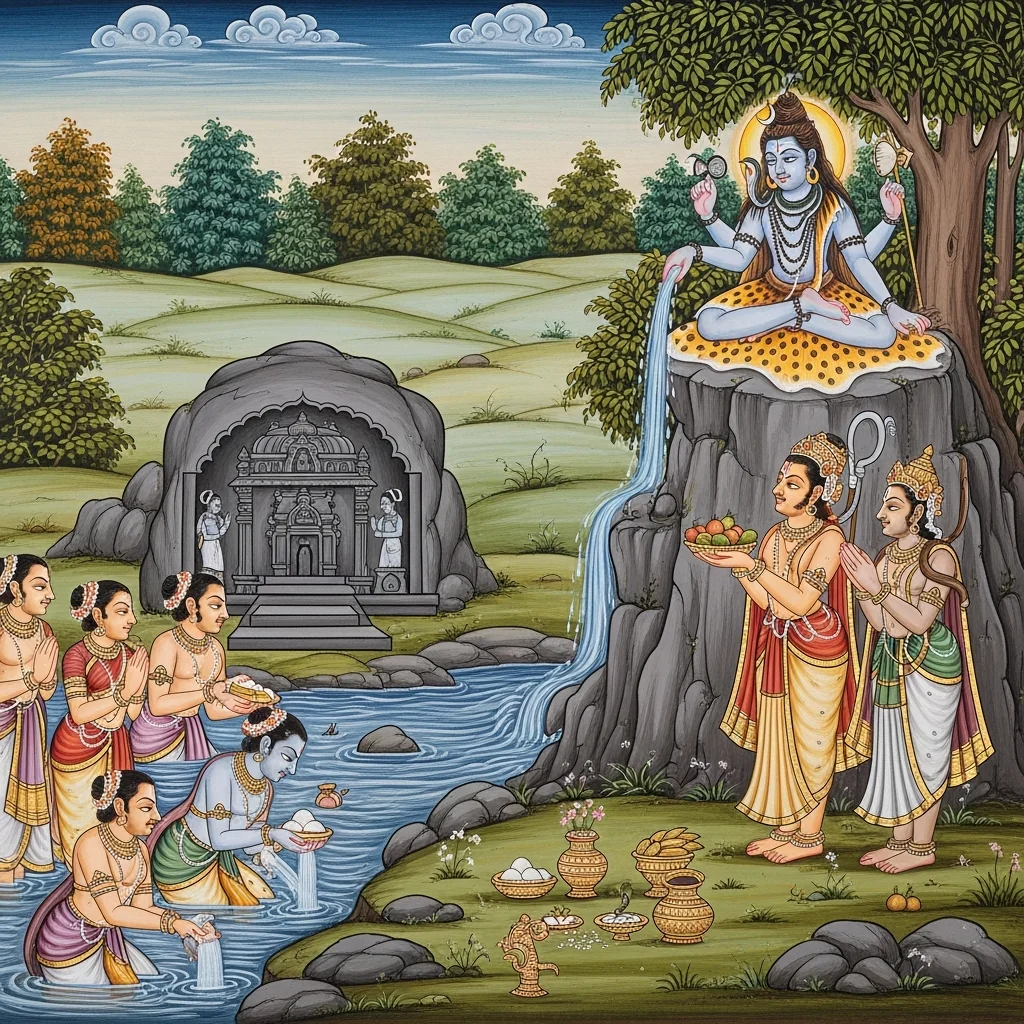
Adhyaya 56
Adhyāya 56 unfolds as a theological dialogue. Uttānapāda asks how Gaṅgā descended and how the supremely meritorious Devāśilā tīrtha arose; Īśvara replies with a sacred origin account: the deities invoke Gaṅgā, Rudra releases her from his matted locks (jaṭā), and she manifests as a Devanadī for human welfare. A tīrtha-complex is then established around Śūlabheda, Devāśilā, and the Prācī Sarasvatī site. The chapter turns to ritual application—holy bathing, tarpaṇa, śrāddha with qualified brāhmaṇas, Ekādaśī fasting, night vigil (jāgaraṇa), Purāṇic recitation, and dāna—as means of purification and ancestral satisfaction. Exemplary narratives follow: Bhānumatī, the widowed daughter of King Vīrasena, undertakes strict vows and a multi-year pilgrimage (Gaṅgā → southern route → Revā region → tīrtha to tīrtha), finally residing with discipline at Śūlabheda/Devāśilā in sustained worship and brāhmaṇa hospitality. A famine-stricken hunter and his wife likewise gain merit through simple offerings, Ekādaśī observance, communal tīrtha rites, truthfulness, and charity. The conclusion briefly ranks the fruits of various gifts (sesame, lamps, land, gold, etc.), exalting brahmadāna as highest and affirming that inner intention (bhāva) determines the outcome.
Shlokas
Verse 1
उत्तानपाद उवाच । अन्यच्च श्रोतुमिच्छामि केन गङ्गावतारिता । रुद्रशीर्षे स्थिता देवी पुण्या कथमिहागता
Uttānapāda said: “I wish to hear something further—by whom was Gaṅgā brought down? And how did that holy Goddess Puṇyā, who abides upon Rudra’s head, come to be here?”
Verse 2
पुण्या देवाशिला नाम तस्या माहात्म्यमुत्तमम् । एतदाख्याहि मे सर्वं प्रसन्नो यदि शङ्कर
There is a holy place called Puṇyā, known as Devāśilā—her greatness is supreme. Tell me all of this, O Śaṅkara, if you are graciously pleased.
Verse 3
ईश्वर उवाच । शृणुष्वैकमना भूत्वा यथा गङ्गावतारिता । देवैः सर्वैर्महाभागा सर्वलोकहिताय वै
Īśvara said: “Listen with a single, steady mind to how Gaṅgā was brought down—the greatly blessed one—made to descend by all the gods for the welfare of all worlds.”
Verse 4
अस्ति विन्ध्यो नगो नाम याम्याशायां महीपते । गीर्वाणास्तु गताः सर्वे तस्य मूर्ध्नि नरेश्वर
There is a mountain named Vindhya in the southern quarter, O lord of the earth. All the gods went there, O king, to its summit.
Verse 5
तत्र चाह्वानिता गङ्गा ब्रह्माद्यैरखिलैः सुरैः । अभ्यर्च्येशं जगन्नाथं देवदेवं जगद्गुरुम्
There, Gaṅgā was invoked by all the gods led by Brahmā, after they had worshipped Īśa—the Lord of the universe, the God of gods, the Guru of the world.
Verse 6
जटामध्यस्थितां गङ्गां मोचयस्वेति भूतले । भास्वन्ती सा ततो मुक्ता रुद्रेण शिरसा भुवि
“Release Gaṅgā, held within the midst of your matted locks, onto the earth!”—thus they prayed. Then that radiant Goddess was released by Rudra from his head onto the world.
Verse 7
तत्र स्थाने महापुण्या देवैरुत्पादिता स्वयम् । ततो देवनदी जाता सा हिताय नृणां भुवि
In that very place the supremely holy stream manifested of herself, brought forth by the devas. From there she became the Devanadī, the river of the gods, arising on earth for the welfare of humankind.
Verse 8
वसन्ति ये तटे तस्याः स्नानं कुर्वन्ति भक्तितः । पिबन्ति च जलं नित्यं न ते यान्ति यमालयम्
Those who dwell upon her bank, bathe with devotion, and daily drink her water—such people do not go to Yama’s abode.
Verse 9
यत्र सा पतिता कुण्डे शूलभेदे नराधिप । देवनद्याः प्रतीच्यां तु तत्र प्राची सरस्वती
O king, in Śūlabheda, in the very pond where she fell—there, to the west of the divine river, flows Sarasvatī, moving eastward.
Verse 10
याम्यायां शूलभेदस्य तत्र तीर्थमनुत्तमम् । तत्र देवशिला पुण्या स्वयं देवेन निर्मिता
On the southern side of Śūlabheda lies an unsurpassed tīrtha; there stands the sacred Devaśilā, a meritorious stone-spot fashioned by God Himself.
Verse 11
तत्र स्नात्वा तु यो भक्त्या तर्पयेत्पितृदेवताः । पितरस्तस्य तृप्यन्ति यावदाभूतसम्प्लवम्
Whoever bathes there with devotion and offers tarpaṇa to the Pitṛs and the devas—his ancestors remain satisfied, even until the cosmic dissolution.
Verse 12
तत्र स्नात्वा तु यो भक्त्या ब्राह्मणान् भोजयेन्नृप । स्वल्पान्नेनापि दत्तेन तस्य चान्तो न विद्यते
O king, whoever bathes there and, with devotion, feeds the Brāhmaṇas—even with a small offering of food—his merit becomes inexhaustible.
Verse 13
उत्तानपाद उवाच । कानि दानानि दत्तानि शस्तानि धरणीतले । यानि दत्त्वा नरो भक्त्या मुच्यते सर्वपातकैः
Uttānapāda said: Which gifts, when given upon the earth, are praised as best—by giving which a man, with devotion, is freed from all sins?
Verse 14
देवशिलाया माहात्म्यं स्नानदानादिजं फलम् । व्रतोपवासनियमैर्यत्प्राप्यं तद्वदस्व मे
Tell me the greatness of Devaśilā—the fruits arising from bathing, charity, and the like—and also what is attained there through vows, fasting, and disciplined observances.
Verse 15
ईश्वर उवाच । आसीत्पुरा महावीर्यश्चेदिनाथो महाबलः । वीरसेन इति ख्यातो मण्डलाधिपतिर्नृप
Īśvara said: Long ago there was a mighty and powerful lord of the Cedis, a king renowned as Vīrasena, ruler over a realm.
Verse 16
राष्ट्रे तस्य रिपुर्नास्ति न व्याधिर्न च तस्कराः । न चाधर्मोऽभवत्तत्र धर्म एव हि सर्वदा
In his kingdom there were no enemies, no disease, and no thieves; unrighteousness did not arise there—dharma alone prevailed always.
Verse 17
सदा मुदान्वितो राजा सभार्यो बहुपुत्रकः । एकासीद्दुहिता तस्य सुरूपा गिरिजा यथा
The king was ever filled with joy, with his queen and many sons; he had but one daughter, fair in form, like Girijā herself.
Verse 18
इष्टा सा पितृमातृभ्यां बन्धुवर्गजनस्य च । कृतं वैवाहिकं कर्म काले प्राप्ते यथाविधि
Beloved of her father and mother and of the whole circle of kin, when the proper time arrived the marriage rites were performed, duly according to rule.
Verse 19
अनन्तरं चेदिपतिर्द्वादशाब्दमखे स्थितः । ततस्तस्यास्तु यो भर्ता स मृत्युवशमागतः
Thereafter, while the lord of Cedi was engaged in a twelve-year sacrificial rite, the husband of that maiden fell under the dominion of Death.
Verse 20
विधवां तां सुतां दृष्ट्वा राजा शोकसमन्वितः । उवाच वचनं तत्र स्वभार्यां दुःखपीडिताम्
Seeing his daughter widowed, the king, overcome with grief, spoke there to his own wife, crushed by sorrow.
Verse 21
प्रिये दुःखमिदं जातं यावज्जीवं सुदुःसहम् । नैषा रक्षयितुं शक्या रूपयौवनगर्विता
“Beloved, this sorrow that has arisen is unbearable for as long as one lives. This girl, proud of her beauty and youth, cannot easily be safeguarded.”
Verse 22
दूषयेत कुलं क्वापि कथं रक्ष्या हि बालिका । नोपायो विद्यते क्वापि भानुमत्याश्च रक्षणे । परस्परं विवदतोः श्रुत्वा तत्कन्यकाब्रवीत्
“Somewhere she might bring reproach upon the lineage—how indeed is the maiden to be protected? Nowhere is any means found for Bhānumatī’s safeguarding.” Hearing the two disputing with one another, the maiden then spoke.
Verse 23
भानुमत्युवाच । न लज्जामि तवाग्रेऽहं जल्पन्ती तात कर्हिचित् । सत्यं नोत्पद्यते दोषो मदर्थे ते नराधिप
Bhānumatī said: “Father, I do not feel ashamed to speak before you at any time. Truly, O king, let no fault arise for you on my account.”
Verse 24
अद्यप्रभृत्यहं तात धारयिष्ये न मूर्धजान् । स्थूलवस्त्रपटार्द्धं तु धारयिष्यामि ते गृहे
“From today onward, Father, I shall not arrange my hair; and in your house I shall wear only coarse cloth, as though half a garment.”
Verse 25
करिष्यामि व्रतान्याशु पुराणविहितानि च । आत्मानं शोषयिष्यामि तोषयिष्ये जनार्दनम्
“I shall promptly undertake the vows enjoined in the Purāṇas. I shall discipline my body through austerity and I shall please Janārdana (Viṣṇu).”
Verse 26
ममैषा वर्तते बुद्धिर्यदि त्वं तात मन्यसे । भानुमत्या वचः श्रुत्वा राजा संहर्षितोऽभवत्
“This is the resolve that stands firm in my mind—if you approve, Father.” Hearing Bhānumatī’s words, the king became greatly delighted.
Verse 27
तीर्थयात्रां समुद्दिश्य कोशं दत्त्वा सुपुष्कलम् । विसृज्य पुरुषान्वृद्धान् कृत्वा तस्याः सुरक्षणे
Intending a pilgrimage to the sacred fords, he bestowed an abundant treasury; and, appointing elderly and trustworthy men, he arranged for her thorough protection.
Verse 28
पुरुषान् सायुधांश्चापि ब्राह्मणान्सपुरोहितान् । दासीदासान्पदातींश्च चास्याः संरक्षणक्षमान्
He also appointed armed men, brāhmaṇas together with the family priest, maidservants and servants, and foot-soldiers—those capable of guarding her well.
Verse 29
ततः पितुर्मतेनैव गङ्गातीरं गता सती । अवगाह्य तटे द्वे तु गङ्गायाः स नराधिप
Then, acting solely in accordance with her father’s counsel, the virtuous lady went to the bank of the Gaṅgā. Having entered the river for a purifying bath, she stayed upon the two banks of the Gaṅgā—O king among men.
Verse 30
नित्यं सम्पूज्य सद्विप्रान्गन्धमाल्यादिभूषणैः । द्वादशाब्दानि सा तीरे गङ्गायाः समवस्थिता
Daily she duly honored the noble brāhmaṇas with perfumes, garlands, and other adornments; and for twelve years she remained residing on the bank of the Gaṅgā.
Verse 31
त्यक्त्वा गङ्गां तदा राज्ञी गता काष्ठां तु दक्षिणाम् । प्राप्ता सा सचिवैः सार्द्धं यत्र रेवा महानदी
Then the queen, leaving the Gaṅgā behind, journeyed toward the southern region. Accompanied by her attendants, she reached the place where the great river Revā flows.
Verse 32
समाः पञ्च स्थिता तत्र ओङ्कारेऽमरकण्टके । उदग्याम्येषु तीर्थेषु तीर्थात्तीर्थं जगाम सा
She stayed there for five years at Oṅkāra and at Amarakāṇṭaka. Then, among those northern tīrthas, she journeyed from one sacred ford to another.
Verse 33
स्नात्वा स्नात्वा पूज्य विप्रान् भक्तिपूर्वमतन्द्रिता । वारुणीं सा दिशं गत्वा देवनद्याश्च सङ्गमे
Bathing again and again, and worshipping the brāhmaṇas with devotion—unceasing in effort—she went toward the western quarter, to the confluence with the divine river.
Verse 34
ददर्श चाश्रमं पुण्यं मुनिसङ्घैः समाकुलम् । दृष्ट्वा मुनिसमूहं सा प्रणिपत्येदमब्रवीत्
She beheld a holy hermitage, thronged with assemblies of sages. Seeing that multitude of seers, she bowed down and spoke as follows.
Verse 35
माहात्म्यमस्य तीर्थस्य नाम चैवास्य कीदृशम् । कथयन्तु महाभागाः प्रसादः क्रियतां मम
“Tell me, O greatly fortunate sages, the greatness of this tīrtha and what its name is. Be gracious to me and explain it.”
Verse 36
ऋषय ऊचुः । चक्रतीर्थं तु विख्यातं चक्रं दत्तं पुरा हरेः । महेश्वरेण तुष्टेन देवदेवेन शूलिना
The sages said: “This is the renowned Cakratīrtha. Long ago, the discus was bestowed upon Hari by Maheśvara—the trident-bearing Lord of lords—being pleased.”
Verse 37
अत्र तीर्थे तु यः स्नात्वा तर्पयेत्पितृदेवताः । अनिवर्तिका गतिस्तस्य जायते नात्र संशयः
At this tīrtha, whoever bathes and then offers tarpaṇa-libations to the Pitṛs and the deities attains an irreversible destiny; of this there is no doubt.
Verse 38
द्वितीयेऽह्नि ततो गच्छेच्छूलभेदे तपस्विनि । पूर्वोक्तेन विधानेन स्नानं कुर्याद्यथाविधि
On the second day thereafter, O ascetic lady, one should go to Śūlabheda; and, following the procedure stated earlier, perform the bath according to rule.
Verse 39
जन्मत्रयकृतैः पापैर्मुच्यते नात्र संशयः । जलेन तिलमात्रेण प्रदद्यादञ्जलित्रयम्
There is no doubt that one is freed from sins accumulated over three births. With water mixed with even a mere sesame-seed measure of til, one should offer three añjali handfuls as libation.
Verse 40
तृप्यन्ति पितरस्तस्य द्वादशाब्दान्यसंशयम् । यः श्राद्धं कुरुते भक्त्या श्रोत्रियैर्ब्राह्मणैर्नृप
O King, without doubt his ancestors remain satisfied for twelve years—he who performs the śrāddha with devotion, employing learned, Veda-trained śrotriya brāhmaṇas.
Verse 41
वार्द्धुष्याद्यास्तु वर्ज्यन्ते पित्ःणां दत्तमक्षयम् । अपरेऽह्णि ततो गच्छेत्पुण्यां देवशिलां शुभाम्
But occasions such as vārddhuṣya and the like are to be avoided; what is offered to the Pitṛs is imperishable. Then, on the following day, one should proceed to the auspicious and meritorious holy spot called Devaśilā.
Verse 42
वीक्ष्यते जाह्नवी पुण्या देवैरुत्पादिता पुरा । स्नात्वा तत्र जलं दद्यात्तिलमिश्रं नराधिप
There one beholds the holy Jāhnavī (Gaṅgā), once brought forth by the gods. Having bathed there, O ruler of men, one should offer water mixed with sesame.
Verse 43
सकृत्पिण्डप्रदानेन मुच्यते ब्रह्महत्यया । एकादश्यामुपोषित्वा पक्षयोरुभयोरपि
By offering the piṇḍa even once, one is freed from the sin of brahmahatyā. And on Ekādaśī, in both lunar fortnights, one should observe a fast.
Verse 44
क्षपाजागरणं कुर्यात्पठेत्पौराणिकीं कथाम् । विष्णुपूजां प्रकुर्वीत पुष्पधूपनिवेदनैः
One should keep vigil through the night and recite a Purāṇic narrative. One should perform worship of Viṣṇu with flowers, incense, and offerings of food.
Verse 45
प्रभाते भोजयेद्विप्रान् दानं दद्यात्सशक्तितः । चतुर्थेऽह्नि ततो गच्छेद्यत्र प्राची सरस्वती
In the morning one should feed brāhmaṇas and give charity according to one’s capacity. Then, on the fourth day, one should go to the place where the eastern-flowing Sarasvatī is found.
Verse 46
ब्रह्मदेहाद्विनिष्क्रान्ता पावनार्थं शरीरिणाम् । तत्र स्नात्वा नरो भक्त्या तर्पयेत्पितृदेवताः
Having issued forth from Brahmā’s body for the purification of embodied beings, she is present there. Bathing there, a man should with devotion satisfy the ancestral deities through libations (tarpaṇa).
Verse 47
श्राद्धं कृत्वा यथान्यायमनिन्द्यान् भोजयेद्द्विजान् । पितरस्तस्य तृप्यन्ति द्वादशाब्दान्यसंशयम्
Having performed the śrāddha according to proper rule, one should feed blameless, worthy twice-born brāhmaṇas. Without doubt, his ancestors are satisfied for twelve years.
Verse 48
सर्वदेवमयं स्थानं सर्वतीर्थमयं तथा । देवकोटिसमाकीर्णं कोटिलिङ्गोत्तमोत्तमम्
It is a place pervaded by all the gods, and likewise containing the essence of all tīrthas. Crowded with crores of deities, Koṭiliṅga is the best of the best among holy shrines.
Verse 49
त्रिरात्रं कुरुते योऽत्र शुचिः स्नात्वा जितेन्द्रियः । पक्षं मासं च षण्मासमब्दमेकं कदाचन
Whoever here, being pure, bathing and having mastered the senses, undertakes an observance for three nights—or for a fortnight, a month, six months, or even a full year—gains the merit proclaimed for this sacred tīrtha.
Verse 50
न तस्य सम्भवो मर्त्ये तस्य वासो भवेद्दिवि । नियमस्थो विमुच्येत त्रिजन्मजनितादघात्
For him there will be no further return to mortal existence; his dwelling becomes heavenly. Established in sacred discipline, he is released from the sin accumulated through three births.
Verse 51
विना पुंसा तु या नारी द्वादशाब्दं शुचिव्रता । तिष्ठते साक्षयं कालं रुद्रलोके महीयते
And a woman who, without a husband, maintains a pure vow for twelve years—she abides for an imperishable span of time and is honored in Rudra’s world.
Verse 52
मुनीनां वचनं श्रुत्वा मुदा परमया ययौ । ततोऽवगाह्य तत्तीर्थमहर्निशमतन्द्रिता
Hearing the sages’ words, she went forth in supreme joy. Then, having immersed herself in that sacred ford, she remained there day and night, unwearied.
Verse 53
दृष्ट्वा तीर्थप्रभावं तु पुनर्वचनमब्रवीत् । श्रूयतां वचनं मेऽद्य ब्राह्मणाः सपुरोहिताः
But after witnessing the power of the sacred tīrtha, she spoke again: “Let my words be heard today, O brāhmaṇas, together with the family priests.”
Verse 54
न त्यजामीदृशं स्थानं यावज्जीवमहर्निशम् । मत्पितुश्च तथा मातुः कथयध्वमिदं वचः
“I shall not abandon such a place as this so long as I live, day and night. And do convey these words of mine to my father and to my mother as well.”
Verse 55
त्वत्कन्या शूलभेदस्था नियता व्रतचारिणी । एवमुक्त्वा स्थिता सा तु तत्र भानुमती नृपः
“Your daughter, abiding at Śūlabheda, is disciplined and devoted to her vow.” Having said thus, Bhānumatī indeed remained there, O king.
Verse 56
। अध्याय
“Chapter” — a colophon marker indicating a division of the text.
Verse 57
अहर्निशं दहेद्धूपं चन्दनं च सदीपकम् । पादशौचं स्वयं कृत्वा स्वयं भोजयते द्विजान् । द्वादशाब्दानि सा राज्ञी सुव्रता तत्र संस्थिता
Day and night she burned incense and sandalwood, keeping the lamps alight. Having herself performed the washing of feet, she herself fed the twice-born. For twelve years that queen, steadfast in her noble vow, remained established there.
Verse 58
ईश्वर उवाच । अन्यद्देवशिलायास्तु माहात्म्यं शृणु भूपते । कथयामि महाबाहो सेतिहासं पुरातनम्
Īśvara said: “Now hear, O king, another greatness—the glory of Devaśilā. I shall recount to you, O mighty-armed one, an ancient sacred history.”
Verse 59
कश्चिद्वनेचरो व्याधः शबरः सह भार्यया । दुर्भिक्षपीडितस्तत्र आमिषार्थं वनं गतः
There was a certain forest-dwelling hunter, a Śabara, together with his wife. Afflicted by famine, he went into the forest seeking meat for sustenance.
Verse 60
नापश्यत्पक्षिणस्तत्र न मृगान्न फलानि च । सरस्ततो ददर्शाथ पद्मिनीखण्डमण्डितम्
There he saw neither birds nor deer, nor even fruits. Then he beheld a lake, adorned with clusters of lotus-plants.
Verse 61
दृष्ट्वा सरोवरं तत्र शबरी वाक्यमब्रवीत् । कुमुदानि गृहाण त्वं दिव्यान्याहारसिद्धये
Seeing the lake there, the Śabarī spoke: “Take these kumuda water-lilies, wondrous in nature, so that we may obtain food.”
Verse 62
देवस्य पूजनार्थं तु शूलभेदस्य यत्नतः । विक्रयो भविता तत्र धर्मशीलो जनो यतः
There they will surely sell well, for people of righteous conduct come with effort to Śūlabheda for the worship of the Deity.
Verse 63
भार्याया वचनं श्रुत्वा जग्राह कुमुदानि सः । उत्तीर्णस्तु तटे यावद्दृष्ट्वा श्रीवृक्षमग्रतः
Hearing his wife’s words, he gathered the kumuda lilies. Then, having come up onto the bank, he saw before him a śrī-vṛkṣa, an auspicious tree.
Verse 64
श्रीफलानि गृहीत्वा तु सुपक्वानि विशेषतः । शूलभेदं स सम्प्राप्तो ददर्श सुबहूञ्जनान्
Taking the śrī-fruits—especially those fully ripe—he reached Śūlabheda and saw a great multitude of people.
Verse 65
चैत्रमासे सिते पक्षे एकादश्यां नराधिप । तस्मिन्नहनि नाश्नीयुर्बाला वृद्धास्तथा स्त्रियः
O king, in the month of Caitra, in the bright fortnight, on the eleventh lunar day—Ekādaśī—on that day even children, the aged, and women would not eat.
Verse 66
मण्डपं ददृशे तत्र कृतं देवशिलोपरि । वस्त्रैः संवेष्टितं दिव्यं स्रङ्माल्यैरुपशोभितम्
There he saw a maṇḍapa pavilion built upon a sacred stone, wrapped in fine cloth and beautifully adorned with garlands and strings of flowers.
Verse 67
ऋषयश्चागतास्तत्र ये चाश्रमनिवासिनः । सोपवासाः सनियमाः सर्वे साग्निपरिग्रहाः
Sages had come there, as well as those dwelling in hermitages—everyone observing fasts and sacred disciplines, all maintaining the holy fires.
Verse 68
देवनद्यास्तटे रम्ये मुनिसङ्घैः समाकुले । आगच्छद्भिर्नृपश्रेष्ठ मार्गस्तत्र न लभ्यते
On the lovely bank of the divine river, crowded with assemblies of sages, O best of kings, those arriving could scarcely find a path there.
Verse 69
दृष्ट्वा जनपदं तत्र तां भार्यां शबरोऽब्रवीत् । गच्छ पृच्छस्व किमपि किमद्य स्नानकारणम्
Seeing the settlement there, the Śabara said to his wife: “Go and ask them—what is it today, and for what reason are the people bathing?”
Verse 70
पर्वाणि यानि श्रूयन्ते किंस्वित्सूर्येन्दुसम्प्लवः । अयनं किं भवेदद्य किं वाक्षयतृतीयका
“Is it one of the well-known sacred occasions? Is it some conjunction involving the Sun and Moon? Is it an ayana (solstitial transition) today—or perhaps a ‘lost’ third lunar day (kṣaya-tṛtīyā)?”
Verse 71
ततः स्वभर्तुर्वचनाच्छबरी प्रस्थिता तदा । पप्रच्छ नारीं दृष्ट्वाग्रे दत्त्वाग्रे कमले शुभे
Then, at her husband’s word, Śabarī set out. Seeing a woman in front, she questioned her, first offering auspicious lotus-flowers.
Verse 72
तिथिरद्यैव का प्रोक्ता किं पर्व कथयस्व मे । किमयं स्नाति लोकोऽयं किं वा स्नानस्य कारणम्
“What tithi has been proclaimed for today? What sacred observance is it—tell me. Why are these people bathing, and what is the cause of this bathing?”
Verse 73
नार्युवाच । अद्य चैकादशी पुण्या सर्वपापक्षयंकरी । उपोषिता सकृद्येन नाकप्राप्तिं करोति सा
The woman said: “Today is the holy Ekādaśī, the destroyer of all sins. Whoever fasts on it even once attains the heavenly realm.”
Verse 74
तस्यास्तद्वचनं श्रुत्वा शबरी शाबराय वै । कथयामास चाव्यग्रा स्त्रीवाक्यं नृपसत्तम
Hearing that woman’s words, Śabarī, without hesitation, conveyed the woman’s statement to the Śabara—O best of kings.
Verse 75
अद्य त्वेकादशी पुण्या बालवृद्धैरुपोषिता । मदनैकादशी नाम सर्वपापक्षयंकरी
“Today indeed is the holy Ekādaśī, observed in fasting by the young and the old alike. It is called Madana-Ekādaśī, the destroyer of all sins.”
Verse 76
नियता श्रूयते तत्र राजपुत्री सुशोभना । व्रतस्था नियताहारा नाम्ना भानुमती सती
It is heard that there is a radiant and beautiful princess there, disciplined in conduct—virtuous Bhānumatī by name—steadfast in her vow and restrained in her diet.
Verse 77
नैतया सदृशी काचित्त्रिषु लोकेषु विश्रुता । दृश्यते सा वरारोहा ह्यवतीर्णा महीतले
No other woman like her is renowned in the three worlds. That noble lady is seen as though she has descended upon the very earth.
Verse 78
भार्याया वचनं श्रुत्वा शबरस्तां जगाद ह । कमलानि यथालाभं दत्त्वा भुङ्क्ष्व हि सत्वरम्
Hearing his wife’s words, the Śabara said to her: “Offer lotuses as you are able, and then eat quickly.”
Verse 79
ममैषा वर्तते बुद्धिर्न भोक्तव्यं मया ध्रुवम् । न मयोपार्जितं भद्रे पापबुद्ध्या शुभं क्वचित्
“This is the resolve that stands firm in my mind: I shall certainly not partake of it. O auspicious lady, nothing truly good can ever be gained by me through sinful intent, nor is this something earned by my own rightful effort.”
Verse 80
शबर्युवाच । न पूर्वं तु मया भुक्तं कस्मिंश्चैव तु वासरे । भुक्तशेषं मया भुक्तं यावत्कालं स्मराम्यहम्
Śabarī said: “Never before, on any day, have I eaten in such a way. As long as I can remember, I have only eaten what remained after others had eaten.”
Verse 81
भार्याया निश्चयं ज्ञात्वा स्नानं कर्तुं जगाम ह । अर्धोत्तरीयवस्त्रेण स्नानं कृत्वा तु भक्तितः
Knowing his wife’s firm decision, he went to perform the ritual bath. Wearing but a half upper-cloth, he bathed with devotion.
Verse 82
सर्वान् देवान्नमस्कृत्य गतो देवशिलां प्रति । तस्थौ स शङ्कमानोऽपि नमस्कृत्य जनार्दनम्
Having bowed to all the gods, he went toward Devaśilā, the sacred stone. Though still anxious, he stood there after offering obeisance to Janārdana (Viṣṇu).
Verse 83
यस्यास्तु कुमुदे दत्ते तया राज्ञ्यै निवेदितम् । तद्दृष्ट्वा पद्मयुगलं तां दासीं साब्रवीत्तदा
When she had offered the pair of lotuses (kumuda), it was presented to the queen. Seeing those two lotus-flowers, the queen then spoke to that maidservant.
Verse 84
कुत्र पद्मद्वयं लब्धं कथ्यतामग्रतो मम । शीघ्रं तत्रैव गत्वा च पद्मानानय चापरान्
“Where were these two lotuses obtained? Tell me at once. Go quickly to that very place and bring more lotuses as well.”
Verse 85
धान्येन वसुना वापि कमलानि समानय । भानुमत्या वचः श्रुत्वा गता सा शबरं प्रति
“Bring the lotuses, even if by paying with grain or wealth.” Hearing Bhānumatī’s words, she went to the Śabara.
Verse 86
श्रीफलानि च पुष्पाणि बहून्यन्यानि देहि मे
“Give me coconuts (śrīphala) and many other kinds of flowers as well.”
Verse 87
शबर्युवाच । श्रीफलानि सपुष्पाणि दास्यामि च विशेषतः । न लोभो न स्पृहा मेऽस्ति गत्वा राज्ञीं निवेदय
Śabarī said: “I will give coconuts together with flowers—indeed, in abundance. I have neither greed nor craving; go and inform the queen.”
Verse 88
तया च सत्वरं गत्वा यथावृत्तं निवेदितम् । शबर्युक्तं पुरस्तस्याः सविस्तरपरं वचः
She went quickly and reported everything exactly as it had happened. Before the queen, she related Śabarī’s words in full detail.
Verse 89
तस्यास्तु वचनं श्रुत्वा राज्ञी तत्र स्वयं गता । उवाच शबरीं प्रीत्या देहि पद्मानि मूल्यतः
Hearing her words, the queen herself went there and, with affection, said to the Śabarī woman: “Give me the lotuses—take their proper price.”
Verse 90
शबर्युवाच । न मूल्यं कामये देवि फलपुष्पसमुद्भवम् । श्रीफलानि च पुष्पाणि यथेष्टं मम गृह्यताम्
Śabarī said: “O Lady, I do not desire payment for what arises as fruit and flower. Take, as you wish, these coconuts and flowers from me.”
Verse 91
अर्चां कुरु यथान्यायं वासुदेवे जगत्पतौ
“Perform the worship rightly, according to proper rule, of Vāsudeva—the Lord of the world.”
Verse 92
राज्ञ्युवाच । विना मूल्यं न गृह्णामि कमलानि तवाधुना । धान्यस्य खारिकामेकां ददामि प्रतिगृह्यताम्
The queen said: “I will not take your lotuses now without payment. I give one khārikā-measure of grain—please accept it.”
Verse 93
दश विंशत्यथ त्रिंशच्चत्वारिंशदथापि वा । गृहाण वा खारिशतं दुर्भिक्षां बोधिमुत्तर
“Take ten, or twenty, or thirty, or even forty (measures)—or take a hundred khāris; overcome the hardship of famine and rise beyond it.”
Verse 94
वसु रत्नं सुवर्णं च अन्यत्ते यदभीप्सितम् । तत्सर्वं सम्प्रदास्यामि कमलार्थे न संशयः
“Wealth, jewels, gold—whatever else you desire—I will surely give all of that for the sake of these lotuses; of this there is no doubt.”
Verse 95
शबर्युवाच । नाहारं चिन्तयाम्यद्य मुक्त्वा देवं वरानने । देवकार्यं विना भद्रे नान्या बुद्धिः प्रवर्तते
Śabarī said: “O fair-faced Lady, today I do not think of my own sustenance, leaving aside everything except the Lord. O gentle one, my mind does not turn to anything other than the service of God.”
Verse 96
राज्ञ्युवाच । न त्वयान्नं परित्याज्यं सर्वमन्ने प्रतिष्ठितम् । तस्मात्सर्वप्रयत्नेन ममान्नं प्रतिगृह्यताम्
The queen said: “You should not renounce food; everything rests upon food. Therefore, with all care, please accept food from me.”
Verse 97
तपस्विनो महाभागा ये चारण्यनिवासिनः । गृहस्थद्वारि ते सर्वे याचन्तेऽन्नमतन्द्रिताः
Those blessed ascetics who dwell in the forest—each of them, without negligence, seeks alms-food at the door of householders.
Verse 98
शबर्युवाच । निषेधश्च कृतः पूर्वं सर्वं सत्ये प्रतिष्ठितम् । सत्येन तपते सूर्यः सत्येन ज्वलतेऽनलः
Śabarī said: “A refusal was made earlier; all stands established in truth. By truth the sun gives heat; by truth the fire blazes.”
Verse 99
सत्येन तिष्ठत्युदधिर्वायुः सत्येन वाति हि । सत्येन पच्यते सस्यं गावः क्षीरं स्रवन्ति च
By truth the ocean is held in its place; by truth the wind indeed blows. By truth the crops are ripened, and by truth the cows yield their milk.
Verse 100
सत्याधारमिदं सर्वं जगत्स्थावरजङ्गमम् । तस्मात्सर्वप्रयत्नेन सत्यं सत्येन पालयेत्
This entire world—both the unmoving and the moving—rests upon truth. Therefore, with every effort, one should protect truth by truth itself.
Verse 101
देवकार्यं तु मे मुक्त्वा नान्या बुद्धिः प्रवर्तते । गृहाण राज्ञि पुष्पाणि कुरु पूजां गदाभृतः
Apart from the service of the Deity, no other intention stirs within me. O Queen, accept these flowers and perform worship of the mace-bearing Lord (Hari).
Verse 102
श्रूयते द्विजवाक्यैस्तु न दोषो विद्यते क्वचित् । कुशाः शाकं पयो मत्स्या गन्धाः पुष्पाक्षता दधि । मांसं शय्यासनं धानाः प्रत्याख्येया न वारि च
It is heard from the words of the twice-born that there is no fault in this anywhere. Kuśa-grass, vegetables, milk, fish, fragrances, flowers, unbroken rice, curd—also meat, a bed and seat, grains—these are not to be refused; not even water is to be rejected.
Verse 103
राज्ञ्युवाच । आरामोपहृतं पुष्पमारण्यं पुष्पमेव च । क्रीतं प्रतिग्रहे लब्धं पुष्पमेवं चतुर्विधम्
The Queen said: “Flowers are of four kinds—those brought from a garden, those from the forest, those that are purchased, and those obtained by accepting a gift.”
Verse 104
उत्तमं पुष्पमारण्यं गृहीतं स्वयमेव च । मध्यमं फलमारामे त्वधमं क्रीतमेव च । प्रतिग्रहेण यल्लब्धं निष्फलं तद्विदुर्बुधाः
Forest-flowers, gathered by one’s own hand, are the best. Those obtained in a garden are of middling worth, while purchased flowers are inferior. Flowers acquired by accepting them as a gift are declared by the wise to be fruitless for worship.
Verse 105
पुरोहित उवाच । गृहाण राज्ञि पुष्पाणि कुरु पूजां गदाभृतः । उपकारः प्रकर्तव्यो व्यपदेशेन कर्हिचित्
The priest said: “O Queen, accept the flowers and perform worship of the mace-bearing Lord. At times, a beneficent act should be carried out under a fitting pretext, so that it may be accomplished.”
Verse 106
ईश्वर उवाच । श्रीफलानि सपद्मानि दत्तानि शबरेण तु । गृहीत्वा तानि राज्ञी सा पूजां चक्रे सुशोभनाम्
The Lord said: “Coconuts and lotuses were given by the Śabara. Taking them, the Queen performed a splendid worship.”}]}} مطابق schema? Wait extra BOM and trailing char. Ensure valid JSON only. Remove stray characters. Ensure no nulls. Ensure Spanish verse 103 had weird nbsp. Clean. Also ensure top-level exactly. Done.】
Verse 107
क्षपाजागरणं चक्रे श्रुत्वा पौराणिकीं कथाम् । शबरस्तु ततो भार्यामिदं वचनमब्रवीत्
Having heard the Purāṇic tale, they kept a night-vigil. Then the Śabara spoke these words to his wife.
Verse 108
दीपार्थं गृह्यतां स्नेहो यथालाभेन सुन्दरि । कृत्वा दीपं ततस्तौ तु कृत्वा पूजां हरेः शुभाम्
“For the lamp, take oil or ghee according to what is available, O fair one.” Then, having prepared the lamp, the two of them performed auspicious worship of Hari.
Verse 109
चक्रतुर्जागरं रात्रौ ध्यायन्तो धरणीधरम् । ततः प्रभातसमये दृष्ट्वा स्नानोत्सुकं जनम्
They kept vigil through the night, meditating on the Bearer of the Earth. Then, at daybreak, they saw the people eager to bathe in the sacred waters.
Verse 110
स्नाति वै शूलभेदे तु देवनद्यां तथापरे । सरस्वत्यां नराः केचिन्मार्कण्डस्य ह्रदेऽपरे
Some indeed bathed at Śūlabheda, and others in the Deva-nadī. Some men bathed in the Sarasvatī, while others bathed in the lake of Mārkaṇḍa.
Verse 111
चक्रतीर्थं गताश्चक्रुः स्नानं केचिद्विधानतः । शुचयस्ते जनाः सर्वे स्नात्वा देवाशिलोपरि
Some went to Cakratīrtha and bathed according to proper rule. All those people became purified; having bathed, they assembled upon the divine rock-slab.
Verse 112
श्राद्धं चक्रुः प्रयत्नेन श्रद्धया पूतचेतसा । तान्दृष्ट्वा शबरो बिल्वैः पिण्डांश्चक्रे प्रयत्नतः
With careful effort, with faith and a purified heart, they performed the śrāddha. Seeing them, a Śabara, a forest-dweller, also diligently prepared piṇḍa-offerings using bilva fruits.
Verse 113
भानुमत्या तथा भर्तुः पिण्डनिर्वपणं कृतम् । अनिन्द्या भोजिता विप्रा दम्भवार्द्धुष्यवर्जिताः
Bhānumatī likewise performed the offering of piṇḍas for her husband. Blameless brāhmaṇas were fed—free from ostentation and arrogance.
Verse 114
हविष्यान्नैस्तथा दध्ना शर्करामधुसर्पिषा । पायसेन तु गव्येन कृतान्नेन विशेषतः
With haviṣya foods, and with curd, sugar, honey, and ghee—especially with milk-based pāyasa and carefully prepared dishes—the offerings and the feeding were carried out.
Verse 115
भोजयित्वा तथा राज्ञी ददौ दानं यथाविधि । पादुकोपानहौ छत्रं शय्यां गोवृषमेव च
After feeding them, the queen then gave gifts according to rule: sandals and shoes, an umbrella, a bed, and also a cow and a bull.
Verse 116
विविधानि च दानानि हेमरत्नधनानि च । चक्रतीर्थे महाराज कपिलां यः प्रयच्छति । पृथ्वी तेन भवेद्दत्ता सशैलवनकानना
There, various gifts are enjoined—gold, jewels, and wealth as well. O great king, whoever gives a tawny cow (kapilā) at Cakratīrtha is deemed to have gifted the entire earth, with its mountains, forests, and groves.
Verse 117
उत्तानपाद उवाच । यानि यानि च दत्तानि शस्तानि जगतीपतेः । तानि सर्वाणि देवेश कथयस्व प्रसादतः
Uttānapāda said: “O Lord of the gods, out of your grace, tell me all those gifts—each and every one—that are praised as excellent for a ruler, the lord of the earth.”
Verse 118
ईश्वर उवाच । तिलप्रदः प्रजामिष्टां दीपदश्चक्षुरुत्तमम् । भूमिदः स्वर्गमाप्नोति दीर्घमायुर्हिरण्यदः
Īśvara said: “One who gives sesame gains beloved offspring; one who gives a lamp gains excellent eyesight. One who gives land attains heaven; one who gives gold gains long life.”
Verse 119
गृहदो रोगरहितो रूप्यदो रूपवान् भवेत् । वासोदश्चन्द्रसालोक्यमर्कसायुज्यमश्वदः
One who donates a house becomes free from disease; one who gives silver becomes endowed with beauty. The giver of garments attains the world of the Moon, and the giver of a horse attains union with the Sun.
Verse 120
वृषदस्तु श्रियं पुष्टां गोदाता च त्रिविष्टपम् । यानशय्याप्रदो भार्यामैश्वर्यमभयप्रदः
The giver of a bull gains flourishing prosperity; the giver of a cow attains heaven. One who gives conveyances and beds obtains a worthy spouse; the giver of fearlessness gains lordly power and freedom from fear.
Verse 121
धान्यदः शाश्वतं सौख्यं ब्रह्मदो ब्रह्म शाश्वतम् । वार्यन्नपृथिवीवासस्तिलकाञ्चनसर्पिषाम्
The giver of grain attains lasting happiness; the giver of sacred knowledge attains the eternal Brahman. Likewise are meritorious the gifts of water, food, land, dwelling, sesame, gold, and ghee.
Verse 122
सर्वेषामेव दानानां ब्रह्मदानं विशिष्यते । येन येन हि भावेन यद्यद्दानं प्रयच्छति
Of all gifts, Brahmadāna—the gift of sacred knowledge—is supreme. Whatever offering a person gives, and with whatever intention and devotion it is offered—
Verse 123
तेन तेन स भावेन प्राप्नोति प्रतिपूजितम् । दृष्ट्वा दानानि सर्वाणि राज्ञी दत्तानि यानि च
By that very intention, he attains a corresponding and honored result. Having seen all those gifts that the queen had bestowed—
Verse 124
उवाच शबरो भार्यां यत्तच्छृणु नरेश्वर । पुराणं पठितं भद्रे ब्राह्मणैर्वेदपारगैः
The Śabara said to his wife: “Listen to this, O lord of men. O auspicious one, a Purāṇa was recited by Brāhmaṇas who had mastered the Vedas.”
Verse 125
श्रुतं च तन्मया सर्वं दानधर्मफलं शुभम् । पूर्वजन्मार्जितं पापं स्नानदानव्रतादिभिः
“I have heard all of that—the auspicious fruits of the dharma of charity. Sins accumulated from former births are destroyed by sacred bathing, by giving, by vows, and by such disciplines.”
Verse 126
शरीरं दुस्त्यजं मुक्त्वा लभते गतिमुत्तमाम् । संसारसागराद्भीतः सत्यं भद्रे वदामि ते
“Casting off this body, so hard to relinquish, one attains the highest state. Fearing the ocean of saṃsāra, I tell you the truth, O auspicious one.”
Verse 127
अनेकानि च पापानि कृतानि बहुशो मया । घातिता जन्तवो भद्रे निर्दग्धाः पर्वताः सदा
Many sins have I committed again and again. I have slain creatures, O auspicious one, and time after time I have burned down mountains.
Verse 128
तेन पापेन दग्धोऽहं दारिद्र्यं न निवर्तते । तीर्थावगाहनं पूर्वं पापेन न कृतं मया
Burned by that sin, my poverty does not cease. Formerly, because of my sinfulness, I did not perform immersion in the sacred tīrthas.
Verse 129
तेनाहं दुःखितो भद्रे दारिद्र्यमनिवर्तिकम् । मातुर्गृहं प्रयाहि त्वं त्यज स्नेहं ममोपरि । नगशृङ्गं समारुह्य मोक्तुमिच्छाम्यहं तनुम्
Therefore I am afflicted, O dear one—this unrelenting poverty will not turn back. Go to your mother’s house; abandon your attachment to me. I shall climb a mountain peak, for I desire to cast off this body.
Verse 130
शबर्युवाच । मात्रा पित्रा न मे कार्यं नापि स्वजनबान्धवैः । या गतिस्तव जीवेश सा ममापि भविष्यति
Śabarī said: “I have no concern with mother or father, nor even with my own kinsmen and relations. Whatever destiny is yours, lord of my life, that very destiny shall be mine as well.”
Verse 131
न स्त्रीणामीदृशो धर्मो विना भर्त्रा स्वजीवितम् । श्रूयन्ते बहवो दोषा धर्मशास्त्रेष्वनेकधा
For women, such a course is not considered dharma—living apart from one’s husband. Many faults are spoken of, in many ways, in the Dharma-śāstras.
Verse 132
पारणं कुरु भोजेन्द्र व्रतं येन न नश्यति । यत्तेऽभिवाञ्छितं किंचिद्विष्णवे कर्तुमर्हसि
Perform the pāraṇa, O noble lord, so that the vow does not fail. And whatever cherished offering you desire, duly offer it unto Viṣṇu.
Verse 133
भार्याया वचनं श्रुत्वा मुमुदे शबरस्ततः । गृहीत्वा श्रीफलं शीघ्रं होमं कृत्वा यथाविधि
Hearing his wife’s words, Śabara rejoiced. Taking at once a coconut (śrīphala), he performed the homa, according to the prescribed rule.
Verse 134
सर्वदेवान्नमस्कृत्य भुक्तोऽपि च तया सह । चैत्र्यां तु विषुवं ज्ञात्वा तस्थौ तत्र दिनत्रयम्
Having bowed to all the gods, and having eaten together with her as well, he recognized the equinox in the month of Caitra and remained there for three days.