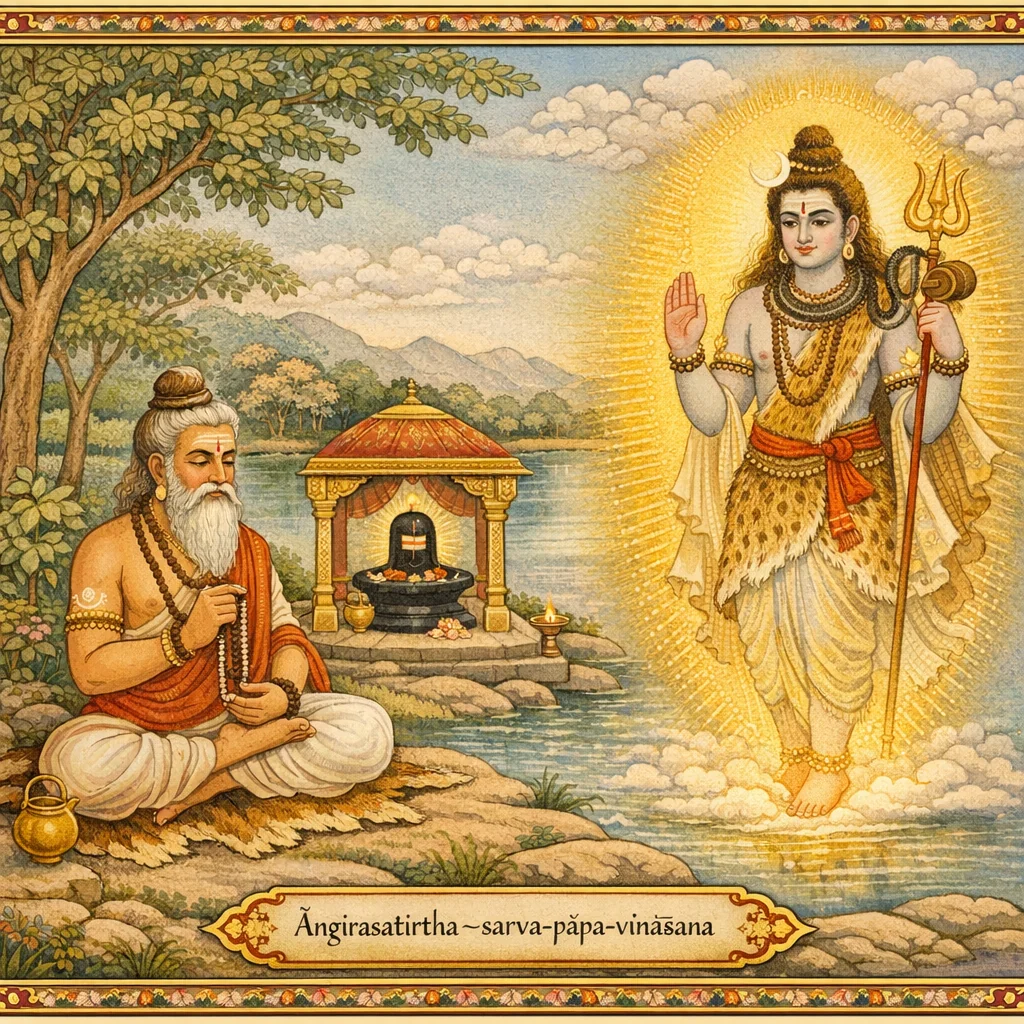
Adhyaya 112
Mārkaṇḍeya directs the royal interlocutor to Āṅgirasatīrtha on the northern bank of the Narmadā, praising it as a universal purifier that destroys all sins (sarva-pāpa-vināśana). An origin-legend follows: the Brāhmaṇa-sage Aṅgiras, learned in the Veda, undertakes long austerities at the dawn of an age to obtain a son. His observance is described in devotional terms—triṣavaṇa bathing, japa to the eternal deity, and worship of Mahādeva supported by ascetic vows such as kṛcchra and cāndrāyaṇa. After twelve years Śiva is pleased and grants a boon. Aṅgiras asks for an ideal son endowed with Vedic learning, disciplined conduct, and wide śāstric mastery, honored by all like a minister of the gods. Śiva grants this, and Bṛhaspati is born; in gratitude Aṅgiras establishes Śaṅkara at that very spot. The phalaśruti concludes that bathing at the tīrtha and worshiping Śiva removes sins, grants progeny and wealth to the needy, fulfills desired aims, and leads the devotee to Rudra’s realm.
Shlokas
Verse 1
श्रीमार्कण्डेय उवाच । ततो गच्छेत्तु राजेन्द्र तीर्थमाङ्गिरसस्य तु । उत्तरे नर्मदाकूले सर्वपापविनाशनम्
Śrī Mārkaṇḍeya said: Then, O best of kings, one should go to the Āṅgirasa-tīrtha on the northern bank of the Narmadā—a sacred place that destroys all sins.
Verse 2
पुरासीदङ्गिरानाम ब्राह्मणो वेदपारगः । पुत्रहेतोर्युगस्यादौ चचार विपुलं तपः
In ancient times there was a brāhmaṇa named Aṅgirā, well-versed in the Vedas. At the beginning of the age, desiring a son, he undertook abundant austerities.
Verse 3
नित्यं त्रिषवणस्नायी जपन्देवं सनातनम् । पूजयंश्च महादेवं कृच्छ्रचान्द्रायणादिभिः
Bathing daily at the three junctions of the day, he continually performed japa to the Eternal Deity. He worshipped Mahādeva, observing austere vows such as the Kṛcchra and Cāndrāyaṇa disciplines.
Verse 4
द्वादशाब्दे ततः पूर्णे तुतोष परमेश्वरः । वरेण छन्दयामास द्विजमाङ्गिरसं वरम्
When twelve years were thus completed, the Supreme Lord was pleased; and, with a boon, He delighted the excellent Āṅgirasa brāhmaṇa.
Verse 5
वव्रे स तु महादेवं पुत्रं पुत्रवतां वरम् । वेदविद्याव्रतस्नातं सर्वशास्त्रविशारदम्
He sought from Mahādeva a son—the best among sons—perfected in Vedic learning and sacred vows, purified by discipline, and accomplished in all śāstras.
Verse 6
देवानां मन्त्रिणं राजन् सर्वलोकेषु पूजितम् । ब्रह्मलक्ष्म्याः सदावासमक्षयं चाव्ययं सुतम्
“O King, grant me a son who will be the counsellor of the gods, honoured in all worlds—an enduring abode of Brahma-Lakṣmī, unfailing and imperishable.”
Verse 7
तथाभिलषितः पुत्रः सर्वविद्याविशारदः । भविष्यति न सन्देहश्चैवमुक्त्वा ययौ हरः
“So shall it be: the son you desire will be proficient in every branch of knowledge—of this there is no doubt.” Having spoken thus, Hara (Śiva) departed.
Verse 8
वरैरङ्गिरसश्चापि बृहस्पतिरजायत । यथाभिलषितः पुत्रो वेदवेदाङ्गपारगः
And by those boons, to Aṅgiras indeed was born Bṛhaspati—the wished-for son, a master of the Veda and its auxiliary limbs (Vedāṅgas).
Verse 9
जाते पुत्रेऽङ्गिरास्तत्र स्थापयामास शङ्करम् । हृष्टतुष्टमना भूत्वा जगामोत्तरपर्वतम्
When the son was born, Aṅgiras established Śaṅkara there; then, with a heart joyful and fully satisfied, he went to the northern mountain.
Verse 10
तत्र चाङ्गिरसे तीर्थे यः स्नात्वा पूजयेच्छिवम् । सर्वपापविनिर्मुक्तो रुद्रलोकं स गच्छति
There, at Aṅgiras Tīrtha, whoever bathes and then worships Śiva becomes freed from all sins and goes to Rudra’s world.
Verse 11
अपुत्रो लभते पुत्रमधनो धनमाप्नुयात् । इच्छते यश्च यं कामं स तं लभति मानवः
The childless obtains a son; the poor attains wealth. Whatever desire a person seeks, that very wish he gains through this sacred merit.
Verse 112
। अध्याय
“Chapter” — an end-of-chapter colophon marker fragment as transmitted.