Adhyaya 212
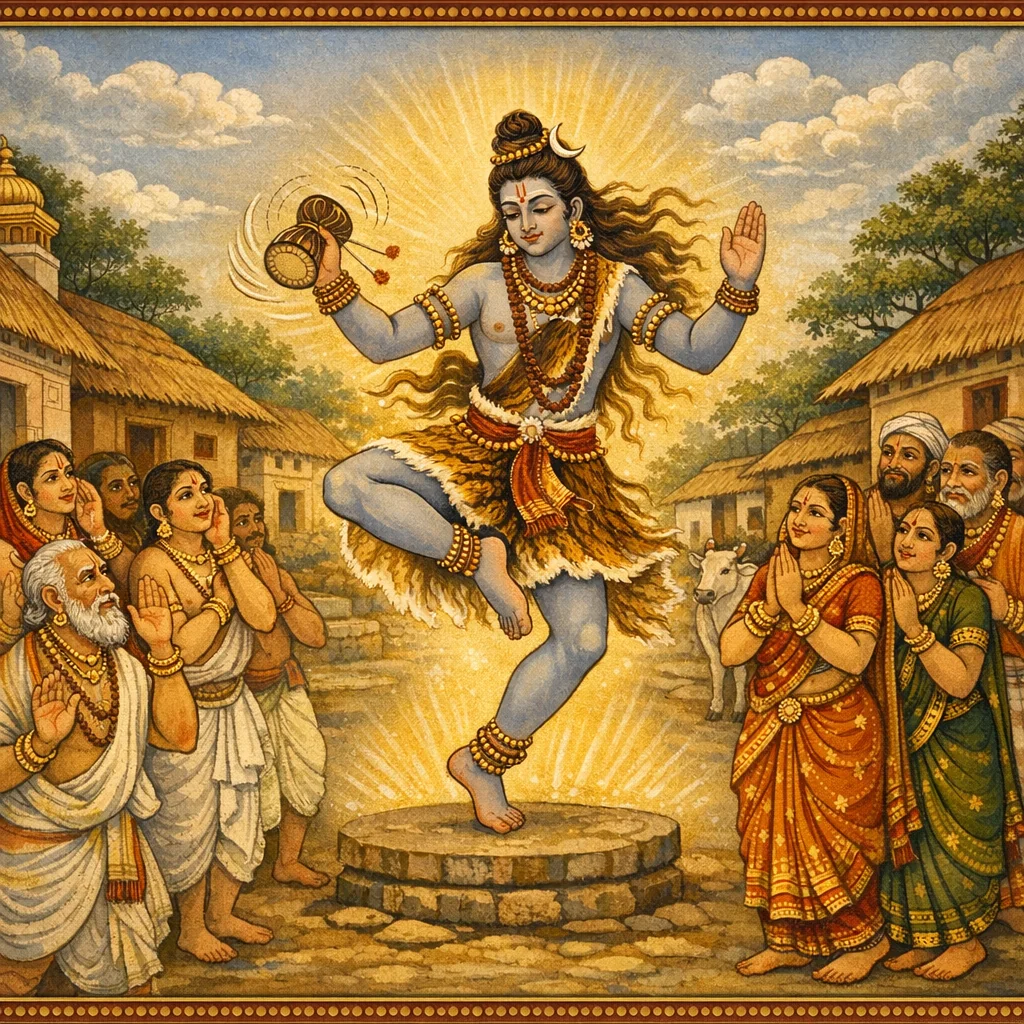
Mārkaṇḍeya recounts a theological episode in which Maheśvara (Śiva) assumes the guise of a mendicant (bhikṣu-rūpa) and enters a village, hungry and thirsty. Marked by ascetic emblems—ash-smeared body, akṣasūtra, trident, matted hair, and ornaments—he sounds a ḍamaru whose beat is likened to a dindima (kettle-drum). Surrounded by children and townsfolk, he alternates song, laughter, speech, and dance, moving so that he seems to appear and vanish before their eyes. A warning motif follows: wherever the Lord playfully sets down the drum, that house becomes “burdened” and is said to perish—an ethical and ritual caution against disrespect, misrecognition of the divine, and the destabilizing force of an uncontrolled encounter with the sacred. When the people begin praising Śaṅkara with devotion, the Lord becomes visible in a “dindima-form,” and from then on he is known as Dīṇḍimeśvara. The chapter ends with a phalaśruti: by darśana and sparśana of this form or site, one is freed from all sins.
Shlokas
Verse 1
श्रीमार्कण्डेय उवाच । अथान्यत्सम्प्रवक्ष्यामि देवस्य चरितं महत् । श्रुतमात्रेण येनाशु सर्वपापैः प्रमुच्यते
Śrī Mārkaṇḍeya said: “Now I shall relate another great deed of the Lord—by merely hearing it, one is quickly freed from all sins.”
Verse 2
भिक्षुरूपं परं कृत्वा देवदेवो महेश्वरः । एकशालां गतो ग्रामं भिक्षार्थी क्षुत्पिपासितः
Assuming the supreme guise of a mendicant, Maheśvara, God of gods, went to the village called Ekaśālā to seek alms, appearing hungry and thirsty.
Verse 3
अक्षसूत्रोद्यतकरो भस्मगुण्ठितविग्रहः । स्फुरत्त्रिशूलो विश्वेशो जटाकुण्डलभूषितः
With a rosary raised in his hand, his body smeared with sacred ash, and his gleaming trident flashing, Viśveśa appeared, adorned with matted locks and earrings.
Verse 4
कृत्तिवासा महाकायो महाहिकृतभूषणः । वादयन्वै डमरुकं डिण्डिमप्रतिमं शुभम्
Clad in a skin-garment, vast of form and adorned with ornaments wrought of great serpents, the Lord played his auspicious ḍamaru, resounding like a mighty war-drum.
Verse 5
कपालपाणिर्भगवान्बालकैर्बहुभिर्वृतः । क्वचिद्गायन्हसंश्चैव नृत्यन्वदन् क्वचित्क्वचित्
The Blessed Lord, holding a skull-bowl in his hand, was surrounded by many boys—at times singing and laughing, at times dancing and speaking, now here, now there.
Verse 6
यत्र यत्र गृहे देवो लीलया डिण्डमं न्यसेत् । भाराक्रान्तं गृहं पार्थ तत्रतत्र विनश्यति
In whatever house the Deva, in sport, would set down that ‘ḍiṇḍima’, O son of Pṛthā, that house—crushed by its weight—would collapse then and there.
Verse 7
एवं सम्प्रचरन् देवो वेष्टितो बहुभिर्जनैः । दृश्यादृश्येन रूपेण निर्जगाम बहिः प्रभुः
Thus, as the Deva moved about, surrounded by many people, the Lord went forth outside, appearing in a form both visible and invisible.
Verse 8
इतश्चेतश्च धावन्तं न पश्यन्ति यदा जनाः । विस्मितास्ते स्थिताः शम्भुर्भविष्यति ततोऽस्तुवन्
When the people could not see Him as He darted here and there, they stood astonished; then they began to praise Him, saying, “He is Śambhu indeed!”
Verse 9
तेषां तु स्तुवतां भक्त्या शङ्करं जगतां पतिम् । डिण्डिरूपो हि भगवांस्तदासौ प्रत्यदृश्यत
As they praised Śaṅkara with devotion—the Lord of the worlds—the Blessed One then appeared before them in the very form of a ḍiṇḍi, a drum.
Verse 10
तदाप्रभृति देवेशो डिण्डिमेश्वर उच्यते । दर्शनात्स्पर्शनाद्राजन् सर्वपापैः प्रमुच्यते
From that time onward, the Lord of gods is called Dīṇḍimeśvara. O King, by His darśana—and even by His touch—one is released from all sins.