Adhyaya 10
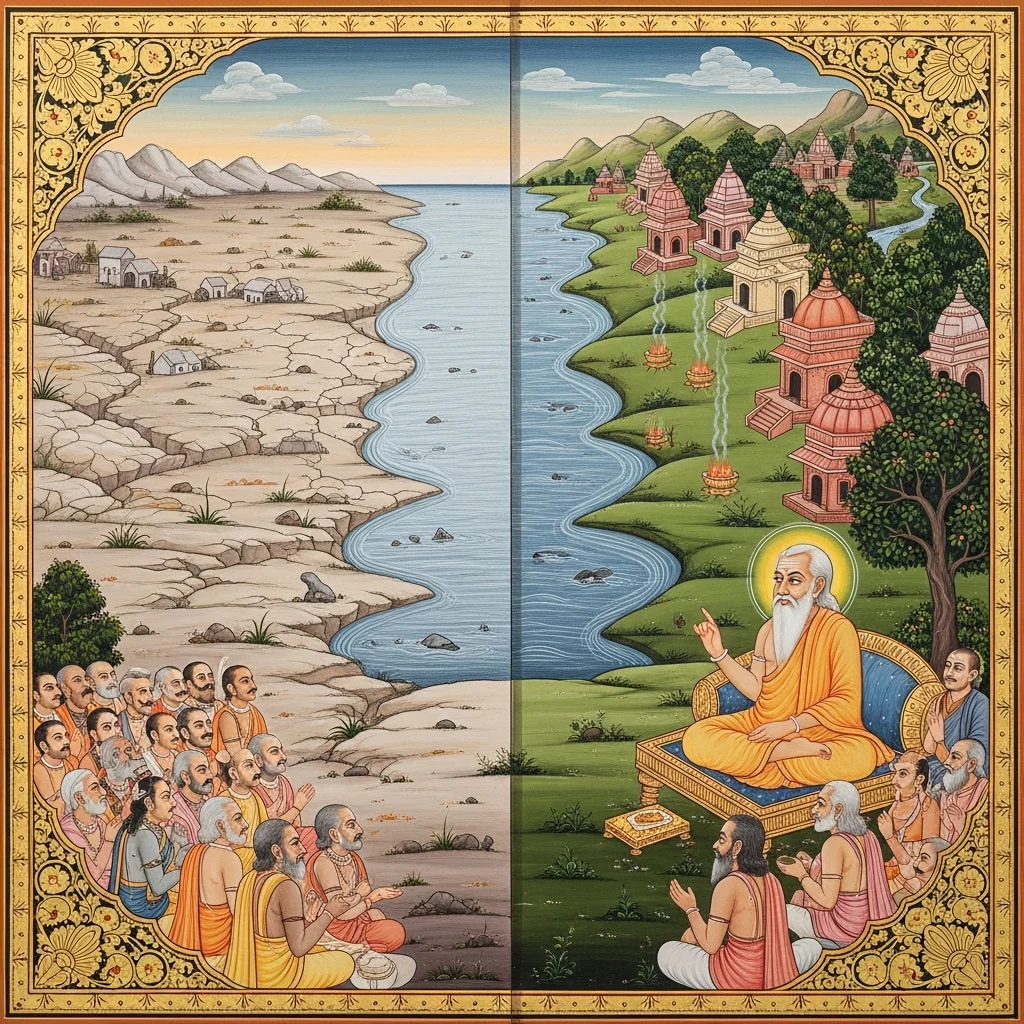
The chapter opens with Yudhiṣṭhira asking about the span of a kalpa and the ordering of the Narmadā region. Mārkaṇḍeya replies by recalling a former kalpa’s end, when anāvṛṣṭi (prolonged drought) dried up rivers and oceans, drove beings to hunger-filled wandering, and shattered ritual and social order—homa and bali sequences failed, and norms of purity were abandoned. In that calamity, great assemblies of ascetics—Kurukṣetra-dwellers, Vaikhānasas, cave-dwelling tapasvins, and others—approach Mārkaṇḍeya for direction. He turns them away from the northern course and sends them south, especially to the banks of the Narmadā, praised as supremely meritorious and frequented by siddhas. Revātata is then portrayed as an extraordinary refuge where shrines and āśramas flourish, agnihotra continues, and varied disciplines of austerity and devotion are practiced: pañcāgni, agnihotra, fasting regimens, cāndrāyaṇa, and kṛcchra. The teaching weaves Śaiva worship of Maheśvara together with continual remembrance of Nārāyaṇa, declaring that devotion aligned with one’s disposition yields corresponding fruits, while clinging to partial supports—like grasping branches instead of the tree—prolongs saṃsāra. Strong phalaśruti follows: worship and disciplined residence on Revā’s banks can lead to non-return, and even those who die in Narmadā’s waters are said to attain exalted states. The chapter concludes by praising reading and recitation as purifying knowledge in accord with Rudra’s authoritative word.
Shlokas
Verse 1
युधिष्ठिर उवाच । कस्मिन्कल्पे महाभागा नर्मदेयं द्विजोत्तम । विभक्ता ऋषिभिः सर्वैस्तपोयुक्तैर्महात्मभिः
Yudhiṣṭhira said: O most excellent Brāhmaṇa, in which kalpa was this auspicious Narmadā-region apportioned and established by all the great sages, endowed with austerity?
Verse 2
एतद्विस्तरतः सर्वं ब्रूहि मे वदतां वर । कल्पान्ते यद्भवेत्कष्टं लोकानां तत्त्वमेव च
Explain all this to me in full detail, O best of speakers—both the hardship that befalls the worlds at the end of a kalpa, and the true principle behind it.
Verse 3
अतीते तु पुरा कल्पे यथेयं वर्ततेऽनघ । अस्यान्त्यस्य च कल्पस्य व्यवस्थां कथय प्रभो । एवमुक्तः सभामध्ये मार्कण्डो वाक्यमब्रवीत्
In a former kalpa long past, just as it is now, O sinless one—tell, O Lord, the ordinance and arrangement of this final kalpa as well. Thus addressed in the midst of the assembly, Mārkaṇḍa spoke these words.
Verse 4
मार्कण्डेय उवाच । वक्ष्येऽहं श्रूयतां सर्वैः कथेयं पूर्वतः श्रुता
Mārkaṇḍeya said: I shall declare it—let all listen—this narrative as it was heard of old.
Verse 5
महत्कथेयं वैशिष्टी कल्पादस्मात्परं तु या । लोकक्षयकरो घोर आसीत्कालः सुदारुणः
This is a great and extraordinary narrative, belonging to a kalpa beyond this one. There was a time—terrible and exceedingly dreadful—that brought about the destruction of the worlds.
Verse 6
तस्मिन्नपि महाघोरे यथेयं वा मृता सती । परितुष्टैर्विभक्ता च शृणुध्वं तां कथामिमाम्
Even in that exceedingly dreadful time, this sacred reality was as though dead. Yet, apportioned and preserved by those fully satisfied—the accomplished ones—it endured; listen now to this very narrative.
Verse 7
युगान्ते समनुप्राप्ते पितामहदिनत्रये । मानसा ब्रह्मणः पुत्राः साक्षाद्ब्रह्मेव सत्तमाः
When the end of the age arrived—during the three-day cycle of the Grandfather (Brahmā)—the mind-born sons of Brahmā, the best of beings, stood forth as if Brahmā himself in manifest form.
Verse 8
सनकाद्या महात्मानो ये च वैमानिका गणाः । यमेन्द्रवरुणाद्याश्च लोकपाला दिनत्रये
The great-souled sages beginning with Sanaka, and the celestial hosts who dwell in the vimānas; and also the guardians of the worlds—Yama, Indra, Varuṇa, and the rest—were present during that three-day span.
Verse 9
कालापेक्षास्तु तिष्ठन्ति लोकवृत्तान्ततत्पराः । ततः कल्पक्षये प्राप्ते तेषां ज्ञानमनुत्तमम्
They remained, awaiting the appointed time, intent on observing the course of the worlds. Then, when the dissolution at the end of the kalpa arrived, their knowledge became unsurpassed.
Verse 10
। अध्याय
Chapter heading: “Adhyāya” (Chapter).
Verse 11
स्वर्लोकं च महश्चैव जनश्चैव तपस्तदा । आश्रयं सत्यलोकं च सर्वलोकमनुत्तमम्
Then are spoken of Svarga-loka, Maharloka, Janaloka, and Tapoloka; yet Satyaloka, the supreme refuge, is declared the unsurpassed realm above all worlds.
Verse 12
कालं युगसहस्रान्तं पुत्रपौत्रसमन्विताः । सत्यलोके च तिष्ठन्ति यावत्संजायते जगत्
For a span ending with a thousand yugas, accompanied by sons and grandsons, they remain in Satyaloka—until the world comes into being again.
Verse 13
ब्रह्मपुत्राश्च ये केचित्कल्पादौ न भवन्ति ह । त्रैलोक्यं ते परित्यज्य अनाधारं भवन्ति च
And those sons of Brahmā who, at the dawn of a kalpa, do not come into manifestation—forsaking the three worlds, they become without support, unmoored.
Verse 14
तैः सार्धं ये तु ते विप्रा अन्ये चापि तपोधनाः । यक्षरक्षःपिशाचाश्च अन्ये वैमानिका गणाः
Along with them are those brāhmaṇas and other ascetics rich in tapas; also Yakṣas, Rākṣasas, and Piśācas, and other hosts of celestial beings who move through the sky.
Verse 15
ऋषयश्च महाभागा वर्णाश्चान्ये पृथग्विधाः । सीदन्ति भूम्यां सहिता ये चान्ये तलवासिनः
Great-souled ṛṣis, and other assemblies of diverse orders—together with those who dwell in the lower regions—all, united, sink down upon the earth, overcome by distress.
Verse 16
अनावृष्टिरभूत्तत्र महती शतवार्षिकी । लोकक्षयकरी रौद्रा वृक्षवीरुद्विनाशिनी
There arose a mighty drought, lasting a hundred years—fierce, bringing ruin upon the worlds, destroying trees and creeping plants.
Verse 17
त्रैलोक्यसंक्षोभकरी सप्तार्णवविशोषणी । ततो लोकाः क्षुधाविष्टा भ्रमन्तीव दिशो दश
It shook the three worlds and dried up the seven oceans. Then beings, seized by hunger, wandered as though bewildered through the ten directions.
Verse 18
कंदैर्मूलैः फलैर्वापि वर्तयन्ते सुदुःखिताः । सरितः सागराः कूपाः सेवन्ते पावनानि च
In extreme misery they sustained themselves with bulbs, roots, and fruits. They resorted to rivers, seas, and wells, seeking even the purifying waters.
Verse 19
तत्रापि सर्वे शुष्यन्ति सरिद्भिः सह सागराः । ततो यान्यल्पसाराणि सत्त्वानि पृथिवीतले
Even there, all the seas dried up along with the rivers. Then, the feeble and low-powered creatures that were upon the surface of the earth…
Verse 20
तान्येवाग्रे प्रलीयन्ते भिन्नान्युरुजलेन वै । अथ संक्षीयमाणासु सरित्सु सह सागरैः
First, those very waters vanish, shattered and overwhelmed by vast floods; then, as the rivers—together with the oceans—begin to dwindle, the world moves toward desiccation.
Verse 21
ऋषीणां षष्टिसाहस्रं कुरुक्षेत्रनिवासिनाम् । ये च वैखानसा विप्रा दन्तोलूखलिनस्तथा
There were sixty thousand sages dwelling in Kurukṣetra—Vaikhānasa brāhmaṇas as well—along with those austere ones who lived on grains pounded by their own teeth.
Verse 22
हिमाचलगुहागुह्ये ये वसन्ति तपोधनाः । सर्वे ते मामुपागम्य क्षुत्तृषार्तास्तपोधनाः
And those treasure-houses of austerity who dwell in the secret caves of the Himālaya—all of them came to me, tapodhana, afflicted by hunger and thirst.
Verse 23
ऊचुः प्राञ्जलयः सर्वे सीदयामो महामुने । सरित्सागरशैलान्तं जगत्संशुष्यते द्विज
With folded hands they all said: “We are perishing, O great sage. The whole world—rivers, oceans, and even the mountain regions—is drying up, O twice-born.”
Verse 24
कुत्र यास्याम सहिता यावत्कालस्य पर्ययः । दीर्घायुरसि विप्रेन्द्र न मृतस्त्वं युगक्षये
“Where shall we go together until the turning of time passes? O best of brāhmaṇas, you are long-lived—you do not perish even at the end of an age.”
Verse 25
भूतं भव्यं भविष्यच्च सर्वं तव हृदि स्थितम् । तस्मात्त्वं वेत्सि सर्वं च कथयस्व महाव्रत
“The past, the present, and the future—all of it abides in your heart. Therefore you know everything; tell us, O great-vowed one.”
Verse 26
कीदृक्कालं महाभाग क्षपिष्यामोऽथ सुव्रत । अनावृष्टिहतं सर्वं सीदते सचराचरम्
“What kind of time must we endure, O fortunate one, O noble-vowed sage? All is struck by lack of rain; the entire world, moving and unmoving, is sinking into ruin.”
Verse 27
परित्राहि महाभाग न यथा याम संक्षयम् । ततः संचिन्त्य मनसा त्वरन्विप्रानथाब्रवम्
“Protect us, O fortunate one, so that we may not go to destruction.” Then, reflecting within my mind, I quickly spoke to the brāhmaṇas.
Verse 28
कुरुक्षेत्रं त्यजध्वं च पुत्रदारसमन्विताः । त्यक्त्वोदीचीं दिशं सर्वे यामो याम्यामनुत्तमाम्
“Leave Kurukṣetra, together with your sons and wives. Abandoning the northern direction, let us all go to the unsurpassed southern quarter.”
Verse 29
नगरग्रामघोषाढ्यां पुरपत्तनशोभिताम् । गच्छामो नर्मदातीरं बहुसिद्धनिषेवितम्
“Let us go to the bank of the Narmadā—rich with cities, villages, and pastoral settlements, beautified by towns and ports—frequented by many Siddhas.”
Verse 30
रुद्राङ्गीं तां महापुण्यां सर्वपापप्रणाशिनीम् । पश्यामस्तां महाभागां न्यग्रोधावारसंकुलाम्
“Let us behold that Rudra-formed (Śiva-pervaded) Lady—the supremely meritorious one who destroys all sins—most fortunate indeed, and rich with groves of banyan trees.”
Verse 31
माहेश्वरैर्भागवतैः सांख्यैः सिद्धैः सुसेविताम् । अनावृष्टिभयाद्भीताः कूलयोरुभयोरपि
“She is well attended by Māheśvaras, Bhāgavatas, Sāṃkhyas, and Siddhas. Terrified by the fear of drought, they stayed on both banks as well.”
Verse 32
आश्रमे ह्याश्रमान्दिव्यान्कारयामो जितव्रताः । एवमुक्तास्तु ते सर्वे समेतानुचरैः सह
“Indeed, within the āśrama we shall have divine hermitages constructed—we who are steadfast in conquered vows. Thus addressed, all of them, together with their attendants, agreed and assembled.”
Verse 33
नर्मदातीरमासाद्य स्थिताः सर्वेऽकुतोभयाः । किंचित्पूर्वमनुस्मृत्य पुरा कल्पादिभिर्भयम्
Reaching the bank of the Narmadā, they all stood fearless. Yet, recalling somewhat of former times, they remembered the ancient fear born of kalpa-changes and the like.
Verse 34
प्राप्तास्तु नर्मदातीरमादावेव कलौ युगे । ततो वर्षशतं पूर्णं दिव्यं रेवातटेऽवसन्
They reached the bank of the Narmadā at the very beginning of the Kali Yuga. Thereafter they dwelt on the bank of the Revā for a full hundred divine years.
Verse 35
षड्विंशच्च सहस्राणि वर्षाणां मानुषाणि च । तत्राश्चर्यं मया दृष्टमृषीणां वसतां नृप
And it amounted to twenty-six thousand human years. There, O King, I witnessed a marvel concerning those sages who dwelt there.
Verse 36
अनावृष्टिहते लोके संशुष्के स्थावरे चरे । भिन्ने युगादिकलने हाहाभूते विचेतने
When the world was struck by drought—when moving and unmoving beings were parched—when the reckoning of yugas and the like was disrupted, and all had fallen into a wailing, bewildered state…
Verse 37
चातुर्वर्णे प्रलीने तु नष्टे होमबलिक्रमे । निःस्वाहे निर्वषट्कारे शौचाचारविवर्जिते
When the fourfold social order had dissolved; when the sequence of homa and bali rites had perished; when “svāhā” and “vaṣaṭ” had fallen silent; and when purity and right conduct were abandoned…
Verse 38
इयमेका सरिच्छ्रेष्ठा ऋषिकोटिनिषेविता । नान्या काचित्त्रिलोकेऽपि रमणीया नरेश्वर
This alone is the finest of rivers, attended by crores of sages. Nowhere in the three worlds is there another river so delightful, O lord of men.
Verse 39
यथेयं पुण्यसलिला इन्द्रस्येवामरावती । देवतायतनैः शुभ्रैराश्रमैश्च सुकल्पितैः
As Amarāvatī is Indra’s own, so is this (Revā) with her holy waters—adorned with radiant shrines of the gods and with well-appointed hermitages.
Verse 40
शोभते नर्मदा देवी स्वर्गे मन्दाकिनी यथा । यावद्वृक्षा महाशैला यावत्सागरसंभवा
The Goddess Narmadā shines like the heavenly Mandākinī in Svarga, so long as forests and mighty mountains endure, and so long as the ocean-born waters remain.
Verse 41
उभयोः कूलयोस्तावन्मण्डितायतनैः शुभैः । हूयद्भिरग्निहोत्रैश्च हविर्धूमसमाकुला
Both her banks were adorned with auspicious shrines and filled with the smoke of offerings, as Agnihotra fires blazed and oblations were poured.
Verse 42
बभूव नर्मदा देवी प्रावृट्काल इव शर्वरी । देवतायतनैर्नैकैः पूजासंस्कारशोभिता
The Goddess Narmadā became like a night in the rainy season—radiantly beautified by many sanctuaries of the gods, and adorned with worship and sacred rites.
Verse 43
सरिद्भिर्भ्राजते श्रेष्ठा पुरी शाक्री च भास्करी । केचित्पञ्चाग्नितपसः केचिदप्यग्निहोत्रिणः
That excellent city shines with its rivers, radiant like the realms of Śakra and Bhāskara. Some perform the austerity of the five fires, and others maintain the Agnihotra.
Verse 44
केचिद्धूमकमश्नन्ति तपस्युग्रे व्यवस्थिताः । आत्मयज्ञरताः केचिदपरे भक्तिभागिनः
Some, firmly established in fierce austerity, live on what is called “smoke-food.” Some delight in the inner sacrifice—self-offering—while others partake of devotion through the share of bhakti.
Verse 45
वैष्णवज्ञानमासाद्य केचिच्छैवं व्रतं तथा । एकरात्रं द्विरात्रं च केचित्षष्ठाहभोजनाः
Some attain Vaiṣṇava wisdom; others likewise undertake Śaiva vows. Some fast for one night or two nights, while others eat only on the sixth day.
Verse 46
चान्द्रायणविधानैश्च कृच्छ्रिणश्चातिकृच्छ्रिणः । एवंविधैस्तपोभिश्च नर्मदातीरशोभितैः
By the disciplines of Cāndrāyaṇa, by the Kṛcchra and Atikṛcchra penances, and by many such austerities, the banks of the Narmadā were made splendid.
Verse 47
यजद्भिः शंकरं देवं केशवं भाति नित्यदा । एकत्वे च पृथक्त्वे च यजतां च महेश्वरम्
Ever does it shine with worshippers of Śaṅkara and of Keśava—those who adore Maheśvara, whether seeing unity or distinction between the deities.
Verse 48
कलौ युगे महाघोरे प्राप्ताः सिद्धिमनुत्तमाम् । यस्य यस्य हि या भक्तिर्विज्ञानं यस्य यादृशम्
Even in the dreadful age of Kali, they attained unsurpassed spiritual fulfillment—each according to the devotion he bears, and according to the understanding he possesses.
Verse 49
यस्मिन्यस्मिंश्च देवे तु तांतामीशोऽददात्प्रभुः । स्वभावैकतया भक्त्या तामेत्यान्तः प्रलीयते
To whichever deity one turns, the Lord grants the corresponding fulfillment. Through devotion that becomes one with one’s own nature, one reaches That and dissolves within it.
Verse 50
संसारे परिवर्तन्ते ये पृथग्भाजिनो नराः । ये महावृक्षमीशानं त्यक्त्वा शाखावलम्बिनः
Those men who insist on separateness keep revolving in saṃsāra—like people who abandon Īśāna, the great tree, and cling instead to mere branches.
Verse 51
पुनरावर्तमानास्ते जायन्ते हि चतुर्युगे । देवान्ते स्थावरान्ते च संसारे चाभ्रमन्क्रमात्
Returning again and again, they are indeed born throughout the four ages—wandering in due course through conditions from the divine to the immobile, and thus circling within saṃsāra.
Verse 52
पुनर्जन्म पुनः स्वर्गे पुनर्घोरे च रौरवे । ये पुनर्देवमीशानं भवं भक्तिसुसंस्थिताः
Again birth, again heaven, and again the dreadful Raurava—this is the return for those who come back repeatedly; but those firmly grounded in devotion to Īśāna, Lord Bhava, find the higher way.
Verse 53
यजन्ति नर्मदातीरे न पुनस्ते भवन्ति च । आ देहपतनात्केचिदुपासन्तः परं गताः
They worship upon the bank of the Narmadā and are not bound again. Some, abiding in worship until the body falls away, attain the supreme state.
Verse 54
केचिद्द्वादशभिर्वर्षैः षड्भरन्ये तपोधनाः । त्रिभिः संवत्सरैः केचित्केचित्संवत्सरेण तु
Some, rich in austerity, attain it in twelve years; others in six. Some in three years, and some indeed within a single year.
Verse 55
षड्भिर्मासैस्तु संसिद्धास्त्रिभिर्मासैस्तथापरे । मुनयो देवमाश्रित्य नर्मदां च यशस्विनीम्
Some become fully accomplished in six months, and others likewise in three months—those sages who take refuge in the Lord and in the glorious Narmadā.
Verse 56
छित्त्वा संसारदोषांश्च अगमन्ब्रह्म शाश्वतम् । एवं कलियुगे घोरे शतशोऽथ सहस्रशः
Cutting off the faults of saṃsāra, they went to the eternal Brahman. Thus, in the dreadful Kali age, this occurs by the hundreds and even by the thousands.
Verse 57
नर्मदातीरमाश्रित्य मुनयो रुद्रमाविशन्
Taking shelter on the bank of the Narmadā, the sages entered into Rudra, attaining union with Śiva.
Verse 58
ये नर्मदातीरमुपेत्य विप्राः शैवे व्रते यत्नमुपप्रपन्नाः । त्रिकालमम्भः प्रविगाह्य भक्त्या देवं समभ्यर्च्य शिवं व्रजन्ति
Those brāhmaṇas who come to the bank of the Narmadā and earnestly undertake a Śaiva vow—bathing in the waters three times a day with devotion and duly worshipping the Lord—go to Śiva.
Verse 59
ध्यानार्चनैर्जाप्यमहाव्रतैश्च नारायणं वा सततं स्मरन्ति । ते धौतपाण्डुरपटा इव राजहंसाः संसारसागरजलस्य तरन्ति पारम्
By meditation, worship, japa, and great vows, they constantly remember Nārāyaṇa as well. Like royal swans with garments washed spotless-white, they cross to the far shore of the ocean-waters of saṃsāra.
Verse 60
सत्यं सत्यं पुनः सत्यमुत्क्षिप्य भुजमुच्यते । इदमेकं सुनिष्पन्नं ध्येयो नारायणः सदा
“Truth—truth—again truth,” it is proclaimed, raising the arm aloft. This one conclusion is perfectly established: Nārāyaṇa is ever to be meditated upon.
Verse 61
यो वा हरं पूजयते जितात्मा मासं च पक्षं च वसेन्नरेन्द्र । रेवां समाश्रित्य महानुभावः स देवदेवोऽथ भवेत्पिनाकी
O king, whoever—self-controlled—worships Hara and dwells for a month and a fortnight taking refuge in the Revā, that great-souled one becomes the Lord of gods—Pinākin (Śiva) indeed.
Verse 62
कीटाः पतंगाश्च पिपीलिकाश्च ये वै म्रियन्तेऽम्भसि नर्मदायाः । ते दिव्यरूपास्तु कुलप्रसूताः शतं समा धर्मपरा भवन्ति
Even worms, moths, and ants that die in the waters of the Narmadā become possessed of divine forms; born into noble lineages, they live for a hundred years devoted to dharma.
Verse 63
कालेन वृक्षाः प्रपतन्ति येऽपि महातरंगौघनिकृत्तमूलाः । ते नर्मदांभोभिरपास्तपापा देदीप्यमानास्त्रिदिवं प्रयान्ति
Even trees that, in time, fall with their roots cut away by the rush of mighty waves—cleansed of sin by the waters of the Narmadā—go forth, shining, to heaven.
Verse 64
अकामकामाश्च तथा सकामा रेवान्तमाश्रित्य म्रियन्ति तीरे । जडान्धमूकास्त्रिदिवं प्रयान्ति किमत्र विप्रा भवभावयुक्ताः
Whether free of desire or filled with desires, those who take refuge in Revā’s end-region and die upon her bank—even the dull, the blind, and the mute—go to heaven. What wonder then, O brāhmaṇas, for those endowed with right devotional disposition?
Verse 65
मासोपवासैरपि शोषिताङ्गा न तां गतिं यान्ति विमुक्तदेहाः । म्रियन्ति रेवाजलपूतकायाः शिवार्चने केशवभावयुक्ताः
Even those whose bodies are emaciated by month-long fasts do not attain that state after leaving the body; but those whose bodies are purified by Revā’s water, who die engaged in Śiva-worship while holding Keśava (Viṣṇu) in their heart, attain it.
Verse 66
नीवारश्यामाकयवेङ्गुदाद्यैरन्यैर्मुनीन्द्रा इह वर्तयन्ति । आप्रित्य कूलं त्रिदशानुगीतं ते नर्मदाया न विशन्ति मृत्युम्
Here the lordly sages sustain themselves on wild rice, millet, barley, jujube and other such fare. Clinging to the bank praised by the gods, they do not enter death in relation to the Narmadā, but transcend its hold.
Verse 67
भ्रमन्ति ये तीरमुपेत्य देव्यास्त्रिकालदेवार्चनसत्यपूताः । विण्मूत्रचर्मास्थितिरोपधानाः कुक्षौ युवत्या न वसन्ति भूयः
Those who wander after reaching the Goddess’s bank—purified by truthfulness and by worship of the deity at the three times of day—no longer dwell again in a young woman’s womb, for this body is but a support of filth, urine, skin, and bones.
Verse 68
किं यज्ञदानैर्बहुभिश्च तेषां निषेवितैस्तीर्थवरैः समस्तैः । रेवातटं दक्षिणमुत्तरं वा सेवन्ति ते रुद्रचरानुपूर्वम्
What need have they of many sacrifices and gifts, or of resorting to all the best tīrthas—those who serve the southern or northern bank of Revā, following the sacred track of Rudra’s wanderings?
Verse 69
ते वञ्चिताः पङ्गुजडान्धभूता लोकेषु मर्त्याः पशुभिश्च तुल्याः । ये नाश्रिता रुद्रशरीरभूतां सोपानपङ्क्तिं त्रिदिवस्य रेवाम्
Deceived are those mortals in the worlds—become as lame, dull, and blind, and equal to beasts—who do not take refuge in Revā, the very body of Rudra, the line of steps that forms the stairway to heaven.
Verse 70
युगं कलिं घोरमिमं य इच्छेद्द्रष्टुं कदाचिन्न पुनर्द्विजेन्द्रः । स नर्मदातीरमुपेत्य सर्वं सम्पूजयेत्सर्वविमुक्तसंगः
O best of the twice-born, whoever wishes to behold this terrible age of Kali and yet not be overcome again—let him go to the bank of the Narmadā and worship there in every way, freed from all attachment.
Verse 71
विघ्नैरनेकैरतियोज्यमाना ये तीरमुझन्ति न नर्मदायाः । ते चैव सर्वस्य हितार्थभूता वन्द्याश्च ते सर्वजनस्य मान्याः
Those who, though pressed by many obstacles, do not abandon the bank of the Narmadā—such people become instruments of the welfare of all; they are worthy of reverence and honored by everyone.
Verse 72
भृग्वत्रिगार्गेयवशिष्ठकङ्काः शतैः समेतैर्नियतास्त्वसंख्यैः । सिद्धिं परां ते हि जलप्लुताङ्गाः प्राप्तास्तु लोकान्मरुतां न चान्ये
Bhr̥gu, Atri, Gārgya, Vasiṣṭha, and Kaṅka—together with hundreds of countless disciplined sages—having immersed their bodies in the sacred waters, attained the highest perfection and reached the worlds of the Maruts; not others (without such sacred immersion and discipline).
Verse 73
ज्ञानं महत्पुण्यतमं पवित्रं पठन्त्यदो नित्यविशुद्धसत्त्वाः । गतिं परां यान्ति महानुभावा रुद्रस्य वाक्यं हि यथा प्रमाणम्
This knowledge is great, most meritorious, and purifying. Those of ever-pure mind who recite it—noble souls—attain the supreme goal, for Rudra’s word stands as authoritative proof.