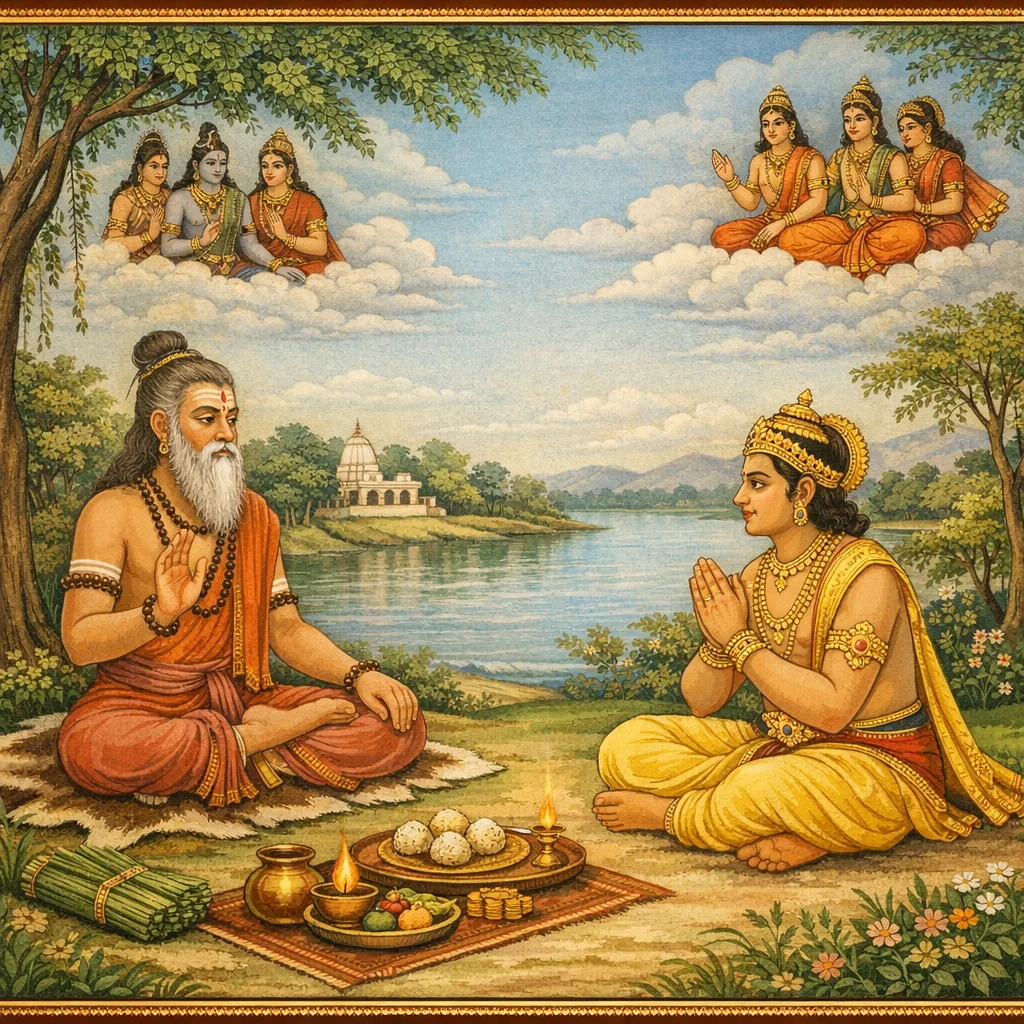
Adhyaya 146
Chapter 146 unfolds as a dialogue: Yudhiṣṭhira asks for the māhātmya (sacred greatness) of a foremost ancestral tīrtha named Asmahaka, and Mārkaṇḍeya replies by citing an earlier authoritative inquiry in an assembly of ṛṣis and devas. The teaching exalts Asmahaka above comparable pilgrimage complexes and ties its power to pitṛ-centered rites: even a single offering of piṇḍa and water can free ancestors from preta-affliction, grant long satisfaction, and yield enduring merit. Ethical counsel is woven in—upholding maryādā according to śruti–smṛti—along with karma doctrine: the embodied being departs “like the wind,” tasting results individually, while social-religious order is sustained through prescribed duties such as snāna, dāna, japa, homa, svādhyāya, deva-arcana, atithi-pūjana, and especially piṇḍodaka-pradāna. A substantial portion details auspicious timings and site-features: amāvāsyā, Vyatīpāta, Manv-ādi, Yug-ādi, ayana/viṣuva, and solar transitions; and a divinely made Brahma-śilā described as gaja-kumbha-nibhā. In Kali-yuga it is said to become especially manifest around Vaiśākha-amāvāsyā. The procedure includes bathing, mantra-praise of Nārāyaṇa/Keśava, feeding brāhmaṇas, śrāddha with darbha and dakṣiṇā, and optional offerings (milk, honey, curd, cool water) understood as directly sustaining the pitṛs. Cosmic witnesses—devas, pitṛs, rivers, oceans, and many ṛṣis—are enumerated to stabilize the site’s authority. The chapter closes with expansive phalāśruti: purification from grave faults, equivalence to great Vedic sacrifices, uplift of ancestors from hell-states, and worldly prosperity, while maintaining a neutral synthesis that treats Brahmā–Viṣṇu–Maheśvara as functionally unified powers.
Shlokas
Verse 1
। मार्कण्डेय उवाच । अस्माहकं ततो गच्छेत्पितृतीर्थमनुत्तमम् । प्रेतत्वाद्यत्र मुच्यन्ते पिण्डेनैकेन पूर्वजाः
Mārkaṇḍeya said: Thereafter one should go to Asmāhaka, the unsurpassed Pitṛ-tīrtha. There, the ancestors are freed from the state of being pretas and other afflictions, by a single piṇḍa-offering.
Verse 2
युधिष्ठिर उवाच । अस्माहकस्य माहात्म्यं कथयस्व ममानघ । स्नानदानेन यत्पुण्यं तथा पिण्डोदकेन च
Yudhiṣṭhira said: O sinless one, tell me the greatness of Asmāhaka—what merit arises from bathing and giving, and also from offering piṇḍa and water oblations.
Verse 3
श्रीमार्कण्डेय उवाच । पुरा कल्पे नृपश्रेष्ठ ऋषिदेवसमागमे । प्रश्नः पृष्टो मया तात यथा त्वमनुपृच्छसि
Śrī Mārkaṇḍeya said: In a former kalpa, O best of kings, at a gathering of ṛṣis and devas, I myself asked this very question, dear one—just as you ask now.
Verse 4
एकत्र सागराः सप्त सप्रयागाः सपुष्कराः । नास्य साम्यं लभन्ते ते नात्र कार्या विचारणा
Even if the seven oceans, together with Prayāga and Puṣkara, were gathered into one place, they would not equal it; here there is no need for further deliberation.
Verse 5
सोमनाथं तु विख्यातं यत्सोमेन प्रतिष्ठितम् । तत्र सोमग्रहे पुण्यं तत्पुण्यं लभते नरः
Somnātha is renowned—established there by Soma, the Moon. Whoever performs at that very place the sacred rite of Somagraha, the ‘seizing’ of Soma, gains the merit belonging to that observance.
Verse 6
मासान्ते पितरो नृणां वीक्षन्ते सन्ततिं स्वकाम् । कश्चिदस्मत्कुलेऽस्माकं पिण्डमत्र प्रदास्यति
At the close of each month, the Pitṛs look toward their own human lineage, wondering: ‘Will someone of our family offer the piṇḍa here?’
Verse 7
प्रपितामहास्तथादित्याः श्रुतिरेषा सनातनी । एवं ब्रुवन्ति देवाश्च ऋषयः सतपोधनाः
So too speak the great-grandfathers and the Ādityas—this is the eternal teaching of Śruti. In this very way speak also the devas and the ṛṣis, rich in tapas and spiritual wealth.
Verse 8
सकृत्पिण्डोदकेनैव शृणु पार्थिव यत्फलम् । द्वादशाब्दानि राजेन्द्र योगं भुक्त्वा सुशोभनम्
Hear, O king, the fruit that arises even from a single offering of piṇḍa and water. O lord of kings, the ancestor enjoys a splendid state of well-being for twelve years.
Verse 9
युगे युगे महाराज अस्माहके पितामहाः । सर्वदा ह्यवलोकन्त आगच्छन्तं स्वगोत्रजम्
Age after age, O great king, our forefathers continually watch, awaiting the arrival of one from their own clan.
Verse 10
भविष्यति किमस्माकममावास्याप्यमाहके । स्नानं दानं च ये कुर्युः पितॄणां तिलतर्पणम्
“What will become of us, even on Amāvāsyā, even in Māgha?”—thus they worry. Those who perform bathing and charity, and who offer sesame-water libations (tilatarpaṇa) to the Pitṛs, bring them support.
Verse 11
ते सर्वपापनिर्मुक्ताः सर्वान्कामांल्लभति वै । जलमध्येऽत्र भूपाल अग्नितीर्थं च तिष्ठति
They are freed from all sins and indeed obtain all desired aims. Here, O king, in the midst of the waters stands the sacred ford known as Agnitīrtha.
Verse 12
दर्शनात्तस्य तीर्थस्य पापराशिर्विलीयते । स्नानमात्रेण राजेन्द्र ब्रह्महत्यां व्यपोहति
By merely beholding that sacred ford, a mass of sins melts away. By bathing alone, O lord of kings, one casts off even the sin of brahmahatyā, the gravest transgression.
Verse 13
शुक्लाम्बरधरो नित्यं नियतः स जितेन्द्रियः । एककालं तु भुञ्जानो मासं तीर्थस्य सन्निधौ
Wearing white garments each day, disciplined and master of the senses, eating only once daily—let one dwell for a month in the presence of the sacred tīrtha.
Verse 14
सुवर्णालंकृतानां तु कन्यानां शतदानजम् । फलमाप्नोति सम्पूर्णं पितृलोके महीयते
In full he attains the fruit equal to the gift of a hundred maidens adorned with gold, and he is honored in the world of the Pitṛs, the Ancestors.
Verse 15
पृथिव्यामासमुद्रायां महाभोगपतिर्भवेत् । धनधान्यसमायुक्तो दाता भवति धार्मिकः
By the power of this sacred observance, one becomes a lord of great enjoyments on earth, even to the ocean’s bounds—endowed with wealth and grain, a giver of gifts, steadfast in dharma.
Verse 16
उपवासी शुचिर्भूत्वा ब्रह्मलोकमवाप्नुयात् । अस्माहकं समासाद्य यस्तु प्राणान् परित्यजेत्
Fasting and becoming pure, one may attain Brahmā’s world. And whoever, having reached this holy place of ours, relinquishes the life-breath here—he too attains the highest auspicious destiny.
Verse 17
कोटिवर्षसहस्राणि रुद्रलोके महीयते । ततः स्वर्गात्परिभ्रष्टः क्षीणकर्मा दिवश्च्युतः
For thousands of crores of years he is honored in Rudra’s realm; then, when his merit is exhausted, he falls from heaven—his store of karma spent, descended from the celestial state.
Verse 18
सुवर्णमणिमुक्ताढ्ये कुले जायेत रूपवान् । कृत्वाभिषेकविधिना हयमेधफलं लभेत्
He is reborn in a lineage abundant in gold, gems, and pearls, endowed with beauty; and by performing the abhiṣeka rite of consecratory bathing, he attains the fruit of the Aśvamedha sacrifice.
Verse 19
धनाढ्यो रूपवान्दक्षो दाता भवति धार्मिकः । चतुर्वेदेषु यत्पुण्यं सत्यवादिषु यत्फलम्
He becomes wealthy, handsome, capable, a generous giver, and righteous in dharma. Whatever merit abides in the four Vedas, and whatever fruit belongs to those who speak truth—
Verse 20
तत्फलं लभते नूनं तत्र तीर्थेऽभिषेचनात् । तीर्थानां परमं तीर्थं निर्मितं शम्भुना पुरा
That very fruit, indeed, one surely gains by performing the abhiṣeka consecratory bathing at that holy tīrtha. It is the supreme tīrtha among tīrthas, fashioned long ago by Śambhu (Śiva).
Verse 21
हृदयेशः स्वयं विष्णुर्जपेद्देवं महेश्वरम् । गन्धर्वाप्सरसश्चैव मरुतो मारुतास्तथा
Viṣṇu himself, the Lord who abides within the heart, recites in japa the Divine Maheśvara; and so too do the Gandharvas and Apsarases, and the Maruts, the wind-gods.
Verse 22
विश्वेदेवाश्च पितरः सचन्द्राः सदिवाकराः । मरीचिरत्र्यङ्गिरसौ पुलस्त्यः पुलहः क्रतुः
The Viśvedevas and the Fathers (Pitṛs), together with the Moon and the Sun; and the sages Marīci, Atri, and Aṅgiras; Pulastya, Pulaha, and Kratu—
Verse 23
प्रचेताश्च वसिष्ठश्च भृगुर्नारद एव च । च्यवनो गालवश्चैव वामदेवो महामुनिः
There were Pracetā and Vasiṣṭha, Bhṛgu and also Nārada; likewise Cyavana, Gālava, and Vāmadeva, the great sage—
Verse 24
वालखिल्याश्च गन्धारास्तृणबिन्दुश्च जाजलिः । उद्दालकश्चर्ष्यशृङ्गो वसिष्ठश्च सनन्दनः
The Vālakhilyas and the Gandhāras were there; Tṛṇabindu and Jājali; Uddālaka and Ṛśyaśṛṅga; and Vasiṣṭha together with Sanandana—
Verse 25
शुक्रश्चैव भरद्वाजो वात्स्यो वात्स्यायनस्तथा । अगस्तिर्मित्रावरुणौ विश्वामित्रो मुनीश्वरः
There too were Śukra and Bharadvāja, Vātsya and Vātsyāyana; Agastya—born of Mitra and Varuṇa—and the lordly sage Viśvāmitra.
Verse 26
गौतमश्च पुलस्त्यश्च पौलस्त्यः पुलहः क्रतुः । सनातनस्तु कपिलो वाह्निः पञ्चशिखस्तथा
Gautama and Pulastya were there, as well as Paulastya, Pulaha, and Kratu; and also Sanātana, Kapila, Vahni, and Pañcaśikha.
Verse 27
अन्येऽपि बहवस्तत्र मुनयः शंसितव्रताः । क्रीडन्ति देवताः सर्व ऋषयः सतपोधनाः
Many other sages as well—whose vows are renowned—were present there; and the deities too sported there, along with all those ṛṣis rich in the wealth of austerity.
Verse 28
मनुष्याश्चैव योगीन्द्राः पितरः सपितामहाः । अस्माहकेऽत्र तिष्ठन्ति सर्व एव न संशयः
Here dwell men also, and the great lords of yoga; the Pitṛs too—together with the grandfathers. All of them abide here for our sake; of this there is no doubt.
Verse 29
पितरः पितामहाश्चैव तथैव प्रपितामहाः । येषां दत्तमुपस्थायि सुकृतं वापि दुष्कृतम्
The fathers, the grandfathers, and likewise the great-grandfathers—before whom one’s offerings stand present—whether those deeds be meritorious or even demeritorious.
Verse 30
अक्षयं तत्र तत्सर्वं यत्कृतं योधनीपुरे । मातरं पितरं त्यक्त्वा सर्वबन्धुसुहृज्जनान्
All that is done there becomes imperishable—whatever is performed at Yodhanīpura—even by one who has abandoned mother and father, and all kinsmen and well-wishers.
Verse 31
धनं धान्यं प्रियान्पुत्रांस्तथा देहं नृपोत्तम । गच्छते वायुभूतस्तु शुभाशुभसमन्वितः
Wealth, grain, beloved sons—and even the body itself, O best of kings—are left behind; the being departs as if become wind, accompanied only by one’s good and evil deeds.
Verse 32
अदृश्यः सर्वभूतानां परमात्मा महत्तरः । शुभाशुभगतिं प्राप्तः कर्मणा स्वेन पार्थिव
Invisible to all beings, the Supreme Self—greater than the great—attains a good or evil course according to one’s own deeds, O king.
Verse 33
युधिष्ठिर उवाच । शुभाशुभं न बन्धूनां जायते केन हेतुना । एकः प्रसूयते जन्तुरेक एव प्रलीयते
Yudhiṣṭhira said: For what reason do a person’s good and evil not belong to the relatives? A creature is born alone, and alone indeed it perishes.
Verse 34
एको हि भुङ्क्ते सुकृतमेक एव हि दुष्कृतम्
Indeed, one alone enjoys the fruit of merit, and one alone likewise bears the fruit of sin.
Verse 35
मार्कण्डेय उवाच । एष त्वयोक्तो नृपते महाप्रश्नः स्मृतो मया
Mārkaṇḍeya said: O King, this profound question that you have asked has been recalled by me.
Verse 36
पितामहमुखोद्गीतं श्रुतं ते कथयाम्यहम् । यन्मे पितामहात्पूर्वं विज्ञातमृषिसंसदि
I shall recount to you what I heard as it was sung from the mouth of the Grandfather (Brahmā)—that very teaching which I earlier came to know from my grandsire in the assembly of sages.
Verse 37
न माता न पिता बन्धुः कस्यचिन्न सुहृत्क्वचित् । कस्य न ज्ञायते रूपं वायुभूतस्य देहिनः
For some embodied being—wind-like in nature—there is no mother, no father, no kinsman, and nowhere any true friend; and his form is not known to anyone.
Verse 38
यद्येवं न भवेत्तात लोकस्य तु नरेश्वर । अमर्यादं भवेन्नूनं विनश्यति चराचरम्
If it were not so, dear one—O lord of men—then surely the world would become without restraint; and all that moves and all that is still would fall into ruin.
Verse 39
एवं ज्ञात्वा पूरा राजन्समस्तैर्लोककर्तृभिः । मर्यादा स्थापिता लोके यथा धर्मो न नश्यति
Knowing this, O King, in former times all the world-sustainers established proper boundaries in the world, so that dharma would not perish.
Verse 40
धर्मे नष्टे मनुष्याणामधर्मोऽभिभवेत्पुनः । ततः स्वधर्मचलनान्नरके गमनं ध्रुवम्
When dharma is destroyed among human beings, adharma again overpowers them. Then, from straying from one’s own duty, going to hell becomes certain.
Verse 41
लोको निरङ्कुशः सर्वो मर्यादालङ्घने रतः । मर्यादा स्थापिता तेन शास्त्रं वीक्ष्य महर्षिभिः
All people become unrestrained, delighting in transgressing boundaries. Therefore the great seers, examining the śāstras, established proper limits.
Verse 42
स्नानं दानं जपो होमः स्वाध्यायो देवतार्चनम् । पिण्डोदकप्रदानं च तथैवातिथिपूजनम्
Bathing, charity, mantra-recitation, fire-offering (homa), Vedic study, worship of the deities, offering piṇḍa and water to the ancestors, and likewise honoring guests—
Verse 43
पितरः पितामहाश्चैव तथैव प्रपितामहाः । त्रयो देवाः स्मृतास्तात ब्रह्मविष्णुमहेश्वराः
The fathers, the grandfathers, and likewise the great-grandfathers—these, dear one, are remembered as a triad of deities: Brahmā, Viṣṇu, and Maheśvara.
Verse 44
पूजितैः पूजिताः सर्वे तथा मातामहास्त्रयः । तस्मात्सर्वप्रयत्नेन श्रुतिस्मृत्यर्थनोदितान्
When they are worshipped, all are thereby worshipped—likewise the three maternal grandfathers as well. Therefore, with every effort, one should follow what is enjoined by the intent of Śruti and Smṛti.
Verse 45
धर्मं समाचरन्नित्यं पापांशेन न लिप्यते । श्रुतिस्मृत्युदितं धर्मं मनसापि न लङ्घयेत्
One who practices dharma every day is not stained by even a trace of sin. One should not transgress—even in the mind—the dharma proclaimed in Śruti and Smṛti.
Verse 46
इह लोके परे चैव यदीच्छेच्छ्रेय आत्मनः । पितापुत्रौ सदाप्येकौ बिम्बाद्बिम्बमिवोद्धृतौ
If one desires one’s own welfare—here in this world and also in the next—know that father and son are always bound as one, like an image drawn forth from an image.
Verse 47
विभक्तौ वाविभक्तौ वा श्रुतिस्मृत्यर्थतस्तथा । उद्धरेदात्मनात्मानमात्मानमवसादयेत्
Whether divided or undivided, one should act in accordance with the intent of Śruti and Smṛti. By one’s own self one should lift oneself up—one should not cast oneself down.
Verse 48
पिण्डोदकप्रदानाभ्यामृते पार्थ न संशयः । एवं ज्ञात्वा प्रयत्नेन पिण्डोदकप्रदो भवेत्
Without offering piṇḍa (funeral rice-balls) and udaka (libations of water), O Pārtha, there is no doubt that one falls short of one’s duty. Knowing this, one should strive diligently to become an offerer of piṇḍa and udaka.
Verse 49
आयुर्धर्मो यशस्तेजः सन्ततिश्चैव वर्धते । पृथिव्यां सागरान्तायां पितृक्षेत्राणि यानि च
Life-span, dharma, fame, spiritual brilliance, and progeny all increase. And on this earth, bounded by the oceans, there are sacred “ancestral fields” (pitṛ-kṣetras)…
Verse 50
तानि ते सम्प्रवक्ष्यामि येषु दत्तं महाफलम् । गयायां पुष्करे ज्येष्ठे प्रयागे नैमिषे तथा
I shall now tell you of those places where offerings bring immense reward: at Gayā, at Puṣkara, at Jyeṣṭha-tīrtha, at Prayāga, and likewise at Naimiṣa.
Verse 51
संनिहत्यां कुरुक्षेत्रे प्रभासे कुरुनन्दन । पिण्डोदकप्रदानेन यत्फलं कथितं बुधैः
At Saṃnihitā in Kurukṣetra, and at Prabhāsa, O joy of the Kurus—whatever merit the wise have declared to arise from offering piṇḍa and udaka (there)…
Verse 52
अस्माहके तदाप्नोति नर्मदायां न संशयः । तत्र ब्रह्मा मुरारिश्च रुद्रश्च उमया सह
That very fruit is attained in our own place—on the Narmadā—without any doubt. There dwell Brahmā, Murāri (Viṣṇu), and Rudra together with Umā.
Verse 53
इन्द्राद्या देवताः सर्वे पितरो मुनयस्तथा । सागराः सरितश्चैव पर्वताश्च बलाहकाः
There are Indra and all the gods, the Pitṛs and the sages as well—oceans, rivers, mountains, and the rain-bearing clouds—present in that place.
Verse 54
तिष्ठन्ति पितरः सर्वे सर्वतीर्थाधिकं ततः । स्थिता ब्रह्मशिला तत्र गजकुम्भनिभा नृप
All the Pitṛs abide there; therefore it surpasses every other tīrtha. There stands the Brahmaśilā, O king, resembling the rounded forehead of an elephant.
Verse 55
कलौ न दृश्या भवति प्रधानं यद्गयाशिरः । वैशाखे मासि सम्प्राप्तेऽमावास्यां नृपोत्तम
O best of kings, in the Kali age that foremost holy mark known as Gayāśiras is not ordinarily seen; but when the new-moon day in the month of Vaiśākha arrives, it becomes manifest.
Verse 56
व्याप्य सा तिष्ठते तीर्थं गजकुम्भनिभा शिला । तच्च गव्यूतिमात्रं हि तीर्थं ततः प्रवक्षते
That stone, like the rounded forehead of an elephant, pervades the place and establishes the tīrtha there; and that sacred precinct is said to extend for the measure of one gavyūti—thus is the tīrtha’s extent declared.
Verse 57
तस्मिन्दिने तत्र गत्वा यस्तु श्राद्धप्रदो भवेत् । पितॄणामक्षया तृप्तिर्जायते शतवार्षिकी
Whoever goes there on that very day and offers śrāddha, an imperishable satisfaction arises for the ancestors, enduring for a hundred years.
Verse 58
अन्यस्यामप्यमावास्यां यः स्नात्वा विजितेन्द्रियः । करोति मनुजः श्राद्धं विधिवन्मन्त्रसंयुतम्
Even on another new-moon day (amāvasyā), a person who bathes, has conquered the senses, and performs śrāddha in due rite, accompanied by mantras—
Verse 59
तस्य पुण्यफलं यत्स्यात्तच्छृणुष्व नराधिप । अग्निष्टोमाश्वमेधाभ्यां वाजपेयस्य यत्फलम्
Hear, O king, the merit that arises from it: it equals the fruit of the Agniṣṭoma and Aśvamedha sacrifices, and likewise the fruit of the Vājapeya.
Verse 60
तत्फलं समवाप्नोति यथा मे शङ्करोऽब्रवीत् । रौरवादिषु सर्वेषु नरकेषु व्यवस्थिताः
He attains that very fruit, just as Śaṅkara told me. And those who are lodged in all the hells beginning with Raurava—
Verse 61
पिता पितामहाद्याश्च पितृके मातृके तथा । पिण्डोदकेन चैकेन तर्पणेन विशेषतः
Father, grandfathers, and the rest—on both the paternal and maternal lines—are especially satisfied by a single offering of piṇḍa and water, above all by tarpaṇa.
Verse 62
क्रीडन्ति पितृलोकस्था यावदाभूतसम्प्लवम् । ये कर्मस्था विकर्मस्था ये जाताः प्रेतकल्मषाः
Those dwelling in the world of the ancestors (Pitṛloka) rejoice until the cosmic dissolution; and even those bound to deeds or misdeeds—those born with the defilement of the preta-state—
Verse 63
पिण्डेनैकेन मुच्यन्ते तेऽपि तत्र न संशयः । अस्माहके शिला दिव्या तिष्ठते गजसन्निभा
By a single piṇḍa offering, even they are released there—of this there is no doubt. In our region stands a divine stone, elephant-like in form.
Verse 64
ब्रह्मणा निर्मिता पूर्वं सर्वपापक्षयंकरी । उपर्यस्या यथान्यायं पितॄनुद्दिश्य भारत
Fashioned long ago by Brahmā, it brings about the destruction of all sins. Upon it, O Bhārata, one should duly perform the rites, directing them toward the ancestors.
Verse 65
दक्षिणाग्रेषु दर्भेषु दद्यात्पिण्डान्विचक्षणः । भूमौ चान्नेन सिद्धेन श्राद्धं कृत्वा यथाविधि
A discerning man should offer the piṇḍas upon kuśa-grass whose tips are set to the south; and on the ground, with properly cooked food, he should perform the śrāddha according to the prescribed rite.
Verse 66
श्राद्धिभ्यो वस्त्रयुग्मानि छत्रोपानत्कमण्डलु । दक्षिणा विविधा देया पितॄनुद्दिश्य भारत
To the brāhmaṇas participating in the śrāddha one should give pairs of garments, along with an umbrella, footwear, and a water-pot; and diverse gifts (dakṣiṇā) should be offered, O Bhārata, with the Pitṛs in mind.
Verse 67
यो ददाति द्विजश्रेष्ठ तस्य पुण्यफलं शृणु । तस्य ते द्वादशाब्दानि तृप्तिं यान्ति न संशयः
O best of the twice-born, hear the meritorious fruit of one who gives: his ancestors attain satisfaction for twelve years—of this there is no doubt.
Verse 68
अस्माहके महाराज पितरश्च पितामहाः । वायुभूता निरीक्षन्ते आगच्छन्तं स्वगोत्रजम्
O great king, our fathers and grandfathers—having become subtle like the wind—watch for the arrival of one born in their own lineage.
Verse 69
अत्र तीर्थे सुतोऽभ्येत्य स्नात्वा तोयं प्रदास्यति । श्राद्धं वा पिण्डदानं वा तेन यास्याम सद्गतिम्
“At this sacred ford our son will come; having bathed, he will offer water. Whether he performs śrāddha or offers piṇḍas, by that we shall attain a good state.”
Verse 70
स्नाने कृते तु ये केचिज्जायन्ते वस्त्रविप्लुषः । प्रीणयेन्नरकस्थांस्तु तैः पितॄन्नात्र संशयः
When the bath is performed, whatever droplets fall from one’s garment—by those very drops one pleases the Pitṛs who are in hell; of this there is no doubt.
Verse 71
केशोदबिन्दवस्तस्य ये चान्ये लेपभाजिनः । तृप्यन्त्यनग्निनसंस्कारा यं मृताः स्युः स्वगोत्रजाः
The drops of water from his hair, and whatever other droplets cling to his body—by them are satisfied even those dead kinsmen of his own lineage who departed without the funeral rites of fire.
Verse 72
तत्र तीर्थे तु ये केचिच्छ्राद्धं कृत्वा विधानतः । नरकादुद्धरन्त्याशु जपन्तः पितृसंहिताम्
At that tīrtha, whoever performs śrāddha according to the proper rule and recites the Pitṛ-saṃhitā quickly rescues (their ancestors) from hell.
Verse 73
वनस्पतिगते सोमे यदा सोमदिनं भवेत् । अक्षयाल्लभते लोकान्पिण्डेनैकेन मानवः
When the Moon is in the Vanaspati asterism and it is Monday, a man attains imperishable worlds even by offering a single piṇḍa.
Verse 74
अक्षयं तत्र वै सर्वं जायते नात्र संशयः । नरकादुद्धरन्त्याशु जपन्ते पितृसंहिताम्
There, indeed, everything becomes imperishable—of this there is no doubt; and by reciting the Pitṛ-saṃhitā they quickly rescue their ancestors from hell.
Verse 75
तस्मिंस्तीर्थे त्वमावास्यां पितॄनुद्दिश्य भारत । नीलं सर्वाङ्गसम्पूर्णं योऽभिषिच्य समुत्सृजेत्
O Bhārata, on the new-moon day at that sacred ford, one who, dedicating the act to the Pitṛs, bathes (consecrates) and then releases a fully sound, whole-limbed ‘nīla’ bull in the rite of vṛṣotsarga performs a powerful act of ancestral dharma.
Verse 76
तस्य पुण्यफलं वक्तुं न तु वाचस्पतिः क्षमः । अस्माहके वृषोत्सर्गाद्यत्पुण्यं समवाप्यते
Even Vācaspati himself is not capable of fully describing the meritorious fruit of that act—the vast puṇya that is attained here through the rite of vṛṣotsarga.
Verse 77
तव शुश्रूषणात्सर्वं तत्प्रवक्ष्यामि भारत । रौरवादिषु ये किंचित्पच्यन्ते तस्य पूर्वजाः
Because of your attentive service, O Bhārata, I shall explain all of that. Even those of his forefathers who are suffering in hells such as Raurava—
Verse 78
वृषोत्सर्गेण तान्सर्वांस्तारयेदेकविंशतिम् । लोहितो यस्तु वर्णेन मुखे पुच्छे च पाण्डुरः
By the rite of releasing a bull, one delivers them all—twenty-one forefathers. The bull should be reddish in hue, yet pale at the face and at the tail—
Verse 79
पिङ्गः खुरविषाणाभ्यां स नीलो वृष उच्यते । यस्तु सर्वाङ्गपिङ्गश्च श्वेतः पुच्छखुरेषु च
If a bull is tawny at the hooves and horns, it is called a ‘nīla’ bull. But the one that is tawny over the whole body and white at the tail and hooves—
Verse 80
स पिङ्गो वृष इत्याहुः पितॄणां प्रीतिवर्धनः । पारावतसवर्णश्च ललाटे तिलको भवेत्
That one is called the ‘piṅga’ bull, and it increases the joy of the Pitṛs. It should also bear a dove-like hue and carry a tilaka mark upon the forehead.
Verse 81
तं वृषं बभ्रुमित्याहुः पूर्णं सर्वाङ्गशोभनम् । सर्वाङ्गेष्वेकवर्णो यः पिङ्गः पुच्छखुरेषु च
That bull is called ‘babhru’—complete and beautiful in every limb. It is of one uniform color over the whole body, and tawny at the tail and hooves—
Verse 82
खुरपिङ्गं तमित्याहुः पितॄणां सद्गतिप्रदम् । नीलं सर्वशरीरेण स्वारक्तनयनं दृढम्
They call that one ‘khura-piṅga’, a bestower of a good destiny upon the Pitṛs. (Another is) the ‘nīla’: blue over the whole body, with naturally reddish eyes, and strong—
Verse 83
तमेव नीलमित्याहुर्नीलः पञ्चविधः स्मृतः । यस्तु वैश्यगृहे जातः स वै नीलो विशिष्यते
That indeed is called “nīla”; the nīla is remembered as fivefold. Yet the one born in a Vaiśya household is regarded as the most distinguished nīla.
Verse 84
न वाहयेद्गृहे जातं वत्सकं तु कदाचन । तेनैव च वृषोत्सर्गे पितॄणामनृणो भवेत्
One should never make a calf born in one’s own home bear burdens or labor. And by that very animal, in the rite of vṛṣotsarga, one becomes free of debt to the Pitṛs.
Verse 85
जातं तु स्वगृहे वत्सं द्विजन्मा यस्तु वाहयेत् । पतन्ति पितरस्तस्य ब्रह्मकोकगता अपि
If a twice-born man makes a calf newly born in his own house labor, then his ancestors are said to fall, even if they have reached Brahmaloka.
Verse 86
यथायथा हि पिबति पीत्वा धूनाति मस्तकम् । पिबन्पितॄन् प्रीणयति नरकादुद्धरेद्धुनन्
In whatever way it drinks, and after drinking shakes its head: by drinking it gladdens the Pitṛs, and by that shaking it swiftly lifts them up from hell.
Verse 87
यथा पुच्छाभिघातेन स्कन्धं गच्छन्ति बिन्दवः । नरकादुद्धरन्त्याशु पतितान् गोत्रिणस्तथा
Just as, with the blow of a tail, droplets fly onto the shoulder, so too it quickly lifts up fallen kinsmen of the same lineage from hell.
Verse 88
गर्जन्प्रावृषि काले तु विषाणाभ्यां भुवं लिखन् । खुरेभ्यो या मृदुद्भूता तया संप्रीणयेदृषीन्
When it bellows in the season of rains and, with its horns, scratches the earth, the soft earth that rises from its hooves—by that one satisfies the Ṛṣis.
Verse 89
पिबन्पितॄन् प्रीणयते खादनोल्लेखने सुरान् । गर्जन्नृषिमनुष्यांश्च धर्मरूपो हि धर्मज
By drinking it pleases the ancestors; by eating and scraping the ground it pleases the gods; by bellowing it pleases Ṛṣis and humans as well—for it is truly Dharma embodied, O son of Dharma.
Verse 90
भूतैर्वापि पिशाचैर्वा चातुर्थिकज्वरेण वा । गृहीतोऽस्माहकं गच्छेत्सर्वेषामाधिनाशनम्
Whether seized by spirits (bhūtas), by piśācas, or by quartan fever—let the afflicted person go to this place; it destroys the ailments of all.
Verse 91
स्नात्वा तु विमले तोये दर्भग्रन्थिं निबन्धयेत् । मस्तके बाहुमूले वा नाभ्यां वा गलकेऽपि वा
After bathing in pure water, one should tie a knot of darbha-grass—on the head, or at the root of the arm, or at the navel, or even at the throat.
Verse 92
गत्वा देवसमीपं च प्रादक्षिण्येन केशवम् । ततः समुच्चरन्मन्त्रं गायत्र्या वाथ वैष्णवम्
Going near the deity and circumambulating Keśava in pradakṣiṇā, one should then recite a mantra—either the Gāyatrī or a Vaiṣṇava mantra.
Verse 93
नारायणं शरण्येशं सर्वदेवनमस्कृतम् । नमो यज्ञाङ्गसम्भूत सर्वव्यापिन्नमोऽस्तु ते
Salutations to Nārāyaṇa, the Lord who is refuge, revered by all the gods. Salutations to you who manifest as the limbs of sacrifice; O all-pervading One, salutations be to you.
Verse 94
नमो नमस्ते देवेश पद्मगर्भ सनातन । दामोदर जयानन्त रक्ष मां शरणागतम्
Homage, homage to you, O Lord of the gods—O Eternal One, lotus-wombed. O Dāmodara, O victorious Ananta—protect me who has come seeking refuge.
Verse 95
त्वं कर्ता त्वं च हर्ता च जगत्यस्मिंश्चराचरे । त्वं पालयसि भूतानि भुवनं त्वं बिभर्षि च
You alone are the creator, and you alone are the withdrawer, of this moving and unmoving world. You protect all beings, and you uphold the whole universe as well.
Verse 96
प्रसीद देवदेवेश सुप्तमङ्गं प्रबोधय । त्वद्ध्याननिरतो नित्यं त्वद्भक्तिपरमो हरे
Be gracious, O Lord of the gods. Awaken your sleeping limb. O Hari—ever absorbed in meditation on you, and devoted to you above all—I seek your favor.
Verse 97
इति स्तुतो मया देव प्रसादं कुरु मेऽच्युत । मां रक्ष रक्ष पापेभ्यस्त्रायस्व शरणागतम्
Thus praised by me, O God—show me your grace, O Acyuta. Protect me, protect me from sins; save me, for I have come seeking refuge.
Verse 98
एवं स्तुत्वा च देवेशं दानवान्तकरं हरिम् । पुनरुक्तेन वै स्नात्वा ततो विप्रांस्तु भोजयेत्
Thus, having praised the Lord of lords, Hari—the destroyer of the Dānavas—one should bathe again with the prescribed recitation, and then feed the brāhmaṇas.
Verse 99
वेदोक्तेन विधानेन स्नानं कृत्वा यथाविधि । पिण्डनिर्वपणं कृत्वा वाचयेत्स्वस्तिकं ततः
After bathing according to rule, following the procedure taught in the Vedas, one should perform the offering of piṇḍas; thereafter, one should have the svastika-rite recited.
Verse 100
एवं स्तुत्वा च देवेशं दानवान्तकरं हरिम् । पुनरुक्तेन वै स्नात्वा ततो विप्रांस्तु भोजयेत्
Thus, having praised the Lord of lords, Hari—the destroyer of the Dānavas—one should bathe again with the prescribed recitation, and then feed the brāhmaṇas.
Verse 101
वेदोक्तेन विधानेन स्नानं कृत्वा यथाविधि । एवं तान्वाचयित्वा तु ततो विप्रान्विसर्जयेत्
Having bathed according to rule, following the Vedic procedure, and having them recite in this manner, one should then respectfully dismiss the brāhmaṇas.
Verse 102
यत्तत्रोच्चरितं किंचित्तद्विप्रेभ्यो निवेदयेत् । तत्र तीर्थे नरः स्नात्वा नारी वा भक्तितत्परा । शक्तितो दक्षिणां दद्यात्कृत्वा श्राद्धं यथाविधि
Whatever has been recited there, one should duly present it to the brāhmaṇas. At that tīrtha, whether a man after bathing or a woman devoted with faith, having performed śrāddha in the proper manner, should give dakṣiṇā according to one’s capacity.
Verse 103
तत्र तीर्थे नरो यावत्स्नापयेद्विधिपूर्वकम् । क्षीरेण मधुना वापि दध्ना वा शीतवारिणा
At that tīrtha, for as long as a man performs the ritual bathing in due form—whether with milk, with honey, with curd, or with cool water—
Verse 104
तावत्पुष्करपात्रेषु पिबन्ति पितरो जलम् । अयने विषुवे चैव युगादौ सूर्यसंक्रमे
For that very duration, the Pitṛs drink the water from lotus-vessels—especially at the solstices, the equinoxes, at the beginning of an age, and at the Sun’s transitions (saṅkrānti).
Verse 105
पुष्पैः सम्पूज्य देवेशं नैवेद्यं यः प्रदापयेत् । सोऽश्वमेधस्य यज्ञस्य फलं प्राप्नोति पुष्कलम्
Whoever worships the Lord of the gods with flowers and offers him food as naivedya attains abundant merit—the very fruit of the Aśvamedha sacrifice.
Verse 106
तत्र तीर्थे तु यो राजन् सूर्यग्रहणमाचरेत् । सूर्यतेजोनिभैर्यानैर्विष्णुलोके महीयते
O King, whoever observes the solar eclipse at that sacred ford is honored in Viṣṇu’s realm, conveyed by radiant celestial vehicles born of the Sun’s splendor.
Verse 107
तत्र तीर्थे तु यः श्राद्धं पितृभ्यः सम्प्रयच्छति । सत्पुत्रेण च तेनैव सम्प्राप्तं जन्मनः फलम्
Whoever, at that sacred ford, duly offers śrāddha to the ancestors—by that very act he gains the true fruit of birth, as though blessed with a virtuous son.
Verse 108
इति श्रुत्वा ततो देवाः सर्वे शक्रपुरोगमाः । ब्रह्मविष्णुमहेशाश्च स्थापयांचक्रुरीश्वरम्
Hearing this, all the gods led by Śakra—together with Brahmā, Viṣṇu, and Maheśa—then established the Lord (Īśvara) there.
Verse 109
सर्वरोगोपशमनं सर्वपातकनाशनम् । यस्तु संवत्सरं पूर्णममावास्यां तु भावितः
It pacifies all diseases and destroys all sins—such is the merit of one who, for a full year, remains devoted to the Amāvāsyā observance.
Verse 110
पितृभ्यः पिण्डदानं च कुर्यादस्माहके नृप । त्रिपुष्करे गयायां च प्रभासे नैमिषे तथा
O King, one should offer piṇḍas to the ancestors at Asmāhaka—(with merit comparable to offerings made) at Tripuṣkara, at Gayā, at Prabhāsa, and likewise at Naimiṣa.
Verse 111
यत्पुण्यं श्राद्धकर्तॄणां तदिहैव भवेद्ध्रुवम् । तिलोदकं कुशैर्मिश्रं यो दद्याद्दक्षिणामुखः
Whatever merit accrues to those who perform śrāddha—here itself it surely arises. He who, facing south, offers sesame-water mixed with kuśa grass (as tarpaṇa) gains that certain fruit.
Verse 112
मन्वादौ च युगादौ च व्यतीपाते दिनक्षये । यो दद्यात्पितृमातृभ्यः सोऽश्वमेधफलं लभेत्
At the beginning of a Manvantara, at the beginning of a Yuga, at Vyatīpāta, and at day’s end—whoever gives offerings to ancestors and mothers attains the fruit of the Aśvamedha.
Verse 113
अस्माहके नरो यस्तु स्नात्वा सम्पूजयेद्धरिम् । ब्रह्माणं शङ्करं भक्त्या कुर्याज्जागरणक्रियाम्
At Asmāhaka, the man who bathes and duly worships Hari—and with devotion also honors Brahmā and Śaṅkara—should perform the rite of night-vigil (jāgaraṇa).
Verse 114
सर्वपापविनिर्मुक्तः शक्रातिथ्यमवाप्नुयात् । तत्र तीर्थे नरः स्नात्वा यः पश्यति जनार्दनम्
Freed from all sins, he attains the hospitality of Śakra (Indra). At that sacred ford, the man who bathes and beholds Janārdana gains this reward.
Verse 115
विशेषविधिनाभ्यर्च्य प्रणम्य च पुनःपुनः । सपुत्रेण च तेनैव पितॄणां विहिता गतिः
Having worshipped with the prescribed special rite and bowing again and again, that very man—together with his son—secures the ordained blessed course for his ancestors (pitṛs).
Verse 116
एकमूर्तिस्त्रयो देवा ब्रह्मविष्णुमहेश्वराः । सत्कार्यकारणोपेताः सुसूक्ष्माः सुमहाफलाः
In one form are the three gods—Brahmā, Viṣṇu, and Maheśvara—endowed with true cause and effect; exceedingly subtle, and bestowing exceedingly great results.
Verse 117
एतत्ते कथितं राजन्महापातकनाशनम् । अस्माहकस्य माहात्म्यं किमन्यत्परिपृच्छसि
This has been told to you, O King—a teaching that destroys great sins. As for the greatness of Asmāhaka that we have described, what more do you wish to ask?