Adhyaya 150
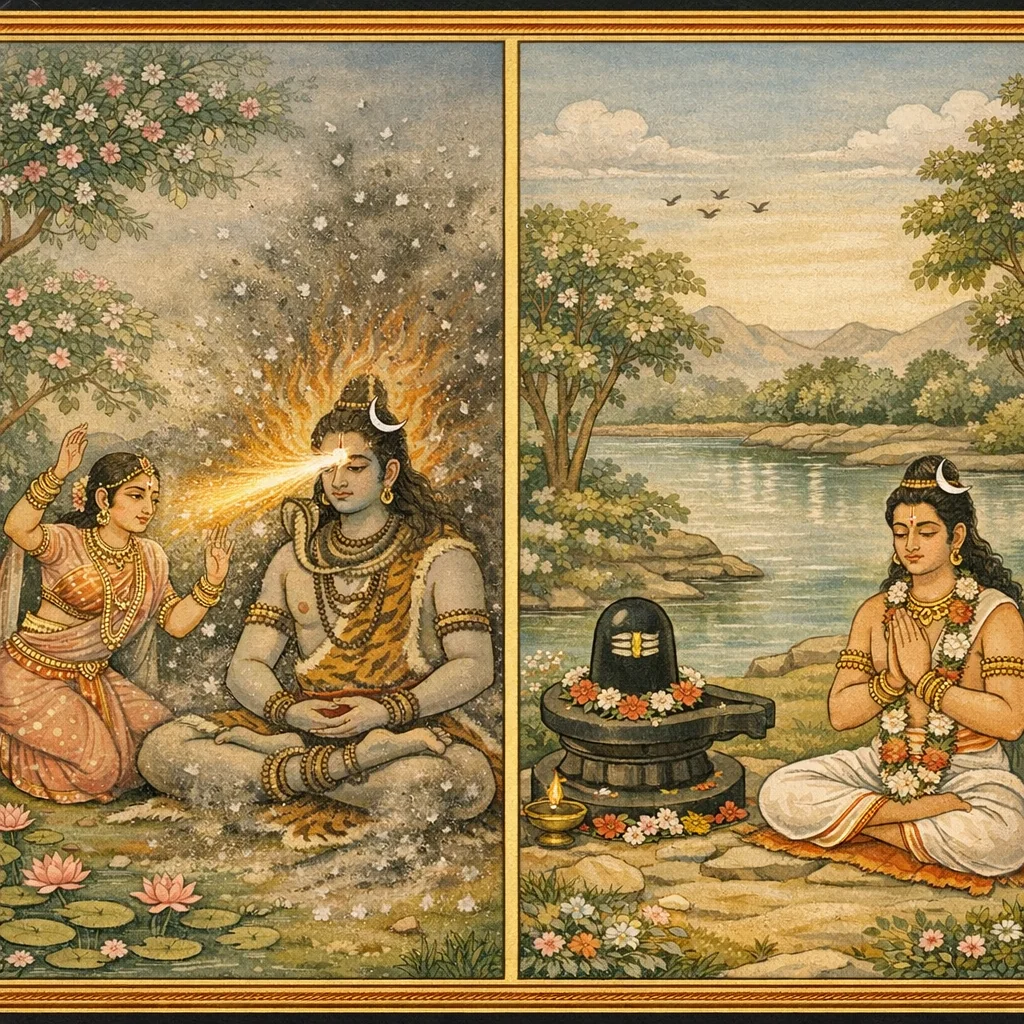
Mārkaṇḍeya directs the king to the eminent shrine of Kusumeśvara on the southern bank of the Narmadā, praised as a purifier of minor transgressions. The deity there is identified as the liṅga installed by Kāma (Kāmadeva) and renowned throughout the worlds. Yudhiṣṭhira then asks how Ananga—Kāma “without a body”—could attain ‘aṅgitva’, the state of being re-embodied with limbs. The tale turns to Kṛtayuga: Mahādeva (Śiva) performs fierce tapas at Gaṅgāsāgara, unsettling the worlds. The gods appeal to Indra, who sends apsarases, Spring, the cuckoo, the southern breeze, and Kāma to disturb Śiva’s austerity. Amid the springtime allure, Śiva remains unmoved; his third eye opens in fire, reducing Kāma to ashes and leaving the worlds “kāma-less.” The gods seek Brahmā, who praises Śiva with Vedic and stotra hymns; Śiva is appeased and, though restoring Kāma’s embodiment is difficult, Ananga returns as a life-giver. Kāma then undertakes tapas on the Narmadā bank, invokes Kuṇḍaleśvara for protection from obstructive beings, and receives the boon of Śiva’s perpetual presence at that tīrtha. Kāma establishes the liṅga named Kusumeśvara. The chapter prescribes observances there—bathing and fasting, especially on Caitra caturdaśī (Madana’s day), morning worship of the Sun, tarpaṇa with sesame-mixed water, and piṇḍa offerings—declaring that piṇḍa-dāna here equals a twelve-year sattra, brings long satisfaction to ancestors, and grants saving merit even to small creatures dying at the site. Devotional renunciation and self-control at Kusumeśvara are said to yield joy in Śiva’s realm and a return to earth as an honored, healthy, eloquent ruler.
Shlokas
Verse 1
श्रीमार्कण्डेय उवाच । ततो गच्छेन्महाराज कुसुमेश्वरमुत्तमम् । दक्षिणे नर्मदाकूले उपपातकनाशनम्
Śrī Mārkaṇḍeya said: “Then, O great king, one should go to the excellent Kusumeśvara on the southern bank of the Narmadā—destroyer of lesser sins.”
Verse 2
कामेन स्थापितो देवः कुसुमेश्वरसंज्ञितः । ख्यातः सर्वेषु लोकेषु देवदेवः सनातनः
Established by Kāma, this deity became known as Kusumeśvara. Renowned in all the worlds, he is the eternal Lord of lords.
Verse 3
कामो मनोभवो विश्वः कुसुमायुधचापभृत् । स कामान् ददाति सर्वान् पूजितो मीनकेतनः
Kāma—mind-born, all-pervading, wielder of the flower-weapon and bow—when worshipped as Mīnaketana, grants every desired object.
Verse 4
तेन निर्दग्धकायेन चाराध्य परमेश्वरम् । अनङ्गेन तथा प्राप्तमङ्गित्वं नर्मदातटे
Thereupon, though his body had been burnt, Anaṅga duly worshipped the Supreme Lord; and thus, upon the bank of the Narmadā, he regained embodied form.
Verse 5
युधिष्ठिर उवाच । अङ्गिभृतस्य नाशत्वमनङ्गस्य तु मे वद । न श्रुतं न च मे दृष्टं भूतपूर्वं कदाचन
Yudhiṣṭhira said: Tell me how the one who bore a body was destroyed, and how the bodiless one, Anaṅga, came to be—this I have never heard, nor have I ever seen anything like it in times past.
Verse 6
एतत्सर्वं यथा वृत्तमाचक्ष्व द्विजसत्तम । श्रोतुमिच्छामि विप्रेन्द्र भीमार्जुनयमैः सह
O best of the twice-born, recount to me how all this came to pass. O foremost of brahmins, I wish to hear it together with Bhīma, Arjuna, and the twins.
Verse 7
श्रीमार्कण्डेय उवाच । आदौ कृतयुगे तात देवदेवो महेश्वरः । तपश्चचार विपुलं गङ्गासागरसंस्थितः
Śrī Mārkaṇḍeya said: In the beginning, in the Kṛta Yuga, dear child, Maheśvara—the God of gods—performed vast austerities while abiding at Gaṅgā-sāgara.
Verse 8
तेन सम्पादिता लोकास्तपसा ससुरासुराः । जग्मुस्ते शरणं सर्वे देवदेवं शचीपतिम्
By the power of his tapas, the worlds—together with devas and asuras—were shaken and distressed. Therefore all of them sought refuge with the lord of the gods, Śacī’s consort, Indra.
Verse 9
व्यापकः सर्वभूतानां देवदेवो महेश्वरः । संतापयति लोकांस्त्रींस्तन्निवारय गोपते
Maheśvara, the God of gods—pervading all beings—scorches the three worlds. O lord of the gods, Indra, restrain him!
Verse 10
श्रुत्वा तद्वचनं तेषां देवानां बलवृत्रहा । चिन्तयामास मनसा तपोविघ्नायचादिशत्
Hearing those words of the gods, the mighty slayer of Vṛtra (Indra) pondered within his heart and then issued commands to obstruct that austerity.
Verse 11
अप्सरां मेनकां रम्भां घृताचीं च तिलोत्तमाम् । वसन्तं कोकिलं कामं दक्षिणानिलमुत्तमम्
He summoned the apsarās Menakā, Rambhā, Ghṛtācī, and Tilottamā—along with Spring, the cuckoo, Kāma, and the excellent southern breeze.
Verse 12
गत्वा तत्र महादेवं तपश्चरणतत्परम् । क्षोभयध्वं यथान्यायं गङ्गासागरवासिनम्
“Go there to Mahādeva, wholly intent upon the practice of austerity, and—by proper means—stir and disturb that Lord who abides at Gaṅgā-sāgara.”
Verse 13
एवमुक्तास्तु ते सर्वे देवराजेन भारत । देवाप्सरःसमोपेता जग्मुस्ते हरसन्निधौ
Thus addressed by the king of the gods, O Bhārata, they all—accompanied by hosts of celestial nymphs—went into the presence of Hara (Śiva).
Verse 14
वसन्तमासे कुसुमाकराकुले मयूरदात्यूहसुकोकिलाकुले । प्रनृत्य देवाप्सरगीतसंकुले प्रवाति वाते यमनैरृताकुले
In the month of spring, when the grove is thronged with blossoms and filled with peacocks, waterfowl, parrots, and cuckoos—when it resounds with the songs and dances of the apsarases—there blows a wind laden with the influences of Yama and Nairṛta, with death and dread.
Verse 15
तेन संमूर्छिताः सर्वे संसर्गाच्च खगोत्तमाः । मधुमाधवगन्धेन सकिन्नरमहोरगाः
By that enchantment all were made faint; and through such contact even the noblest birds—together with the Kinnaras and the great serpents—were intoxicated by the fragrance of Madhu and Mādhava, the honeyed scent of spring.
Verse 16
यावदालोकते तावत्तद्वनं व्याकुलीकृतम् । वीक्षते मदनाविष्टं दशावस्थागतं जनम्
As far as one could look, that forest was thrown into agitation; and people were seen possessed by Kāma (desire), fallen into manifold conditions and states.
Verse 17
देवदेवोऽपि देवानामवस्थात्रितयं गतः । सात्त्विकीं राजसीं राजंस्तामसीं तां शृणुष्व मे
Even the God of gods entered a threefold state. Hear from me, O King, those states: the sāttvika, the rājasika, and the tāmasika.
Verse 18
एकं योगसमाधिना मुकुलितं चक्षुर्द्वितीयं पुनः पार्वत्या जघनस्थलस्तनतटे शृङ्गारभारालसम् । अन्यद्दूरनिरस्तचापमदनक्रोधानलोद्दीपितं शम्भोर्भिन्नरसं समाधिसमये नेत्रत्रयं पातु वः
May Śambhu’s three eyes protect you: one eye closed in yogic samādhi; the second, again, languid under the weight of love as it rests upon Pārvatī’s hips and breasts; and the other—kindled as a fire of wrath against Madana, whose bow has been cast far away—manifesting a distinct power at the very moment of samādhi.
Verse 19
एवं दृष्टः स देवेन सशरः सशरासनः । भस्मीभूतो गतः कामो विनाशः सर्वदेहिनाम्
Thus seen by the God, Kāma—together with his arrows and bow—went away reduced to ashes, becoming the destroyer of embodied beings, as desire that brings ruin.
Verse 20
कामं दृष्ट्वा क्षयं यातं तत्र देवाप्सरोगणाः । भीता यथागतं सर्वे जग्मुश्चैव दिशो दश
Seeing Kāma brought to destruction there, the hosts of gods and apsarases—terrified—departed as they had come, dispersing into the ten directions.
Verse 21
कामेन रहिता लोकाः ससुरासुरमानवाः । ब्रह्माणं शरणं जग्मुर्देवा इन्द्रपुरोगमाः
With Kāma gone, the worlds—of gods, asuras, and humans alike—were bereft of desire; and the gods, led by Indra, went for refuge to Brahmā.
Verse 22
सीदमानं जगद्दृष्ट्वा तमूचुः परमेष्ठिनम् । जानासि त्वं जगच्छेषं प्रभो मैथुनसम्भवात्
Seeing the world sinking into decline, they spoke to Parameṣṭhin (Brahmā): “O Lord, you know what remains of the world—since creation proceeds from conjugal union.”
Verse 23
प्रजाः सर्वा विशुष्यन्ति कामेन रहिता विभो
“All creatures are withering away, O Lord, for they are bereft of Kāma (the power of desire and procreation).”
Verse 24
एतच्छ्रुत्वा वचस्तेषां देवानां प्रपितामहः । जगाम सहितस्तत्र यत्र देवो महेश्वरः
Hearing these words of the Devas, the Prāpitāmaha (Brahmā), accompanied by them, went to the place where the Lord Maheśvara was.
Verse 25
अतोषयज्जगन्नाथं सर्वभूतमहेश्वरम् । स्तुतिभिस्तण्डकैः स्तोत्रैर्वेदवेदाङ्गसम्भवैः
He propitiated Jagannātha, Maheśvara—the Lord of all beings—by praises, rhythmic hymns, and stotras fashioned from the Vedas and the Vedāṅgas.
Verse 26
ततस्तुष्टो महादेवो देवानां परमेश्वरः । उवाच मधुरां वाणीं देवान्ब्रह्मपुरोगमान्
Then Mahādeva, the supreme Lord of the Devas, being pleased, spoke sweet words to the gods with Brahmā at their head.
Verse 27
किं कार्यं कश्च सन्तापः किं वागमनकारणम् । देवतानामृषीणां च कथ्यतां मम माचिरम्
“What is the matter, and what is this distress? For what reason have you come? Tell me at once—both you Devas and you Ṛṣis.”
Verse 28
देवा ऊचुः । कामनाशाज्जगन्नाशो भवितायं चराचरे । त्रैलोक्यं त्वं पुनः शम्भो उत्पादयितुमर्हसि
The Devas said: “With Kāma destroyed, the world—moving and unmoving—will come to ruin. O Śambhu, you ought to bring forth the three worlds once again.”
Verse 29
एतच्छ्रुत्वा वचस्तेषां विमृश्य परमेश्वरः । चिन्तयामास कामस्य विग्रहं भुवि दुर्लभम्
Hearing their words, Parameśvara reflected and began to consider the embodiment of Kāma—something difficult to obtain upon the earth.
Verse 30
आजगाम ततः शीघ्रमनङ्गो ह्यङ्गतां गतः । प्राणदः सर्वभूतानां पश्यतां नृपसत्तम
Then swiftly came Anaṅga (Kāma), indeed having regained embodied form—he who bestows the life-breath upon all beings—while all looked on, O best of kings.
Verse 31
ततः शङ्खनिनादेन भेरीणां निःस्वनेन च । अभ्यनन्दंस्ततो देवं सुरासुरमहोरगाः
Then, with the blare of conches and the resounding of bhērī drums, the Deva was celebrated by gods, asuras, and great serpents alike.
Verse 32
नमस्ते देवदेवेश कृतार्थाः सुरसत्तमाः । विसर्जिताः पुनर्जग्मुर्यथागतमरिन्दम
“Salutations to You, O God of gods, Lord of lords; our purpose is fulfilled!”—thus spoke the foremost of the devas; and, dismissed, they returned by the very path they had come, O subduer of foes.
Verse 33
गतेषु सर्वदेवेषु कामदेवोऽपि भारत । तपश्चचार विपुलं नर्मदातटमाश्रितः
When all the gods had departed, Kāmadeva too, O Bhārata, undertook vast austerities, taking refuge on the bank of the Narmadā.
Verse 34
तपोजपकृशीभूतो दिव्यं वर्षशतं किल । महाभूतैर्विघ्नकरैः पीड्यमानः समन्ततः
Worn thin by austerity and mantra-recitation, for a full hundred divine years indeed, he was harassed on every side by great elemental beings that caused obstacles.
Verse 35
आत्मविघ्नविनाशार्थं संस्मृतः कुण्डलेश्वरः । चकार रक्षां सर्वत्र शरपाते नृपोत्तम
To destroy the obstacles that threatened him, he remembered and invoked Kuṇḍaleśvara; and Kuṇḍaleśvara spread protection everywhere—amid the shower of arrows, O best of kings.
Verse 36
ततस्तुष्टो महादेवो दृढभक्त्या वरप्रदः । वरेण छन्दयामास कामं कामविनाशनः
Then Mahādeva—pleased by steadfast devotion, the giver of boons—invited Kāma to choose a boon; He who destroys desire offered him grace.
Verse 37
ज्ञात्वा तुष्टं महादेवमुवाच झषकेतनः । प्रणतः प्राञ्जलिर्भूत्वा देवदेवं त्रिलोचनम्
Knowing Mahādeva to be pleased, Jhaṣaketu (Kāmadeva) spoke—bowed down, with joined palms—unto the God of gods, the Three-Eyed Lord.
Verse 38
यदि तुष्टोऽसि देवेश यदि देयो वरो मम । अत्र तीर्थे जगन्नाथ सदा संनिहितो भव
“If you are pleased, O Lord of the gods—if a boon is to be granted to me—then here at this tīrtha, O Jagannātha, be ever present.”
Verse 39
तथेति चोक्त्वा वचनं देवदेवो महेश्वरः । जगामाकाशमाविश्य स्तूयमानोऽप्सरोगणैः
Saying, “So be it,” the God of gods, Maheśvara, entered the sky and departed, praised by hosts of apsarases.
Verse 40
गते चादर्शनं देवे कामदेवो जगद्गुरुम् । स्थापयामास राजेन्द्र कुसुमेश्वरसंज्ञितम्
When the Deva had vanished from sight, Kāmadeva, O lord of kings, established there the World-Teacher, Śiva, under the name “Kusumeśvara.”
Verse 41
तत्र तीर्थे तु यः स्नात्वा ह्युपवासपरायणः । चैत्रमासे चतुर्दश्यां मदनस्य दिनेऽथवा
And whoever, at that tīrtha, bathes and is devoted to fasting—on the fourteenth day of the month of Caitra, or on the day sacred to Madana (Kāma)—
Verse 42
प्रभाते विमले प्राप्ते स्नात्वा पूज्य दिवाकरम् । तिलमिश्रेण तोयेन तर्पयेत्पितृदेवताः
When the pure morning has arrived, one should bathe and worship the Sun; then, with water mixed with sesame, one should offer tarpaṇa to the Pitṛ-deities, the ancestral divinities.
Verse 43
कृत्वा स्नानं विधानेन पूजयित्वा च तं नृप । पिण्डनिर्वपणं कुर्यात्तस्य पुण्यफलं शृणु
O King, having performed the bath according to rule and having worshipped Him, one should offer piṇḍas; hear now the meritorious fruit of that act.
Verse 44
सत्त्रयाजिफलं यच्च लभते द्वादशाब्दिकम् । पिण्डदानात्फलं तच्च लभते नात्र संशयः
Whatever fruit a performer of a sattra-sacrifice obtains over twelve years—that very fruit is gained by piṇḍa-giving; of this there is no doubt.
Verse 45
अङ्कुल्लमूले यः पिण्डं पित्ःनुद्दिश्य दापयेत् । तस्य ते द्वादशाब्दानि तृप्तिं यान्ति पितामहाः
Whoever, at the root of the Aṅkulla tree, causes a piṇḍa offering to be made for the Pitṛs—his grandfathers and ancestors attain satisfaction for twelve years.
Verse 46
कृमिकीटपतङ्गा ये तत्र तीर्थे युधिष्ठिर । प्राप्नुवन्ति मृताः स्वर्गं किं पुनर्ये नरा मृताः
O Yudhiṣṭhira, even worms, insects, and moths that die at that sacred tīrtha attain heaven—how much more, then, human beings who die there.
Verse 47
संन्यासं कुरुते योऽत्र जितक्रोधो जितेन्द्रियः । कुसुमेशे नरो भक्त्या स गच्छेच्छिवमन्दिरम्
Whoever here at Kusumeśa takes up renunciation (sannyāsa)—having conquered anger and mastered the senses—such a person, in devotion, goes to Śiva’s abode.
Verse 48
तत्र दिव्याप्सरोभिश्च देवगन्धर्वगायनैः । क्रीडते सेव्यमानस्तु कल्पकोटिशतं नृप
There, attended by celestial Apsarases and by divine Gandharva singers, he revels—honored and served—for a hundred crores of kalpas, O King.
Verse 49
पूर्णे चैव ततः काल इह मानुष्यतां गतः । जायते राजराजेन्द्रैः पूज्यमानो नृपो महान्
And when that span of time is completed, returning here to human birth, he is born a great king—honored even by emperors among kings.
Verse 50
सुरूपः सुभगो वाग्मी विक्रान्तो मतिमाञ्छुचिः । जीवेद्वर्षशतं साग्रं सर्वव्याधिविवर्जितः
Handsome, fortunate, eloquent, valiant, intelligent, and pure—he lives a full hundred years and more, free from all diseases.
Verse 51
एतत्पुण्यं पापहरं तीर्थकोटिशताधिकम् । कुसुमेशेति विख्यातं सर्वदेवनमस्कृतम्
This sacred merit removes sins, surpassing hundreds of crores of tīrthas; it is famed as “Kusumeśa,” revered by all the gods.
Verse 150
। अध्याय
Chapter (heading marker).