Adhyaya 12
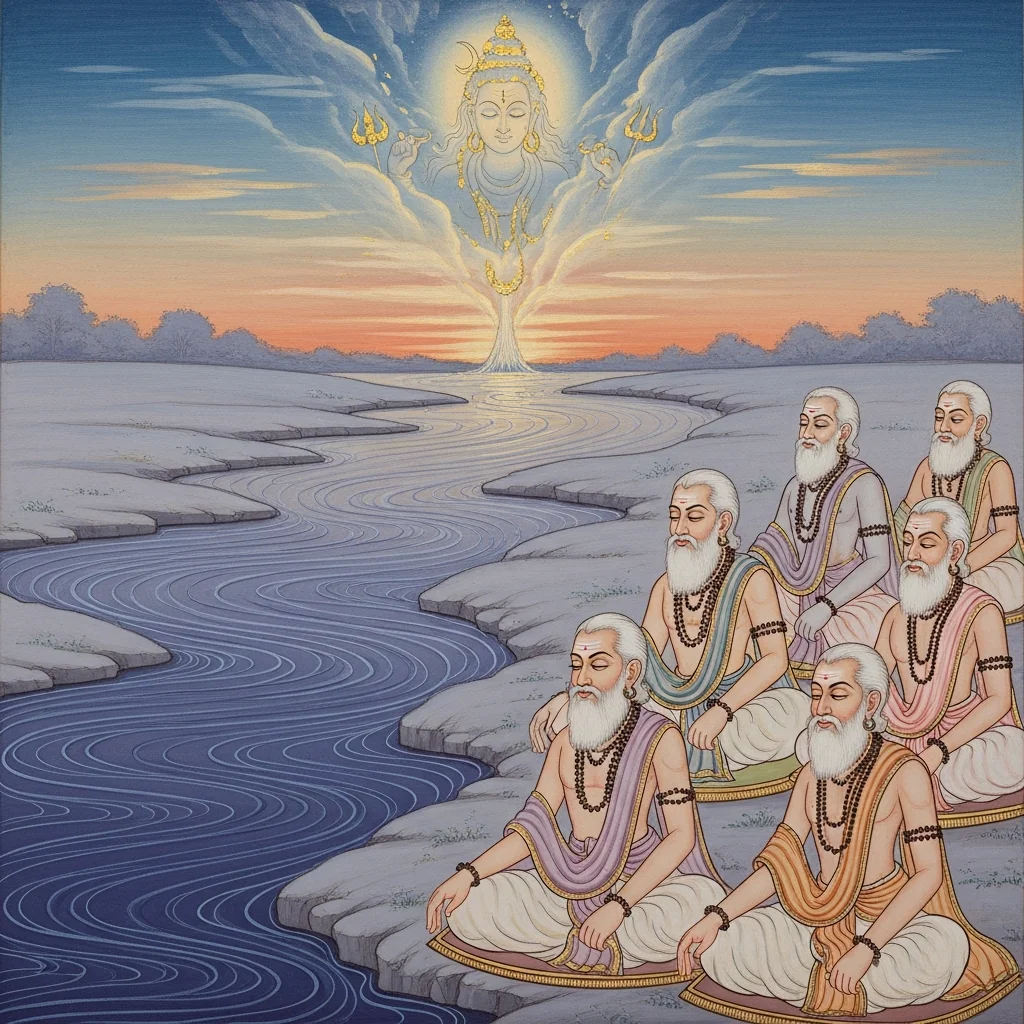
Mārkaṇḍeya, speaking within a narrative frame where a king is the listener, relates that after hearing the prior teaching the assembled sages rejoice and, with joined hands, begin praising the Narmadā (Revā). The chapter is a sustained stotra addressing the river as divine power—purifying water, remover of wrongdoing, refuge of all tīrthas—and as one arisen from Rudra’s own body (rudrāṅga-samudbhavā). The hymn emphasizes Narmadā’s ability to cleanse sin and protect beings afflicted by suffering and moral error, contrasting painful wandering with the liberating touch of her waters. It also affirms her steady sacred presence even in the Kali age, when other waters are said to be diminished or polluted. In the concluding phalaśruti, those who recite or hear the hymn—especially after bathing in the Narmadā—are promised a purified destiny and nearness to Maheśvara/Rudra, portrayed with images of divine conveyance and celestial adornment. Thus the chapter serves as both liturgical praise and ethical-theological instruction on devotion, sacred ecology, and liberation-oriented practice.
Shlokas
Verse 1
श्रीमार्कण्डेय उवाच । एतच्छ्रुत्वा वचो राजन्संहृष्टा ऋषयोऽभवन् । नर्मदां स्तोतुमारब्धाः कृताञ्जलिपुटा द्विजाः
Śrī Mārkaṇḍeya said: Hearing these words, O King, the sages were filled with delight. With palms joined in reverence, the twice-born began to hymn the Narmadā.
Verse 2
नमोऽस्तु ते पुण्यजले नमो मकरगामिनि । नमस्ते पापमोचिन्यै नमो देवि वरानने
Salutations to you whose waters are holy; salutations to you who move with the makara’s current. Salutations to you, remover of sins; salutations, O Goddess of beautiful face.
Verse 3
नमोऽस्तु ते पुण्यजलाश्रये शुभे विशुद्धसत्त्वं सुरसिद्धसेविते । नमोऽस्तु ते तीर्थगणैर्निषेविते नमोऽस्तु रुद्राङ्गसमुद्भवे वरे
Homage to you, auspicious abode of holy waters, utterly pure in nature, served by gods and siddhas. Homage to you, resorted to by hosts of tīrthas. Homage to you, supreme and excellent, born from Rudra’s own body—O divine river.
Verse 4
नमोऽस्तु ते देवि समुद्रगामिनि नमोऽस्तु ते देवि वरप्रदे शिवे । नमोऽस्तु लोकद्वयसौख्यदायिनि ह्यनेकभूतौघसमाश्रितेऽनघे
Homage to you, O Goddess, who flows onward to the ocean. Homage to you, auspicious Goddess, bestower of boons. Homage to you who grant well-being in both worlds and are the refuge of countless beings—O sinless one.
Verse 5
सरिद्वरे पापहरे विचित्रिते गन्धर्वयक्षोरगसेविताङ्गे । सनातनि प्राणिगणानुकम्पिनि मोक्षप्रदे देवि विधेहि शं नः
O best of rivers, remover of sin, wondrously adorned, whose banks are attended by Gandharvas, Yakṣas, and Nāgas. O eternal one, compassionate to multitudes of beings: O Goddess who grants mokṣa, ordain well-being for us.
Verse 6
महागजैर्घमहिषैर्वराहैः संसेविते देवि महोर्मिमाले । नताः स्म सर्वे वरदे सुखप्रदे विमोचयास्मान्पशुपाशबन्धात्
O Goddess garlanded with mighty waves, attended by great elephants, powerful buffaloes, and boars: we all bow to you, O giver of boons and bestower of happiness. Release us from the bondage of the noose that binds the paśu.
Verse 7
पापैरनेकैरशुभैर्विबद्धा भ्रमन्ति तावन्नरकेषु मर्त्याः । महानिलोद्भूततरङ्गभूतं यावत्तवाम्भो हि न संस्पृशन्ति
So long as mortals, bound by many inauspicious sins, do not touch your waters—whose waves rise like forms stirred by great winds—so long they wander through hells.
Verse 8
अनेकदुःखौघभयार्दितानां पापैरनेकैरभिवेष्टितानाम् । गतिस्त्वमम्भोजसमानवक्रे द्वन्द्वैरनेकैरपि संवृतानाम्
For those tormented by fear amid floods of many sorrows, and wrapped about by countless sins—for those covered over by manifold pairs of opposites—you are the refuge and the way, O Goddess whose face is as lovely as a lotus.
Verse 9
नद्यश्च पूता विमला भवन्ति त्वां देवि सम्प्राप्य न संशयोऽत्र । दुःखातुराणामभयं ददासि शिष्टैरनेकैरभिपूजितासि
Other rivers too become purified and spotless upon reaching you, O Goddess—of this there is no doubt. To those distressed by suffering you grant fearlessness, and you are worshipped by many righteous and learned people.
Verse 10
स्पृष्टं करैश्चन्द्रमसो रवेश्च तदैव दद्यात्परमं पदं तु । यत्रोपलाः पुण्यजलाप्लुतास्ते शिवत्वमायान्ति किमत्र चित्रम्
If the hands of the Moon and the Sun were to touch it, it would at once grant the supreme state. Where even stones, bathed in your holy waters, attain auspiciousness as ‘Śiva-nature’—what wonder is there in this?
Verse 11
भ्रमन्ति तावन्नरकेषु मर्त्या दुःखातुराः पापपरीतदेहाः । महानिलोद्भूततरङ्गभङ्गं यावत्तवाम्भो न हि संश्रयन्ति
Mortals, distressed by suffering and clothed in sin, wander through the hells so long as they do not take refuge in your waters—waters whose breaking waves are driven up by mighty winds.
Verse 12
। अध्याय
Chapter (colophon marker).
Verse 13
सरांसि नद्यः क्षयमभ्युपेता घोरे युगेऽस्मिन् हि कलौ प्रदूषिते । त्वं भ्राजसे देवि जलौघपूर्णा दिवीव नक्षत्रपथे च गङ्गा
In this dreadful age of Kali, when lakes and rivers have dwindled and become defiled, you alone, O Goddess, shine forth—brimming with torrents of water—like the heavenly Gaṅgā that gleams along the starry path of the sky.
Verse 14
तव प्रसादाद्वरदे वरिष्ठे कालं यथेमं परिपालयित्वा । यामोऽथ रुद्रं तव सुप्रसादाद्वयं तथा त्वं कुरु वै प्रसादम्
By your grace, O best of boon-givers, may we pass through and safeguard this time as it ought to be. Then, through your great favor, may we attain Rudra—so you too, indeed, show us your compassion.
Verse 15
गतिस्त्वमम्बेव पितेव पुत्रांस्त्वं पाहि नो यावदिमं युगान्तम् । कालं त्वनावृष्टिहतं सुघोरं यावत्तरामस्तव सुप्रसादात्
You are our refuge—like a mother, like a father to their children. Protect us until the end of this age, so that by your great grace we may cross beyond this terrible time, stricken by drought.
Verse 16
पठन्ति ये स्तोत्रमिदं द्विजेन्द्राः शृण्वन्ति ये चापि नराः प्रशान्ताः । ते यान्ति रुद्रं वृषसंयुतेन यानेन दिव्याम्बरभूषिताश्च
Those best of the twice-born who recite this hymn, and those calm-minded people who also listen to it—adorned in divine garments—go to Rudra by a celestial vehicle yoked with a bull.
Verse 17
ये स्तोत्रमेतत्सततं पठन्ति स्नात्वा तु तोये खलु नर्मदायाः । अन्ते हि तेषां सरिदुत्तमेयं गतिं विशुद्धामचिराद्ददाति
Those who continually recite this hymn after bathing in the waters of the Narmadā—at life’s end this best of rivers swiftly grants them a pure and sanctified passage.
Verse 18
प्रातः समुत्थाय तथा शयानो यः कीर्तयेतानुदिनं स्तवं च । स मुक्तपापः सुविशुद्धदेहः समाश्रयं याति महेश्वरस्य
Whoever chants this praise daily—whether rising in the morning or even while lying down—becomes freed from sins; with a thoroughly purified being, they attain the shelter of Maheśvara.