Adhyaya 143
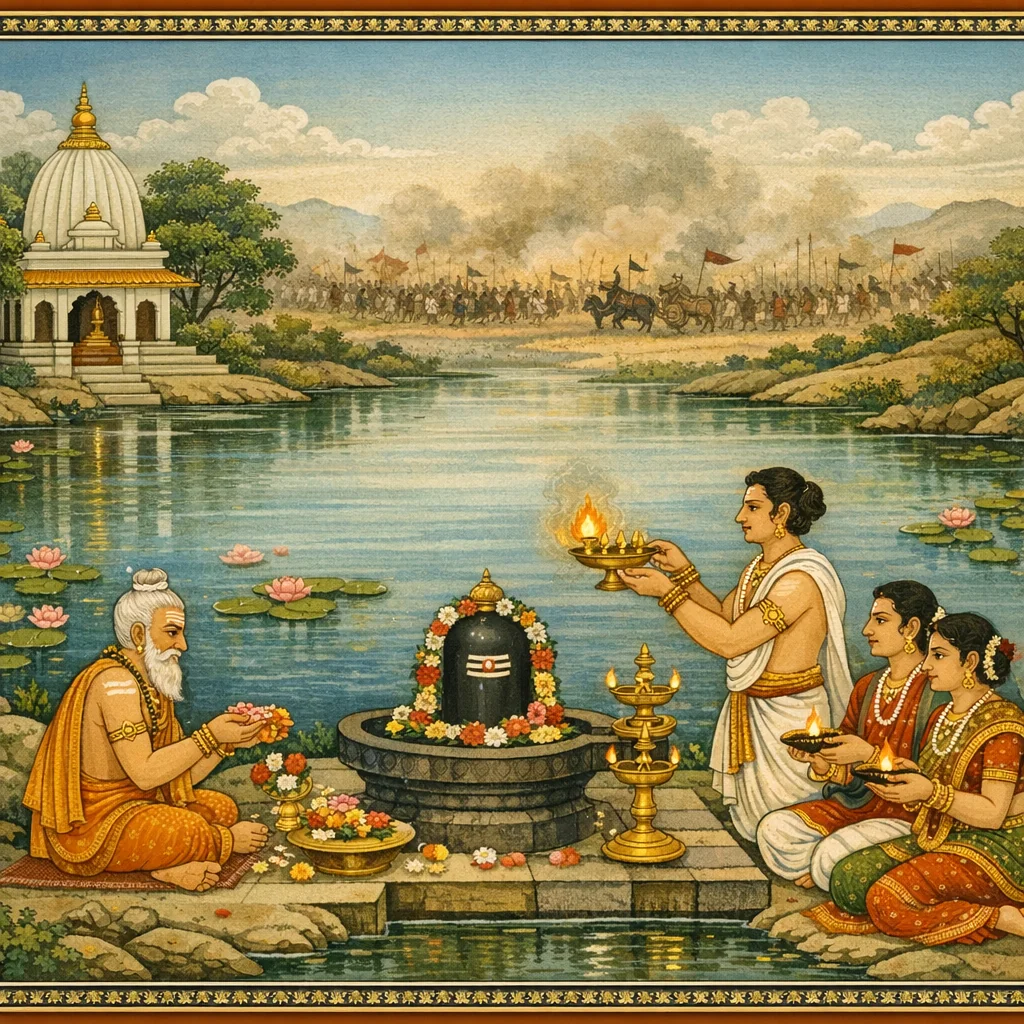
This chapter is a tīrtha-māhātmya discourse spoken by Śrī Mārkaṇḍeya to a king. It extols the eminent sacred ford called Yojaneśvara, where the Nara–Nārāyaṇa Ṛṣis performed tapas and won victory in a primordial struggle between devas and dānavas. The narrative compresses sacred history across the yugas: in Tretā-yuga the same divine principle is linked with Rāma–Lakṣmaṇa, who, after ritual bathing at the tīrtha, defeat Rāvaṇa. In Kali-yuga it manifests as Bala–Keśava (Balarāma–Kṛṣṇa), born in the Vāsudeva lineage, accomplishing arduous deeds such as slaying Kaṃsa, Cāṇūra, Muṣṭika, Śiśupāla, and Jarāsandha; it also gestures to the Kurukṣetra/Dharma-kṣetra war, where divine agency proves decisive in the fall of key warriors. Prescriptions follow: bathe at the tīrtha, worship Bala–Keśava, observe fasting and night-vigil (prajāgara), sing devotional praises, and honor brāhmaṇas with reverence. The phalaśruti promises the removal of sins—including grave transgressions—the akṣaya (imperishable) fruit of gifts and worship offered there, and freedom from pāpa for the righteous who hear, read, or recite this chapter.
Shlokas
Verse 1
श्रीमार्कण्डेय उवाच । ततो गच्छेन्महाराज योजनेश्वरमुत्तमम् । यत्र सिद्धौ पुरा कल्पे नरनारायणावृषी
Śrī Mārkaṇḍeya said: “Thereafter, O great king, one should go to the excellent holy place called Yojaneśvara, where in a former kalpa the two sages Nara and Nārāyaṇa attained perfection (siddhi).”
Verse 2
तत्र तीर्थे तपस्तप्त्वा सङ्ग्रामे देवदानवैः । जयं प्राप्तौ महात्मानौ नरनारायणावुभौ
At that tīrtha, having performed austerities (tapas), the two great souls Nara and Nārāyaṇa won victory in battle over the devas and the dānavas.
Verse 3
पुनस्त्रेतायुगे प्राप्ते तौ देवौ रामलक्ष्मणौ । तत्र तीर्थे पुनः स्नात्वा रावणो दुर्जयो हतः
Again, when the Tretā Yuga arrived, those two divine ones became Rāma and Lakṣmaṇa; and after bathing again at that tīrtha, Rāvaṇa—otherwise invincible—was slain.
Verse 4
पुनः पार्थ कलौ प्राप्ते तौ देवौ बलकेशवौ । वसुदेवकुले जातौ दुष्करं कर्म चक्रतुः
Again, O Pārtha, when the Kali age arrived, those two divine ones became Bala and Keśava; born in the lineage of Vasudeva, they accomplished deeds difficult to perform.
Verse 5
नरकं कालनेमिं च कंसं चाणूरमुष्टिकौ । शिशुपालं जरासंधं जघ्नतुर्बलकेशवौ
Bala and Keśava slew Naraka and Kālanemi, Kaṃsa, and also Cāṇūra and Muṣṭika, as well as Śiśupāla and Jarāsandha.
Verse 6
ततस्तत्र रिपून्संख्ये भीष्मद्रोणपुरःसरान् । कर्णदुर्योधनादींश्च निहनिष्यति स प्रभुः
Then, there in that battle, that Lord will strike down the enemies—led by Bhīṣma and Droṇa—along with Karṇa, Duryodhana, and the rest.
Verse 7
धर्मक्षेत्रे कुरुक्षेत्रे तत्र युध्यन्ति ते क्षणम् । भीमार्जुननिमित्तेन शिष्यौ कृत्वा परस्परम्
On the field of dharma, Kurukṣetra, they fight there for a time—making each other, as it were, ‘disciples’ through the occasion of Bhīma and Arjuna.
Verse 8
तत्र तीर्थे पुनर्गत्वा तपः कृत्वा सुदुष्करम् । पूजयित्वा द्विजान्भक्त्या यास्येते द्वारकां पुनः
Having gone again to that tīrtha, performing very difficult austerities, and worshipping the twice-born with devotion, they will go once more to Dvārakā.
Verse 9
तत्र तीर्थे तु यः स्नात्वा पूजयेद्बलकेशवौ । तेन देवो जगद्धाता पूजितस्त्रिगुणात्मवान्
But whoever bathes at that tīrtha and worships Bala and Keśava—by him the God who upholds the world, whose nature pervades the three guṇas, is truly worshipped.
Verse 10
उपवासी नरो भूत्वा यस्तु कुर्यात्प्रजागरम् । मुच्यते सर्वपापेभ्यो गायंस्तस्य शुभां कथाम्
And the person who, having fasted, keeps a night-long vigil is freed from all sins, while singing the auspicious sacred narrative of that Lord.
Verse 11
यावतस्तत्र तीर्थे तु वृक्षान् पश्यन्ति मानवाः । ब्रह्महत्यादिकं पापं तावदेषां प्रणश्यति
So long as people, at that sacred ford, behold the trees there, for just that long their sins—beginning with brahmin-slaying and the like—are destroyed.
Verse 12
प्रातरुत्थाय ये केचित्पश्यन्ति बलकेशवौ । तेनैव सदृशाः सर्वे देवदेवेन चक्रिणा
Whoever, rising in the morning, beholds Bala and Keśava—by that very act they all become like the Lord of Lords, the discus-bearing God.
Verse 13
ते पूज्यास्ते नमस्कार्यास्तेषां जन्म सुजीवितम् । ये नमन्ति जगत्पूज्यं देवं नारायणं हरिम्
They are worthy of worship; they are worthy of reverent salutations; their birth is well-spent—those who bow to Nārāyaṇa, Hari, the God worshipped by the whole world.
Verse 14
तत्र तीर्थे तु यद्दानं स्नानं देवार्चनं नृप । क्रियते तत्फलं सर्वमक्षयायोपकल्पते
O King, whatever charity, sacred bathing, and worship of the devas is performed at that tīrtha—its entire fruit becomes inexhaustible.
Verse 15
अग्नेरपत्यं प्रथमं सुवर्णं भूर्वैष्णवी सूर्यसुताश्च गावः । लोकास्त्रयस्तेन भवन्ति दत्ता यः काञ्चनं गां च भुवं च दद्यात्
Gold is first called the offspring of Agni; the Earth is Vaiṣṇavī; and cows are said to be daughters of the Sun. For one who gives gold, a cow, and land, it is as though the three worlds are given in merit.
Verse 16
एतत्ते कथितं सर्वं तीर्थमाहात्म्यमुत्तमम् । अतीतं च भविष्यच्च वर्तमानं महाबलम्
Thus, all this supreme greatness of the tīrtha has been told to you—its mighty power in the past, in the future, and in the present.
Verse 17
श्रुत्वा वापि पठित्वेदं श्रावयिपत्वाथ धार्मिकान् । मुच्यते सर्वपापेभ्यो नात्र कार्या विचारणा
By merely hearing this, or by reading it, and then causing the righteous to hear it, one is freed from all sins—of this there is no need for doubt or deliberation.
Verse 143
। अध्याय
End of the chapter (adhyāya marker).