Adhyaya 38
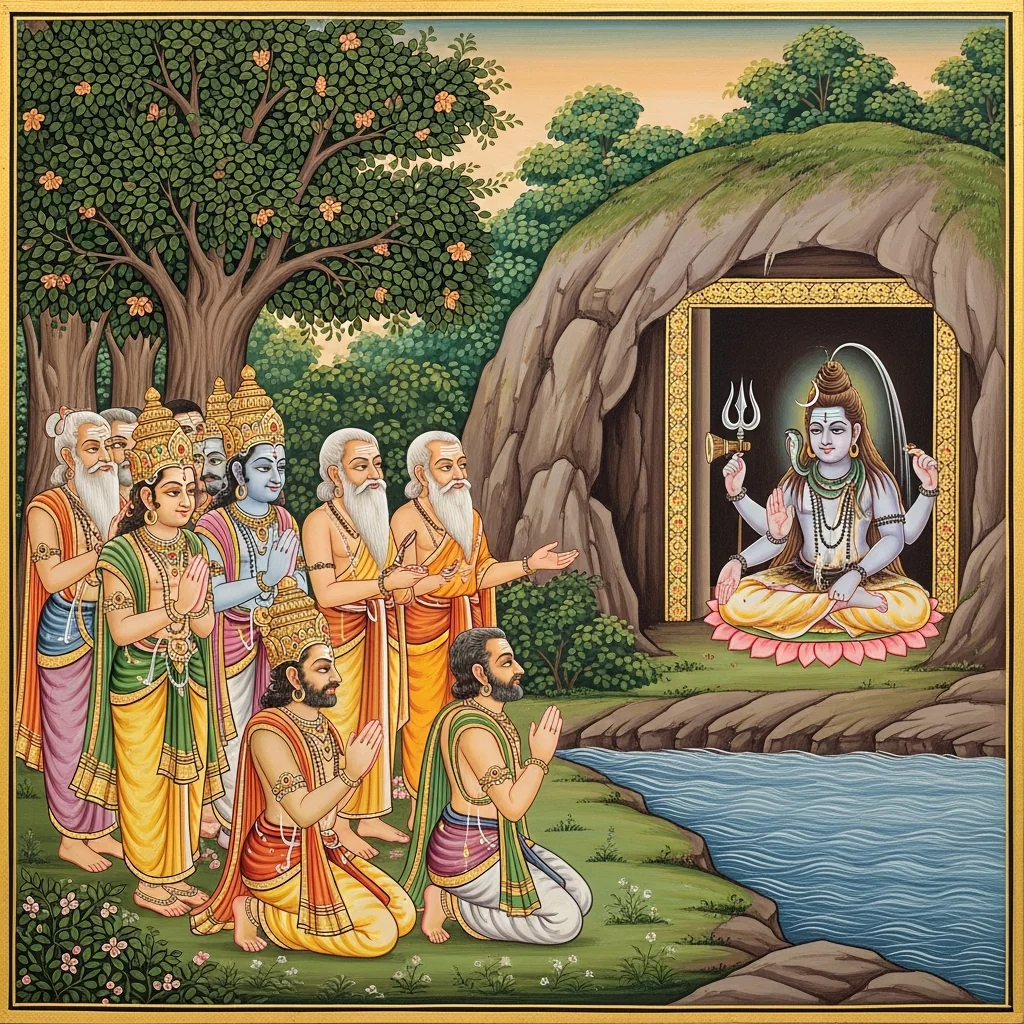
This chapter unfolds as a dialogue: Yudhiṣṭhira asks Mārkaṇḍeya why Mahādeva, revered as jagad-guru, dwelt for a long time in a cave (guhā). Mārkaṇḍeya recounts a Kṛtayuga episode at the great hermitage of Dāruvana, where disciplined practitioners of all āśramas lived in strict observance. Śiva, traveling with Umā, is urged by her to assume a Kāpālika-like ascetic guise—matted hair, ash, tiger-skin, skull-bowl, and ḍamaru—and enter the forest, which unsettles the hermitage women. When the Brahmin sages return and perceive the disruption, they unite in resolve and perform a satya-prayoga (truth-act) that causes Śiva’s liṅga to fall, bringing cosmic disturbance. The gods appeal to Brahmā; the sages counsel Śiva on the potency of Brahminical tapas and anger, and the narrative turns toward reconciliation and re-sanctification. Śiva then goes to the bank of the Narmadā, undertakes the supreme vow as “Guhāvāsī,” and establishes a liṅga there—hence the name Narmadeśvara. The chapter closes with tīrtha prescriptions and phalaśruti: worship, bathing, offerings to ancestors, feeding Brahmins, gifts, fasting on specific lunar dates, and other observances yield stated ritual fruits and protection; even recitation and faithful listening are said to grant the merit of sacred bathing.
Shlokas
Verse 1
श्रीमार्कण्डेय उवाच । ततो गच्छेत राजेन्द्र गुहावासीति चोत्तमम् । यत्र सिद्धो महादेवो गुहावासी समार्बुदम्
Śrī Mārkaṇḍeya said: Then, O best of kings, one should go to the excellent holy place called Guhāvāsī—where Mahādeva attained perfected power and manifested as “Guhāvāsī” upon Mount Arbuda.
Verse 2
युधिष्ठिर उवाच । केन कार्येण भो तात महादेवो जगद्गुरुः । गुहायामनयत्कालं सुदीर्घं द्विजसत्तम
Yudhiṣṭhira said: For what purpose, O revered sir, did Mahādeva—the teacher of the world—spend a very long time within a cave, O best of brāhmaṇas?
Verse 3
एतद्विस्तरतः सर्वं कथयस्व ममानघ । श्रोतुमिच्छाम्यहं सर्वपरं कौतूहलं हि मे
Explain all of this to me in detail, O sinless one. I wish to hear it in full, for my curiosity and longing to know are profound.
Verse 4
मार्कण्डेय उवाच । साधु प्रश्नो महाराज पृष्टो यो वै त्वयोत्तमः । पुराणे विस्तरो ह्यस्य न शक्यो हि मयाधुना
Mārkaṇḍeya said: Noble indeed, O great king, is this excellent question you have asked. Its full elaboration belongs to the Purāṇic tradition, and at present I cannot relate it in exhaustive detail.
Verse 5
कथितुं वृद्धभावत्वादतीतो बहुकालिकः । संक्षेपात्तेन ते तात कथयामि निबोध मे
Because of my advanced age, much time has passed, and I cannot recount it at length. Therefore, dear one, I shall tell it to you in brief—listen well and understand my words.
Verse 6
पुरा कृतयुगे राजन्नासीद्दारुवनं महत् । नानाद्रुमलताकीर्णं नानावल्ल्युपशोभितम्
In ancient times, in the Kṛtayuga, O king, there was a vast forest called Dāruvana—filled with many kinds of trees and creepers, beautified by diverse climbing vines.
Verse 7
सिंहव्याघ्रवराहैश्च गजैः खड्गैर्निषेवितम् । बहुपक्षियुतं दिव्यं यथा चैत्ररथं वनम्
It was frequented by lions, tigers, boars, elephants, and rhinoceroses; filled with many birds, it was wondrous—like the celestial Caitraratha forest.
Verse 8
तत्र केचिन्महाप्राज्ञा वसन्ति संशितव्रताः । वसन्ति परया भक्त्या चतुराश्रमभाविताः
There dwell certain greatly wise ones, firm in well-disciplined vows. Abiding there with supreme devotion, they are established in the spirit of the four āśramas (stages of life).
Verse 9
ब्रह्मचारी गृहस्थश्च वानप्रस्थो यतिस्तथा । स्वधर्मनिरताः सर्वे वाञ्छन्तः परमं पदम्
Whether as celibate students, householders, forest-dwellers, or renunciants—each devoted to one’s own dharma—they all aspire to the supreme state.
Verse 10
तावद्वसन्तसमये कस्मिंश्चित्कारणान्तरे । विमानस्थो महादेवो गच्छन्वै ह्युमया सह
Then, in the season of spring, on some other occasion, Mahādeva—seated in a celestial car—was traveling indeed together with Umā.
Verse 11
ददर्श तोय आवासमृक्सामयजुर्नादितम् । अलक्ष्यागतनिर्गम्यं सर्वपापक्षयंकरम्
He beheld a waterside sacred dwelling, resonant with the chants of Ṛk, Sāma, and Yajus; entered and departed unseen, it was a place that brings about the destruction of all sins.
Verse 12
तं दृष्ट्वा मुदिता देवी हर्षगङ्गदया गिरा । पप्रच्छ देवदेवेशं शशाङ्ककृतभूषणम्
Seeing it, the Goddess rejoiced; with words flowing in joy and tenderness, she questioned the Lord of the gods, whose ornament is the moon.
Verse 13
देव्युवाच । कस्यायमाश्रमो देव वेदध्वनिनिनादितः । यं दृष्ट्वा क्षुत्पिपासाद्यैः श्रमैश्च परिहीयते
The Goddess said: “O God, whose hermitage is this, resounding with the sound of the Veda? On seeing it, hunger, thirst, and other fatigues are diminished.”
Verse 14
महेश्वर उवाच । किं त्वया न श्रुतं देवि महादारुवनं महत् । बहुविप्रजनो यत्र गृहधर्मेण वर्तते
Maheśvara said: “O Goddess, have you not heard of the great Mahādāruvana? There, many brāhmaṇas live, conducting themselves according to the dharma of household life.”
Verse 15
अत्र यः स्त्रीजनः कश्चिद्भर्तृशुश्रूषणे रतः । नान्यो देवो न वै धर्मो ज्ञायते शैलनन्दिनि
Here, any woman devoted to serving her husband—O daughter of the mountain—knows no other deity and no other dharma as her guiding vow.
Verse 16
एतच्छ्रुत्वा परं वाक्यं देवदेवेन भाषितम् । कौतूहलसमाविष्टा शङ्करं पुनरब्रवीत्
Having heard these weighty words spoken by the Lord of the gods, she—filled with curiosity—again addressed Śaṅkara.
Verse 17
यत्त्वयोक्तं महादेव पतिधर्मरताः स्त्रियः । तासां त्वं मदनो भूत्वा चारित्रं क्षोभय प्रभो
“O Mahādeva, you said that the women here are devoted to the dharma of fidelity to their husbands. Then, O Lord, become like Madana and stir their conduct—test their steadfastness.”
Verse 18
ईश्वर उवाच । यत्त्वयोक्तं च वचनं न हि मे रोचते प्रिये । ब्राह्मणा हि महद्भूतं न चैषां विप्रियं चरेत्
Īśvara said: “Beloved, the words you have spoken do not please me. Brāhmaṇas are a mighty sacred power; therefore one should never act in a way that is displeasing to them.”
Verse 19
मन्युप्रहरणा विप्राश्चक्रप्रहरणो हरिः । चक्रात्क्रूरतरो मन्युस्तस्माद्विप्रं न कोपयेत्
Brāhmaṇas wield anger as their weapon, while Hari wields the discus. Anger is more dreadful than the discus; therefore one should never provoke a Brāhmaṇa to wrath.
Verse 20
न ते देवा न ते लोका न ते नगा न चासुराः । दृश्यन्ते त्रिषु लोकेषु ये तैर्दृष्टैर्न नाशिताः
Neither gods, nor worlds, nor mountains, nor even asuras are seen in the three worlds—if they have been beheld by them in anger and not destroyed.
Verse 21
तेषां मोक्षस्तथा स्वर्गो भूमिर्मर्त्ये फलानि च । येषां तुष्टा महाभागा ब्राह्मणाः क्षितिदेवताः
Liberation and heaven, prosperity on earth, and fruits in the human realm belong to those with whom the noble Brāhmaṇas—divinities upon the earth—are pleased.
Verse 22
एवं ज्ञात्वा महाभागे असद्ग्राहं परित्यज । तत्र लोके विरुद्धं वै कुप्यन्ते येन वै द्विजाः
Knowing this, O noble lady, abandon this improper insistence. For in the world, Brāhmaṇas become angered by that which is contrary to right order.
Verse 23
देव्युवाच । नाहं ते दयिता देव नाहं ते वशवर्तिनी । अकृत्वाधश्व वै तासां मानं सुरसुपूजितम्
The Goddess said: “O God, I am not your beloved; I am not under your control—unless you first bring low their honor, which is greatly revered even by the gods.”
Verse 24
लोकलोके महादेव अशक्यं नास्ति ते प्रभो । क्रियतां मम चैवैकमेतत्कार्यं सुरोत्तम
In this world and beyond, O Mahādeva, nothing is impossible for you, O Lord. O best of the gods, let this one task of mine be accomplished.
Verse 25
एवमुक्तो महादेवो देव्या वाक्यहिते रतः । कृत्वा कापालिकं रूपं ययौ दारुवनं प्रति
Thus addressed, Mahādeva—intent on fulfilling the Goddess’s words—assumed the form of a Kāpālika and went toward Dāruvana.
Verse 26
महाहितजटाजूटं नियम्य शशिभूषणम् । कण्ठत्राणं परं कृत्वा धारयन् कर्णकुण्डले
He bound up his well-ordered matted jaṭā, adorned with the moon; fashioning a supreme protective ornament for his neck, he wore earrings upon his ears.
Verse 27
व्याघ्रचर्मपरीधानो मेखलाहारभूषितः । नूपुरध्वनिनिघोषैः कम्पयन् वै वसुंधराम्
Clad in a tiger-skin and adorned with belt and garlands, he made the very earth tremble with the resounding sound of his anklets (nūpura).
Verse 28
महानूर्द्ध्वजटामाली कृत्तिभस्मानुलेपनः । कृत्वा हस्ते कपालं तु ब्रह्मणश्च महात्मनः
With lofty jaṭā piled high and a garland of jaṭā, smeared with sacred ash and clad in a skin, the Great Lord took into his hand a skull-bowl—said to be that of the great-souled Brahmā—assuming the guise of a wandering mendicant.
Verse 29
महाडमरुघोषेण कम्पयन् वै वसुंधराम् । प्रभातसमये प्राप्तो महादारुवनं प्रति
With the thunderous sound of his great ḍamaru he made the earth tremble; and at the time of dawn he arrived, heading toward the vast forest of Dāruvana.
Verse 30
तावत्पुण्यजनः सर्वपुष्पपत्रफलार्थिकः । निर्गतो बहुभिः सार्द्धं पवमानः समन्ततः
Just then the pious folk, seeking every kind of flower, leaf, and fruit, went out together in great numbers, roaming about on all sides.
Verse 31
तद्दृष्ट्वा महदाश्चर्यं रूपं देवस्य भारत । युवतीनां मनस्तासां कामेन कलुषीकृतम्
O Bhārata, beholding that wondrous form of the Deity, the minds of those young women were clouded and tainted by desire.
Verse 32
शोभनं पुरुषं दृष्ट्वा सर्वा अपि वराङ्गनाः । क्लेदभावं ततो जग्मुर्मुदा दारुवनस्त्रियः
Seeing that handsome man, all the fair-limbed women—the women of Dāruvana—were seized by delighted agitation, their hearts melting in joyful excitement.
Verse 33
विकारा बहवस्तासां देवं दृष्ट्वा महाद्भुतम् । संजाता विप्रपत्नीनां तदा तासु नरोत्तम
O best of men, when the brāhmaṇa wives beheld the utterly wondrous Deity, many powerful stirrings and changes of emotion arose within them.
Verse 34
परिधानं न जानन्ति काश्चिद्दृष्ट्वा वराङ्गनाः । उत्तरीयं तथा चान्या महामोहसमन्विताः
Some of the beautiful women, upon seeing him, no longer knew what they were wearing; others, seized by great delusion, lost all sense even of their upper garment.
Verse 35
केशभारपरिभ्रष्टा काचिदेवासनोत्थिता । दातुकामा तदा भैक्ष्यं चेष्टितुं नैव चाशकत्
One woman, her hair dishevelled and slipping loose, rose from her seat; though she wished to give alms, she was then unable even to act properly to offer the mendicant’s food.
Verse 36
काचिद्दृष्ट्वा महादेवं रूपयौवनगर्विता । उत्सङ्गे संस्थितं बालं विस्मृता पायितुं स्तनम्
Another woman, proud of her beauty and youth, on beholding Mahādeva forgot to nurse the child resting in her lap, her mind carried away in wonder.
Verse 37
कामबाणहता चान्या बाहुभ्यां पीड्य सुस्तनौ । निःश्वसन्ती तदा चोष्णं न किंचित्प्रतिजल्पति
Yet another, struck by Kāma’s arrows, pressed her fair breasts with her arms; breathing hot sighs, she could utter nothing at all.
Verse 38
। अध्याय
“Chapter”: a chapter-marker/colophon indicating a section break.
Verse 39
तावत्ते ब्राह्मणाः सर्वे भ्रमित्वा काननं महत् । आगताः स्वगृहे दारान् ददृशुश्च हतौजसः
Meanwhile, all those brāhmaṇas, having wandered through the great forest, returned to their own homes and beheld their wives—yet found their vigor and confidence broken.
Verse 40
यासां पूर्वतरा भक्तिः पातिव्रत्ये पतीन्प्रति । चलितास्ता विदित्वाशु निर्जग्मुर्द्विजसत्तमाः
Realizing at once that their wives’ former steadfast devotion to their husbands—rooted in the vow of pativratā fidelity—had been shaken, the best of the twice-born quickly set out again.
Verse 41
संविदं परमां कृत्वा ज्ञात्वा देवं महेश्वरम् । क्षोभयित्वा मनस्तासां ततश्चादर्शनं गतम्
Having formed a supreme resolve and recognizing the deity as Maheśvara himself, they stirred the minds of those women—and then the divine presence vanished from sight.
Verse 42
क्रोधाविष्टो द्विजः कश्चिद्दण्डमुद्यम्य धावति । कल्माषयष्टिमन्ये च तथान्ये दर्भमुष्टिकाम्
One twice-born, seized by anger, ran forward raising a staff; others took up speckled sticks, and still others grasped fistfuls of darbha grass.
Verse 43
इतश्चेतश्च ते सर्वे भ्रमित्वा काननं नृप । एकीभूत्वा महात्मानो व्याजह्रुश्च रुषा गिरम्
O King, after roaming here and there through the forest, all those great-souled men gathered together and spoke words in anger.
Verse 44
यदिदं च हुतं किंचिद्गुरवस्तोषिता यदि । तेन सत्येन देवस्य लिङ्गं पततु चोत्तमम्
If indeed we have made any offering, and if our teachers have truly been satisfied, then by that truth may the Lord’s exalted liṅga fall down.
Verse 45
आश्रमादाश्रमं सर्वे न त्यजामो विधिक्रमात् । तेन सत्येन देवस्य लिङ्गं पततु भूतले
We do not abandon the duties of the āśrama—moving from one hermitage-stage to another—contrary to the ordained order. By that truth, may the Lord’s liṅga fall upon the earth.
Verse 46
एवं सत्यप्रभावेन त्रिरुक्तेन द्विजन्मनाम् । शिवस्य पश्यतो लिङ्गं पतितं धरणीतले
Thus, by the power of truth—proclaimed three times by the twice-born—the Liṅga fell upon the face of the earth, even as Śiva looked on.
Verse 47
हाहाकारो महानासील्लोकालोकेऽपि भारत । देवस्य पतिते लिङ्गे जगतश्च महाक्षये
O Bhārata, a great cry of lament arose—even across the worlds—when the Lord’s Liṅga had fallen and a vast ruin of the cosmos threatened.
Verse 48
पतमानस्य लिङ्गस्य शब्दोऽभूच्च सुदारुणः । उल्कापाता दिशां हाहा भूमिकम्पाश्च दारुणाः
As the Liṅga was falling, a terribly fierce roar arose. Meteors rained down; cries of “Alas!” resounded in every direction, and dreadful earthquakes shook the earth.
Verse 49
पतन्ति पर्वताग्राणि शोषं यान्ति च सागराः । देवस्य पतिते लिङ्गे देवा विमनसोऽभवन्
Mountain peaks began to crumble, and even the oceans seemed to dry up. When the Lord’s Liṅga had fallen, the gods became downcast and distressed.
Verse 50
समेत्य सहिताः सर्वे ब्रह्माणं परमेष्ठिनम् । कृताञ्जलिपुटाः सर्वे स्तुवन्ति विविधैः स्तवैः
Then all of them gathered together and approached Brahmā, the Supreme Ordainer. With hands joined in reverence, they praised him with many kinds of hymns.
Verse 51
ततस्तुष्टो जगन्नाथश्चतुर्वदनपङ्कजः । आर्तान्प्राह सुरान्सर्वान्मा विषादं गमिष्यथ
Pleased, the Lord of the world—Brahmā, lotus-faced and four-mouthed—spoke to all the afflicted gods: “Do not fall into despair.”
Verse 52
ब्रह्मशापाभिभूतोऽसौ देवदेवस्त्रिलोचनः । तुष्टैस्तैस्तपसा युक्तैः पुनर्मोक्षं गमिष्यति
That three-eyed God of gods has been overcome by Brahmā’s curse. Yet, when the prescribed austerities are duly undertaken and fulfilled, he will once again attain release.
Verse 53
एतच्छ्रुत्वा ययुर्देवा यथागतमरिन्दम । भावयित्वा ततः सर्वे मुनयश्चैव भारत
Hearing this, the gods departed as they had come, O subduer of foes. Then all the sages too, O Bhārata, reflected upon it and proceeded onward.
Verse 54
विश्वामित्रवसिष्ठाद्या जाबालिरथ कश्यपः । समेत्य सहिताः सर्वे तमूचुस्त्रिपुरान्तकम्
Viśvāmitra, Vasiṣṭha, and others—Jābāli and Kaśyapa as well—assembled together, and all of them spoke to him, Tripurāntaka (Śiva).
Verse 55
ब्रह्मतेजो हि बलवद्द्विजानां हि सुरेश्वर । क्षान्तियुक्तस्तपस्तप्त्वा भविष्यसि गतक्लमः
For the brahmic splendor of the twice-born is indeed powerful, O Lord of the gods. Endowed with forbearance, having practiced austerity, you will become free from weariness and affliction.
Verse 56
यतः क्षोभादृषीणां च तदेवं लिङ्गमुत्तमम् । पतितं ते महादेव न तत्पूज्यं भविष्यति
Because of the sages’ agitation, this supreme Liṅga has thus fallen, O Mahādeva; therefore, in its fallen state, it will no longer be fit to be worshiped.
Verse 57
न तच्छ्रेयोऽग्निहोत्रेण नाग्निष्टोमेन लभ्यते । प्राप्नुवन्ति च यच्छ्रेयो मानवा लिङ्गपूजने
That highest good is not attained by the Agnihotra, nor by the Agniṣṭoma; rather, the good that people attain—indeed the supreme welfare—is gained through worship of the Liṅga.
Verse 58
देवदानवयक्षाणां गन्धर्वोरगरक्षसाम् । वचनेन तु विप्राणामेतत्पूज्यं भविष्यति
For gods, dānavas, yakṣas, gandharvas, nāgas, and rākṣasas alike, by the very word of the Brāhmaṇas, this shall become worthy of reverence.
Verse 59
ब्रह्मविष्ण्विन्द्रचन्द्राणामेतत्पूज्यं भविष्यति । यत्फलं तव लिङ्गस्य इह लोके परत्र च
This shall be worship-worthy even for Brahmā, Viṣṇu, Indra, and Candra; and the fruit of worship of your Liṅga will be obtained both in this world and in the world beyond.
Verse 60
एवमुक्तो जगन्नाथः प्रणिपत्य द्विजोत्तमान् । मुदा परमया युक्तः कृताञ्जलिरभाषत
Thus addressed, Jagannātha bowed down to the best of the Brāhmaṇas; filled with supreme joy, with hands folded in reverence, he spoke.
Verse 61
ब्राह्मणा जङ्गमं तीर्थं निर्जलं सार्वकामिकम् । येषां वाक्योदकेनैव शुध्यन्ति मलिनो जनाः
Brāhmaṇas are a moving tīrtha—waterless, yet granting all desired aims; by the “water” of their words alone, even defiled people are purified.
Verse 62
न तत्क्षेत्रं न तत्तीर्थमूषरं पुष्कराणि च । ब्राह्मणे मन्युमुत्पाद्य यत्र गत्वा स शुध्यति
There is no sacred field, no holy ford—not even deserts or the Puṣkaras—where a person becomes purified by going there, if he has first provoked anger in a Brāhmaṇa.
Verse 63
न तच्छास्त्रं यन्न विप्रप्रणीतं न तद्दानं यन्न विप्रप्रदेयम् । न तत्सौख्यं यन्नविप्रप्रसादान्न तद्दुःखं यन्न विप्रप्रकोपात्
That is not true śāstra which is not set forth by Brāhmaṇas; that is not true charity which is not to be given to Brāhmaṇas. There is no happiness that does not arise from the favor of Brāhmaṇas, and no sorrow that does not arise from their displeasure.
Verse 64
पृथिव्यां यानि तीर्थानि गङ्गाद्याः सरितस्तथा । एकस्य विप्रवाक्यस्य कलां नार्हन्ति षोडशीम्
All the tīrthas on earth, and even rivers beginning with the Gaṅgā, do not equal even a sixteenth part of a single Brāhmaṇa’s word.
Verse 65
अभिनन्द्य द्विजान्सर्वाननुज्ञातो महर्षिभिः । ततोऽगमत्तदा देवो नर्मदातटमुत्तमम्
Having honored all the twice-born, and receiving leave from the great sages, the Deva then proceeded to the excellent bank of the Narmadā.
Verse 66
परमं व्रतमास्थाय गुहावासी समार्बुदम् । तपश्चचार भगवाञ्जपस्नानरतः सदा
Undertaking the supreme vow and dwelling in a cave at Arbuda, the Blessed Lord performed austerities, ever devoted to japa and sacred bathing.
Verse 67
समाप्ते नियमे तात स्थापयित्वा महेश्वरम् । वन्द्यमानः सुरैः सार्द्धं कैलासमगमत्प्रभुः
When the observance was completed, O dear one, having established Maheśvara there, the Lord—praised by the gods—went with them to Kailāsa.
Verse 68
नर्मदायास्तटे तेन स्थापितः परमेश्वरः । तेनैव कारणेनासौ नर्मदेश्वर उच्यते
On the bank of the Narmadā, the Supreme Lord, Parameśvara, was established by him; for that very reason He is called “Narmadeśvara.”
Verse 69
योऽर्चयेन्नर्मदेशानं यतिर्वै संजितेन्द्रियः । स्नात्वा चैव महादेवमश्वमेधफलं लभेत्
That self-controlled renunciant who worships Narmadeśāna, the Lord of the Narmadā, and bathes there in devotion to Mahādeva, attains merit equal to the fruit of an Aśvamedha sacrifice.
Verse 70
ददाति यः पितृभ्यस्तु तिलपुष्पकुशोदकम् । त्रिःसप्तपूर्वजास्तस्य स्वर्गे मोदन्ति पाण्डव
O Pāṇḍava, whoever offers to the Pitṛs sesame, flowers, kuśa grass, and water—his ancestors for thrice seven generations rejoice in heaven.
Verse 71
यस्तु भोजयते विप्रांस्तस्मिंस्तीर्थे नराधिप । पायसं घृतमिश्रं तु स लभेत्कोटिजं फलम्
O king, whoever feeds brāhmaṇas at that sacred tīrtha—serving them pāyasa (rice-pudding) mixed with ghee—obtains merit a crore-fold in measure.
Verse 72
सुवर्णं रजतं वापि ब्राह्मणेभ्यो युधिष्ठिर । ददाति तोयमध्यस्थः सोऽग्निष्टोमफलं लभेत्
O Yudhiṣṭhira, whoever—standing in the midst of the water—gives gold or silver to brāhmaṇas attains the merit equal to the Agniṣṭoma sacrifice.
Verse 73
अष्टम्यांवा चतुर्दश्यां निराहारो वसेत्तु यः । नर्मदेश्वरमासाद्य प्राप्नुयाज्जन्मनः फलम्
Whoever stays there fasting on the eighth or the fourteenth lunar day, and approaches Narmadeśvara, gains the true fruition of human birth.
Verse 74
अग्निप्रवेशं यः कुर्यात्तस्मिंस्तीर्थे नराधिप । तस्य व्याधिभयं न स्यात्सप्तजन्मसु भारत
O king, whoever performs agnipraveśa at that tīrtha—O Bhārata—will have no fear of disease for seven births.
Verse 75
अनाशकं तु यः कुर्यात्तस्मिंस्तीर्थे नराधिप । अनिवर्तिका गतिस्तस्य रुद्रलोके भविष्यति
O king, whoever undertakes complete abstinence from food at that tīrtha—his course becomes irreversible, and he will attain the world of Rudra.
Verse 76
एष ते विधिरुद्दिष्टस्तस्योत्पत्तिर्नरोत्तम । पुराणे विहिता तात संज्ञा तस्य तु विस्तरात्
Thus, O best of men, the prescribed procedure has been explained to you; its origin, dear one, and its designation are set forth in the Purāṇa in full detail.
Verse 77
एतं कीर्तयते यस्तु नर्मदेश्वरसम्भवम् । भक्त्या शृणोति च नरः सोऽपि स्नानफलं लभेत्
Whoever recounts this account of Narmadeśvara’s manifestation—and whoever hears it with devotion—he too attains the merit of bathing at the tīrtha.