Adhyaya 145
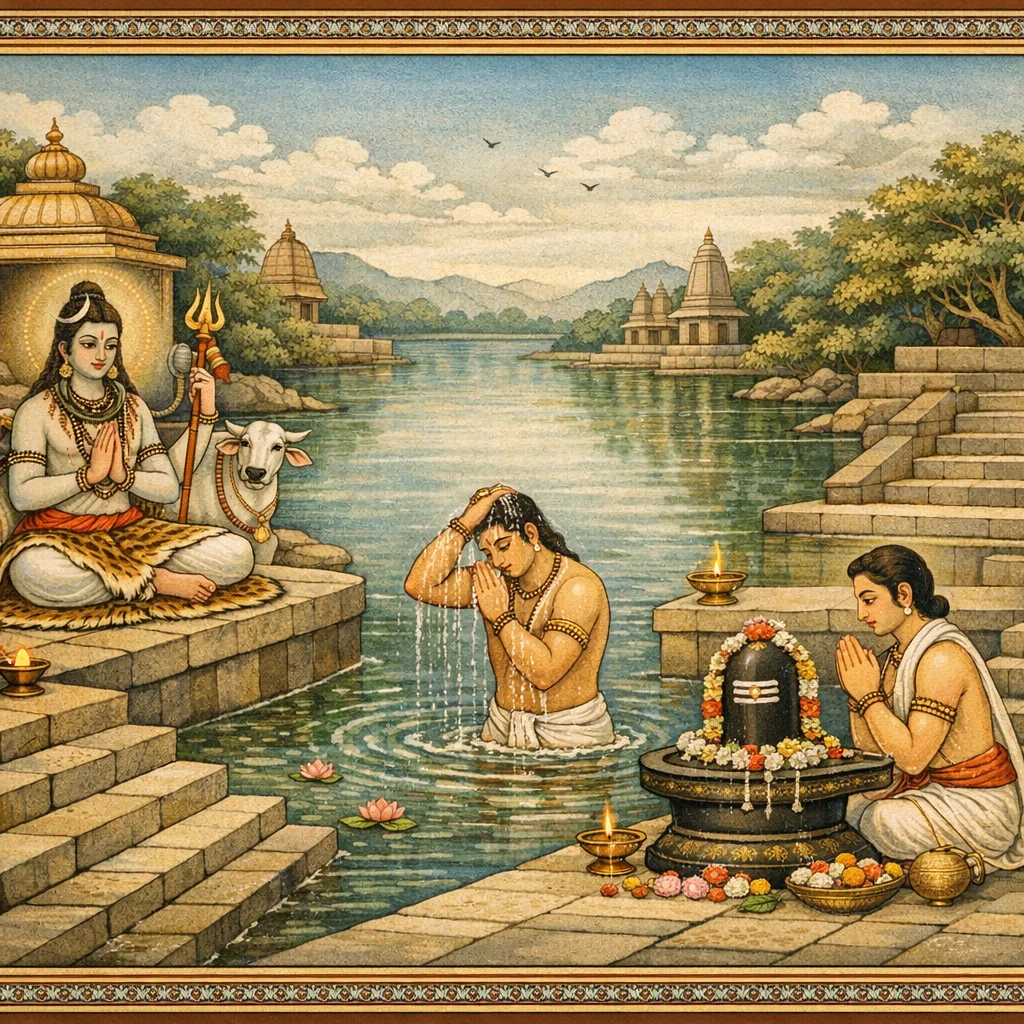
This adhyāya gives a brief theological instruction attributed to Mārkaṇḍeya, addressing the seeker as a “guardian/leader of the land” and directing him to the unsurpassed Śivātīrtha. The teaching is framed as a prescriptive pilgrimage route with a graded sequence of religious observances. First, mere darśana of the deity at Śivātīrtha is said to erase all moral taints (sarva-kilbiṣa). Next, the text prescribes disciplined practice: bathing at the tīrtha while conquering anger and restraining the senses, followed by worship of Mahādeva, yielding merit equal to an Agniṣṭoma sacrifice. Finally, devotion joined with fasting (upavāsa) and Śiva-worship is praised as an irreversible spiritual course that culminates in Rudraloka. Thus the chapter unites self-restraint, ritual acts (snāna, pūjā, upavāsa), and promised fruits of purification and post-mortem ascent into a compact guide for pilgrimage.
Shlokas
Verse 1
मार्कण्डेय उवाच । ततो गच्छेद्धरापाल शीवतीर्थमनुत्तमम् । दर्शनाद्यस्य देवस्य मुच्यते सर्वकिल्बिषैः
Mārkaṇḍeya said: Then, O protector of the earth, one should go to the unsurpassed Śiva-tīrtha. By the very sight of the Deity there, one is released from all sins.
Verse 2
शिवतीर्थे तु यः स्नात्वा जितक्रोधो जितेन्द्रियः । पूजयेत महादेवं सोऽग्निष्टोमफलं लभेत्
But whoever bathes at Śiva-tīrtha, having conquered anger and mastered the senses, and worships Mahādeva—he attains the fruit of the Agniṣṭoma sacrifice.
Verse 3
तत्र तीर्थे तु यो भक्त्या सोपवासोऽर्चयेच्छिवम् । अनिवर्तिका गतिस्तस्य रुद्रलोकादसंशयम्
And whoever, at that tīrtha, worships Śiva with devotion while fasting—his onward course becomes irreversible; without doubt he attains Rudra’s world.
Verse 145
। अध्याय
End of the chapter (Adhyāya).