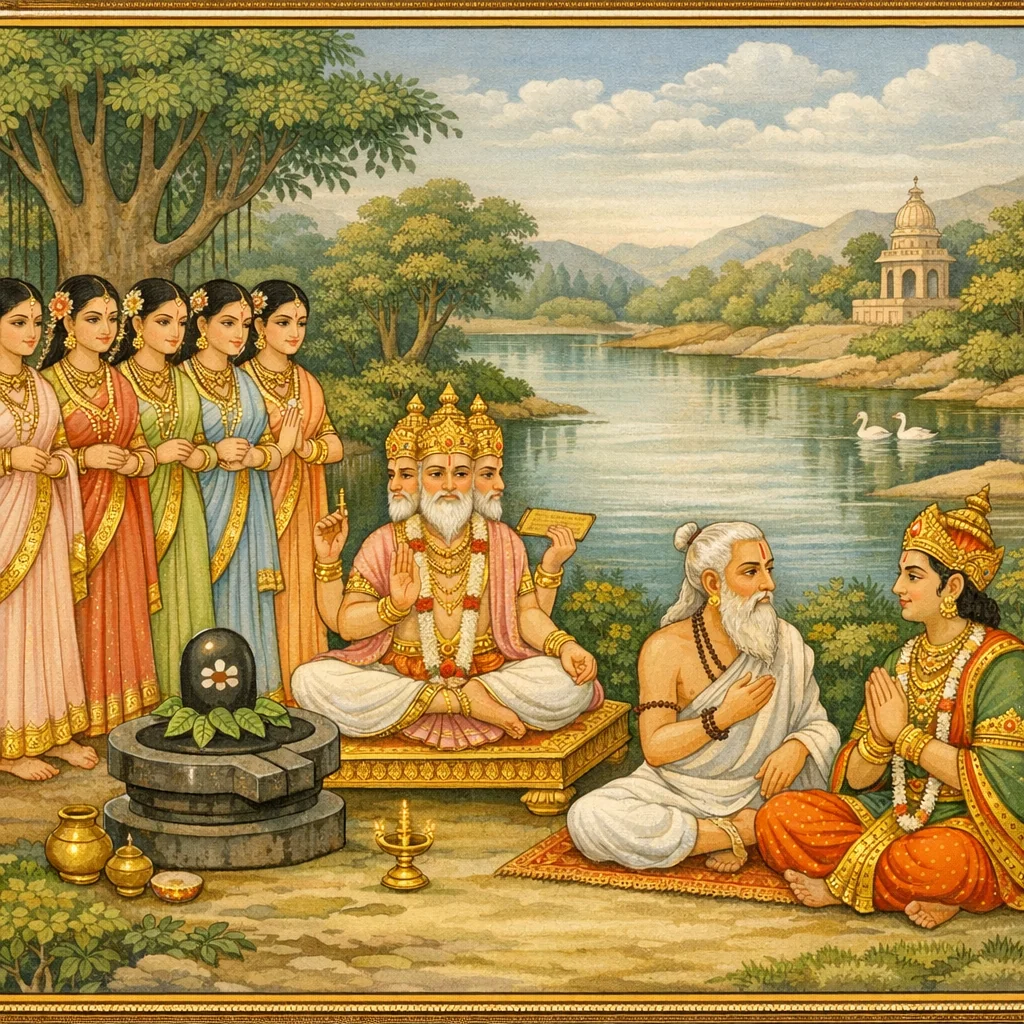
Adhyaya 206
Mārkaṇḍeya addresses a king and directs him to an exceedingly auspicious tīrtha called Daśakanyā, praised as supremely beautiful and universally sin-destroying. The chapter establishes the site’s sanctity through a Śaiva origin-legend: at this ford Mahādeva is linked with ten virtuous maidens, and their marriage arrangement with Brahmā causes the place to become renowned by the name “Daśakanyā.” The teaching then turns from naming to prescribed conduct. Performing kanyādāna there—giving a richly adorned maiden in marriage—yields vast merit, said hyperbolically to grant residence near Śiva for “hair-count” years, followed by a rare human rebirth culminating in great wealth. It also extols devotional bathing (snāna) and the gift of gold to a peaceful brāhmaṇa; even a tiny amount is said to dissolve faults of speech, mind, and body. The phalāśruti concludes with ascent to heaven, honor among Vidyādharas and Siddhas, and abode until cosmic dissolution, presenting the tīrtha as a meeting point of rite, righteous intention, and cosmological reward.
Shlokas
Verse 1
श्रीमार्कण्डेय उवाच । गच्छेत्ततः क्षोणिनाथ तीर्थं परमशोभनम् । सर्वपापहरं पुण्यं दशकन्येति विश्रुतम् । महादेवकृतं पुण्यं सर्वकामफलप्रदम्
Śrī Mārkaṇḍeya said: Thereafter, O lord of the earth, one should go to a supremely beautiful tīrtha—holy and destroying all sins—renowned as Daśakanyā. It is a sacred place established by Mahādeva, bestowing the fruits of all rightful desires.
Verse 2
तत्र तीर्थे महादेवो दशकन्या गुणान्विताः । ब्रह्मणो वरयामास ह्युद्वाहेन युयोज ह
At that tīrtha, Mahādeva sought in marriage the ten maidens endowed with virtues, and indeed joined them to Brahmā in wedlock.
Verse 3
तदाप्रभृति तत्तीर्थं दशकन्येति विश्रुतम् । सर्वपापहरं पुण्यमक्षयं कीर्तितं फलम्
From that time onward, that sacred ford became renowned as “Daśakanyā.” It is praised as holy, removing all sins, and granting an imperishable spiritual fruit.
Verse 4
तत्र तीर्थे तु यः कन्यां ददाति समलंकृताम् । प्राप्नोति पुरुषो दत्त्वा यथाशक्त्या स्वलंकृताम्
At that very tīrtha, a man who gives a maiden in dāna—duly adorned—obtains the promised reward by offering her according to his means, with proper ornaments.
Verse 5
तेन दानोत्थपुण्येन पूतात्मानो नराधिप । वसन्ति रोमसंख्यानि वर्षाणि शिवसन्निधौ
O king, by the merit born of that giving, their souls become purified, and they dwell in the presence of Śiva for years as countless as the hairs upon the body.
Verse 6
ततः कालेन महता त्विह लोके नरेश्वर । मानुष्यं प्राप्य दुष्प्राप्यं धनकोटीपतिर्भवेत्
Then, after a long span of time, O lord of men, returning to this world and attaining the rare human birth, one becomes the master of wealth in crores.
Verse 7
तत्र तीर्थे तु यो भक्त्या स्नात्वा विप्राय काञ्चनम् । सम्प्रयच्छति शान्ताय सोऽत्यन्तं सुखमश्नुते
At that tīrtha, whoever bathes with devotion and then offers gold to a peaceful brāhmaṇa attains supreme happiness.
Verse 8
वाचिकं मानसं वापि कर्मजं यत्पुरा कृतम् । तत्सर्वं विलयं याति स्वर्णदानेन भारत
O Bhārata, whatever sin was formerly committed by speech, by mind, or by action—all of it is dissolved through the gift of gold.
Verse 9
नरो दत्त्वा सुवर्णं चापि वालाग्रमात्रकम् । तत्र तीर्थे दिवं याति मृतो नास्त्यत्र संशयः
Even if a man gives at that tīrtha gold only the measure of a hair’s tip, upon death he goes to heaven—of this there is no doubt.
Verse 10
तत्र विद्याधरैः सिद्धैर्विमानवरमास्थितः । पूज्यमानो वसेत्तावद्यावदाभूतसम्प्लवम्
There, seated in an excellent celestial vimāna, honored by the Vidyādharas and the Siddhas, he dwells for as long as the cosmic dissolution of beings.
Verse 206
अध्यायः
Here ends the sacred chapter.