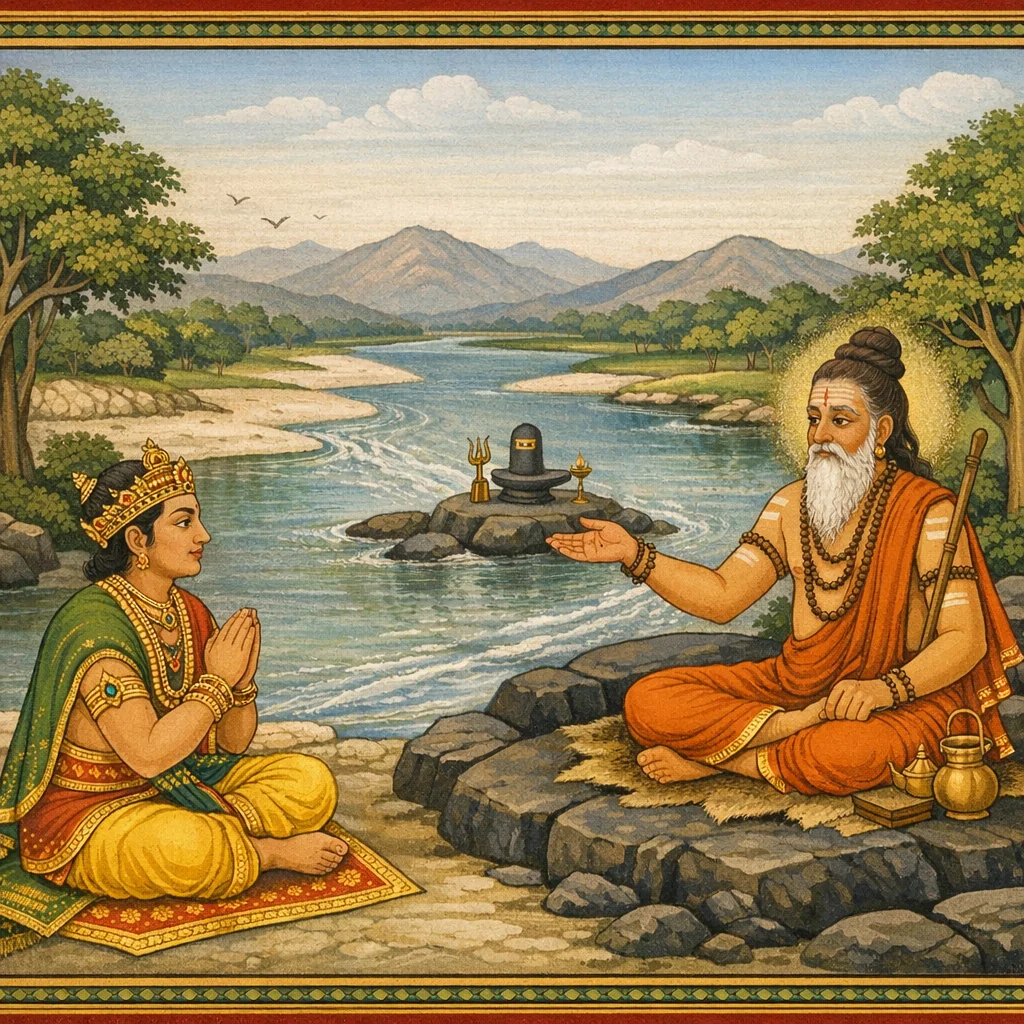
Adhyaya 158
Chapter 158 records Mārkaṇḍeya’s theological and ritual instruction on the supreme tīrtha called Saṅgameśvara, on the southern bank of the Narmadā, praised as a remover of sin and fear. The sanctity of the site is first established through sacred geography and waters: a virtuous stream arising from the Vindhya joins the Narmadā at the confluence, and enduring signs—such as dark stones with crystalline brilliance—are cited as present testimony. The chapter then sets out graded devotional acts with their phalaśruti. Bathing at the confluence and worshiping Saṅgameśvara yields the merit of an Aśvamedha sacrifice; gifting ritual hangings like bells, banners, and canopies is linked to celestial conveyance and nearness to Rudra. “Filling” offerings to the liṅga with curd, coconut, and prescribed abhiṣeka substances (curd, honey, ghee) promise long residence in Śiva’s realm, heavenward results, and continuity of merit across multiple births (including “seven births” motifs). Ethical counsel accompanies ritual: Mahādeva is declared the supreme recipient (mahāpātra), brahmacarya-based worship is praised, and honoring Śiva-yogins is exalted—feeding even one such ascetic is said to surpass feeding multitudes of Veda-knowing brāhmaṇas. The chapter closes with an explicit salvific claim: relinquishing life at Saṅgameśvara prevents return; from Śivaloka there is no rebirth.
Shlokas
Verse 1
श्रीमार्कण्डेय उवाच । ततो गच्छेत्परं तीर्थं सङ्गमेश्वरमुत्तमम् । नर्मदादक्षिणे कूले सर्वपापभयापहम्
Śrī Mārkaṇḍeya said: Then one should go to the supreme holy place called Saṅgameśvara, on the southern bank of the Narmadā—remover of all sins and fears.
Verse 2
धनदस्तत्र विश्रान्तो मुहूर्तं नृपसत्तम । पितृलोकात्समायातः कैलासं धरणीधरम्
There Dhanada (Kubera) rested for a moment, O best of kings. Having come from the world of the ancestors, he proceeded to Kailāsa, the mountain that upholds the earth.
Verse 3
प्रत्ययार्थं नृपश्रेष्ठ ह्यद्यापि धरणीतले । कृष्णवर्णा हि पाषाणा दृश्यन्ते स्फटिकोज्ज्वलाः
As proof, O best of kings, even today upon the earth’s surface, black-hued stones are seen—yet shining with crystal-like brilliance.
Verse 4
विन्ध्यनिर्झरनिष्क्रान्ता पुण्यतोया सरिद्वरा । प्रविष्टा नर्मदातोये सर्वपापप्रणाशने
A most excellent river, emerging from the waterfalls of the Vindhya and filled with holy waters, enters into the waters of the Narmadā—the destroyer of all sins.
Verse 5
सङ्गमे तत्र यः स्नात्वा पूजयेत्सङ्गमेश्वरम् । अश्वमेधस्य यज्ञस्य फलं प्राप्नोत्यसंशयम्
Whoever bathes there at that confluence and worships Saṅgameśvara attains—without doubt—the merit that comes from the Aśvamedha sacrifice.
Verse 6
घण्टापताकावितनं यो ददेत्सङ्गमेश्वरे । हंसयुक्तविमानस्थो दिव्यस्त्रीशतसंवृतः
He who offers bells, banners, and canopies to Saṅgameśvara will ride in a celestial chariot drawn by swans, surrounded by hundreds of divine women.
Verse 7
स रुद्रपदमाप्नोति रुद्रस्यानुचरो भवेत् । दधि भक्ते न देवस्य यः कुर्याल्लिङ्गपूरणम्
He attains the state of Rudra and becomes Rudra’s attendant. And whoever, with devotion, fills (anoints and serves) the Lord’s liṅga with curd—
Verse 8
सिक्थसंख्यं शिवे लोके स वसेत्कालमीप्सितम् । श्रीफलैः पूरयेल्लिङ्गं निःस्वो भूत्वा भवस्य तु
He will dwell in Śiva’s world for a desired span of time—measured, as it were, by the count of wax-drops. Even if poor, one who fills the liṅga of Bhava with coconuts attains that reward.
Verse 9
सोऽपि तत्फलमाप्नोति गतः स्वर्गे नरेश्वर । अक्षया सन्ततिस्तस्य जायते सप्तजन्मसु
He too attains that very fruit and goes to heaven, O lord of men; and for him an unbroken lineage arises, enduring through seven births.
Verse 10
स्नपनं देवदेवस्य दध्ना मधुघृतेन वा । यः करोति विधानेन तस्य पुण्यफलं शृणु
Hear the meritorious fruit of him who, according to rule, performs the ritual bathing (abhiṣeka) of the God of gods with curd, or with honey and ghee.
Verse 11
धृतक्षीरवहा नद्यो यत्र वृक्षा मधुस्रवाः । तत्र ते मानवा यान्ति सुप्रसन्ने महेश्वरे
Where rivers flow with ghee and milk, and where trees drip honey—there those people go, when Maheśvara is exceedingly pleased.
Verse 12
पत्रं पुष्पं फलं तोयं यस्तु दद्यान्महेश्वरे । तत्सर्वं सप्तजन्मानि ह्यक्षयं फलमश्नुते
Whoever offers to Maheśvara a leaf, a flower, a fruit, or water—he partakes of an inexhaustible reward from that, enduring through seven births.
Verse 13
सर्वेषामेव पात्राणां महापात्रं महेश्वरः । तस्मात्सर्वप्रयत्नेन पूजनीयो महेश्वरः
Among all worthy recipients, Maheśvara is the supreme recipient; therefore, with every effort, Maheśvara should be worshiped.
Verse 14
ब्रह्मचर्यस्थितो नित्यं यस्तु पूजयते शिवम् । इह जीवन्स देवेशो मृतो गच्छेदनामयम्
Whoever, ever established in brahmacarya, worships Śiva—while living here he becomes dear to the Lord of gods; and upon death he goes to the state free from all affliction.
Verse 15
शिवे तु पूजिते पार्थ यत्फलं प्राप्यते बुधैः । योगीन्द्रे चैव तत्पार्थ पूजिते लभते फलम्
O Pārtha, the very fruit that the wise obtain by worshipping Śiva is obtained, O Pārtha, by worshipping the lord among yogins.
Verse 16
ते धन्यास्ते महात्मानस्तेषां जन्म सुजीवितम् । येषां गृहेषु भुञ्जन्ति शिवभक्तिरता नराः
Blessed are they—great-souled indeed—and their birth is well-lived, in whose homes men devoted to Śiva’s worship partake of food.
Verse 17
संनिरुध्येन्द्रियग्रामं यत्रयत्र वसेन्मुनिः । तत्र तत्र कुरुक्षेत्रं नैमिषं पुष्कराणि च
Wherever a sage dwells, having restrained the host of senses, that very place becomes Kurukṣetra—becomes Naimiṣa, and even Puṣkara as well.
Verse 18
यत्फलं वेदविदुषि भोजिते शतसंख्यया । तत्फलं जायते पार्थ ह्येकेन शिवयोगिना
O Pārtha, the fruit gained by feeding a hundred Veda-knowing scholars—this very fruit arises from honouring even a single Śiva-yogin.
Verse 19
यत्र भुञ्जति भस्माङ्गी मूर्खो वा यदि पण्डितः । तत्र भुञ्जति देवेशः सपत्नीको वृषध्वजः
Wherever the ash-smeared devotee eats—whether foolish or learned—there the Lord of gods, the Bull-bannered One, partakes together with His consort.
Verse 20
विप्राणां वेदविदुषां कोटिं संभोज्य यत्फलम् । भिक्षामात्रप्रदानेन तत्फलं शिवयोगिनाम्
The fruit obtained by feeding a crore of Veda-knowing brāhmaṇas—that same fruit is obtained by Śiva-yogins through the mere giving of alms.
Verse 21
सङ्गमेश्वरमासाद्य प्राणत्यागं करोति यः । न तस्य पुनरावृत्तिः शिवलोकात्कदाचन
Whoever, having reached Saṅgameśvara, gives up his life—there is never for him any return from Śiva’s world.
Verse 158
। अध्याय
“Chapter.” (A section marker/colophon.)