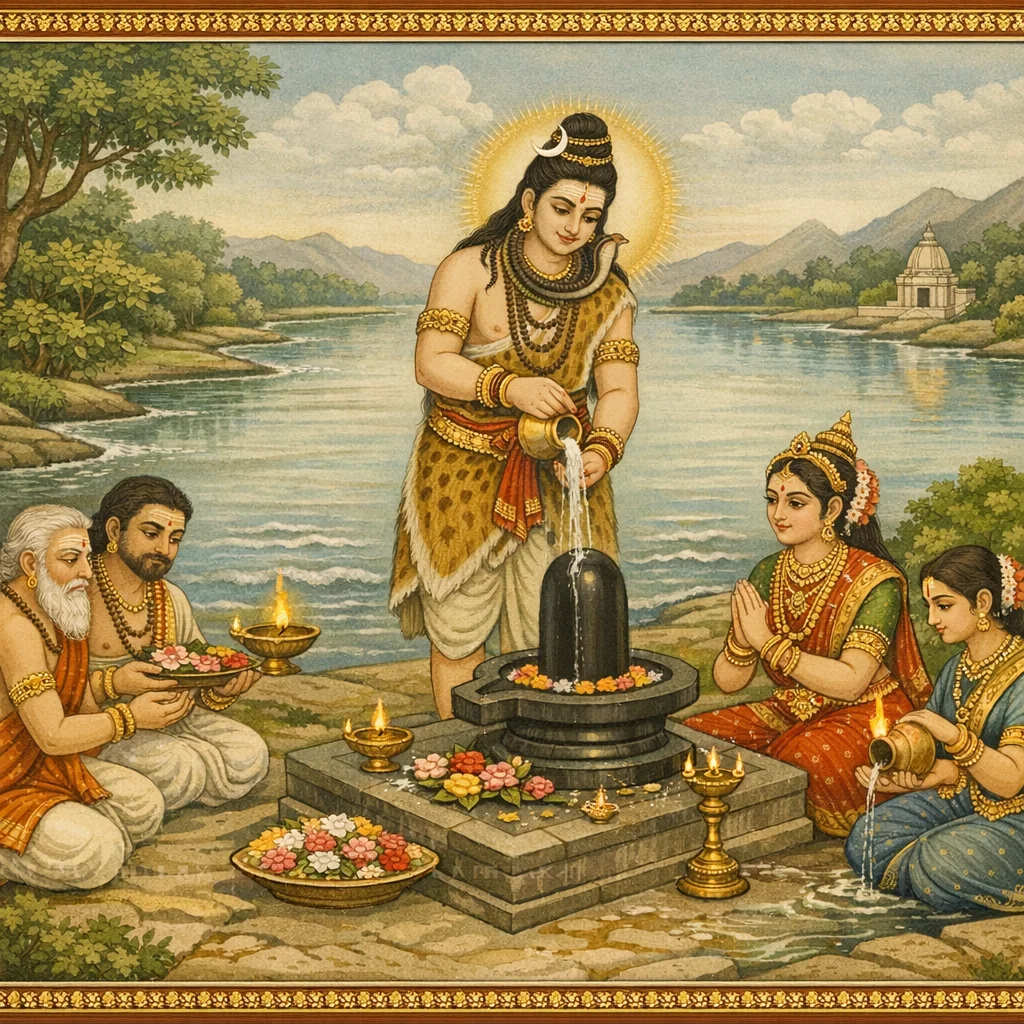
Adhyaya 226
Mārkaṇḍeya extols a highly meritorious tīrtha named Vimaleśvara, lying within a one-krośa circuit, as a ritual-ethical means of purification and wish-fulfillment. Its power is affirmed through exempla: Indra is cleansed after slaying Triśiras, Tvaṣṭṛ’s son; an ascetic brāhmaṇa becomes radiant and stainless through tapas; Bhānu is healed of a disfiguring affliction by austerity and Śiva’s grace; and Vibhaṇḍaka’s son attains “vaimalya” after discerning the impurity born of social entanglements and undertaking a twelve-year discipline with his wife Śāntā at the Revā–ocean junction, observing kṛcchra and cāndrāyaṇa to please Tryambaka. A Daruvana episode relates that Śiva, urged by Śarvāṇī, establishes a purified station at the Narmadā–sea confluence and explains the name Vimaleśvara as a beneficent, world-sustaining presence. Brahmā’s creation of Tilottamā and the ensuing moral disturbance are resolved by silence, triple bathing, remembrance of Śiva, and worship at the confluence, culminating in restored purity. The chapter ends with prescriptions: bathing and Śiva-worship destroy sins and raise one to Brahmaloka; fasting and darśana on aṣṭamī, caturdaśī, and festival days cast off long-accumulated pāpa and grant access to Śiva’s abode; śrāddha performed by rule relieves ancestral debt. Gifts of gold, grain, garments, umbrella, footwear, and kamaṇḍalu are commended, along with devotional arts—song, dance, recitation—and temple-building, praised as a royal merit.
Shlokas
Verse 1
मार्कण्डेय उवाच । ततः क्रोशान्तरे पुण्यं तीर्थं तद्विमलेश्वरम् । यत्र स्नानेन दानेन जपहोमार्चनादिभिः
Mārkaṇḍeya said: Then, at a distance of one krośa, there is the holy tīrtha called Vimaleśvara—where, by bathing, giving charity, and by practices such as japa, homa, and worship,
Verse 2
विमलेश्वरमाराध्य यो यदिच्छेत्स तल्लभेत् । स्वर्गलाभादिकं वापि पार्थिवं वा यथेप्सितम्
Having propitiated Vimaleśvara, whatever a person desires—he obtains that: whether the attainment of heaven and the like, or worldly goals, as wished.
Verse 3
पुरा त्रिशिरसं हत्वा त्वष्टुः पुत्रं शतक्रतुः । यस्य तीर्थस्य माहात्म्याद्वैमल्यं परमं गतः
Formerly, after killing Triśiras, the son of Tvaṣṭṛ, Śatakratu (Indra) attained supreme purity through the greatness of this tīrtha.
Verse 4
यत्र वेदनिधिर्विप्रो महत्तप्त्वा तपः पुरा । नानाकर्ममलैः क्षीणैर्विमलोऽभवदर्कवत्
There, a brāhmaṇa—truly a treasury of the Vedas—once performed great tapas; and when the stains of many deeds were worn away, he became spotless, radiant like the sun.
Verse 5
महादेवप्रसादेन सोमवत्प्रियदर्शनः । पुरा भानुमतीं भानुः सुतां स्मरशरार्दितः
By Mahādeva’s grace he became pleasing to behold, like the Moon. Formerly Bhānu, tormented by Kāma’s arrows, longed for Bhānumatī, the daughter.
Verse 6
चकमे तेन दोषेण कुष्ठरोगार्दितोऽभवत् । स चाप्यत्र तपस्तप्त्वा विमलत्वमुपागतः
Because of that very fault he was afflicted with leprosy. Yet, having performed tapas here, he attained purity—spotlessness—once again.
Verse 7
महादेवेन तुष्टेन स्वस्थानं मुदितोऽभजत् । तथैव च पुरा पार्थ विभाण्डकसुतो मुनिः
When Mahādeva was pleased, he joyfully returned to his own abode. In the same way, O Pārtha, in former times the sage who was the son of Vibhāṇḍaka also received such grace.
Verse 8
योगिसङ्गं वने प्राप्य पुरे च नृपतेस्तथा । राजसंसर्गदोषाद्वै मालिन्यं परमात्मनः
In the forest he gained the company of yogins, and in the city he likewise came into contact with a king. Yet, through the fault of association with royal power, even a great soul incurs impurity.
Verse 9
विचारयन्नभ्युपेत्य रेवासागरसङ्गमम् । शान्तया भार्यया सार्द्धं तप्त्वा द्वादशवत्सरान्
Reflecting deeply, he approached the confluence of the Revā and the ocean; and together with his wife Śāntā, he performed austerities for twelve years.
Verse 10
कृच्छ्रचान्द्रायणैर्देवं तोषयंस्त्र्यम्बकं मुनिः । महादेवेन तुष्टेन सोऽपि वैमल्यमाप्तवान्
By the severe Kṛcchra and Cāndrāyaṇa observances, the sage pleased Tryambaka. When Mahādeva was satisfied, he too attained complete purity.
Verse 11
शर्वाण्या प्रेरितः शर्वः पुरा दारुवने नृप । मोहनान्मुनिपत्नीनां स्वं दीक्ष्य विमलं किल
Urged by Śarvāṇī, Śarva once went to the Dāru forest, O king. After enchanting the wives of the sages, he indeed made his own state consecrated by dīkṣā and spotless.
Verse 12
विचार्य परमस्थानं नर्मदोदधिसङ्गमम् । तत्र स्थित्वा महाराज तपस्तप्त्वा सहोमया
Having discerned the supreme place—the confluence of the Narmadā and the ocean—he stayed there, O great king, and performed austerities together with Homā.
Verse 13
विमलोऽसौ यतो जातस्तेनासौ विमलेश्वरः । तेन नाम्ना स्वयं तस्थौ लोकानां हितकाम्यया
Because he became ‘vimala’ (spotless) there, he came to be known as Vimaleśvara. Bearing that very name, he himself abides there out of compassion, desiring the welfare of the worlds.
Verse 14
ततस्तिलोत्तमां सृष्ट्वा ब्रह्मा लोकपितामहः । प्रजानाथोऽपि तां सृष्ट्वा दृष्ट्वाग्रे सुमनोहराम्
Then Brahmā, the grandsire of the worlds, created Tilottamā; and the Lord of creatures too, having brought her forth, beheld before him her exceedingly enchanting beauty.
Verse 15
भावियोगबलाक्रान्तः स तस्यामभिकोऽभवत् । तेन वीक्ष्य सदोषत्वं रेवातीरद्वयं श्रितः
Overpowered by the force of impending destiny (and desire), he became attached to her. Realizing through that attachment his own tainted condition, he resorted to both banks of the Revā, seeking purification.
Verse 16
तीर्थान्यनुसरन्मौनी त्रिस्नायी संस्मरञ्छिवम् । रेवार्णवसमायोगे स्नात्वा सम्पूज्य शङ्करम् । कालेनाल्पेन राजर्षे ब्रह्माप्यमलतां गतः
O royal sage, following the sacred fords in silence, bathing thrice and remembering Śiva—after bathing at the confluence where the Revā meets the ocean and duly worshipping Śaṅkara—even Brahmā, in a short time, attained stainless purity.
Verse 17
एवमन्येऽपि बहुशो देवर्षिनृपसत्तमाः । त्यक्त्वा दोषमलं तत्र विमला बहवोऽभवन्
So too, many times, other divine seers and foremost kings—casting off the grime of faults there—became pure and stainless in great numbers.
Verse 18
तथा त्वमपि राजेन्द्र तत्र स्नात्वा शिवार्चनात् । अमलोऽपि विशेषेण वैमल्यं प्राप्स्यसे परम्
In the same way, O lord of kings, by bathing there and worshipping Śiva, even if you are already pure you will, most especially, attain supreme stainlessness.
Verse 19
तत्र स्नात्वा नरो नारी पूजयित्वा महेश्वरम् । पापदोषविनिर्मुक्तो ब्रह्मलोके महीयते
A man or a woman, bathing there and worshipping Maheśvara, is freed from sin and fault and is honored in Brahmā’s world.
Verse 20
तत्रोपवासं यः कृत्वा पश्येत विमलेश्वरम् । अष्टम्यां च चतुर्दश्यां सर्वपर्वसु पार्थिव
O king, whoever fasts there and beholds Vimaleśvara—on the eighth lunar day, on the fourteenth, and on all festival occasions—gains great merit.
Verse 21
सप्तजन्मकृतं पापं हित्वा याति शिवालयम् । श्राद्धं कृत्वा विधानेन पित्ःणामनृणी भवेत् । ब्राह्मणान् भोजयेच्छक्त्या तेभ्यो दद्याच्च दक्षिणाम्
Casting off the sins accumulated over seven births, one goes to Śiva’s abode. Performing śrāddha according to proper rule, one becomes free of debt to the ancestors; one should feed brāhmaṇas according to one’s capacity and give them dakṣiṇā.
Verse 22
यद्यदिष्टतमं लोके यच्चैवात्महितं गृहे । तत्तद्गुणवते देयं तत्रैवाक्षयमिच्छता । स्वर्णधान्यानि वासांसि छत्रोपानत्कमण्डलुम्
Whatever is most cherished in the world, and whatever is beneficial in one’s home—let that be given to a worthy recipient by one who seeks imperishable merit there: gold, grains, garments, an umbrella, footwear, and a water-pot (kamandalu).
Verse 23
गृहं देवस्य वै शक्त्या कृत्वा स्याद्भुवि भूपतिः । गीतनृत्यकथाभिश्च तोषयेत्परमेश्वरम्
By building, according to one’s ability, a house (temple) for the Lord, a man becomes a ruler upon earth; and by songs, dances, and sacred narrations he should delight Parameśvara.