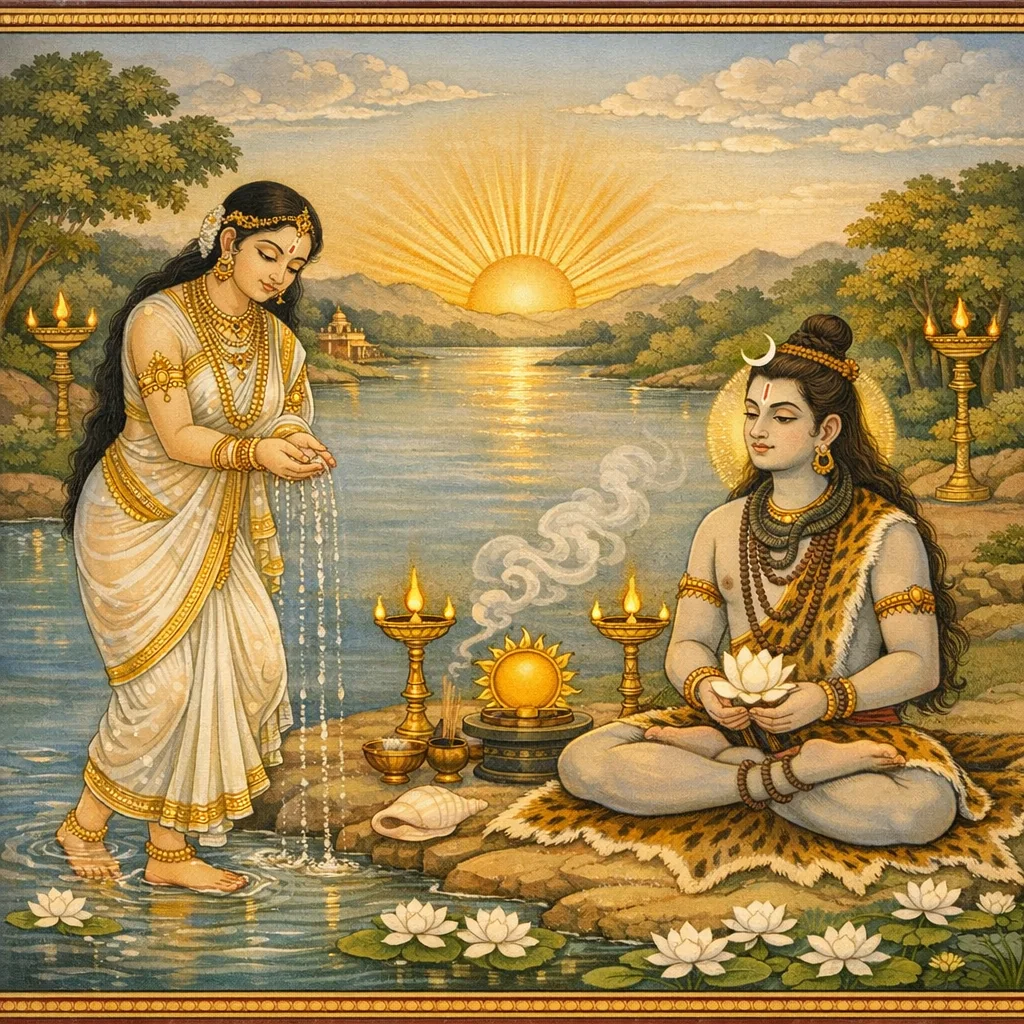
Adhyaya 197
Chapter 197 records Mārkaṇḍeya’s praise of a foremost Sūryatīrtha named Mūlasthāna, an auspicious “root-site” connected with Padmajā (Brahmā) and the installation of Bhāskara (the Sun). On the bank of the Narmadā (Revā), the disciplined pilgrim bathes with a regulated mind, offers piṇḍa and water to ancestors and deities, and then beholds the Mūlasthāna shrine. A special calendrical observance is taught: when Śukla Saptamī falls on Sunday (Ādityavāsara), one should bathe in Revā water, perform tarpaṇa, give gifts according to one’s means, bring karavīra flowers and red sandal-water, and devoutly install/worship Bhāskara. Incense is offered (notably with kundā flowers), lamps are lit in all directions, one fasts, and keeps night-vigil with devotional music. The promised fruit is freedom from intense suffering and long residence in the solar realm, attended by gandharvas and apsarases.
Shlokas
Verse 1
श्रीमार्कण्डेय उवाच । तस्यैवानन्तरं गच्छेत्सूर्यतीर्थमनुत्तमम् । मूलस्थानमिति ख्यातं पद्मजस्थापितं शुभम्
Śrī Mārkaṇḍeya said: Thereafter one should proceed to the unsurpassed Sūryatīrtha, the auspicious place famed as Mūlasthāna, established by Padmajā (Brahmā).
Verse 2
मूलश्रीपतिना देवी प्रोक्ता स्थापय भास्करम् । श्रुत्वा देवोदितं देवी स्थापयामास भास्करम्
The Goddess was instructed by the primal Lord of Śrī (Viṣṇu), “Establish Bhāskara, the Sun.” Hearing the divine command, the Goddess indeed established Bhāskara.
Verse 3
प्रोच्यते नर्मदातीरे मूलस्थानाख्यभास्करः
On the bank of the Narmadā, Bhāskara is spoken of as “Mūlasthāna,” the Sun of the primal seat.
Verse 4
तत्र तीर्थे नरो यस्तु स्नात्वा नियतमानसः । संतर्प्य पितृदेवांश्च पिण्डेन सलिलेन च
At that tīrtha, whatever man bathes with a disciplined mind and satisfies the Pitṛs and the Gods with piṇḍa-offerings and with water—
Verse 5
मूलस्थानं ततः पश्येत्स गच्छेत्परमां गतिम् । गुह्याद्गुह्यतरस्तत्र विशेषस्तु श्रुतो मया
Then, having beheld Mūlasthāna, he attains the highest state. There, I have heard of a distinction more secret than the secret itself.
Verse 6
समागमे मुनीनां तु शङ्कराच्छशिशेखरात् । सदा वै शुक्लसप्तम्यां मूलमादित्यवासरः
In the assembly of sages, Śaṅkara—Śaśiśekhara—declared: on every bright-lunar seventh day (Śukla Saptamī), the “Mūla” observance falls on Sunday, the day of Āditya.
Verse 7
तदा रेवाजलं गत्वा स्नात्वा संतर्प्य देवताः । पित्ःंश्च भरतश्रेष्ठ दत्त्वा दानं स्वशक्तितः
Then, O best of the Bharatas, go to the waters of the Revā (Narmadā); bathe, satisfy the deities and the ancestors, and give charity according to your capacity—
Verse 8
करवीरैस्ततो गत्वा रक्तचन्दनवारिणा । संस्थाप्य भास्करं भक्त्या सम्पूज्य च यथाविधि
Then, with karavīra (oleander) flowers and water fragrant with red sandal, one should install Bhāskara with devotion and worship him fully according to the prescribed rule.
Verse 9
ततः सागुरुकैर्धूपैः कुन्दरैश्च विशेषतः । धूपयेद्देवदेवेशं दीपान् बोध्य दिशो दश
Thereafter, one should incense the God of gods, the Lord of lords, with fragrant smoke—especially with aguru and kundara—and then kindle lamps, illuminating all the ten directions for worship.
Verse 10
उपोष्य जागरं कुर्याद्गीतवाद्यं विशेषतः । एवं कृते महीपाल न भवेदुग्रदुःखभाक्
Having fasted, one should keep a night-vigil—especially with sacred singing and instrumental music. When this is done, O king, one does not become a sufferer of fierce sorrow.
Verse 11
सूर्यलोके वसेत्तावद्यावत्कल्पशतत्रयम् । गन्धर्वैरप्सरोभिश्च सेव्यमानो नृपोत्तम
For as long as three hundred kalpas, he dwells in the world of Sūrya, honored and attended by Gandharvas and Apsarases, O best of kings.
Verse 197
अध्याय
“Chapter” (a manuscript/edition marker indicating the adhyāya division).