Adhyaya 44
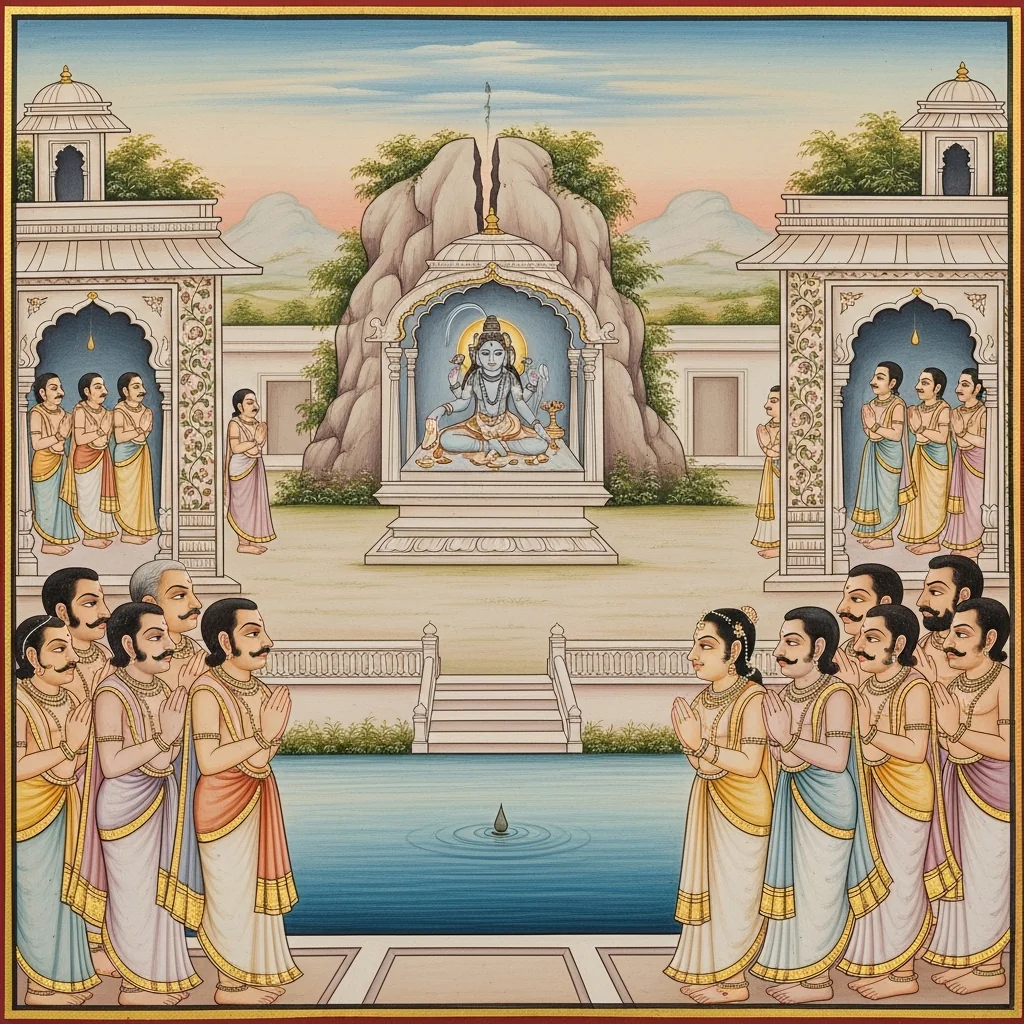
This chapter unfolds as an instructive dialogue: Mārkaṇḍeya answers Yudhiṣṭhira’s question aimed at liberation. He points to a supreme tīrtha on the southern bank of the Revā, established by Śūlapāṇi (Śiva) for human seekers of mokṣa. Located on or near the Bhṛgu-named mountain and set upon its summit, it is famed in the three worlds as Śūlabheda. A graded teaching of purification is given: faults of speech, mind, and body are removed through kīrtana (devotional praise) and darśana of the tīrtha; its sacred radius is five krośas, and it bestows both bhukti and mukti. A mythic-hydrological theme follows: a Gaṅgā-current linked with Bhogavatī (the netherworld) is said to emerge as a sin-destroying flow connected with the triśūla’s “piercing” (bheda). Sarasvatī too is recalled as having fallen into a kuṇḍa where the triśūla split the rock, highlighting the power to release ancient sins (prācīna-aghavimocanī). The text then asserts superiority: even renowned tīrthas such as Kedāra, Prayāga, Kurukṣetra, and Gayā do not equal Śūlabheda in full measure. The chapter prescribes śrāddha rites (piṇḍa and water offerings), regular drinking of the site’s water, and honoring worthy brāhmaṇas without hypocrisy or anger, along with a thirteen-day dāna observance of heightened merit. The devotional itinerary includes darśana of Gaṇanātha/Gajānana and reverence to Kambalakṣetrapa, followed by worship of Mahādeva (Śūlapāṇi), Umā, and Mārkaṇḍeśa dwelling in a cave. Entering the guhā and reciting a “three-syllable” mantra is said to yield a fraction of Nīlaparvata’s merit; the place is further praised as sarvadevamaya and associated with an eminent koṭiliṅga. Finally, signs of authentication (pratyaya) are given—sparks or movements seen in the liṅga during bathing, and an oil-drop that does not spread—presented as tokens of the tīrtha’s power. The discourse closes by stressing its “most secret” nature, total sin-removal, and the phalaśruti that hearing or remembering Śūlabheda three times daily purifies the practitioner inwardly and outwardly.
Shlokas
Verse 1
श्रीमार्कण्डेय उवाच । तीर्थानां परमं तीर्थं तच्छृणुष्व नराधिप । रेवाया दक्षिणे कूले निर्मितं शूलपाणिना
Śrī Mārkaṇḍeya said: O lord of men, listen to the supreme tīrtha among all sacred fords—established on the southern bank of the Revā by the Trident-bearing Lord.
Verse 2
मोक्षार्थं मानवेन्द्राणां निर्मितं नृपसत्तम युधिष्ठिर उवाच । श्रुता मे विविधा धर्मास्तीर्थानि विविधानि च । दानधर्माः समस्ताश्च त्वत्प्रसादाद्द्विजोत्तम
It was established for the mokṣa—liberation—of kings among men, O best of rulers. Yudhiṣṭhira said: Through your grace, O best of brāhmaṇas, I have heard the many forms of dharma, the many tīrthas, and all the disciplines of dāna, sacred charity.
Verse 3
अन्यच्च श्रोतुमिच्छामि संसारश्छिद्यते यथा । पुनरागमनं नास्ति मोक्षप्राप्तिर्भवेद्यथा
And I wish to hear further: how saṃsāra may be cut asunder, how there may be no return again, and how attainment of mokṣa—liberation—may come to be.
Verse 4
एतदाख्याहि मे सर्वं प्रसादाद्द्विजसत्तम
Explain all this to me, O best of brāhmaṇas, out of your gracious favor.
Verse 5
मार्कण्डेय उवाच । शृणुष्वैकमना भूत्वा तीर्थात्तीर्थान्तरं महत् । श्रुते यस्य प्रभावे तु मुच्यते चाब्दिकादघात्
Mārkaṇḍeya said: Listen with a single-pointed mind to a great tīrtha beyond all tīrthas. Merely by hearing of its power, one is released even from sins committed through words.
Verse 6
वाचिकैर्मानसैर्वापि शारीरैश्च विशेषतः । कीर्तनात्तस्य तीर्थस्य मुच्यते सर्वपातकैः
Whether the sins are of speech, of mind, or especially of the body—by praising and proclaiming that tīrtha, one is freed from all downfalls and transgressions.
Verse 7
पञ्चक्रोशप्रमाणं तु तच्च तीर्थं महीपते । भुक्तिमुक्तिप्रदं दिव्यं प्राणिनां पापकर्मिणाम्
O king, that sacred tīrtha extends for a measure of five krośas. It is a divine tīrtha that bestows both bhukti (worldly enjoyment) and mukti (liberation), even upon beings burdened with sinful deeds.
Verse 8
रेवाया दक्षिणे कूले पर्वतो भृगुसंज्ञितः । तस्य मूर्ध्नि च तत्तीर्थं स्थापितं चैव शम्भुना
On the southern bank of the Revā stands a mountain known as Bhṛgu. Upon its summit that sacred tīrtha was established by Śambhu (Śiva) himself.
Verse 9
शूलभेदेति विख्यातं त्रिषु लोकेषु भूपते । तत्र स्थिताश्च ये वृक्षास्तीर्थाच्चैव चतुर्दिशम्
O king, it is renowned in the three worlds by the name “Śūlabheda”. And the trees that stand there, in the four directions around that tīrtha as well, are part of its sacred sphere.
Verse 10
पतिता निलयं यान्ति रुद्रस्य नात्र संशयः । मृतास्तत्रैव ये केचिज्जन्तवो भुवि पक्षिणः
Those who have fallen into sin attain the abode of Rudra—of this there is no doubt. And whatever creatures die there—birds and beings upon the earth—
Verse 11
ते यान्ति परमं लोकं तत्र तीर्थे न संशयः । पातालान्निःसृता गङ्गा भोगवतीतिसंज्ञिता
—they go to the highest world through that tīrtha, with no doubt at all. From Pātāla emerges a Gaṅgā-stream known by the name Bhogavatī.
Verse 12
निष्क्रान्ता शूलभेदाच्च सर्वपापक्षयंकरी । या सा गीर्वाणनाम्न्यन्या वहेत्पुण्या महानदी
Issuing forth from Śūlabheda, she destroys the residue of all sins. That holy great river flows also under another name—Gīrvāṇā.
Verse 13
पतिता कुण्डमध्ये तु यत्र भिन्नं त्रिशूलिना । शम्भुना च पुरा तात उत्पाद्य च सरस्वती
There she fell into the midst of a pool, at the place where it was cleft by the Trident-bearer. Long ago, dear one, Śambhu produced there the Sarasvatī as well.
Verse 14
सा तत्र पतिता राजन् प्राचीनाघविमोचिनी । भास्वत्या त्रितयं यत्र शिला गीर्वाणसंज्ञिता
O king, she descended there as the remover of ancient sins. There is a radiant triad, and a stone there that is known as ‘Gīrvāṇā’.
Verse 15
तत्र तीर्थे च तत्तीर्थं न भूतं न भविष्यति । केदारं च प्रयागं च कुरुक्षेत्रं गया तथा
In that sacred region, such a tīrtha has not existed before, nor will it exist again. Even famed places like Kedāra, Prayāga, Kurukṣetra, and Gayā—
Verse 16
अन्यानि च सुतीर्थानि कलां नार्हन्ति षोडशीम् । पञ्च स्थानानि तीर्थानि पृथग्भूतानि यानि च
Other excellent tīrthas do not equal even a sixteenth part (of its merit). And the five tīrtha-places that are distinct from one another—
Verse 17
वक्ष्यामि च समासेन एकैकं च पृथक्पृथक् । गया नाभ्यां यथा पुण्या चक्रतीर्थं च तत्समम्
I shall explain concisely—each one, separately and in order. Just as Gayā and Nābhi are supremely meritorious, so too is Cakratīrtha, equal to them in holiness.
Verse 18
धर्मारण्ये यथा कूपं शूलभेदं च तत्समम् । ब्रह्मयूपं यथा पुण्यं देवनद्यास्तथैव च
Just as the sacred well in Dharmāraṇya is holy, so is Śūlabheda, equal to it. And just as Brahmayūpa is meritorious, so too is the Devanadī, of the same sanctity.
Verse 19
यथा गयाशिरः पुण्यं सुराणां च यथा शिला । यथा च पुष्करं स्थानं मार्कण्डह्रद एव च
Just as Gayāśiras is holy, and just as the sacred stone revered by the gods is holy, so too are Puṣkara’s sacred precinct and the lake of Mārkaṇḍa.
Verse 20
दत्त्वा पिण्डोदकं तत्र पिण्डाणां च तथाक्षयम् । यस्तत्र कुरुते श्राद्धं तोयं पिबति नित्यशः । मुच्यते सर्वपापैस्तु उरगः कञ्चुकैरिव । अनिन्द्यान्पूजयेद्विप्रान् दम्भक्रोधविवर्जितान्
Having offered there piṇḍa and water-libations—thus securing imperishable merit for the ancestral offerings—whoever performs śrāddha in that place and regularly drinks its water is freed from all sins, like a serpent shedding its slough. One should honor blameless brāhmaṇas, free from hypocrisy and anger.
Verse 21
त्रयोदशदिनं दानं त्रयोदशगुणं भवेत् । अभ्यर्चितं सुरं दृष्ट्वा गणनाथं गजाननम्
A gift given for thirteen days becomes thirteenfold in fruit. Having beheld and worshiped Gaṇanātha, the elephant-faced Lord, the revered deity…
Verse 22
सर्वे विघ्ना विनश्यन्ति दृष्ट्वा कम्बलक्षेत्रपम्
All obstacles are destroyed upon seeing the Lord of Kambalakṣetra.
Verse 23
पूजयेत्परया भक्त्या शूलपाणिं महेश्वरम्
With supreme devotion one should worship Maheśvara, the trident-bearing Lord.
Verse 24
देवस्य पूर्वभागे तु उमा पूज्या प्रयत्नतः । मार्कण्डेशं ततो भक्त्या पूजयेद्गुहवासिनम्
On the eastern side of the deity, Umā should be worshiped with careful effort. Then, with devotion, one should worship Mārkaṇḍeśa, who abides in the cave.
Verse 25
मुच्यन्ते पातकैः सर्वैरज्ञानज्ञानसंचितैः । गुहामध्ये प्रविष्टस्तु जपेत्सूक्तं तु त्र्यक्षरम्
One is freed from all sins—whether amassed through ignorance or even through misguided knowing; then, having entered the cave’s inner recess, one should chant the sacred three-syllabled formula.
Verse 26
नीलपर्वतजं पुण्यं षष्ठांशेन लभेत सः । त्रिनरास्तत्र तिष्ठन्ति सादित्यमरुतैः सह
He gains, as a sixth part, the merit that arises from Nīlaparvata. There, three divine persons abide, together with the Ādityas and the Maruts.
Verse 27
सर्वदेवमयं स्थानं कोटिलिङ्गमनुत्तमम् । यथा नदीनदाः सर्वे सागरे यान्ति संक्षयम्
This place is pervaded by all the gods—an unsurpassed Koṭiliṅga. Just as all rivers and streams finally merge and come to rest in the ocean,
Verse 28
तथा पापानि नश्यन्ति शूलभेदस्य दर्शनात् । प्रत्यक्षो दृश्यतेऽद्यापि प्रत्ययो ह्यवनीपते
So too, sins are destroyed merely by beholding Śūlabheda. Even today, O lord of the earth, its proof is seen directly—plain to experience.
Verse 29
विस्फुलिङ्गा लिङ्गमध्ये स्पन्दन्ते स्नानयोगतः । द्वितीयः प्रत्ययस्तत्र तैलबिन्दुर्न सर्पति
Sparks are seen to tremble within the Liṅga when the bathing rite is performed. This is the second sign there: a drop of oil neither creeps nor spreads.
Verse 30
एवं हि प्रत्ययस्तत्र शूलभेदप्रभावजः । यः स्मरेच्छूलभेदं तु त्रिकालं नित्यमेव च
Thus, the confirming sign there arises from the very power of Śūlabheda. Whoever remembers Śūlabheda—at the three times of day, constantly—
Verse 31
स पूतश्च भवेत्साक्षात्सबाह्याभ्यन्तरो नृप । न कस्यचिन्मया ख्यातं पृष्टोऽहं त्रिदशैरपि
He becomes purified at once—outwardly and inwardly, O king. This has not been disclosed by me to anyone, though I was questioned even by the gods.
Verse 32
गुह्याद्गुह्यतरं तीर्थं सदा गोप्यं कृतं मया । सर्वपापहरं पुण्यं सर्वदोषघ्नमुत्तमम्
This is a tīrtha more secret than the secret itself, kept concealed by me always—holy, supreme, removing all sins and destroying every fault.
Verse 33
सर्वतीर्थमयं तीर्थं शूलभेदं जनेश्वर । श्रुते यस्य प्रभावे तु मुच्यते सर्वपातकैः
Śūlabheda is a tīrtha that contains the essence of all tīrthas, O lord of people. Merely by hearing of its greatness, one is freed from all grave sins.
Verse 34
शूलभेदं मया तात संक्षेपात्कथितं तव । यः शृणोति नरो भक्त्या मुच्यते सर्वपातकैः
Dear one, I have told you of Śūlabheda briefly. Any person who listens with devotion is freed from all grave sins.