Adhyaya 189
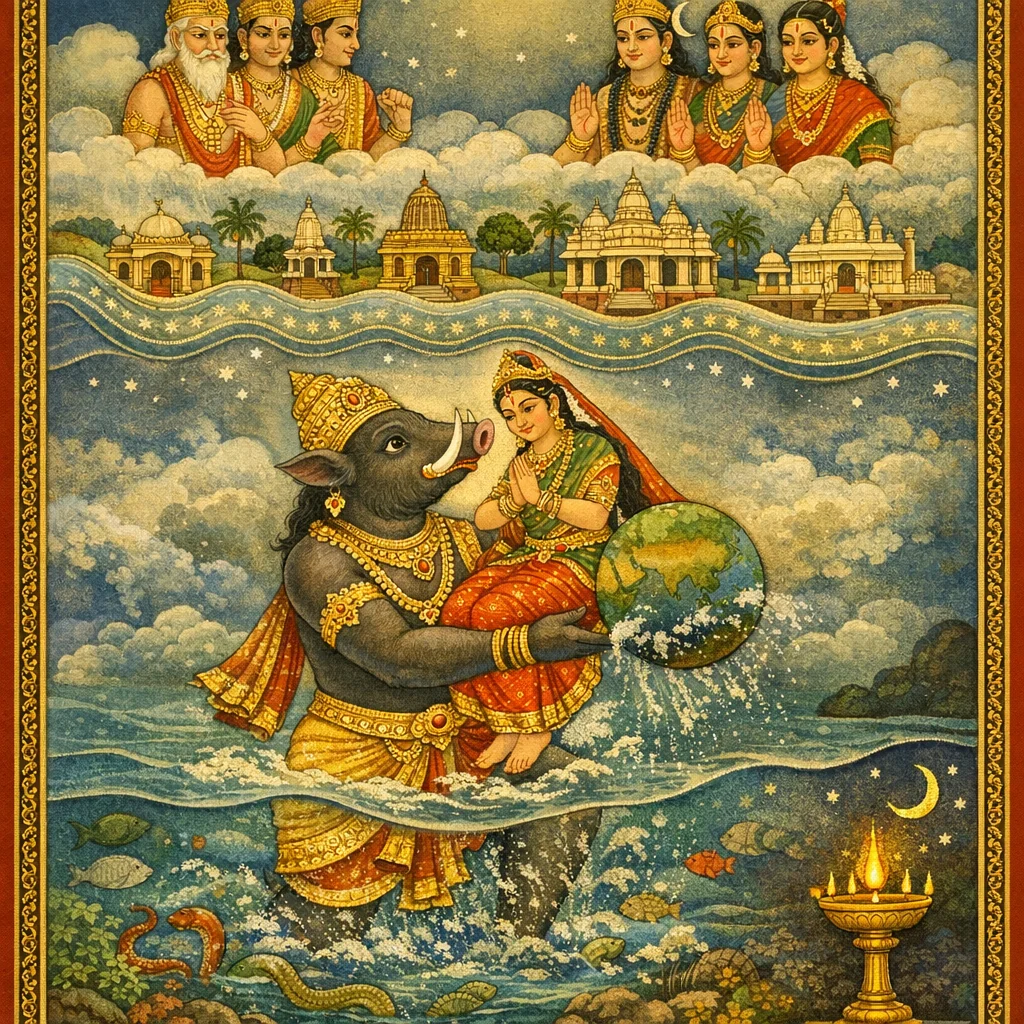
Mārkaṇḍeya directs Yudhiṣṭhira to a “most splendid” tīrtha, where Varāha (Viṣṇu) is remembered as the Upholder and Lifter of the Earth (dharaṇīdhara). In an embedded cosmogonic account, Hari lies in yoganidrā upon the serpent-bed in the Milk Ocean; when the Earth sinks under its burden, the distressed Devas petition him to restore cosmic stability. Viṣṇu then assumes the formidable, tusked form of Varāha and raises the Earth upon his tusk. The chapter next describes a fivefold manifestation of Varāha connected with the northern bank of the Narmadā and specific named sites for the first through fifth forms, culminating in the fifth, Udīrṇa-Varāha, associated with Bhṛgukaccha. It then prescribes the vrata: in the month of Jyeṣṭha, bright fortnight, especially on Ekādaśī, the pilgrim observes haviṣya dietary restraint, keeps night vigil (jāgaraṇa), bathes in the river, offers sesame and barley to ancestors and deities, and gives graded gifts (cow, horse, gold, land) to worthy brāhmaṇas, worshipping at each Varāha station. The phalaśruti declares that simultaneous darśana of the five Varāhas, together with Narmadā rites and remembrance of Nārāyaṇa, destroys even grave sins and grants liberation; a Śaṅkara-authority statement adds that timely darśana of Loṭaṇeśvara brings release from embodied existence.
Shlokas
Verse 1
श्रीमार्कण्डेय उवाच । ततो गच्छेत्तु राजेन्द्र तीर्थं परमशोभनम् । उदीर्णो यत्र वाराहो ह्यभवद्धरणीधरः
Śrī Mārkaṇḍeya said: “Then, O king, one should go to a supremely splendid sacred ford (tīrtha), where the Boar, Varāha, manifested in mighty form and became the upholder of the Earth.”
Verse 2
धन्वदंष्ट्रां करालाग्रां बिभ्रच्च पृथिवीमिमाम् । स एव पञ्चमः प्रोक्तो वाराहो मुक्तिदायकः
Bearing fearsome, sharp-pointed tusks and lifting up this very Earth, that same Varāha is proclaimed the “fifth”—the Boar-form who bestows liberation (mokṣa).
Verse 3
युधिष्ठिर उवाच । कथमुदीर्णरूपोऽभूद्वाराहो धरणीधरः । वाराहत्वं गतः केन पञ्चमः केन संज्ञितः
Yudhiṣṭhira said: “How did Varāha, the upholder of the Earth, arise in that mighty form? By whom did he assume boarhood, and why is he designated as the ‘fifth’?”
Verse 4
मार्कण्डेय उवाच । आदिकल्पे पुरा राजन्क्षीरोदे भगवान् हरिः । शेते स भोगिशयने योगनिद्राविमोहितः
Mārkaṇḍeya said: “In the primordial kalpa, O king, the Blessed Lord Hari lay upon the Ocean of Milk (Kṣīroda), reclining on the serpent-couch, absorbed in yogic sleep.”
Verse 5
बभूव नृपतिश्रेष्ठ गत्वा वै देवसंनिधौ । अवोचद्भारखिन्नाहं गमिष्यामि रसातलम्
O best of kings, (the Earth) went into the presence of the gods and said: “I am weary from the burden; I shall go down to Rasātala, the nether realm.”
Verse 6
दृष्ट्वा देवाः समुद्विग्ना गता यत्र जनार्दनः । तुष्टुवुर्वाग्भिरिष्टाभिः केशवं जगत्पतिम्
Seeing this, the gods, deeply alarmed, went to where Janārdana was, and with cherished hymns of praise they extolled Keśava, the Lord of the world.
Verse 7
देवा ऊचुः । नमो नमस्ते देवेश सुरार्तिहर सर्वग । विश्वमूर्ते नमस्तुभ्यं त्राहि सर्वान्महद्भयात्
The gods said: “Homage, homage to You, O Lord of the gods—remover of the devas’ distress, the All-pervading One! O embodied form of the universe, homage to You. Save us all from this great fear.”
Verse 8
इत्युक्तो दैवतैर्देवो ह्युवाच किमुपस्थितम् । कार्यं वदध्वं मे देवा यत्कृत्यं मा चिरं कृथाः
Thus addressed by the gods, the Lord said: “What has arisen? Tell Me, O gods, what task is to be done—do not delay in stating what must be accomplished.”
Verse 9
देवा ऊचुः । धरा धरित्री भूतानां भारोद्विग्ना निमज्जति । तामुद्धर हृषीकेश लोकान्संस्थापय स्थितौ
The Devas said: “Earth, the sustainer of beings, oppressed by the burden, is sinking down. O Hṛṣīkeśa, lift her up and re-establish the worlds in their proper stability and order.”
Verse 10
एवमुक्तः सुरैः सर्वैः केशवः परमेश्वरः । वाराहं रूपमास्थाय सर्वयज्ञमयं विभुः
Thus addressed by all the gods, Keśava—the Supreme Lord—assumed the form of Varāha, the Boar, that all-pervading One who is the very essence of every sacrifice.
Verse 11
दंष्ट्राकरालं पिङ्गाक्षं समाकुञ्चितमूर्धजम् । कृत्वाऽनन्तं पादपीठं दंष्ट्राग्रेणोद्धरन्भुवम्
Terrible with tusks, tawny-eyed, with hair bristling and curled—making Ananta his footstool—he lifted up the Earth upon the tip of his tusk.
Verse 12
सपर्वतवनामुर्वीं समुद्रपरिमेखलाम् । उद्धृत्य भगवान् विष्णुरुदीर्णः समजायत
Having raised up the Earth—together with her mountains and forests, girdled by the ocean—Lord Viṣṇu rose up in majesty.
Verse 13
दर्शयन्पञ्चधात्मानमुत्तरे नर्मदातटे । तथाद्यं कोरलायां तु द्वितीयं योधनीपुरे
Revealing himself in five forms upon the northern bank of the Narmadā: the first (manifestation) is at Koralā, and the second at Yodhanīpura.
Verse 14
जयक्षेत्राभिधाने तु जयेति परिकीर्तितम् । असुरान्मोहयल्लिङ्गस्तृतीयः परिकीर्तितः
At the place known as Jayakṣetra, it is celebrated as ‘Jaya’. There, a liṅga that deluded the Asuras is proclaimed as the third (manifestation).
Verse 15
पावनाय जगद्धेतोः स्थितो यस्माच्छशिप्रभः । अतस्तु नृपशार्दूल श्वेत इत्याभिधीयते
Because, for the purification of the world’s cause (the Lord), he abides there shining with moonlike radiance—therefore, O tiger among kings, he is known as ‘Śveta’ (the White One).
Verse 16
उद्धृत्य जगतां देवीमुदीर्णो भृगुकच्छके । ततः पञ्चम उदीर्णो वराह इति संज्ञितः
Having lifted up the Goddess of the worlds (Earth), he rose in glory at Bhṛgukacchaka. Thereupon the fifth exalted manifestation is known by the name ‘Varāha’.
Verse 17
इति पञ्चवराहास्ते कथितः पाण्डुनन्दन । युगपद्दर्शनं चैषां ब्रह्महत्यां व्यपोहति
Thus these five Varāhas have been declared to you, O son of Pāṇḍu. The simultaneous darśana of them removes even the sin of brahma-hatyā, the slaying of a brāhmaṇa.
Verse 18
ज्येष्ठे मासि सिते पक्ष एकादश्यां विशेषतः । गत्वा ह्यादिवराहं तु सम्प्राप्ते दशमीदिने
In the month of Jyeṣṭha, in the bright fortnight—especially on Ekādaśī—one should go to Ādi-Varāha when the Daśamī day has been reached, following the proper observance leading into Ekādaśī.
Verse 19
हविष्यमन्नं भुञ्जीयाल्लघुसायं गते रवौ । रात्रौ जागरणं कुर्याद्वाराहे ह्यादिसंज्ञके
When the sun has set, one should partake of a light meal of haviṣya, pure ritual food. Through the night one should keep vigil at the sacred Varāha shrine known as Ādi.
Verse 20
ततः प्रभाते ह्युषसि संस्नात्वा नर्मदाजले । संतर्प्य पितृदेवांश्च तिलैर्यवविमिश्रितैः
Then, at dawn, having bathed in the waters of the Narmadā, one should offer satisfaction-offerings to the Pitṛs and the Devas with sesame seeds mixed with barley.
Verse 21
धेनुं दद्याद्द्विजे योग्ये सर्वाभरणभूषिताम् । निर्ममो निरहङ्कारो दानं दद्याद्द्विजातये
One should gift a cow, adorned with all ornaments, to a worthy brāhmaṇa. Free from possessiveness and ego, one should give dāna, sacred charity, to the twice-born (dvijāti).
Verse 22
गत्वा सम्पूजयेद्देवं वाराहं ह्यादिसंज्ञितम् । अनेन विधिना पूज्य पश्चाद्गच्छेज्जयं त्वरन्
Having gone there, one should worship the Lord Varāha, known as Ādi, with the full rites. Having worshipped according to this procedure, one should then proceed swiftly to the place called Jaya.
Verse 23
त्वरितं तु जयं गत्वा पूर्वकं विधिमाचरेत् । अश्वं दद्याद्द्विजाग्र्याय जयपूर्वाभिनिर्गतम्
Having quickly reached Jaya, one should perform the rite prescribed earlier. One should give a horse to an eminent brāhmaṇa—one that has come forth from the region of Jaya.
Verse 24
लिङ्गे चैव तिला देयाः श्वेते हिरण्यमेव च । उदीर्णे च भुवं दद्यात्पूर्वकं विधिमाचरेत्
At the Liṅga too, sesame should be offered, and also white gold. At Udīrṇa, one should donate land, performing the earlier prescribed rite.
Verse 25
अनस्तमित आदित्ये वराहान्पञ्च पश्यतः । यत्फलं लभते पार्थ तदिहैकमनाः शृणु
O son of Pṛthā, listen with single-pointed mind to the fruit one attains by beholding five Varāhas while the sun has not set, in full daylight.
Verse 26
ब्रह्महत्या सुरापानं स्तेयं गुर्वङ्गनागमः । एभिस्तु सह संयोगो विश्वस्तानां च वञ्चनम्
Brahmin-slaying, drinking liquor, theft, approaching the wife of one’s teacher—association with such sins, and deceiving those who trust you, are grievous offences.
Verse 27
स्वसृदुहितृभगिनीकुलदारोपबृंहणम् । आ जन्ममरणाद्यावत्पापं भरतसत्तम
Intercourse with one’s sister, daughter, female relatives, or the wives of one’s family—such sin, O best of the Bhāratas, persists up to (the cycle of) birth and death.
Verse 28
तीर्थपञ्चकपूतस्य वैष्णवस्य विशेषतः । युगपच्चविनश्येत तूलराशिरिवानलात्
For a Vaiṣṇava especially—one purified by the five tīrthas—those sins are destroyed at once, like a heap of cotton by fire.
Verse 29
नारायणानुस्मरणाज्जपध्यानाद्विशेषतः । विप्रणश्यन्ति पापानि गिरिकूटसमान्यपि
By remembering Nārāyaṇa—especially through japa and meditation—even sins heaped up like mountain-peaks are completely destroyed.
Verse 30
दृष्ट्वा पञ्च वराहान्वै पौरुषे महति स्थितः । आप्लवन्नर्मदातोये श्राद्धं कृत्वा यथाविधि
Having beheld the Five Varāhas and remaining steadfast in that great sacred observance, one should bathe in the waters of the Narmadā and then perform śrāddha according to rule.
Verse 31
उदयास्तमनादर्वाग्यः पश्येल्लोटणेश्वरम् । कलेवरविमुक्तः स इत्येवं शङ्करोऽब्रवीत्
Whoever beholds Loṭaṇeśvara before sunrise or after sunset becomes freed from embodiment—so declared Śaṅkara (Śiva).
Verse 32
मुक्तिं प्रयाति सहसा दुष्प्रापां परमेश्वरीम् । पौरुषे क्रियमाणेऽपि न सिद्धिर्जायते यदि
He attains liberation (mokṣa) at once—rare to obtain and belonging to the Supreme Lord—when, even though the Pauruṣa rite is being performed, success does not arise by ordinary means.
Verse 33
ब्रुवन्ति स्वर्गगमनमपि पापान्वितस्य च । यत्र तत्र गतस्यैव भवेत्पञ्चवराहकी
They say that even one burdened with sin gains passage to heaven; and for whoever has gone there—whencesoever he may have come—the merit of the Pañca-Varāha (tīrtha/rite) surely arises.
Verse 34
ज्येष्ठस्यैकादशीतिथौ ध्रुवं तत्र वसेन्नरः । आदिं जयं तथा श्वेतं लिङ्गमुदीर्णमेव च
On the eleventh lunar day (Ekādaśī) of Jyeṣṭha, a man should certainly stay there; and he should worship/visit the liṅgas named Ādi, Jaya, Śveta, and also Udīrṇa.
Verse 35
आश्रित्य तस्या द्रष्टव्या वराहास्तु यतस्ततः । ज्येष्ठस्यैकादशीतिथौ विष्णुना प्रभुविष्णुना
Taking refuge there, the Varāhas are to be beheld on every side; on Jyeṣṭha Ekādaśī, by Viṣṇu—by Lord Viṣṇu—they are especially made manifest and accessible.
Verse 36
वाराहं रूपमास्थाय उद्धृता धरणी विभो । पुण्यात्पुण्यतमा तेन ह्यशेषाघौघनाशिनी
O Mighty Lord, assuming the form of Varāha, You lifted up the Earth. Therefore this (tīrtha/this merit) is the most sanctifying of sanctities, for it destroys every flood of sin without remainder.
Verse 37
दृष्ट्वा पञ्चवराहान्वै क्रोडमुदीर्णरूपिणम् । पूजयित्वा विधानेन पश्चाज्जागरणं चरेत्
Having beheld the Five Varāhas, in their exalted boar-form, one should worship them according to the prescribed ordinance, and thereafter observe a night-long vigil.
Verse 38
सपञ्चवर्तिकान् दीपान् घृतेनोज्ज्वाल्य भक्तितः । पुराणश्रवणैर्नृत्यैर्गीतवाद्यैः सुमङ्गलैः
With devotion, lighting ghee-lamps with five wicks, one should keep vigil by listening to the Purāṇas, with dances, and with auspicious singing and instrumental music.
Verse 39
वेदजाप्यैः पवित्रैश्च क्षपयित्वा च शर्वरीम् । यत्पुण्यं लभते मर्त्यो ह्याजमीढ शृणुष्व तत्
Spending the night in pure acts—through sacred Vedic recitations and other purifying japa—listen, O Ājamīḍha: the merit a mortal gains thereby, that I shall now declare.
Verse 40
रेवाजलं पुण्यतमं पृथिव्यां तथा च देवो जगतां पतिर्हरिः । एकादशी पापहरा नरेन्द्र बह्वायासैर्लभ्यते मानवानाम्
The waters of the Revā are the most holy upon the earth; likewise Hari, the Lord of the worlds, is divine. And Ekādaśī, O king, is a destroyer of sins—attained by human beings only with great effort and observance.
Verse 41
एकैकशो ब्रह्महत्यादिकानि शक्तानि हन्तुं पापसङ्घानि राजन् । नैते सर्वे युगपद्वै समेता हन्तुं शक्ताः किं न तद्ब्रूहि राजन्
O king, each mass of sins—beginning with brahmahatyā—has the power to strike a person down. Yet even if all these sins were to assemble together at once, they would not be able to destroy the one protected by this dharma. Tell me, O king: how can that be?
Verse 42
यथेदमुक्तं तव धर्मसूनो श्रुतं च यच्छङ्कराच्चन्द्रमौलेः । श्रुत्वेदमिच्छन्मुच्यते सर्वपापैः पठन्पदं याति हि वृत्रशत्रोः
O son of Dharma, just as this has been spoken to you—and as it was heard from Śaṅkara, the moon-crested Lord—so too, whoever hears this teaching with faith is freed from all sins; and whoever recites it attains the state (abode) of Indra, Vṛtra’s slayer.
Verse 189
अध्याय
Chapter (end/heading marker).