Adhyaya 65
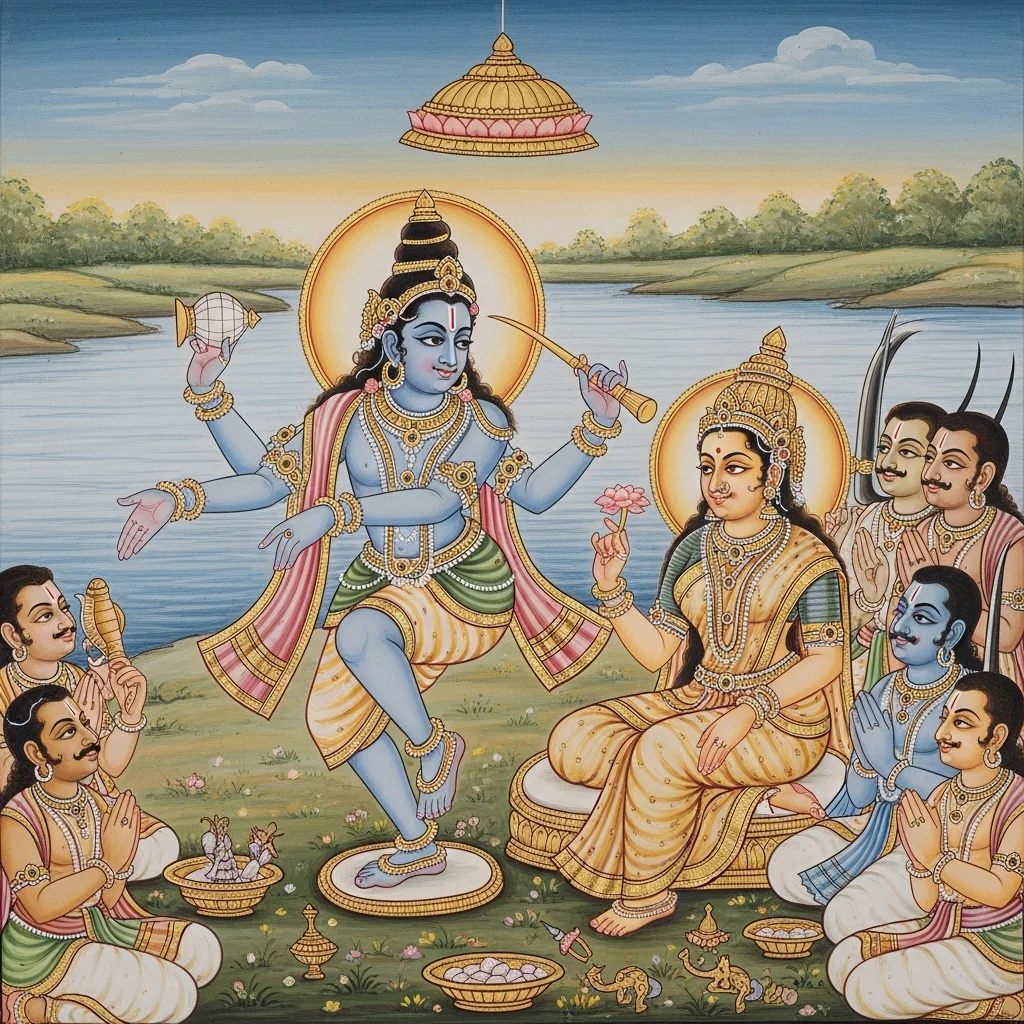
This chapter unfolds as a dialogue in which the sage Mārkaṇḍeya instructs Yudhiṣṭhira about a sacred Narmadā-bank tīrtha called Ānandeśvara. It first recounts the origin: after the demons are slain, Maheśvara (Śiva) is honored by gods and beings; taking the Bhairava form with Gaurī as his consort, he performs a divine dance on the southern bank of the Narmadā. From this foundational event the tīrtha gains the name Ānandeśvara and is praised as a place of purifying power. The teaching then turns to ritual guidance: worship is recommended on Aṣṭamī, Caturdaśī, and Paurṇamāsī, with fragrant anointing and the honoring of brāhmaṇas according to one’s means. Go-dāna and vastra-dāna are commended, and a seasonal śrāddha observance is prescribed (notably the trayodaśī in Vasanta), with practical offerings such as inguda, badara, bilva, akṣata, and water. The closing phalaśruti declares that these acts bring enduring satisfaction to the ancestors and ensure continuity of progeny across many births, presenting ritual performance as both dharmic duty and long-range spiritual welfare.
Shlokas
Verse 1
श्रीमार्कण्डेय उवाच । ततो गच्छेत्तु राजेन्द्र आनन्देश्वरमुत्तमम् । तत्तीर्थं कथयिष्यामि सर्वपापक्षयंकरम्
Śrī Mārkaṇḍeya said: Then, O lord of kings, one should go to the excellent Ānandeśvara. I shall describe that sacred tīrtha, which brings about the destruction of all sins.
Verse 2
युधिष्ठिर उवाच । आनन्दश्चैव संजातो रुद्रस्य द्विजसत्तम । कथ्यतां मे च तत्सर्वं संक्षेपात्सह बान्धवैः
Yudhiṣṭhira said: O best of Brahmins, how did Rudra come to be filled with joy? Tell me all of that—briefly—and also how it concerns one’s kinsmen.
Verse 3
श्रीमार्कण्डेय उवाच । कथयामि नृपश्रेष्ठ आनन्देश्वरमुत्तमम् । दानवानां वधं कृत्वा देवदेवो महेश्वरः
Śrī Mārkaṇḍeya said: O best of kings, I shall recount the excellent Ānandeśvara. Having slain the Dānavas, Maheśvara—the God of gods—(then manifested this glory).
Verse 4
पूजितो दैवतैः सर्वैः किन्नरैर्यक्षपन्नगैः । आनन्दसंयुतो देवो ननर्त वृषवाहनः
Worshipped by all the gods, and by Kinnaras, Yakṣas, and serpents, the Deity—filled with bliss—danced, He whose mount is the Bull.
Verse 5
भैरवं रूपमास्थाय गौर्या चार्द्धाङ्गसंस्थितः । भूतवेतालकङ्कालैर्भैरवैर्भैरवो वृतः
Assuming the form of Bhairava, with Gaurī abiding as half of His body, Bhairava was surrounded by Bhairavas—by hosts of Bhūtas, Vetālas, and skeletal spirits.
Verse 6
ननर्त नर्मदातीरे दक्षिणे पाण्डुनन्दन । तुष्टैर्मरुद्गणैः सर्वैः स्थापितः कमलासनः
He danced on the southern bank of the Narmadā, O son of Pāṇḍu. And, with all the Marut hosts delighted, the Lotus-seated Brahmā was established there.
Verse 7
तदाप्रभृति तत्तीर्थमानन्देश्वरमुच्यते । अष्टम्यां च चतुर्दश्यां पौर्णमास्यां नराधिप
From that time onward, that sacred ford came to be known as Ānandeśvara. O king, its worship is especially commended on the eighth lunar day, the fourteenth, and on the full-moon day.
Verse 8
विधिवच्चार्चयेद्देवं सुगन्धेन विलेपयेत् । ब्राह्मणान्पूजयेत्तत्र यथाशक्त्या युधिष्ठिर
One should worship the Lord there according to proper rite, anointing Him with fragrant unguents; and one should honor brāhmaṇas there, O Yudhiṣṭhira, to the best of one’s ability.
Verse 9
गोदानं तत्र कर्तव्यं वस्त्रदानं शुभावहम् । वसन्तस्य त्रयोदश्यां श्राद्धं तत्रैव कारयेत्
There one should perform the gift of a cow, and the gift of garments which brings auspiciousness. On the thirteenth lunar day in the spring season, one should also have the śrāddha performed there itself.
Verse 10
इङ्गुदैर्बदरैर्बिल्वैरक्षतैश्च जलेन वा । प्रेतानां कारयेच्छ्राद्धमानन्देश्वर उत्तमे
At the excellent Ānandeśvara, one should perform śrāddha for the departed with iṅguda fruits, jujubes (badara), bilva fruits, and unbroken rice—or even with water alone.
Verse 11
आनन्दिता भवेयुस्ते यावदाभूतसम्प्लवम् । सन्ततेर्वै न विच्छेदः सप्तजन्मसु जायते । आनन्दो हि भवत्तेषां प्रतिजन्मनि भारत
They will remain joyful until the dissolution of beings. Indeed, their lineage will not be broken for seven births, and happiness will come to them in every birth, O Bhārata.
Verse 65
। अध्याय
End of the chapter (adhyāya).