Adhyaya 16
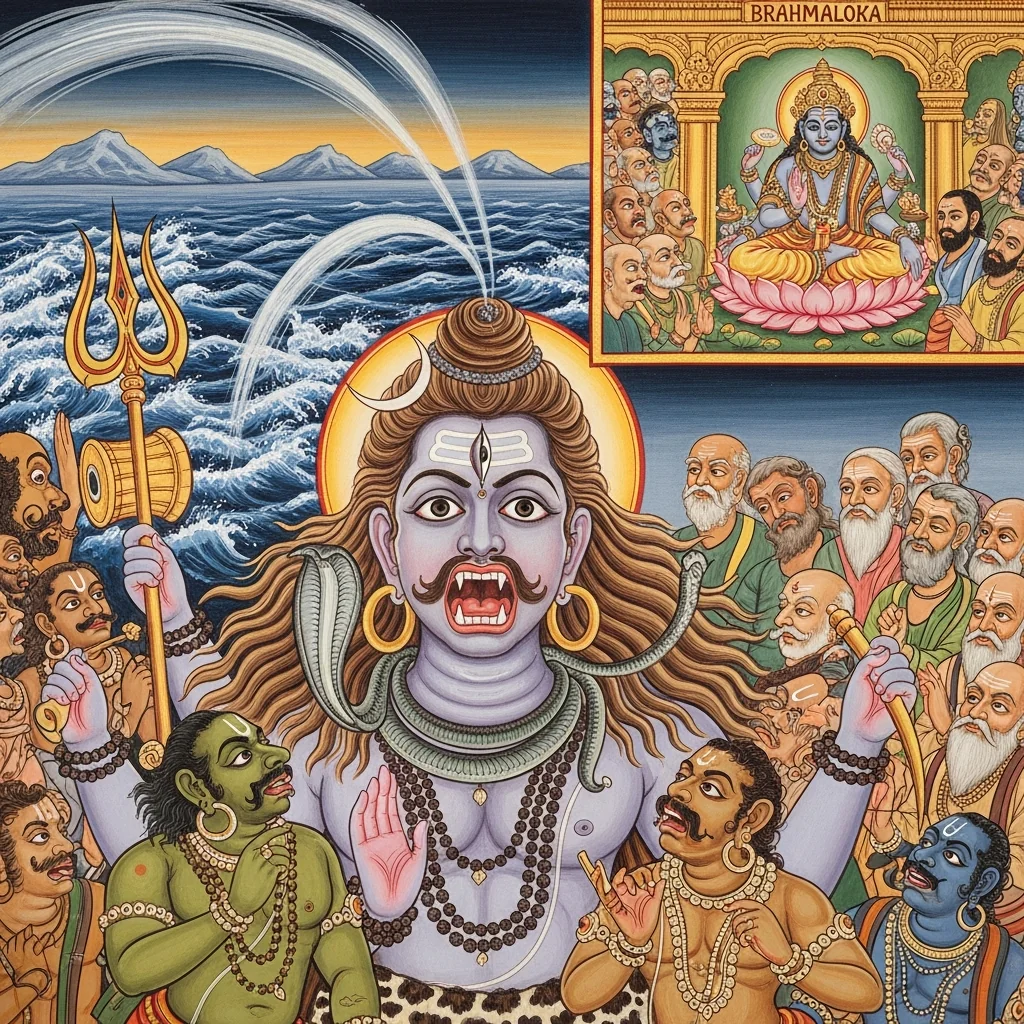
Adhyāya 16 unfolds a high-theology sequence through Mārkaṇḍeya’s narration: a formidable Śiva (Śūlī/Hara/Śambhu) dances amid terrifying bhūta-gaṇas, clad in an elephant-hide covering, wreathed in smoke and sparks, with a vadavāmukha-like gaping mouth—evoking the mood of cosmic dissolution (saṃhāra/saṃvartaka-kāla). The shock of the divine aṭṭahāsa (terrific laughter) reverberates through the directions, churns the oceans, and reaches Brahmaloka, unsettling the ṛṣis, who seek clarification from Brahmā. Brahmā explains the phenomenon as Kāla (Time) itself—described through year-cycles (saṃvatsara, parivatsara, etc.), subtle/atomic dimensions, and supreme lordship—turning fear into metaphysical understanding. A stotra then follows: Brahmā offers mantra-inflected praise to Mahādeva, affirming Him as encompassing Śaṅkara, Viṣṇu, and the creator principle, and as beyond speech and mind. Mahādeva reassures Brahmā, bids him behold the “burning” world being drawn in by many mouths, and then disappears. The phalaśruti concludes that hearing or reciting this highly meritorious stotra brings auspicious destiny, freedom from fear, and protection in dangers (battle, theft, fire, forest, ocean), with Śiva praised as the reliable guardian.
Shlokas
Verse 1
श्रीमार्कण्डेय उवाच । समातृभिर्भूतगणश्च घोरैर्वृतः समन्तात्स ननर्त शूली । गजेन्द्रचर्मावरणे वसानः संहर्तुकामश्च जगत्समस्तम्
Śrī Mārkaṇḍeya said: Surrounded on every side by the fierce host of Bhūtas along with the Mothers, the trident-bearing Lord began to dance. Clad in the hide of the lord of elephants, He appeared intent on drawing the entire universe into dissolution.
Verse 2
महेश्वरः सर्वसुरेश्वराणां मन्त्रैरनेकेखबद्धमाली । मेदोवसारक्तविचर्चिताङ्गस्त्रैलोक्यदाहे प्रणनर्त शम्भुः
Maheśvara—Śambhu—danced for the burning of the three worlds, wearing garlands bound from many mystic syllables and the mantras of all the lords of the gods, while His limbs were smeared with fat, marrow, and blood.
Verse 3
स कालरात्र्या सहितो महात्मा काले त्रिलोकीं सकलां जहार । संवर्तकाख्यः सहभानुभावः शम्भुर्महात्मा जगतो वरिष्ठः
That great Soul, accompanied by Kālarātrī, in due time seized up the entire threefold world. Known as Saṃvartaka, radiant like the sun, that exalted Śambhu—supreme over the universe—stood forth.
Verse 4
स विस्फुलिङ्गोत्करधूममिश्रं महोल्कवज्राशनिवाततुल्यम् । ततोऽट्टहासं प्रमुमोच घोरं विवृत्य वक्त्रं वडवामुखाभम्
Then, opening His mouth wide like the mare-faced fire, He released a dreadful roar of laughter—like a storm of thunderbolts and meteors, mingled with smoke and showers of sparks.
Verse 5
सहस्रवज्राशनिसंनिभेन तेनाट्टहासेन हरोद्गतेन । आपूरितास्तत्र दिशो दशैव संक्षोभिताः सर्वमहार्णवाश्च
By that peal of laughter that rose from Hara—like a thousand thunderbolts—the ten directions were completely filled, and all the great oceans were thrown into turmoil.
Verse 6
स ब्रह्मलोकं प्रजगाम शब्दो ब्रह्माण्डभाण्डं प्रचचाल सर्वम् । किमेतदित्याकुलचेतनास्ते वित्रस्तरूपा ऋषयो बभूवुः
That sound reached Brahmaloka, and the entire “vessel” of the cosmic egg shook. Thinking, “What is this?”, the sages became bewildered in mind and took on terrified expressions.
Verse 7
प्रणम्य सर्वे सहसैव भीता ब्रह्माणमूचुः परमेश्वरेशम् । भीताश्च सर्वे ऋषयस्ततस्ते सुरासुरैश्चैव महोरगैश्च
Frightened, they all at once bowed down and spoke to Brahmā, the lord among the gods. Then all those sages too were afraid—along with the Devas and Asuras and the mighty serpent-beings.
Verse 8
विद्युत्प्रभाभासुरभीषणाङ्गः क एष चिक्रीडति भूतलस्थः । कालानलं गात्रमिदं दधानो यस्याट्टहासेन जगद्विमूढम्
“Who is this, standing upon the earth, as if at play—yet with a terrifying body blazing like lightning, bearing a frame that is the fire of Time—by whose thunderous laughter the whole world is cast into bewilderment?”
Verse 9
वित्रस्तरूपं प्रबभौ क्षणेन संहर्तुमिच्छेत्किमयं त्रिलोकीम् । सार्धं त्वया सप्तभिरर्णकैश्च जनस्तपः सत्यमभिप्रयाति
In a moment he has appeared in a terrifying form—does he truly wish to dissolve the three worlds? Along with you and the seven oceans, all beings hasten toward austerity (tapas) and truth (satya) as their only refuge.
Verse 10
संहर्तुकामो हि क एष देव एतत्समस्तं कथयाप्रमेय । न दृष्टमेतद्विषमं कदापि जानासि तत्त्वं परमो मतो नः
O god, who is this that desires dissolution? Explain this whole matter, O immeasurable one. Never have we seen anything so dreadful; you know the truth—therefore you are regarded by us as the highest authority.
Verse 11
निशम्य तद्वाक्यमथाबभाषे ब्रह्मा समाश्वास्य सुरादिसङ्घान्
Hearing those words, Brahmā then spoke, first reassuring the assembled hosts of the gods and other celestial beings.
Verse 12
श्रीब्रह्मोवाच । स एष कालस्त्रिदिवं त्वशेषं संहर्तुकामो जगदक्षयात्मा । पूर्णे च शेते परिवत्सराणां भविष्यतीशानविभुर्न चित्रम्
Śrī Brahmā said: “This is Kāla (Time) himself—imperishable in essence—who now wishes to withdraw even the entire heaven of the gods. When the cycle of the ‘parivatsara’ years is completed, he will become the sovereign, all-pervading Lord; this is no wonder.”
Verse 13
संवत्सरोऽयं परिवत्सरश्च उद्वत्सरो वत्सर एष देवः । दृष्टोऽप्यदृष्टः प्रहुतः प्रकाशी स्थूलश्च सूक्ष्मः परमाणुरेषः
“He is the year—saṃvatsara, parivatsara, udvatsara, and vatsara—this very deity. Though seen, he is also unseen; though invoked in offerings, he is self-luminous. He is both gross and subtle—indeed, he is the very atom.”
Verse 14
नातः परं किंचिदिहास्ति लोके परापरोऽयं प्रभुरात्मवादी । तुष्येत मे कालसमानरूप इत्येवमुक्त्वा भगवान्सुरेशः
“In this world there is nothing higher than Him. This Lord is both transcendent and immanent, the revealer of the Self. ‘May the One whose form is Time (Kāla) be gracious to me’—having spoken thus, the blessed Lord of the gods (Indra) …”
Verse 15
सनत्कुमारप्रमुखैः समेतः संतोषयामास ततो यतात्मा
Then, with Sanatkumāra and the other sages at the fore, the self-controlled one brought them reassurance and contentment.
Verse 16
। अध्याय
“Chapter.” (A section marker; not a metrical verse.)
Verse 17
ओङ्कार हुङ्कारपरिष्कृताय स्वधावषट्कार नमोनमस्ते । गुणत्रयेशाय महेश्वराय ते त्रयीमयाय त्रिगुणात्मने नमः
Salutations, salutations to You—adorned with Oṃ and Huṃ, and praised through svadhā and vaṣaṭ. Homage to You, Maheśvara, Lord of the three guṇas; to You who are the very essence of the Vedic triad, whose being is the threefold guṇas.
Verse 18
त्वं शङ्करत्वं हि महेश्वरोऽसि प्रधानमग्र्यं त्वमसि प्रविष्टः । त्वं विष्णुरीशः प्रपितामहश्च त्वं सप्तजिह्वस्त्वमनन्तजिह्वः
You are indeed Śaṅkara; You are Maheśvara. You have entered into primordial Pradhāna, the foremost source. You are Viṣṇu, the Lord, and also the Grandfather of beings (Brahmā). You are the seven-tongued fire, and You are the infinite-tongued One.
Verse 19
स्रष्टासि सृष्टिश्च विभो त्वमेव विश्वस्य वेद्यं च परं निधानम् । आहुर्द्विजा वेदविदो वरेण्यं परात्परस्त्वं परतः परोऽसि
O All-pervading One, You alone are the Creator and the very act of creation; You are the supreme treasure and the ultimate object to be known in the universe. The twice-born, the knowers of the Veda, proclaim You the most worthy of adoration—higher than the highest, beyond all beyond.
Verse 20
सूक्ष्मातिसूक्ष्मं प्रवदन्ति यच्च वाचो निवर्तन्ति मनो यतश्च
They declare That to be subtler than the subtlest—That from which words turn back, and from which the mind also withdraws.
Verse 21
श्रीमहादेव उवाच । त्वया स्तुतोऽहं विविधैश्च मन्त्रैः पुष्णामि शान्तिं तव पद्मयोने । ईक्षस्व मां लोकमिमं ज्वलन्तं वक्त्रैरनेकैः प्रसभं हरन्तम्
Śrī Mahādeva said: “O Lotus-born (Brahmā), since you have praised Me with many mantras, I bestow peace upon you. Behold Me now—blazing in this world—forcefully consuming it with My many mouths.”
Verse 22
एवमुक्त्वा स देवेशो देव्या सह जगत्पतिः । पितामहं समाश्वास्य तत्रैवान्तरधीयत
Having spoken thus, the Lord of gods—the Master of the universe—together with the Goddess comforted Pitāmaha (Brahmā) and vanished from that very place.
Verse 23
इदं महत्पुण्यतमं वरिष्ठं स्तोत्रं निशम्येह गतिं लभन्ते । पापैरनेकैः परिवेष्टिता ये प्रयान्ति रुद्रं विमलैर्विमानैः
Hearing this supremely meritorious and excellent hymn, people attain the blessed path here itself. Even those surrounded by many sins proceed to Rudra, borne in spotless celestial chariots.
Verse 24
भयं च तेषां न भवेत्कदाचित्पठन्ति ये तात इदं द्विजाग्र्याः । सङ्ग्रामचौराग्निवने तथाब्धौ तेषां शिवस्त्राति न संशयोऽत्र
O dear one, for the foremost among the twice-born who recite this, fear never arises. In battle, among thieves, in fire, in the forest, and even in the ocean—Śiva protects them; of this there is no doubt.