Adhyaya 111
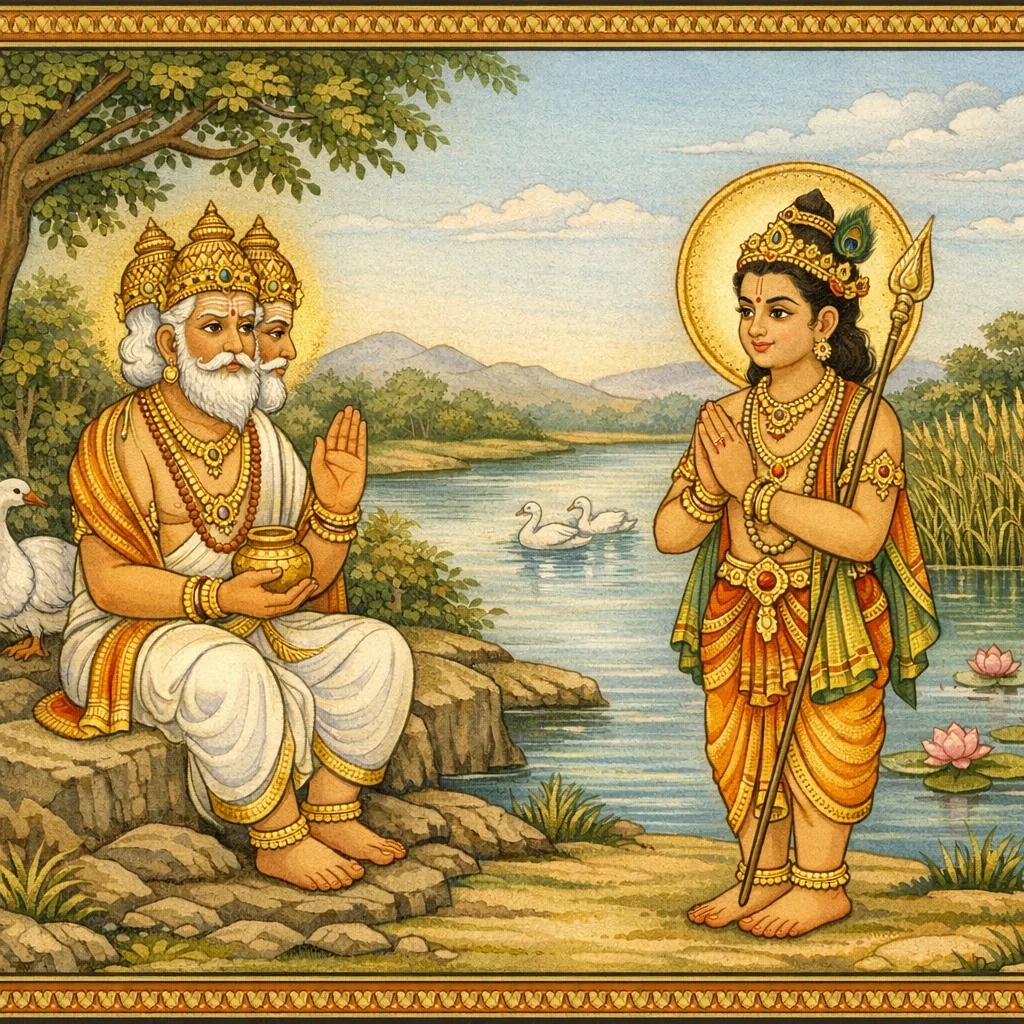
The chapter unfolds as a dialogue: Yudhiṣṭhira asks Mārkaṇḍeya to recount Skanda’s life-context and to teach the proper observance and merit of a sacred tīrtha on the Narmadā. Mārkaṇḍeya explains that the gods, bereft of a commander, petition Śiva, and he narrates the divine chain of events behind Skanda’s manifestation—Śiva’s intention toward Umā, the gods’ intervention through Agni, Umā’s responsive curse affecting the gods’ progeny, and the transfer of celestial tejas. Agni cannot bear the tejas and places it in Gaṅgā; Gaṅgā, in turn, deposits it in a reed-thicket (śara-stamba). The Kṛttikās nurse the child, who appears as Ṣaṇmukha (six-faced) and is praised by many names—Kārttikeya, Kumāra, Gaṅgāgarbha, Agnija. After extensive tapas and tīrtha-circulation, Skanda performs severe austerities on the southern bank of the Narmadā; Śiva and Umā grant boons, appointing him the eternal senāpati of the gods and bestowing the peacock mount. The site becomes renowned as Skanda-tīrtha, rare and sin-destroying. The chapter concludes with stated fruits: bathing there and worshipping Śiva yields merit equal to sacrifice; ancestral rites with sesame-mixed water and a single proper piṇḍa offering satisfy the pitṛs for twelve years. Deeds done there become imperishable; and one who undertakes death according to śāstra-guided procedure attains Śiva’s abode, followed by auspicious rebirth endowed with Vedic learning, health, longevity, and continuity of lineage.
Shlokas
Verse 1
श्रीमार्कण्डेय उवाच । नर्मदादक्षिणे कूले तीर्थं परमशोभनम् । स्कन्देन निर्मितं पूर्वं तपः कृत्वा सुदारुणम्
Śrī Mārkaṇḍeya said: On the southern bank of the Narmadā there is a supremely splendid tīrtha, established long ago by Skanda after he performed intense and arduous austerities.
Verse 2
युधिष्ठिर उवाच । स्कन्दस्य चरितं सर्वमाजन्म द्विजसत्तम । तीर्थस्य च विधिं पुण्यं कथयस्व यथार्थतः
Yudhiṣṭhira said: O best of the twice-born, tell me truthfully the entire life-story of Skanda from his birth, and also the holy, merit-bestowing vidhi of this tīrtha.
Verse 3
श्रीमार्कण्डेय उवाच । देवदेवेन वै तप्तं तपः पूर्वं युधिष्ठिर । विज्ञप्तेन सुरैः सर्वैरुमादेवी विवाहिता
Śrī Mārkaṇḍeya said: Formerly, O Yudhiṣṭhira, the God of gods undertook austerities; and at the entreaty of all the devas, Umādevī was wedded to him.
Verse 4
नास्ति सेनापतिः कश्चिद्देवानां सुरसत्तम । नीयन्ते दानवैर्घोरैः सर्वे देवाः सवासवाः
There is no commander for the gods, O best of the celestials; therefore all the devas—Indra included—are being overpowered and driven away by the fearsome Dānavas.
Verse 5
यथा निशा विना चन्द्रं दिवसो भास्करं विना । न शोभते मुहूर्तं वै तथा सेना विनायका
As night without the moon and day without the sun do not shine even for a moment, so too an army without a leader cannot flourish.
Verse 6
एवं ज्ञात्वा महादेव परया दयया विभो । सेनानीर्दीयतां कश्चित्त्रिषु लोकेषु विश्रुतः
Knowing this, O Mahādeva, O mighty Lord, out of supreme compassion grant a commander—one renowned throughout the three worlds.
Verse 7
एतच्छ्रुत्वा शुभं वाक्यं देवानां परमेश्वरः । कामयान उमां देवीं सस्मार मनसा स्मरम्
Hearing these auspicious words of the gods, the Supreme Lord—desiring Goddess Umā—remembered within his mind Smara (Kāma), the god of love.
Verse 8
तेन मूर्छितसर्वाङ्गः कामरूपो जगद्गुरुः । कामयामास रुद्राणीं दिव्यं वर्षशतं किल
Struck by that influence, the World-Teacher—assuming a form moved by desire—became as though senseless in every limb, and indeed longed for Rudrāṇī for a divine span of a hundred years.
Verse 9
देवराजस्ततो ज्ञात्वा महामैथुनगं हरम् । संमन्त्र्य दैवतैः सार्द्धं प्रैषयज्जातवेदसम्
Then the Lord of the Devas, understanding that Hara had entered a mighty act of union, consulted together with the gods and dispatched Jātavedas (Agni).
Verse 10
तेन गत्वा महादेवः परमानन्दसंस्थितः । सहसा तेन दृष्टोऽसौ हाहेत्युक्त्वा समुत्थितः
When he (Agni) went there, he saw Mahādeva abiding in supreme bliss; suddenly noticed by him, Agni cried out ‘Alas, alas!’ and rose up at once.
Verse 11
ततः क्रुद्धा महादेवी शापवाचमुवाच ह । वेपमाना महाराज शृणु यत्ते वदाम्यहम्
Then the Great Goddess, enraged, uttered words of curse. Trembling, she said: “O great king, listen to what I declare to you.”
Verse 12
अहं यस्मात्सुरैः सर्वैर्याचिता पुत्रजन्मनि । कृता रतिश्च विफला संप्रेष्य जातवेदसम्
Because I was entreated by all the gods for the begetting of a son, yet the act of love was made fruitless by sending Jātavedas (Agni),
Verse 13
तस्मात्सर्वे पुत्रहीना भविष्यन्ति न संशयः । हरेणोक्तस्ततो वह्निरस्माकं बीजमावह
“Therefore all of you shall be without sons—of this there is no doubt. Then, commanded by Hara, Fire carried away our seed.”
Verse 14
यथा भवति लोकेषु तथा त्वं कर्तुमर्हसि । मम तेजस्त्वया शक्यं गृहीतुं सुरसत्तम । देवकार्यार्थसिद्ध्यर्थं नान्यः शक्तो जगत्त्रये
“As it is possible among the worlds, so you should act. O best of the gods, you alone are able to receive my fiery potency; for the accomplishment of the gods’ purpose, no other is capable in the three worlds.”
Verse 15
अग्निरुवाच । तेजसस्तव मे देव का शक्तिर्धारणे विभो । करोति भस्मसात्सर्वं त्रैलोक्यं सचराचरम्
Agni said: “O Lord, what power have I to hold your fiery potency? It reduces to ashes the entire three worlds, with all that moves and all that does not.”
Verse 16
ईश्वर उवाच । उदरस्थेन बीजेन यदि ते जायते रुजा । तदा क्षिपस्व तत्तेजो गङ्गातोये हुताशन
Īśvara said: “If, with the seed lodged in your belly, pain arises in you, then cast that fiery potency into the waters of the Gaṅgā, O Hutāśana (Fire).”
Verse 17
एवमुक्त्वा महादेवोऽमोघं बीजमुत्तमम् । हव्यवाहमुखे सर्वं प्रक्षिप्यान्तरधीयत
Having spoken thus, Mahādeva placed the excellent, unfailing seed entirely into the mouth of Havyavāha (Agni), and then vanished from sight.
Verse 18
गते चादर्शनं देवे दह्यमानो हुताशनः । गङ्गातोये विनिक्षिप्य जगाम स्वंनिवेशनम्
When the Deva (Śiva) had disappeared from sight, Agni—still burning with that unbearable energy—cast it into the waters of the Gaṅgā and then returned to his own abode.
Verse 19
असहन्ती तु तत्तेजो गङ्गापि सरितां वरा । शरस्तम्बे विनिक्षिप्य जगामाशु यथागतम्
Unable to endure that blazing energy, even Gaṅgā—the foremost of rivers—placed it into a clump of reeds and swiftly returned the way she had come.
Verse 20
तत्र जातं तु तद्दृष्ट्वा सर्वे देवाः सवासवाः । कृत्तिकां प्रेषयामासुः स्तन्यं पाययितुं तदा
Seeing the child born there, all the gods—together with Indra—then sent the Kṛttikās to nurse him with their milk.
Verse 21
दृष्ट्वा ता आगताः सर्वा गङ्गागर्भे महामतेः । षण्मुखैः षण्मुखो भूत्वा पिपासुरपिबत्स्तनम्
Seeing them all arrive within Gaṅgā’s womb-like refuge, the great-souled one became six-faced, with six mouths; and, thirsting, he drank the milk of their breasts.
Verse 22
जातकर्मादिसंस्कारान्वेदोक्तान्पद्मसम्भवः । चकार सर्वान्दाजेन्द्र विधिदृष्टेन कर्मणा
Padma-sambhava (Brahmā) performed all the Veda-enjoined saṃskāras—beginning with the birth-rite, jātakarma—O king of the Dāsas, according to the proper rule and procedure.
Verse 23
षण्मुखात्षण्मुखो नाम कार्त्तिकेयस्तु कृत्तिकात् । कुमारश्च कुमारत्वाद्गङ्गागर्भोऽग्निजोऽपरः
Because he had six faces, he was called Ṣaṇmukha; because of the Kṛttikās, he was known as Kārttikeya. Ever youthful, he was called Kumāra; and he was famed also as Gaṅgā-garbha and as Agnija, “born of Fire.”
Verse 24
एवं कुमारः सम्भूतो ह्यनधीत्य स वेदवित् । शास्त्राण्यनेकानि वेद चचार विपुलं तपः
Thus was Kumāra manifested; though not formally taught, he was a knower of the Veda. He understood many śāstras and undertook immense austerity (tapas).
Verse 25
देवारण्येषु सर्वेषु नदीषु च नदेषु च । पृथिव्यां यानि तीर्थानि समुद्राद्यानि भारत
In all divine forests, in rivers and streams, and in whatever tīrthas exist upon the earth—beginning with the oceans, O Bhārata—(he moved among them).
Verse 26
ततः पर्याययोगेन नर्मदातटमाश्रितः । नर्मदादक्षिणे कूले चचार विपुलं तपः
Thereafter, in the proper course of time, he took refuge upon the banks of the Narmadā, and on her southern shore he performed vast austerities.
Verse 27
ऋग्यजुःसामविहितं जपञ्जाप्यमहर्निशम् । ध्यायमानो महादेवं शुचिर्धमनिसंततः
Day and night he recited the japa enjoined by the Ṛg, Yajus, and Sāma Vedas, meditating upon Mahādeva—pure, and steadfastly restraining the currents of vital breath.
Verse 28
ततो वर्षसहस्रान्ते पूर्णे देवो महेश्वरः । उमया सहितः काले तदा वचनमब्रवीत्
Then, when a full thousand years had been completed, the Lord Maheśvara, together with Umā, spoke these words at the proper time.
Verse 29
ईश्वर उवाच । अहं ते वरदस्तात गौरी माता पिता ह्यहम् । वरं वृणीष्व यच्चेष्टं त्रिषु लोकेषु दुर्लभम्
Īśvara said: “Dear son, I am your bestower of boons; and Gaurī is your mother—indeed, I am your father. Choose a boon, whatever you desire, even if it is hard to obtain in the three worlds.”
Verse 30
षण्मुख उवाच । यदि तुष्टो महादेव उमया सह शङ्कर । वृणोमि मातापितरौ नान्या गतिर्मतिर्मम
Ṣaṇmukha said: “If you are pleased, O Mahādeva—O Śaṅkara together with Umā—then I choose you both as my mother and father. I have no other refuge and no other resolve.”
Verse 31
एतच्छ्रुत्वा शुभं वाक्यं पुत्रस्य वदनाच्च्युतम् । तथेत्युक्त्वा तु स्नेहेन प्रेम्णा तं परिषस्वजे
Hearing those auspicious words that fell from the son’s lips, he replied, “So be it,” and, out of affection and love, embraced him.
Verse 32
ततस्तं मूर्ध्न्युपाघ्राय ह्युमयोवाच शङ्करः
Then Śaṅkara, having smelled (kissed) him upon the head, spoke—together with Umā.
Verse 33
ईश्वर उवाच । अक्षयश्चाव्ययश्चैव सेनानीस्त्वं भविष्यसि
Īśvara said: “You shall be imperishable and undecaying; and you shall become the Commander of the divine hosts.”
Verse 34
शिखी च ते वाहनं दिव्यरूपो दत्तो मया शक्तिधरस्य संख्ये । सुरासुरादींश्च जयेति चोक्त्वा जगाम कैलासवरं महात्मा
“And the peacock, of divine form, is given by me as your mount for the battle of the Spear-bearer. Having said, ‘Conquer the gods, asuras, and the rest,’ that great Lord departed for excellent Kailāsa.”
Verse 35
गते चादर्शनं देवे तदा स शिखिवाहनः । स्थापयित्वा महादेवं जगाम सुरसन्निधौ
When the Lord had departed and vanished from sight, then he—he whose mount was the peacock—having established Mahādeva, went into the presence of the gods.
Verse 36
तदाप्रभृति तत्तीर्थं स्कन्दतीर्थमिति श्रुतम् । सर्वपापहरं पुण्यं मर्त्यानां भुवि दुर्लभम्
From that time onward, that sacred ford became known as “Skanda-tīrtha.” It is holy, removing all sins, and rare for mortals to attain upon the earth.
Verse 37
तत्र तीर्थे तु यो राजन्भक्त्या स्नात्वार्चयेच्छिवम् । गन्धमाल्याभिषेकैश्च याज्ञिकं स लभेत्फलम्
O King, whoever at that tīrtha bathes with devotion and worships Śiva—offering fragrances, garlands, and libations—obtains the fruit equal to that of a sacrifice.
Verse 38
स्कन्दतीर्थे तु यः स्नात्वा पूजयेत्पितृदेवताः । तिलमिश्रेण तोयेन तस्य पुण्यफलं शृणु
Hear the sacred reward: whoever bathes at Skanda-tīrtha and then worships the deities of the ancestors (Pitṛs) with water mixed with sesame attains great merit.
Verse 39
पिण्डदानेन चैकेन विधियुक्तेन भारत । द्वादशाब्दानि तुष्यन्ति पितरो नात्र संशयः
O Bhārata, by a single piṇḍa-offering performed according to scriptural rule, the ancestors remain satisfied for twelve years—of this there is no doubt.
Verse 40
तत्र तीर्थे तु राजेन्द्र शुभं वा यादि वाशुभम् । इह लोके परे चैव तत्सर्वं जायतेऽक्षयम्
O lord of kings, at that tīrtha—whether one performs an auspicious act or an inauspicious one—its consequence, in this world and the next, becomes enduring and unfailing.
Verse 41
तत्र तीर्थे तु यः कश्चित्प्राणत्यागं करिष्यति । शास्त्रयुक्तेन विधिना स गच्छेच्छिवमन्दिरम्
At that tīrtha, whoever relinquishes the body in the manner sanctioned by the śāstras attains the sacred abode of Śiva.
Verse 42
कल्पमेकं वसित्वा तु देवगन्धर्वपूजितः । अत्र भारतवर्षे तु जायते विमले कुले
Having dwelt for one kalpa, honored by the gods and the Gandharvas, he is then born here in Bhārata-varṣa in a pure and noble family.
Verse 43
वेदवेदाङ्गतत्त्वज्ञः सर्वव्याधिविवर्जितः । जीवेद्वर्षशतं साग्रं पुत्रपौत्रसमन्वितः
He becomes a knower of the truth of the Vedas and their Vedāṅgas, free from all diseases, and lives a full hundred years and more, endowed with sons and grandsons.
Verse 44
इदं ते कथितं राजन्स्कन्दतीर्थस्य सम्भवम् । धन्यं यशस्यमायुष्यं सर्वदुःखघ्नमुत्तमम् । सर्वपापहरं पुण्यं देवदेवेन भाषितम्
O King, thus have I told you the origin and greatness of Skanda-tīrtha—most excellent, bestowing blessedness, fame, and longevity; destroying all sorrows; a holy merit that removes every sin, as declared by the God of gods.
Verse 111
। अध्याय
End of the chapter (Adhyāya).