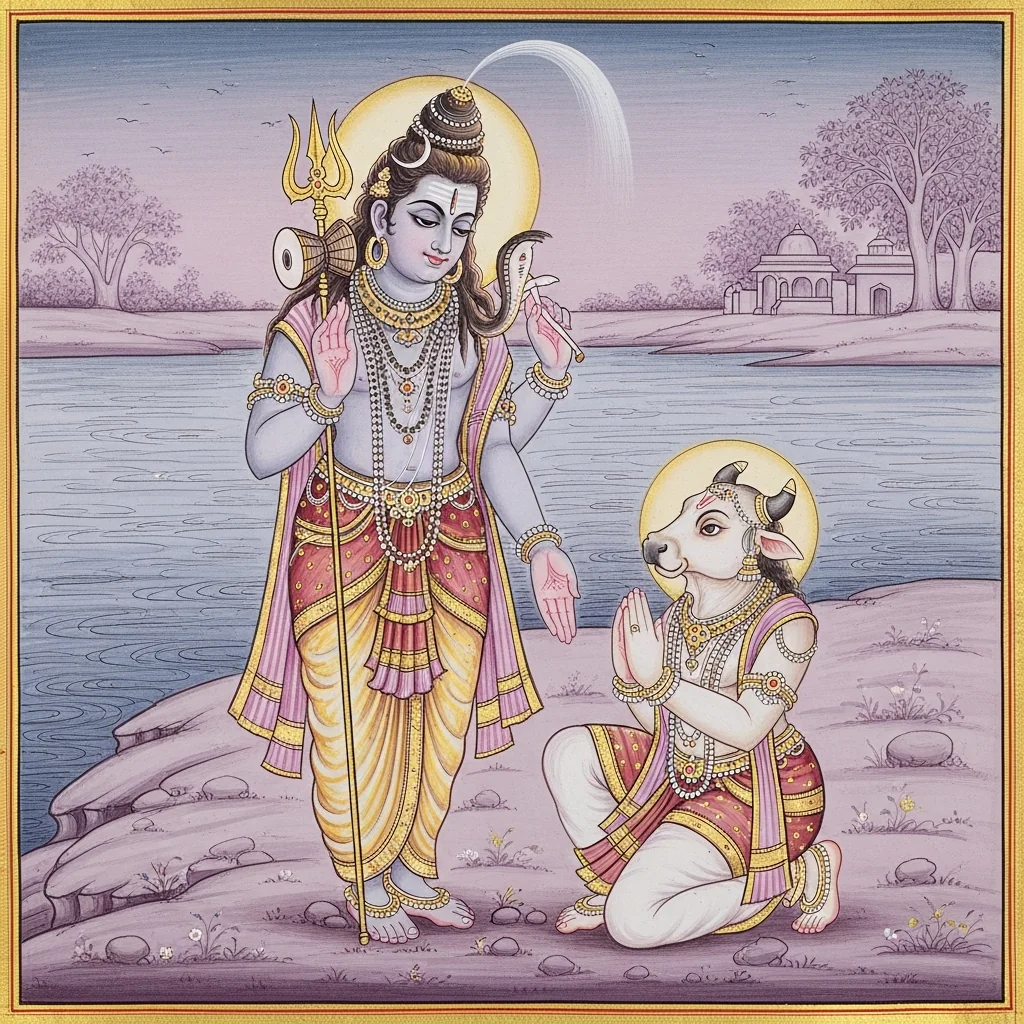
Adhyaya 80
Mārkaṇḍeya, speaking to a royal listener, points to the eminent Nandikeśvara tīrtha associated with the siddha Nandī. Nandī is portrayed as the model of disciplined pilgrimage: placing the Revā river foremost in devotion, he moves from tīrtha to tīrtha while performing tapas. Pleased with this sustained ascetic journey, Śiva offers a boon. Nandī refuses wealth, progeny, and sensory aims, asking only for unwavering bhakti to Śiva’s lotus-feet across births—even if reborn in non-human forms—thus affirming devotion as continuity beyond a single life. Śiva grants this and leads the accomplished devotee to His abode, establishing the tīrtha’s sacred authority. The phalaśruti declares that bathing and worship of the three-eyed Śiva here yields merit equal to an Agniṣṭoma sacrifice. Death at the tīrtha is said to bring Śiva’s companionship and long enjoyment in an imperishable aeon, followed by auspicious rebirth in a pure lineage with Vedic knowledge and longevity. The chapter closes by stressing the tīrtha’s rarity and its power to destroy sin.
Shlokas
Verse 1
श्रीमार्कण्डेय उवाच । ततो गच्छेत्तु राजेन्द्र नन्दिकेश्वरमुत्तमम् । यत्र सिद्धो महानन्दी तत्ते सर्वं वदाम्यहम्
Śrī Mārkaṇḍeya said: “Then, O king of kings, you should go to the supreme Nandikeśvara—where the great Nandī attained perfection. I shall tell you all about it.”
Verse 2
रेवायां पुरतः कृत्वा पुरा नन्दी गणेश्वरः । तपस्तपञ्जयं कुर्वंस्तीर्थात्तीर्थं जगाम ह
In ancient times Nandī, the lord of Śiva’s attendants, keeping the Revā (Narmadā) before him as his guiding presence, went from one tīrtha to another, performing austerities and conquering the hardships of tapas.
Verse 3
दधिस्कन्दं मधुस्कन्दं यावत्त्यक्त्वा तु गच्छति । तावत्तुष्टो महादेवो नन्दिनाथमुवाच ह
So long as he moved on, leaving behind the sacred stations known as Dadhiskanda and Madhuskanda, for that very perseverance Mahādeva became pleased and spoke to Nandī, his foremost attendant.
Verse 4
ईश्वर उवाच । भोभोः प्रसन्नो नन्दीश वरं वृणु यथेप्सितम् । तपसा तेन तुष्टोऽहं तीर्थयात्राकृतेन ते
Īśvara said: “O Nandīśa, I am well pleased. Choose a boon according to your desire. By your austerity and by your pilgrimage to the tīrthas, I am satisfied.”
Verse 5
नन्दीश्वर उवाच । न चाहं कामये वित्तं न चाहं कुलसन्ततिम् । मुक्त्वा न कामये कामं तव पादाम्बुजात्परम्
Nandīśvara said: “I do not desire wealth; I do not desire lineage and progeny. Apart from liberation (mokṣa), I seek no other desire—nothing beyond Your lotus-feet.”
Verse 6
कृमिकीटपतङ्गेषु तिर्यग्योनिं गतस्य वा । जन्म जन्मान्तरेऽप्यस्तु भक्तिस्त्वयि ममाचला
Even if I should enter the wombs of worms, insects, or birds—indeed, even if I fall into any animal birth—may my devotion to You remain unshaken, birth after birth.
Verse 7
तथेत्युक्त्वा महादेवः परया कृपया नृप । गृहीत्वा तं करे सिद्धं जगाम निलयं हरः
“So be it,” said Mahādeva, O king, with supreme compassion. Taking that perfected siddha by the hand, Hara returned to His own abode.
Verse 8
तस्मिंस्तीर्थे तु यः स्नात्वा भक्त्या त्र्यक्षं प्रपूजयेत् । अग्निष्टोमस्य यज्ञस्य फलं प्राप्नोति मानवः
Whoever bathes at that tīrtha and, with devotion, worships Tryakṣa—the Three-eyed Śiva—attains merit equal to the fruit of the Agniṣṭoma sacrifice.
Verse 9
तत्र तीर्थे तु यः स्नात्वा प्राणत्यागं करोति चेत् । शिवस्यानुचरो भूत्वा मोदते कल्पमक्षयम्
If, after bathing at that tīrtha, a person relinquishes life there, then, becoming an attendant of Śiva, he rejoices for an imperishable kalpa (aeon).
Verse 10
ततः कालेन महता जायते विमले कुले । वेदवेदाङ्गतत्त्वज्ञो जीवेच्च शरदां शतम्
Thereafter, in the course of great time, one is born in a pure and noble family, becomes a knower of the truths of the Vedas and their auxiliaries (Vedāṅgas), and lives for a hundred autumns.
Verse 11
एतत्ते कथितं तात तीर्थमाहात्म्यमुत्तमम् । दुर्लभं मर्त्यसंज्ञस्य सर्वपापक्षयंकरम्
Thus, dear one, I have told you the supreme glory of this tīrtha—rare to be attained by those called mortal, and a cause for the destruction of all sins.
Verse 80
। अध्याय
Here begins the chapter (Adhyāya).