Adhyaya 141
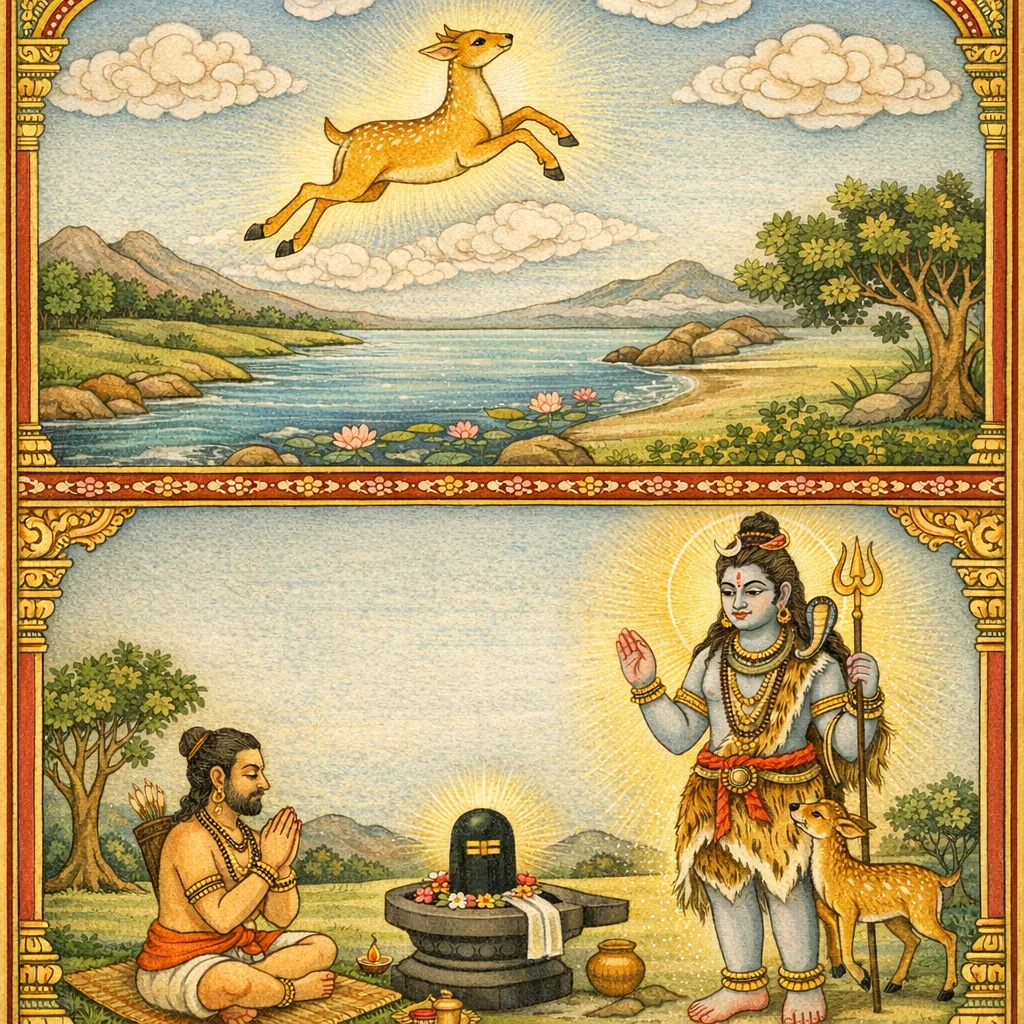
Mārkaṇḍeya recounts the origin of the tīrtha known as Tāpeśvara. A hunter (vyādha) witnesses a doe escape fear by plunging into the water and then rising into the sky. Struck with wonder, he lays down his bow, turns toward renunciation, and performs prolonged austerity (tapas), said to last a thousand divine years. Pleased, Maheśvara (Śiva) appears and offers a boon. The hunter asks to dwell near Śiva; the Lord grants it and vanishes. The hunter then installs (sthapayitvā) Maheśvara, worships according to proper rite (pūjā-vidhāna), and attains heaven. From that time the ford becomes famed in the three worlds as “Tāpeśvara,” linked with the hunter’s burning remorse and penance (vyādha-anuttāpa). One who bathes there and worships Śaṅkara reaches Śiva-loka; those who bathe in the Narmadā waters at Tāpeśvara are freed from the three afflictions (tāpa-traya). Bathing observances are especially commended on Aṣṭamī, Caturdaśī, and Tṛtīyā for the pacification of all sins.
Shlokas
Verse 1
श्रीमार्कण्डेय उवाच । ततो गच्छेन्महीपाल तापेश्वरमनुत्तमम् । यत्र सा हरिणी सिद्धा व्याधभीता नरेश्वर
Śrī Mārkaṇḍeya said: Then, O protector of the earth, one should go to the unsurpassed Tāpeśvara—where that doe attained perfection, frightened by a hunter, O king.
Verse 2
जले प्रक्षिप्य गात्राणि ह्यन्तरिक्षं गता तु सा । व्याधो विस्मितचित्तस्तु तां मृगीमवलोक्य च
Casting her limbs into the water, she indeed rose into the sky. And the hunter, his mind filled with wonder, looked upon that doe.
Verse 3
विमुच्य सशरं चापं प्रारेभे तप उत्तमम् । दिव्यं वर्षसहस्रं तु व्याधेनाचरितं तपः
Casting aside his bow together with its arrows, he began the highest austerity. For a thousand divine years, the hunter practiced that penance.
Verse 4
अतीते तु ततः काले परितुष्टो महेश्वरः । वरं ब्रूहि महाव्याध यत्ते मनसि रोचते
When that time had passed, Maheśvara, well pleased, said: “Speak, O great hunter—choose the boon that delights your heart.”
Verse 5
व्याध उवाच । यदि तुष्टोऽसि देवेश यदि देयो वरो मम । तव पार्श्वे महादेव वासो मे प्रतिदीयताम्
The hunter said: “If you are pleased, O Lord of gods—if a boon is to be granted to me—then, O Mahādeva, may residence beside you be bestowed upon me.”
Verse 6
ईश्वर उवाच । एवं भवतु ते व्याध यस्त्वया काङ्क्षितो वरः । दैवदेवो महादेव इत्युक्त्वान्तरधीयत । गते चादर्शनं देवे स्थापयित्वा महेश्वरम्
The Lord said: “So be it for you, O hunter—this boon you have desired.” Saying, “Mahādeva is the God of gods,” he vanished from sight. And when the Deity had disappeared, the hunter established Maheśvara there as a sacred presence.
Verse 7
पूजयित्वा विधानेन गतो व्याधस्ततो दिवम् । तदाप्रभृति तत्तीर्थं त्रिषु लोकेषु विश्रुतम्
Having worshipped according to proper rite, the hunter then went to heaven. From that time onward, that sacred tīrtha became renowned in all the three worlds.
Verse 8
व्याधानुतापसंजातं तापेश्वरमिति श्रुतम् । तत्र तीर्थे तु यः स्नात्वा सम्पूजयति शङ्करम्
Born from the hunter’s remorse, it is renowned as “Tāpeśvara.” And at that tīrtha, whoever bathes and duly worships Śaṅkara—
Verse 9
शिवलोकमवाप्नोति मामुवाच महेश्वरः । ये स्नाता नर्मदातोये तीर्थे तापेश्वरे नराः
“He attains Śiva’s world,” Maheśvara told me. Those people who have bathed in the waters of the Narmadā at the Tāpeśvara tīrtha—
Verse 10
तापत्रयविमुक्तास्ते नात्र कार्या विचारणा । अष्टम्यां च चतुर्दश्यां तृतीयायां विशेषतः
They are freed from the threefold afflictions—of this there is no doubt. Especially on the eighth lunar day, the fourteenth, and most particularly the third.
Verse 11
स्नानं समाचरेन्नित्यं सर्वपातकशान्तये
One should perform bathing daily, for the pacification of all sins.
Verse 141
। अध्याय
End of the chapter (adhyāya).