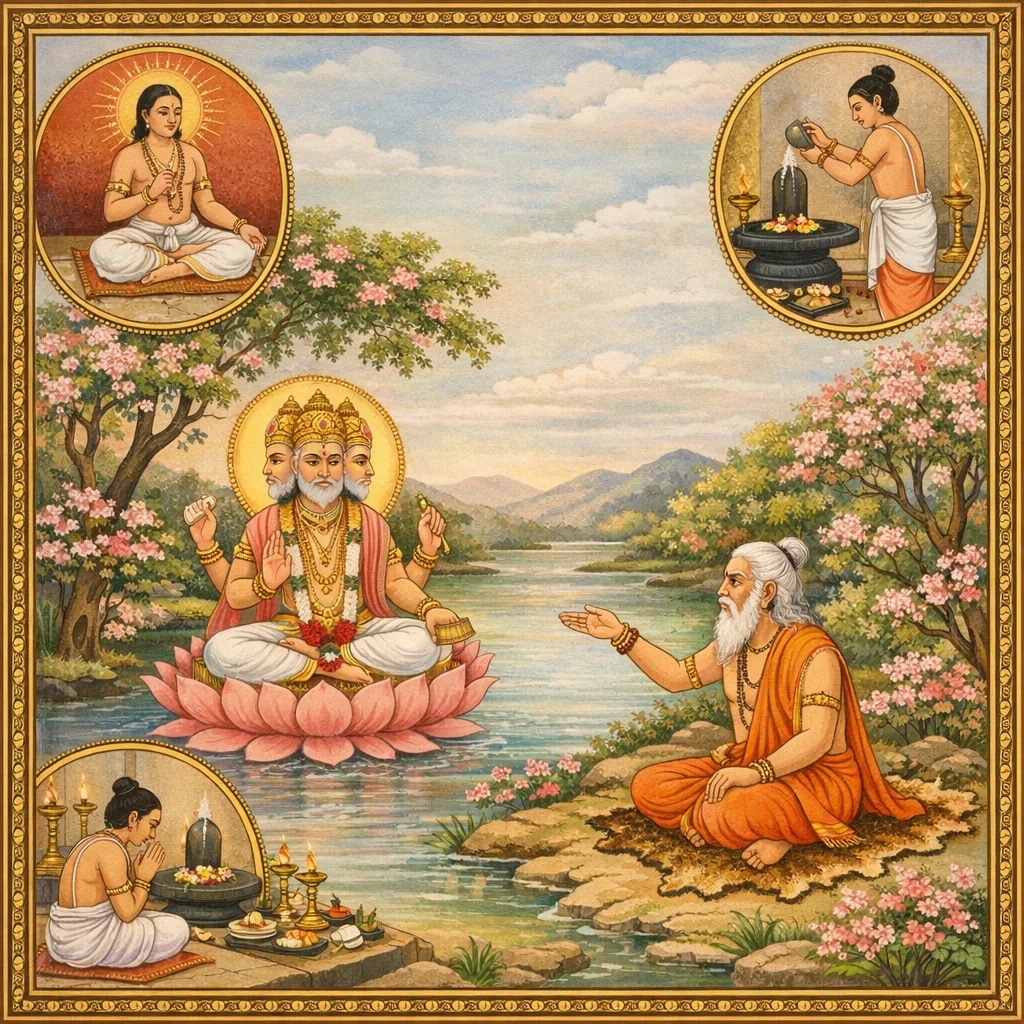
Adhyaya 129
Chapter 129 is a tīrtha-māhātmya teaching spoken by Śrī Mārkaṇḍeya to a king, directing him to Brahmatīrtha on the bank of the Narmadā. It is praised as an unsurpassed sacred ford, greater than other tīrthas, with Brahmā portrayed as the eminent deity presiding there. Even mere darśana—reverent seeing and visiting—is said to purify. Purification is presented in graded form: wrongs born of speech, of mind, and of action. A normative ritual ethic is then set forth: those who bathe there and follow śruti-smṛti-based injunctions perform proper prāyaścitta and attain heavenly residence, while those who abandon śāstra through desire and greed are censured as straying from true expiation. The chapter lists further ritual fruits: worship of pitṛs and devas after bathing yields Agniṣṭoma-like merit; gifts dedicated to Brahmā are declared imperishable; even brief Gāyatrī-japa is magnified as encompassing the efficacy of Ṛg–Yajus–Sāman. The closing phala extends to death at the tīrtha (a non-returning path to Brahmaloka), merit connected with bodily remains left there, and auspicious rebirth as a Brahma-knower endowed with learning, honor, health, and longevity—culminating in “amṛtatva” (deathlessness) in a theological sense.
Shlokas
Verse 1
श्रीमार्कण्डेय उवाच । ततो गच्छेन्महीपाल ब्रह्मतीर्थमनुत्तमम् । अन्येषां चैव तीर्थानां परात्परतरं महत्
Śrī Mārkaṇḍeya said: Then, O king, one should go to the unsurpassed Brahma-tīrtha—great, and higher than the highest among other sacred fords.
Verse 2
तत्र तीर्थे सुरश्रेष्ठो ब्रह्मा लोकपितामहः । चतुर्णामपि वर्णानां नर्मदातटमाश्रितः
At that tīrtha is Brahmā, the best among the gods, the grandsire of the worlds—dwelling upon the bank of the Narmadā, a refuge for all four varṇas.
Verse 3
वाचिकं मानसं पापं कर्मजं यत्पुराकृतम् । तत्क्षालयति देवेशो दर्शनादेव पातकम्
Sins committed by speech, by mind, and by deeds—even those done long ago—are washed away by the Lord of the gods; merely by His darśana, the stain of sin is cleansed.
Verse 4
श्रुतिस्मृत्युदितान्येव तत्र स्नात्वा द्विजर्षभाः । प्रायश्चित्तानि कुर्वन्ति तेषां वासस्त्रिविष्टपे
O best of Brahmins, having bathed there, people perform the expiations taught in Śruti and Smṛti—and for them there is residence in Triviṣṭapa (heaven).
Verse 5
ये पुनः शास्त्रमुत्सृज्य कामलोभप्रपीडिताः । प्रायश्चित्तं वदिष्यन्ति ते वै निरयगामिनः
But those who, abandoning the authority of śāstra and driven by desire and greed, declare (invent) expiations—such people indeed go to hellish states.
Verse 6
स्नात्वादौ पातकी ब्रह्मन्नत्वा तु कीर्तयेदघम् । तस्य तन्नश्यते क्षिप्रं तमः सूर्योदये यथा
O Brāhmaṇa, even a sinner—having first bathed there and then bowed—should confess and recount his wrongdoing; that sin perishes swiftly, like darkness at sunrise.
Verse 7
तत्र तीर्थे तु यः स्नात्वा पूजयेत्पितृदेवताः । अग्निष्टोमस्य यज्ञस्य स लभेत्फलमुत्तमम्
Whoever bathes at that tīrtha and worships the Pitṛ-deities gains the supreme fruit of the Agniṣṭoma sacrifice.
Verse 8
तत्र तीर्थे तु यद्दानं ब्रह्मोद्दिश्य प्रयच्छति । तदक्षयफलं सर्वमित्येवं शङ्करोऽब्रवीत्
At that tīrtha, whatever gift one offers with Brahmā (or Brahman) in mind—its result becomes wholly imperishable. Thus spoke Śaṅkara.
Verse 9
गायत्रीसारमात्रोऽपि तत्र यः क्रियते जपः । ऋग्यजुःसामसहितः स भवेन्नात्र संशयः
Even if one performs only the essence of the Gāyatrī as japa there, that japa becomes endowed with the power of Ṛg, Yajus, and Sāman—of this there is no doubt.
Verse 10
तत्र तीर्थे तु यो भक्त्या त्यजेद्देहं सुदुस्त्यजम् । अनिवर्तिका गतिस्तस्य ब्रह्मलोकान्न संशयः
Whoever, with devotion, gives up the body—so hard to relinquish—at that tīrtha, attains an irreversible destiny: Brahmaloka, without doubt.
Verse 11
यावदस्थीनि तिष्ठन्ति ब्रह्मतीर्थे च देहिनाम् । तावद्वर्षसहस्राणि देवलोके महीयते
So long as a person’s bones remain at Brahmatīrtha, for that many thousands of years he is honored and exalted in the world of the devas.
Verse 12
अवतीर्णस्ततो लोके ब्रह्मज्ञो जायते कुले । उत्तमः सर्ववर्णानां देवानामिव देवता
After descending again into the world, he is born in a family as a knower of Brahman—excellent among all social orders, like a deity among the devas.
Verse 13
विद्यास्थानानि सर्वाणि वेत्ति वेदाङ्गपारगः । जायते पूजितो लोके राजभिः स न संशयः
He comes to know all the seats of learning and becomes a master of the Vedas and their auxiliaries; he is honored in the world—revered even by kings, without doubt.
Verse 14
पुत्रपौत्रसमोपेतः सर्वव्याधिविवर्जितः । जीवेद्वर्षशतं साग्रं ब्रह्मतीर्थप्रभावतः
Endowed with sons and grandsons, free from all diseases, one lives a full hundred years and more—by the power of Brahmatīrtha.
Verse 15
एतत्पुण्यं पापहरं तीर्थं ज्ञानवतां वरम् । ये पश्यन्ति महात्मानो ह्यमृतत्वं प्रयान्ति ते
This tīrtha is holy and sin-destroying—supreme for the wise. The great-souled who behold it indeed attain immortality.
Verse 129
। अध्याय
End of the chapter.