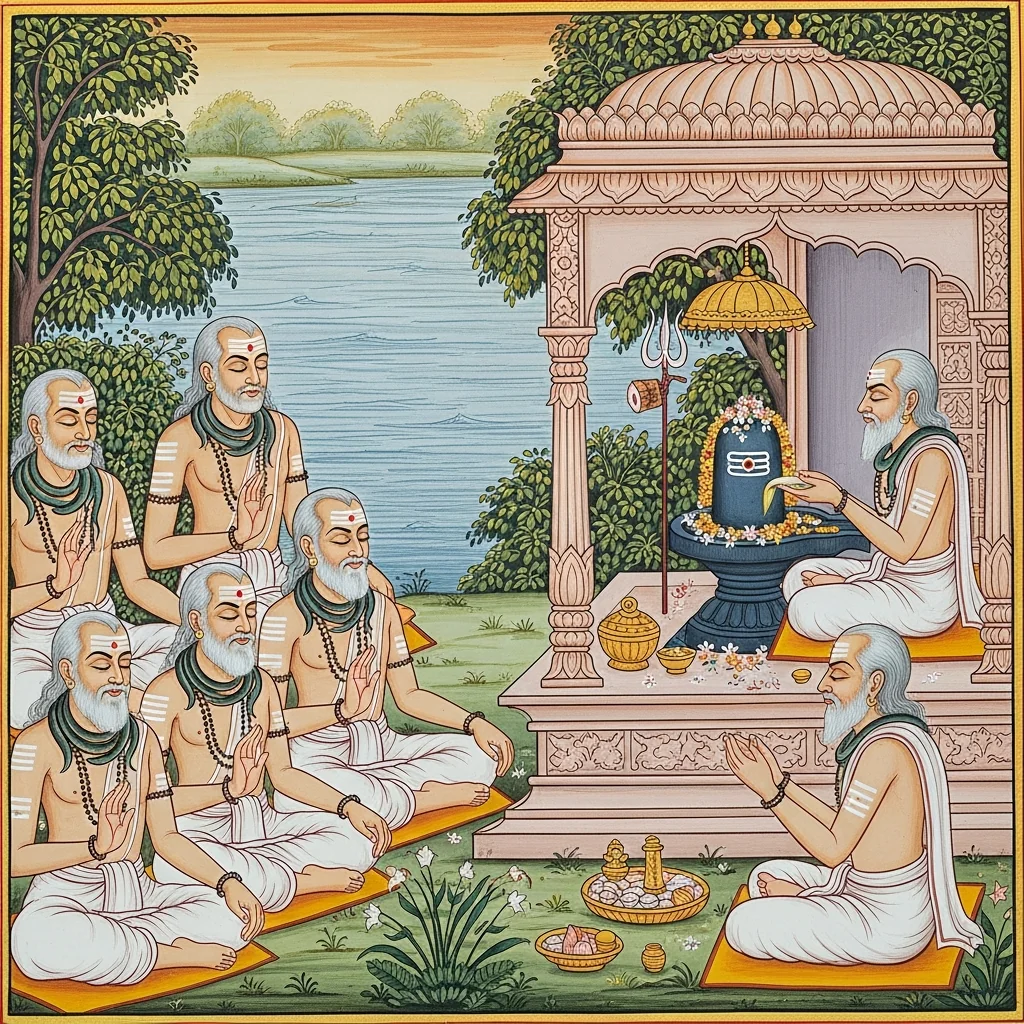
Adhyaya 11
Chapter 11 unfolds as a dialogue in which Yudhiṣṭhira asks why certain sacred observances and tīrthas remain spiritually potent even amid yuga-ending crises, and how sages attain liberation through prescribed niyamas (disciplines). Mārkaṇḍeya answers by placing śraddhā (faithful, devout trust) at the center: without it, ritual acts are said to be fruitless; with it, after merit gathered over many births, devotion to Śaṅkara (Śiva) becomes attainable. The chapter then extols Narmadā-tīra, the bank of Revā, as a place of swift siddhi: worship of Śiva—especially liṅga-pūjā—regular bathing, and the wearing of bhasma (sacred ash) are described as rapid purifiers of sin, even for those with a morally troubled past. A detailed ethical warning follows against dependence on improper food—especially what is termed śūdrānna within a prescriptive purity discourse—linking eating to karmic consequence and spiritual decline. It contrasts sincere Pāśupata-aligned observance with hypocrisy, greed, and ostentation, declaring that such faults can nullify tīrtha benefits. In a hymn-like exhortation (contextually attributed to Nandin), the listener is urged to renounce greed, remain steady in devotion to Śiva, perform japa of the pañcākṣarī mantra, and rely on Revā’s sanctity. The chapter closes with claims about recitation and practice near the Narmadā—Rudra-adhyāya, Vedic passages, and Purāṇa reading—bringing purification and higher destinies, and with a yuga-end drought episode where sages take refuge at Narmadā-tīra, reaffirming Revā as an enduring sanctuary and “best of rivers” for ultimate welfare.
Shlokas
Verse 1
युधिष्ठिर उवाच । अहो महत्पुण्यतमा विशिष्टा क्षयं न याता इह या युगान्ते । तस्मात्सदा सेव्यतमा मुनीन्द्रैर्ध्यानार्चनस्नानपरायणैश्च
Yudhiṣṭhira said: Ah! Most meritorious and exceptional is this, for it does not perish even at the end of an age. Therefore it is always most worthy of resort by great sages—devoted to meditation, worship, and sacred bathing.
Verse 2
यामाश्रित्य गता मोक्षमृषयो धर्मवत्सलाः । ये त्वयोक्तास्तु नियमा ऋषीणां वेदनिर्मिताः
Relying upon this, the dharma-loving sages attained liberation; and those disciplines you mentioned—the niyamas of the seers, fashioned from the Vedas—
Verse 3
मोक्षावाप्तिर्भवेद्येषां नियमैश्च पृथग्विधैः । दशद्वादशभिर्वापि षड्भिरष्टाभिरेव वा
For those who follow various kinds of disciplines, attainment of liberation becomes possible—whether by ten, or twelve, or even by six, or by eight observances.
Verse 4
त्रिभिस्तथा चतुर्भिर्वा वर्षैर्मासैस्तथैव च । मुच्यन्ते कलिदोषैस्ते देवेशानसमर्चनात्
Whether in three or four years—or likewise in months—people are freed from the faults of Kali through worship of Īśāna, the Lord of the gods.
Verse 5
ब्रह्माणं वा सुरश्रेष्ठ केशवं वा जगद्गुरुम् । अर्चयन्पापमखिलं जहात्येव न संशयः
O best among the gods, by worshipping Brahmā—or Keśava, the Guru of the world—one surely casts off all sin; of this there is no doubt.
Verse 6
एतद्विस्तरतः सर्वं कथयस्व ममानघ । यस्मिन्संसारगहने निमग्नाः सर्वजन्तवः । ते कथं त्रिदिवं प्राप्ता इति मे संशयो वद
Explain all this to me in detail, O sinless one. When all creatures are sunk in the dense thicket of worldly existence, how did they attain heaven? Tell me—this is my doubt.
Verse 7
श्रीमार्कण्डेय उवाच । जन्मान्तरैरनेकैस्तु मानुष्यमुपलभ्यते । भक्तिरुत्पद्यते चात्र कथंचिदपि शङ्करे
Śrī Mārkaṇḍeya said: After many births one attains a human life; and here, somehow, devotion to Śaṅkara (Śiva) also arises.
Verse 8
तीर्थदानोपवासानां यज्ञैर्देवद्विजार्चनैः । अवाप्तिर्जायते पुंसां श्रद्धया परया नृप
O King, the true attainment—the merit and spiritual fruit—of pilgrimages, gifts, fasts, sacrifices, and the worship of gods and brāhmaṇas arises for people only through supreme faith (śraddhā).
Verse 9
तस्माच्छ्रद्धा प्रकर्तव्या मानवैर्धर्मवत्सलैः । ईशोऽपि श्रद्धया साध्यस्तेन श्रद्धा विशिष्यते
Therefore, humans who cherish dharma should cultivate faith; for even the Lord is attained through faith—hence faith is pre-eminent.
Verse 10
अन्यथा निष्फलं सर्वं श्रद्धाहीनं तु भारत । तस्मात्समाश्रयेद्भक्तिं रुद्रस्य परमेष्ठिनः
Otherwise, O Bhārata, all that is performed without faith is fruitless. Therefore one should take refuge in devotion to Rudra, the Supreme Lord.
Verse 11
। अध्याय
Chapter marker: “Adhyāya” (Chapter).
Verse 12
तामसी सर्वलोकस्य त्रिविधं च फलं लभेत् । ते कर्मफलसंयोगादावर्तन्ते पुनःपुनः
Through a tāmasic disposition, beings in the world obtain threefold results; and by their connection with the fruits of actions, they revolve again and again in repeated return.
Verse 13
जन्मान्तरशतैस्तेषां ज्ञानिनां देवयाजिनाम् । देवत्रये भवेद्भक्तिः क्षयात्पापस्य कर्मणः
For those wise ones who worship the gods, after hundreds of births devotion arises toward the triad of deities, when sinful karma is exhausted.
Verse 14
ईशानात्तु पुनर्मोक्षो जायते छिन्नसंशयः । ये पुनर्नर्मदातीरमाश्रित्य द्विजपुंगवाः
But from Īśāna (Śiva) liberation is indeed obtained—this is beyond doubt. And those foremost among the twice-born who take refuge on the bank of the Narmadā…
Verse 15
त्रयीमार्गमसन्दिग्धास्ते यान्ति परमां गतिम् । एकाग्रमनसो ये तु शङ्करं शिवमव्ययम्
Those who, without doubt, abide on the path of the Vedic triad attain the supreme state. And those whose minds are one-pointed upon Śaṅkara—Śiva, the Imperishable…
Verse 16
अर्चयन्तीह निरताः क्षिप्रं सिध्यन्ति ते जनाः । कालेन महता सिद्धिर्जायतेऽन्यत्र देहिनाम्
Those who, devoted to worship here, remain intent attain accomplishment swiftly; elsewhere, embodied beings gain such success only after a long time.
Verse 17
नर्मदायाः पुनस्तीरे क्षिप्रं सिद्धिरवाप्यते । षड्भिर्वर्षैस्तु सिध्यन्ति ये तु सांख्यविदो जनाः
On the farther bank of the Narmadā, spiritual accomplishment is attained swiftly. Even those well-versed in Sāṃkhya reach perfection there within six years.
Verse 18
वैष्णवा ज्ञानसम्पन्नास्तेऽपि सिध्यन्ति चाग्रतः । सर्वयोगविदो ये च समुद्रमिव सिन्धवः
The Vaiṣṇavas endowed with true knowledge—those too attain perfection there, and foremost. And those who know all yogas, like rivers flowing into the ocean, also reach fulfillment.
Verse 19
एकीभवन्ति कल्पान्ते योगे माहेश्वरे गताः । सर्वेषामेव योगानां योगो माहेश्वरो वरः
Those who enter Māheśvara Yoga become one at the end of the kalpa. Of all yogic paths, Māheśvara Yoga is declared the most excellent.
Verse 20
तमासाद्य विमुच्यन्ते येऽपि स्युः पापयोनयः । शिवमर्च्य नदीकूले जायन्ते ते न योनिषु
Reaching that holy place (Śiva), even those born of sinful origins are set free. Having worshiped Śiva on the riverbank, they are no longer born again into ordinary womb-bound existences.
Verse 21
गतिरेषा दुरारोहा सर्वपापक्षयंकरी । मुच्यन्ते मङ्क्षु संसाराद्रेवामाश्रित्य जन्तवः
This path is hard to ascend, yet it destroys all sins. Creatures who take refuge in Revā are swiftly freed from saṃsāra.
Verse 22
तस्मात्स्नायी भवेन्नित्यं तथा भस्मविलेपनः । नर्मदातीरमासाद्य क्षिप्रं सिद्धिमवाप्नुयात्
Therefore one should bathe daily and likewise anoint oneself with sacred ash. Reaching the bank of the Narmadā, one may swiftly obtain spiritual perfection.
Verse 23
त्रिकालं पूजयेच्छान्तो यो नरो लिङ्गमादरात् । सर्वरोगविनिर्मुक्तः स याति परमां गतिम्
That person who, with a peaceful mind, reverently worships the Liṅga at the three times of day—freed from all diseases—attains the supreme goal.
Verse 24
षड्भिः सिध्यति मसैस्तु यद्यपि स्यात्स पापकृत् । ये पुनः शुद्धमनसो मासैः शुध्यन्ति ते त्रिभिः
Even if one is a sinner, one attains success within six months; but those whose minds are pure become purified within three months.
Verse 25
यथा दिनकरस्पृष्टं हिमं शैलाद्विशीर्यन्ते । तद्वद्विलीयते पापं स्पृष्टं भस्मकणैः शुभैः
Just as snow upon a mountain melts when touched by the sun, so does sin dissolve when touched by the auspicious particles of sacred ash.
Verse 26
वैनतेयभयत्रस्ता यथा नश्यन्ति पन्नगाः । तद्वत्पापानि नश्यन्ति भस्मनाभ्युक्षितानि ह
Just as serpents perish when terrified by Vainateya (Garuḍa), so sins perish when one is sprinkled or anointed with sacred ash.
Verse 27
नर्मदातोयपूतेन भस्मनोद्धूलयन्ति ये । सद्यस्ते पापसङ्घाच्च मुच्यन्ते नात्र संशयः
Those who smear themselves with sacred ash purified by the waters of the Narmadā are immediately freed from heaps of sins—of this there is no doubt.
Verse 28
व्रतं पाशुपतं भक्तया यथोक्तं पालयन्ति ये । शूद्रान्नेन विहीनास्तु ते यान्ति परमां गतिम्
Those who, with devotion, observe the Pāśupata vow exactly as prescribed—and who refrain from subsisting on Śūdra-provided food—attain the supreme state.
Verse 29
अमृतं ब्राह्मणस्यान्नं क्षत्रियान्नं पयः स्मृतम् । वैश्यान्नमन्नमेव स्याच्छूद्रान्नं रुधिरं स्मृतम्
Food from a Brāhmaṇa is regarded as nectar; food from a Kṣatriya is remembered as milk; food from a Vaiśya is simply food; but food from a Śūdra is remembered as blood.
Verse 30
शूद्रान्नरससंपुष्टा ये म्रियन्ते द्विजोत्तमाः । ते तपोज्ञानहीनास्तु काका गृध्रा भवन्ति ते
Those “best of the twice-born” who die nourished by the taste of food provided by a Śūdra are bereft of tapas and spiritual knowledge; they become crows and vultures.
Verse 31
दुष्कृतं हि मनुष्याणामन्नमाश्रित्य तिष्ठति । यो यस्यान्नं समश्नाति स तस्याश्नाति किल्बिषम्
Indeed, people’s wrongdoing clings to their food. Whoever eats another’s food, in truth eats that person’s sin.
Verse 32
विशेषाद्यतिधर्मेण तपोलौल्यं समाश्रिताः । नरकं यान्त्यसन्दिग्धमित्येवं शङ्करोऽब्रवीत्
In particular, those who take up the discipline of renunciants yet cling to a craving for austerities go to hell without doubt—thus Śaṅkara spoke.
Verse 33
ईदृग्रूपाश्च ये विप्राः पाशुपत्ये व्यवस्थिताः । ते महत्पापसंघातं दहन्त्येव न संशयः
Brāhmaṇas who are of such a kind and remain firmly established in the Pāśupata path burn away great masses of sin—there is no doubt of it.
Verse 34
विडम्बेन च संयुक्ता लौलुप्येन च पीडिताः । असंग्राह्या इत्येवं श्रुतिनोदना
Those who are entangled in hypocrisy and tormented by greed are “not to be accepted”—such is the admonition of the Śruti.
Verse 35
मातापितृकृतैर्दोषैरन्ये केचित्स्वकर्मजैः । नष्टा ज्ञानावलेपेन अहङ्कारेणऽपरे
Some are ruined by faults committed by their mother and father; some by those born of their own deeds. Others are destroyed by pride in learning, and still others by egoism—ahamkāra.
Verse 36
शाङ्करे प्रस्थिता धर्मे ये स्मृत्यर्थबहिष्कृताः । क्लिश्यमानास्तु कलेन ते यान्ति परमां गतिम्
Those who set forth on Śaṅkara’s path of dharma—even if excluded by the ordinances of Smṛti—yet, though afflicted by the age of Kali, attain the supreme state.
Verse 37
अश्रद्दधानाः पुरुषा मूर्खा दम्भविवर्धिताः । न सिध्यन्ति दुरात्मानः कुदृष्टान्तार्थकीर्तनाः
Men who lack faith—foolish, swollen with hypocrisy—do not attain success. Those of wicked mind, who cite distorted examples and twisted meanings, never reach spiritual accomplishment.
Verse 38
महाभाग्येऽपि तीर्थस्य शाङ्करं व्रतमास्थिताः । वियोनिं यान्त्यसन्दिग्धं लौलुप्येन समन्विताः
Even at a supremely fortunate holy place, those who undertake a Śaiva vow while filled with greed certainly fall into an unfit womb—an ignoble rebirth.
Verse 39
न तीर्थैर्न च दानैश्च दुष्कृतं हि विलुप्यते । अज्ञानाच्च प्रमादाच्च कृतं पापं विनश्यति
Evil deeds are not truly erased merely by pilgrimage or by gifts. But sin committed through ignorance or heedlessness can be destroyed when one awakens to right understanding and restraint.
Verse 40
एवं ज्ञात्वा तु विधिना वर्तितव्यं द्विजातिभिः । परं ब्रह्म जपद्भिश्च वार्तितव्यं मुहुर्मुहुः
Knowing this, the twice-born should conduct themselves according to the proper rule. And those who perform japa of the Supreme Brahman should contemplate It again and again, continually.
Verse 41
ऊर्ध्वरूपं विरूपाक्षं योऽधीते रुद्रमेव च । ईशानं पश्यते साक्षात्षण्मासात्सङ्गवर्जितः
One who studies the ‘Ūrdhvarūpa’ and ‘Virūpākṣa’ hymns, and also the Rudra-text, and who remains free from worldly attachments—within six months beholds Īśāna (Śiva) directly.
Verse 42
संहिताया दशावृत्तीर्यः करोति सुसंयतः । नर्मदातटमाश्रित्य स मुच्येत्सर्वपातकैः
Disciplined and self-restrained, whoever performs ten recitations of the Saṃhitā while staying on the bank of the Narmadā is freed from all grave sins.
Verse 43
पुराणसंहितां वापि शैवीं वा वैष्णवीमपि । यः पठेन्नर्मदातीरे शिवाग्रे स शिवात्मकः
Whether a Purāṇic compendium, or a Śaiva one, or even a Vaiṣṇava one—whoever reads it on the Narmadā’s bank before Śiva becomes of Śiva’s very nature.
Verse 44
आ भूतसंक्षयं यावत्स्वर्गलोके महीयते । संसाख्यसनं हातुं पुरा प्रोक्तं तु नन्दिना
He is honored in the heavenly world until the dissolution of beings. This ‘seat of reckoning’—the discipline for abandoning worldly entanglement—was formerly taught by Nandī.
Verse 45
देवर्षिसिद्धगन्धर्वसमवाये शिवालये । नन्दिगीतामिमां राजञ्छृणुष्वैकमनाः शुभाम्
In Śiva’s temple, amid the assembly of divine seers, siddhas, and gandharvas: “O King, listen with single-pointed mind to this auspicious Song of Nandī.”
Verse 46
स्वर्गमोक्षप्रदां पुण्यां संसारभयनाशिनीम्
Auspicious and meritorious—granting heaven and liberation—destroying the fear of worldly existence in saṃsāra.
Verse 47
संसारगह्वरगुहां प्रविहातुमेतां चेदिच्छथ प्रतिपदं भवतापखिन्नाः । नानाविधैर्निजकृतैर्बहुकर्मपाशैर्बद्धाः सुखाय शृणुतैकहितं मयोक्तम्
If you, wearied at every step by the burning misery of saṃsāra, truly wish to escape this deep cavern of worldly existence—though bound by many nooses of action, wrought by your own deeds in countless ways—then, for your welfare and peace, listen to this single, beneficial teaching that I declare.
Verse 48
शक्र वक्रगतिं मा गा मा कृथा यम यातनाम् । चेतः प्रचेतः शमय लौलुप्यं त्यज वित्तप
O Śakra, do not take the crooked path; do not fashion suffering in Yama’s realm. O mind—be mindful: pacify yourself, abandon greed, O lord of wealth.
Verse 49
दीनानाथविशिष्टेभ्यो धनं सर्वं परित्यज । यदि संसारजलधेर्वीचीप्रेङ्खोल्लनातुरः
Give up all your wealth and bestow it upon the destitute and the unprotected—especially such needy ones—if you are distressed by being tossed about by the waves of the ocean of saṃsāra.
Verse 50
जन्मोद्विग्नं मृतेस्त्रस्तं ग्रस्तं कामादिभिर्नरम् । स्रस्तं यो न यमादिभ्यः पिनाकी पाति पावनः
The Pure Lord Pinākī (Śiva) protects that person—anxious about birth, terrified of death, and seized by desire and other passions—so that he does not fall into the hands of Yama and the like.
Verse 51
मा धेहि गर्वं कीनाश हास्यं यास्यसि पीडयन् । प्राणिनं सर्वशरणं तद्भावि शरणं तव
Do not take on pride, O miser; while tormenting a living being you will become an object of ridicule. The refuge of all creatures—He will become your refuge in the end.
Verse 52
कालः करालको बालः को मृत्युः को यमाधमः । शिवविष्णुपराणां हि नराणां किं भयं भवेत्
Fierce Time becomes like a child—what is Death, what is that base Yama—for men devoted to Śiva and Viṣṇu? What fear could ever arise for them?
Verse 53
भवभारार्तजन्तूनां रेवातीरनिवासिनाम् । भर्गश्च भगवांश्चैव भवभीतिविभेदनौ
For creatures distressed by the heavy burden of worldly existence, especially those dwelling on the banks of the Revā, Bharga (Śiva) and the Blessed Lord (Viṣṇu) are the two who shatter the fear of saṃsāra.
Verse 54
शिवं भज शिवं ध्याय शिवं स्तुहि शिवं यज । शिवं नम वराक त्वं ज्ञानं मोक्षं यदीच्छसि
Worship Śiva, meditate on Śiva, praise Śiva, offer sacrifice unto Śiva; bow to Śiva, O helpless one—if you desire true knowledge and liberation (mokṣa).
Verse 55
पठ पञ्चाननं शास्त्रं मन्त्रं पञ्चाक्षरं जप । धेहि पञ्चात्मकं तत्त्वं यज पञ्चाननं परम्
Study the sacred teaching of the Five-faced Lord; chant the five-syllabled mantra; contemplate the fivefold principle; and worship the Supreme Pañcānana.
Verse 56
किं तैः कर्मगणैः शोच्यैर्नानाभावविशेषितैः । यदि पञ्चाननः श्रीमान् सेव्यते सर्वथा शिवः
What need is there for those pitiable heaps of rituals and actions—varied and differentiated by countless intentions—if glorious Pañcānana Śiva is served wholeheartedly in every way?
Verse 57
किं संसारगजोन्मत्तबृंहितैर्निभृतैरपि । यदि पञ्चाननो देवो भावगन्धोपसेवितः
What use are even restrained, solemn utterances that merely echo the trumpeting of the world’s maddened elephant—if the five-faced Lord is not worshipped with the true fragrance of inner devotion?
Verse 58
रे मूढ किं विषादेन प्राप्य कर्मकदर्थनाम् । भवानीवल्लभं भीमं जप त्वं भयनाशनम्
O fool, why sink into despair, having fallen into the humiliation wrought by your own deeds? Chant Bhīma—Bhavānī’s beloved—who destroys fear.
Verse 59
नर्मदातीरनिलयं दुःखौघविलयंकरम् । स्वर्गमोक्षप्रदं भर्गं भज मूढ सुरेश्वरम्
O deluded one, worship the Lord of the gods—Bharga—who dwells on the banks of the Narmadā, who dissolves floods of sorrow, and who grants both heaven and liberation.
Verse 60
विहाय रेवां सुरसिन्धुसेव्यां तत्तीरसंस्थं च हरं हरिं च । उन्मत्तवद्भावविवर्जितस्त्वं क्व यासि रे मूढ दिगन्तराणि
Abandoning Revā, served even by the gods, and forsaking Hara and Hari who abide upon her banks—bereft of right feeling like a madman—where do you go, O fool, wandering to distant quarters?
Verse 61
भज रेवाजलं पुण्यं यज रुद्रं सनातनम् । जप पञ्चाक्षरीं विद्यां व्रज स्थानं च वाञ्छितम्
Revere the sacred waters of Revā; worship Rudra, the Eternal; chant the five-syllabled mantra—then you shall attain the desired abode.
Verse 62
क्लेशयित्वा निजं कायमुपायैर्बहुभिस्तु किम् । भज रेवां शिवं प्राप्य सुखसाध्यं परं पदम्
Why torment your own body with many contrived methods? Worship Revā and Śiva, and attain the supreme state, easily accomplished through their grace.
Verse 63
एवं कैलासमासाद्य नदीं स शिवसन्निधौ । जगौ यल्लोकपालानां तन्मयोक्तं तवाधुना
Thus, having reached Kailāsa, he spoke in the presence of Śiva to the guardians of the worlds; that very account I have now related to you.
Verse 64
मार्कण्डेय उवाच । स्नानदानपरो यस्तु नित्यं धर्ममनुव्रतः । नर्मदातीरमाश्रित्य मुच्यते सर्वपातकैः
Mārkaṇḍeya said: Whoever is devoted to bathing and charity, and daily follows dharma—taking refuge on the bank of the Narmadā—is freed from all sins.
Verse 65
विधिहीनो जपेन्नित्यं वेदान्सर्वाञ्छतं समाः । मृत्युलाङ्गलजाप्येन समो योऽप्यधिको गुणैः
Even if one, lacking the proper ritual procedure, were to recite all the Vedas every day for a hundred years, the fruit would be only equal—at best—to the merit gained by the japa of the Mṛtyu-lāṅgala mantra; indeed, that japa surpasses in excellence.
Verse 66
बीजयोन्यविशुद्धस्तु यथा रुद्रं न विन्दति । तथा लाङ्गलमन्त्रोऽपि न तिष्ठति गतायुषि
Just as one whose seed and lineage are impure does not attain Rudra, so too the Lāṅgala mantra does not remain effective for one whose lifespan is spent, spiritually depleted at life’s end.
Verse 67
गायत्रीजपसंयुक्तः संयमी ह्यधिको गुणैः । अग्निमीडे इषेत्वो वा अग्न आयाहि नित्यदा
One who is disciplined and devoted to the japa of the Gāyatrī becomes superior in virtues. Or else, by regularly chanting Vedic invocations such as “agnim īḍe,” “iṣetvo,” and also “agna āyāhi,” one should do so daily.
Verse 68
शन्नो देवीति कूलस्थो जपेन्मुच्येत किल्बिषैः
Standing upon the river-bank, one should repeat the mantra beginning “śaṃ no devī…”. By doing so, one is released from sins.
Verse 69
साङ्गोपाङ्गांस्तथा वेदाञ्जपन्नित्यं समाहितः । न तत्फलमवाप्नोति गायत्र्या संयमी यथा
Even if one recites the Vedas daily—together with their auxiliaries and appendages—while remaining focused, one does not obtain a fruit equal to that of a self-controlled person devoted to the Gāyatrī.
Verse 70
रुद्राध्यायं सकृज्जप्त्वा विप्रो वेदसमन्वितः । मुच्यते सर्वपापेभ्यो विष्णुलोकं स गच्छति
A brāhmaṇa, established in Vedic knowledge, who recites the Rudra chapter even once, is freed from all sins and goes to Viṣṇu’s world.
Verse 71
अन्यद्वै जप्यसंस्थानं सूक्तमारण्यकं तथा । मुच्यते सर्वपापेभ्यो विष्णुलोकं स गच्छति
Likewise, by reciting other established japa texts—Vedic sūktas and also passages of the Āraṇyakas—one is freed from all sins and goes to Viṣṇu’s world.
Verse 72
यत्किंचित्क्रियते जाप्यं यच्च दानं प्रदीयते । नर्मदाजलमाश्रित्य तत्सर्वं चाक्षयं भवेत्
Whatever japa is performed and whatever charity (dāna) is given—when done in reliance upon the waters of the Narmadā—everything becomes imperishable, of unfailing merit.
Verse 73
एवंविधैर्व्रतैर्नित्यं नर्मदां ये समाश्रिताः । ते मृता वैष्णवं यान्ति पदं वा शैवमव्ययम्
Those who continually take refuge in the Narmadā and regularly observe such vows—upon death they attain the imperishable station: either the Vaiṣṇava realm or the Śaiva realm.
Verse 74
सत्यलोकं नराः केचित्सूर्यलोकं तथापरे । अप्सरोगणसंवीता यावदाभूतसम्प्लवम्
Some people reach Satyaloka, and others likewise reach Sūryaloka—attended by hosts of apsarases—until the time of the cosmic dissolution of beings.
Verse 75
एवं वै वर्तमानेऽस्मिंल्लोके तु नृपपुंगव । ऋषीणां दशकोट्यस्तु कुरुक्षेत्रनिवासिनाम्
Thus, while this world continues as it is, O best of kings, it is said that ten crores of ṛṣis dwell in Kurukṣetra.
Verse 76
मया सह महाभाग नर्मदातटमाश्रिताः । फलमूलकृताहारा अर्चयन्तः स्थिताः शिवम्
O fortunate one, together with me they have taken shelter on the bank of the Narmadā; living on fruits and roots, they remain there worshipping Śiva.
Verse 77
तच्च वर्षशतं दिव्यं कालसंख्यानुमानतः । षड्विंशतिसहस्राणि तानि मानुषसंख्यया
That heavenly span of one hundred years—reckoned by the divine measure of time—amounts, in human calculation, to twenty-six thousand years.
Verse 78
ततस्तस्यामतीतायां सन्ध्यायां नृपसत्तम । शेषं मानुष्यमेकं तु काले वर्षशतं स्थितम्
Then, O best of kings, when that twilight-period had passed, there remained only a single human span; yet in the course of time it endured for a hundred years.
Verse 79
ततोऽभवदनावृष्टिर्लोकक्षयकरी तदा । यया यातं जगत्सर्वं क्षयं भूयो हि दारुणम्
After that, there arose a drought that brought ruin upon the worlds; through it the entire creation again moved toward dreadful destruction.
Verse 80
ये पूर्वमिह संसिद्धा ऋषयो वेदपारगाः । तेषां प्रभावाद्भगवान् ववर्ष बलवृत्रहा
By the spiritual might of those sages who had formerly attained perfection here—ṛṣis who had crossed to the far shore of the Vedas—the Blessed Lord, the mighty slayer of Vṛtra, sent down rain.
Verse 81
महती भूरिसलिला समन्ताद्वृष्टिराहिता । ततो वृष्ट्या तु तेषां वै वर्तनं समजायत
Then a great rain, heavy with abundant waters on every side, poured down all around; and by that rainfall their sustenance and continuance were restored.
Verse 82
पुनर्युगान्ते सम्प्राप्ते किंचिच्छेषे कलौ युगे । निःशेषमभवत्सर्वं शुष्कं स्थावरजङ्गमम्
Again, when the end of the age drew near and only a little remained of the Kali Yuga, everything—both the immovable and the moving—became completely dried up.
Verse 83
निर्वृक्षौषधगुल्मं च तृणवीरुद्विवर्जितम् । अनावृष्टिहतं सर्वं भूमण्डलमभूद्भृशम्
The whole earth-sphere was grievously struck by drought—devoid of trees, herbs, and shrubs, and bereft of grasses and creepers.
Verse 84
ततस्ते ऋषयः सर्वे क्षुत्तृषार्ताः सहस्रशः । युगस्वभावमाविष्टा हीनसत्त्वा अभवन्नृप
Then those sages, in their thousands, tormented by hunger and thirst, were overtaken by the very nature of the age; their vitality waned, O king.
Verse 85
नष्टहोमस्वधाकारे युगान्ते समुपस्थिते । किं कार्यं क्व नु यास्यामः कोऽस्माकं शरणं भवेत्
When the end of the age arrived and the rites of homa and the svadhā offerings had vanished, what are we to do? Where indeed shall we go? Who could become our refuge?
Verse 86
तानहं प्रत्युवाचेदं मा भैष्टेति पुनःपुनः । ईदृग्विधा मया दृष्टा बहवः कालपर्ययाः
To them I replied again and again, “Do not fear.” I have witnessed many such turnings and reversals of time.
Verse 87
नर्मदातीरमाश्रित्य ते सर्वे गमिता मया । एषा हि शरणं देवी सम्प्राप्ते हि युगक्षये
Taking refuge on the bank of the Narmadā, I led all of them here. For this Goddess, Narmadā, is truly the refuge when the end of an age (yuga) arrives.
Verse 88
नान्या गतिरिहास्माकं विद्यते द्विजसत्तमाः । जनित्री सर्वभूतानां विशेषेण द्विजोत्तमाः
O best of the twice-born, here we have no other way and no other refuge. She is the mother of all beings—most especially, O foremost Brāhmaṇas.
Verse 89
पितामहा ये पितरो ये चान्ये प्रपितामहाः । ते समस्ता गताः स्वर्गं समाश्रित्य महानदीम्
Grandfathers, fathers, and other ancestors—great-grandfathers as well—have all attained heaven by taking refuge in the great river.
Verse 90
भृग्वाद्याः सप्त ये त्वासन्मम पूर्वपितामहाः । धौमृणी च महाभागा मम भार्या शुचिस्मिता । मनस्वती च या मता भार्गवोऽङ्गिरसस्तथा
The seven beginning with Bhṛgu were my ancient forefathers; and Dhaumṛṇī, the blessed one—my wife of pure smile; and Manasvatī, remembered in tradition; likewise Bhārgava and Āṅgirasa—all are connected with this sacred attainment.
Verse 91
पुलस्त्यः पुलहश्चैव वसिष्ठात्रेयकाश्यपाः । तथान्ये च महाभागा नियमव्रतचारिणः । अन्ये च शतसाहस्रा अत्र सिद्धिं समागताः
Pulastya, Pulaha, Vasiṣṭha, Atri, and Kāśyapa—and other great souls, observers of disciplines and vows—indeed hundreds of thousands of others have attained spiritual perfection here.
Verse 92
तस्मादियं महाभागा न मोक्तव्या कदाचन । नान्या काचिन्नदी शक्ता लोकत्रयफलप्रदा
Therefore this greatly blessed river should never be abandoned. No other river has the power to bestow the fruits pertaining to all the three worlds.
Verse 93
द्वन्द्वैरनेकैर्बहुभिः क्षुत्तृषाद्यैर्महाभयैः । मुच्यन्ते ते नराः सद्यो नर्मदातीरवासिनः
Those people who dwell on the bank of the Narmadā are immediately freed from many kinds of opposites and hardships—hunger, thirst, and other great fears.
Verse 94
तस्मात्सर्वप्रयत्नेन सेवितव्या सरिद्वरा । वाञ्छद्भिः परमं श्रेय इह लोके परत्र च
Therefore, with every effort, the best of rivers should be served and honored by those who seek the highest good—both in this world and in the world beyond.