Adhyaya 8
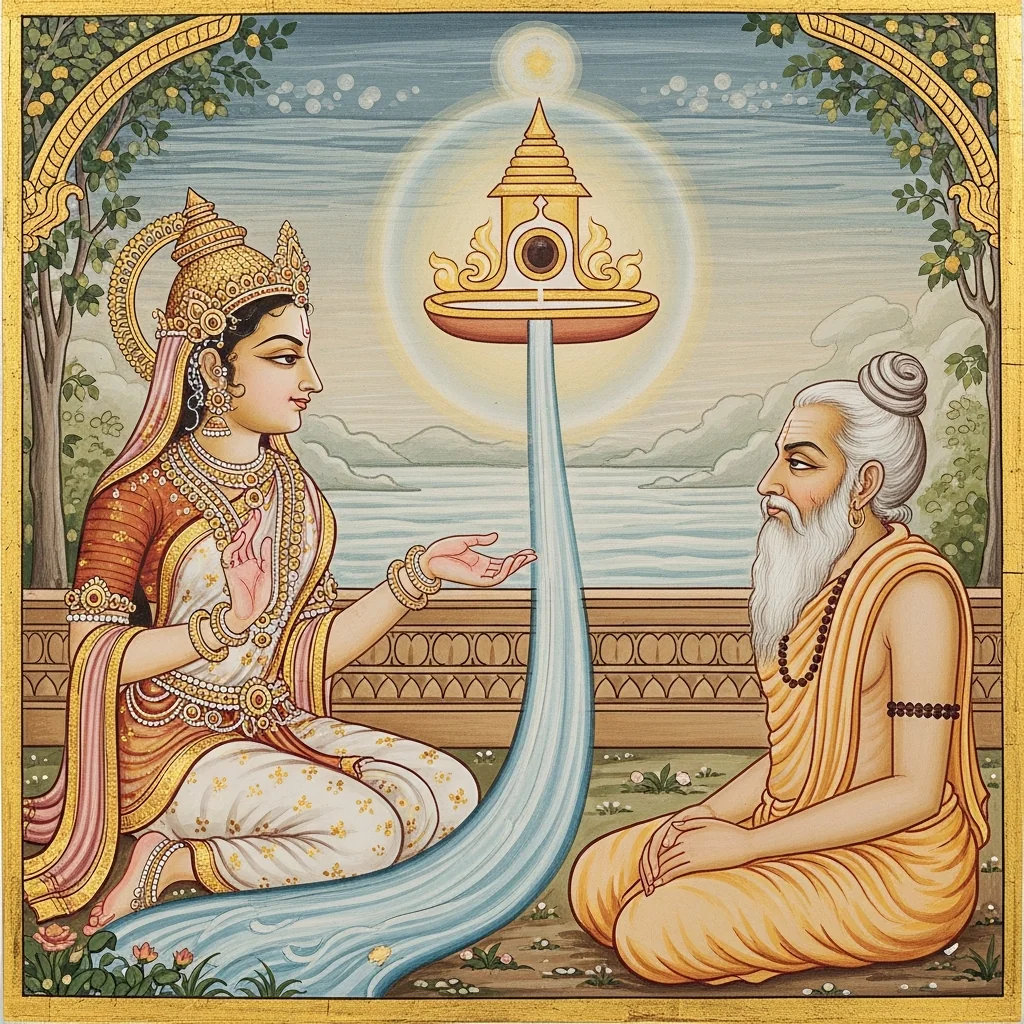
Mārkaṇḍeya describes an extreme cosmic moment: after the world is submerged, he remains in mid-ocean, exhausted by vast time, and meditatively remembers the Deity who enables one to cross the great flood. He then beholds a radiant, crane-like bird and wonders how such a divine being can appear in that terrifying sea. The bird reveals itself as Mahādeva (Maheśvara), the supreme reality encompassing even Brahmā and Viṣṇu, and declares that the universe has been withdrawn in dissolution (saṃhāra). Invited to rest within the bird’s wing, the sage undergoes a passage as though across immense ages. A sudden anklet-sound opens a vision: ten adorned maidens arrive from the directions, worship the bird, and enter a hidden inner realm like the interior of a mountain. Within appear a wondrous city and a resplendent river, culminating in the sight of a multi-hued, marvelous liṅga surrounded by divine beings in a state of withdrawal. A luminous maiden identifies herself as Narmadā (Revā), born from Rudra’s body, explaining that the ten maidens are the directions and that Mahādeva, the great yogin, has brought the liṅga to be worshiped even during cosmic contraction. She teaches that “liṅga” is that into which the moving and unmoving world dissolves, and that the gods are now condensed by māyā but will reappear with creation. The chapter ends with instruction: bathe and worship Mahādeva in Narmadā’s waters with mantra and proper method; this removes sin. Narmadā is affirmed as a great purifier for the human world.
Shlokas
Verse 1
मार्कण्डेय उवाच । नष्टे लोके पुनश्चान्ये सलिलेन समावृते । महार्णवस्य मध्यस्थो बाहुभ्यामतरं जलम्
Mārkaṇḍeya said: When the world had perished and again all was covered by waters, I found myself in the midst of the great ocean, swimming through the flood with my arms.
Verse 2
दिव्ये वर्षशते पूर्णे श्रान्तोऽहं नृपसत्तम । ध्यातुं समारभं देवं महदर्णवतारणम्
When a divine hundred years had passed, I was exhausted, O best of kings; then I began to meditate upon the Lord—the Savior who carries one across the great ocean.
Verse 3
ध्यायमानस्ततः काले अपश्यं पक्षिणं परम् । हारकुन्देन्दुसंकाशं बकं गोक्षीरपाण्डुरम्
As I meditated at that time, I beheld a wondrous bird—a crane, radiant like a garland, jasmine, and the moon, pale-white like cow’s milk.
Verse 4
ततोऽहं विस्मयाविष्टस्तं बकं समुदीक्ष्य वै । अस्मिन्महार्णवे घोरे कुतोऽयं पक्षिसंभवः
Then, filled with astonishment as I looked upon that crane, I wondered: ‘In this dreadful great ocean, how could any bird have come to be?’
Verse 5
तरन्बाहुभिरश्रान्तस्तं बकं प्रत्यभाषिषि । पाक्षरूपं समास्थाय कस्त्वमेकार्णवीकृते
Still swimming tirelessly with my arms, I addressed that crane: ‘Assuming a bird-form, who are you in this world reduced to a single ocean?’
Verse 6
भ्रमसे दिव्ययोगात्मन्मोहयन्निव मां प्रभो । एतत्कथय मे सर्वं योऽसि सोऽसि नमोऽस्तु ते
‘You move about, O Lord of divine yoga, as if bewildering me. Tell me all of this—whoever you are, you are; salutations to you.’
Verse 7
सोऽब्रवीन्मां महादेवो ब्रह्माहं विष्णुरेव च । जगत्सर्वं मया वत्स संहृतं किं न बुध्यसे
Then Mahādeva spoke to me: ‘I am Brahmā, and I am Viṣṇu as well. Dear child, I have withdrawn the entire universe—do you not understand?’
Verse 8
। अध्याय
Chapter (a manuscript/edition marker; not a complete metrical verse).
Verse 9
पक्षिरूपं समास्थाय अतोऽत्राहं समागतः । किमर्थमातुरो भूत्वा भ्रमसीत्थं महार्णवे
Assuming a bird-form, I have therefore come here. For what reason do you, distressed, wander thus in the great ocean?
Verse 10
शीघ्रं प्रविश मत्पक्षौ येन विश्रमसे द्विज । एवमुक्तस्ततस्तेन देवेनाहं नरेश्वर
“Quickly enter my wings, O twice-born, so that you may rest.” Thus addressed by that divine being, O king of men, I then did as I was told.
Verse 11
ततोऽहं तस्य पक्षान्ते प्रलीनस्तु भ्रमञ्जले । काले युगसाहस्रान्ते अश्रान्तोऽर्णवमध्यगः
Then I remained absorbed at the end of his wing while the waters whirled about. When time reached the end of a thousand yugas, I was still unwearied, situated in the midst of the ocean.
Verse 12
ततः शृणोमि सहसा दिक्षु सर्वासु सुव्रत । किंचिन्नूपुरसंमिश्रमद्भुतं शब्दमुत्तमम्
Then, all at once, O man of good vows, I heard in every direction a wondrous and excellent sound, mingled with the tinkling of anklets.
Verse 13
तदार्णवजलं सर्वं संक्षिप्तं सहसाभवत् । किमेतदिति संचिन्त्य दिशः समवलोकयम्
At that moment all the ocean’s waters suddenly drew together and contracted. Wondering, “What is this?”, I pondered and looked in every direction.
Verse 14
दश कन्यास्ततो दिक्षु आगताश्च महार्णवे । वस्त्रालंकारसहिता दिग्भ्यो नूपुरभूषिताः
Then ten maidens came from the directions upon the great ocean—clad in garments and ornaments, their ankles adorned with tinkling anklets, as though the quarters themselves had taken form.
Verse 15
काचिच्चन्द्रसमाभासा काचिदादित्यसप्रभा । काचिदंजनपुञ्जाभा काचिद्रक्तोत्पलप्रभा
One shone with the cool radiance of the moon; one blazed like the sun; one appeared as a mass of añjana-darkness; one gleamed like the splendor of a red lotus.
Verse 16
नानारूपधरा सौम्या नानाभरणभूषिता । अर्घ्यपाद्यादिभिर्माल्यैर्बकमभ्यर्च्य सुव्रताः
Gentle, bearing diverse forms and adorned with many ornaments, those maidens of noble vow worshipped Baka with offerings of arghya, pādya, and garlands.
Verse 17
ततस्तं पर्वताकारं गुह्यं पक्षिणमव्ययम् । प्रविवेश महाघोरं पर्वतो ह्यर्णवं स्वराट्
Then that mysterious, imperishable bird, mountain-shaped, entered the exceedingly dreadful ocean; for the sovereign “Mountain” indeed plunged into the sea.
Verse 18
योजनानां सहस्राणि तावन्त्येव शतानि च । त्रिंशद्योजनसाहस्रं यावद्भूमण्डलं त्विति
“There are thousands of yojanas—and likewise hundreds; the earth-circle extends to thirty thousand yojanas”—so it was stated.
Verse 19
ततो भूमण्डलं दिव्यं पञ्चरत्नसमाकुलम् । दिव्यस्फटिकसोपानं रुक्मस्तंभमनोरमम्
Then I beheld a divine earth-circle, filled with the five precious gems—having celestial crystal stairways and delightful pillars of gold.
Verse 20
योजनानां सहस्रं तु विस्तराद्द्विगुणायतम् । वापीकूपसमाकीर्णं प्रासादाट्टालकावृतम्
Its breadth was a thousand yojanas, and its length was twice that. It was filled with ponds and wells, and encircled by mansions and lofty towers.
Verse 21
कल्पवृक्षसमाकीर्णं ध्वजषष्टिविभूषितम् । तस्मिन्पुरवरे रम्ये नानारत्नोपशोभितम्
It was crowded with wish-fulfilling trees and adorned with banners and flagstaffs. That delightful best of cities shone with many kinds of jewels.
Verse 22
तथान्यच्च पुरं रम्यं पताकोज्ज्वलवेदिकम् । शतयोजनविस्तीर्णं तावद्द्विगुणमायतम्
Likewise there was another charming city, its platforms gleaming with banners. It was a hundred yojanas wide, and twice that in length.
Verse 23
पुरमध्ये ततस्तस्मिन्नदी परमशोभना । महती पुण्यसलिला नानारत्नशिला तथा
Then, within that city, there was a river of supreme beauty—vast, with holy waters, and with stones bearing many kinds of jewels.
Verse 24
तस्यास्तीरे मया दृष्टं तडित्सूर्यसमप्रभम् । इन्द्रनीलमहानीलैश्चितं रत्नैः समन्ततः
On its bank I saw something radiant like lightning and the sun, inlaid on every side with jewels—sapphires and great blue gems.
Verse 25
क्वचिद्वह्निसमाकारं क्वचिदिन्द्रायुधप्रभम् । क्वचिद्धूम्रं क्वचित्पीतं क्वचिद्रक्तं क्वचित्सितम्
In one place it looked like fire; in another it shone like Indra’s rainbow. Somewhere it was smoky-hued, somewhere yellow, somewhere red, and somewhere white.
Verse 26
नानावर्णैः समायुक्तं लिङ्गमद्भुतदर्शनम् । ब्रह्मविष्ण्विन्द्रसाध्यैश्च समन्तात्परिवारितम्
It was a liṅga endowed with many colors, a sight of sheer wonder—surrounded on all sides by Brahmā, Viṣṇu, Indra, and the Sādhyas.
Verse 27
नन्दीश्वरगणाध्यक्षैश्चेन्द्रादित्यैश्च तद्वृतम् । पश्यामि लिङ्गमीशानं महालिङ्गं तमेव च
It was encircled by Nandīśvara, the leaders of Śiva’s hosts, and by Indra and the Ādityas. I behold that very liṅga of Īśāna—the great Mahāliṅga itself.
Verse 28
परिवार्य ततस्तं तु प्रसुप्तान्देवदानवान् । निमीलिताक्षान्पश्यामि दिव्याभरणभूषितान्
Then, surrounding it, I behold gods and dānavas lying as if asleep, their eyes closed, adorned with divine ornaments.
Verse 29
ततस्ताः पद्मपत्राक्ष्यो नार्यः परमसंमताः । नद्यास्तस्या जले स्नात्वा दिव्यपुष्पैर्मनोरमैः
Then those women, lotus-leaf-eyed and most esteemed, bathed in the waters of that river and came forth with delightful celestial flowers.
Verse 30
दत्त्वार्घपाद्यं विधिवल्लिंगस्य सह पक्षिणा । अर्चयन्तीर्वरारोहा दश ताः प्रमदोत्तमाः
Having duly offered arghya and pādya to the Liṅga, together with the bird, those ten finest of women—graceful and noble—began to worship it according to proper rite.
Verse 31
ततस्त्वभ्यर्च्य तल्लिङ्गं तस्मिन्नेव पुरोत्तमे । सर्वा अदर्शनं जग्मुर्विद्युतोऽभ्रगणेष्विव
Then, having worshipped that very Liṅga in that excellent sacred precinct, they all vanished from sight—like flashes of lightning amid clusters of clouds.
Verse 32
न चासौ पक्षिराट्तस्मिन्न स्त्रियो न च देवताः । तदेवैकं स्थितं लिङ्गमर्चयन्विस्मयान्वितः
But in that place there was neither that kingly bird, nor the women, nor any deities—only that single Liṅga remained standing there, while I worshipped it, filled with wonder.
Verse 33
ततोऽहं दुःखमूढात्मा रुद्रमायेति चिन्तयन् । ततः कन्याः समुत्तीर्य दिव्यांबरविभूषणाः
Then I, my mind bewildered by sorrow, reflected: “This is surely Rudra’s māyā.” Thereupon maidens emerged, adorned with divine garments and ornaments.
Verse 34
भासयन्त्यो जगत्सर्वं विद्युतोऽभ्रगणानिव । पद्मैर्हिरण्मयैर्दिव्यैरर्चयित्वा शुभाननाः
Radiating brilliance over the whole world like lightning amid masses of clouds, those fair-faced maidens worshipped with divine golden lotuses.
Verse 35
विविशुस्तज्जलं क्षिप्रं समंताद्वरभूषणाः । तस्मिन्पुरवरे चान्ये तामेवाहं पुनःपुनः
Adorned with splendid ornaments, they quickly entered that water on all sides. And in that excellent sacred place, I again and again beheld that very maiden.
Verse 36
पश्यामि ह्यमरां कन्यामर्चयन्तीं महेश्वरम् । ततोऽहं तां वरारोहामपृच्छं कमलेक्षणाम्
Indeed, I saw an immortal maiden worshipping Maheśvara. Then I questioned that graceful one, lotus-eyed and radiant.
Verse 37
का त्वमस्मिन्पुरे देवि वससे शिवमर्चती । ताश्चागताः स्त्रियः सर्वाः क्व गतास्ते गणेश्वराः
“Who are you, O Devī, dwelling in this sacred place and worshipping Śiva? And all those women who arrived—where have they gone? And where are those gaṇeśvaras, Śiva’s attendants?”
Verse 38
नमोऽस्तु ते महाभागे ब्रूहि पुण्ये महेश्वरि । तव प्रसादाद्विज्ञातुमेतदिच्छामि सुव्रते । दयां कृत्वा महादेवि कथयस्व ममानघे
Reverence to you, O most fortunate one. Speak, O holy Maheśvarī. By your grace I wish to understand this. O you of noble vows—show compassion, great Goddess; tell me, O sinless one.
Verse 39
श्र्युवाच । विस्मृताहं कथं विप्र दृष्ट्वा कल्पे पुरातने । मा तेऽभूत्स्मृतिविभ्रंशः सा चाहं कल्पवाहिनी
The blessed lady said: “How could I be forgotten, O brāhmaṇa, when you have seen me in an ancient kalpa? Let there be no confusion in your memory—I am she, the one who endures from kalpa to kalpa.”
Verse 40
नर्मदा नाम विख्याता रुद्रदेहाद्विनिःसृता । यास्ताः कन्यास्त्वया दृष्टा ह्यर्चयन्त्यो महेश्वरम्
I am renowned by the name Narmadā, sprung forth from Rudra’s own body. And those maidens you saw here—indeed, they were worshipping Maheśvara (Śiva).
Verse 41
याभिस्त्विह समानीतः पक्षिराजसमन्विताः । दिशस्ता विद्धि सर्वेशाः सर्वास्त्वं मुनिसत्तम
And those by whom you were brought here, accompanied by the king of birds—know, O best of sages, that they are the very guardians of all the directions, the lords of all quarters.
Verse 42
तिर्यक्पक्षिस्वरूपेण महायोगी महेश्वरः । एभिः शिवपुराद्विप्र आनीतः स महेश्वरः
Maheśvara—the great Yogin—assumed the form of a bird. O brāhmaṇa, by these very beings Maheśvara was brought here from Śivapura.
Verse 43
सैष देवो महादेवो लिङ्गमूर्तिर्व्यवस्थितः । अर्च्यते ब्रह्मविष्ण्विन्द्रैः सुरासुरजगद्गुरुः
This very God is Mahādeva, established here in the form of the Liṅga. He is worshipped by Brahmā, Viṣṇu, and Indra—the teacher of gods, asuras, and the whole world.
Verse 44
लयमायाति यस्माद्धि जगत्सर्वं चराचरम् । तेन लिङ्गमिति प्रोक्तं पुराणज्ञैर्महर्षिभिः
Because from him indeed the entire world—moving and unmoving—passes into dissolution, therefore the great seers, knowers of the Purāṇas, have declared him to be ‘Liṅga’.
Verse 45
तेन देवगणाः सर्वे संक्षिप्ता मायया पुरा । प्रलीनाश्चैव लोकेश न दृश्यन्ते हि सांप्रतम्
By him, long ago, all the hosts of gods were drawn in and withdrawn by Māyā; and having dissolved, O lord of the worlds, they are indeed not seen at present.
Verse 46
पुनर्दृश्या भविष्यन्ति सृजमानाः स्वयंभुवा । साहं लिङ्गार्चनपरा नर्मदा नाम नामतः
They will be seen again, once they are created anew by Svayaṃbhū (the Self-born). And I—devoted to the worship of the Liṅga—am known by name as Narmadā.
Verse 47
कालं युगसहस्रस्य रुद्रस्य परिचारिका । अस्य प्रसादादमरस्तथा त्वं द्विजपुंगव
For a span of a thousand yugas I have served Rudra. By his grace, O best of brāhmaṇas, you too shall become deathless.
Verse 48
सत्यार्जवदयायुक्तः सिद्धोऽसि त्वं शिवार्चनात् । एवमुक्त्वा तु सा देवी तत्रैवान्तरधीयत
Endowed with truthfulness, straightforwardness, and compassion, you have attained accomplishment through the worship of Śiva. Having spoken thus, that Goddess vanished then and there.
Verse 49
ताः स्त्रियः स च देवेशो बकरूपो महेश्वरः । तस्यास्तद्वचनं श्रुत्वा अवतीर्य महानदीम्
Those women, and that Lord of gods—Maheśvara in the form of a crane—having heard her words, then descended to the great river.
Verse 50
स्नात्वा समर्चय त्वं हि विधिना मन्त्रपूर्वकम् । ततोऽहं सहसा तस्मात्समुत्तीर्य जलाशयात्
“Having bathed, you should worship the Lord properly, according to the prescribed rite and with mantras. Then I at once emerged from that water-reservoir and came up to the shore.”
Verse 51
न च पश्यामि तल्लिङ्गं न च तां निम्नगां नृप । तदैव लोकाः संजाताः क्षितिश्चैव सकानना
“And, O King, I no longer see that liṅga, nor do I see that river. At that very moment the worlds came forth again, and the earth too, together with its forests.”
Verse 52
ऋक्षचन्द्रार्कविततं तदेव च नभस्तलम् । यथापूर्वमदृष्टं तु तथैव च पुनः कृतम् । नतोऽहं मनसा देवमपूजयं महेश्वरम्
“The same sky, spread with stars, the moon, and the sun, appeared once more—just as it had been before. Then I bowed in my mind and worshipped the God, Maheśvara.”
Verse 53
एवं बके पुरा कल्पे मया दृष्टेयमव्यया । नर्मदा मर्त्यलोकस्य महापातकनाशिनी
Thus, in the ancient Bake Kalpa, I beheld this imperishable Narmadā—she who destroys the great sins of the human world.
Verse 54
तस्माद्धर्मपरैर्विप्रैः क्षत्रशूद्रविशादिभिः । सदा सेव्या महाभागा धर्मवृद्ध्यर्थकारिभिः
Therefore, dharma-minded brāhmaṇas—and kṣatriyas, śūdras, vaiśyas, and others—should always revere and serve this greatly fortunate (Narmadā), seeking the increase of dharma and true welfare.
Verse 55
येऽपि भक्तया सकृत्तोये नर्मदाया महेश्वरम् । स्नात्वा ते सर्वं पापं नाशयन्त्यसंशयम्
Even those who, with devotion, bathe just once in the waters of Narmadā in connection with Maheśvara destroy all sin, without doubt.