Adhyaya 14
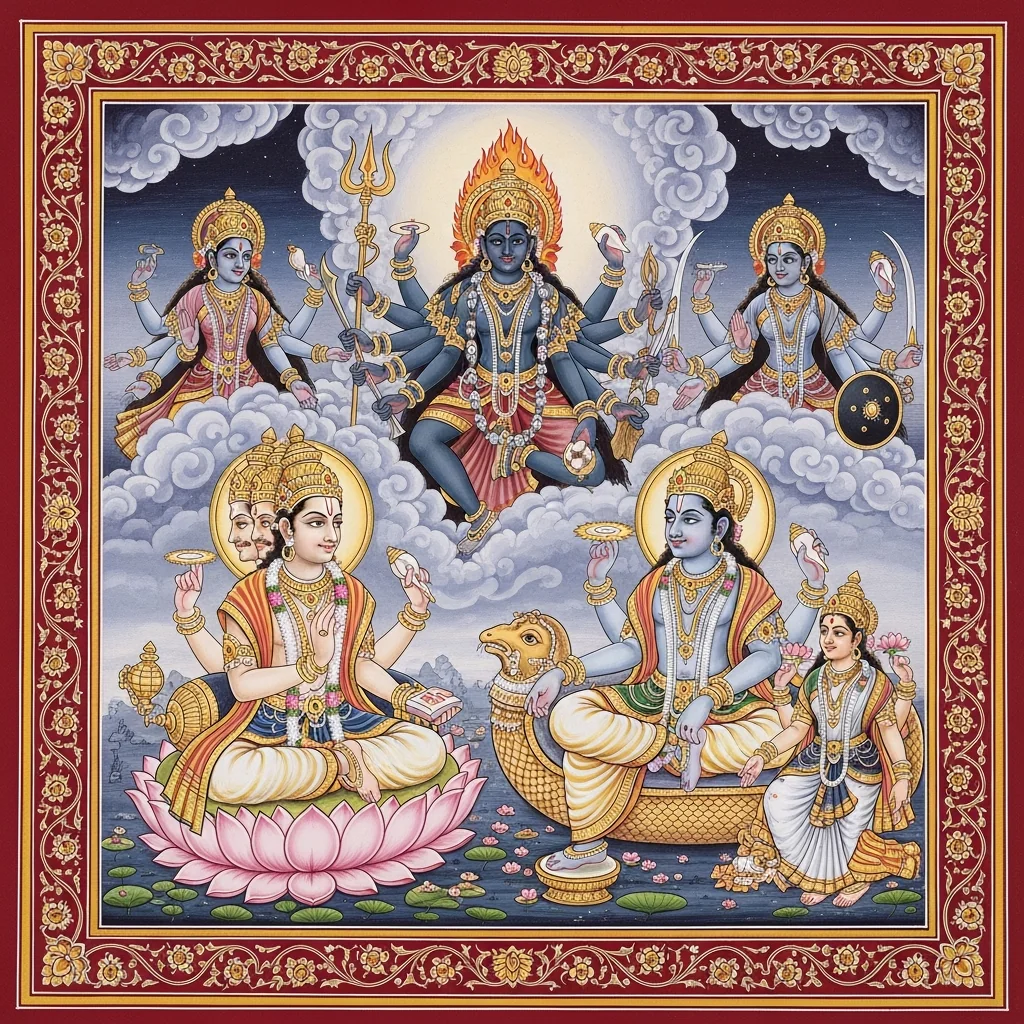
This chapter unfolds as a royal–sage dialogue. Yudhiṣṭhira asks what wondrous event occurred after the sages dwelling on the Narmadā’s bank departed for a higher realm. Mārkaṇḍeya replies by describing a cosmic emergency—a fierce upheaval of destruction (rāudra-saṃhāra) that signals the loosening of the world’s order. Led by Brahmā and Viṣṇu, the gods ascend to Kailāsa, praise the eternal Mahādeva, and petition for dissolution at the close of an immense time-cycle. The teaching is set forth in a threefold mode: the one Divine Reality appears as Brāhmī (creation), Vaiṣṇavī (preservation), and Śaivī (dissolution), culminating in entry into a transcendent Śaiva “pada” beyond elemental conditions. Dissolution is then set in motion. Mahādeva commands Devī to relinquish her gentle form and assume a fierce, Rudra-aligned manifestation. Devī hesitates out of compassion, but Śiva’s wrathful utterance compels her transformation into a Kālārātri-like form. A rising description follows—terrifying iconography, multiplication into innumerable bodies, attendance of gaṇas, and the ordered destabilizing and burning of the three worlds—portraying cosmic dissolution as a theologically governed process rather than a random catastrophe.
Shlokas
Verse 1
युधिष्ठिर उवाच । ततस्त ऋषयः सर्वे महाभागास्तपोधनाः । गतास्तु परमं लोकं ततः किं जातमद्भुतम्
Yudhiṣṭhira said: When all those most blessed sages, rich in the power of austerity, departed to the highest realm, what wondrous event occurred thereafter?
Verse 2
श्रीमार्कण्डेय उवाच । ततस्तेषु प्रयातेषु नर्मदातीरवासिषु । बभूव रौद्रसंहारः सर्वभूतक्षयंकरः
Śrī Mārkaṇḍeya said: After those who dwelt upon the banks of the Narmadā had departed, there arose a fierce, Rudra-like destruction, bringing ruin upon all beings.
Verse 3
कैलासशिखरस्थं तु महादेवं सनातनम् । ब्रह्माद्याः प्रास्तुवन् देवमृग्यजुःसामभिः शिवम्
Then Brahmā and the other gods praised the eternal Mahādeva upon the summit of Kailāsa, extolling Śiva with hymns drawn from the Ṛg, Yajur, and Sāma Vedas.
Verse 4
संहर त्वं जगद्देव सदेवासुरमानुषम् । प्राप्तो युगसहस्रान्तः कालः संहरणक्षमः
O Lord of the world, withdraw and dissolve the universe—together with gods, asuras, and humankind. The time has come: the end of a thousand yugas, fit for dissolution.
Verse 5
मद्रूपं तु समास्थाय त्वया चैतद्विनिर्मितम् । वैष्णवीं मूर्तिमास्थाय त्वयैतत्परिपालितम्
(O Śiva,) assuming my form, you created all this; and assuming the Vaiṣṇava form, you have protected and sustained it.
Verse 6
एका मूर्तिस्त्रिधा जाता ब्राह्मी शैवी च वैष्णवी । सृष्टिसंहाररक्षार्थं भवेदेवं महेश्वर
One Form became three—Brahmā’s, Śiva’s, and Viṣṇu’s—so that creation, dissolution, and protection may be fulfilled thus, O Maheśvara.
Verse 7
एतच्छ्रुत्वा वचस्तथ्यं विष्णोश्च परमेष्ठिनः । सगणः सपरीवारः सह ताभ्यां सहोमया
Hearing these truthful words of Viṣṇu and of Parameṣṭhin (Brahmā), (Śiva)—with his gaṇas and retinue—went forth with them, accompanied also by Umā.
Verse 8
समलोकान्विभिद्येमान्भगवान्नीललोहितः । भूराद्यब्रह्मलोकान्तं भित्त्वाण्डं परतः परम्
The Blessed Lord Nīlalohita pierced through all these worlds; breaking the cosmic egg from Bhūḥ (earth) up to Brahmaloka, He went beyond—into That which is beyond the beyond.
Verse 9
शैवं पदमजं दिव्यमाविशत्सह तैर्विभुः । न तत्र वायुर्नाकाशं नाग्निस्तत्र न भूतलम्
The all-pervading Lord entered, together with them, the divine, unborn Śaiva Abode. There is no wind there, no ether; no fire is there, nor the earth-plane.
Verse 10
यत्र संतिष्ठे देव उमया सह शङ्करः । न सूर्यो न ग्रहास्तत्र न ऋक्षाणि दिशस्तथा
Where the God Śaṅkara abides together with Umā—there is neither sun nor planets; neither constellations nor even the directions as such.
Verse 11
न लोकपाला न सुखं न च दुःखं नृपोत्तम
There are no world-guardians there, O best of kings—no pleasure, and no sorrow either.
Verse 12
ब्राह्मं पदं यत्कवयो वदन्ति शैवं पदं यत्कवयो वदन्ति । क्षेत्रज्ञमीशं प्रवदन्ति चान्ये सांख्याश्च गायन्ति किलादिमोक्षम्
That which poets call the ‘Brāhma’ state, and that which poets call the ‘Śaiva’ state—others proclaim as the Lord, the Knower of the Field; and the Sāṃkhyas indeed sing of it as the primal liberation.
Verse 13
यद्ब्रह्म आद्यं प्रवदन्ति केचिद्यं सर्वमीशानमजं पुराणम् । तमेकरूपं तमनेकरूपमरूपमाद्यं परमव्ययाख्यम्
That which some declare to be the primordial Brahman—He who is all, the Lord (Īśāna), unborn and ancient—Him they describe as one-formed, as many-formed, as formless: the primal, supreme One, known as the Imperishable.
Verse 14
। अध्याय
Chapter (colophon/section marker).
Verse 15
ततस्त्रयस्ते भगवन्तमीशं सम्प्राप्य संक्षिप्य भवन्त्यर्थकम् । पृथक्स्वरूपैस्तु पुनस्त एव जगत्समस्तं परिपालयन्ति
Then those three, having reached the Blessed Lord Īśa, become gathered into one essential reality; yet again, taking distinct forms, they protect and sustain the entire universe.
Verse 16
संहारं सर्वभूतानां रुद्रत्वे कुरुते प्रभुः । विष्णुत्वे पालयेल्लोकान्ब्रह्मत्वे सृष्टिकारकः
As Rudra, the Lord brings about the dissolution of all beings; as Viṣṇu, He protects the worlds; as Brahmā, He becomes the maker of creation.
Verse 17
प्रकृत्या सह संयुक्तः कालो भूत्वा महेश्वरः । विश्वरूपा महाभागा तस्य पार्श्वे व्यवस्थिता
United with Prakṛti, Maheśvara becomes Kāla (Time). And the greatly blessed One, of universal form, stands established at His side.
Verse 18
यामाहुः प्रकृतिं तज्ज्ञाः पदार्थानां विचक्षणाः । पुरुषत्वे प्रकृतित्वे च कारणं परमेश्वरः
That which the knowers of truth—discerning in the principles of existence—call ‘Prakṛti’: the Supreme Lord (Parameśvara) alone is the ultimate cause behind both the status of Puruṣa and the status of Prakṛti.
Verse 19
तस्मादेतज्जगत्सर्वं चराचरम् । तस्मिन्नेव लयं याति युगान्ते समुपस्थिते
Therefore this entire universe—moving and unmoving—dissolves into Him alone when the end of the age arrives.
Verse 20
भगलिङ्गाङ्कितं सर्वं व्याप्तं वै परमेष्ठिना । भगरूपो भवेद्विष्णुर्लिङ्गरूपो महेश्वरः
All this is pervaded by the Supreme (Parameṣṭhin), marked by ‘Bhaga’ and ‘Liṅga’. Viṣṇu is of the form ‘Bhaga’, and Maheśvara is of the form ‘Liṅga’.
Verse 21
भाति सर्वेषु लोकेषु गीयते भूर्भुवादिषु । प्रविष्टः सर्वभूतेषु तेन विष्णुर्भगः स्मृतः
He shines in all the worlds and is sung of in Bhūr, Bhuvar, and the rest. Having entered into all beings, therefore Viṣṇu is remembered as “Bhaga”.
Verse 22
विशनाद्विष्णुरित्युक्तः सर्वदेवमयो महान् । भासनाद्गमनाच्चैव भगसंज्ञा प्रकीर्तिता
Because He “enters and pervades,” He is called Viṣṇu—the Great One who contains all the gods. And because of shining and movement, the designation “Bhaga” is proclaimed.
Verse 23
ब्रह्मादिस्तम्बपर्यन्तं यस्मिन्नेति लयं जगत् । एकभावं समापन्नं लिङ्गं तस्माद्विदुर्बुधाः
That into which the universe dissolves—from Brahmā down to the blade of grass—is known by the wise as the Liṅga, for it is the One Reality into which all becomes unified.
Verse 24
महादेवस्ततो देवीमाह पार्श्वे स्थितां तदा । संहरस्व जगत्सर्वं मा विलम्बस्व शोभने
Then Mahādeva spoke to Devī standing at His side: “Withdraw the entire universe; do not delay, O beautiful one.”
Verse 25
त्यज सौम्यमिदं रूपं सितचन्द्रांशुनिर्मलम् । रुद्रं रूपं समास्थाय संहरस्व चराचरम्
“Set aside this gentle form, pure as the rays of the white moon. Assuming the Rudra-form, dissolve the moving and the unmoving.”
Verse 26
रौद्रैर्भूतगणैर्घोरैर्देवि त्वं परिवारिता । जीवलोकमिमं सर्वं भक्षयस्वाम्बुजेक्षणे
O Devī, surrounded by dreadful hosts of fierce beings, devour this entire world of living creatures, O lotus-eyed one.
Verse 27
ततोऽहं मर्दयिष्यामि प्लावयिष्ये तथा जगत् । कृत्वा चैकार्णवं भूयः सुखं स्वप्स्ये त्वया सह
Then I shall crush and inundate the world as well; and having made it once again a single ocean, I shall sleep in peace together with you.
Verse 28
श्रीदेव्युवाच । नाहं देव जगच्चैतत्संहरामि महाद्युते । अम्बा भूत्वा विचेष्टं न भक्षयामि भृशातुरम्
The Goddess said: O god of great radiance, I do not destroy this world. Having become a mother, I cannot devour one who is helpless and greatly afflicted.
Verse 29
स्त्रीस्वभावेन कारुण्यं करोति हृदयं मम । कथं वै निर्दहिष्यामि जगदेतज्जगत्पते
By a woman’s very nature, compassion fills my heart. How then could I burn this world, O Lord of the universe?
Verse 30
तस्मात्त्वं स्वयमेवेदं जगत्संहर शङ्कर । अथैवमुक्तस्तां देवीं धूर्जटिर्नीललोहितः
Therefore, O Śaṅkara, you yourself withdraw this world. When she spoke thus, Dhūrjaṭi—Nīlalohita—addressed the Goddess…
Verse 31
क्रुद्धो निर्भर्त्सयामास हुङ्कारेण महेश्वरीम् । ॐ हुंफट्त्वं स इत्याह कोपाविष्टैरथेक्षणैः
Enraged, he rebuked Maheśvarī with a fierce huṃkāra, declaring, “Oṃ huṃ phaṭ—so be it!”—his eyes suffused with wrath.
Verse 32
हुंकारिता विशालाक्षी पीनोरुजघनस्थला । तत्क्षणाच्चाभवद्रौद्रा कालरात्रीव भारत
Struck by the huṃkāra, the large-eyed Goddess—broad-hipped and full-thighed—at that very instant became dreadful, like Kālarātrī, O Bhārata.
Verse 33
हुंकुर्वती महानादैर्नादयन्ती दिशो दश । व्यवर्धत महारौद्रा विद्युत्सौदामिनी यथा
Uttering “huṃ” with mighty roars and making the ten directions resound, the supremely fierce one expanded, like a blazing lightning-flash.
Verse 34
विद्युत्सम्पातदुष्प्रेक्ष्या विद्युत्संघातचञ्चला । विद्युज्ज्वालाकुला रौद्रा विद्युदग्निनिभेक्षणा
Hard to behold like a crashing bolt of lightning, trembling like clustered flashes, wreathed in lightning-flames—fierce—her gaze like lightning-fire.
Verse 35
मुक्तकेशी विशालाक्षी कृशग्रीवा कृशोदरी । व्याघ्रचर्माम्बरधरा व्यालयज्ञोपवीतिनी
With loosened hair and wide eyes—slender-necked, slender-waisted—she wore a tiger-skin garment and bore a sacred thread of serpents.
Verse 36
वृश्चिकैरग्निपुञ्जाभैर्गोनसैश्च विभूषिता । त्रैलोक्यं पूरयामास विस्तारेणोच्छ्रयेण च
Adorned with scorpions like heaps of fire and with mighty serpents, she filled the three worlds by her vast breadth and towering height.
Verse 37
भासुराङ्गा तु संवृत्ता कृष्णसर्पैककुण्डला । चित्रदण्डोद्यतकरा व्याघ्रचर्मोपसेविता
Her limbs blazed with splendor; she wore a single earring of a black serpent. With a wondrous staff raised in her hand, she was attended and clad in tiger-skin.
Verse 38
व्यवर्धत महारौद्रा जगत्संहारकारिणी । सृक्किणी लेलिहाना च क्रूरफूत्कारकारिणी
That supremely terrifying Raudrī form swelled in might—an agent of cosmic dissolution—licking her blood-smeared lips and breathing forth savage, dreadful blasts.
Verse 39
व्यात्तास्या घुर्घुरारावा जगत्संक्षोभकारिणी । खेलद्भूतानुगा क्रूरा निःश्वासोच्छ्वासकारिणी
With gaping mouth and a rumbling, growling roar, she shook the very cosmos; cruel and dreadful, attended by leaping hosts of bhūtas, she heaved with harsh inhalations and exhalations.
Verse 40
जाताट्टअहासा दुर्नासा वह्निकुण्डसमेक्षणा । प्रोद्यत्किलकिलारावा ददाह सकलं जगत्
Her loud, bursting laughter arose; her visage was hideous, her eyes like pits of fire. With an upsurging cry of “kilakila,” she burned the entire world.
Verse 41
दह्यमानाः सुरास्तत्र पतन्ति धरणीतले । पतन्ति यक्षगन्धर्वाः सकिन्नरमहोरगाः
There, the gods—ablaze—fell down upon the earth; Yakṣas and Gandharvas fell as well, together with Kinnaras and mighty serpents.
Verse 42
पतन्ति भूतसङ्घाश्च हाहाहैहैविराविणः । बुम्बापातैः सनिर्घातैरुदितार्तस्वरैरपि
Hosts of bhūtas too came crashing down, crying “hā hā” and “hai hai”; with thunderous impacts and resounding blows, they raised anguished wails as well.
Verse 43
व्याप्तमासीत्तदा विश्वं त्रैलोक्यं सचराचरम् । संपतद्भिः पतद्भिश्च ज्वलद्भूतगणैर्मही
Then the entire universe—the three worlds with all that moves and stands—was filled; the earth was covered by flaming hosts of bhūtas, rushing and falling everywhere.
Verse 44
जातैश्चटचटाशब्दैः पतद्भिर्गिरिसानुभिः । तत्र रौद्रोत्सवे जाता रुद्रानन्दविवर्धिनी
Amid crackling “caṭa-caṭa” sounds and mountain-slopes collapsing as they fell, there arose the festival of Raudra—she who increased Rudra’s delight.
Verse 45
विहिंसमाना भूतानि चर्वमाणाचरानपि । तत्तद्गन्धमुपादाय शिवारावविराविणी
She tormented the beings and even chewed up the immobile ones; seizing their various odors, she roared with Śiva-like cries.
Verse 46
गलच्छोणितधाराभिमुखा दिग्धकलेवरा । चण्डशीलाभवच्चण्डी जगत्संहारकर्मणि
Facing streams of flowing blood, her body smeared and stained, Caṇḍī became of a ferocious nature—set upon the work of destroying the world.
Verse 47
येऽपि प्राप्ता महर्लोकं भृग्वाद्याश्च महर्षयः । तेऽपि नश्यन्ति शतशो ब्रह्मक्षत्त्रविशादयः
Even those great seers—Bhṛgu and others—who had attained Maharloka: even they perished by the hundreds, along with brāhmaṇas, kṣatriyas, vaiśyas, and the rest.
Verse 48
देवासुरा भयत्रस्ताः सयक्षोरगराक्षसाः । विशन्ति केऽपि पातालं लीयन्ते च गुहादिषु
Struck with fear, the Devas and Asuras—along with Yakṣas, Nāgas, and Rākṣasas—some plunge into the netherworld, while others hide away in caves and similar refuges.
Verse 49
सा च देवी दिशः सर्वा व्याप्य मृत्युरिव स्थिता । युगक्षयकरे काले देवेन विनियोजिता
And that Goddess, pervading all directions, stood like Death itself—appointed by the Lord for the time that brings the ending of an age.
Verse 50
एकापि नवधा जाता दशधा दशधा तथा । चतुःषष्टिस्वरूपा च शतरूपाट्टहासिनी
Though one, she became ninefold, then tenfold and again tenfold; she took on sixty-four forms, and even a hundred forms—laughing aloud in fierce exultation.
Verse 51
जज्ञे सहस्ररूपा च लक्षकोटितनुः शिवा । नानारूपायुधाकारा नानावादनचारिणी
The auspicious Goddess was born thousand-formed, with bodies numbering in hundreds of thousands and crores—bearing weapons of many kinds and moving forth with countless faces.
Verse 52
एवंरूपाऽभवद्देवी शिवस्यानुज्ञया नृप । दिक्षु सर्वासु गगने विकटायुधशीलिनः
Thus formed, O King, the Goddess became so by Śiva’s consent; and in all directions across the sky were those who wielded terrible weapons.
Verse 53
रुन्धन्तो नश्यमानांस्तान्गणा माहेश्वराः स्थिताः । विचरन्ति तया सार्द्धं शूलपट्टिशपाणयः
The Māheśvara gaṇas stood there, hemming in those who were being destroyed; bearing tridents and battle-axes in their hands, they roamed together with her.
Verse 54
ततो मातृगणाः केचिद्विनायकगणैः सह । व्यवर्धन्त महारौद्रा जगत्संहारकारिणः
Then certain hosts of the Mothers, together with the hosts of Vināyaka, grew mightily—exceedingly fierce, bringing about the destruction of the world.
Verse 55
ततस्तस्या व्यवर्धन्त दंष्ट्राः कुन्देन्दुसन्निभाः । योजनानां सहस्राणि अयुतान्यर्बुदानि च
Thereupon her fangs—bright like jasmine and the moon—grew vast: by thousands of yojanas, by tens of thousands, and even by crores beyond measure.
Verse 56
दंष्ट्रावलिः कररुहाः क्रूरास्तीक्ष्णाश्च कर्कशाः । वियद्दिशो लिखन्त्येव सप्तद्वीपां वसुंधराम्
Her rows of fangs and her nails—cruel, keen, and harsh—seemed to rake even the quarters of the sky, scoring the earth of the seven dvīpas.
Verse 57
तस्या दंष्ट्राभिसम्पातैश्चूर्णिता वनपर्वताः । शिलासंचयसंघाता विशीर्यते सहस्रशः
By the crashing blows of her fangs, forests and mountains were ground to powder; heaps of piled rocks shattered into fragments by the thousand.
Verse 58
हिमवान्हेमकूटश्च निषधो गन्धमादनः । माल्यवांश्चैव नीलश्च श्वेतश्चैव महागिरिः
Himavān, Hemakūṭa, Niṣadha, Gandhamādana, Mālyavān, Nīla, and Śveta—those mighty mountains—were all shaken and thrown into turmoil.
Verse 59
मेरुमध्यमिलापीठं सप्तद्वीपं च सार्णवम् । लोकालोकेन सहितं प्राकम्पत नृपोत्तम
The central seat around Meru—the seven dvīpas with their encircling oceans—together with Lokāloka, the boundary mountain, began to quake, O best of kings.
Verse 60
दंष्ट्राशनिविस्पृष्टाश्च विशीर्यन्ते महाद्रुमाः । उत्पातैश्च दिशो व्याप्ता घोररूपैः समन्ततः
Struck by fearsome fangs and by thunderbolts, great trees were shattered; and all directions, on every side, were filled with dreadful portents.
Verse 61
तारा ग्रहगणाः सर्वे ये च वैमानिका गणाः । शिवासहस्रैराकीर्णा महामातृगणैस्तथा
All the stars and hosts of planets, and the celestial companies who move in aerial cars, were thronged with thousands of Śivas and likewise with the hosts of the Great Mothers.
Verse 62
सा चचार जगत्कृत्स्नं युगान्ते समुपस्थिते । भ्रमद्भिश्च ब्रुवद्भिश्च क्रोशद्भिश्च समन्ततः
As the end of the age drew near, she ranged through the entire world—while beings everywhere reeled about, cried out, and spoke in confusion on all sides.
Verse 63
प्रमथद्भिर्ज्वलद्भिश्च रौद्रैर्व्याप्ता दिशो दश । विस्तीर्णं शैलसङ्घातं विघूर्णितगिरिद्रुमम्
The ten directions were pervaded by furious, blazing, raging forces; and the wide ranges of mountains were thrown into upheaval, with trees on the hills whirled about.
Verse 64
प्रभिन्नगोपुरद्वारं केशशुष्कास्थिसंकुलम् । प्रदग्धग्रामनगरं भस्मपुंजाभिसंवृतम्
Gateways and archways were smashed; the place was strewn with hair, dried remains, and bones. Villages and cities were burned down, covered over with heaps of ash.
Verse 65
चिताधूमाकुलं सर्वं त्रैलोक्यं सचराचरम् । हाहाकाराकुलं सर्वमहहस्वननिस्वनम्
All the three worlds—with all that moves and does not move—were choked with the smoke of funeral pyres; everything was filled with cries of ‘Alas! Alas!’ and with dreadful sounds and clamour.
Verse 66
जगदेतदभूत्सर्वमशरण्यं निराश्रयम्
This entire world became without refuge—without any shelter at all.