Adhyaya 198
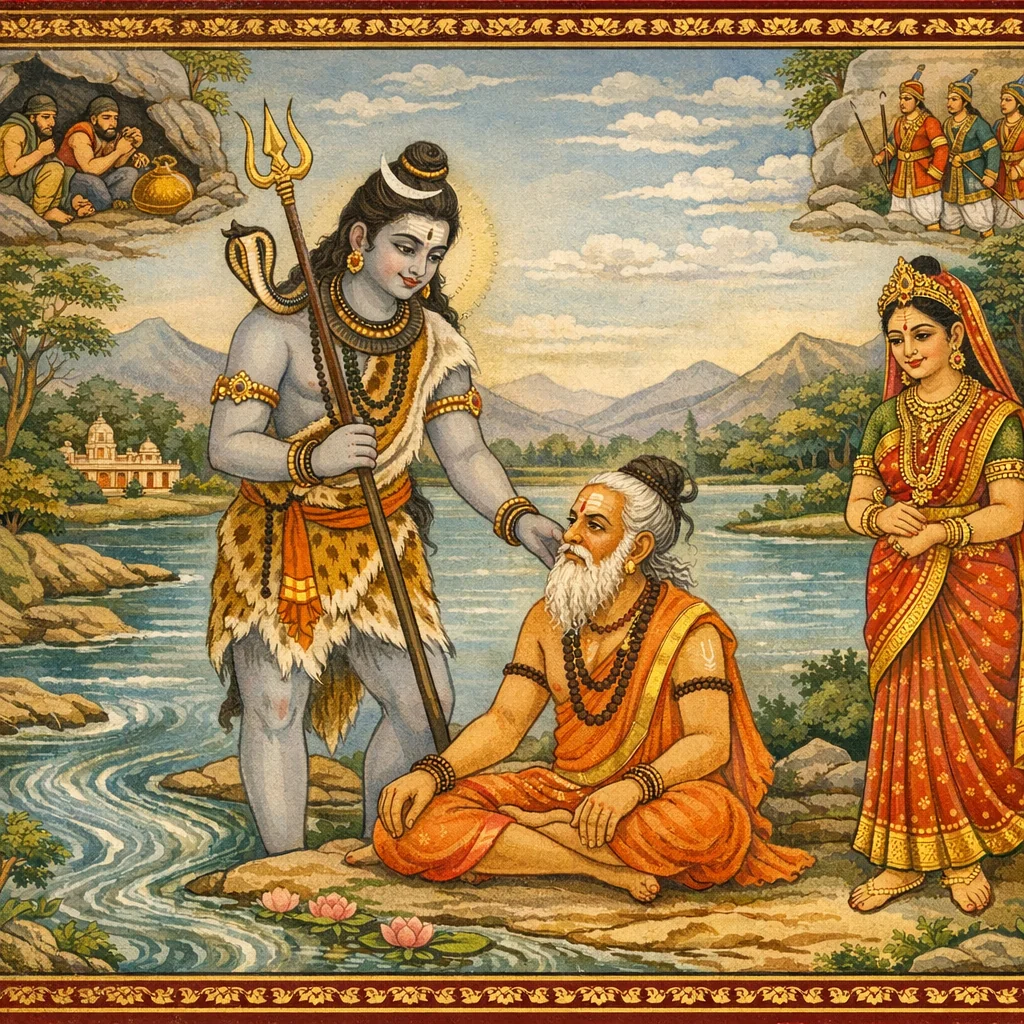
Mārkaṇḍeya directs the listener to Bhadrakālī-saṅgama, famed as Śūlatīrtha, a divinely established ford ever visited by the devas. Its power is praised: mere darśana—especially when joined with snāna and dāna—is said to remove misfortune, evil omens, the effects of curses, and other demerit. Yudhiṣṭhira asks why, on the bank of the Narmadā, Devī is called Śūleśvarī and Śiva Śūleśvara. Mārkaṇḍeya recounts the tale of the brāhmaṇa ascetic Māṇḍavya, steadfast in severe tapas and silence, whose hermitage is compromised when thieves hide stolen goods there. Royal guards, receiving no reply from the silent sage, punish him by impalement upon a śūla; yet he endures and lives through unwavering inner remembrance of Śiva. Śiva appears, cuts the śūla, and teaches karmavipāka: varied suffering and fortune arise from past actions, and patient endurance without dharma-nindā is itself tapas. Māṇḍavya asks the secret of the śūla’s nectar-like effect and requests that Śiva and Umā abide at its root and tip; immediately sacred forms manifest—Śiva as a liṅga at the base and Devī’s image to the left—establishing the worship of Śūleśvara and Śūleśvarī. Devī then lists many of her named manifestations across holy sites, and the chapter ends with phalāśruti and ritual guidance—worship, offerings, pitṛ rites, and fasts with night-vigil—promising purification and nearness to Śiva-loka, as the tīrtha becomes renowned as Śūleśvarī-tīrtha.
Shlokas
Verse 1
मार्कण्डेय उवाच । ततो गच्छेन्महीपाल भद्रकालीतिसङ्गमम् । शूलतीर्थमिति ख्यातं स्वयं देवेन निर्मितम्
Mārkaṇḍeya said: Thereafter, O king, one should go to the confluence called Bhadrakālī-saṅgama—renowned as Śūla-tīrtha, a sacred ford fashioned by the Deity Himself.
Verse 2
पञ्चायतनमध्ये तु तिष्ठते परमेश्वरः । शूलपाणिर्महादेवः सर्वदेवतपूजितः
There, in the midst of the five shrines, stands Parameśvara—Mahādeva, the Trident-bearer—worshiped by all the gods.
Verse 3
स सङ्गमो नृपश्रेष्ठ नित्यं देवैर्निषेवितः । दर्शनात्तस्य तीर्थस्य स्नानदानाद्विशेषतः
That confluence, O best of kings, is ever resorted to by the gods. By merely beholding that tīrtha—and even more so by bathing and giving charity there—
Verse 4
दौर्भाग्यं दुर्निमित्तं च ह्यभिशापो नृपग्रहः । यदन्यद्दुष्कृतं कर्म नश्यते शङ्करोऽब्रवीत्
Misfortune, evil omens, curses, and even afflictions that seize kings—as well as whatever other sinful deeds there may be—are destroyed: thus Śaṅkara declared.
Verse 5
युधिष्ठिर उवाच । कथं शूलेश्वरी देवी कथं शूलेश्वरो हरः । प्रथितो नर्मदातीरे एतद्विस्तरतो वद
Yudhiṣṭhira said: How is the Goddess renowned as Śūleśvarī, and how is Hara renowned as Śūleśvara on the banks of the Narmadā? Tell this to me in full detail.
Verse 6
मार्कण्डेय उवाच । बभूव ब्राह्मणः कश्चिन्माण्डव्य इति विश्रुतः । वृत्तिमान्सर्वधर्मज्ञः सत्ये तपसि च स्थितः
Mārkaṇḍeya said: There was a certain brāhmaṇa, renowned as Māṇḍavya—upright in conduct, knowing all dharma, and firmly established in truth and austerity.
Verse 7
अशोकाश्रममध्यस्थो वृक्षमूले महातपाः । ऊर्ध्वबाहुर्महातेजास्तस्थौ मौनव्रतान्वितः
In the very midst of the Aśoka-āśrama, at the foot of a tree, that great ascetic of mighty splendor stood with arms uplifted, steadfastly observing the vow of silence.
Verse 8
तस्य कालेन महता तीव्रे तपसि वर्ततः । तमाश्रममनुप्राप्ता दस्यवो लोप्त्रहारिणः
As he continued for a long time in severe austerity, bandits—robbers who had stolen valuables—came and reached that hermitage.
Verse 9
अनुसर्प्यमाणा बहुभिः पुरुषैर्भरतर्षभ । ते तस्यावसथे लोप्त्रं न्यदधुः कुरुनन्दन
O bull among the Bhāratas, pursued by many men, they placed that stolen treasure in the ascetic’s dwelling, O joy of the Kurus.
Verse 10
निधाय च तदा लीनास्तत्रैवाश्रममण्डले । तेषु लीनेष्वथो शीघ्रं ततस्तद्रक्षिणां बलम्
Having deposited it, they hid right there within the precincts of the āśrama. And when they had concealed themselves, swiftly thereafter the force of the guards arrived.
Verse 11
आजगाम ततोऽपश्यंस्तमृषिं तस्करानुगाः । तमपृच्छंस्तदा वृत्तं रक्षिणस्तं तपोधनम्
Then, seeing that ṛṣi, the pursuers of the thieves came up. The guards questioned that tapodhana—whose treasure was austerity—about what had occurred.
Verse 12
वद केन पथा याता दस्यवो द्विजसत्तम । तेन गच्छामहे ब्रह्मन् यथा शीघ्रतरं वयम्
“Tell us—by which path did the bandits go, O best of the twice-born? By that route we shall proceed, O Brahmin, so that we may reach them more swiftly.”
Verse 13
तथा तु वचनं तेषां ब्रुवतां स तपोधनः । न किंचिद्वचनं राजन्नवदत्साध्वसाधु वा
Though they spoke to him thus, that tapodhana—whose wealth was austerity—uttered not a single word, O King, neither ‘good’ nor ‘not good’.
Verse 14
ततस्ते राजपुरुषा विचिन्वन्तस्तमाश्रमम् । संयम्यैनं ततो राज्ञे सर्वान् दस्यून्न्यवेदयन्
Then the king’s men searched that āśrama; restraining him, they reported to the king that all the bandits had been found there.
Verse 15
तं राजा सहितैश्चोरैरन्वशाद्वध्यतामिति । सम्बध्य तं च तैर्राजञ्छूले प्रोतो महातपाः
The king commanded, “Let him be executed along with the thieves.” Thus, O King, they bound that great ascetic and impaled him upon a stake.
Verse 16
ततस्ते शूलमारोप्य तं मुनिं रक्षिणस्तदा । प्रतिजग्मुर्महीपाल धनान्यादाय तान्यथ
Then, having set that sage upon the stake, the guards went back, O ruler of the earth, taking away those goods as well.
Verse 17
शूलस्थः स तु धर्मात्मा कालेन महता तदा । ध्यायन्देवं त्रिलोकेशं शङ्करं तमुमापतिम्
Fixed upon the tip of a trident, that righteous-souled one remained so for a very long time, meditating on the Lord of the three worlds—Śaṅkara, the consort of Umā.
Verse 18
बहुकालं महेशानं मनसाध्याय संस्थितः । निराहारोऽपि विप्रर्षिर्मरणं नाभ्यपद्यत
For a long time he remained absorbed in mental meditation upon Maheśāna; though fasting, that brahmin-seer did not succumb to death.
Verse 19
धारयामास विप्राणामृषभः स हृदा हरिम् । शूलाग्रे तप्यमानेन तपस्तेन कृतं तदा
That foremost of brahmins held Hari within his heart; and while being scorched upon the trident’s tip, he performed that austerity then.
Verse 20
सन्तापं परमं जग्मुः श्रुत्वैतन्मुनयोऽखिलाः । ते रात्रौ शकुना भूत्वा संन्यवर्तन्त भारत
Hearing this, all the sages were struck with the deepest anguish. Then at night, becoming birds, they returned—O Bhārata.
Verse 21
दर्शयन्तो मुनेः शक्तिं तमपृच्छन् द्विजोत्तमम् । श्रोतुमिच्छाम ते ब्रह्मन् किं पापं कृतवानसि
Recognizing the sage’s power, they questioned that best of the twice-born: “Brahman, we wish to hear—what sin have you committed?”
Verse 22
श्रीमार्कण्डेय उवाच । ततः स मुनिशार्दूलस्तानुवाच तपोधनान् । दोषतः किं गमिष्यामि न हि मेऽन्यो पराध्यति
Śrī Markaṇḍeya said: Then that tiger among sages spoke to those rich in austerity: “Because of my own fault, what can I say? No one else has wronged me.”
Verse 23
एवमुक्त्वा ततः सर्वानाचचक्षे ततो मुनिः । मुनयश्च ततो राज्ञे द्वितीयेऽह्नि न्यवेदयन्
Having spoken thus, the sage then explained everything to them. Thereafter the sages, on the second day, reported the matter to the king.
Verse 24
राजा तु तमृषिं श्रुत्वा निष्क्रान्तः सह बन्धुभिः । प्रसादयामास तदा शूलस्थमृषिसत्तमम्
Hearing about that sage, the king set out with his kinsmen and then sought to appease the best of sages who was fixed upon the trident.
Verse 25
राजोवाच । यन्मयाऽपकृतं तात तवाज्ञानवशाद्बहु । प्रसादये त्वां तत्राहं न मे त्वं क्रोद्धुमर्हसि
The king said: “Father, whatever great wrong I did to you under the sway of ignorance, I now seek to appease you. You should not be angry with me.”
Verse 26
एवमुक्तस्ततो राज्ञा प्रसादमकरोन्मुनिः । कृतप्रसादं राजा तं ततः समवतारयत्
Thus addressed by the king, the sage granted him favor. When the favor had been obtained, the king then had him brought down.
Verse 27
अवतीर्यमाणस्तु मुनिः शूले मांसत्वमागते । अतिसंपीडितो विप्रः शङ्करं मनसागमत्
As the sage was coming down, the stake had already sunk into his flesh. Crushed by intense pain, the brāhmaṇa turned to Śaṅkara in his mind, seeking refuge.
Verse 28
संध्यातः शङ्करस्तेन बहुकालोपवासतः । प्रादुर्भूतो महादेवः शूलं तस्य तथाछिनत्
Because he had long practiced fasting and had meditated upon Śaṅkara, Mahādeva manifested before him and at once cut away that stake.
Verse 29
शूलमूलस्थितः शम्भुस्तुष्टः प्राह पुनःपुनः । ब्रूहि किं क्रियतां विप्र सत्त्वस्थानपरायण
Śambhu, standing at the very base of the stake, pleased, spoke again and again: “Tell me, O brāhmaṇa devoted to the steady seat of purity—what shall be done for you?”
Verse 30
अदेयमपि दास्यामि तुष्टोऽस्म्यद्योमया सह । किं तु सत्यवतां लोके सिद्धिर्न स्याच्च भूयसी
Even what ought not to be given, I shall grant—today I am pleased with you. Yet in the world of the truthful, there can be no excessive “success” that transgresses dharma.
Verse 31
स्वकर्मणोऽनुरूपं हि फलं भुञ्जन्ति जन्तवः । शुभेन कर्मणा भूतिर्दुःखं स्यात्पातकेन तु
Creatures indeed partake of results in accord with their own deeds. Through auspicious action there is prosperity; through sinful action, suffering arises.
Verse 32
बहुभेदप्रभिन्नं तु मनुष्येषु विपच्यते । केषां दरिद्रभावेन केषां धनविपत्तिजम्
Among human beings, karma ripens in many differentiated ways— for some as poverty, for others as calamity befalling their wealth.
Verse 33
सन्तत्यभावजं केषां केषांचित्तद्विपर्ययः । तथा दुर्वृत्तितस्तेषां फलमाविर्भवेन्नृणाम्
For some, the fruit appears as the absence of progeny; for others, the opposite occurs. Likewise, for people, results manifest in accordance with their misconduct and way of life.
Verse 34
केषांचित्पुत्रमरणे वियोगात्प्रियमित्रयोः । राजचौराग्नितः केषां दुःखं स्याद्दैवनिर्मितम्
For some, grief comes through the death of a son, or through separation from beloved friends. For others, suffering arises through kings, thieves, or fire—afflictions shaped by destiny.
Verse 35
तच्छरीरे तु केषांचित्कर्मणा सम्प्रदृश्यते । जराश्च विविधाः केषां दृश्यन्ते व्याधयस्तथा
In the bodies of some, the fruit is plainly seen through karma itself. In others, diverse forms of aging are observed, and likewise diseases.
Verse 36
दृश्यन्ते चाभिशापाश्च पूर्वकर्मानुसंचिताः । कष्टाः कष्टतरावस्था गताः केचिदनागसः
Curses too are seen, accumulated in accordance with former deeds. Some, though seemingly blameless, fall into hardship and even harsher conditions.
Verse 37
पूर्वकर्मविपाकेन धर्मेण तपसि स्थिताः । दान्ताः स्वदारनिरता भूरिदाः परिपूजकाः
Ripened by the results of their former deeds, they remain established in dharma and austerity—self-controlled, devoted to their own wives, abundant givers, and reverent worshippers.
Verse 38
ह्रीमन्तो नयसंयुक्ता अन्ये बहुगुणैर्युताः । दुर्गमामापदं प्राप्य निजकर्मसमुद्भवाम्
Some are modest and guided by right conduct; others are endowed with many virtues—yet, when they meet an inescapable calamity born of their own past actions…
Verse 39
न संज्वरन्ति ये मर्त्या धर्मनिन्दां न कुर्वते । इदमेव तपो मत्वा क्षिपन्ति सुविचेतसः
Those mortals who do not burn inwardly and do not speak ill of dharma—wise in mind—regard this itself as austerity, and thereby cast away their distress.
Verse 40
हा भ्रातर्मातः पुत्रेति कष्टेषु न वदन्ति ये । स्मरन्ति मां महेशानमथवा पुष्करेक्षणम्
Those who, in times of hardship, do not cry, “Alas—brother! mother! son!”, but instead remember Me—Maheśa—or else Puṣkarekṣaṇa, the Lotus-eyed Lord…
Verse 41
दुष्कृतं पूर्वजं भोक्तुं ध्रुवं तदुपशाम्यति
The evil deed from the past must indeed be experienced in its fruit; then, surely, it comes to rest and is pacified.
Verse 42
दिनानि यावन्ति वसेत्स कष्टे यथाकृतं चिन्तयद्देवमीशम् । तावन्ति सौम्यानि कृतानि तेन भवन्ति विप्र श्रुतिनोदनैषा
For as many days as a man dwells in hardship, reflecting on the Lord God Īśa in accordance with his deeds, for that many days gentle merits are produced by him, O brāhmaṇa—this is the urging of the śruti.
Verse 43
यस्मात्त्वया कष्टगतेन नित्यं स्मृतश्चाहं मनसा पूजितश्च । गौरीसहायस्तेन इहागतोऽस्मि ब्रूह्यद्य कृत्यं क्रियतां किं नु विप्र
Because you—though fallen into hardship—have always remembered Me and worshipped Me in your mind, I have come here accompanied by Gaurī. Tell Me today, O brāhmaṇa: what should be done for you—what task shall be accomplished?
Verse 44
माण्डव्य उवाच । तुष्टो यद्युमया सार्धं वरदो यदि शङ्कर । तदा मे शूलसंस्थस्य संशयं परमं वद
Māṇḍavya said: If you are pleased—together with Umā—and if you are truly the giver of boons, O Śaṅkara, then tell me my supreme doubt, as I remain impaled upon the trident.
Verse 45
न रुजा मम कापि स्याच्छूलसंप्रोतितेऽगके । अमृतस्रावि तच्छूलं प्रभावात्कस्य शंस मे
No pain at all arises in my body though I am pierced by the trident. That trident seems to drip amṛta—tell me, by whose power is this so?
Verse 46
श्रीशूलपाणिरुवाच । शूलस्थेन त्वया विप्र मनसा चिन्तितोऽस्मि यत् । अनयानां निहन्ताहं दुःखानां विनिबर्हणः
Śrī Śūlapāṇi said: O brāhmaṇa, because you—though upon the trident—have contemplated me with your mind, I am the slayer of misfortunes and the uprooter who removes sorrows.
Verse 47
ध्यातमात्रो ह्यहं विप्र पाताले वापि संस्थितः । शूलमूले त्वहं शम्भुरग्रे देवी स्वयं स्थिता । जगन्माताम्बिका देवी त्वामृतेनान्वपूरयत्
O brāhmaṇa, the moment I am meditated upon, I am present—even if I abide in the netherworlds. At the root of the Trident I am Śambhu, and at its tip the Goddess herself stands. That Mother of the universe, Ambikā, has filled you with nectar-like grace.
Verse 48
माण्डव्य उवाच । पूर्वमेव स्थितो यस्माच्छूलं व्याप्योमया सह । प्रसादप्रवणो मह्यमिदानीं चानया सह
Māṇḍavya said: Since, from of old, you have remained pervading this Trident together with Umā, now too be inclined to favor me—along with her.
Verse 49
यस्याः संस्मरणादेव दौर्भाग्यं प्रलयं व्रजेत् । न दौर्भाग्यात्परं लोके दुःखाद्दुःखतरं किल
By merely remembering her, misfortune is driven to destruction. Truly, in this world there is nothing more painful than misfortune—no sorrow more grievous than sorrow itself.
Verse 50
किलैवं श्रूयते गाथा पुराणेषु सुरोत्तम । त्रैलोक्यं दहतस्तुभ्यं सौभाग्यमेकतां गतम्
O best of the gods, such a sacred tale is indeed heard in the Purāṇas: when you were burning the three worlds, fortune gathered itself into one place for you.
Verse 51
विष्णोर्वक्षःस्थलं प्राप्य तत्स्थितं चेति नः श्रुतम् । पीतं तद्वक्षसस्त्रस्तदक्षेण परमेष्ठिना
We have heard that it reached Viṣṇu’s chest and remained there; and that, from Viṣṇu’s breast, it was drunk by Parameṣṭhin (Brahmā) with his trembling eye.
Verse 52
तस्मात्सतीति संजज्ञ इयमिन्दीवरेक्षणा । यजतस्तस्य देवेश तव मानावखण्डनात्
Therefore this lotus-eyed Goddess came to be known as Satī. O Lord of the gods, it was because, while he was performing the sacrifice, your honor was insulted and broken.
Verse 53
जुहावाग्नौ तु सा देवी ह्यात्मानं प्राणसंज्ञिकम् । आत्मानं भस्मसात्कृत्वा प्रालेयाद्रेस्ततः सुता
Then the Goddess offered herself—her very life—into the fire. Having reduced her body to ashes, she was thereafter born as the daughter of the Himālaya, the Prāleya Mountain.
Verse 54
मेनकायां प्रभो जाता साम्प्रतं या ह्युमाभिधा । अनादिनिधना देवी ह्यप्रतर्क्या सुरेश्वर
O Lord, she who is now called Umā was born of Menakā. Yet that Goddess is without beginning or end, and beyond the grasp of reasoning, O Lord of the gods.
Verse 55
यदि तुष्टोऽसि देवेश ह्युमा मे वरदा यदि । उभावप्यत्र वै स्थाने स्थितौ शूलाग्रमूलयोः
If you are pleased, O Lord of the gods—if Umā is truly a bestower of boons to me—then may you both abide here in this sacred place, at the trident’s tip and at its root.
Verse 56
अवतारो यत्र तत्र संस्थितिं वै ततः कुरु
Wherever your descent (manifestation) may be, establish your abiding presence there as well.
Verse 57
श्रीमार्कण्डेय उवाच । तेनैवमुक्ते सहसा कृत्वा भूमण्डलं द्विधा । निःसृतौ शूलमूलाग्राल्लिङ्गार्चाप्रतिरूपिणौ
Śrī Mārkaṇḍeya said: When this was spoken, in an instant the surface of the earth split into two; and from the base and tip of the trident there emerged—manifest as the very forms of liṅga-worship—two divine appearances.
Verse 58
प्रद्योतयद्दिशः सर्वा लिङ्गं मूले प्रदृश्यते । वामतः प्रतिमा देवी तदा शूलेश्वरी स्थिता
Illuminating all the directions, the liṅga was seen at the base; and on the left side stood the Goddess’s image—then established as Śūleśvarī.
Verse 59
विलोभयन्ती च जगद्भाति पूरयती दिशः । दृष्ट्वा कृताञ्जलिपुटः स्तुतिं चक्रे द्विजोत्तमः
Enchanting the world, she shone forth, filling the quarters. Seeing this, the foremost of brāhmaṇas, hands folded in reverence, offered a hymn of praise.
Verse 60
माण्डव्य उवाच । त्वमस्य जगतो माता जगत्सौभाग्यदेवता । न त्वया रहितं किंचिद्ब्रह्माण्डेऽस्ति वरानने
Māṇḍavya said: You are the Mother of this world, the Goddess who bestows the world’s good fortune. O fair-faced one, within the brahmāṇḍa there exists nothing at all apart from you.
Verse 61
प्रसादं कुरु धर्मज्ञे मम त्वाज्ञप्तुमर्हसि । ईदृशेनैव रूपेण केषु स्थानेषु तिष्ठसि । प्रसादप्रवणा भूत्वा वद तानि महेश्वरि
Show me your grace, O knower of dharma; you ought to instruct me. In this very form, in which places do you abide? Inclined to compassion, tell me those places, O Maheśvarī.
Verse 62
श्रीदेव्युवाच । सर्वगा सर्वभूतेषु द्रष्टव्या सर्वतो भुवि । सर्वलोकेषु यत्किंचिद्विहितं न मया विना
The Blessed Goddess said: I am all-pervading—seen within all beings and everywhere upon the earth. In all worlds, whatever is ordained or brought to pass is not done without me.
Verse 63
तथापि येषु स्थानेषु द्रष्टव्या सिद्धिमीप्सुभिः । स्मर्तव्या भूतिकामेन तानि वक्ष्यामि तत्त्वतः
Yet, in those particular places where I should be beheld by seekers of spiritual accomplishment, and remembered by those who desire prosperity, those places I shall declare in truth.
Verse 64
वाराणस्यां विशालाक्षी नैमिषे लिङ्गधारिणी । प्रयागे ललिता देवी कामुका गन्धमादने
In Vārāṇasī I am Viśālākṣī; in Naimiṣa, Liṅgadhāriṇī. In Prayāga I am the Goddess Lalitā; on Gandhamādana I am known as Kāmukā.
Verse 65
मानसे कुमुदा नाम विश्वकाया तथाऽपरे । गोमन्ते गोमती नाम मन्दरे कामचारिणी
At Mānasasaras I am called Kumudā; elsewhere I am Viśvakāyā. On Gomanta I am named Gomatī; on Mandara I abide as Kāmacāriṇī.
Verse 66
मदोत्कटा चैत्ररथे हयन्ती हास्तिने पुरे । कान्यकुब्जे स्थिता गौरी रम्भा ह्यमलपर्वते
In Caitraratha I am Madotkaṭā; in Hāstinapura, Hayantī. In Kānyakubja I am established as Gaurī; and on Amalaparvata I am Rambhā.
Verse 67
एकाम्रके कीर्तिमती विश्वां विश्वेश्वरे विदुः । पुष्करे पुरुहूता च केदारे मार्गदायिनी
At Ekāmra she is known as Kīrtimatī, She of holy fame. At Viśveśvara she is understood to be Viśvā, the All-pervading. At Puṣkara she is Puruhūtā, the Much-invoked. At Kedāra she is Mārgadāyinī, the Giver of the path, guiding devotees on the way of dharma.
Verse 68
नन्दा हिमवतः प्रस्थे गोकर्णे भद्रकर्णिका । स्थानेश्वरे भवानी तु बिल्वके बिल्वपत्त्रिका
On the slopes of Himavat she is Nandā, bestower of bliss. At Gokarṇa she is Bhadrakarṇikā, of auspicious ear. At Sthāneśvara she is Bhavānī, the consort of Bhava, Śiva. And at Bilvaka she is Bilvapattrikā, worshipped with bilva leaves.
Verse 69
श्रीशैले माधवी नाम भद्रे भद्रेश्वरीति च । जया वराहशैले तु कमला कमलालये
At Śrīśaila she bears the name Mādhavī. At Bhadra she is called Bhadreśvarī. On Varāhaśaila she is Jayā, Victory. And at Kamalālaya she is Kamalā, lotus-lovely, worshipped as the fortune and auspiciousness of that sacred seat.
Verse 70
रुद्रकोट्यां तु कल्याणी काली कालञ्जरे तथा । महालिङ्गे तु कपिला माकोटे मुकुटेश्वरी
At Rudrakoṭī she is Kalyāṇī, the Auspicious One. At Kālañjara she is Kālī. At Mahāliṅga she is Kapilā. And at Mākoṭa she is Mukuṭeśvarī, Lady of the Crowned Shrine.
Verse 71
शालिग्रामे महादेवी शिवलिङ्गे जलप्रिया । मायापुर्यां कुमारी तु संताने ललिता तथा
At Śāligrāma she is Mahādevī. At Śivaliṅga she is Jalapriyā, she who delights in sacred waters. In Māyāpurī she is Kumārī. And at Saṃtāna she is Lalitā, the Graceful One.
Verse 72
उत्पलाक्षी सहस्राक्षे हिरण्याक्षे महोत्पला । गयायां विमला नाम मङ्गला पुरुषोत्तमे
At Sahasrākṣa she is Utpalākṣī, Lotus-eyed. At Hiraṇyākṣa she is Mahotpalā, the Great Lotus. In Gayā she is named Vimalā, the Stainless One. And at Puruṣottama she is Maṅgalā, Auspiciousness itself.
Verse 73
विपाशायाममोघाक्षी पाटला पुण्ड्रवर्धने । नारायणी सुपार्श्वे तु त्रिकूटे भद्रसुन्दरी
On the Vipāśā river she is Amoghākṣī, whose unfailing gaze grants fruition. In Puṇḍravardhana she is Pāṭalā. At Supārśva she is Nārāyaṇī. And at Trikūṭa she is Bhadrasundarī, beautiful and auspicious.
Verse 74
विपुले विपुला नाम कल्याणी मलयाचले । कोटवी कोटितीर्थेषु सुगन्धा गन्धमादने
At Vipula she is named Vipulā. On Mount Malaya she is Kalyāṇī. Among the Koṭitīrthas she is Koṭavī. And on Gandhamādana she is Sugandhā, the Fragrant One.
Verse 75
गोदाश्रमे त्रिसन्ध्या तु गङ्गाद्वारे रतिप्रिया । शिवचण्डे सभानन्दा नन्दिनी देविकातटे
At Godāśrama she is Trisandhyā, She of the three sacred junctions of time. At Gaṅgādvāra she is Ratipriyā, delighting in devotion and love. At Śivacaṇḍa she is Sabhānandā, the joy of the divine assembly. And on the bank of the Devikā she is Nandinī, She who gladdens.
Verse 76
रुक्मिणी द्वारवत्यां तु राधा वृन्दावने वने । देवकी मथुरायां तु पाताले परमेश्वरी
In Dvāravatī she is Rukmiṇī; in the forest of Vṛndāvana she is Rādhā. In Mathurā she is Devakī; and in Pātāla she is Parameśvarī, the Supreme Lady.
Verse 77
चित्रकूटे तथा सीता विन्ध्ये विन्ध्यनिवासिनी । सह्याद्रावेकवीरा तु हरिश्चन्द्रे तु चण्डिका
At Citrakūṭa she is revered as Sītā; in the Vindhya range as Vindhya-nivāsinī, “She who dwells in the Vindhyas.” On the Sahya mountains she is Ekavīrā; and at Hariścandra she is Caṇḍikā.
Verse 78
रमणा रामतीर्थे तु यमुनायां मृगावती । करवीरे महालक्ष्मी रूपादेवी विनायके
At Rāma-tīrtha she is called Ramaṇā; on the Yamunā she is Mṛgāvatī. At Karavīra she is Mahālakṣmī; and at Vināyaka she is famed as Rūpādevī.
Verse 79
आरोग्या वैद्यनाथे तु महाकाले महेश्वरी । अभयेत्युष्णतीर्थे तु मृगी वा विन्ध्यकन्दरे
At Vaidyanātha she is Ārogyā, the giver of health; at Mahākāla she is Maheśvarī. At Uṣṇa-tīrtha she is called Abhayā, “the Bestower of fearlessness”; and in the caves of the Vindhyas she is known as Mṛgī.
Verse 80
माण्डव्ये माण्डुकी नाम स्वाहा माहेश्वरे पुरे । छागलिङ्गे प्रचण्डा तु चण्डिकामरकण्टके
At Māṇḍavya she is called Māṇḍukī; in the city of Māheśvara she is Svāhā; at Chāga-liṅga she is Pracaṇḍā, the exceedingly fierce; and at Amarakāṇṭaka she is worshipped as Caṇḍikā.
Verse 81
सोमेश्वरे वरारोहा प्रभासे पुष्करावती । वेदमाता सरस्वत्यां पारा पारातटे मुने
At Someśvara she is Varārohā; at Prabhāsa she is Puṣkarāvatī; on the Sarasvatī she is Veda-mātā, the Mother of the Vedas; and on the far bank she is Pārā, O sage.
Verse 82
महालये महाभागा पयोष्ण्यां पिङ्गलेश्वरी । सिंहिका कृतशौचे तु कर्तिके चैव शांकरी
At Mahālaya she is Mahābhāgā; on the Payoṣṇī river she is Piṅgaleśvarī; at Kṛtaśauca she is Siṃhikā; and at the Kārtika tīrtha she is indeed Śāṃkarī.
Verse 83
उत्पलावर्तके लोला सुभद्रा शोणसङ्गमे । मता सिद्धवटे लक्ष्मीस्तरंगा भारताश्रमे
At Utpalāvartaka she is Lolā; at the confluence on the Śoṇa she is Subhadrā; at Siddhavaṭa she is revered as Matā, the Mother; and at Bhārata-āśrama she is Taraṅgā, “She of the waves”.
Verse 84
जालन्धरे विश्वमुखी तारा किष्किन्धपर्वते । देवदारुवने पुष्टिर्मेधा काश्मीरमण्डले
In Jālandhara she is Viśvamukhī, “She whose face is the universe”; on Kiṣkindhā mountain she is Tārā; in the Devadāru forest she is Puṣṭi, nourishment and thriving; and in the realm of Kāśmīra she is Medhā, sacred intelligence.
Verse 85
भीमादेवी हिमाद्रौ तु पुष्टिर्वस्त्रेश्वरे तथा । कपालमोचने शुद्धिर्माता कायावरोहणे
On the Himālaya she is Bhīmādevī; at Vastreśvara she is Puṣṭi. At Kapālamocana she is Śuddhi, purity itself; and at Kāyāvarohaṇa she is worshipped as the Mother (Mātā).
Verse 86
शङ्खोद्धारे ध्वनिर्नाम धृतिः पिण्डारके तथा । काला तु चन्द्रभागायामच्छोदे शक्तिधारिणी
At Śaṅkhoddhāra she is called Dhvani, the sacred resonance; at Piṇḍāraka she is Dhṛti, steadfastness. On the Candrabhāgā river she is Kālā; and at Acchoda she is Śaktidhāriṇī, the bearer of divine power.
Verse 87
वेणायाममृता नाम बदर्यामुर्वशी तथा । ओषधी चोत्तरकुरौ कुशद्वीपे कुशोदका
In Veṇā she is known as Amṛtā; in Badarī as Urvaśī. In Uttarakuru she is called Oṣadhī, and in Kuśadvīpa she is remembered as Kuśodakā.
Verse 88
मन्मथा हेमकूटे तु कुमुदे सत्यवादिनी । अश्वत्थे वन्दिनीका तु निधिर्वैश्रवणालये
At Hemakūṭa she is called Manmathā; at Kumuda, Satyavādinī. At Aśvattha she is known as Vandinīkā, and in the abode of Vaiśravaṇa she is named Nidhi.
Verse 89
गायत्री वेदवदने पार्वती शिवसन्निधौ । देवलोके तथेन्द्राणी ब्रह्मास्ये तु सरस्वती
At Vedavadana she is called Gāyatrī; in Śiva’s very presence she is Pārvatī. In the world of the gods she is Indrāṇī, and upon Brahmā’s mouth she is Sarasvatī.
Verse 90
सूर्यबिम्बे प्रभा नाम मातॄणां वैष्णवी मता । अरुन्धती सतीनां तु रामासु च तिलोत्तमा
In the Sun’s orb she is called Prabhā; among the Mothers she is revered as Vaiṣṇavī. Among chaste wives she is Arundhatī, and among the Rāmās she is Tilottamā.
Verse 91
चित्रे ब्रह्मकला नाम शक्तिः सर्वशरीरिणाम् । शूलेश्वरी भृगुक्षेत्रे भृगौ सौभाग्यसुन्दरी
At Citra she is called Brahmakalā, the Śakti abiding within all embodied beings. In Bhṛgu’s holy region she is Śūleśvarī, and at Bhṛgu she is Saubhāgyasundarī, the beautiful bestower of good fortune.
Verse 92
एतदुद्देशतः प्रोक्तं नामाष्टशतमुत्तमम् । अष्टोत्तरं च तीर्थानां शतमेतदुदाहृतम्
Thus, in brief, the excellent set of eight hundred names has been spoken; and likewise the one hundred and eight names of the tīrthas have been declared.
Verse 93
इदमेव परं विप्र सर्वेषां तु भविष्यति । पठत्यष्टोत्तरशतं नाम्नां यः शिवसन्निधौ
This indeed becomes the highest good for all, O brāhmaṇa: whoever recites the one hundred and eight names in Śiva’s very presence.
Verse 94
स मुच्यते नरः पापैः प्राप्नोति स्त्रियमीप्सिताम् । स्नात्वा नारी तृतीयायां मां समभ्यर्च्य भक्तितः
That man is freed from sins and attains the woman he desires. Likewise, a woman—having bathed on the third tithi and worshipped me with devotion—obtains auspicious results.
Verse 95
न सा स्याद्दुःखिनी जातु मत्प्रभावान्नरोत्तम । नित्यं मद्दर्शने नारी नियताया भविष्यति
By my power she will never become sorrowful, O best of men. Through constant beholding of me, that woman will become steady and disciplined.
Verse 96
पतिपुत्रकृतं दुःखं न सा प्राप्स्यति कर्हिचित् । मदालये तु या नारी तुलापुरुषसंज्ञितम्
She will never suffer sorrow caused by husband or son. And that woman who, in my abode, performs the rite known as Tulāpuruṣa—
Verse 97
सम्पूज्य मण्डयेद्देवांल्लोकपालांश्च साग्निकान् । सपत्नीकान्द्विजान्पूज्य वासोभिर्भूषणैस्तथा
After duly worshipping them, one should honor and adorn the Devas and the guardians of the directions, together with their sacred fires. One should also worship eminent Brāhmaṇas along with their wives, offering garments and ornaments.
Verse 98
भूतेभ्यस्तु बलिं दद्यादृत्विग्भिः सह देशिकः । ततः प्रदक्षिणीकृत्य तुलामित्यभिमन्त्रयेत्
Then the officiating preceptor, together with the ritual priests, should offer a bali-oblation to the elemental beings. After circumambulating, he should consecrate the weighing-balance by reciting the mantra beginning with ‘O Tulā…’.
Verse 99
शुचिरक्ताम्बरो वा स्याद्गृहीत्वा कुसुमाञ्जलिम् । नमस्ते सर्वदेवानां शक्तिस्त्वं परमा स्थिता
Clad in pure red garments, taking a handful of flowers, one should bow and say: ‘Salutations to you—you are the supreme Power abiding behind all the gods.’
Verse 100
साक्षिभूता जगद्धात्री निर्मिता विश्वयोनिना । त्वं तुले सर्वभूतानां प्रमाणमिह कीर्तिता
You are the Witness, the Upholder of the world, fashioned by the Source of the universe. O Tulā, here you are proclaimed the measure and standard of all beings.
Verse 101
कराभ्यां बद्धमुष्टिभ्यामास्ते पश्यन्नुमामुखम् । ततोऽपरे तुलाभागेन्यसेयुर्द्विजपुंगवाः
With both hands clenched into fists, he should sit, gazing upon the face of Umā. Then, on the other pan of the balance, the foremost Brāhmaṇas should place the prescribed offerings.
Verse 102
द्रव्यमष्टविधं तत्र ह्यात्मवित्तानुसारतः । मन्दशभूते विप्रेन्द्र पृथिव्यां यदधिष्ठितम्
There, the materials are of eight kinds, to be chosen according to one’s own means. O best of Brāhmaṇas, they are substances established upon the earth and connected with the gross elements.
Verse 103
सुवर्णं चैव निष्पावांस्तथा राजिकुसुम्भकम् । तृणराजेन्दुलवणं कुङ्कुमं तु तथाष्टमम्
These include: gold; niṣpāva beans; mustard and safflower; rock-salt; and saffron as the eighth item.
Verse 104
एषामेकतमं कुर्याद्यथा वित्तानुसारतः । साम्यादभ्यधिकं यावत्काञ्चनादि भवेद्द्विज
From among these, one should employ whichever is feasible according to one’s wealth. O Brāhmaṇa, it may be equal to the donor’s weight or even exceed it—especially when gold and similar items are used.
Verse 105
तावत्तिष्ठेन्नरो नारी पश्चादिदमुदीरयेत् । नमो नमस्ते ललिते तुलापुरुषसंज्ञिते
So long should the man or woman remain (in position); thereafter one should recite: “Homage, homage to You, O Lalitā, known as Tulāpuruṣa.”
Verse 106
त्वमुमे तारयस्वास्मानस्मात्संसारकर्दमात् । ततोऽवतीर्य मुरवे पूर्वमर्द्धं निवेदयेत्
“O Umā, deliver us from this mire of worldly saṃsāra.” Then, descending (from the balance/seat), one should first offer the earlier portion to Murāri (Viṣṇu).
Verse 107
ऋत्विग्भ्योऽपरमर्द्धं च दद्यादुदकपूर्वकम् । तेभ्यो लब्धा ततोऽनुज्ञां दद्यादन्येषु चार्थिषु
The latter half should be given to the officiating priests (ṛtvij), preceded by the customary libation of water; then, having obtained their permission, one should distribute gifts to other petitioners as well.
Verse 108
सपत्नीकं गुरुं रक्तवाससी परिधापयेत् । अन्यांश्च ऋत्विजः शक्त्या गुरुं केयूरकङ्कणैः
One should clothe the preceptor, together with his wife, in red garments; and, according to one’s capacity, honor the other priests as well, bestowing upon the guru armlets and bracelets.
Verse 109
शुक्लां गां क्षीरिणीं दद्याल्ललिता प्रीयतामिति । अनेन विधिना या तु कुर्यान्नारी ममालये
One should gift a white, milk-yielding cow, saying, “May Lalitā be pleased.” Any woman who performs (the rite) in this very manner at My abode—
Verse 110
मत्तुल्या सा भवेद्राज्ञां तेजसा श्रीरिवामला । सावित्रीव च सौन्दर्ये जन्मानि दश पञ्च च
She becomes equal to me; among queens she shines with splendor—pure as Śrī herself—and in beauty she is like Sāvitrī, for ten and even five more births.
Verse 111
श्रीमार्कण्डेय उवाच । एवं निशम्य वचनं गौर्या द्विजवरोत्तमः । नमस्कृत्य जगामाशु धर्मराज निवेशनम्
Śrī Mārkaṇḍeya said: Hearing thus the words of Gaurī, that best of brahmins bowed in reverence and swiftly went to the abode of Dharmarāja.
Verse 112
तदा प्रभृति तत्तीर्थं ख्यातं शूलेश्वरीति च । तस्मिंस्तीर्थे तु यः स्नात्वा तर्पयेत्पितृदेवताः
From that time onward, that sacred ford became renowned as Śūleśvarī. Whoever bathes at that tīrtha and then offers tarpana rites to the ancestral deities—
Verse 113
ब्राह्मणानन्नवासोभिः पिण्डैः पितृपितामहान् । भक्तोपहारैर्देवेशमुमया सह शङ्करं
—(He should honor) brahmins with food and garments, (and offer) piṇḍa oblations to fathers and grandfathers; and with offerings made in devotion, worship Śaṅkara, the Lord of the gods, together with Umā—
Verse 114
धूपगुग्गुलदानैश्च दीपदानैः सुबोधितैः । सर्वपापविनिर्मुक्तः स गच्छेच्छिवसन्निधिम्
By gifts of incense and guggulu, and by well-performed offerings of lamps, he is freed from all sins and goes to the very presence of Śiva.
Verse 115
तस्मिंस्तीर्थे तु यः कश्चिदभियुक्तो नरेश्वर । अम्भिशापि तथा स्नातस्त्रिदिनं मुच्यते नरः
O lord of men, whoever—though afflicted or accused—bathes at that tīrtha, even with mere water, is released from that burden within three days.
Verse 116
कृष्णपक्षे चतुर्दश्यां रात्रौ जागर्ति यो नरः । उपवासपरः शुद्धः शिवं सम्पूजयेन्नरः । प्रमुच्य पापसंमोहं रुद्रलोकं स गच्छति
Whoever keeps vigil on the night of the fourteenth day in the dark fortnight, remaining pure and devoted to fasting, and worships Śiva with full reverence—casting off the delusion born of sin—goes to Rudra’s world.
Verse 117
त्रिनेत्रश्च चतुर्बाहुः साक्षाद्रुद्रोऽपरः । क्रीडते देवकन्याभिर्यावच्चन्द्रार्कतारकम्
Three-eyed and four-armed—verily another Rudra in visible form—he sports with celestial maidens for as long as the moon, the sun, and the stars endure.
Verse 198
अध्याय
Chapter (Adhyāya).