Adhyaya 79
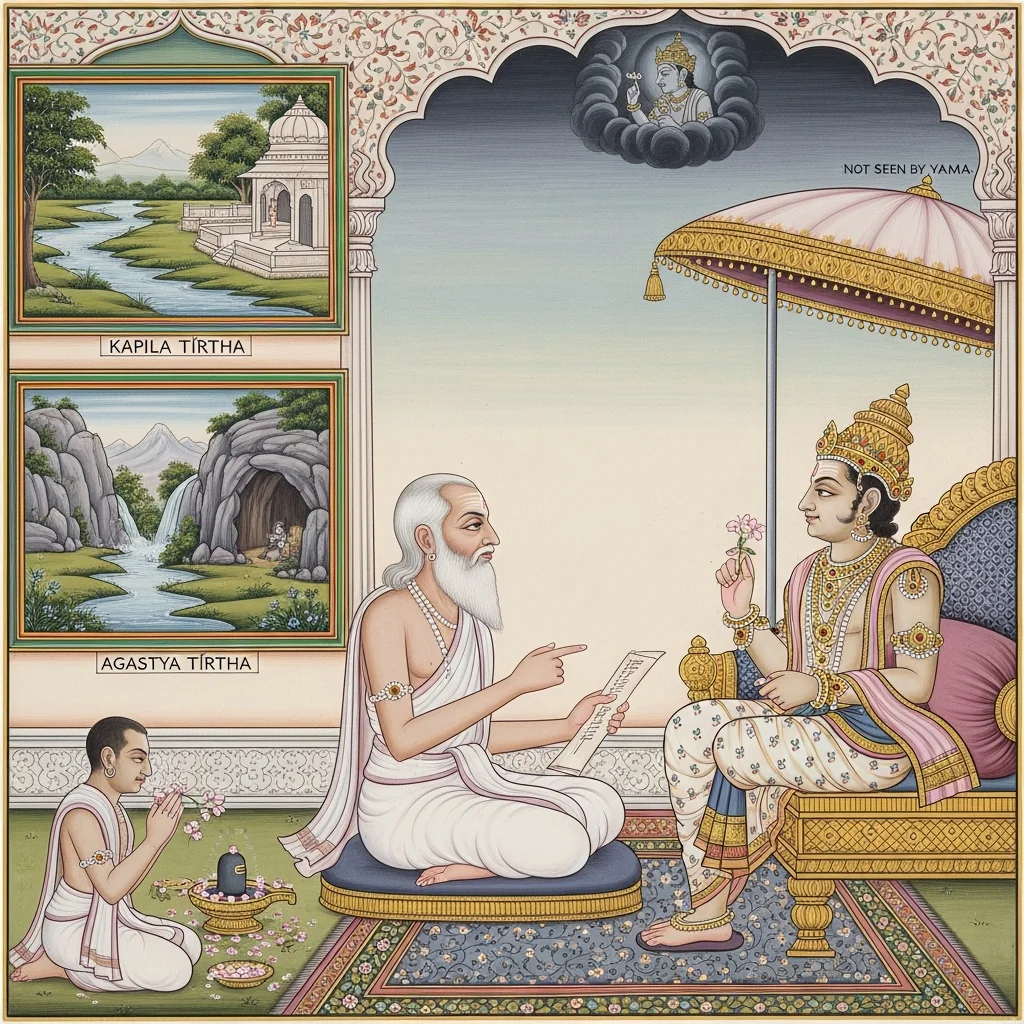
This adhyāya is cast as a theological instruction given by Śrī Mārkaṇḍeya to a royal listener. He directs the seeker to two greatly praised tīrthas—Dadhiskanda and Madhuskanda—declared to be causes of pāpa-kṣaya, the diminishing of moral impurity. At Dadhiskanda, the sacred bath is joined with a gift of curd (dadhi) to a dvija (Brahmin). The promised fruit spans many births: freedom from disease, afflictions of old age, grief, and envy, and continued birth in a “pure” lineage for a long period. At Madhuskanda, gifting sesame mixed with honey, and separately offering a honey-mixed piṇḍa, is said to keep one from Yama’s realm or vision for many lives and to sustain prosperity through descendants, including grandchildren and great-grandchildren. The chapter ends with another piṇḍa rule (mixed with curd) and a procedural note: after bathing, rites are performed facing south (dakṣiṇāmukha), by which father, grandfather, and great-grandfather are satisfied for twelve years—an explicit statement of ancestral-rite efficacy.
Shlokas
Verse 1
। श्रीमार्कण्डेय उवाच । ततो गच्छेत्तु राजेन्द्र तीर्थद्वयमनुत्तमम् । दधिस्कन्दं मधुस्कन्दं सर्वपापक्षयंकरम्
Śrī Mārkaṇḍeya said: “Then, O king of kings, you should go to the two unsurpassed tīrthas—Dadhiskanda and Madhuskanda—both of which bring about the destruction of all sins.”
Verse 2
दधिस्कन्दे नरः स्नात्वा यस्तु दद्याद्द्विजे दधि । उपतिष्ठेत्ततस्तस्य सप्तजन्मनि भारत
At Dadhiskanda, if a man bathes and then gives curd (dadhi) in dāna to a twice-born (dvija, brāhmaṇa), then for him—O Bhārata—prosperity and auspicious support attend him for seven births.
Verse 3
न व्याधिर्न जरा तस्य न शोको नैव मत्सरः । दशचन्द्रशतं यावज्जायते विमले कुले
For him there will be no disease, no old age, no sorrow, and no envy; for as long as a thousand months, he is born into a pure and noble lineage.
Verse 4
मधुस्कन्देऽपि मधुना मिश्रितान्यस्तिलान्ददेत् । नासौ वैवस्वतं देवं पश्येद्वै जन्मसप्ततिम्
And at Madhuskanda, if one gives sesame seeds (tila) mixed with honey, he will not behold Vaivasvata (Yama), the god of death, for seventy births.
Verse 5
मधुना सह सम्मिश्रं पिण्डं यस्तु प्रदापयेत् । तस्य पौत्रप्रपौत्रेभ्यो दारिद्र्यं नैव जायते
Whoever offers a piṇḍa (funerary oblation) mixed with honey—poverty will not arise for his grandsons and great-grandsons.
Verse 6
दधिभिः सह संमिश्रं पिण्डं यस्तु प्रदापयेत् । तस्मिंस्तीर्थे नरः स्नात्वा विधिवद्दक्षिणामुखः
Whoever offers a piṇḍa mixed with curd (dadhi)—having bathed at that very tīrtha, the person should, according to rule, face south (dakṣiṇāmukha) while performing the rite.
Verse 7
पिता पितामहश्चैव तथैव प्रपितामहः । द्वादशाब्दानि तुष्यन्ति नात्र कार्या विचारणा
One’s father, grandfather, and great-grandfather are satisfied for twelve years—of this there is no need for doubt or debate.