Adhyaya 4
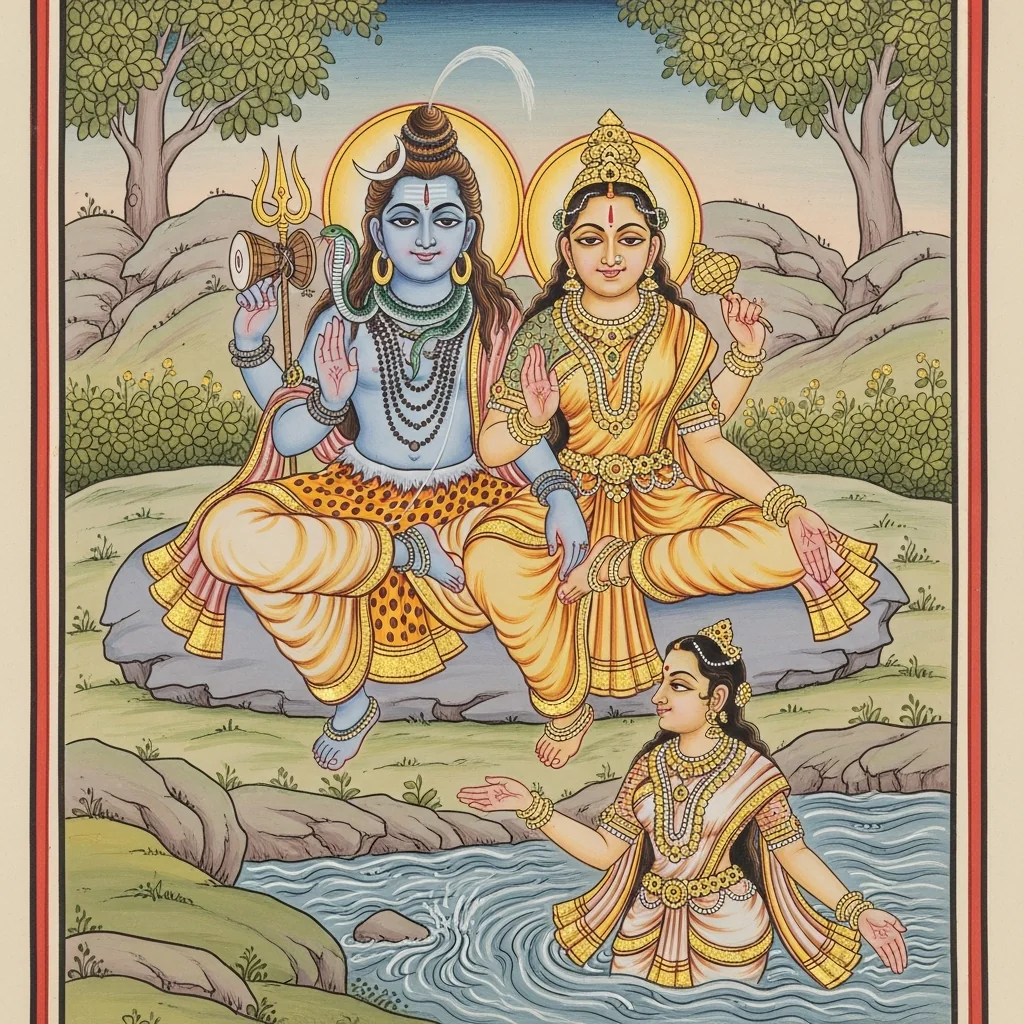
This chapter unfolds a nested chain of testimony. Mārkaṇḍeya recounts how he approached Trikūṭa’s summit and reverently worshiped Mahādeva (Śiva). Yudhiṣṭhira then asks about a lotus-eyed woman seen wandering in the dark cosmic ocean, declaring herself to be Rudra-born. Mārkaṇḍeya says he once asked Manu the same; Manu explains that Śiva, with Umā, performed severe tapas on Ṛkṣaśaila, and from Śiva’s perspiration arose a supremely meritorious river—Revā, the Narmadā—appearing as that lotus-eyed woman. In the Kṛtayuga the river, in feminine form, worships Rudra and seeks boons: imperishability at cosmic dissolution, the power to remove grave sins through devotional bathing, recognition as the “southern Gaṅgā,” bathing-fruit equal to major rites, and Śiva’s abiding presence on her banks. Śiva grants these, distinguishes outcomes for dwellers on the northern and southern banks, and extends salvific benefit widely. The chapter ends with a list of Rudra-origin river-names and a phalaśruti promising merit and an exalted post-mortem destiny to those who recite, hear, and remember them.
Shlokas
Verse 1
श्रीमार्कण्डेय उवाच । ततोऽर्णवात्समुत्तीर्य त्रिकूटशिखरे स्थितम् । महाकनकवर्णाभे नानावर्णशिलाचिते
Śrī Mārkaṇḍeya said: Then, having risen up from the ocean, I beheld Him stationed upon the peak of Trikūṭa—resplendent like radiant gold, adorned with stones of many colors.
Verse 2
महाशृङ्गे समासीनं रुद्रकोटिसमन्वितम् । महादेवं महात्मानमीशानमजमव्ययम्
(I saw) Mahādeva seated upon the great peak, attended by crores of Rudras—Mahādeva, the great-souled Lord, Īśāna, unborn and imperishable.
Verse 3
सर्वभूतमयं तात मनुना सह सुव्रत । भूयो ववन्दे चरणौ सर्वदेवनमस्कृतौ
O dear one of noble vow, together with Manu I again bowed to those feet of the Lord who pervades all beings—feet revered by all the gods.
Verse 4
। अध्याय
(Chapter marker: Adhyāya—beginning of the chapter.)
Verse 5
युधिष्ठिर उवाच । एतच्छ्रुत्वा तु मे तात परं कौतूहलं हृदि । जातं तत्कथयस्वेति शृण्वतः सह बान्धवैः
Yudhiṣṭhira said: Hearing this, O venerable sir, a great curiosity has arisen in my heart. Please relate that account as we listen—together with my kinsmen.
Verse 6
का सा पद्मपलाशाक्षी तमोभूते महार्णवे । योगिवद्भ्रमते नित्यं रुद्रजां स्वां च याब्रवीत्
Who is that lotus‑petal‑eyed maiden who, upon the great ocean turned to darkness, ever wanders like a yogin—and who spoke of her own origin as born of Rudra?
Verse 7
श्रीमार्कण्डेय उवाच । एतमेव मया प्रश्नं पुरा पृष्टो मनुः स्वयम् । तदेव तेऽद्य वक्ष्यामि अबलायाः समुद्भवम्
Śrī Mārkaṇḍeya said: This very question was once asked by me to Manu himself. That same matter I shall tell you today—the origin of that maiden.
Verse 8
व्यतीतायां निशायां तु ब्रह्मणः परमेष्ठिनः । ततः प्रभाते विमले सृज्यमानेषु जन्तुषु
When the night of Brahmā, the Paramēṣṭhin, the Supreme Lord of beings, had passed, then—at the pure and stainless dawn—while living creatures were being brought forth in creation,
Verse 9
मनुं प्रणम्य शिरसा पृच्छाम्येतद्युधिष्ठिर । केयं पद्मपलाशाक्षी श्यामा चंद्रनिभानना
Bowing to Manu with my head, I ask this, O Yudhiṣṭhira: Who is this dark-hued lady with lotus-petal eyes and a face like the moon?
Verse 10
एकार्णवे भ्रमत्येका रुद्रजास्मीति वादिनी । सावित्री वेदमाता च ह्यथवा सा सरस्वती
Alone she wanders in the single cosmic ocean, declaring, ‘I am born of Rudra.’ Could she be Sāvitrī, the Mother of the Vedas—or indeed Sarasvatī herself?
Verse 11
मन्दाकिनी सरिच्छ्रेष्ठा लक्ष्मीर्वा किमथो उमा । कालरात्रिर्भवेत्साक्षात्प्रकृतिर्वा सुखोचिता
Is she Mandākinī, the foremost of rivers? Or Lakṣmī—or else Umā? Could she be Kālārātrī herself, or Prakṛti, the very Source fit to bring forth well-being?
Verse 12
एतदाचक्ष्व भगवन्का सा ह्यमृतसंभवा । चरत्येकार्णवे घोरे प्रनष्टोरगराक्षसे
Tell me this, O Blessed One: who is she, born of amṛta, who moves about in the dreadful single ocean—where serpents and rākṣasas have perished?
Verse 13
मनुरुवाच । शृणु वत्स यथान्यायमस्या वक्ष्यामि संभवम् । यया रुद्रसमुद्भूता या चेयं वरवर्णिनी
Manu said: Listen, dear child, in proper order; I shall explain her origin—she who arose from Rudra, this lady of most excellent beauty.
Verse 14
पुरा शिवः शान्ततनुश्चचार विपुलं तपः । हितार्थं सर्वलोकानामुमया सह शंकरः
Formerly, Śiva of tranquil form undertook vast austerities; Śaṅkara, together with Umā, performed that tapas for the welfare of all the worlds.
Verse 15
ऋक्षशैलं समारुह्य तपस्तेपे सुदारुणम् । अदृश्यः सर्वभूतानां सर्वभूतात्मको वशी
Ascending Ṛkṣaśaila, he performed exceedingly severe tapas—unseen by all beings, yet the Self of all beings, the sovereign master.
Verse 16
तपतस्तस्य देवस्य स्वेदः समभवत्किल । तं गिरिं प्लावयामास स स्वेदो रुद्रसंभवः
As that God was absorbed in austerity, sweat indeed arose from Him; and that sweat—born of Rudra—flooded the mountain.
Verse 17
तस्मादासीत्समुद्भूता महापुण्या सरिद्वरा । या सा त्वयार्णवे दृष्टा पद्मपत्रायतेक्षणा
From that there arose a supremely meritorious, most holy river, the best of streams—the very one you saw in the ocean, she whose eyes are long like lotus petals.
Verse 18
स्त्रीरूपं समवस्थाय रुद्रमाराधयत्पुरा । आद्ये कृतयुगे तस्मिन्समानामयुतं नृप
O King, in that primordial Kṛta Yuga, she once assumed the form of a woman and worshipped Rudra, continuing that observance for ten thousand years.
Verse 19
ततस्तुष्टो महादेव उमया सह शंकरः । ब्रूहि त्वं तु महाभागे यत्ते मनसि वर्तते
Then Śaṅkara, the great Lord, pleased with her, together with Umā, said: “O most fortunate one, speak—what is it that abides in your mind?”
Verse 20
सरिदुवाच । प्रलये समनुप्राप्ते नष्टे स्थावरजंगमे । प्रसादात्तव देवेश अक्षयाहं भवे प्रभो
The River said: “When dissolution (pralaya) arrives and the moving and unmoving creation is destroyed, by Your grace, O Lord of gods, may I remain imperishable, O Master.”
Verse 21
सरित्सु सागरेष्वेव पर्वतेषु क्षयिष्वपि । तव प्रसादाद्देवेश पुण्या क्षय्या भवे प्रभो
Even if rivers, oceans, and the mountains themselves should waste away, by your grace, O Lord of gods, may I remain holy and able to diminish the sins of beings, O Master.
Verse 22
पापोपपातकैर्युक्ता महापातकिनोऽपि ये । मुच्यन्ते सर्वपापेभ्यो भक्त्या स्नात्वा तु शंकर
Even those burdened with sins and lesser transgressions—even great sinners—are freed from all sins, O Śaṅkara, when they bathe with devotion.
Verse 23
उत्तरे जाह्नवीदेशे महापातकनाशिनी । भवामि दक्षिणे मार्गे यद्येवं सुरपूजिता
In the northern land of Jāhnavī (Gaṅgā) she is famed as the destroyer of great sins; so too, may I become such upon the southern path, if in this way I am worshipped by the gods.
Verse 24
स्वर्गादागम्य गंगेति यथा ख्याता क्षितौ विभो । तथा दक्षिणगङ्गेति भवेयं त्रिदशेश्वर
Just as she, descending from heaven, is renowned on earth as “Gaṅgā,” O Lord, so may I be renowned as “the Southern Gaṅgā,” O ruler of the gods.
Verse 25
पृथिव्यां सर्वतीर्थेषु स्नात्वा यल्लभते फलम् । तत्फलं लभते मर्त्यो भक्त्या स्नात्वा महेश्वर
Whatever fruit a person gains by bathing in all the tīrthas upon the earth—those very fruits a mortal gains by bathing here with devotion, O Maheśvara.
Verse 26
ब्रह्महत्यादिकं पापं यदास्ते संचितं क्वचित् । मासमात्रेण तद्देव क्षयं यात्ववगाहनात्
Whatever sin—beginning with brahma-hatyā—may be amassed anywhere, O Lord: by immersion (here) it is exhausted and destroyed within merely a month.
Verse 27
यत्फलं सर्ववेदेषु सर्वयज्ञेषु शंकर । अवगाहेन तत्सर्वं भवत्विति मतिर्मम
Whatever fruit abides in all the Vedas and in all sacrifices, O Śaṅkara—may all of that be gained through immersion (here); such is my resolve.
Verse 28
सर्वदानोपवासेषु सर्वतीर्थावगाहने । तत्फलं मम तोयेन जायतामिति शंकर
O Śaṅkara, may the very fruit of all charities and fasts, and of bathing in all sacred fords, arise through my waters.
Verse 29
मम तीरे नरा ये तु अर्चयन्ति महेश्वरम् । ते गतास्तव लोकं स्युरेतदेव भवेच्छिव
O Śiva, those who worship Maheśvara upon my bank—having departed, may they attain Your world; let this indeed be so.
Verse 30
मम कूले महेशान उमया सह दैवतैः । वस नित्यं जगन्नाथ एष एव वरो मम
O Maheśāna, dwell forever upon my bank, together with Umā and the gods. O Lord of the world—this alone is my boon.
Verse 31
सुकर्मा वा विकर्मा वा शान्तो दान्तो जितेन्द्रियः । मृतो जन्तुर्मम जले गच्छतादमरावतीम्
Whether one has acted rightly or wrongly—whether peaceful, self-controlled, and master of the senses—any creature that dies in my waters, let it go to Amarāvatī.
Verse 32
त्रिषु लोकेषु विख्याता महापातकनाशिनी । भवामि देवदेवेश प्रसन्नो यदि मन्यसे
O Lord of lords of gods, if You deem it fitting and are pleased, may I become renowned in the three worlds as the destroyer of great sins.
Verse 33
एतांश्चान्यान्वरान्दिव्यान्प्रार्थितो नृपसत्तम । नर्मदया ततः प्राह प्रसन्नो वृषवाहनः
O best of kings, thus requested by Narmadā for these and other divine boons, Vṛṣavāhana (Śiva), being pleased, then spoke.
Verse 34
श्रीमहेश उवाच । एवं भवतु कल्याणि यत्त्वयोक्तमनिन्दिते । नान्या वरार्हा लोकेषु मुक्त्वा त्वां कमलेक्षणे
Śrī Maheśa said: “So be it, O auspicious one—exactly as you have spoken, O blameless lady. In the worlds there is none other worthy of boons apart from you, O lotus-eyed one.”
Verse 35
यदैव मम देहात्त्वं समुद्भूता वरानने । तदैव सर्वपापानां मोचिनी त्वं न संशयः
From the very moment you arose from my body, O fair-faced one, from that moment you have been the liberator from all sins—of this there is no doubt.
Verse 36
कल्पक्षयकरे काले काले घोरे विशेषतः । उत्तरं कूलमाश्रित्य निवसन्ति च ये नराः
At the time that brings the end of an aeon—especially in dreadful times—those people who take refuge on the northern bank and dwell there…
Verse 37
अपि कीटपतङ्गाश्च वृक्षगुल्मलतादयः । आ देहपतनाद्देवि तेऽपि यास्यन्ति सद्गतिम्
…even insects and birds, and even trees, shrubs, creepers, and the like—O Goddess—until the body falls, they too shall attain a good destiny.
Verse 38
दक्षिणं कूलमाश्रित्य ये द्विजा धर्मवत्सलाः । आ मृत्योर्निवसिष्यन्ति ते गताः पितृमन्दिरे
Those twice-born who are devoted to dharma and take refuge on the southern bank will dwell there until death; after that, they go to the abode of the Pitṛs, the ancestral realm.
Verse 39
अहं हि तव वाक्येन कस्मिंश्चित्कारणान्तरे । त्वत्तीरे निवसिष्यामि सदैव ह्युमया समम्
Indeed, at your word—and for a particular divine purpose—I shall dwell upon your bank, ever together with Umā.
Verse 40
एवं देवि महादेवि एवमेव न संशयः । ब्रह्मेन्द्रचन्द्रवरुणैः साध्यैश्च सह विष्णुना
So it is, O Goddess, O Great Goddess—exactly so, without doubt—together with Brahmā, Indra, Candra, Varuṇa, the Sādhyas, and also Viṣṇu.
Verse 41
उत्तरे देवि ते कूले वसिष्यन्ति ममाज्ञया । दक्षिणे पितृभिः सार्द्धं तथान्ये सुरसुन्दरि
On your northern bank, O Goddess, they shall dwell by My command; on the southern bank, together with the Pitṛs, and likewise others too, O celestial beauty.
Verse 42
वसिष्यन्ति मया सार्द्धमेष ते वर उत्तमः । गच्छ गच्छ महाभागे मर्त्यान्पापाद्विमोचय
They shall dwell together with Me—this is your highest boon. Go, go, O greatly fortunate one, and release mortals from sin.
Verse 43
सहिता ऋषिसंघैश्च तथा सिद्धसुरासुरैः । एवमुक्ता महादेव उमया सहितो विभुः
Accompanied by hosts of Ṛṣis, and also by Siddhas, Devas, and Asuras—thus addressed—Mahādeva, the all-powerful Lord, was together with Umā.
Verse 44
वन्द्यमानोऽथ मनुना मया चादर्शनं गतः । तेन चैषा महापुण्या महापातकनाशिनी
Then, being worshipfully praised by Manu and by me, he disappeared from sight. Through that, this (river) became supremely holy, a destroyer of the greatest sins.
Verse 45
कथिता पृच्छ्यते या ते मा ते भवतु विस्मयः । एषा गंगा महापुण्या त्रिषु लोकेषु विश्रुता
Though she has been described, you ask again—let there be no surprise at that. This is the Gaṅgā, supremely holy and renowned throughout the three worlds.
Verse 46
दशाभिः पञ्चभिः स्रोतैः प्लावयन्ती दिशो दश । शोणो महानदश्चैव नर्मदा सुरसा कृता
With fifteen streams she floods the ten directions. The Śoṇa, the Mahānadā, and also the Narmadā were made “Surasā”—divinely sanctified.
Verse 47
मन्दाकिनी दशार्णा च चित्रकूटा तथैव च । तमसा विदिशा चैव करभा यमुना तथा
Mandākinī, Daśārṇā, and likewise Citrakūṭā; and also Tamasā, Vidiśā, Karabhā, and likewise Yamunā.
Verse 48
चित्रोत्पला विपाशा च रञ्जना वालुवाहिनी । ऋक्षपादप्रसूतास्ताः सर्वा वै रुद्रसंभवाः
Citrotpalā, Vipāśā, Raṅjanā, and Vāluvāvāhinī—these rivers, born from Ṛkṣapāda, are all indeed manifestations arising from Rudra.
Verse 49
सर्वपापहराः पुण्याः सर्वमंगलदाः शिवाः । इत्येतैर्नामभिर्दिव्यैः स्तूयते वेदपारगैः
They are holy, destroyers of all sins, bestowers of every auspiciousness, and truly Śiva in nature; with such divine names she is praised by those who have mastered the Vedas.
Verse 50
पुराणज्ञैर्महाभागैराज्यपैः सोमपैस्तथा । इत्येतत्सर्वमाख्यातं महाभाग्यं नरोत्तम
Thus has all this supreme good-fortune been narrated—by noble Purāṇa-knowers, by those who offer ghee, and by Soma-drinkers as well, O best of men.
Verse 51
मनुनोक्तं पुरा मह्यममृतायाः समुद्भवम् । पुण्यं पवित्रमतुलं रुद्रोद्गीतमिदं शुभम्
Formerly Manu told me how she arose from Amṛtā: a holy, purifying, incomparable, auspicious account, sung forth by Rudra.
Verse 52
ये नराः कीर्तयिष्यन्ति भक्त्या शृण्वन्ति येऽपि च । प्रातरुत्थाय नामानि दश पञ्च च भारत
Those who recite them with devotion—and those who even listen—having risen at dawn, (reciting) the fifteen names, O Bhārata,
Verse 53
ते नराः सकलं पुण्यं लभिष्यन्त्यवगाहजम् । विमानेनार्कवर्णेन घण्टाशतनिनादिना
Those people will obtain the full measure of merit born of sacred bathing, and (depart) in a celestial chariot radiant like the sun, resounding with the sound of a hundred bells.
Verse 54
त्यक्त्वा मानुष्यकं भावं यास्यन्ति परमां गतिम्
Casting off the human condition, they will attain the supreme destination.